Loading...

Top
Help
×

By creating an account you can:

Logo TaxTMI
Call Us / Help / Feedback

Contact Us At :

E-mail: [email protected]

Call / WhatsApp at: +91 99117 96707

For more information, Check Contact Us

FAQs :

To know Frequently Asked Questions, Check FAQs

Most Asked Video Tutorials :

For more tutorials, Check Video Tutorials

Submit Feedback/Suggestion :

Email :
Please provide your email address so we can follow up on your feedback.
Category :
Description :
Min 15 characters 0/2000
Make Most of Text Search
  1. Checkout this video tutorial: How to search effectively on TaxTMI.
  2. Put words in double quotes for exact word search, eg: "income tax"
  3. Avoid noise words such as : 'and, of, the, a'
  4. Sort by Relevance to get the most relevant document.
  5. Press Enter to add multiple terms/multiple phrases, and then click on Search to Search.
  6. Text Search
  7. The system will try to fetch results that contains ALL your words.
  8. Once you add keywords, you'll see a new 'Search In' filter that makes your results even more precise.
  9. Text Search
Add to...
You have not created any category. Kindly create one to bookmark this item!
Create New Category
Hide
Title :
Description :
❮❮ Hide
Default View
Expand ❯❯
Close ✕
🔎 News - Adv. Search
TEXT SEARCH:

Press 'Enter' to add multiple search terms. Rules for Better Search

Search In:
Main Text + AI Text
  • Main Text
  • Main Text + AI Text
  • AI Text
Category: ?
Categorized by AI
---- All Categories ----
  • ---- All Categories ----
  • Income Tax
  • GST
  • Customs, DGFT & SEZ
  • FEMA & RBI
  • Corp. Laws, SEBI & IBC
  • PMLA, Black Money & ED
  • Budget
  • News and Press Release
  • PTI News
Month:
---- All Months ----
  • ---- All Months ----
  • January
  • February
  • March
  • April
  • May
  • June
  • July
  • August
  • September
  • October
  • November
  • December
Year:
---- All Years ----
  • ---- All Years ----
  • 2026
  • 2025
  • 2024
  • 2023
  • 2022
  • 2021
  • 2020
  • 2019
  • 2018
  • 2017
  • 2016
  • 2015
  • 2014
  • 2013
  • 2012
  • 2011
Sort By: ?
In Sort By 'Default', exact matches for text search are shown at the top, followed by the remaining results in their regular order.
Relevance Default Date
    Govt exempts critical petrochemical products from customs duty amid West Asia crisis
    GST fraud unearthed in Meerut, 1 arrested
    HIGHLIGHTS
    Haryana records highest SGST growth in FY26: Report
    Parliament amends IBC to speed up insolvency cases
    CM Siddaramaiah questions Centre over ‘tax terrorism’ against Karnataka
    ED seizes Rs 1.2 crore cash, pistol during raids against 'history-sheeter' in Kolkata
    IBC helps improving health of Indian banking sector: Sitharaman
    Opposition slams govt on insolvency law in Rajya Sabha
    Form No. 126 (Earlier Form No. 15C/15D)- Frequently Asked Questions
    Guidance Note – Form 125
    Parliament passes amendments to IBC to quicken resolution process, reduce backlog
    Form No. 125 – Frequently Asked Questions (FAQ)
    Guidance Note – Form 124
    Form No. 124 – Frequently Asked Questions (FAQ)
    Ministry of Statistics and Programme Implementation develops India SDG Dashboard in partnership with United Nations Resident Coordinator Office which ...
    Guidance Note – Form 123
    Digitalisation and technological upgradation relates to data collection, processing, analysis and dissemination undertaken for improvement of Official...
    CBIC introduces one-time relief measure for eligible units in SEZs to sell manufactured goods in Domestic Tariff Area (DTA) at concessional customs du...
    Form No. 123 – Frequently Asked Questions (FAQ)
❯❯
Maximize Maximize Maximize
0 / 200
Expand Note
Add to Folder

No Folders have been created

+

Are you sure you want to delete "My most important" ?

NOTE:

News
Showing Results for :
Reset Filters
Results Found:
Show All Summaries Hide All Summaries
April 2, 2026
Show AI Summary
Customs duty exemption on critical petrochemical imports aims to stabilise supply chains and ease cost pressures.
Full customs duty exemption has been granted on specified critical petrochemical imports as a temporary and targeted measure to protect supply stability amid disruptions in global supply chains caused by the West Asia crisis. The exemption is intended to ensure continued availability of essential petrochemical inputs for domestic industry, reduce cost pressures on downstream sectors, and provide relief to consumers of final products. The exemption remains valid until June 30 and covers Methanol, Anhydrous ammonia, Toluene, Styrene, Dichloromethane, Vinyl chloride monomer, Poly butadiene, Styrene butadiene and Unsaturated polyester resins.
April 2, 2026
Show AI Summary
GST fraud through fake firms and fake invoices exposed alleged illegal input tax credit claims and circular trading.
GST fraud involving fake firms, shell companies, fake invoices and circular trading was detected during a police investigation. The alleged racket used fake Aadhaar and PAN details to unlawfully avail input tax credit and underreported sales in GST returns, causing an estimated loss of around Rs 3 crore to the government exchequer, with the total involvement suspected to be higher. One accused was arrested, while efforts continued to trace other persons involved.
April 1, 2026
Show AI Summary
GST revenues rise on stronger imports and domestic sales, marking one of the highest monthly collections this fiscal.
GST revenues rose about 9 per cent in March to over two lakh crore rupees, reaching the third highest monthly collection in the 2025-26 fiscal. The increase was supported by higher receipts from imports as well as domestic sales and purchases, reflecting a recovery in tax mop-ups after earlier tax cuts.
April 1, 2026
Show AI Summary
State GST collection growth in Haryana leads the country, driven by stronger compliance, economic activity and taxpayer base expansion.
State GST collection growth in Haryana was reported as the highest among all states in FY26, with post-settlement SGST collection rising to Rs 48,289 crore from Rs 39,743 crore in FY25. The increase of 21.5 per cent exceeded the national average SGST growth of 5.7 per cent. Total GST collection in the State also grew by 8.6 per cent, placing Haryana fifth among states and Union Territories in gross domestic GST collection.
April 1, 2026
Show AI Summary
Insolvency resolution framework tightened to speed up admissions, reduce delays, and support rescue of viable businesses.
Parliament has amended the Insolvency and Bankruptcy Code to speed up admission and resolution of insolvency cases, reduce backlog, and preserve enterprise value. The changes introduce stricter timelines, greater reliance on information utilities, stronger liquidation oversight, and an enabling framework for group and cross-border insolvency. The bill also replaces the underused fast-track process with a creditor-initiated framework, exempts MSMEs from disqualification under specified provisions, and requires insolvency applications to be admitted within 14 days once default is established.
April 1, 2026
Show AI Summary
Tax devolution dispute intensifies as Karnataka alleges unfair GST returns, denied compensation, and shrinking fiscal share.
Karnataka Chief Minister Siddaramaiah alleged that the Union Government's tax devolution and fiscal policy towards Karnataka amounted to tax terrorism or tax plunder, saying the state receives only a small share in return for its tax contribution. He said Karnataka has repeatedly raised concerns about unfair distribution of taxes, cess, surcharge revenues, GST compensation, and central funding, and claimed these issues have weakened the state's finances and increased dependence on borrowing. He also described GST implementation as flawed and unscientific, leading to significant financial losses.
April 1, 2026
Show AI Summary
Money laundering probe leads to searches, cash seizure and firearm recovery in Kolkata-linked premises.
Money laundering investigation under the Prevention of Money Laundering Act led to searches at multiple premises in Kolkata linked to an alleged criminal syndicate, including the residence and commercial premises of an accused history-sheeter, a business entity, and associated persons. During the raids, the Enforcement Directorate seized about Rs 1.2 crore cash from a location linked to one associate and recovered a country-made pistol from the accused's premises.
April 1, 2026
Show AI Summary
Corporate resolution under insolvency law gains faster admission, stronger creditor oversight, and MSME promoter participation safeguards.
The Insolvency and Bankruptcy Code is presented as a framework for corporate resolution and banking-sector improvement through asset recovery, with liquidation remaining a residual measure where resolution fails. The current amendments focus on expeditious admission based on the existence of default, greater reliance on information utilities, statutory timelines, stronger liquidation oversight, and a creditor-initiated insolvency framework with out-of-court initiation, debtor-in-possession structure, and defined timelines. The amendments also enable group and cross-border insolvency and exempt MSMEs from specified disqualifications so that existing promoters may participate in resolution.
April 1, 2026
Show AI Summary
Insolvency and bankruptcy reform debate centers on creditor haircuts, tribunal backlog, and concerns over corporate defaulter protection.
The Rajya Sabha debated the Insolvency and Bankruptcy Code (Amendment) Bill, 2026, amid criticism of repeated amendments, substantial creditor haircuts, alleged favouritism toward large corporate defaulters, and ongoing pendency and infrastructure bottlenecks in insolvency tribunals. Members raised concerns over proposed creditor-initiated insolvency changes, executive rule-making on cross-border insolvency, and the limited effectiveness of MSME resolution mechanisms, while others supported the Code and urged stronger institutional capacity and better use of insolvency funds.
April 1, 2026
Show AI Summary
Tax deduction at source relief for branch-based non-residents through Form No. 126 and Assessing Officer certification.
Form No. 126 is an optional self-declaration and treaty-benefit request for a specified non-resident person carrying on business or profession in India through a branch, to obtain an Assessing Officer certificate authorising receipt of specified sums without deduction of tax at source. Eligibility depends on whether the applicant is a banking company or insurer, or another branch-based business or profession, and the form must be filed online before income is received. The certificate is valid for the relevant tax year unless cancelled earlier.
April 1, 2026
Show AI Summary
Specified senior citizen declaration governs pension and interest income reporting, bank deduction, and return-filing exemption.
Form No. 125 is the declaration furnished by a specified senior citizen to the specified bank for pension and interest income. It applies to a resident aged seventy-five years or more who has pension income and only interest from the same specified bank, and who gives the prescribed declaration. The form is used by the deductor for reporting and is stated to exempt the taxpayer from return-filing compliance for the relevant tax year. It is filed once each financial year and requires key personal, bank, pension, and tax-regime details.
April 1, 2026
Show AI Summary
Insolvency and Bankruptcy Code amendments aim to speed resolution, cut backlog, and strengthen the financial ecosystem.
Amendments to the Insolvency and Bankruptcy Code were passed to accelerate insolvency resolution, reduce case backlog, and strengthen the financial ecosystem. The changes focus on shortening the time taken for admission of insolvency resolution applications and improving the efficiency of the resolution framework. The government accepted all recommendations made by the Lok Sabha Select Committee and added one further recommendation from the Ministry of Corporate Affairs.
April 1, 2026
Show AI Summary
Specified senior citizen declaration governs return-filing exemption for pension and interest income through a specified bank.
Form No. 125 is the declaration to be furnished by a specified senior citizen in relation to pension income and interest received or receivable through a specified bank. The declaration is confined to pension and interest income and does not extend to other income. Filing the form enables exemption from filing an income-tax return, while the specified bank computes total income and deducts tax accordingly. The form must be submitted once for each tax year, may be filed in paper or electronically, and may be revised or withdrawn if income details change.
April 1, 2026
Show AI Summary
Tax deduction at source claims form requires employee details, supporting evidence, and annual disclosure to employer.
Form No. 124 is the employee's statement of particulars of claims for deduction of tax at source under section 392(5)(b) of the Income-tax Act, 2025 read with Rule 205 of the Income-tax Rules, 2026. It is furnished to the current employer so that deductions, exemptions and allowances may be considered for correct tax deduction from salary. The form is filed once every financial year and requires employee details, claim particulars, supporting evidence and a declaration that the particulars are correct and complete.
April 1, 2026
Show AI Summary
Employee tax benefit declarations guide salary TDS computation through Form No. 124 and supporting evidence.
Form No. 124 is the employee statement furnished to an employer for consideration of deductions, exemptions, allowances, and other tax benefits while computing taxable salary and TDS liability. It applies where the employee seeks employer recognition of claims relating to house rent allowance, leave travel allowance, interest on housing loan, and investment- or expenditure-based deductions, together with supporting evidence. The form has Part A for employee particulars and Part B for the tax benefits claimed with annexures in support of those claims.
April 1, 2026
Show AI Summary
Statistical data dissemination and SDG monitoring strengthened through a centralized dashboard, expert review, and public access tools.
MoSPI maintains a centralized digital mechanism for public access to its statistical publications and has developed the India SDG Dashboard in partnership with the United Nations Resident Coordinator Office as a centralized data platform for monitoring SDG indicators aligned with the National Indicator Framework. The Ministry's publications compile social and environmental statistics for evidence-based planning, policymaking, research, and analysis, while expert committees, the e-Sankhyiki portal, the Advance Release Calendar, and stakeholder consultations are used to improve coverage, dissemination, transparency, and usability.
April 1, 2026
Show AI Summary
Perquisites and fringe benefit reporting through Form 123 for employee salary disclosures and tax valuation compliance.
Form No. 123 is the employer-issued statement for reporting the value of perquisites, fringe benefits, amenities and profits in lieu of salary provided to an employee during a financial year. It is issued where salary paid or payable exceeds one lakh and fifty thousand rupees, and it is due by 30 April of the following year. The form captures employer and employee details, valuation of perquisites, tax deducted or paid, and a declaration certifying correctness and completeness.
April 1, 2026
Show AI Summary
Digitalisation of official statistics uses AI, machine learning and secure data systems to improve dissemination and access.
Digitalisation and technological upgradation in the Official Statistical System include modules for data collection, processing, analysis and dissemination, with a Data Innovation Lab integrating Artificial Intelligence and Machine Learning. Security by design principles, cyber security guidelines, agency-based compliance monitoring, a Chief Information Security Officer, and security audit with SSL certification support the deployment of applications. These reforms are continuous and are expected to improve data collection, validation, processing and dissemination.
April 1, 2026
Show AI Summary
Concessional customs duty relief for eligible SEZ units enables limited DTA sales with value addition and export-linked caps.
A one-time customs relief window allows eligible SEZ manufacturing units to sell manufactured goods in the Domestic Tariff Area at concessional duty rates for a limited period. Eligibility is confined to units that commenced production on or before 31 March 2025, and the goods must have undergone minimum 20% value addition over inputs. DTA sales under the relief are capped at 30% of the highest annual FOB value of exports in any of the three preceding financial years, with certain sensitive sectors excluded and faceless assessment applying to clearances.
April 1, 2026
Show AI Summary
Perquisite valuation statement under income tax rules continues to govern employee benefits, tax details, and return compliance.
Form No. 123 is the employer-issued statement of perquisites, fringe benefits or amenities, and profits in lieu of salary for an employee, replacing the earlier Form 12BA. It certifies valuation of monetary and non-monetary perquisites for income-tax return purposes and is generally required where salary exceeds the prescribed threshold. The form contains Part A with employer and employee particulars and Part B with perquisite-wise valuation and salary tax details, including tax deducted at source and remittance particulars.

News

Back

All News

Showing Results for :
Reset Filters
No Records Found

News

Back

All News

Showing Results for : Reset Filters
News and Press Release

Flash Report on Central Sector Infrastructure Projects worth ₹150 crore and above

April 25, 2026

Contents
Summary
Note

Note

-

Bookmark

Print

Print

PAIMANA Portal Tracks 1,941 Infrastructure Projects worth ₹41.50 lakh crore as of March 2026

The Ministry of Statistics and Programme Implementation (MoSPI) continues to strengthen monitoring of Central Sector infrastructure projects through its PAIMANA platform, enabling improved tracking, timely reviews, and data-driven decision-making across Ministries. The portal tracks 1,941 Infrastructure Projects worth of ₹41.50 lakh crore as of March 2026.

Key Highlights

  • As of March 2026, 1,941 ongoing infrastructure projects, with a total revised cost of ₹41.50 lakh crore, are being monitored across 17 Central Ministries/Departments. The cumulative expenditure incurred on these projects stands at ₹19.93 lakh crore, accounting for approximately 48.02 per cent of the revised project cost, indicating steady progress in project implementation.
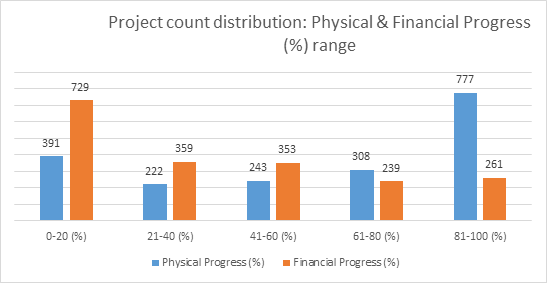
  • A significant proportion of projects are at advanced stages, with 777 projects (~40%) achieving over 80% physical progress, while 261 (~13%) have crossed 80% financial completion. The data also reflects a balanced pipeline, with projects distributed across early and advanced stages of implementation.
  • The Transport & Logistics sector (as per the DEA’s Harmonized Master List) accounts for the highest number of ongoing projects (1428 projects), with revised estimates of ₹22.66 lakh crore underscoring priority to connectivity-driven infrastructure growth.
  • 1,941 ongoing infrastructure projects include 786 Mega projects (project cost of ₹1,000 crore & above) with an original cost of ₹30.48 lakh crore, and 1,155 Major projects (project cost below ₹1,000 crore and up to ₹150 crore) amounting to ₹5.41 lakh crore.
  • Physical and financial progress broadly move in tandem, with a large number of projects clustered at the initial (0–20%) and advanced (81–100%) stages, indicating a pipeline of newly-started projects alongside many nearing completions. While physical progress exceeds financial progress in the 81–100% range, financial progress is relatively higher in the early stages, reflecting upfront expenditure patterns in project implementation.
2.   Ministry/ Departments-wise progress of Infrastructure Projects

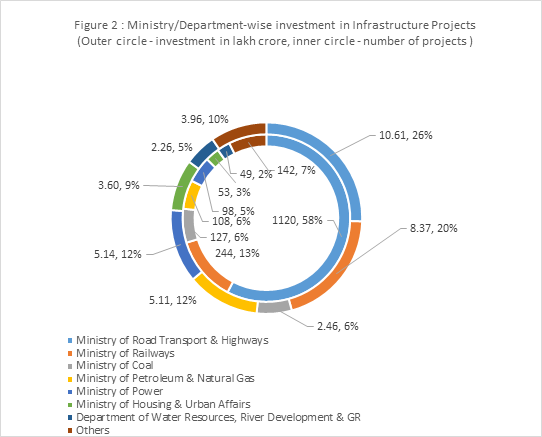
  • Ministry of Road Transport & Highways accounts for the highest number of projects, with 1120 projects (58%), and a share of total revised project cost of ₹10.61 lakh crore (26%), highlighting its central role in national infrastructure development.
  • Ministry of Railways is implementing 244 projects (13%), and also commands the largest share of total revised project cost at ₹8.37 lakh crore (20%).
  • Ministry of Coal accounts for implementing 127 projects (6%), with a total revised project cost of ₹2.46 lakh crore (6%).
  • The Ministry of Petroleum & Natural Gas, Ministry of Power, Ministry of Housing & Urban Affairs, and the Department of Water Resources, River Development & GR are implementing 108, 98, 53, and 49 projects, with associated revised costs of ₹5.11 lakh crore, ₹5.14 lakh crore, ₹3.6 lakh crore, and ₹2.26 lakh crore, respectively.
  • The remaining 142 projects (7%), with a total revised cost of ₹3.96 lakh crore (10%), are distributed across various Ministries/Departments including Higher Education, Civil Aviation, Steel, Telecommunications, Labour & Employment, Ports, Shipping & Waterways, Health & Family Welfare, Mines, DPIIT, and Sports. (Refer Annexure I)
3.   Sector-wise (as per DEA’s Harmonized Master List of Infrastructure) Progress of Infrastructure Projects

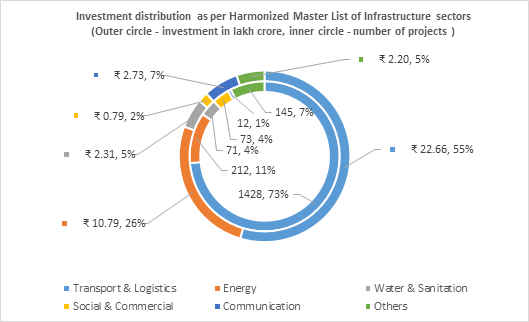
  • Transport & Logistics remains the dominant sector, accounting for 55% of total revised cost (₹22.66 lakh crore) across 1,428 projects (73 % of the total Projects), underscoring the central role of Roads & Highways, Railways, Aviation, Urban Public Transport, Shipping, and Inland Waterways in economic integration and logistics efficiency.
  • The Energy sector follows with 26% of aggregated revised cost (₹10.79 lakh crore) across 212 projects, reflecting sustained emphasis on Oil & Gas infrastructure, electricity generation, transmission and distribution networks, and energy storage systems.
  • Communication infrastructure, with a revised cost of ₹2.73 lakh crore (7%) across 12 projects, represents targeted interventions aimed at strengthening digital connectivity.
  • Water & Sanitation projects account for ₹2.31 lakh crore (5%) across 71 projects, highlighting continued focus on essential urban services.
  • Social & Commercial infrastructure, comprising 73 projects with a revised cost of ₹0.79 lakh crore (2%), reflects selective investments in education, healthcare, real estate, and tourism, hospitality and wellness.
  • Projects classified under ‘Others’, amounting to ₹2.20 lakh crore (5%) across 145 projects, indicate diversification across sectors such as coal, steel, metals, and mining.

(Refer Annexure II)
4.   Completed Projects and New Additions

  • During March 2026, 25 projects were commissioned, including major assets in Road Transport & Highways, Petroleum & Natural Gas, Housing & Urban Affairs, Railways, Power, Ports, Shipping and Waterways, Telecommunications, Steel and Labour and Employment. Notable commissioned projects include the “Delhi-Ghaziabad-Meerut Regional Rapid Transit System [RRTS] corridor” (₹ 30,274 crore) from Ministry of Housing & Urban Affairs, and the “Tehri Pumped Storage Plant Project [4x250 MW] (₹ 8,339 crore) from Ministry of Power.
  • During March 2026, 12 additional projects from MoRTH were brought under the monitoring of PAIMANA.

5.    Next date of Press Release: Flash Report for the month of April 2026 would be released on 25th May 2026.

Note

  1. The press release summarizes highlights from the MoSPI’s Flash Report (March 2026) on Central Sector Infrastructure Projects (₹150 crore and above), available at https://www.ipm.mospi.gov.in/ or via the QR code.

 

  1. PAIMANA is a centralized web-based portal for monitoring of Central Sector Infrastructure Projects worth ₹150 crore and above. Operating on the "one data, one entry" principle, it integrates with DPIIT’s IPMP portal via APIs to automatically update more than 70% of project data from various Ministries/Departments. PAIMANA also serves as a national repository designed to standardize infrastructure monitoring and support informed decision-making for nation-building.

Annexure I

Ministry/ Departments-wise progress of Central Sector Infrastructure Projects

S. No

Ministry/ Department

Project Count

Revised Cost

(₹ Lakh cr.)

Cumulative Expenditure           (₹ Lakh cr.)

1

Ministry of Road Transport & Highways

1120

10.61

3.52

2

Ministry of Railways

244

8.37

5.69

3

Ministry of Coal

127

2.46

0.80

4

Ministry of Petroleum & Natural Gas

108

5.11

2.99

5

Ministry of Power

98

5.14

1.94

6

Ministry of Housing & Urban Affairs

53

3.60

1.98

7

Department of Water Resources, River Development & GR

49

2.26

1.61

8

Department of Higher Education

29

0.14

0.08

9

Ministry of Civil Aviation

26

0.23

0.11

10

Ministry of Health & Family Welfare

23

0.21

0.08

11

Ministry of Steel

19

0.23

0.10

12

Ministry of Labour and Employment

12

0.03

0.02

13

Department of Telecommunications

12

2.73

0.77

14

Ministry of Ports, Shipping and Waterways

11

0.22

0.15

15

Ministry of Mines

6

0.10

0.07

16

Department for Promotion of Industry & Internal Trade

3

0.05

0.01

17

Department of Sports

1

0.01

0.01


Total

1941

41.50

19.93


Annexure II

Sector-wise (as per DEA’s Harmonized Master List of Infrastructure) progress of Central Sector Infrastructure Projects

S. No

HML Category

Project Count

Revised Cost      (₹ Lakh cr.)

Cumulative Expenditure      (₹ Lakh cr.)

1

Transport & Logistics

1428

22.66

11.28

2

Energy

212

10.79

5.21

3

Water & Sanitation

71

2.31

1.65

4

Communication

12

2.73

0.77

5

Social & Commercial

73

0.79

0.34

6

Others

145

2.21

0.67


Total

1941

41.50

19.93


Topics

Acts Income Tax

