Loading...

Top
Help
×

By creating an account you can:

Logo TaxTMI
Call Us / Help / Feedback

Contact Us At :

E-mail: [email protected]

Call / WhatsApp at: +91 99117 96707

For more information, Check Contact Us

FAQs :

To know Frequently Asked Questions, Check FAQs

Most Asked Video Tutorials :

For more tutorials, Check Video Tutorials

Submit Feedback/Suggestion :

Email :
Please provide your email address so we can follow up on your feedback.
Category :
Description :
Min 15 characters 0/2000
Make Most of Text Search
  1. Checkout this video tutorial: How to search effectively on TaxTMI.
  2. Put words in double quotes for exact word search, eg: "income tax"
  3. Avoid noise words such as : 'and, of, the, a'
  4. Sort by Relevance to get the most relevant document.
  5. Press Enter to add multiple terms/multiple phrases, and then click on Search to Search.
  6. Text Search
  7. The system will try to fetch results that contains ALL your words.
  8. Once you add keywords, you'll see a new 'Search In' filter that makes your results even more precise.
  9. Text Search
Add to...
You have not created any category. Kindly create one to bookmark this item!
Create New Category
Hide
Title :
Description :
❮❮ Hide
Default View
Expand ❯❯
Close ✕
🔎 News - Adv. Search
TEXT SEARCH:

Press 'Enter' to add multiple search terms. Rules for Better Search

Search In:
Main Text + AI Text
  • Main Text
  • Main Text + AI Text
  • AI Text
Category: ?
Categorized by AI
---- All Categories ----
  • ---- All Categories ----
  • Income Tax
  • GST
  • Customs, DGFT & SEZ
  • FEMA & RBI
  • Corp. Laws, SEBI & IBC
  • PMLA, Black Money & ED
  • Budget
  • News and Press Release
  • PTI News
Month:
---- All Months ----
  • ---- All Months ----
  • January
  • February
  • March
  • April
  • May
  • June
  • July
  • August
  • September
  • October
  • November
  • December
Year:
---- All Years ----
  • ---- All Years ----
  • 2026
  • 2025
  • 2024
  • 2023
  • 2022
  • 2021
  • 2020
  • 2019
  • 2018
  • 2017
  • 2016
  • 2015
  • 2014
  • 2013
  • 2012
  • 2011
Sort By: ?
In Sort By 'Default', exact matches for text search are shown at the top, followed by the remaining results in their regular order.
Relevance Default Date
    275 former judges, officials slam US international religious freedom report
    Sour taste: West Asia crisis hits rice exports from MP's Raisen and Balaghat districts
    IFQM'S FIRST MSME SYMPOSIUM CALLS FOR A 'NATIONAL QUALITY SPRINT' TO INTEGRATE WITH GLOBAL VALUE CHAINS
    110th Meeting of Network Planning Group under PM GatiShakti evaluates key Infrastructure projects
    NPC Signs Agreement with Ministry of Environment, Forest and Climate Change (MoEF&CC) to act as Environment Audit Designated Agency
    Rupee crashes 64 paise to settle at all-time low of 93.53 against US dollar
    EOU forms special team to track tender scams in Bihar
    Make life easier for taxpayers, use technology to check evasion: FM to IT officers
    UIDAI chief praises Andaman and Nicobar for top performance in Aadhaar updates
    Gujarat gearing up to be USD 1 trillion economy by 2030 under PM's guidance: CM Patel
    India's forex reserves drop USD 7 bn to USD 709.76 bn
    Rupee crashes 82 paise to settle at 93.71 against US dollar
    MSRTC won't face fuel supply issue for next 2 months, but there is no plan B, says minister
    CBDT notifies rules for simplified income tax law, to be effective from April 1
    MRO services in India to grow to USD 5.7 billion by 2030
    IEA advocates work from home, reduced air travel to tackle oil shock
    Uttarakhand GST scam: Officials float firms, make dealings with dubious company to unearth evasion
    SC rejects another PIL alleging violation of wildlife norms by Vantara
    HDFC Bank chairman quits; bank says 'baffled' as Chakraborty declines to detail ethics concerns
    'Sense of worry among exporters': Govt approves Rs 497 cr 'RELIEF' scheme amid West Asia disruptions
❯❯
Maximize Maximize Maximize
0 / 200
Expand Note
Add to Folder

No Folders have been created

+

Are you sure you want to delete "My most important" ?

NOTE:

News
Showing Results for :
Reset Filters
Results Found:
Show All Summaries Hide All Summaries
March 21, 2026
Show AI Summary
Restrictions recommendation on a socio cultural organization challenged as biased, prompting calls for contributor background checks.
A coalition of 275 retired judges, civil servants and armed forces officers criticised a USCIRF report recommending asset freezes and movement restrictions against the RSS as biased and "highly motivated," urged vetting of report contributors, and stressed that critiques must be grounded in verifiable evidence and contextual understanding rather than broad generalisations.
March 21, 2026
Show AI Summary
Trade disruption: West Asia crisis halts rice exports, raising costs and threatening supply chains and small mill viability
The West Asia crisis has disrupted exports of Raisen basmati and Balaghat boiled non-basmati rice by raising freight rates and creating container shortages, causing port backlogs, delayed shipments, strained payment cycles and working capital, falling farmgate and rice prices, reduced paddy arrivals, and threatening small and medium millers despite regional product identification used in exports.
March 21, 2026
Show AI Summary
National quality sprint to align MSMEs with global value chains through cluster programmes and industry led quality courses.
A national quality sprint was proposed to align MSMEs with global value chains through cluster based interventions targeting measurable operational improvements within 12 months. IFQM paired this agenda with industry led, actionable mechanisms: cluster development, a Quality Excellence Prize with a multi stage assessment, a Leadership Development Course, a Zero Defect Manufacturing course, and an Excellence in Manufacturing Engineering course to build capacity, benchmark quality systems, and enable export competitiveness.
March 21, 2026
Show AI Summary
Multimodal connectivity advances: projects evaluated to align infrastructure with integrated PM GatiShakti goals, boosting logistics efficiency.
The Network Planning Group reviewed six projects under PM GatiShakti standards-two rail (Arakkonam-Chengalpattu doubling; Whitefield-Bangarpet quadrupling), two metro (Mumbai Metro Line 11; Pune Metro Line 4 extensions), and two highways (Badnawar-Petlawad four laning; Fotu La Tunnel)-to ensure integrated multimodal infrastructure, last mile connectivity, passenger freight separation, and enhanced logistics efficiency, with anticipated outcomes of reduced congestion, improved punctuality and safety, lower transport costs, and socioeconomic benefits for project catchments.
March 21, 2026
Show AI Summary
Environment audit designated agency role assigned: NPC to manage auditor certification, registration and capacity building under new rules.
The Government designated the National Productivity Council as the Environment Audit Designated Agency under the Environment Audit Rules, 2025, assigning NPC responsibility to develop eligibility and screening criteria, conduct examinations and certification for Certified Environmental Auditors, specify registration criteria for Registered Environmental Auditors, maintain an online public register, and manage renewal, suspension, withdrawal or cancellation processes, monitoring and disciplinary measures, alongside establishing digital systems and capacity building programmes to administer the national environmental audit framework.
March 20, 2026
Show AI Summary
Currency depreciation driven by persistent foreign outflows and rising oil prices, heightening reserve pressure and inflation risks.
Rupee depreciation accelerated due to persistent foreign portfolio outflows and surging crude oil prices, intensifying exchange rate pressure and inflationary risk. Geopolitical tensions disrupting energy supplies were cited as a key driver, while heavy foreign equity selling and a notable decline in foreign exchange reserves reinforced market stress and reserve management challenges for monetary authorities.
March 20, 2026
Show AI Summary
Tender irregularities monitored by a dedicated EOU team investigating collusion, portal manipulation and related financial offences.
A specialised EOU team has been formed to monitor and investigate tender irregularities across government departments, targeting collusion, manipulation of departmental portals and bypassing of procurement safeguards, with particular attention to illegal mining schemes involving departmental officials. Concurrently, the EOU has advanced financial crime probes including an examination paper leak, an investigation into disproportionate assets with cross border property evidence, PMLA referrals to the enforcement agency for asset confiscation review, and inquiries into GST evasion and fraud in cooperatives, banks and post offices.
March 20, 2026
Show AI Summary
Tax simplification: streamline compliance for honest taxpayers while using technology to detect willful evasion and reduce litigation.
Finance Minister directs tax authorities to make compliance easy for honest taxpayers while using technology to detect willful evasion under the streamlined Income Tax Act, 2025; calls for local-language awareness campaigns and administrative steps to reduce litigation by clarifying and consolidating statutory provisions.
March 20, 2026
Show AI Summary
Aadhaar biometric updates strengthen identity verification; coordination and cybersecurity measures expand digital access safeguards nationwide
UIDAI commended Andaman and Nicobar for strong implementation of Aadhaar biometric updates and adult enrolment verification, while noting terrain and connectivity challenges that require coordination with local administration. UIDAI emphasised the Aadhaar mobile application for remote identity management and a cybersecurity bug bounty programme engaging vetted ethical hackers to secure public-facing applications, and urged timely biometric updates for children to prevent authentication problems in examinations and welfare schemes.
March 20, 2026
Show AI Summary
Economic development goal: state pursues large-scale economy growth through industrial support, infrastructure upgrades and policy transparency.
Gujarat sets an economic development goal to become a large-scale economy by following central policy direction, with the state committing targeted support to industries through policy-driven facilitation, transparency, and updated regulatory measures. Operational measures emphasize infrastructure, water and electricity improvements, inclusive regional development beyond traditional industrial belts, expansion of the MSME sector, export-oriented sectoral strengths, investor attraction via the Vibrant Gujarat initiative, and a long-term roadmap toward national development milestones, with infrastructure upgrades and investment facilitation as core mechanisms.
March 20, 2026
Show AI Summary
Foreign exchange reserves decline indicates central bank reserve composition shifts and affects external liquidity management policy.
The central bank reported a weekly decline in overall foreign exchange reserves driven mainly by a fall in foreign currency assets, alongside an increase in gold holdings and minor decreases in Special Drawing Rights and the reserve position with the international monetary institution, changes which alter reserve composition and dollar-denominated valuation.
March 20, 2026
Show AI Summary
Currency depreciation pressures the rupee as fund outflows and rising oil amid geopolitical tensions create a negative bias.
The rupee fell to a record low of 93.71 against the dollar, primarily due to sustained foreign institutional investor outflows and rising global crude prices amid geopolitical tensions; higher energy costs were noted as risks to the trade deficit and inflation, while major central banks' rate-hold stances and recent net foreign equity sales were cited as contextual factors, with analysts forecasting a continued negative bias and a near-term trading range for the spot exchange rate.
March 20, 2026
Show AI Summary
Fuel supply security ensured short term by priority allocations, but no contingency plan exists for prolonged disruption.
MSRTC's diesel supply is secured for the next two months by central priority allocations and Indian Oil Corporation deliveries, but the corporation has no contingency plan if supplies stop. The fleet of around 15,800 buses depends on diesel; electric buses are too few to substitute meaningfully. Competitive tendering has produced higher per litre discounts and projected annual procurement savings, while MSRTC continues to carry substantial accumulated operational losses and anticipates higher fuel costs with the planned induction of additional diesel buses.
March 20, 2026
Show AI Summary
House Rent Allowance rules revised to expand higher-city relief and require landlord-tenant disclosure for exemption claims.
The notification establishes Income-tax Rules effective April 1 to implement the simplified Income-tax Act, preserving a refined House Rent Allowance framework with higher-city treatment and mandatory landlord-tenant disclosure for HRA claims; it tightens capital gains, non-resident taxation and stock-exchange rules, prescribes inclusion of pre-conversion holding time for converted securities when determining holding period, and imposes expanded auditor and corporate verification duties alongside over one hundred and fifty official forms.
March 20, 2026
Show AI Summary
MRO sector expansion driven by fleet and airport growth, enabled by trade and investment reforms supporting domestic aerospace capacity.
Projected expansion of India's MRO market to 5.7 billion USD by 2030 is driven by fleet and airport capacity growth and enabled by policy reforms such as ratification of the Cape Town Convention, liberalised foreign direct investment, and reductions in GST and customs duties on aviation components. Special economic zones, greenfield airport projects and offset driven reinvestment support manufacturing and leasing, while accelerated logistics, skilled personnel and higher value engine and component overhaul capabilities remain essential to realise the forecast.
March 20, 2026
Show AI Summary
Demand reduction measures recommended to ease oil shock, prioritise targeted consumer relief and transport demand management.
The IEA recommends immediate demand side measures-remote work, lower highway speeds, reduced business air travel, expanded public transport, LPG use restriction for non essentials, and improved driving and industrial fuel efficiency-to cut oil and refined product consumption. It advises targeted fiscal relief for vulnerable consumers due to limited fiscal space, highlights coordinated strategic stock releases as a supply response, and stresses restoring Strait of Hormuz transit as essential for stabilising markets while prioritising demand reduction to ease macroeconomic pressures.
March 19, 2026
Show AI Summary
Undercover GST investigation exposes supplier using closed firms to suppress sales, prompting seizure and ledger blockage.
Uttarakhand GST officials covertly floated and staffed firms to engage a supplier suspected of evading GST by misusing closed-entity names and suppressing sales; documents on sales, purchases, stock movement and financial transactions were seized during a search and seizure, recoveries were deposited to the GST exchequer and ledgers blocked pending forensic analysis.
March 19, 2026
Show AI Summary
Validity of import permits affirmed; documented wildlife imports under valid permits cannot be later invalidated.
The court accepted the Special Investigation Team's finding that no violations were found under domestic statutes or the Convention on International Trade in Endangered Species, and noted the CITES Secretariat also found no missing documentation or evidence of commercial importation. Emphasising finality of authorised administrative acts, the court held that imports made under valid permits with requisite documentation cannot be subsequently treated as prohibited merely because objections are raised later, and dismissed the duplicative petition.
March 19, 2026
Show AI Summary
Corporate governance concerns after a chairman's ethics based resignation prompt interim leadership and regulator engagement.
An abrupt resignation by the part time non executive chairman citing differences over values and ethics-without specific allegations-triggered board engagement, a Nomination and Remuneration Committee disclosure, appointment of an interim chairman, and regulatory consultation; the bank and regulator publicly reported no material governance concerns while market confidence reacted to the leadership change.
March 19, 2026
Show AI Summary
Export relief scheme RELIEF extends obligations and subsidises freight/insurance to ease conflict linked logistics disruptions for exporters.
The RELIEF scheme, implemented by ECGC under the Export Promotion Mission with a dedicated financial outlay, provides targeted, time bound measures for exporters affected by West Asia conflict related logistics disruptions. It includes automatic extension of export obligations for Advance Authorisations and EPCG authorisations without penalty, facilitation of ECGC coverage for forthcoming consignments, and partial reimbursement of extraordinary freight and insurance costs for MSMEs lacking ECGC cover. The scheme applies to consignments destined for or transhipped through specified Gulf and West Asia markets and is subject to dashboard monitoring and periodic review by the EPM Steering Committee.

News

Back

All News

Showing Results for :
Reset Filters
No Records Found

News

Back

All News

Showing Results for : Reset Filters
News and Press Release

MoSPI Breaks New Ground: First-Ever Deep Dive into Unincorporated Construction Sector in Decades

April 11, 2026

Contents
Summary
Note

Note

-

Bookmark

Print

Print

Nearly 1 crore households built their own homes or undertook construction for self-use

10 Lakh+ Small Builders Power Economy: Unincorporated Construction Sector Comes into Focus

Snapshot:

  • MoSPI releases the technical report of pilot study on construction - marking NSO’s first such effort in decades to estimate key economic indicators of construction activities in the unincorporated sector and own-account household construction in a reference period of last 365 days.
  • During the reference period, an estimated 98.54 lakh households undertook own-account construction for their own use.
  • 10.27 lakh construction agencies (unincorporated establishments) were estimated to be engaged in this sector.
  • Approximately 77 per cent of these agencies engaged at least one hired worker on a fairly regular basis.
  • Estimated average value of fixed assets owned by such construction establishments was ₹5.21 lakh.
  • Nearly 23% of rural households undertaking own-account construction for own-use availed institutional funding reflecting increasing access to formal credit in rural areas.

The Ministry of Statistics and Programme Implementation (MoSPI) has released a technical report presenting the key findings from a Pilot study conducted on Construction Activities in Unincorporated Sector Establishments and Households. This study marks the first comprehensive attempt in decades by the National Statistics Office (NSO) to estimate key economic indicators for construction activities undertaken by unincorporated construction agencies (establishments engaged in construction activity), as well as own-account construction carried out by households for their own use. The study underscores MoSPI’s sustained efforts to bridge critical data gaps in sectors where reliable information has been limited. Data from the pilot study also served as an important input for the revised series of the national accounts statistics brought out by MoSPI. A brief overview of the pilot study in terms of coverage, sampling strategy, data collection mechanism, etc., is provided in the Endnote.

The construction sector plays a crucial role in Indian economy, serving both as a driver of growth and an indicator of economic progress. As a key engine of development, it contributes significantly to output, employment, and capital formation, while maintaining strong backward and forward linkages with various other sub-sectors of the economy. While the incorporated segment of the construction sector is to be covered under the recently launched Annual Survey of Incorporated Services Sector Enterprises (ASISSE), data remains limited for unincorporated construction enterprises and households undertaking own-account construction for own use in India. Recognizing the importance of generating robust and reliable estimates of key economic parameters in the construction sector, this pilot study was undertaken alongside Annual Survey of Unincorporated Sector Enterprises (ASUSE) 2025 in the same First Stage Units (FSUs) during the survey period from July to December 2025.

The pilot study, apart from capturing expenses and receipts, was designed to collect key information on employment and a broader set of economic parameters for construction establishments (both market and non-market), including fixed assets, outstanding loans, and various components of expenditure. For households, it focuses on capturing expenditure on construction activities, details of labour engagement, and sources of finance.

The findings of this pilot study served as a crucial input for the National Accounts Division (NAD) in updating and refining the rates and ratios used for estimating several economic indicators in the construction sector under the new series of national accounts.

Estimated number of construction activities undertaken:

It was estimated that 98.54 lakh households have undertaken construction during last 365 days (the reference period of the estimates)[1]. It was also estimated that 10.27 lakh unincorporated construction agencies were engaged in this sector which included both market and non-market establishment.

Average number of worker engaged in the construction sector:

On an average, an unincorporated builder establishment engaged in construction activities employed about five workers during the reference period. Further, approximately 77 per cent of such establishments reported engaging at least one hired worker on a fairly regular basis.

A household undertaking own-account construction for its own use during the reference period engaged around four labourers on an average.

Fixed Assets and Loan:

Fixed assets owned per unincorporated establishment engaged in construction activity has been estimated to be ₹5.21 lakh. The financial access, as reflected by the outstanding loan per establishment in the sector, was estimated to be little more than ₹1.40 lakh.

Value Addition and productivity:

The GVA per market establishment[2] for the unincorporated construction sector was estimated to be about Rs. 7.98 lakh and the corresponding output per establishment was Rs. 16.25 lakh.

The NVA and output per non-market establishment was observed to be Rs. 2.77 lakh and Rs. 5.59 lakh respectively.
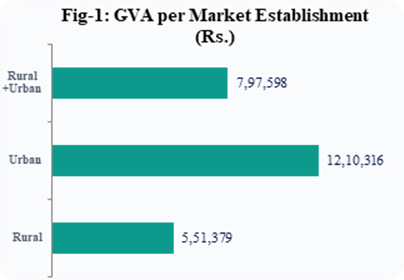
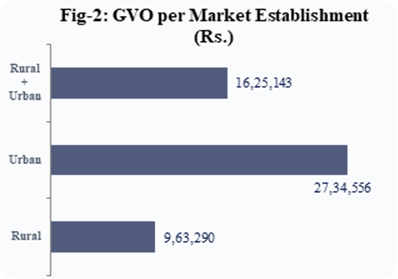
 

Title: GVA per Market Establishment (Rs.)

Financing Sources and Cost Composition of Household Construction Activities

On an average, about 97% of households reported their own income as one of the sources of fund to undertake construction activities, which accounted for approximately 77% of the total amount spent on construction.

Nearly 21% of households availed institutional (financial or non-financial) loan for financing their construction activities accounting for about 17% of the total construction expenditure. The proportion of households accessing institutional loans was higher in rural areas (23%) compared to urban areas (13%).

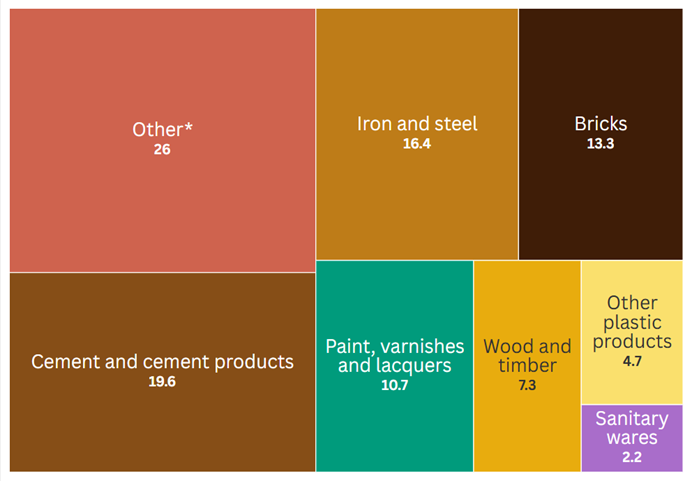
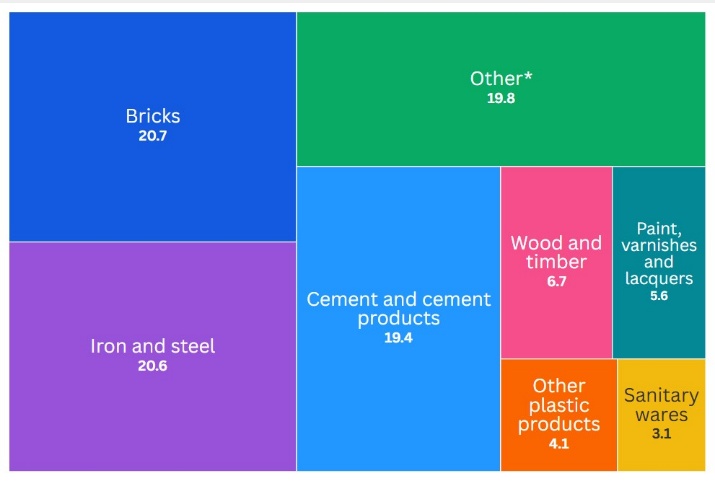
About three-fourths of household construction expenditure was on materials, with labour accounting for around 22 per cent. Within materials used for construction, bricks, cement, and iron and steel together comprised nearly 60 per cent of total expenditure.

Fig-3: Percentage Distribution of expenditure of materials: Household

*other includes petroleum, coal tar products, glass and glass products and other materials.

Fig-4: Percentage Distribution of expenditure of materials: Establishment

*other includes petroleum, coal tar products, glass and glass products and other materials.

Estimates of key indicators of the pilot study are given in Table 1 below. The detailed technical report also contains insights on major states and is available in the website of the Ministry (https://www.mospi.gov.in). Further, interactive tables and visualizations on other surveys conducted by NSO may be accessed on the Data Catalogue section of https://esankhyiki.mospi.gov.in/.

Table 1: Estimates of key indicators from Pilot Study on Construction Activities in Unincorporated Sector Establishments and Households

Indicator

Rural

Urban

Rural + Urban

(1)

(2)

(3)

(4)

Number of households undertaking own-account construction for own use

75,07,391

23,47,089

98,54,480

Number of establishments engaged in unincorporated construction activities

6,51,791

3,75,168

10,26,959

No. of Labourers engaged per household undertaking own account construction

4.2

4.4

4.3

No. of workers engaged per establishment in unincorporated construction activities

4.5

5.5

4.8

GVA per market establishment (Rs.)

5,51,379

12,10,316

7,97,598

Endnote: A brief about the coverage, sampling scheme, sample size and data collection mechanism in the Pilot Study on Construction Activities in Unincorporated Sector Establishments and Households:

A. Coverage of the pilot study:

A.1. Unincorporated Establishments: Market and non-market establishments engaged in construction activities

A.2. Households: own account construction undertaken by households for own use

A.3. Construction Activities: all activities under 2-digit NIC (2008) codes 41, 42 and 43 were considered in the definition of construction for the purpose of this pilot.

A.4.Expenditure on construction (for last 365 days or last financial year): Eligibility of establishments engaged in construction activities, as well as households undertaking own-account construction for own use, was determined based on whether their expenditure exceeded pre-specified thresholds, which varied by sector and type of sample entity. The expenditure threshold was set at ₹25,000 in rural areas and ₹50,000 in urban areas for establishments, and ₹10,000 in rural areas and ₹20,000 in urban areas for households. Any amount spent on construction below these cut-offs were not treated as construction work for this pilot study.

B. Sampling Scheme:

The survey has been conducted following a multi-stage stratified sampling scheme where first stage units (FSUs) were census villages in rural and UFS (Urban Frame Survey) blocks in urban areas.  The ultimate stage units (USU) were either establishments engaged in construction activities or households who has undertaken own account construction for own use.   

C. Sample Size:

In the pilot study, data were collected from a total of 19,154 households, 4,470 market establishments, and 717 non-market establishments pertaining to 11,981 surveyed FSUs (5,104 in rural and 6,877 in urban).

D. Data Collection Mechanism:

The pilot study has been conducted based on area frame and establishments/households have been listed in the selected FSUs of both rural and urban sector. Mostly, data were collected from the selected establishments/households through oral enquiry for the last 365 days. The data for the survey were collected in tablet using Computer Assisted Personal Interviewing (CAPI).

This pilot study has been carried out with Annual Survey of Unincorporated Sector Enterprises (ASUSE) 2025 in the same FSUs selected for the survey period July, 2025 – December, 2025. The listing schedule of ASUSE was suitably modified to accommodate the listing and selection of establishments and households undertaking construction under the coverage of the pilot study. The detailed establishment schedule was canvassed independently of ASUSE for collecting construction related information.

E. Detailed Technical Report of the Pilot Study:

For detailed understanding of the objectives, coverage, concepts, methodology and key findings from the pilot study one may refer to the Technical Report on Pilot Study on Construction Activities in Unincorporated Sector Establishments and Households published by NSO, MoSPI and available on the website of the ministry (https://www.mospi.gov.in).

Topics

Acts Income Tax