Loading...

βœ•
Top
Help
×

By creating an account you can:

Logo TaxTMI
Call Us / Help / Feedbackβœ•

Contact Us At :

E-mail: [email protected]

Call / WhatsApp at: +91 99117 96707

For more information, Check Contact Us

FAQs :

To know Frequently Asked Questions, Check FAQs

Most Asked Video Tutorials :

For more tutorials, Check Video Tutorials

Submit Feedback/Suggestion :

Email :
Please provide your email address so we can follow up on your feedback.
Category :
Description :
Min 15 characters 0/2000
Make Most of Text Search βœ•
  1. Checkout this video tutorial: How to search effectively on TaxTMI.
  2. Put words in double quotes for exact word search, eg: "income tax"
  3. Avoid noise words such as : 'and, of, the, a'
  4. Sort by Relevance to get the most relevant document.
  5. Press Enter to add multiple terms/multiple phrases, and then click on Search to Search.
  6. Text Search
  7. The system will try to fetch results that contains ALL your words.
  8. Once you add keywords, you'll see a new 'Search In' filter that makes your results even more precise.
  9. Text Search
β•³
Add to...
You have not created any category. Kindly create one to bookmark this item!
βœ•
Create New Category
Hide
Title :
Description :
❮❮ Hide
Default View
Expand ❯❯
Close βœ•
🔎 News - Adv. Search
TEXT SEARCH:

Press 'Enter' to add multiple search terms. Rules for Better Search

Search In:
Main Text + AI Text
  • Main Text
  • Main Text + AI Text
  • AI Text
Category: ?
Categorized by AI
---- All Categories ----
  • ---- All Categories ----
  • Income Tax
  • GST
  • Customs, DGFT & SEZ
  • FEMA & RBI
  • Corp. Laws, SEBI & IBC
  • PMLA, Black Money & ED
  • Budget
  • News and Press Release
  • PTI News
Month:
---- All Months ----
  • ---- All Months ----
  • January
  • February
  • March
  • April
  • May
  • June
  • July
  • August
  • September
  • October
  • November
  • December
Year:
---- All Years ----
  • ---- All Years ----
  • 2026
  • 2025
  • 2024
  • 2023
  • 2022
  • 2021
  • 2020
  • 2019
  • 2018
  • 2017
  • 2016
  • 2015
  • 2014
  • 2013
  • 2012
  • 2011
Sort By: ?
In Sort By 'Default', exact matches for text search are shown at the top, followed by the remaining results in their regular order.
Relevance Default Date
    RBI Strengthens Framework on Unauthorised Electronic Banking Transactions
    RBI, IRDAI and SEBI Intensify Measures to Help Citizens Reclaim Unclaimed Deposits
    I-PAC raids: SC quizzes Bengal govt, says ED officers also have fundamental rights
    Guidance Note – Form 4
    AI Wealthtech Startup Novelty Wealth Raises $1.4M Led by IndiaQuotient to Scale their Wealth Advisory Platform for Indian investors
    Form 4 – Frequently Asked Questions
    ED identified Rs 36,000 crore in cybercrime proceeds in 257 cases till Feb 28: Govt
    Guidance Note – Form 3
    Punjab Governor highlights Aadhaar as key to transparent service delivery
    After Zomato, Swiggy hikes platform fee by 17 pc to Rs 17.58 per order
    Lekhakar Launches End-to-End Accounting Outsourcing Services for Indian SMEs, Reporting 40% Rise in GST and Payroll Compliance Demand
    Form No. 3 – Frequently Asked Questions (FAQs)
    Guidance Note – Form 2
    Iran war halts Marathwada turmeric exports, prices drop in domestic market
    The Banker Media Announces Asia’s Leading Annual Summit for Urban Cooperative Banks in Lucknow
    Form No. 2 – Frequently Asked Questions (FAQs)
    Guidance Note – Form 1
    Form No. 1 – Frequently Asked Questions
    FAQs on Interplay and Transition from the Income Tax Act, 1961 to the Income Tax Act, 2025
    Alkami Expands India Engineering Hub to Support Next Phase of Digital Banking Innovation
❯❯
Maximize Maximize Maximize
0 / 200
Expand Note
Add to Folder

No Folders have been created

+

Are you sure you want to delete "My most important" ?

NOTE:

News
Showing Results for :
Reset Filters
Results Found:
Show All Summaries Hide All Summaries
March 24, 2026
Show AI Summary
Unauthorised electronic banking transactions framework updated with compensation, AI fraud detection, and stronger mule account safeguards.
RBI has revised its framework on unauthorised electronic banking transactions, including a proposed compensation mechanism for small-value fraudulent transactions, to update customer-liability rules in response to technological change. The broader framework also relies on AI-driven fraud detection, mule account surveillance, real-time transaction monitoring, and public financial literacy campaigns to curb cyber fraud and strengthen safe banking practices.
March 24, 2026
Show AI Summary
Unclaimed financial assets: regulators expand digital portals, nomination reforms and simplified claim processes to help rightful claimants trace funds.
Measures by RBI, IRDAI and SEBI simplify identification, tracing and settlement of unclaimed financial assets through claim reforms, digital portals, nomination requirements and awareness drives. RBI has consolidated claim directions, introduced an incentive scheme, supported common application procedures and launched UDGAM; IRDAI and SEBI have adopted similar tracing, documentation and portal-based mechanisms for insurance proceeds and mutual fund amounts. Banks transfer long-inactive balances to the DEA Fund, and a nationwide campaign supported restitution of unclaimed assets to rightful owners.
March 24, 2026
Show AI Summary
Fundamental rights of ED officers shape maintainability debate over alleged obstruction during a money-laundering raid.
Maintainability of the ED's plea was examined in relation to alleged obstruction during a money-laundering raid at the I-PAC office. The issue was whether ED officers, acting in their individual capacity, could invoke fundamental rights under Article 32 and whether the petition had to identify the specific right allegedly violated. Arguments also addressed whether obstruction of statutory duties amounts to a constitutional violation and the relevance of Section 66 of PMLA in the context of the investigation and reporting of related offences.
March 24, 2026
Show AI Summary
Transfer of assets in India reporting requires accountant-certified Form 4, electronic filing, and cross-verification of returned income.
Form 4 is an accountant's report for income attributable to transfer of assets located in India under section 9(10), filed once in a tax year along with the return of income. It captures taxpayer details, transfer particulars, income derived, values of Indian and global assets, valuation methodology, and supporting documents such as valuation reports, financial statements, and sale documents. The form is filed electronically with UDIN and digital signature, and is used for cross-verification of income offered in the return.
March 24, 2026
Show AI Summary
AI wealth intelligence platform scales regulated fee-only advisory for Indian investors with unified financial insights.
A SEBI-RIA licensed wealth management platform has raised seed funding to scale a purpose-trained AI wealth intelligence product for Indian investors. The platform aggregates financial data across banks, brokerages, mutual funds, and other accounts into a unified view of assets, liabilities, portfolio performance, risk exposure, diversification, and concentration, and presents structured, actionable insights for personal finance decision-making. It operates on a zero-commission, fee-only advisory model aligned with investor interests.
March 24, 2026
Show AI Summary
Income attributable to transfer of assets in India requires an accountant's report filed online with UDIN and a valid PAN.
Form 4 is an accountant's report for computing income attributable to transfer of assets located in India, to be filed once in a tax year along with the return of income through the e-filing portal with a valid PAN and UDIN. The form requires supporting valuation, financial, and sale-related documents, cannot be edited after submission, and does not require proof of tax payment at filing, though payment evidence may be needed for return processing.
March 24, 2026
Show AI Summary
Cybercrime investigation coordination under money laundering law expands through data-sharing platforms, FIR access, and victim-centric complaint handling
The Enforcement Directorate has identified proceeds of crime in cybercrime investigations under the Prevention of Money Laundering Act, while sharing information with other law enforcement agencies through nodal officers and under Section 66(2) when relevant contraventions are noticed. It also uses the SAHYOG, Samanvaya and cyber police portal, along with the Inter-operable Criminal Justice System portal, for cybercrime data sharing, analytics and access to FIRs. A standard operating procedure has been issued for complaints through the National Cybercrime Reporting Portal and the Citizen Financial Cyber Fraud Reporting and Management System.
March 24, 2026
Show AI Summary
Zero Coupon Bond compliance reporting under Form 3 requires accountant certification of investment use, timelines, and sinking fund maintenance.
Form 3 under Rule 7 is the accountant's certificate for notified Zero Coupon Bonds issued by infrastructure capital companies, infrastructure capital funds, infrastructure debt funds and public sector companies. It certifies, for each relevant tax year, the amount of bond proceeds actually invested and verifies compliance with the prescribed utilisation timelines, minimum investment thresholds and, for infrastructure debt funds, maintenance of a sinking fund and investment of accrued interest in Government securities. The form is filed electronically with digital signature or electronic verification and includes the accountant's certificate with UDIN where applicable.
March 24, 2026
Show AI Summary
Aadhaar-based service delivery strengthens transparency, direct welfare transfer, and beneficiary targeting across public administration.
Aadhaar is highlighted as a governance instrument for transparent and efficient service delivery, linking citizens to bank accounts and enabling Direct Benefit Transfer so subsidies and financial assistance reach eligible beneficiaries directly. It is described as reducing fraud, eliminating ghost beneficiaries, and improving access to welfare schemes and government services across rural and underserved sections. The text also notes Aadhaar's use in birth registration, healthcare, health insurance claims, property-related matters, agricultural grain procurement, pension distribution, and food security implementation.
March 24, 2026
Show AI Summary
Platform fee increases in food delivery reflect higher operating costs, GST inclusion, and rising delivery expenses.
Food delivery platforms increased the platform fee charged to users on a per-order basis, with the revised charge stated to be inclusive of GST. The fee is a fixed amount added to delivery and restaurant charges and is linked to operating costs, technology maintenance, and customer support. The increase comes alongside comparable revisions by competing services and against the backdrop of rising fuel costs affecting delivery operations.
March 24, 2026
Show AI Summary
Accounting outsourcing services for SMEs expand compliance support across GST, payroll, income tax filing, and financial reporting.
Accounting outsourcing services for SMEs combine bookkeeping, GST compliance, income tax filing, payroll management, accounts payable and receivable support, and financial advisory under a single engagement model. The service package addresses rising demand from small and medium-sized enterprises seeking assistance with GST filing cycles, payroll compliance, audit preparation, and maintenance of accurate financial records while managing business operations. The offering includes monthly reconciliation and financial reporting, GST return filing, input tax credit reconciliation, ITR filing, payroll processing with PF/ESI compliance and TDS on salaries, vendor and debtor tracking, and budgeting and cash flow planning.
March 24, 2026
Show AI Summary
Zero Coupon Bonds compliance certificate must be filed electronically each tax year by eligible issuers.
Form No. 3 is the prescribed accountant's certificate under rule 7 for certifying utilisation of funds raised through notified Zero Coupon Bonds. It is mandatory for each relevant tax year and applies to every issuer of a notified Zero Coupon Bond, including infrastructure capital companies, infrastructure capital funds, infrastructure debt funds, and public sector companies. The certificate must be filed electronically within two months from the end of the relevant tax year and is year-specific, with revision permitted only if the system enables it.
March 24, 2026
Show AI Summary
Zero-coupon bond notification under Rule 7 requires strict filing, investment, rating and listing compliance before tax recognition.
Form 2 is the prescribed application under Rule 7 for infrastructure capital companies, infrastructure capital funds, infrastructure debt funds and public sector companies seeking notification of a proposed zero-coupon bond. Notification is a mandatory pre-condition for the bond to qualify as a zero-coupon bond and to obtain the special tax treatment of discount. The form collects applicant, bond and investment details so the Central Government can verify tenure, credit rating, listing, investment commitments and reporting undertakings.
March 24, 2026
Show AI Summary
Turmeric export disruption hits Marathwada trade as conflict halts shipments and weakens domestic prices.
The conflict involving the US, Israel and Iran has disrupted turmeric exports from Maharashtra's Marathwada region, with shipments to Gulf and African markets reported to have stopped completely. The trade interruption has affected turmeric grown across the region's turmeric belts, including Hingoli, Nanded, Wardha, Parbhani, Yavatmal and Washim. The Vasmat variety from Hingoli received a Geographical Indication tag in 2024, and consignments from Hingoli and adjoining areas are shipped abroad after processing through Tamil Nadu and Kerala.
March 24, 2026
Show AI Summary
AI-driven cooperative banking summit spotlights digital innovation, cybersecurity, regulatory compliance and sector-wide collaboration in urban cooperative banks.
The Bharat Cooperative Banking Summit & Awards 2026 is a three-day forum for urban cooperative banks focused on AI-driven cooperative banking, digital innovation, cybersecurity, regulatory technology, operational resilience and regulatory compliance. It brings together senior leaders, policymakers, regulators, fintech partners and technology providers for collaboration, knowledge exchange and alignment with evolving digital and regulatory expectations. The awards segment recognises excellence in leadership, innovation, governance, financial inclusion, digital transformation and service within the cooperative movement.
March 24, 2026
Show AI Summary
Zero Coupon Bond notification requires mandatory advance filing of Form No. 2 with prescribed details and supporting documents.
Form No. 2 is the prescribed electronic application under rule 7 of the Income-tax Rules for notification of a Zero Coupon Bond under section 2(112) of the Act. Filing is mandatory before issue, must be made at least three months in advance, and is issue-specific. It is to be filed by an infrastructure capital company, infrastructure capital fund, infrastructure debt fund, or public sector company with the required details and supporting annexures.
March 24, 2026
Show AI Summary
Client code modification reporting requires monthly online filing by stock exchanges for cash and derivative transactions.
A monthly statement is required from stock exchanges reporting modified client code transactions in cash and derivative market transactions. The form must be filed online by all stock exchanges through the income tax e-filing portal, and its smart-form format captures basic exchange details. The format also incorporates commodity derivative details previously associated with Form 3BC, which has been rendered redundant, while no other changes are made to the Cash Market and Derivative Market tables.
March 24, 2026
Show AI Summary
Stock exchange reporting rules require monthly filing of client code modification statements through the e-filing portal.
Form No. 1 is a mandatory monthly statement to be furnished by a stock exchange for transactions in which client codes have been modified after registration in the system. It applies to both cash and derivative markets, must be filed within 15 days from the end of each relevant month, and is submitted only online through the Income Tax e-Filing portal. Once filed and acknowledged, it cannot be edited, and submission requires a valid PAN.
March 24, 2026
Show AI Summary
Tax Year transition and repeal savings preserve continuity while the Income-tax Act, 2025 simplifies compliance and reorganises filings.
The Income-tax Act, 2025 replaces the Income-tax Act, 1961 as a streamlined and modernised code, while preserving the underlying tax policy, continuity of pending matters, and the existing compliance architecture. The new Act substitutes the concept of Assessment Year with Tax Year, applies prospectively from 1 April 2026, and continues the old Act for tax years beginning before that date. Transitional provisions preserve rights, liabilities, pending proceedings, tax payments, return filing, reassessment, appeals, deductions, and losses under the repealed Act, while the new Act reorganises forms, withholding provisions, and compliance statements in simplified and consolidated form.
March 24, 2026
Show AI Summary
Anticipatory banking drives India hub expansion for stronger engineering, data, and cloud support across digital banking platforms.
Expansion of a global capability center in India to strengthen engineering, data intelligence and cloud architecture support for a digital sales and service platform used by financial institutions. The India hub is intended to deepen technical capacity for platform development, security, scalability and reliable digital banking delivery, while supporting the company's move toward anticipatory banking through data-driven and AI-enabled capabilities.

News

Back

All News

Showing Results for :
Reset Filters
No Records Found

News

Back

All News

Showing Results for : Reset Filters
News and Press Release

MoSPI Breaks New Ground: First-Ever Deep Dive into Unincorporated Construction Sector in Decades

April 11, 2026

Contents
Summary
Note

Note

-

Bookmark

Print

Print

Nearly 1 crore households built their own homes or undertook construction for self-use

10 Lakh+ Small Builders Power Economy: Unincorporated Construction Sector Comes into Focus

Snapshot:

  • MoSPI releases the technical report of pilot study on construction - marking NSO’s first such effort in decades to estimate key economic indicators of construction activities in the unincorporated sector and own-account household construction in a reference period of last 365 days.
  • During the reference period, an estimated 98.54 lakh households undertook own-account construction for their own use.
  • 10.27 lakh construction agencies (unincorporated establishments) were estimated to be engaged in this sector.
  • Approximately 77 per cent of these agencies engaged at least one hired worker on a fairly regular basis.
  • Estimated average value of fixed assets owned by such construction establishments was ₹5.21 lakh.
  • Nearly 23% of rural households undertaking own-account construction for own-use availed institutional funding reflecting increasing access to formal credit in rural areas.

The Ministry of Statistics and Programme Implementation (MoSPI) has released a technical report presenting the key findings from a Pilot study conducted on Construction Activities in Unincorporated Sector Establishments and Households. This study marks the first comprehensive attempt in decades by the National Statistics Office (NSO) to estimate key economic indicators for construction activities undertaken by unincorporated construction agencies (establishments engaged in construction activity), as well as own-account construction carried out by households for their own use. The study underscores MoSPI’s sustained efforts to bridge critical data gaps in sectors where reliable information has been limited. Data from the pilot study also served as an important input for the revised series of the national accounts statistics brought out by MoSPI. A brief overview of the pilot study in terms of coverage, sampling strategy, data collection mechanism, etc., is provided in the Endnote.

The construction sector plays a crucial role in Indian economy, serving both as a driver of growth and an indicator of economic progress. As a key engine of development, it contributes significantly to output, employment, and capital formation, while maintaining strong backward and forward linkages with various other sub-sectors of the economy. While the incorporated segment of the construction sector is to be covered under the recently launched Annual Survey of Incorporated Services Sector Enterprises (ASISSE), data remains limited for unincorporated construction enterprises and households undertaking own-account construction for own use in India. Recognizing the importance of generating robust and reliable estimates of key economic parameters in the construction sector, this pilot study was undertaken alongside Annual Survey of Unincorporated Sector Enterprises (ASUSE) 2025 in the same First Stage Units (FSUs) during the survey period from July to December 2025.

The pilot study, apart from capturing expenses and receipts, was designed to collect key information on employment and a broader set of economic parameters for construction establishments (both market and non-market), including fixed assets, outstanding loans, and various components of expenditure. For households, it focuses on capturing expenditure on construction activities, details of labour engagement, and sources of finance.

The findings of this pilot study served as a crucial input for the National Accounts Division (NAD) in updating and refining the rates and ratios used for estimating several economic indicators in the construction sector under the new series of national accounts.

Estimated number of construction activities undertaken:

It was estimated that 98.54 lakh households have undertaken construction during last 365 days (the reference period of the estimates)[1]. It was also estimated that 10.27 lakh unincorporated construction agencies were engaged in this sector which included both market and non-market establishment.

Average number of worker engaged in the construction sector:

On an average, an unincorporated builder establishment engaged in construction activities employed about five workers during the reference period. Further, approximately 77 per cent of such establishments reported engaging at least one hired worker on a fairly regular basis.

A household undertaking own-account construction for its own use during the reference period engaged around four labourers on an average.

Fixed Assets and Loan:

Fixed assets owned per unincorporated establishment engaged in construction activity has been estimated to be ₹5.21 lakh. The financial access, as reflected by the outstanding loan per establishment in the sector, was estimated to be little more than ₹1.40 lakh.

Value Addition and productivity:

The GVA per market establishment[2] for the unincorporated construction sector was estimated to be about Rs. 7.98 lakh and the corresponding output per establishment was Rs. 16.25 lakh.

The NVA and output per non-market establishment was observed to be Rs. 2.77 lakh and Rs. 5.59 lakh respectively.
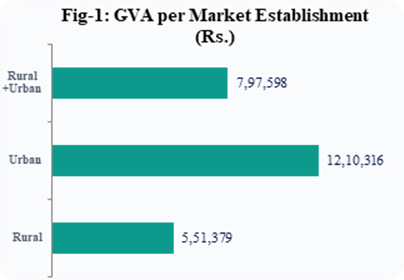
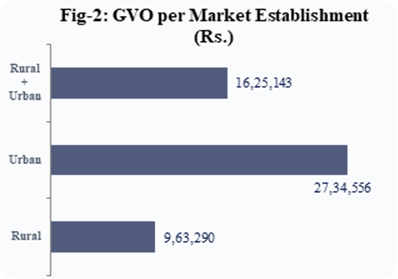
 

Title: GVA per Market Establishment (Rs.)

Financing Sources and Cost Composition of Household Construction Activities

On an average, about 97% of households reported their own income as one of the sources of fund to undertake construction activities, which accounted for approximately 77% of the total amount spent on construction.

Nearly 21% of households availed institutional (financial or non-financial) loan for financing their construction activities accounting for about 17% of the total construction expenditure. The proportion of households accessing institutional loans was higher in rural areas (23%) compared to urban areas (13%).

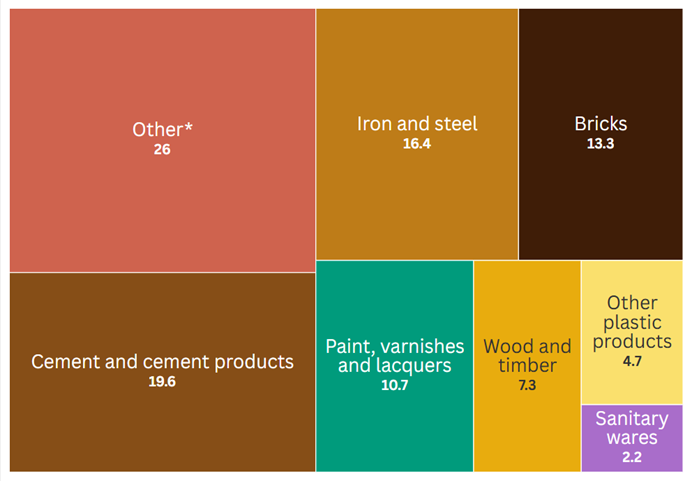
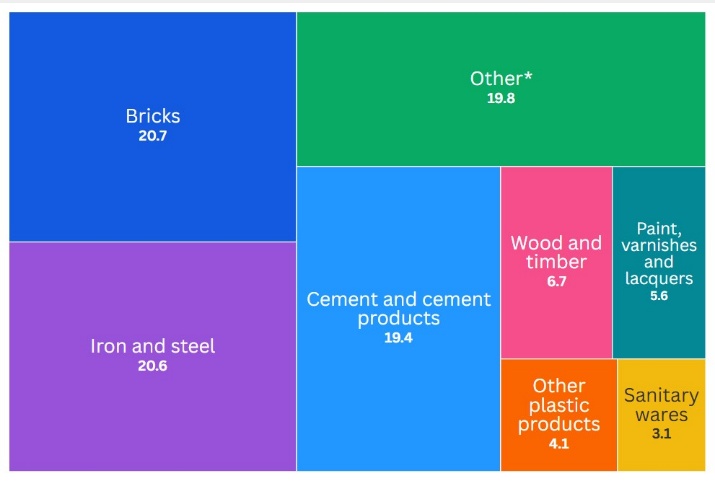
About three-fourths of household construction expenditure was on materials, with labour accounting for around 22 per cent. Within materials used for construction, bricks, cement, and iron and steel together comprised nearly 60 per cent of total expenditure.

Fig-3: Percentage Distribution of expenditure of materials: Household

*other includes petroleum, coal tar products, glass and glass products and other materials.

Fig-4: Percentage Distribution of expenditure of materials: Establishment

*other includes petroleum, coal tar products, glass and glass products and other materials.

Estimates of key indicators of the pilot study are given in Table 1 below. The detailed technical report also contains insights on major states and is available in the website of the Ministry (https://www.mospi.gov.in). Further, interactive tables and visualizations on other surveys conducted by NSO may be accessed on the Data Catalogue section of https://esankhyiki.mospi.gov.in/.

Table 1: Estimates of key indicators from Pilot Study on Construction Activities in Unincorporated Sector Establishments and Households

Indicator

Rural

Urban

Rural + Urban

(1)

(2)

(3)

(4)

Number of households undertaking own-account construction for own use

75,07,391

23,47,089

98,54,480

Number of establishments engaged in unincorporated construction activities

6,51,791

3,75,168

10,26,959

No. of Labourers engaged per household undertaking own account construction

4.2

4.4

4.3

No. of workers engaged per establishment in unincorporated construction activities

4.5

5.5

4.8

GVA per market establishment (Rs.)

5,51,379

12,10,316

7,97,598

Endnote: A brief about the coverage, sampling scheme, sample size and data collection mechanism in the Pilot Study on Construction Activities in Unincorporated Sector Establishments and Households:

A. Coverage of the pilot study:

A.1. Unincorporated Establishments: Market and non-market establishments engaged in construction activities

A.2. Households: own account construction undertaken by households for own use

A.3. Construction Activities: all activities under 2-digit NIC (2008) codes 41, 42 and 43 were considered in the definition of construction for the purpose of this pilot.

A.4.Expenditure on construction (for last 365 days or last financial year): Eligibility of establishments engaged in construction activities, as well as households undertaking own-account construction for own use, was determined based on whether their expenditure exceeded pre-specified thresholds, which varied by sector and type of sample entity. The expenditure threshold was set at ₹25,000 in rural areas and ₹50,000 in urban areas for establishments, and ₹10,000 in rural areas and ₹20,000 in urban areas for households. Any amount spent on construction below these cut-offs were not treated as construction work for this pilot study.

B. Sampling Scheme:

The survey has been conducted following a multi-stage stratified sampling scheme where first stage units (FSUs) were census villages in rural and UFS (Urban Frame Survey) blocks in urban areas.  The ultimate stage units (USU) were either establishments engaged in construction activities or households who has undertaken own account construction for own use.   

C. Sample Size:

In the pilot study, data were collected from a total of 19,154 households, 4,470 market establishments, and 717 non-market establishments pertaining to 11,981 surveyed FSUs (5,104 in rural and 6,877 in urban).

D. Data Collection Mechanism:

The pilot study has been conducted based on area frame and establishments/households have been listed in the selected FSUs of both rural and urban sector. Mostly, data were collected from the selected establishments/households through oral enquiry for the last 365 days. The data for the survey were collected in tablet using Computer Assisted Personal Interviewing (CAPI).

This pilot study has been carried out with Annual Survey of Unincorporated Sector Enterprises (ASUSE) 2025 in the same FSUs selected for the survey period July, 2025 – December, 2025. The listing schedule of ASUSE was suitably modified to accommodate the listing and selection of establishments and households undertaking construction under the coverage of the pilot study. The detailed establishment schedule was canvassed independently of ASUSE for collecting construction related information.

E. Detailed Technical Report of the Pilot Study:

For detailed understanding of the objectives, coverage, concepts, methodology and key findings from the pilot study one may refer to the Technical Report on Pilot Study on Construction Activities in Unincorporated Sector Establishments and Households published by NSO, MoSPI and available on the website of the ministry (https://www.mospi.gov.in).

Topics

Acts Income Tax