Loading...

Top
Help
×

By creating an account you can:

Logo TaxTMI
Call Us / Help / Feedback

Contact Us At :

E-mail: [email protected]

Call / WhatsApp at: +91 99117 96707

For more information, Check Contact Us

FAQs :

To know Frequently Asked Questions, Check FAQs

Most Asked Video Tutorials :

For more tutorials, Check Video Tutorials

Submit Feedback/Suggestion :

Email :
Please provide your email address so we can follow up on your feedback.
Category :
Description :
Min 15 characters 0/2000
Make Most of Text Search
  1. Checkout this video tutorial: How to search effectively on TaxTMI.
  2. Put words in double quotes for exact word search, eg: "income tax"
  3. Avoid noise words such as : 'and, of, the, a'
  4. Sort by Relevance to get the most relevant document.
  5. Press Enter to add multiple terms/multiple phrases, and then click on Search to Search.
  6. Text Search
  7. The system will try to fetch results that contains ALL your words.
  8. Once you add keywords, you'll see a new 'Search In' filter that makes your results even more precise.
  9. Text Search
Add to...
You have not created any category. Kindly create one to bookmark this item!
Create New Category
Hide
Title :
Description :
❮❮ Hide
Default View
Expand ❯❯
Close ✕
🔎 News - Adv. Search
TEXT SEARCH:

Press 'Enter' to add multiple search terms. Rules for Better Search

Search In:
Main Text + AI Text
  • Main Text
  • Main Text + AI Text
  • AI Text
Category: ?
Categorized by AI
---- All Categories ----
  • ---- All Categories ----
  • Income Tax
  • GST
  • Customs, DGFT & SEZ
  • FEMA & RBI
  • Corp. Laws, SEBI & IBC
  • PMLA, Black Money & ED
  • Budget
  • News and Press Release
  • PTI News
Month:
---- All Months ----
  • ---- All Months ----
  • January
  • February
  • March
  • April
  • May
  • June
  • July
  • August
  • September
  • October
  • November
  • December
Year:
---- All Years ----
  • ---- All Years ----
  • 2026
  • 2025
  • 2024
  • 2023
  • 2022
  • 2021
  • 2020
  • 2019
  • 2018
  • 2017
  • 2016
  • 2015
  • 2014
  • 2013
  • 2012
  • 2011
Sort By: ?
In Sort By 'Default', exact matches for text search are shown at the top, followed by the remaining results in their regular order.
Relevance Default Date
❯❯
Maximize Maximize Maximize
0 / 200
Expand Note
Add to Folder

No Folders have been created

+

Are you sure you want to delete "My most important" ?

NOTE:

News
Showing Results for :
Reset Filters
Results Found:
Show All Summaries Hide All Summaries
March 25, 2026
Show AI Summary
Form 9 receipt for approved scientific research payments supports deduction claims and compliance tracking.
Form 9 is the prescribed receipt for payments received towards an approved scientific research programme under section 45(3)(c) read with Rule 30. It is issued to the sponsor by the executing institution, records the payment against the approved programme in FORM 8, and supports the sponsor's deduction claim subject to compliance with the Act and Rules. The form is programme-specific, may be issued for each payment or tranche including advance payments, and captures the sponsor details, payment particulars, approved cost, approved tax years, and cumulative receipts. It is not filed with the tax department but retained as supporting evidence.
March 25, 2026
Show AI Summary
Scientific research programme approval under tax law requires Form 8, with defined scope, cost, compliance and monitoring conditions.
Form 8 is the statutory approval order for a scientific research programme under section 45(3)(c) of the Income-tax Act, 2025 and Rule 30. It is issued after examination of a sponsor's Form 7 application, records the approved scope, duration, cost, tax years and conditions of the programme, and is signed by the designated authority. The approval is programme-specific, cost-specific and time-bound, while post-approval compliance includes separate books, audit, reporting, asset restrictions and final completion reporting.
March 25, 2026
Show AI Summary
Energy Star ratings shape window air conditioner pricing by raising upfront cost while lowering electricity bills and maintenance.
Energy Star ratings for window air conditioners reflect Bureau of Energy Efficiency standards and indicate how much cooling an AC delivers per unit of electricity consumed. Higher-rated units generally cost more upfront because they use advanced components, smarter controls, and more efficient motors and compressors, but they can lower electricity bills, reduce maintenance, and extend service life. Choosing the right star rating depends on usage patterns, room size, budget, and local electricity tariffs, with energy efficiency affecting both purchase price and long-term ownership cost.
March 25, 2026
Show AI Summary
Scientific research programme approval in FORM 8 governs tax deduction eligibility, compliance conditions, and programme-specific approval limits.
Approval in FORM 8 records the prescribed authority's sanction of a scientific research programme under section 45(3)(c) read with Rule 30, following an application in FORM 7. It is a statutory approval order, not a filing by the sponsor, and identifies the programme, approved tax years, approved total cost, and any attached conditions. FORM 8 is programme-specific and cost-specific, and deduction depends on compliance with the Act, the Rules, and post-approval obligations.
March 25, 2026
Show AI Summary
Scientific research approval through Form 7 creates a programme-specific gateway for deduction eligibility and post-approval compliance.
Prior approval for a sponsored scientific research programme is obtained through Form 7, which is the programme-specific application for approval of expenditure on scientific research carried out through a National Laboratory, University, Indian Institute of Technology or specified person. The prescribed authority examines the programme's feasibility and scientific merit, communicates approval or rejection in Form 8, and the approval is cost-specific and only a pre-condition for deduction. Post-approval compliance requires separate accounts, periodic reporting, restricted use of funds and completion reports.
March 25, 2026
Show AI Summary
Prior approval for scientific research deduction requires FORM 7 before commencement, with strict programme-specific compliance conditions.
A sponsor seeking deduction for expenditure on a scientific research programme must furnish FORM 7 as the prescribed application for prior approval before commencement. Separate applications are required for each programme, and the form calls for details of the sponsor, the proposed research programme, its duration and estimated cost, and the executing institution. Approval may be granted only for eligible programmes carried out through specified institutions, while market research, sales promotion, routine quality control, commercial production, and routine data collection are excluded.
March 25, 2026
Show AI Summary
Rupee weakness amid foreign fund outflows, lower crude prices and expectations of RBI dollar support.
The rupee weakened in early trade against the US dollar amid sustained foreign fund outflows and market uncertainty linked to the West Asia crisis. The decline was partly cushioned by lower global crude oil prices, a weaker dollar and a firm opening in domestic equity markets. Market participants also expected RBI intervention through dollar sales, while exporters were hedging and importers buying on dips.
March 25, 2026
Show AI Summary
Audit report compliance for deduction claims under income-tax law requires Form 6, UDIN, and electronic verification.
Form 6 is the prescribed income-tax audit report for an assessee claiming deduction under Section 44 or Section 51 of the Income-tax Act, 2025, and must be certified by an accountant. It is to be filed electronically through the Income-tax e-Filing Portal, verified by Digital Signature Certificate, and furnished one month before the due date for the return of income for the relevant Tax Year. The form requires audit confirmation, supporting records, UDIN generation, and assessee verification for claims under both deduction provisions.
March 25, 2026
Show AI Summary
Audit-certified deduction reporting requires electronic Form 6 filing, accountant certification, UDIN, and digital verification for qualifying expenditure claims.
Form 6 is the prescribed audit report for an eligible assessee claiming deductions under section 44 for preliminary or project-related expenditure or under section 51 for mineral prospecting and development expenditure. It must be certified by an accountant and furnished electronically through the Income-tax e-Filing Portal. The form is filed once in the first tax year in which the deduction is claimed, at least one month before the due date for furnishing the return of income, with UDIN generation and digital verification required.
March 25, 2026
Show AI Summary
Money laundering bail refusal highlights serious economic offences, sufficient PMLA material, and unresolved double mortgage allegations.
Bail was refused in a money laundering prosecution under the Prevention of Money Laundering Act where the court found sufficient material linking the accused to the offence and treated the recorded PMLA statements as forming a formidable case. The court observed that economic offences pose a serious threat to the financial health of the country and that the gravity, seriousness and magnitude of the alleged conduct, along with the accused's major role, weighed against release on bail. Partial repayment did not discharge criminal liability, and the absence of an explanation for the alleged double mortgage remained relevant at the bail stage.
March 24, 2026
Show AI Summary
Money laundering bail disputes hinge on fraudulent credit facilities, double mortgaging, and the gravity of economic offences.
Bail in a money laundering prosecution was opposed on the basis that the accused was linked to allegedly fraudulent borrowing and diversion of bank credit facilities, including mortgage and alleged double sale of secured properties. The prosecution relied on statements under the Prevention of Money Laundering Act and other material to contend that sufficient evidence connected the accused to the offence and that the matter involved a serious economic offence affecting the financial system.
March 24, 2026
Show AI Summary
Scheduled Caste status and religious conversion: membership ends immediately on conversion to a non-specified faith.
A person belonging to a Scheduled Caste loses that status on conversion to a religion other than Hinduism, Sikhism or Buddhism, and the loss is immediate and complete from the moment of conversion. The bar in the Scheduled Castes Order, 1950 is categorical, so a person who professes and practices a non-specified religion cannot claim Scheduled Caste membership for statutory benefits, protections, reservations or other entitlements flowing from that status.
March 24, 2026
Show AI Summary
Green budget drives welfare schemes, electric mobility, disaster readiness and sectoral infrastructure spending across Delhi.
Delhi's FY27 budget sets out a broad fiscal and welfare programme with major allocations for environmental protection, education, health, transport, urban development, social welfare and water supply. It introduces measures such as free diagnostic tests for newborn babies, bicycles for girl students, free LPG cylinders for ration card-holding families on Holi and Diwali, the Mahila Samriddhi Yojna, electric auto-rickshaw permits for women and transgender persons, and expanded Ayushman Bharat Health coverage. It also provides for electric buses, a semiconductor policy, disaster management infrastructure, firefighting upgrades and water and sewage projects.
March 24, 2026
Show AI Summary
Preliminary expense disclosure in Form 5 requires electronic filing, detailed reporting, and strict compliance for income-tax deduction claims.
Form 5 is a mandatory electronic statement for an assessee claiming deduction for preliminary expenses under the Income-tax Act, 2025, to be furnished in accordance with Rule 27 and one month prior to the due date for filing the return of income. It requires disclosure of assessee particulars and transaction-level details of qualifying preliminary expenses, including feasibility reports, project reports, market or business surveys, and engineering services, with related PAN, TDS, and payment particulars.
March 24, 2026
Show AI Summary
Preliminary expenses deduction reporting requires electronic Form 5, with item-wise disclosure, verification, and timely portal filing.
Electronic Form 5 is the prescribed statement for reporting preliminary expenses claimed as a deduction under Section 44 of the Income-tax Act, 2025. It applies to eligible expenditure connected with setting up or extension of a business, including feasibility reports, project reports, market or business surveys, and engineering services related to business, and must be filed for each tax year through the income-tax portal using digital signature or electronic verification. The form requires disclosure of assessee particulars, item-wise expense details, service-provider information, payment particulars, and TDS data where applicable.
March 24, 2026
Show AI Summary
Functional cooperatives survey training set to standardise nationwide data collection and measure economic contribution.
Preparatory training was organised for the Rapid Survey of Functional Cooperatives before six months of field work beginning in April 2026. The workshop brought together senior officers and field functionaries who will serve as Master Trainers for subsequent regional training, with the aim of standardising nationwide survey operations. The survey will assess the contribution of functional cooperatives to employment generation and economic activity across rural and urban areas, and will estimate indicators such as Gross Value Added, Gross Value of Output and employment generated by cooperatives.
March 24, 2026
Show AI Summary
Unincorporated sector survey shows stronger employment, higher value added, rising wages and wider internet adoption across establishments.
Annual Survey of Unincorporated Sector Enterprises (ASUSE) 2025 covers unincorporated non-agricultural establishments in manufacturing, trade and other services, and collects data on workers, Gross Value Added, emoluments, fixed assets, loans, ownership, registration status and use of information and communication technology for policymaking and national accounts. The survey reports growth in establishments, employment, Gross Value Added, labour productivity, female-owned proprietary establishments, emolument per hired worker and internet use, and notes a revised sampling design enabling quarterly selection and district-level annual estimates.
March 24, 2026
Show AI Summary
District-led export promotion expands through local committees, action plans, and market access support for MSMEs and farmers.
District-led export promotion under the Districts as Export Hubs initiative is implemented through State Export Promotion Committees and District Export Promotion Committees across all States and Union Territories. District Export Action Plans identify export potential in local products and sectors, while outreach events, public data portals, and district-level committees are used to build awareness, address bottlenecks, and support exporters, manufacturers, MSMEs, farmers, and small-scale industries.
March 24, 2026
Show AI Summary
Export policy and trade facilitation framework strengthens competitiveness, digital governance, and market access across India's export ecosystem.
India's export framework is being strengthened through policy support, financial incentives, digital trade facilitation, infrastructure development, and trade agreements to expand competitiveness and global market access. The Foreign Trade Policy 2023, RoDTEP, the Export Promotion Mission, export credit support, and export-linked infrastructure are described as core instruments for improving trade finance, logistics, market readiness, and MSME competitiveness. Digital governance tools and trade agreements are said to support faster compliance, transparency, market access, and investment flows.
March 24, 2026
Show AI Summary
Startup ecosystem collaboration advances industry-linked innovation support for HVAC, manufacturing, testing, and pilot deployment opportunities.
Industry-linked innovation support is being advanced through a Memorandum of Understanding to strengthen the manufacturing and startup ecosystem. The collaboration is directed at product startups working in HVAC technologies, digital solutions, advanced manufacturing processes, and supply chain innovation, with the aim of enabling scalable, industry-relevant solutions through structured engagement. Startups will receive mentorship, testing facilities, R&D infrastructure, pilot opportunities, market linkages, and structured Proof-of-Concept programmes.

News

Back

All News

Showing Results for :
Reset Filters
No Records Found

News

Back

All News

Showing Results for : Reset Filters
News and Press Release

MoSPI Breaks New Ground: First-Ever Deep Dive into Unincorporated Construction Sector in Decades

April 11, 2026

Contents
Summary
Note

Note

-

Bookmark

Print

Print

Nearly 1 crore households built their own homes or undertook construction for self-use

10 Lakh+ Small Builders Power Economy: Unincorporated Construction Sector Comes into Focus

Snapshot:

  • MoSPI releases the technical report of pilot study on construction - marking NSO’s first such effort in decades to estimate key economic indicators of construction activities in the unincorporated sector and own-account household construction in a reference period of last 365 days.
  • During the reference period, an estimated 98.54 lakh households undertook own-account construction for their own use.
  • 10.27 lakh construction agencies (unincorporated establishments) were estimated to be engaged in this sector.
  • Approximately 77 per cent of these agencies engaged at least one hired worker on a fairly regular basis.
  • Estimated average value of fixed assets owned by such construction establishments was ₹5.21 lakh.
  • Nearly 23% of rural households undertaking own-account construction for own-use availed institutional funding reflecting increasing access to formal credit in rural areas.

The Ministry of Statistics and Programme Implementation (MoSPI) has released a technical report presenting the key findings from a Pilot study conducted on Construction Activities in Unincorporated Sector Establishments and Households. This study marks the first comprehensive attempt in decades by the National Statistics Office (NSO) to estimate key economic indicators for construction activities undertaken by unincorporated construction agencies (establishments engaged in construction activity), as well as own-account construction carried out by households for their own use. The study underscores MoSPI’s sustained efforts to bridge critical data gaps in sectors where reliable information has been limited. Data from the pilot study also served as an important input for the revised series of the national accounts statistics brought out by MoSPI. A brief overview of the pilot study in terms of coverage, sampling strategy, data collection mechanism, etc., is provided in the Endnote.

The construction sector plays a crucial role in Indian economy, serving both as a driver of growth and an indicator of economic progress. As a key engine of development, it contributes significantly to output, employment, and capital formation, while maintaining strong backward and forward linkages with various other sub-sectors of the economy. While the incorporated segment of the construction sector is to be covered under the recently launched Annual Survey of Incorporated Services Sector Enterprises (ASISSE), data remains limited for unincorporated construction enterprises and households undertaking own-account construction for own use in India. Recognizing the importance of generating robust and reliable estimates of key economic parameters in the construction sector, this pilot study was undertaken alongside Annual Survey of Unincorporated Sector Enterprises (ASUSE) 2025 in the same First Stage Units (FSUs) during the survey period from July to December 2025.

The pilot study, apart from capturing expenses and receipts, was designed to collect key information on employment and a broader set of economic parameters for construction establishments (both market and non-market), including fixed assets, outstanding loans, and various components of expenditure. For households, it focuses on capturing expenditure on construction activities, details of labour engagement, and sources of finance.

The findings of this pilot study served as a crucial input for the National Accounts Division (NAD) in updating and refining the rates and ratios used for estimating several economic indicators in the construction sector under the new series of national accounts.

Estimated number of construction activities undertaken:

It was estimated that 98.54 lakh households have undertaken construction during last 365 days (the reference period of the estimates)[1]. It was also estimated that 10.27 lakh unincorporated construction agencies were engaged in this sector which included both market and non-market establishment.

Average number of worker engaged in the construction sector:

On an average, an unincorporated builder establishment engaged in construction activities employed about five workers during the reference period. Further, approximately 77 per cent of such establishments reported engaging at least one hired worker on a fairly regular basis.

A household undertaking own-account construction for its own use during the reference period engaged around four labourers on an average.

Fixed Assets and Loan:

Fixed assets owned per unincorporated establishment engaged in construction activity has been estimated to be ₹5.21 lakh. The financial access, as reflected by the outstanding loan per establishment in the sector, was estimated to be little more than ₹1.40 lakh.

Value Addition and productivity:

The GVA per market establishment[2] for the unincorporated construction sector was estimated to be about Rs. 7.98 lakh and the corresponding output per establishment was Rs. 16.25 lakh.

The NVA and output per non-market establishment was observed to be Rs. 2.77 lakh and Rs. 5.59 lakh respectively.
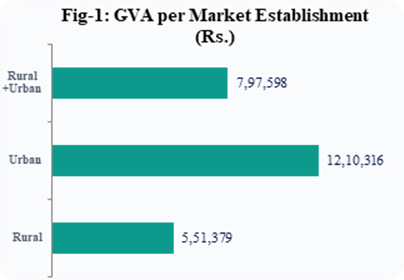
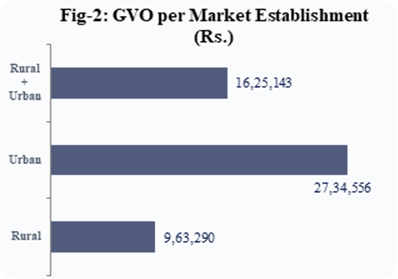
 

Title: GVA per Market Establishment (Rs.)

Financing Sources and Cost Composition of Household Construction Activities

On an average, about 97% of households reported their own income as one of the sources of fund to undertake construction activities, which accounted for approximately 77% of the total amount spent on construction.

Nearly 21% of households availed institutional (financial or non-financial) loan for financing their construction activities accounting for about 17% of the total construction expenditure. The proportion of households accessing institutional loans was higher in rural areas (23%) compared to urban areas (13%).

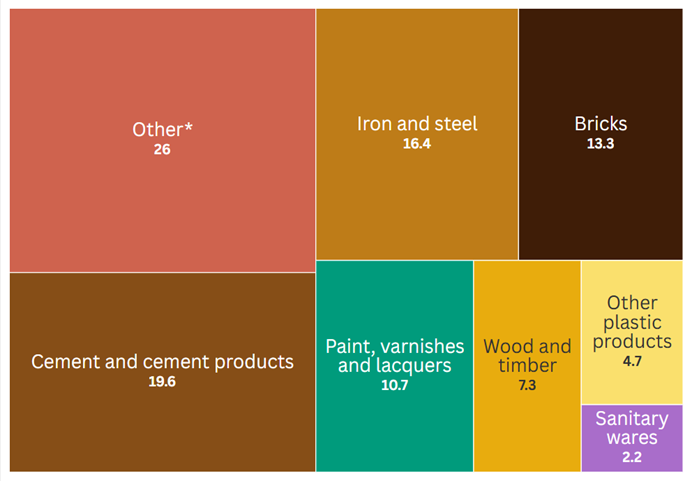
About three-fourths of household construction expenditure was on materials, with labour accounting for around 22 per cent. Within materials used for construction, bricks, cement, and iron and steel together comprised nearly 60 per cent of total expenditure.

Fig-3: Percentage Distribution of expenditure of materials: Household

*other includes petroleum, coal tar products, glass and glass products and other materials.

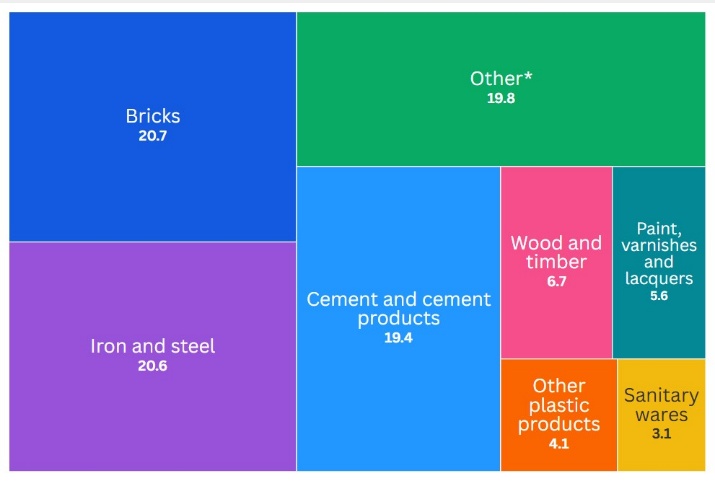
Fig-4: Percentage Distribution of expenditure of materials: Establishment

*other includes petroleum, coal tar products, glass and glass products and other materials.

Estimates of key indicators of the pilot study are given in Table 1 below. The detailed technical report also contains insights on major states and is available in the website of the Ministry (https://www.mospi.gov.in). Further, interactive tables and visualizations on other surveys conducted by NSO may be accessed on the Data Catalogue section of https://esankhyiki.mospi.gov.in/.

Table 1: Estimates of key indicators from Pilot Study on Construction Activities in Unincorporated Sector Establishments and Households

Indicator

Rural

Urban

Rural + Urban

(1)

(2)

(3)

(4)

Number of households undertaking own-account construction for own use

75,07,391

23,47,089

98,54,480

Number of establishments engaged in unincorporated construction activities

6,51,791

3,75,168

10,26,959

No. of Labourers engaged per household undertaking own account construction

4.2

4.4

4.3

No. of workers engaged per establishment in unincorporated construction activities

4.5

5.5

4.8

GVA per market establishment (Rs.)

5,51,379

12,10,316

7,97,598

Endnote: A brief about the coverage, sampling scheme, sample size and data collection mechanism in the Pilot Study on Construction Activities in Unincorporated Sector Establishments and Households:

A. Coverage of the pilot study:

A.1. Unincorporated Establishments: Market and non-market establishments engaged in construction activities

A.2. Households: own account construction undertaken by households for own use

A.3. Construction Activities: all activities under 2-digit NIC (2008) codes 41, 42 and 43 were considered in the definition of construction for the purpose of this pilot.

A.4.Expenditure on construction (for last 365 days or last financial year): Eligibility of establishments engaged in construction activities, as well as households undertaking own-account construction for own use, was determined based on whether their expenditure exceeded pre-specified thresholds, which varied by sector and type of sample entity. The expenditure threshold was set at ₹25,000 in rural areas and ₹50,000 in urban areas for establishments, and ₹10,000 in rural areas and ₹20,000 in urban areas for households. Any amount spent on construction below these cut-offs were not treated as construction work for this pilot study.

B. Sampling Scheme:

The survey has been conducted following a multi-stage stratified sampling scheme where first stage units (FSUs) were census villages in rural and UFS (Urban Frame Survey) blocks in urban areas.  The ultimate stage units (USU) were either establishments engaged in construction activities or households who has undertaken own account construction for own use.   

C. Sample Size:

In the pilot study, data were collected from a total of 19,154 households, 4,470 market establishments, and 717 non-market establishments pertaining to 11,981 surveyed FSUs (5,104 in rural and 6,877 in urban).

D. Data Collection Mechanism:

The pilot study has been conducted based on area frame and establishments/households have been listed in the selected FSUs of both rural and urban sector. Mostly, data were collected from the selected establishments/households through oral enquiry for the last 365 days. The data for the survey were collected in tablet using Computer Assisted Personal Interviewing (CAPI).

This pilot study has been carried out with Annual Survey of Unincorporated Sector Enterprises (ASUSE) 2025 in the same FSUs selected for the survey period July, 2025 – December, 2025. The listing schedule of ASUSE was suitably modified to accommodate the listing and selection of establishments and households undertaking construction under the coverage of the pilot study. The detailed establishment schedule was canvassed independently of ASUSE for collecting construction related information.

E. Detailed Technical Report of the Pilot Study:

For detailed understanding of the objectives, coverage, concepts, methodology and key findings from the pilot study one may refer to the Technical Report on Pilot Study on Construction Activities in Unincorporated Sector Establishments and Households published by NSO, MoSPI and available on the website of the ministry (https://www.mospi.gov.in).

Topics

Acts Income Tax