Loading...

✕
Top
Help
×

By creating an account you can:

Logo TaxTMI
Call Us / Help / Feedback✕

Contact Us At :

E-mail: [email protected]

Call / WhatsApp at: +91 99117 96707

For more information, Check Contact Us

FAQs :

To know Frequently Asked Questions, Check FAQs

Most Asked Video Tutorials :

For more tutorials, Check Video Tutorials

Submit Feedback/Suggestion :

Email :
Please provide your email address so we can follow up on your feedback.
Category :
Description :
Min 15 characters 0/2000
Make Most of Text Search ✕
  1. Checkout this video tutorial: How to search effectively on TaxTMI.
  2. Put words in double quotes for exact word search, eg: "income tax"
  3. Avoid noise words such as : 'and, of, the, a'
  4. Sort by Relevance to get the most relevant document.
  5. Press Enter to add multiple terms/multiple phrases, and then click on Search to Search.
  6. Text Search
  7. The system will try to fetch results that contains ALL your words.
  8. Once you add keywords, you'll see a new 'Search In' filter that makes your results even more precise.
  9. Text Search
╳
Add to...
You have not created any category. Kindly create one to bookmark this item!
✕
Create New Category
Hide
Title :
Description :
❮❮ Hide
Default View
Expand ❯❯
Close ✕
🔎 News - Adv. Search
TEXT SEARCH:

Press 'Enter' to add multiple search terms. Rules for Better Search

Search In:
Main Text + AI Text
  • Main Text
  • Main Text + AI Text
  • AI Text
Category: ?
Categorized by AI
---- All Categories ----
  • ---- All Categories ----
  • Income Tax
  • GST
  • Customs, DGFT & SEZ
  • FEMA & RBI
  • Corp. Laws, SEBI & IBC
  • PMLA, Black Money & ED
  • Budget
  • News and Press Release
  • PTI News
Month:
---- All Months ----
  • ---- All Months ----
  • January
  • February
  • March
  • April
  • May
  • June
  • July
  • August
  • September
  • October
  • November
  • December
Year:
---- All Years ----
  • ---- All Years ----
  • 2026
  • 2025
  • 2024
  • 2023
  • 2022
  • 2021
  • 2020
  • 2019
  • 2018
  • 2017
  • 2016
  • 2015
  • 2014
  • 2013
  • 2012
  • 2011
Sort By: ?
In Sort By 'Default', exact matches for text search are shown at the top, followed by the remaining results in their regular order.
Relevance Default Date
    Union Minister of Commerce and Industry Shri Piyush Goyal Urges Industry to Leverage FTAs with Developed Nations through Quality Focus
    14th Ministerial Conference of the World Trade Organization to be held in Yaoundé from 26–29 March 2026 under Cameroon’s chairmanship
    DPIIT Signs MoU with a Leading Fintech Platform to Strengthen India’s Startup Ecosystem
    All India Workshop of Trainers (AIWOT) for Rapid Survey of Functional Cooperatives (RSFC)
    Flash Report on Central Sector Infrastructure Projects worth ₹150 crore and above
    FORM 22 — Frequently Asked Questions (FAQs)
    Guidance Note - Form 21
    Several 'facilitative' steps taken in Budget for middle class: Sitharaman
    The World Famous American Pan-Asian Brand, P.F. Chang's, Debuts in the Tricity with Mohali Restaurant at HLP Gallerria
    FORM 21— Frequently Asked Questions (FAQs)
    Guidance Note - Form 20
    Andhra Pradesh to see no electricity tariff hike for FY27
    Why Interest Rates Matter When Choosing a Personal Loan: Key Insights for Salaried Borrowers
    Time Use Survey (TUS) 2024
    PAIMANA PORTAL AND MANAGEMENT OF MAJOR INFRASTRUCTURE PROJECTS
    CTIL, IIFT Extends Support to International Economic Law Moot Court Competition
    FORM 20 — Frequently Asked Questions (FAQs)
    Guidance Note - Form 19
    Insolvency and Bankruptcy Code has failed to serve purpose: Oppn members in LS
    Form 19 – Frequently Asked Questions
❯❯
Maximize Maximize Maximize
0 / 200
Expand Note
Add to Folder

No Folders have been created

+

Are you sure you want to delete "My most important" ?

NOTE:

News
Showing Results for :
Reset Filters
Results Found:
Show All Summaries Hide All Summaries
March 25, 2026
Show AI Summary
Free trade agreements and voluntary CSR are highlighted as tools for quality-led growth and inclusive development.
India's expanded free trade agreements are presented as a means of securing preferential market access for goods and services, with reduced or zero duty benefits linked to stronger export competitiveness. Indian industry, farmers, MSMEs, fishermen and artisans are urged to use these opportunities through a sustained focus on quality, higher standards and improved production and service capability. The statement also presents voluntary corporate social responsibility beyond statutory minima as an example of tangible social commitment.
March 25, 2026
Show AI Summary
Multilateral trading system priorities shape India's agenda on WTO reform, food security, digital trade, and development concerns.
The WTO Ministerial Conference agenda covers WTO reform, the e-commerce work programme and moratorium, investment facilitation for development, fisheries subsidies, and agriculture-related issues. India's priorities include a development-centric multilateral trading system, a permanent solution on Public Stockholding for food security, effective Special and Differential Treatment, and a fully functional, automatic, and binding dispute settlement mechanism. India also supports policy space in digital trade, balanced fisheries subsidy disciplines, and investment facilitation for developing countries.
March 25, 2026
Show AI Summary
Startup ecosystem partnership expands incorporation support, mentorship and financial tools for early-stage founders through a dedicated platform.
DPIIT entered into a strategic partnership with a leading fintech platform through a Memorandum of Understanding to strengthen India's startup ecosystem by supporting startups, innovators and entrepreneurs with financial tools, founder enablement programmes and ecosystem assistance. The collaboration is directed towards helping early- and growth-stage startups scale through digital payment solutions, financial infrastructure, incorporation support, mentorship and structured guidance for formalising and expanding operations. A dedicated platform, Startup Sahayak, has been launched to provide end-to-end assistance for early-stage founders, including company incorporation, access to schemes and guidance on funding opportunities.
March 25, 2026
Show AI Summary
Cooperative sector survey training strengthens data quality and prepares nationwide collection on economic contribution and employment generation.
The Rapid Survey of Functional Cooperatives is being prepared through an all-India training workshop to equip master trainers with conceptual clarity, survey methodology, technical know-how, and uniform understanding of survey concepts. The survey will be conducted nationwide from April 2026 using the National Cooperative Database as the sampling frame and a web-based data collection system to generate sector-wise estimates of economic contribution and employment generation.
March 25, 2026
Show AI Summary
Infrastructure project monitoring through PAIMANA tracks ongoing Central Sector projects, sector-wise progress, and new additions across Ministries.
Central Sector infrastructure projects worth Rs.150 crore and above are monitored through the PAIMANA portal, which standardises infrastructure tracking, auto-updates project data from Ministries and Departments, and supports timely review and data-driven decision-making. As of February 2026, the portal records 1,948 ongoing projects across 17 Central Ministries and Departments, with a revised cost of Rs.41.98 lakh crore and cumulative expenditure of Rs.19.71 lakh crore. The portfolio covers multiple sectors, led by Transport & Logistics and Energy, and includes new additions and commissioned projects during February 2026.
March 25, 2026
Show AI Summary
Skill development project approval through Form 22 requires online filing, verified disclosures, and compliance with prescribed conditions.
Form 22 is the prescribed income-tax application for an eligible company seeking approval of a skill development project under Section 47(1)(b) of the Income-tax Act, 2025, read with Rule 39. The form is filed before commencement of the project through the e-filing portal and requires disclosure of the project structure, training institute particulars, proposed expenditure, supporting documents, and compliance details. It is verified by DSC or EVC, and defects must be rectified within the prescribed time or the application may be treated as invalid.
March 25, 2026
Show AI Summary
Agricultural extension project notification under Form 21 requires approval, compliance, renewal, and revocation safeguards.
Form 21 is the notification instrument issued by the Central Board of Direct Taxes for an approved Agricultural Extension Project under Section 47(1)(a) of the Income-tax Act, 2025 read with Rule 37. It is issued after examination of Form 20, records the project particulars, approved tax years, expected expenditure, and notification conditions, and is authenticated by signature and Official Gazette publication. The notification remains valid for up to three Tax Years, is subject to compliance and renewal requirements, and may be revoked for cessation, non-genuine activities, or breach of approval conditions.
March 25, 2026
Show AI Summary
Facilitative tax and customs reform measures in the Finance Bill 2026 aim to ease compliance, support MSMEs, and promote trade.
The Finance Bill 2026 is described as a set of facilitative tax and customs measures centred on trust-based tax administration, ease of living, MSME support, trade facilitation and customs reform. The measures highlighted include lower tax collected at source on certain foreign remittances and overseas tour packages, customs duty exemption on critical drugs, duty-free import treatment for medicines and personal use articles, permission to file updated income-tax returns after reassessment proceedings begin, and a foreign asset disclosure scheme for small taxpayers. The Bill also seeks to reduce compliance burden and dispute potential through customs rationalisation and facilitation-first enforcement.
March 25, 2026
Show AI Summary
Pan-Asian dining expansion marks P.F. Chang's Tricity debut with a Mohali restaurant and signature wok-first menu.
P.F. Chang's expands its India footprint by opening its first restaurant in Mohali at HLP Gallerria, marking its Tricity debut and eighth outlet in the country. The launch is part of the brand's North India growth strategy and extends its presence beyond metro locations. The Mohali restaurant highlights the brand's wok-first cooking, scratch-made sauces, signature Pan-Asian dishes, and menu options tailored for Indian diners, including vegetarian and Jain selections, alongside MSG-free preparation and a premium casual dining experience.
March 25, 2026
Show AI Summary
Agricultural extension project notification under income-tax rules sets approval conditions, duration limits, and compliance requirements for tax benefits.
Form 21 is the prescribed income-tax notification form for an approved agricultural extension project under Section 47(1)(a) of the Income-tax Act, 2025, issued after approval under Rule 37 and published in the Official Gazette. It notifies the project, specifies the approved tax year(s), and sets out the terms, conditions, duration, expenditure limits, and beneficiary charges. The form records the applicant's particulars, project purpose, commencement date, approved period, estimated expenditure, and other conditions attached to approval.
March 25, 2026
Show AI Summary
Agricultural Extension Project approval requires Form 20 filing, prior Ministry clearance, and electronic verification before commencement.
Form 20 is the prescribed income-tax application for approval of an Agricultural Extension Project under Section 47(1)(a) read with Rule 37. It must be filed electronically before commencement of the project and before seeking notification, with prior Ministry of Agriculture approval and compliance with Rule 37 conditions. The form requires applicant and project particulars, supporting documents, and verification through DSC or EVC. Defects must be rectified within one month, approval is notified in Form 21 and published in the Official Gazette, and it remains valid for up to three tax years.
March 25, 2026
Show AI Summary
Electricity tariff stability keeps consumer burden unchanged while supporting farmers, households, industry, and power sector efficiency.
The Andhra Pradesh Electricity Regulatory Commission approved a tariff order for FY2026-27 keeping electricity tariffs unchanged across consumer categories, while also undertaking true-up/down and performance review of the distribution companies for FY2024-25 after public consultation. The order records a lower approved revenue gap than projected by the distribution companies and provides for full Government support of the approved gap, with the effect that consumers are not subjected to tariff increase or additional true-up burden.
March 25, 2026
Show AI Summary
Personal loan interest rates shape EMI burden, repayment costs, and borrowing decisions for salaried individuals.
Interest rates are a primary determinant of the affordability of personal loans for salaried borrowers, directly affecting monthly EMI outgo, total repayment burden and overall budget planning. Even small differences in the rate can materially alter long-term repayment commitments, making comparison of rates and related charges an important step before borrowing. The rate offered to a salaried borrower is described as dependent on credit score, repayment history, monthly income, job stability, existing financial obligations and employer profile.
March 25, 2026
Show AI Summary
Unpaid caregiving work shows a clear gender gap in Time Use Survey 2024, with women participating more and spending more time.
Time Use Survey 2024 measures participation in paid and unpaid activities and reports unpaid caregiving for household members among persons aged 15 to 59 years. It compares Time Use Survey 2024 with Time Use Survey 2019, noting differences in participation rates and average daily time spent on caregiving by men and women. The release highlights that women participate more in unpaid caregiving and spend more time on it than men.
March 25, 2026
Show AI Summary
Infrastructure project monitoring through PAIMANA, integrated dashboards, and escalation-based review to reduce delays and improve execution.
MoSPI monitors ongoing Central Sector infrastructure projects costing Rs. 150 crore and above through PAIMANA, a web-based monitoring system integrated with DPIIT's portal under the principle of One Data One Entry. The platform automatically fetches project data, reduces manual entry, supports evidence-based monitoring, and provides customized dashboards, monthly reviews, and analytics for stakeholders. Delay-mitigation measures also include PRAGATI reviews and DPIIT's Project Monitoring Group, which uses milestone-based monitoring and a 5-tier escalation framework for issue resolution and fast-tracking of approvals and clearances.
March 25, 2026
Show AI Summary
International trade law and WTO dispute settlement shaped CTIL's support for a regional moot court competition.
CTIL supported the 24th edition of the John H. Jackson Moot Court Competition as a Platinum Sponsor for the West and South Asia regional round. The event focused on international trade law, WTO law and dispute settlement, with CTIL research staff serving as judges and CTIL presenting its work in trade and investment law, capacity-building programmes and policy discourse.
March 25, 2026
Show AI Summary
Agricultural extension project approval governs online filing, verification, and compliance for tax-benefit eligibility under the income-tax framework.
Form 20 is the prescribed income-tax application for approval of an agricultural extension project under Section 47(1)(a) of the Income-tax Act, 2025 read with Rule 37. It is used by an assessee seeking approval for a project undertaken for training, education and guidance of farmers, with prior approval from the Ministry of Agriculture and Farmers Welfare and expected expenditure, excluding land and building, exceeding the specified threshold. The form serves to secure approval-related tax benefits and to furnish structured disclosure of the project, expenditure estimates, beneficiary details, compliance history and prior approvals.
March 25, 2026
Show AI Summary
Specified business notification for semiconductor wafer fabrication units through Form 19 and electronic filing requirements.
Form 19 is prescribed for an application seeking notification of a semiconductor wafer fabrication manufacturing unit as a specified business under the Income-tax law. It is used by an assessee carrying on, or proposing to carry on, semiconductor wafer fabrication manufacturing, and the application captures particulars of the assessee, the unit, and fulfilment of prescribed conditions to enable verification of eligibility for notification. The completed form, together with supporting approval documents where applicable, is filed electronically and examined for compliance with the statutory and rule-based requirements.
March 25, 2026
Show AI Summary
Insolvency resolution delays and tribunal capacity constraints dominate debate on insolvency law amendments.
Debate on the Insolvency and Bankruptcy Code (Amendment) Bill, 2025 highlighted concerns that insolvency resolution and liquidation suffer from delay, value deterioration and low recoveries. Opposition members said limited capacity of the National Company Law Tribunal hampers timely disposal of cases and weakens the resolution framework, while also criticising the insolvency ecosystem for facilitating stripping of corporate assets. The discussion noted efforts to address timelines, capacity constraints and creditor recovery through the select committee report.
March 25, 2026
Show AI Summary
Semiconductor wafer fabrication notification governs specified business status, mandatory filing, and tax benefits under the prescribed form.
Form 19 is the prescribed application for notification of a semiconductor wafer fabrication manufacturing unit as a specified business under section 46 of the Income-tax Act, 2025. It is required for assessee carrying on or proposing to carry on semiconductor wafer fabrication activity and is mandatory for claiming the associated tax benefits. The form seeks particulars of the assessee, the specified business, the proposed unit, commencement details, prescribed approvals, and confirmation that the unit is exclusively for semiconductor wafer fabrication, located in India, and operating under the required conditions.

News

Back

All News

Showing Results for :
Reset Filters
No Records Found

News

Back

All News

Showing Results for : Reset Filters
News and Press Release

MoSPI Breaks New Ground: First-Ever Deep Dive into Unincorporated Construction Sector in Decades

April 11, 2026

Contents
Summary
Note

Note

-

Bookmark

Print

Print

Nearly 1 crore households built their own homes or undertook construction for self-use

10 Lakh+ Small Builders Power Economy: Unincorporated Construction Sector Comes into Focus

Snapshot:

  • MoSPI releases the technical report of pilot study on construction - marking NSO’s first such effort in decades to estimate key economic indicators of construction activities in the unincorporated sector and own-account household construction in a reference period of last 365 days.
  • During the reference period, an estimated 98.54 lakh households undertook own-account construction for their own use.
  • 10.27 lakh construction agencies (unincorporated establishments) were estimated to be engaged in this sector.
  • Approximately 77 per cent of these agencies engaged at least one hired worker on a fairly regular basis.
  • Estimated average value of fixed assets owned by such construction establishments was ₹5.21 lakh.
  • Nearly 23% of rural households undertaking own-account construction for own-use availed institutional funding reflecting increasing access to formal credit in rural areas.

The Ministry of Statistics and Programme Implementation (MoSPI) has released a technical report presenting the key findings from a Pilot study conducted on Construction Activities in Unincorporated Sector Establishments and Households. This study marks the first comprehensive attempt in decades by the National Statistics Office (NSO) to estimate key economic indicators for construction activities undertaken by unincorporated construction agencies (establishments engaged in construction activity), as well as own-account construction carried out by households for their own use. The study underscores MoSPI’s sustained efforts to bridge critical data gaps in sectors where reliable information has been limited. Data from the pilot study also served as an important input for the revised series of the national accounts statistics brought out by MoSPI. A brief overview of the pilot study in terms of coverage, sampling strategy, data collection mechanism, etc., is provided in the Endnote.

The construction sector plays a crucial role in Indian economy, serving both as a driver of growth and an indicator of economic progress. As a key engine of development, it contributes significantly to output, employment, and capital formation, while maintaining strong backward and forward linkages with various other sub-sectors of the economy. While the incorporated segment of the construction sector is to be covered under the recently launched Annual Survey of Incorporated Services Sector Enterprises (ASISSE), data remains limited for unincorporated construction enterprises and households undertaking own-account construction for own use in India. Recognizing the importance of generating robust and reliable estimates of key economic parameters in the construction sector, this pilot study was undertaken alongside Annual Survey of Unincorporated Sector Enterprises (ASUSE) 2025 in the same First Stage Units (FSUs) during the survey period from July to December 2025.

The pilot study, apart from capturing expenses and receipts, was designed to collect key information on employment and a broader set of economic parameters for construction establishments (both market and non-market), including fixed assets, outstanding loans, and various components of expenditure. For households, it focuses on capturing expenditure on construction activities, details of labour engagement, and sources of finance.

The findings of this pilot study served as a crucial input for the National Accounts Division (NAD) in updating and refining the rates and ratios used for estimating several economic indicators in the construction sector under the new series of national accounts.

Estimated number of construction activities undertaken:

It was estimated that 98.54 lakh households have undertaken construction during last 365 days (the reference period of the estimates)[1]. It was also estimated that 10.27 lakh unincorporated construction agencies were engaged in this sector which included both market and non-market establishment.

Average number of worker engaged in the construction sector:

On an average, an unincorporated builder establishment engaged in construction activities employed about five workers during the reference period. Further, approximately 77 per cent of such establishments reported engaging at least one hired worker on a fairly regular basis.

A household undertaking own-account construction for its own use during the reference period engaged around four labourers on an average.

Fixed Assets and Loan:

Fixed assets owned per unincorporated establishment engaged in construction activity has been estimated to be ₹5.21 lakh. The financial access, as reflected by the outstanding loan per establishment in the sector, was estimated to be little more than ₹1.40 lakh.

Value Addition and productivity:

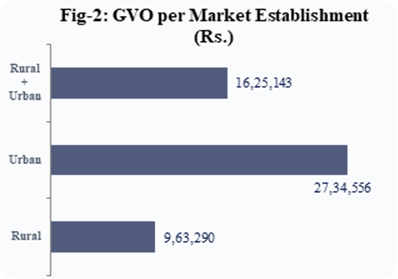
The GVA per market establishment[2] for the unincorporated construction sector was estimated to be about Rs. 7.98 lakh and the corresponding output per establishment was Rs. 16.25 lakh.

The NVA and output per non-market establishment was observed to be Rs. 2.77 lakh and Rs. 5.59 lakh respectively.
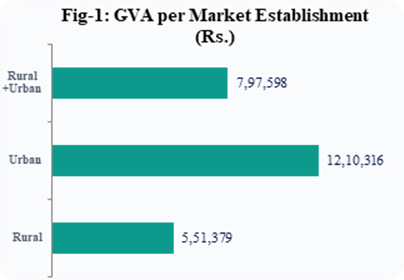
 

Title: GVA per Market Establishment (Rs.)

Financing Sources and Cost Composition of Household Construction Activities

On an average, about 97% of households reported their own income as one of the sources of fund to undertake construction activities, which accounted for approximately 77% of the total amount spent on construction.

Nearly 21% of households availed institutional (financial or non-financial) loan for financing their construction activities accounting for about 17% of the total construction expenditure. The proportion of households accessing institutional loans was higher in rural areas (23%) compared to urban areas (13%).

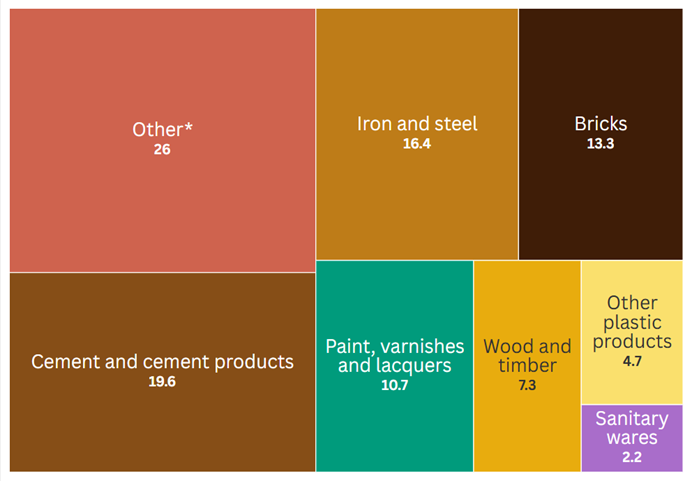
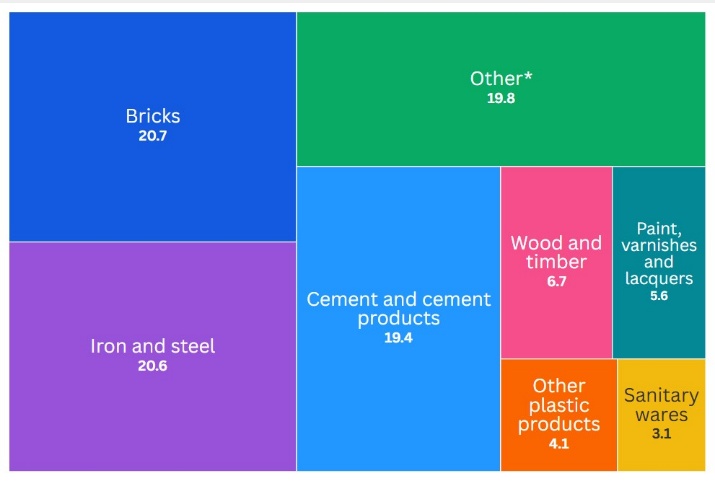
About three-fourths of household construction expenditure was on materials, with labour accounting for around 22 per cent. Within materials used for construction, bricks, cement, and iron and steel together comprised nearly 60 per cent of total expenditure.

Fig-3: Percentage Distribution of expenditure of materials: Household

*other includes petroleum, coal tar products, glass and glass products and other materials.

Fig-4: Percentage Distribution of expenditure of materials: Establishment

*other includes petroleum, coal tar products, glass and glass products and other materials.

Estimates of key indicators of the pilot study are given in Table 1 below. The detailed technical report also contains insights on major states and is available in the website of the Ministry (https://www.mospi.gov.in). Further, interactive tables and visualizations on other surveys conducted by NSO may be accessed on the Data Catalogue section of https://esankhyiki.mospi.gov.in/.

Table 1: Estimates of key indicators from Pilot Study on Construction Activities in Unincorporated Sector Establishments and Households

Indicator

Rural

Urban

Rural + Urban

(1)

(2)

(3)

(4)

Number of households undertaking own-account construction for own use

75,07,391

23,47,089

98,54,480

Number of establishments engaged in unincorporated construction activities

6,51,791

3,75,168

10,26,959

No. of Labourers engaged per household undertaking own account construction

4.2

4.4

4.3

No. of workers engaged per establishment in unincorporated construction activities

4.5

5.5

4.8

GVA per market establishment (Rs.)

5,51,379

12,10,316

7,97,598

Endnote: A brief about the coverage, sampling scheme, sample size and data collection mechanism in the Pilot Study on Construction Activities in Unincorporated Sector Establishments and Households:

A. Coverage of the pilot study:

A.1. Unincorporated Establishments: Market and non-market establishments engaged in construction activities

A.2. Households: own account construction undertaken by households for own use

A.3. Construction Activities: all activities under 2-digit NIC (2008) codes 41, 42 and 43 were considered in the definition of construction for the purpose of this pilot.

A.4.Expenditure on construction (for last 365 days or last financial year): Eligibility of establishments engaged in construction activities, as well as households undertaking own-account construction for own use, was determined based on whether their expenditure exceeded pre-specified thresholds, which varied by sector and type of sample entity. The expenditure threshold was set at ₹25,000 in rural areas and ₹50,000 in urban areas for establishments, and ₹10,000 in rural areas and ₹20,000 in urban areas for households. Any amount spent on construction below these cut-offs were not treated as construction work for this pilot study.

B. Sampling Scheme:

The survey has been conducted following a multi-stage stratified sampling scheme where first stage units (FSUs) were census villages in rural and UFS (Urban Frame Survey) blocks in urban areas.  The ultimate stage units (USU) were either establishments engaged in construction activities or households who has undertaken own account construction for own use.   

C. Sample Size:

In the pilot study, data were collected from a total of 19,154 households, 4,470 market establishments, and 717 non-market establishments pertaining to 11,981 surveyed FSUs (5,104 in rural and 6,877 in urban).

D. Data Collection Mechanism:

The pilot study has been conducted based on area frame and establishments/households have been listed in the selected FSUs of both rural and urban sector. Mostly, data were collected from the selected establishments/households through oral enquiry for the last 365 days. The data for the survey were collected in tablet using Computer Assisted Personal Interviewing (CAPI).

This pilot study has been carried out with Annual Survey of Unincorporated Sector Enterprises (ASUSE) 2025 in the same FSUs selected for the survey period July, 2025 – December, 2025. The listing schedule of ASUSE was suitably modified to accommodate the listing and selection of establishments and households undertaking construction under the coverage of the pilot study. The detailed establishment schedule was canvassed independently of ASUSE for collecting construction related information.

E. Detailed Technical Report of the Pilot Study:

For detailed understanding of the objectives, coverage, concepts, methodology and key findings from the pilot study one may refer to the Technical Report on Pilot Study on Construction Activities in Unincorporated Sector Establishments and Households published by NSO, MoSPI and available on the website of the ministry (https://www.mospi.gov.in).

Topics

Acts Income Tax