Loading...

Top
Help
×

By creating an account you can:

Logo TaxTMI
Call Us / Help / Feedback

Contact Us At :

E-mail: [email protected]

Call / WhatsApp at: +91 99117 96707

For more information, Check Contact Us

FAQs :

To know Frequently Asked Questions, Check FAQs

Most Asked Video Tutorials :

For more tutorials, Check Video Tutorials

Submit Feedback/Suggestion :

Email :
Please provide your email address so we can follow up on your feedback.
Category :
Description :
Min 15 characters 0/2000
Make Most of Text Search
  1. Checkout this video tutorial: How to search effectively on TaxTMI.
  2. Put words in double quotes for exact word search, eg: "income tax"
  3. Avoid noise words such as : 'and, of, the, a'
  4. Sort by Relevance to get the most relevant document.
  5. Press Enter to add multiple terms/multiple phrases, and then click on Search to Search.
  6. Text Search
  7. The system will try to fetch results that contains ALL your words.
  8. Once you add keywords, you'll see a new 'Search In' filter that makes your results even more precise.
  9. Text Search
Add to...
You have not created any category. Kindly create one to bookmark this item!
Create New Category
Hide
Title :
Description :
❮❮ Hide
Default View
Expand ❯❯
Close ✕
🔎 News - Adv. Search
TEXT SEARCH:

Press 'Enter' to add multiple search terms. Rules for Better Search

Search In:
Main Text + AI Text
  • Main Text
  • Main Text + AI Text
  • AI Text
Category: ?
Categorized by AI
---- All Categories ----
  • ---- All Categories ----
  • Income Tax
  • GST
  • Customs, DGFT & SEZ
  • FEMA & RBI
  • Corp. Laws, SEBI & IBC
  • PMLA, Black Money & ED
  • Budget
  • News and Press Release
  • PTI News
Month:
---- All Months ----
  • ---- All Months ----
  • January
  • February
  • March
  • April
  • May
  • June
  • July
  • August
  • September
  • October
  • November
  • December
Year:
---- All Years ----
  • ---- All Years ----
  • 2026
  • 2025
  • 2024
  • 2023
  • 2022
  • 2021
  • 2020
  • 2019
  • 2018
  • 2017
  • 2016
  • 2015
  • 2014
  • 2013
  • 2012
  • 2011
Sort By: ?
In Sort By 'Default', exact matches for text search are shown at the top, followed by the remaining results in their regular order.
Relevance Default Date
❯❯
Maximize Maximize Maximize
0 / 200
Expand Note
Add to Folder

No Folders have been created

+

Are you sure you want to delete "My most important" ?

NOTE:

News
Showing Results for :
Reset Filters
Results Found:
Show All Summaries Hide All Summaries
March 26, 2026
Show AI Summary
Deduction claims for offshore banking units require Form 35, accountant verification, and filing with the return of income.
Form 35 is the accountant's report to be filed with the return of income by assessees claiming deduction on income from Offshore Banking Units in Special Economic Zones or units of an International Financial Services Centre. It must be verified by a chartered accountant and filed by the return due date. The form captures unit particulars, permissions, income, expenses, net income and previous claims, and requires e-verification with the chartered accountant's digital signature certificate.
March 26, 2026
Show AI Summary
Additional employee cost deduction guidance for audited assessees filing Form 34 with Chartered Accountant verification.
Form 34 is the prescribed report to be filed with the return of income by audited assessees claiming deduction for additional employee cost under section 146 of the Income-tax Act, 2025. It is verified by a Chartered Accountant and filed under Rule 68. The deduction is stated to be 30% of the additional employee cost for three tax years, and the form applies to assessees earning business or professional income who are liable to audit under section 44AB and satisfy the payment conditions for employee emoluments through permitted banking or electronic modes.
March 26, 2026
Show AI Summary
Marine insurance loss and abandonment claims explained through partial loss, total loss and claim documentation requirements.
Marine insurance distinguishes partial loss from total loss, including particular average loss, general average loss, actual total loss and constructive total loss. Abandonment allows the insured to relinquish rights in damaged or lost cargo or vessel to the insurer and claim the insured value when recovery or repair is not commercially viable. The claim process depends on prompt notice, formal relinquishment, supporting documents, surveyor assessment and verification under the policy terms.
March 26, 2026
Show AI Summary
Additional employee cost deduction through Form 34 depends on audit, eligibility conditions, and prescribed payment modes.
Deduction for additional employee cost is claimed through Form 34, which audited assessees must file with the return of income and have verified by a Chartered Accountant. The form applies to business or professional assessees liable to audit and supports a deduction of 30% of additional employee cost for three consecutive tax years. Additional employees are subject to eligibility conditions, and emoluments exclude employer pension or provident fund contributions and terminal lump-sum payments.
March 26, 2026
Show AI Summary
SEZ deduction claim documentation requires Form 33, reserve account details and plant acquisition particulars for verification.
Form 33 is the prescribed statement for an assessee claiming deduction in respect of profits and gains derived by newly established units in SEZ under section 144 of the Income-tax Act, 2025. It is to be furnished along with the return of income and verified by the proprietor, partner or director. The form captures particulars of the assessee, the unit, the SEZ Reinvestment Allowance Reserve Account, withdrawals from the reserve, and details of plant or machinery purchased from withdrawn amounts, together with verification and e-verification requirements.
March 26, 2026
Show AI Summary
SEZ reinvestment reserve reporting: Form 33 supports deduction claims for new plant and machinery purchases under section 144.
Form 33 is the prescribed statement for assessees claiming deduction under section 144 in respect of profits and gains derived by newly established units in SEZs. It is filed where amounts are withdrawn from the SEZ Reinvestment Reserve Account for purchase of new plant or machinery, and it must be verified by the proprietor, partner, or director. The form is to be filed along with the return of income, and the deduction is based on the particulars reported in the form.
March 26, 2026
Show AI Summary
Audit report form requirements govern deduction claims under specified income-tax provisions, with section-wise disclosures and chartered accountant verification.
Form 32 is the prescribed audit-report form for assessees claiming deductions under the specified provisions of the Income-tax Act, 2025, and it must be verified by a Chartered Accountant. The form is filed by the due date applicable to the audit report and requires basic particulars, section-specific disclosure fields, supporting documents such as agreements, SEZ notifications, start-up certification, turnover and profit details, and capital expenditure details where relevant. Filing is completed by entering the applicable deduction particulars and electronic verification through the Chartered Accountant's DSC.
March 26, 2026
Show AI Summary
Insolvency and Bankruptcy Code misuse allegations surface over creditor voting control and resolution process conduct in a fraud FIR.
Fraud allegations arose from an FIR filed on the basis of an Enforcement Directorate complaint linked to a money laundering probe. The complaint stated that Experion entities were examined in relation to the insolvency proceedings of Dignity Buildcon Private Limited and were said to have misused the Insolvency and Bankruptcy Code during the Corporate Insolvency Resolution Process. It further alleged acquisition of debt and debentures to increase voting rights in the Committee of Creditors and pressure on the authorised representative of Alchemist Asset Reconstruction Company to vote for a resolution plan.
March 26, 2026
Show AI Summary
Audit report requirements govern deductions for specified business, start-ups, SEZ units, and North-Eastern eligible businesses.
Form 32 is the audit report required for deductions under the specified provisions of the Income-tax Act, 2025, and must be verified by a Chartered Accountant. It applies to claims for specified business capital expenditure, industrial and infrastructure undertakings, SEZ development, eligible start-ups, housing projects, North-Eastern business units, and newly established SEZ units, and must be filed by the audit-report due date. The document also states the conditions for specified business capital expenditure, start-up eligibility and duration, and the qualifying North-Eastern businesses.
March 26, 2026
Show AI Summary
Rent deduction declaration requires Form 31, with landlord details, rent evidence, and e-verification alongside the return.
Form 31 is the declaration to be furnished by an assessee claiming deduction under section 134 of the Income-tax Act, 2025 in respect of rent paid for residential accommodation. It applies to a resident individual who pays rent for furnished or unfurnished accommodation, does not receive house rent allowance, and does not own residential property at the place of employment or residence. The form is to be filed along with the return of income and requires rent details, landlord particulars, supporting documents, and e-verification through DSC or Aadhaar.
March 26, 2026
Show AI Summary
Rent deduction declaration under section 134 requires Form 31 for eligible resident individuals without house rent allowance.
Form 31 is the declaration required for claiming deduction under section 134 for rent paid for residential accommodation. It applies to a resident individual who does not receive house rent allowance and does not own residential property at the place of employment or residence. The form must be filed along with the return of income, and the deduction is available on the basis of details furnished in the form, subject to the annual ceiling of Rs. 60,000.
March 26, 2026
Show AI Summary
Deduction for dependant with disability requires Form 30, supported by medical certification, filing details, and electronic verification.
Deduction for maintenance, medical treatment, training and rehabilitation of a dependant with disability is supported by Form 30, which must be filed by a resident individual claiming expenditure for a dependant with disability or payments under an approved scheme. The form is filed with the return of income, supported by the medical authority certificate, and requires completion of assessee details, patient and disability particulars, upload of the signed verification, and e-verification through DSC or Aadhaar.
March 26, 2026
Show AI Summary
Disability-related tax deduction requires Form 30, medical certification, and timely filing with the return of income.
Deduction is available for maintenance, including medical treatment, training and rehabilitation, of a dependant who is a person with disability, and for payments made under a qualifying insurance or specified scheme. Form 30 is the prescribed statement for claiming the deduction and must be filed by a resident individual along with the return of income. The medical authority certificate must be uploaded online, and a fresh certificate is required when a temporary disability certificate expires.
March 26, 2026
Show AI Summary
Carry forward and set-off of amalgamated losses depends on Form 29 production certification and verified compliance.
Form 29 is the prescribed certificate for an amalgamated company to evidence achievement and maintenance of the prescribed level of production in an undertaking received through amalgamation. It is filed with the return of income to support compliance with the conditions for carry forward and set-off of accumulated loss and unabsorbed depreciation of the amalgamating company. The form must be certified by the principal officer and verified by an accountant, and it requires confirmation that the prescribed production threshold has been achieved and maintained within the specified period.
March 26, 2026
Show AI Summary
Freight disruption and export relief measures shape India's response to West Asia-linked logistics stress and production shortages.
West Asia-related disruption in shipping and logistics has led to steep increases in freight charges, container shortages, stranded cargo and shipment cancellations affecting exporters in eastern India. Perishable goods, engineering products, textiles and medicines are among the sectors most affected, while the LPG supply crunch has added to production difficulties and air cargo costs have risen because of route changes and cancellations. The text also refers to relief measures, including waiver-based port concessions, the RELIEF scheme for conflict-linked losses and reimbursement support for eligible MSME exporters.
March 26, 2026
Show AI Summary
Production compliance certificate governs carry forward and set-off benefits for amalgamated companies under the income tax rules.
Form 29 is the mandatory certificate under Rule 60 for an amalgamated company claiming carry forward and set-off of accumulated losses and unabsorbed depreciation under Section 116(4)(b)(iii). It certifies achievement and maintenance of the prescribed production level in acquired industrial undertakings, requires electronic filing with the return of income, and may cover multiple amalgamating companies. The production condition is 50% of installed capacity within four years of amalgamation and maintenance up to five years, with possible governmental relaxation in suitable cases.
March 26, 2026
Show AI Summary
Slump sale reporting requires accountant certification of net worth and capital gains through online Form 28 filing.
Accountant's report in Form No. 28 (Form No. 3CEA) is required for an assessee undertaking a slump sale to certify the computation of net worth and capital gains under the Income Tax Act, 2025. The form applies where an undertaking or division is transferred as a going concern for a lump-sum consideration without assigning individual values to assets and liabilities. It must be furnished online on the income tax e-filing portal on or before the due date for filing the assessee's income tax return.
March 26, 2026
Show AI Summary
Slump sale reporting under income tax law requires mandatory accountant certification, online filing, and timely submission through Form 28.
Form No. 28 is the accountant's report required under section 77(4) of the Income-tax Act, 2025 for computation of capital gains in a slump sale. It applies where an undertaking or division is transferred as a going concern for lump-sum consideration without assigning separate values to assets and liabilities, and it is mandatory for certifying net worth and capital gains. The form must be filed once in a year on or before the due date for the income-tax return, only online, and cannot be edited after submission. A valid PAN is required.
March 26, 2026
Show AI Summary
Capital gains attribution framework for specified entities filing Form 27 with valuation support and electronic certification.
Form 27 is filed by every specified entity to furnish details of the amount attributed to capital assets remaining with the entity where a specified person receives capital asset or stock-in-trade on dissolution or reconstitution. It supports computation under Rule 50 and must be certified on the basis of a registered valuer's report. The form is filed electronically with the return of income and includes particulars of the amount taxable, its attribution to remaining assets, and the valuer's details.
March 26, 2026
Show AI Summary
Form No. 27 reporting requirement governs valuation-based attribution of income on dissolution or reconstitution of a specified entity.
Form No. 27 is a mandatory income-tax reporting form prescribed under Rule 50 for a specified entity where income becomes taxable under section 67(10) on dissolution or reconstitution and a specified person receives capital asset, stock-in-trade, or both. It operationalises the attribution of such taxable income to the capital assets remaining with the specified entity and must be furnished for each tax year in which the relevant event occurs. The form requires electronic filing with the return of income and valuation-based attribution supported by a registered valuer's report.

News

Back

All News

Showing Results for :
Reset Filters
No Records Found

News

Back

All News

Showing Results for : Reset Filters
News and Press Release

MoSPI Breaks New Ground: First-Ever Deep Dive into Unincorporated Construction Sector in Decades

April 11, 2026

Contents
Summary
Note

Note

-

Bookmark

Print

Print

Nearly 1 crore households built their own homes or undertook construction for self-use

10 Lakh+ Small Builders Power Economy: Unincorporated Construction Sector Comes into Focus

Snapshot:

  • MoSPI releases the technical report of pilot study on construction - marking NSO’s first such effort in decades to estimate key economic indicators of construction activities in the unincorporated sector and own-account household construction in a reference period of last 365 days.
  • During the reference period, an estimated 98.54 lakh households undertook own-account construction for their own use.
  • 10.27 lakh construction agencies (unincorporated establishments) were estimated to be engaged in this sector.
  • Approximately 77 per cent of these agencies engaged at least one hired worker on a fairly regular basis.
  • Estimated average value of fixed assets owned by such construction establishments was ₹5.21 lakh.
  • Nearly 23% of rural households undertaking own-account construction for own-use availed institutional funding reflecting increasing access to formal credit in rural areas.

The Ministry of Statistics and Programme Implementation (MoSPI) has released a technical report presenting the key findings from a Pilot study conducted on Construction Activities in Unincorporated Sector Establishments and Households. This study marks the first comprehensive attempt in decades by the National Statistics Office (NSO) to estimate key economic indicators for construction activities undertaken by unincorporated construction agencies (establishments engaged in construction activity), as well as own-account construction carried out by households for their own use. The study underscores MoSPI’s sustained efforts to bridge critical data gaps in sectors where reliable information has been limited. Data from the pilot study also served as an important input for the revised series of the national accounts statistics brought out by MoSPI. A brief overview of the pilot study in terms of coverage, sampling strategy, data collection mechanism, etc., is provided in the Endnote.

The construction sector plays a crucial role in Indian economy, serving both as a driver of growth and an indicator of economic progress. As a key engine of development, it contributes significantly to output, employment, and capital formation, while maintaining strong backward and forward linkages with various other sub-sectors of the economy. While the incorporated segment of the construction sector is to be covered under the recently launched Annual Survey of Incorporated Services Sector Enterprises (ASISSE), data remains limited for unincorporated construction enterprises and households undertaking own-account construction for own use in India. Recognizing the importance of generating robust and reliable estimates of key economic parameters in the construction sector, this pilot study was undertaken alongside Annual Survey of Unincorporated Sector Enterprises (ASUSE) 2025 in the same First Stage Units (FSUs) during the survey period from July to December 2025.

The pilot study, apart from capturing expenses and receipts, was designed to collect key information on employment and a broader set of economic parameters for construction establishments (both market and non-market), including fixed assets, outstanding loans, and various components of expenditure. For households, it focuses on capturing expenditure on construction activities, details of labour engagement, and sources of finance.

The findings of this pilot study served as a crucial input for the National Accounts Division (NAD) in updating and refining the rates and ratios used for estimating several economic indicators in the construction sector under the new series of national accounts.

Estimated number of construction activities undertaken:

It was estimated that 98.54 lakh households have undertaken construction during last 365 days (the reference period of the estimates)[1]. It was also estimated that 10.27 lakh unincorporated construction agencies were engaged in this sector which included both market and non-market establishment.

Average number of worker engaged in the construction sector:

On an average, an unincorporated builder establishment engaged in construction activities employed about five workers during the reference period. Further, approximately 77 per cent of such establishments reported engaging at least one hired worker on a fairly regular basis.

A household undertaking own-account construction for its own use during the reference period engaged around four labourers on an average.

Fixed Assets and Loan:

Fixed assets owned per unincorporated establishment engaged in construction activity has been estimated to be ₹5.21 lakh. The financial access, as reflected by the outstanding loan per establishment in the sector, was estimated to be little more than ₹1.40 lakh.

Value Addition and productivity:

The GVA per market establishment[2] for the unincorporated construction sector was estimated to be about Rs. 7.98 lakh and the corresponding output per establishment was Rs. 16.25 lakh.

The NVA and output per non-market establishment was observed to be Rs. 2.77 lakh and Rs. 5.59 lakh respectively.
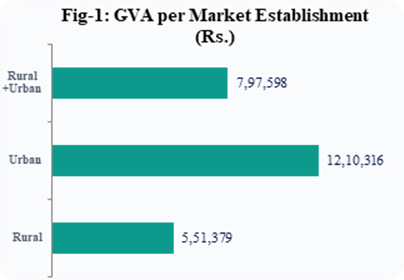
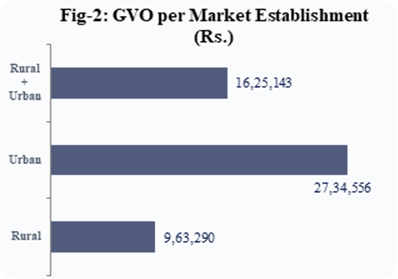
 

Title: GVA per Market Establishment (Rs.)

Financing Sources and Cost Composition of Household Construction Activities

On an average, about 97% of households reported their own income as one of the sources of fund to undertake construction activities, which accounted for approximately 77% of the total amount spent on construction.

Nearly 21% of households availed institutional (financial or non-financial) loan for financing their construction activities accounting for about 17% of the total construction expenditure. The proportion of households accessing institutional loans was higher in rural areas (23%) compared to urban areas (13%).

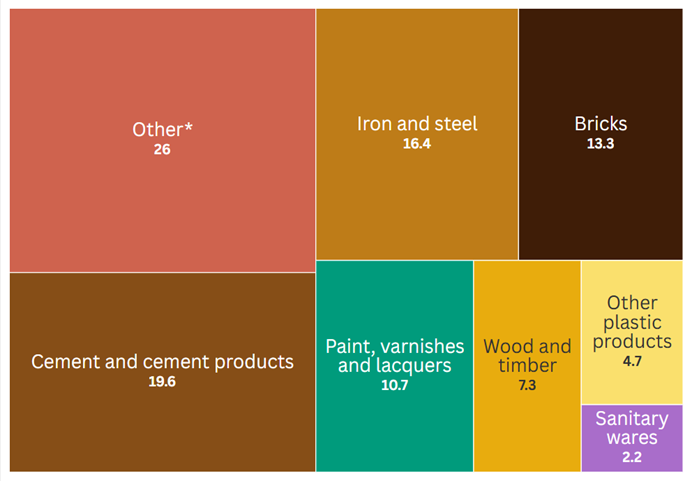
About three-fourths of household construction expenditure was on materials, with labour accounting for around 22 per cent. Within materials used for construction, bricks, cement, and iron and steel together comprised nearly 60 per cent of total expenditure.

Fig-3: Percentage Distribution of expenditure of materials: Household

*other includes petroleum, coal tar products, glass and glass products and other materials.

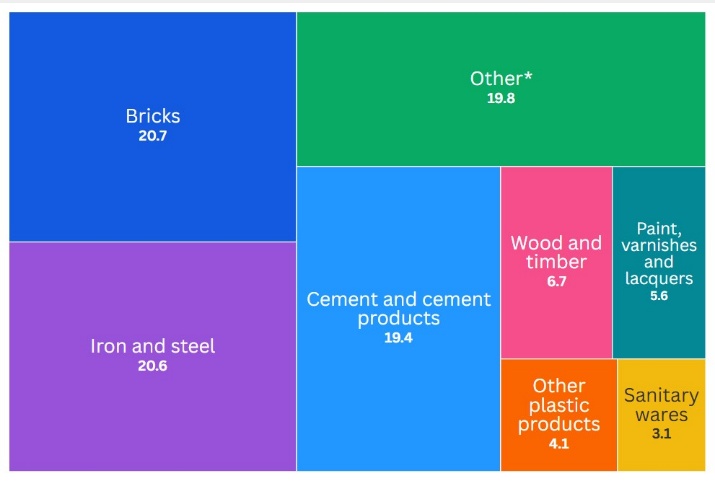
Fig-4: Percentage Distribution of expenditure of materials: Establishment

*other includes petroleum, coal tar products, glass and glass products and other materials.

Estimates of key indicators of the pilot study are given in Table 1 below. The detailed technical report also contains insights on major states and is available in the website of the Ministry (https://www.mospi.gov.in). Further, interactive tables and visualizations on other surveys conducted by NSO may be accessed on the Data Catalogue section of https://esankhyiki.mospi.gov.in/.

Table 1: Estimates of key indicators from Pilot Study on Construction Activities in Unincorporated Sector Establishments and Households

Indicator

Rural

Urban

Rural + Urban

(1)

(2)

(3)

(4)

Number of households undertaking own-account construction for own use

75,07,391

23,47,089

98,54,480

Number of establishments engaged in unincorporated construction activities

6,51,791

3,75,168

10,26,959

No. of Labourers engaged per household undertaking own account construction

4.2

4.4

4.3

No. of workers engaged per establishment in unincorporated construction activities

4.5

5.5

4.8

GVA per market establishment (Rs.)

5,51,379

12,10,316

7,97,598

Endnote: A brief about the coverage, sampling scheme, sample size and data collection mechanism in the Pilot Study on Construction Activities in Unincorporated Sector Establishments and Households:

A. Coverage of the pilot study:

A.1. Unincorporated Establishments: Market and non-market establishments engaged in construction activities

A.2. Households: own account construction undertaken by households for own use

A.3. Construction Activities: all activities under 2-digit NIC (2008) codes 41, 42 and 43 were considered in the definition of construction for the purpose of this pilot.

A.4.Expenditure on construction (for last 365 days or last financial year): Eligibility of establishments engaged in construction activities, as well as households undertaking own-account construction for own use, was determined based on whether their expenditure exceeded pre-specified thresholds, which varied by sector and type of sample entity. The expenditure threshold was set at ₹25,000 in rural areas and ₹50,000 in urban areas for establishments, and ₹10,000 in rural areas and ₹20,000 in urban areas for households. Any amount spent on construction below these cut-offs were not treated as construction work for this pilot study.

B. Sampling Scheme:

The survey has been conducted following a multi-stage stratified sampling scheme where first stage units (FSUs) were census villages in rural and UFS (Urban Frame Survey) blocks in urban areas.  The ultimate stage units (USU) were either establishments engaged in construction activities or households who has undertaken own account construction for own use.   

C. Sample Size:

In the pilot study, data were collected from a total of 19,154 households, 4,470 market establishments, and 717 non-market establishments pertaining to 11,981 surveyed FSUs (5,104 in rural and 6,877 in urban).

D. Data Collection Mechanism:

The pilot study has been conducted based on area frame and establishments/households have been listed in the selected FSUs of both rural and urban sector. Mostly, data were collected from the selected establishments/households through oral enquiry for the last 365 days. The data for the survey were collected in tablet using Computer Assisted Personal Interviewing (CAPI).

This pilot study has been carried out with Annual Survey of Unincorporated Sector Enterprises (ASUSE) 2025 in the same FSUs selected for the survey period July, 2025 – December, 2025. The listing schedule of ASUSE was suitably modified to accommodate the listing and selection of establishments and households undertaking construction under the coverage of the pilot study. The detailed establishment schedule was canvassed independently of ASUSE for collecting construction related information.

E. Detailed Technical Report of the Pilot Study:

For detailed understanding of the objectives, coverage, concepts, methodology and key findings from the pilot study one may refer to the Technical Report on Pilot Study on Construction Activities in Unincorporated Sector Establishments and Households published by NSO, MoSPI and available on the website of the ministry (https://www.mospi.gov.in).

Topics

Acts Income Tax