Loading...

Top
Help
×

By creating an account you can:

Logo TaxTMI
Call Us / Help / Feedback

Contact Us At :

E-mail: [email protected]

Call / WhatsApp at: +91 99117 96707

For more information, Check Contact Us

FAQs :

To know Frequently Asked Questions, Check FAQs

Most Asked Video Tutorials :

For more tutorials, Check Video Tutorials

Submit Feedback/Suggestion :

Email :
Please provide your email address so we can follow up on your feedback.
Category :
Description :
Min 15 characters 0/2000
Make Most of Text Search
  1. Checkout this video tutorial: How to search effectively on TaxTMI.
  2. Put words in double quotes for exact word search, eg: "income tax"
  3. Avoid noise words such as : 'and, of, the, a'
  4. Sort by Relevance to get the most relevant document.
  5. Press Enter to add multiple terms/multiple phrases, and then click on Search to Search.
  6. Text Search
  7. The system will try to fetch results that contains ALL your words.
  8. Once you add keywords, you'll see a new 'Search In' filter that makes your results even more precise.
  9. Text Search
Add to...
You have not created any category. Kindly create one to bookmark this item!
Create New Category
Hide
Title :
Description :
❮❮ Hide
Default View
Expand ❯❯
Close ✕
🔎 News - Adv. Search
TEXT SEARCH:

Press 'Enter' to add multiple search terms. Rules for Better Search

Search In:
Main Text + AI Text
  • Main Text
  • Main Text + AI Text
  • AI Text
Category: ?
Categorized by AI
---- All Categories ----
  • ---- All Categories ----
  • Income Tax
  • GST
  • Customs, DGFT & SEZ
  • FEMA & RBI
  • Corp. Laws, SEBI & IBC
  • PMLA, Black Money & ED
  • Budget
  • News and Press Release
  • PTI News
Month:
---- All Months ----
  • ---- All Months ----
  • January
  • February
  • March
  • April
  • May
  • June
  • July
  • August
  • September
  • October
  • November
  • December
Year:
---- All Years ----
  • ---- All Years ----
  • 2026
  • 2025
  • 2024
  • 2023
  • 2022
  • 2021
  • 2020
  • 2019
  • 2018
  • 2017
  • 2016
  • 2015
  • 2014
  • 2013
  • 2012
  • 2011
Sort By: ?
In Sort By 'Default', exact matches for text search are shown at the top, followed by the remaining results in their regular order.
Relevance Default Date
❯❯
Maximize Maximize Maximize
0 / 200
Expand Note
Add to Folder

No Folders have been created

+

Are you sure you want to delete "My most important" ?

NOTE:

News
Showing Results for :
Reset Filters
Results Found:
Show All Summaries Hide All Summaries
March 26, 2026
Show AI Summary
Tax Residency Certificate issued on request supports residence proof for DTAA benefits and section 159 purposes.
Form 43 is the Tax Residency Certificate issued by the Assessing Officer to certify residence in India for the purposes of section 159 and Double Taxation Avoidance Agreement benefits. It is not filed by the taxpayer; it is issued on request when Form 42 is submitted with the required documents. The certificate is generated through the ITBA and made available on the e-filing portal, and no specific statutory limit is stated on the number of certificates that may be issued in a year for distinct valid periods.
March 26, 2026
Show AI Summary
Tax residency certificate application streamlined through Form 42, with electronic filing, document upload, and issuance of Form 43.
Form 42 is the application for a tax residency certificate in India for the purposes of section 159 of the Income-tax Act, 2025 and treaty benefits under a Double Taxation Avoidance Agreement. It is filed electronically by a resident claiming Indian tax residency, with supporting identity, incorporation, and other documents, and may be verified through electronic verification code, Aadhaar OTP, net banking, bank or demat account mechanisms, or digital signature. Processing of the form results in issue of Form 43.
March 26, 2026
Show AI Summary
Tax Residency Certificate application Form 42 governs online filing, supporting documents, and DTAA benefit access.
Form 42 is the prescribed application for obtaining a Tax Residency Certificate in India for the purposes of claiming benefits under Double Taxation Avoidance Agreements. It is filed online through the e-filing portal, requires a valid PAN, and is not mandatory in every case. The form cannot be edited after submission, though withdrawal may be enabled, and supporting documents such as passport, incorporation records, and proof of stay in India may be required.
March 26, 2026
Show AI Summary
Petroleum and LPG supply security remains intact as the government rejects shortage claims and cites ample stock cover.
India's petroleum and LPG supply position is described as secure, with about 60 days of fuel stock cover and no rationing or shortage at retail outlets. The government says crude supplies for the next 60 days have been tied up from multiple international sources, refinery utilisation is above full capacity, and alternative imports have offset disruption linked to tensions around the Strait of Hormuz. It also states that 800,000 tonnes of LPG cargoes have been secured, about one month of LPG supply is arranged, and measures have been taken to prevent hoarding and keep deliveries steady.
March 26, 2026
Show AI Summary
DTAA self-declaration for non-residents enables treaty tax benefits through electronic filing and residency verification.
Form 41 is a self-declaration for non-resident taxpayers seeking Double Taxation Avoidance Agreement benefits on income from India. It is filed once in a tax year, requires a valid Tax Residency Certificate and Tax Identification Number, and is submitted electronically through the income-tax e-filing portal. Treaty benefits depend on valid filing, supported by the required documents and electronic verification.
March 26, 2026
Show AI Summary
DTAA compliance through Form 41 governs non-resident tax relief, online filing, and supporting residency documentation requirements.
Form 41 is a self-declaration under section 159(8) of the Income-tax Act, 2025 for non-resident taxpayers seeking DTAA benefits with India. It is mandatory, filed annually through the Income Tax e-filing portal, and requires a valid Tax Residency Certificate and tax identification number. The form cannot be edited after submission, no proof of tax payment is required, and the DTAA benefit is unavailable without a valid electronically filed form and supporting documents.
March 26, 2026
Show AI Summary
Tax deferral for foreign retirement accounts through Form 40 applies to resident Indians with irrevocable relief option.
Form 40 is the prescribed electronic form for a resident Indian to exercise the option under Section 159 of the Income Tax Act, 2025, read with Rule 74, to claim tax relief in respect of income accrued in a foreign retirement account maintained in a notified country. The option is intended to prevent double taxation by deferring taxation in India until withdrawal or redemption of the income in the foreign country. The option may be exercised only once, is irrevocable, and applies to all future years and all specified accounts.
March 26, 2026
Show AI Summary
Startup ecosystem support gains momentum through industry mentorship, innovation challenges, and market access for emerging technology startups.
Startup ecosystem support is being advanced through a Memorandum of Understanding between DPIIT and a digital entertainment company to promote product startups in digital entertainment, online gaming, esports, interactive media, and AI-driven technologies. The collaboration is intended to provide structured industry engagement, mentorship, knowledge exchange, curated opportunities, Proof-of-Concept development, market access, and integration into industry ecosystems wherever feasible. It also contemplates innovation challenges, hackathons, workshops, masterclasses, pilot collaborations, and outreach through Startup India programmes.
March 26, 2026
Show AI Summary
Corporate law and management programme launches as a two-year residential LL.M. with integrated regulatory and compliance training.
IICA and NLUJAA, Assam have jointly launched a two-year, full-time residential LL.M. programme in Corporate Law and Management. The course is designed to integrate legal education with managerial and compliance-oriented perspectives, and to strengthen professional competencies in corporate law, governance and regulatory frameworks through academic engagement linked to the Ministry of Corporate Affairs. The programme carries 54 credits across four semesters, with the first year at NLUJAA and the second year at the IICA Campus, IMT Manesar.
March 26, 2026
Show AI Summary
Tax relief for foreign retirement accounts requires valid Form 40 filing, online verification, and timely self-declaration.
Form 40 is the prescribed electronic form for a resident Indian to exercise the option for relief under section 158 of the Income-tax Act, 2025 in respect of income from a retirement benefit account maintained in a notified country. Valid filing within the prescribed due date is mandatory for an admissible claim, the option once exercised applies for the tax year and subsequent years, and the form cannot be edited after submission. The filing requires self-declaration, PAN, online verification, and supporting documents showing the foreign tax treatment and income computations.
March 26, 2026
Show AI Summary
Relief for additional salary and lump-sum receipts is streamlined through Form 39's electronic filing and self-computation system.
Form 39 is the prescribed electronic form for claiming relief under section 157(1) of the Income Tax Act, 2025 in cases involving additional salary or family pension received in arrears or in advance, gratuity, retrenchment compensation, commutation of pension, and similar lump-sum receipts. The form is filed on the e-filing portal, supports self-computation of admissible relief under Rule 73, and may be used for TDS purposes. The revised form includes basic details, receipt-specific computation columns, auto-populated summary fields, supporting document requirements, and electronic verification.
March 26, 2026
Show AI Summary
Relief under section 157(1) through Form 39 requires electronic filing, PAN, and complete particulars for qualifying lump-sum receipts.
Relief under section 157(1) is claimed through Form 39 by an employee receiving additional salary, family pension, gratuity, retrenchment compensation, commutation of pension, or similar lump-sum receipts that may increase the tax burden in the year of receipt. The form may also be furnished to the tax-deductor for TDS purposes. It must be filed electronically, cannot be filed offline, requires a valid PAN, contains separate sections for different receipts, and cannot be edited after verification and acknowledgment.
March 26, 2026
Show AI Summary
Foreign inward remittance certificate supports royalty deduction claims for resident authors and patentees through bank-certified Form 38 filing.
Form 38 is the prescribed certificate for foreign inward remittance and is filed with the return of income to support a royalty deduction claim under the Income-tax Act, 2025. It applies to an individual resident in India who is an author or patentee deriving specified royalty income. The form is certified by the bank manager of the receiving bank, requires supporting remittance and verification documents, and is submitted through details of payer, payee, payment, and electronic verification.
March 26, 2026
Show AI Summary
Foreign royalty deduction requires Form 38, bank certification, and proof that remittance reached India within the prescribed period.
Form 38 is the prescribed statement to be filed with the return of income for claiming deduction in respect of foreign inward remittance from royalty income. It applies to an individual resident in India who is an author or patentee, must be certified by the receiving bank manager, and serves to evidence that the foreign royalty was brought into India within the prescribed period. The deduction is subject to the stated monetary ceiling for the financial year.
March 26, 2026
Show AI Summary
Royalty income deduction for patentees hinges on Form 37, electronic filing, patent certification, and foreign remittance conditions.
Form 37 is the prescribed certificate for claiming deduction in respect of royalty income received by a resident individual patentee under the Income Tax Act, 2025. The form requires completion of patentee details, patent particulars, royalty agreement information, royalty received, foreign remittance data, and deduction claimed. Part A is verified by the patentee and Part B is certified by the Controller of Patents. It is filed electronically with supporting documents such as the royalty agreement, bank statement, foreign inward remittance certificate, and RBI approval where applicable.
March 26, 2026
Show AI Summary
Patent royalty deduction compliance requires valid Form 37, electronic filing, mandatory PAN, and certification by the Controller of Patents.
Form 37 is the prescribed certificate for a resident individual patentee claiming deduction for royalty income under section 152(5) of the Income-tax Act, 2025. The patentee must self-declare the royalty details in Part B, while the Controller of Patents must certify the patent registration and related particulars in Part C. The form must be filed electronically on the e-filing portal within the prescribed due date, cannot be filed offline, and once validly submitted it cannot be edited. PAN of the patentee is mandatory, no attachment is required, and royalty amounts received in foreign currency must be stated in Indian rupees.
March 26, 2026
Show AI Summary
Royalty income deduction claims require Form 36, with author declaration, publisher certification, and foreign remittance details.
Form 36 is the prescribed electronic certificate for claiming deduction under section 151(5) of the Income-tax Act, 2025 in respect of royalty income or similar consideration received by an author for publication of a book. It requires disclosure of the author, the book, the payer, royalty receipts, foreign remittance details, and the deduction claimed, along with taxpayer declaration and publisher certification. Supporting documents include the author-publisher agreement, royalty statements, bank records, and ISBN or publication proof.
March 26, 2026
Show AI Summary
Royalty income deduction certificate requires timely electronic filing by authors, with mandatory PAN, self-declaration, and publisher certification.
Form 36 is the prescribed certificate for claiming deduction under section 151(5) of the Income-tax Act, 2025 by authors of scientific, literary or artistic books who receive royalty income, copyright fees, lump-sum consideration, or similar income. The form must be filed electronically by the author, with self-declaration and publisher certification, on or before the applicable due date, and valid filing is a mandatory condition for an admissible deduction claim. The form cannot be edited after submission, offline filing is not permitted, and the author's PAN and deduction amount claimed are mandatory fields.
March 26, 2026
Show AI Summary
Deduction claims for offshore banking and IFSC units require accountant-certified Form 35 with income, expense and permission details.
Form 35 is the accountant's report to be furnished with the return of income for assessees claiming deduction on income from Offshore Banking Units in Special Economic Zones or units of an International Financial Services Centre. It applies to scheduled or foreign banks having such a unit, and requires verification by a chartered accountant. The form covers basic assessee details, unit particulars, permission documents, prior deduction claims, and income, expense and deduction figures, with e-verification through the chartered accountant's digital signature certificate.
March 26, 2026
Show AI Summary
Deduction claims for offshore banking units require Form 35, accountant verification, and filing with the return of income.
Form 35 is the accountant's report to be filed with the return of income by assessees claiming deduction on income from Offshore Banking Units in Special Economic Zones or units of an International Financial Services Centre. It must be verified by a chartered accountant and filed by the return due date. The form captures unit particulars, permissions, income, expenses, net income and previous claims, and requires e-verification with the chartered accountant's digital signature certificate.

News

Back

All News

Showing Results for :
Reset Filters
No Records Found

News

Back

All News

Showing Results for : Reset Filters
News and Press Release

MoSPI Breaks New Ground: First-Ever Deep Dive into Unincorporated Construction Sector in Decades

April 11, 2026

Contents
Summary
Note

Note

-

Bookmark

Print

Print

Nearly 1 crore households built their own homes or undertook construction for self-use

10 Lakh+ Small Builders Power Economy: Unincorporated Construction Sector Comes into Focus

Snapshot:

  • MoSPI releases the technical report of pilot study on construction - marking NSO’s first such effort in decades to estimate key economic indicators of construction activities in the unincorporated sector and own-account household construction in a reference period of last 365 days.
  • During the reference period, an estimated 98.54 lakh households undertook own-account construction for their own use.
  • 10.27 lakh construction agencies (unincorporated establishments) were estimated to be engaged in this sector.
  • Approximately 77 per cent of these agencies engaged at least one hired worker on a fairly regular basis.
  • Estimated average value of fixed assets owned by such construction establishments was ₹5.21 lakh.
  • Nearly 23% of rural households undertaking own-account construction for own-use availed institutional funding reflecting increasing access to formal credit in rural areas.

The Ministry of Statistics and Programme Implementation (MoSPI) has released a technical report presenting the key findings from a Pilot study conducted on Construction Activities in Unincorporated Sector Establishments and Households. This study marks the first comprehensive attempt in decades by the National Statistics Office (NSO) to estimate key economic indicators for construction activities undertaken by unincorporated construction agencies (establishments engaged in construction activity), as well as own-account construction carried out by households for their own use. The study underscores MoSPI’s sustained efforts to bridge critical data gaps in sectors where reliable information has been limited. Data from the pilot study also served as an important input for the revised series of the national accounts statistics brought out by MoSPI. A brief overview of the pilot study in terms of coverage, sampling strategy, data collection mechanism, etc., is provided in the Endnote.

The construction sector plays a crucial role in Indian economy, serving both as a driver of growth and an indicator of economic progress. As a key engine of development, it contributes significantly to output, employment, and capital formation, while maintaining strong backward and forward linkages with various other sub-sectors of the economy. While the incorporated segment of the construction sector is to be covered under the recently launched Annual Survey of Incorporated Services Sector Enterprises (ASISSE), data remains limited for unincorporated construction enterprises and households undertaking own-account construction for own use in India. Recognizing the importance of generating robust and reliable estimates of key economic parameters in the construction sector, this pilot study was undertaken alongside Annual Survey of Unincorporated Sector Enterprises (ASUSE) 2025 in the same First Stage Units (FSUs) during the survey period from July to December 2025.

The pilot study, apart from capturing expenses and receipts, was designed to collect key information on employment and a broader set of economic parameters for construction establishments (both market and non-market), including fixed assets, outstanding loans, and various components of expenditure. For households, it focuses on capturing expenditure on construction activities, details of labour engagement, and sources of finance.

The findings of this pilot study served as a crucial input for the National Accounts Division (NAD) in updating and refining the rates and ratios used for estimating several economic indicators in the construction sector under the new series of national accounts.

Estimated number of construction activities undertaken:

It was estimated that 98.54 lakh households have undertaken construction during last 365 days (the reference period of the estimates)[1]. It was also estimated that 10.27 lakh unincorporated construction agencies were engaged in this sector which included both market and non-market establishment.

Average number of worker engaged in the construction sector:

On an average, an unincorporated builder establishment engaged in construction activities employed about five workers during the reference period. Further, approximately 77 per cent of such establishments reported engaging at least one hired worker on a fairly regular basis.

A household undertaking own-account construction for its own use during the reference period engaged around four labourers on an average.

Fixed Assets and Loan:

Fixed assets owned per unincorporated establishment engaged in construction activity has been estimated to be ₹5.21 lakh. The financial access, as reflected by the outstanding loan per establishment in the sector, was estimated to be little more than ₹1.40 lakh.

Value Addition and productivity:

The GVA per market establishment[2] for the unincorporated construction sector was estimated to be about Rs. 7.98 lakh and the corresponding output per establishment was Rs. 16.25 lakh.

The NVA and output per non-market establishment was observed to be Rs. 2.77 lakh and Rs. 5.59 lakh respectively.
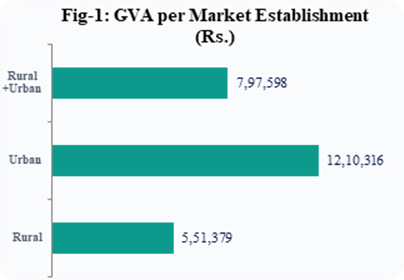
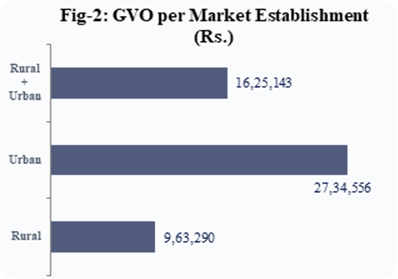
 

Title: GVA per Market Establishment (Rs.)

Financing Sources and Cost Composition of Household Construction Activities

On an average, about 97% of households reported their own income as one of the sources of fund to undertake construction activities, which accounted for approximately 77% of the total amount spent on construction.

Nearly 21% of households availed institutional (financial or non-financial) loan for financing their construction activities accounting for about 17% of the total construction expenditure. The proportion of households accessing institutional loans was higher in rural areas (23%) compared to urban areas (13%).

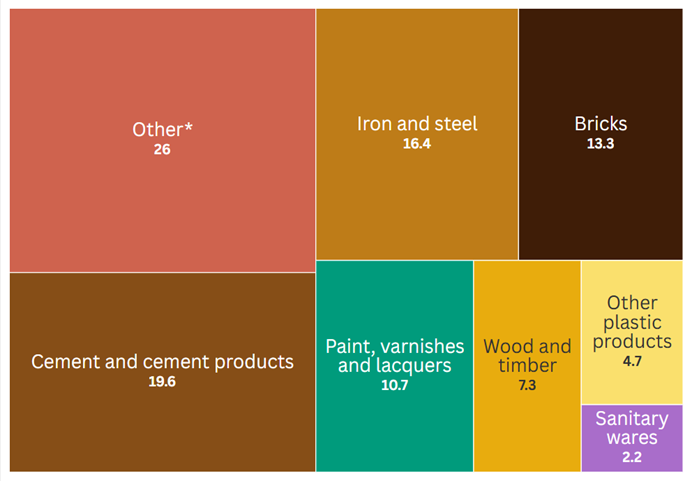
About three-fourths of household construction expenditure was on materials, with labour accounting for around 22 per cent. Within materials used for construction, bricks, cement, and iron and steel together comprised nearly 60 per cent of total expenditure.

Fig-3: Percentage Distribution of expenditure of materials: Household

*other includes petroleum, coal tar products, glass and glass products and other materials.

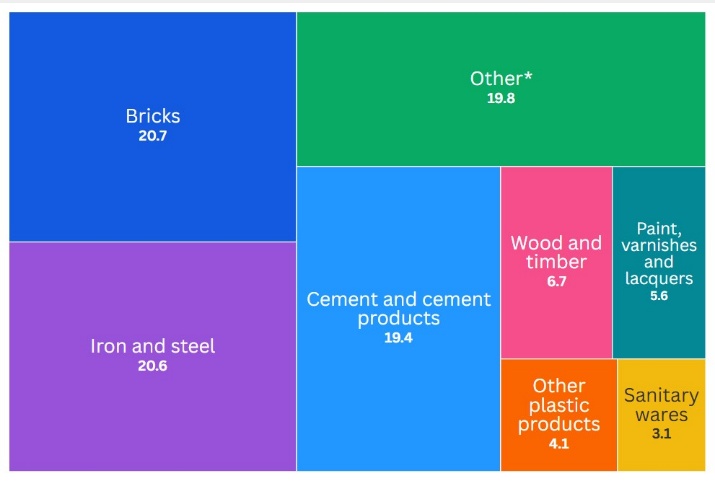
Fig-4: Percentage Distribution of expenditure of materials: Establishment

*other includes petroleum, coal tar products, glass and glass products and other materials.

Estimates of key indicators of the pilot study are given in Table 1 below. The detailed technical report also contains insights on major states and is available in the website of the Ministry (https://www.mospi.gov.in). Further, interactive tables and visualizations on other surveys conducted by NSO may be accessed on the Data Catalogue section of https://esankhyiki.mospi.gov.in/.

Table 1: Estimates of key indicators from Pilot Study on Construction Activities in Unincorporated Sector Establishments and Households

Indicator

Rural

Urban

Rural + Urban

(1)

(2)

(3)

(4)

Number of households undertaking own-account construction for own use

75,07,391

23,47,089

98,54,480

Number of establishments engaged in unincorporated construction activities

6,51,791

3,75,168

10,26,959

No. of Labourers engaged per household undertaking own account construction

4.2

4.4

4.3

No. of workers engaged per establishment in unincorporated construction activities

4.5

5.5

4.8

GVA per market establishment (Rs.)

5,51,379

12,10,316

7,97,598

Endnote: A brief about the coverage, sampling scheme, sample size and data collection mechanism in the Pilot Study on Construction Activities in Unincorporated Sector Establishments and Households:

A. Coverage of the pilot study:

A.1. Unincorporated Establishments: Market and non-market establishments engaged in construction activities

A.2. Households: own account construction undertaken by households for own use

A.3. Construction Activities: all activities under 2-digit NIC (2008) codes 41, 42 and 43 were considered in the definition of construction for the purpose of this pilot.

A.4.Expenditure on construction (for last 365 days or last financial year): Eligibility of establishments engaged in construction activities, as well as households undertaking own-account construction for own use, was determined based on whether their expenditure exceeded pre-specified thresholds, which varied by sector and type of sample entity. The expenditure threshold was set at ₹25,000 in rural areas and ₹50,000 in urban areas for establishments, and ₹10,000 in rural areas and ₹20,000 in urban areas for households. Any amount spent on construction below these cut-offs were not treated as construction work for this pilot study.

B. Sampling Scheme:

The survey has been conducted following a multi-stage stratified sampling scheme where first stage units (FSUs) were census villages in rural and UFS (Urban Frame Survey) blocks in urban areas.  The ultimate stage units (USU) were either establishments engaged in construction activities or households who has undertaken own account construction for own use.   

C. Sample Size:

In the pilot study, data were collected from a total of 19,154 households, 4,470 market establishments, and 717 non-market establishments pertaining to 11,981 surveyed FSUs (5,104 in rural and 6,877 in urban).

D. Data Collection Mechanism:

The pilot study has been conducted based on area frame and establishments/households have been listed in the selected FSUs of both rural and urban sector. Mostly, data were collected from the selected establishments/households through oral enquiry for the last 365 days. The data for the survey were collected in tablet using Computer Assisted Personal Interviewing (CAPI).

This pilot study has been carried out with Annual Survey of Unincorporated Sector Enterprises (ASUSE) 2025 in the same FSUs selected for the survey period July, 2025 – December, 2025. The listing schedule of ASUSE was suitably modified to accommodate the listing and selection of establishments and households undertaking construction under the coverage of the pilot study. The detailed establishment schedule was canvassed independently of ASUSE for collecting construction related information.

E. Detailed Technical Report of the Pilot Study:

For detailed understanding of the objectives, coverage, concepts, methodology and key findings from the pilot study one may refer to the Technical Report on Pilot Study on Construction Activities in Unincorporated Sector Establishments and Households published by NSO, MoSPI and available on the website of the ministry (https://www.mospi.gov.in).

Topics

Acts Income Tax