Loading...

Top
Help
×

By creating an account you can:

Logo TaxTMI
Call Us / Help / Feedback

Contact Us At :

E-mail: [email protected]

Call / WhatsApp at: +91 99117 96707

For more information, Check Contact Us

FAQs :

To know Frequently Asked Questions, Check FAQs

Most Asked Video Tutorials :

For more tutorials, Check Video Tutorials

Submit Feedback/Suggestion :

Email :
Please provide your email address so we can follow up on your feedback.
Category :
Description :
Min 15 characters 0/2000
Make Most of Text Search
  1. Checkout this video tutorial: How to search effectively on TaxTMI.
  2. Put words in double quotes for exact word search, eg: "income tax"
  3. Avoid noise words such as : 'and, of, the, a'
  4. Sort by Relevance to get the most relevant document.
  5. Press Enter to add multiple terms/multiple phrases, and then click on Search to Search.
  6. Text Search
  7. The system will try to fetch results that contains ALL your words.
  8. Once you add keywords, you'll see a new 'Search In' filter that makes your results even more precise.
  9. Text Search
Add to...
You have not created any category. Kindly create one to bookmark this item!
Create New Category
Hide
Title :
Description :
❮❮ Hide
Default View
Expand ❯❯
Close ✕
🔎 News - Adv. Search
TEXT SEARCH:

Press 'Enter' to add multiple search terms. Rules for Better Search

Search In:
Main Text + AI Text
  • Main Text
  • Main Text + AI Text
  • AI Text
Category: ?
Categorized by AI
---- All Categories ----
  • ---- All Categories ----
  • Income Tax
  • GST
  • Customs, DGFT & SEZ
  • FEMA & RBI
  • Corp. Laws, SEBI & IBC
  • PMLA, Black Money & ED
  • Budget
  • News and Press Release
  • PTI News
Month:
---- All Months ----
  • ---- All Months ----
  • January
  • February
  • March
  • April
  • May
  • June
  • July
  • August
  • September
  • October
  • November
  • December
Year:
---- All Years ----
  • ---- All Years ----
  • 2026
  • 2025
  • 2024
  • 2023
  • 2022
  • 2021
  • 2020
  • 2019
  • 2018
  • 2017
  • 2016
  • 2015
  • 2014
  • 2013
  • 2012
  • 2011
Sort By: ?
In Sort By 'Default', exact matches for text search are shown at the top, followed by the remaining results in their regular order.
Relevance Default Date
❯❯
Maximize Maximize Maximize
0 / 200
Expand Note
Add to Folder

No Folders have been created

+

Are you sure you want to delete "My most important" ?

NOTE:

News
Showing Results for :
Reset Filters
Results Found:
Show All Summaries Hide All Summaries
March 28, 2026
Show AI Summary
Pass-through taxation for venture capital income requires annual reporting through Form 74 with investor-wise income details.
Form 74 is the annual statement required from a Venture Capital Company or Venture Capital Fund registered with SEBI when income is paid or credited to investors from investments in Venture Capital Undertakings. The form records fund details, compliance declarations, income classification, proportions of income heads, and investor-wise particulars. It is filed electronically under digital signature by 15 June of the following financial year, after verification by a qualified accountant, and is supported by the SEBI registration certificate, fund deed where applicable, audited accounts, and certified income distribution records.
March 28, 2026
Show AI Summary
Government dated securities issuance calendar sets auctions, retail bidding reservation, greenshoe flexibility, and monthly switch buybacks.
Indicative issuance calendar for Government of India dated securities, including Sovereign Green Bonds, is released for the first half of the fiscal year 2026-27. The auctions include a non-competitive bidding facility reserving five per cent of the notified amount for specified retail investors, and the Government of India may modify the calendar, issue different types of instruments, exercise the greenshoe option, and conduct switch or buyback auctions subject to the applicable general notification.
March 28, 2026
Show AI Summary
Government borrowing plan finalised with dated securities, green bonds, treasury bills and liquidity support arrangements.
Government borrowing for the first half of FY 2026-27 has been finalised in consultation with the Reserve Bank of India, through dated securities, sovereign green bonds and treasury bills. The plan distributes borrowing across weekly auctions and multiple maturities, provides for switching and buyback of securities to smoothen the redemption profile, reserves a greenshoe option, and sets the Ways and Mean Advances limit to address temporary mismatches in government accounts.
March 28, 2026
Show AI Summary
Treasury bill issuance calendar fixes quarterly auction schedule and preserves flexibility to adjust timing and amounts as needed.
Treasury bill issuance calendar for the quarter ending June 2026 fixes the proposed auction and issue schedule for 91-day, 182-day and 364-day Treasury Bills through weekly auctions in April, May and June 2026. The Government of India, in consultation with the Reserve Bank of India, retains flexibility to modify the indicated auction amounts and timing depending on requirements, evolving market conditions and other relevant factors, after due notice to the market. The calendar is subject to change where circumstances so warrant, and auctions remain subject to the governing notification and its amendments.
March 28, 2026
Show AI Summary
Insurance for All by 2047 drives Oriental Insurance growth, with premium milestone and expanded risk protection offerings.
Oriental Insurance Company Limited has crossed a gross premium milestone for FY 2025-2026, reflecting growing trust in public sector insurance institutions and alignment with the Government's objective of expanding financial inclusion under the vision of Insurance for All by 2047. Growth is attributed to strong contributions from Group Personal Accident, Health, Fire and Motor insurance portfolios, together with innovative offerings and planned new products addressing evolving risk needs.
March 28, 2026
Show AI Summary
Investor facilitation camps streamline unclaimed dividends, unclaimed shares, and IEPF claim redressal through single-window support.
Investor facilitation camps under the Investor Education and Protection Fund framework provide single-window support for claim redressal, unclaimed dividends, unclaimed shares and pending IEPFA claims. The Bhubaneswar "Niveshak Shivir" offered on-the-spot KYC and nomination updates, direct interaction with company representatives and RTAs, and assistance through a Search Facility Help Desk for identifying unclaimed investments transferred to the IEPF. Participants were guided on locating potential claims and proceeding through Form IEPF-5.
March 28, 2026
Show AI Summary
Startup ecosystem collaboration expands support for fuel-tech innovation, market access, mentorship and technology-driven solutions.
Structured support for startups in fuel-tech, manufacturing, deep-tech and allied sectors is to be advanced through a memorandum of understanding. The collaboration covers innovation challenges and hackathons, investor connect programmes, skill development initiatives, pilot opportunities and market access for early-stage innovators. It also seeks to support startups from ideation through prototyping, use the Startup India platform for wider outreach, and strengthen industry-startup linkages for technology-driven solutions and indigenous innovation.
March 28, 2026
Show AI Summary
Pass-through taxation for venture capital income through Form 74, with online filing and investor-level reporting requirements.
Form 74 is a statement to be furnished by a Venture Capital Fund or Venture Capital Company in relation to income paid or credited to investors for section 222. It is filed online by the specified fund or company by 15 June of the following financial year, with supporting registration, deed, audited accounts, and certified income distribution records kept in possession. The form supports pass-through taxation, so the income is reported in the hands of investors according to its character.
March 28, 2026
Show AI Summary
Decriminalisation and proportionate regulation reshape compliance through civil penalties, graded enforcement, and faster adjudication.
The Jan Vishwas (Amendment of Provisions) Bill, 2026 proposes amendment of 784 provisions across 79 Central Acts and decriminalisation of 717 provisions to promote Ease of Doing Business, together with 67 amendments to facilitate Ease of Living. It shifts minor, technical, or procedural defaults from criminal penalties to civil and administrative enforcement, including warnings, monetary penalties, graded enforcement, and rationalisation of fines in proportion to the offence. The Bill also provides for Adjudicating Officers and Appellate Authorities to support time-bound enforcement and natural justice.
March 28, 2026
Show AI Summary
Consensus-based WTO reform: India urges inclusive, member-driven negotiations, development concerns, and safeguards against multilateral fragmentation.
Consensus-based decision-making was emphasised as central to the WTO's legitimacy, with India calling for reform discussions to address structural asymmetries inherited from the Uruguay Round and to preserve the sovereign right of Members not to accept rules they do not agree to. India supported a careful stock-take of the current impasse, with reform deliberations conducted in a transparent, inclusive and Member-driven manner, and warned that fragmentation within the institutional framework would weaken the multilateral trading system.
March 28, 2026
Show AI Summary
Duty Deferment Scheme for manufacturer importers eases liquidity, speeds clearance, and supports compliant monthly duty payment.
Duty Deferment Scheme for Eligible Manufacturer Importers permits deferred payment of import duties for qualifying manufacturer importers, with duties payable monthly after goods are cleared. The scheme is framed as a trade facilitation measure to improve liquidity, support faster cargo clearance, reduce dwell time, strengthen import planning and inventory management, and enhance supply chain efficiency and payment discipline. Eligibility depends on a valid importer-exporter code, prescribed EXIM filing history, GST compliance, financial solvency, and a clean compliance record. Applications are submitted online through the AEO portal without physical interface.
March 28, 2026
Show AI Summary
Pass-through income reporting through Form 73 enables securitisation trust investors to classify income correctly for tax returns.
Form 73 is the investor-wise statement furnished by a Securitisation Trust under the pass-through income framework. It is auto-generated from Form 72 and records income paid, credited or deemed to be credited during the tax year so that investors can report the income under the correct heads in their return. The form is not separately filed with the department; it is downloaded, verified and furnished to each investor by the trust. It includes trust particulars, investor details, head-wise income breakup, verification by the authorised person, and the date of payment or credit.
March 28, 2026
Show AI Summary
Securitisation trust income reporting through Form 73 enables investor disclosure, income classification, and pass-through compliance.
Form 73 is the prescribed statement of income distributed by a securitisation trust to each investor under section 221. It is not filed separately, but generated as a child form from the parent Form 72 by the person responsible to pay on behalf of the securitisation trust, and then furnished to each investor. The form is auto-generated through the e-filing portal from the data filed in Form 72, with no separate documents required and no offline filing facility.
March 28, 2026
Show AI Summary
Pass-through taxation for securitisation trusts drives Form 72 reporting, investor statements, and income classification compliance.
Form 72 is the annual consolidated statement required from every securitisation trust for reporting income paid or credited to investors under section 221 of the Income Tax Act, 2025, and is filed electronically under rule 145. The form captures trust particulars, registration details, total income by head, investor-wise income distribution, authorised-person verification, and accountant certification. It is due by 15 June of the financial year following the tax year, and supports the pass-through taxation mechanism by enabling Form 73 statements to be auto-generated for investors after filing.
March 28, 2026
Show AI Summary
Foreign tax credit compliance through Form No. 45 requires electronic intimation after dispute settlement and supporting undertakings.
Form No. 45 is a new electronic intimation form for a resident assessee to report settlement of a dispute relating to foreign tax for which credit was not earlier claimed, where foreign tax credit is now intended to be claimed. Filing is mandatory in the specified circumstances, must be made through the Income-tax e-filing portal, and is due within six months from the end of the month in which the dispute is finally settled after Form No. 44 has been filed. The form requires supporting evidence, undertakings, and accountant verification in cases where Form No. 44 required such verification.
March 28, 2026
Show AI Summary
Foreign tax credit intimation form streamlines settlement-based claims for previously unclaimed credit under the filing rules.
Form No. 45 provides a structured electronic intimation for settlement of dispute regarding foreign tax for which credit was not claimed. It applies to a resident assessee with foreign income who seeks foreign tax credit after the dispute is finally settled, where Form No. 44 had already been filed for the relevant tax year. The form must be filed within six months from the end of the month in which the dispute is finally settled, with supporting documents, and must be verified by an accountant where Form No. 44 required accountant verification.
March 28, 2026
Show AI Summary
Securitization trust income reporting through Form 72, with online filing, prescribed records, and pass-through taxation compliance.
Form 72 is the statement of income paid or credited by a securitization trust to its investors. It must be furnished to the Income-tax Department online by the person responsible for paying or crediting income on behalf of the trust, by 15 June of the financial year following the tax year in which the income was paid or credited. Filing requires the trust's books, audited financial statements, income details from securitised assets, investor particulars, distribution records, and the applicable registration certificate.
March 28, 2026
Show AI Summary
Audit report compliance for offshore banking unit investment divisions governs exemption and concessional taxation claims under income tax rules.
Form 71 is the mandatory audit report for a registered investment division of an offshore banking unit where a specified fund seeks exemption under section 11 read with Schedule VI or concessional taxation under section 210(3) of the ITA 2025. It certifies fulfilment of the prescribed eligibility conditions, including separate books, audit by an accountant, relevant documentation, and filing by the specified date. The form is filed electronically with supporting records and, when validly furnished, supports the claim to exemption or concessional rates.
March 28, 2026
Show AI Summary
Tax exemption compliance for specified funds depends on timely electronic filing of Form 71 and accountant verification.
Form 71 is the prescribed audit report for verification by an accountant in respect of the computation of exempt income of a specified fund attributable to the investment division of an offshore banking unit. It is linked to the claim of exemption or taxation at concessional rates for eligible income, and its filing is one of the conditions for admissibility of that claim. The form must be filed electronically on the income-tax e-filing portal and verified by the accountant either through digital signature or electronic verification code. It cannot be filed offline, and once validly submitted and acknowledged it cannot be edited.
March 28, 2026
Show AI Summary
Specified fund compliance for Form 70 governs exempt income reporting and concessional taxation claims for offshore banking units.
Form 70 is the prescribed e-form for a specified fund to furnish the annual statement of exempt income attributable to the investment division of an offshore banking unit under section 11 read with Schedule VI, together with income taxable at concessional rates under section 210(3) of the ITA 2025. Filing is mandatory for a specified fund seeking exemption or concessional taxation and must be made electronically on the e-filing portal by the due date, with supporting documents, verification by the Trustee or Principal Officer, and the audit report in Form 71 certifying separate accounts and audit of the eligible investment division.

News

Back

All News

Showing Results for :
Reset Filters
No Records Found

News

Back

All News

Showing Results for : Reset Filters
News and Press Release

MoSPI Breaks New Ground: First-Ever Deep Dive into Unincorporated Construction Sector in Decades

April 11, 2026

Contents
Summary
Note

Note

-

Bookmark

Print

Print

Nearly 1 crore households built their own homes or undertook construction for self-use

10 Lakh+ Small Builders Power Economy: Unincorporated Construction Sector Comes into Focus

Snapshot:

  • MoSPI releases the technical report of pilot study on construction - marking NSO’s first such effort in decades to estimate key economic indicators of construction activities in the unincorporated sector and own-account household construction in a reference period of last 365 days.
  • During the reference period, an estimated 98.54 lakh households undertook own-account construction for their own use.
  • 10.27 lakh construction agencies (unincorporated establishments) were estimated to be engaged in this sector.
  • Approximately 77 per cent of these agencies engaged at least one hired worker on a fairly regular basis.
  • Estimated average value of fixed assets owned by such construction establishments was ₹5.21 lakh.
  • Nearly 23% of rural households undertaking own-account construction for own-use availed institutional funding reflecting increasing access to formal credit in rural areas.

The Ministry of Statistics and Programme Implementation (MoSPI) has released a technical report presenting the key findings from a Pilot study conducted on Construction Activities in Unincorporated Sector Establishments and Households. This study marks the first comprehensive attempt in decades by the National Statistics Office (NSO) to estimate key economic indicators for construction activities undertaken by unincorporated construction agencies (establishments engaged in construction activity), as well as own-account construction carried out by households for their own use. The study underscores MoSPI’s sustained efforts to bridge critical data gaps in sectors where reliable information has been limited. Data from the pilot study also served as an important input for the revised series of the national accounts statistics brought out by MoSPI. A brief overview of the pilot study in terms of coverage, sampling strategy, data collection mechanism, etc., is provided in the Endnote.

The construction sector plays a crucial role in Indian economy, serving both as a driver of growth and an indicator of economic progress. As a key engine of development, it contributes significantly to output, employment, and capital formation, while maintaining strong backward and forward linkages with various other sub-sectors of the economy. While the incorporated segment of the construction sector is to be covered under the recently launched Annual Survey of Incorporated Services Sector Enterprises (ASISSE), data remains limited for unincorporated construction enterprises and households undertaking own-account construction for own use in India. Recognizing the importance of generating robust and reliable estimates of key economic parameters in the construction sector, this pilot study was undertaken alongside Annual Survey of Unincorporated Sector Enterprises (ASUSE) 2025 in the same First Stage Units (FSUs) during the survey period from July to December 2025.

The pilot study, apart from capturing expenses and receipts, was designed to collect key information on employment and a broader set of economic parameters for construction establishments (both market and non-market), including fixed assets, outstanding loans, and various components of expenditure. For households, it focuses on capturing expenditure on construction activities, details of labour engagement, and sources of finance.

The findings of this pilot study served as a crucial input for the National Accounts Division (NAD) in updating and refining the rates and ratios used for estimating several economic indicators in the construction sector under the new series of national accounts.

Estimated number of construction activities undertaken:

It was estimated that 98.54 lakh households have undertaken construction during last 365 days (the reference period of the estimates)[1]. It was also estimated that 10.27 lakh unincorporated construction agencies were engaged in this sector which included both market and non-market establishment.

Average number of worker engaged in the construction sector:

On an average, an unincorporated builder establishment engaged in construction activities employed about five workers during the reference period. Further, approximately 77 per cent of such establishments reported engaging at least one hired worker on a fairly regular basis.

A household undertaking own-account construction for its own use during the reference period engaged around four labourers on an average.

Fixed Assets and Loan:

Fixed assets owned per unincorporated establishment engaged in construction activity has been estimated to be ₹5.21 lakh. The financial access, as reflected by the outstanding loan per establishment in the sector, was estimated to be little more than ₹1.40 lakh.

Value Addition and productivity:

The GVA per market establishment[2] for the unincorporated construction sector was estimated to be about Rs. 7.98 lakh and the corresponding output per establishment was Rs. 16.25 lakh.

The NVA and output per non-market establishment was observed to be Rs. 2.77 lakh and Rs. 5.59 lakh respectively.
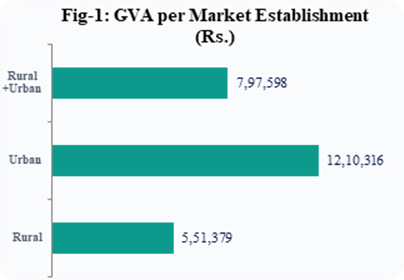
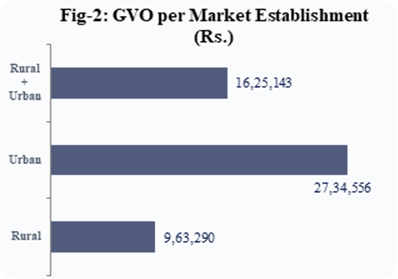
 

Title: GVA per Market Establishment (Rs.)

Financing Sources and Cost Composition of Household Construction Activities

On an average, about 97% of households reported their own income as one of the sources of fund to undertake construction activities, which accounted for approximately 77% of the total amount spent on construction.

Nearly 21% of households availed institutional (financial or non-financial) loan for financing their construction activities accounting for about 17% of the total construction expenditure. The proportion of households accessing institutional loans was higher in rural areas (23%) compared to urban areas (13%).

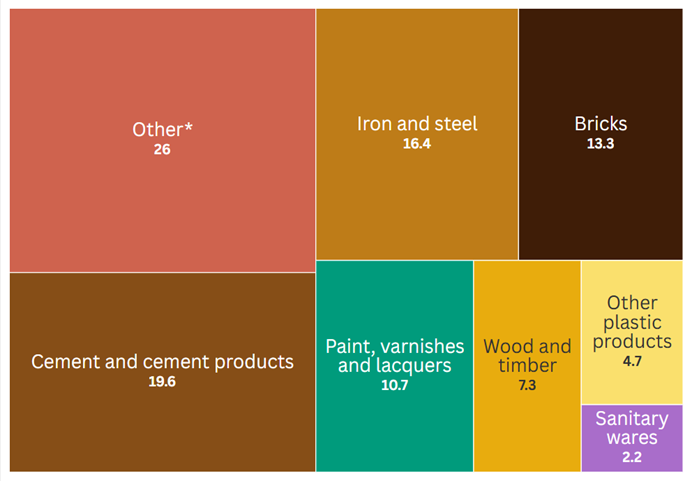
About three-fourths of household construction expenditure was on materials, with labour accounting for around 22 per cent. Within materials used for construction, bricks, cement, and iron and steel together comprised nearly 60 per cent of total expenditure.

Fig-3: Percentage Distribution of expenditure of materials: Household

*other includes petroleum, coal tar products, glass and glass products and other materials.

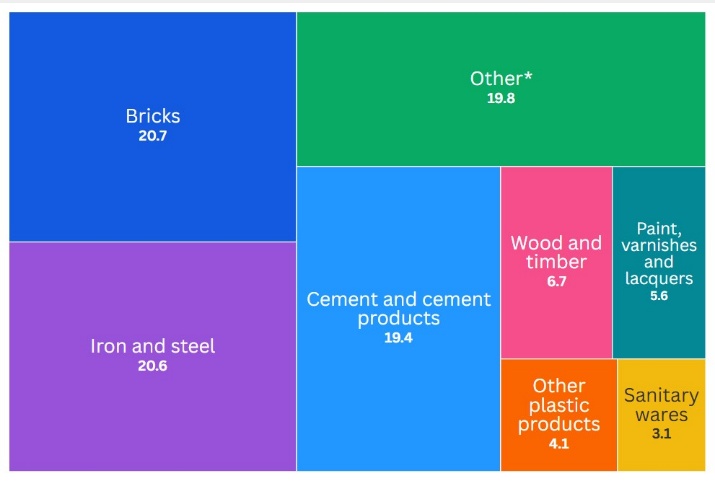
Fig-4: Percentage Distribution of expenditure of materials: Establishment

*other includes petroleum, coal tar products, glass and glass products and other materials.

Estimates of key indicators of the pilot study are given in Table 1 below. The detailed technical report also contains insights on major states and is available in the website of the Ministry (https://www.mospi.gov.in). Further, interactive tables and visualizations on other surveys conducted by NSO may be accessed on the Data Catalogue section of https://esankhyiki.mospi.gov.in/.

Table 1: Estimates of key indicators from Pilot Study on Construction Activities in Unincorporated Sector Establishments and Households

Indicator

Rural

Urban

Rural + Urban

(1)

(2)

(3)

(4)

Number of households undertaking own-account construction for own use

75,07,391

23,47,089

98,54,480

Number of establishments engaged in unincorporated construction activities

6,51,791

3,75,168

10,26,959

No. of Labourers engaged per household undertaking own account construction

4.2

4.4

4.3

No. of workers engaged per establishment in unincorporated construction activities

4.5

5.5

4.8

GVA per market establishment (Rs.)

5,51,379

12,10,316

7,97,598

Endnote: A brief about the coverage, sampling scheme, sample size and data collection mechanism in the Pilot Study on Construction Activities in Unincorporated Sector Establishments and Households:

A. Coverage of the pilot study:

A.1. Unincorporated Establishments: Market and non-market establishments engaged in construction activities

A.2. Households: own account construction undertaken by households for own use

A.3. Construction Activities: all activities under 2-digit NIC (2008) codes 41, 42 and 43 were considered in the definition of construction for the purpose of this pilot.

A.4.Expenditure on construction (for last 365 days or last financial year): Eligibility of establishments engaged in construction activities, as well as households undertaking own-account construction for own use, was determined based on whether their expenditure exceeded pre-specified thresholds, which varied by sector and type of sample entity. The expenditure threshold was set at ₹25,000 in rural areas and ₹50,000 in urban areas for establishments, and ₹10,000 in rural areas and ₹20,000 in urban areas for households. Any amount spent on construction below these cut-offs were not treated as construction work for this pilot study.

B. Sampling Scheme:

The survey has been conducted following a multi-stage stratified sampling scheme where first stage units (FSUs) were census villages in rural and UFS (Urban Frame Survey) blocks in urban areas.  The ultimate stage units (USU) were either establishments engaged in construction activities or households who has undertaken own account construction for own use.   

C. Sample Size:

In the pilot study, data were collected from a total of 19,154 households, 4,470 market establishments, and 717 non-market establishments pertaining to 11,981 surveyed FSUs (5,104 in rural and 6,877 in urban).

D. Data Collection Mechanism:

The pilot study has been conducted based on area frame and establishments/households have been listed in the selected FSUs of both rural and urban sector. Mostly, data were collected from the selected establishments/households through oral enquiry for the last 365 days. The data for the survey were collected in tablet using Computer Assisted Personal Interviewing (CAPI).

This pilot study has been carried out with Annual Survey of Unincorporated Sector Enterprises (ASUSE) 2025 in the same FSUs selected for the survey period July, 2025 – December, 2025. The listing schedule of ASUSE was suitably modified to accommodate the listing and selection of establishments and households undertaking construction under the coverage of the pilot study. The detailed establishment schedule was canvassed independently of ASUSE for collecting construction related information.

E. Detailed Technical Report of the Pilot Study:

For detailed understanding of the objectives, coverage, concepts, methodology and key findings from the pilot study one may refer to the Technical Report on Pilot Study on Construction Activities in Unincorporated Sector Establishments and Households published by NSO, MoSPI and available on the website of the ministry (https://www.mospi.gov.in).

Topics

Acts Income Tax