Loading...

Top
Help
×

By creating an account you can:

Logo TaxTMI
Call Us / Help / Feedback

Contact Us At :

E-mail: [email protected]

Call / WhatsApp at: +91 99117 96707

For more information, Check Contact Us

FAQs :

To know Frequently Asked Questions, Check FAQs

Most Asked Video Tutorials :

For more tutorials, Check Video Tutorials

Submit Feedback/Suggestion :

Email :
Please provide your email address so we can follow up on your feedback.
Category :
Description :
Min 15 characters 0/2000
Make Most of Text Search
  1. Checkout this video tutorial: How to search effectively on TaxTMI.
  2. Put words in double quotes for exact word search, eg: "income tax"
  3. Avoid noise words such as : 'and, of, the, a'
  4. Sort by Relevance to get the most relevant document.
  5. Press Enter to add multiple terms/multiple phrases, and then click on Search to Search.
  6. Text Search
  7. The system will try to fetch results that contains ALL your words.
  8. Once you add keywords, you'll see a new 'Search In' filter that makes your results even more precise.
  9. Text Search
Add to...
You have not created any category. Kindly create one to bookmark this item!
Create New Category
Hide
Title :
Description :
❮❮ Hide
Default View
Expand ❯❯
Close ✕
🔎 News - Adv. Search
TEXT SEARCH:

Press 'Enter' to add multiple search terms. Rules for Better Search

Search In:
Main Text + AI Text
  • Main Text
  • Main Text + AI Text
  • AI Text
Category: ?
Categorized by AI
---- All Categories ----
  • ---- All Categories ----
  • Income Tax
  • GST
  • Customs, DGFT & SEZ
  • FEMA & RBI
  • Corp. Laws, SEBI & IBC
  • PMLA, Black Money & ED
  • Budget
  • News and Press Release
  • PTI News
Month:
---- All Months ----
  • ---- All Months ----
  • January
  • February
  • March
  • April
  • May
  • June
  • July
  • August
  • September
  • October
  • November
  • December
Year:
---- All Years ----
  • ---- All Years ----
  • 2026
  • 2025
  • 2024
  • 2023
  • 2022
  • 2021
  • 2020
  • 2019
  • 2018
  • 2017
  • 2016
  • 2015
  • 2014
  • 2013
  • 2012
  • 2011
Sort By: ?
In Sort By 'Default', exact matches for text search are shown at the top, followed by the remaining results in their regular order.
Relevance Default Date
    Union Minister of Commerce and Industry Shri Piyush Goyal holds bilateral meeting with EU Trade Commissioner Mr Maros Sefcovic on the sidelines of WTO...
    Union Minister of Commerce and Industry Shri Piyush Goyal holds bilateral meeting with Canada’s Minister of International Trade Mr Maninder Sidhu on...
    Union Minister of Commerce and Industry holds bilateral meeting with UK Secretary of State for Business and Trade Mr Peter J Kyle on the sidelines of ...
    Union Minister of Commerce and Industry Shri Piyush Goyal holds bilateral meeting with New Zealand Trade Minister Mr. Todd Michael McClay on sidelines...
    Challenge of overcapacity and overfishing arises from heavily subsidised industrial fleets, not from small-scale fishermen in India and other developi...
    WTO talks conclude; no consensus on extension of e-commerce duty moratorium
    WTO MC: Members intensify talks on e-commerce duty moratorium extension at Yaounde
    Rs 26.8 crore hydroponic marijuana seized at Pune airport; one held
    Commerce Minister Piyush Goyal to visit Canada in May for trade talks
    Two more Indian LPG tankers carrying day's cooking gas cross Strait of Hormuz
    Civil aviation ministry looks at multiple options to minimise West Asia crisis impact on airlines
    Planters' body ask Assam govt to address 'administrative' concerns for providing land patta
    PM Modi calls for unity among people to face global crises, tells parties to avoid divisive politics
    Achieving 'Viksit Bharat' requires collective effort of 1.4 bn citizens amid global challenges: Modi
    IBEX India 2026: Anchoring the Next Phase of BFSI Innovation
    India cautions WTO members against weaponising ‘transparency’ to justify trade retaliation
    CM urges Odisha people to avoid panic buying, hoarding amid West Asia crisis
    Nucleus Software Marks 30 Years on BSE, Advances Customer-Centric, AI-Led Global Growth Strategy
    Delhi HC refuses interim relief to Experion Developers in Dignity Buildcon insolvency rigging case
    Form 75 – Frequently Asked Questions
❯❯
Maximize Maximize Maximize
0 / 200
Expand Note
Add to Folder

No Folders have been created

+

Are you sure you want to delete "My most important" ?

NOTE:

News
Showing Results for :
Reset Filters
Results Found:
Show All Summaries Hide All Summaries
March 30, 2026
Show AI Summary
Member-driven WTO reforms discussed as India and the European Union review trade cooperation and advance free trade agreement processes.
India and the European Union reviewed trade and economic cooperation on the sidelines of the WTO Ministerial Conference, with discussion on WTO reform, the moratorium on customs duties on electronic transmissions, and the Investment Facilitation for Development Agreement. The parties agreed that WTO reforms should remain member-driven and considered steps to complete the necessary processes for the early signing of the recently concluded India-EU Free Trade Agreement.
March 30, 2026
Show AI Summary
India-Canada CEPA talks advance alongside wider sectoral cooperation and WTO reform discussions at MC14.
India and Canada discussed expediting CEPA negotiations and broadening sectoral cooperation in shipbuilding, pharmaceuticals, tourism, education, nuclear energy, agriculture and critical minerals. The Ministers also exchanged views on WTO reforms, the customs duties moratorium on electronic transmissions, the Investment Facilitation for Development Agreement, dispute settlement and the MPIA, while India stressed consensus-based WTO decision-making and priority for unfinished agricultural mandates.
March 30, 2026
Show AI Summary
India-UK trade cooperation advances as both sides review CETA implementation and promote wider stakeholder outreach.
India and the United Kingdom reviewed implementation of the India-UK Comprehensive Economic and Trade Agreement after completing internal approval processes, and looked forward to its entry into force in line with the agreed timeline. The discussion also emphasised outreach initiatives, business delegations and regional engagement to broaden stakeholder use of the agreement and ensure its benefits reach businesses across both countries.
March 30, 2026
Show AI Summary
Member-driven WTO reform and India-New Zealand trade cooperation advance alongside FTA progress and sectoral engagement.
India and New Zealand discussed preparations for the Prime Minister's visit, progress toward the India-New Zealand Free Trade Agreement, and practical cooperation in agriculture and sports. India reiterated support for a member-driven WTO, emphasising General Council-led reform, consideration of the moratorium on customs duties on electronic transmissions, and incorporation of the Investment Facilitation for Development Agreement, while both sides stressed the need for clarity, progress, and continued member engagement.
March 30, 2026
Show AI Summary
Fisheries subsidies negotiations stress equity, sustainability and special treatment for developing countries and artisanal fishers.
India's position in the fisheries subsidies negotiations at the World Trade Organization centred on preserving sustainability, equity and development space in the second phase of discussions on overcapacity and overfishing. India supported a Ministerial Decision that would guide Phase II negotiations in line with Sustainable Development Goal 14.6 and emphasised the need for Special and Differential Treatment for developing countries and least developed countries, together with the principles of Common but Differentiated Responsibilities and Respective Capabilities and the Polluter Pays Principle. India pressed for a lengthy transition period, stronger disciplines on distant-water industrial fishing fleets, a permanent carve-out for small-scale and artisanal fishers, and subsidy disciplines based on per capita intensity.
March 30, 2026
Show AI Summary
WTO e-commerce duty moratorium remains unresolved as members fail to agree on extension and talks continue
Failure to agree at the WTO Ministerial Conference on extending the moratorium on customs duties for electronic transmissions leaves the issue unresolved, with negotiations to continue in Geneva. The moratorium on e-commerce duty bans, together with the related TRIPS non-violation and situation complaints moratorium, is due to expire at the end of the month. The conference also advanced WTO reform, fisheries subsidies negotiations, and decisions on small economies and special and differential treatment under the SPS and TBT Agreements.
March 29, 2026
Show AI Summary
E-commerce customs duty moratorium extension faces split views as members debate digital trade and revenue implications.
World Trade Organisation members are negotiating whether to extend the moratorium on customs duties on electronic transmissions, including digital downloads and streaming, as the current extension is due to expire. Members remain divided on the duration of any further extension, with some opposing renewal or preferring a short extension and others seeking a longer period. The issue is linked to ongoing concerns over the treatment of digital imports and the scope of the duty ban that has been periodically renewed since 1998.
March 29, 2026
Show AI Summary
Misdeclared import consignment leads to seizure of hydroponic marijuana at airport and arrest of one person.
Customs authorities at Pune International Airport seized a consignment of hydroponic marijuana that had been declared as food items and packed in boxes labelled as "Mandarin orange sacs". The goods arrived from Bangkok, and inspection revealed sealed tin cans containing a vacuum-sealed pack of hydroponic marijuana. The entire consignment yielded 76.58 kg of the contraband, and one person was arrested in connection with the seizure.
March 29, 2026
Show AI Summary
Trade agreement negotiations advance as India discusses Canada, UK, EU and New Zealand economic cooperation priorities.
India and Canada discussed expediting negotiations for a comprehensive economic partnership agreement, alongside cooperation in high-tech sectors, clean energy transition, nuclear energy, agriculture, and critical minerals. India and the United Kingdom reviewed implementation of the comprehensive economic and trade agreement, with both sides completing their respective approval processes and looking forward to its entry into force. India and the European Union reviewed progress on the recently concluded free trade agreement, while India and New Zealand discussed preparations for the prime minister's upcoming visit.
March 29, 2026
Show AI Summary
Strait of Hormuz shipping disruption eases as Indian LPG tankers safely transit and support domestic fuel supply.
Safe transit of Indian-flagged LPG tankers through the Strait of Hormuz has been maintained despite conflict-related disruption to shipping in the region. The passage of additional carriers, together with earlier arrivals of LPG, crude oil and gasoline vessels, has helped support India's fuel supply chain at a time when the country depends heavily on imported LPG for domestic cooking gas demand. Continued maritime monitoring, coordination for vessels remaining in the western Persian Gulf, and repatriation of Indian seafarers have also been facilitated.
March 29, 2026
Show AI Summary
Jet fuel taxation relief is being explored to ease airline operating costs amid West Asia conflict pressures.
Measures are being explored to reduce the impact of the West Asia conflict on airlines, including discussions with state governments on lowering taxes on jet fuel. Airlines are facing higher operating costs because of surging oil prices, airspace curbs, and longer flight routes, with aviation turbine fuel forming a substantial part of total expenses and value added tax on such fuel varying across states.
March 29, 2026
Show AI Summary
Tea land transfer concerns prompt calls for clear guidelines, labour law harmonisation, and protection of industry liabilities.
Tea planters' body has sought clear guidelines before implementation of the amended law for transfer of housing line land to tea garden workers, citing administrative, financial and legal complications where land is mortgaged and labour quarters are company-built assets. It has also pointed to continuing management responsibility for housing and welfare amenities under labour law, urged full recognition of in-kind benefits for wage computation, requested release of pending subsidy payments, and called for policy support, market diversification, quality control, and a minimum sustainable price for made tea.
March 28, 2026
Show AI Summary
National unity and aviation expansion drive highlighted as leaders urge restraint amid global crises and promote regional growth.
Prime Minister urged unity and restraint in responding to global crises, warning political parties against divisive remarks that may harm national interests. He linked the inauguration of Noida International Airport, its cargo terminal and MRO facility to a broader push for connectivity, regional growth and lower travel costs. The address also highlighted aviation expansion, the UDAN scheme, logistics development, transport infrastructure and self-reliance in the MRO sector.
March 28, 2026
Show AI Summary
Aviation and infrastructure policy drive regional growth, affordable travel, domestic maintenance capacity and reduced import dependence.
Government policy on aviation, infrastructure and energy is presented as part of a broader strategy to advance economic development, improve citizen convenience and strengthen national resilience amid global disruption. The address emphasised safeguarding the interests of families and farmers, reducing costs and saving time, while maintaining calm and unity during external crises. It also highlighted the inauguration of Noida International Airport as a transport and logistics hub, the expansion of the UDAN scheme, development of domestic maintenance, repair and overhaul capacity, and ethanol blending as a measure to reduce crude oil imports and foreign exchange outgo.
March 28, 2026
Show AI Summary
BFSI innovation platform brings together digital banking, cybersecurity, AI solutions, and regulatory dialogue for industry leaders.
IBEX India 2026 is presented as a dual-track BFSI platform combining a trade exhibition and a leadership conference to showcase and strategise innovation in banking and financial services. The exhibition brings together technology providers, fintech participants and BFSI solution specialists to present banking technologies, cybersecurity tools, AI-driven solutions, IT infrastructure services, KYC and onboarding solutions, surveillance systems and payment services intended to improve operational efficiency. The conference discusses digital transformation, cybersecurity resilience, the interaction between traditional banking and fintech, and the evolving regulatory landscape, including the growing role of AI.
March 28, 2026
Show AI Summary
Trade transparency and WTO reform need capacity-building, not retaliation, to ensure fair compliance and multilateral balance.
Trade transparency under the WTO Technical Barriers to Trade framework requires members to share information on trade policies, subsidies and regulatory measures, but India has cautioned that transparency must not be weaponised to justify trade retaliation or challenge legitimate domestic policies. It stressed that disclosure obligations should be backed by sustained capacity-building support so all members, especially developing countries, can meet them fairly and effectively. India also supported time-bound WTO reform with milestones, robust evidentiary analysis and a member-driven consensus process.
March 28, 2026
Show AI Summary
Panic buying and hoarding control take priority as Odisha urges supply stability amid the West Asia conflict.
Amid the West Asia conflict, the Odisha Chief Minister urged people to avoid panic buying and unnecessary purchasing so that supply chains remain stable and essential commodities continue to be available without disruption. The state government stated that accurate information would reach citizens and that hoarding and black marketing would be strictly prevented. He also welcomed the Central government's excise duty cut on petrol and diesel as a timely measure to shield consumers from rising global oil prices and support economic stability, energy security, and essential supplies.
March 28, 2026
Show AI Summary
Customer-centric AI-led banking platforms drive Nucleus Software's long-term digital transformation strategy and global expansion.
Nucleus Software marked 30 years of listing on the Bombay Stock Exchange, describing the milestone as evidence of strong governance, disciplined execution and sustained value creation. The company said its growth has been driven by customer-centricity and domain-led innovation, with digital lending and transaction banking platforms supporting financial institutions across multiple countries. It stated that FinnOne Neo and FinnAxia are designed to improve operations through scalable, cloud-ready and API-driven architecture, with AI-led capabilities central to its strategy.
March 28, 2026
Show AI Summary
Insolvency resolution process abuse allegations prompt refusal of interim protection and no-coercive-step relief in a fraud-linked FIR challenge.
Interim protection was declined in a fraud-linked FIR arising from a corporate insolvency process, as the investigation was at a nascent stage and the court was not inclined to stay the probe without hearing both sides. The request for a no-coercive-step order was also refused, while the investigating agency was directed to file a status report. The FIR concerns allegations of manipulation of the resolution process, acquisition of valuable land at a fraction of its market value, and structured financial flows through related entities.
March 28, 2026
Show AI Summary
Pass-through income reporting through Form 75 requires timely furnishing by venture capital funds and companies.
Form 75 is the statement of income paid or credited by a Venture Capital Company or Venture Capital Fund to a person liable to tax under section 222. It is a child form of Form 74, not filed separately, and is automatically generated from Form 74 data through the e-filing portal with no separate documents or attachments. The form must be furnished to each investor by 30 June of the following financial year and is a mandatory compliance requirement.

News

Back

All News

Showing Results for :
Reset Filters
No Records Found

News

Back

All News

Showing Results for : Reset Filters
News and Press Release

MoSPI Breaks New Ground: First-Ever Deep Dive into Unincorporated Construction Sector in Decades

April 11, 2026

Contents
Summary
Note

Note

-

Bookmark

Print

Print

Nearly 1 crore households built their own homes or undertook construction for self-use

10 Lakh+ Small Builders Power Economy: Unincorporated Construction Sector Comes into Focus

Snapshot:

  • MoSPI releases the technical report of pilot study on construction - marking NSO’s first such effort in decades to estimate key economic indicators of construction activities in the unincorporated sector and own-account household construction in a reference period of last 365 days.
  • During the reference period, an estimated 98.54 lakh households undertook own-account construction for their own use.
  • 10.27 lakh construction agencies (unincorporated establishments) were estimated to be engaged in this sector.
  • Approximately 77 per cent of these agencies engaged at least one hired worker on a fairly regular basis.
  • Estimated average value of fixed assets owned by such construction establishments was ₹5.21 lakh.
  • Nearly 23% of rural households undertaking own-account construction for own-use availed institutional funding reflecting increasing access to formal credit in rural areas.

The Ministry of Statistics and Programme Implementation (MoSPI) has released a technical report presenting the key findings from a Pilot study conducted on Construction Activities in Unincorporated Sector Establishments and Households. This study marks the first comprehensive attempt in decades by the National Statistics Office (NSO) to estimate key economic indicators for construction activities undertaken by unincorporated construction agencies (establishments engaged in construction activity), as well as own-account construction carried out by households for their own use. The study underscores MoSPI’s sustained efforts to bridge critical data gaps in sectors where reliable information has been limited. Data from the pilot study also served as an important input for the revised series of the national accounts statistics brought out by MoSPI. A brief overview of the pilot study in terms of coverage, sampling strategy, data collection mechanism, etc., is provided in the Endnote.

The construction sector plays a crucial role in Indian economy, serving both as a driver of growth and an indicator of economic progress. As a key engine of development, it contributes significantly to output, employment, and capital formation, while maintaining strong backward and forward linkages with various other sub-sectors of the economy. While the incorporated segment of the construction sector is to be covered under the recently launched Annual Survey of Incorporated Services Sector Enterprises (ASISSE), data remains limited for unincorporated construction enterprises and households undertaking own-account construction for own use in India. Recognizing the importance of generating robust and reliable estimates of key economic parameters in the construction sector, this pilot study was undertaken alongside Annual Survey of Unincorporated Sector Enterprises (ASUSE) 2025 in the same First Stage Units (FSUs) during the survey period from July to December 2025.

The pilot study, apart from capturing expenses and receipts, was designed to collect key information on employment and a broader set of economic parameters for construction establishments (both market and non-market), including fixed assets, outstanding loans, and various components of expenditure. For households, it focuses on capturing expenditure on construction activities, details of labour engagement, and sources of finance.

The findings of this pilot study served as a crucial input for the National Accounts Division (NAD) in updating and refining the rates and ratios used for estimating several economic indicators in the construction sector under the new series of national accounts.

Estimated number of construction activities undertaken:

It was estimated that 98.54 lakh households have undertaken construction during last 365 days (the reference period of the estimates)[1]. It was also estimated that 10.27 lakh unincorporated construction agencies were engaged in this sector which included both market and non-market establishment.

Average number of worker engaged in the construction sector:

On an average, an unincorporated builder establishment engaged in construction activities employed about five workers during the reference period. Further, approximately 77 per cent of such establishments reported engaging at least one hired worker on a fairly regular basis.

A household undertaking own-account construction for its own use during the reference period engaged around four labourers on an average.

Fixed Assets and Loan:

Fixed assets owned per unincorporated establishment engaged in construction activity has been estimated to be ₹5.21 lakh. The financial access, as reflected by the outstanding loan per establishment in the sector, was estimated to be little more than ₹1.40 lakh.

Value Addition and productivity:

The GVA per market establishment[2] for the unincorporated construction sector was estimated to be about Rs. 7.98 lakh and the corresponding output per establishment was Rs. 16.25 lakh.

The NVA and output per non-market establishment was observed to be Rs. 2.77 lakh and Rs. 5.59 lakh respectively.
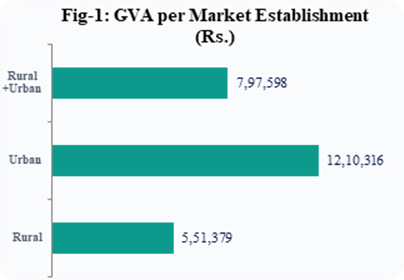
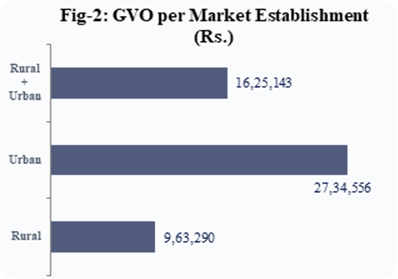
 

Title: GVA per Market Establishment (Rs.)

Financing Sources and Cost Composition of Household Construction Activities

On an average, about 97% of households reported their own income as one of the sources of fund to undertake construction activities, which accounted for approximately 77% of the total amount spent on construction.

Nearly 21% of households availed institutional (financial or non-financial) loan for financing their construction activities accounting for about 17% of the total construction expenditure. The proportion of households accessing institutional loans was higher in rural areas (23%) compared to urban areas (13%).

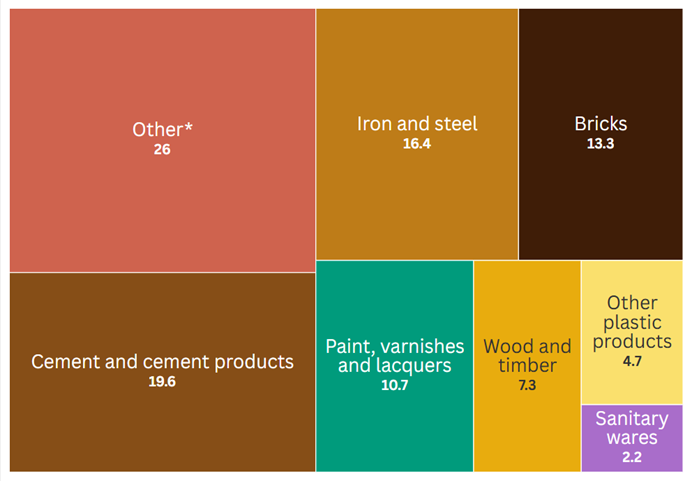
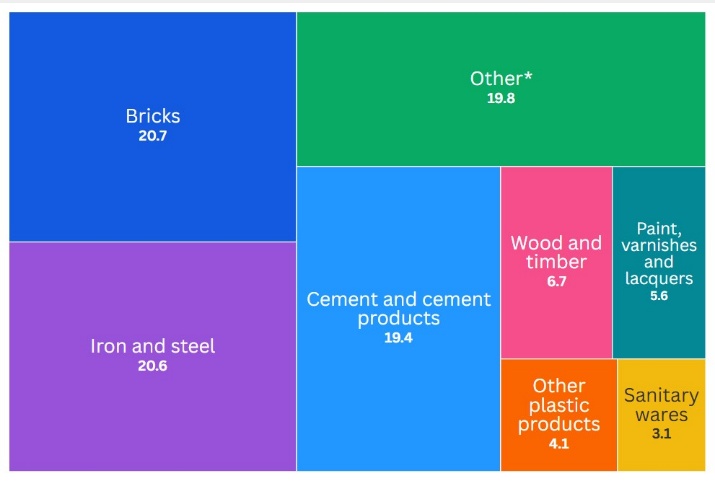
About three-fourths of household construction expenditure was on materials, with labour accounting for around 22 per cent. Within materials used for construction, bricks, cement, and iron and steel together comprised nearly 60 per cent of total expenditure.

Fig-3: Percentage Distribution of expenditure of materials: Household

*other includes petroleum, coal tar products, glass and glass products and other materials.

Fig-4: Percentage Distribution of expenditure of materials: Establishment

*other includes petroleum, coal tar products, glass and glass products and other materials.

Estimates of key indicators of the pilot study are given in Table 1 below. The detailed technical report also contains insights on major states and is available in the website of the Ministry (https://www.mospi.gov.in). Further, interactive tables and visualizations on other surveys conducted by NSO may be accessed on the Data Catalogue section of https://esankhyiki.mospi.gov.in/.

Table 1: Estimates of key indicators from Pilot Study on Construction Activities in Unincorporated Sector Establishments and Households

Indicator

Rural

Urban

Rural + Urban

(1)

(2)

(3)

(4)

Number of households undertaking own-account construction for own use

75,07,391

23,47,089

98,54,480

Number of establishments engaged in unincorporated construction activities

6,51,791

3,75,168

10,26,959

No. of Labourers engaged per household undertaking own account construction

4.2

4.4

4.3

No. of workers engaged per establishment in unincorporated construction activities

4.5

5.5

4.8

GVA per market establishment (Rs.)

5,51,379

12,10,316

7,97,598

Endnote: A brief about the coverage, sampling scheme, sample size and data collection mechanism in the Pilot Study on Construction Activities in Unincorporated Sector Establishments and Households:

A. Coverage of the pilot study:

A.1. Unincorporated Establishments: Market and non-market establishments engaged in construction activities

A.2. Households: own account construction undertaken by households for own use

A.3. Construction Activities: all activities under 2-digit NIC (2008) codes 41, 42 and 43 were considered in the definition of construction for the purpose of this pilot.

A.4.Expenditure on construction (for last 365 days or last financial year): Eligibility of establishments engaged in construction activities, as well as households undertaking own-account construction for own use, was determined based on whether their expenditure exceeded pre-specified thresholds, which varied by sector and type of sample entity. The expenditure threshold was set at ₹25,000 in rural areas and ₹50,000 in urban areas for establishments, and ₹10,000 in rural areas and ₹20,000 in urban areas for households. Any amount spent on construction below these cut-offs were not treated as construction work for this pilot study.

B. Sampling Scheme:

The survey has been conducted following a multi-stage stratified sampling scheme where first stage units (FSUs) were census villages in rural and UFS (Urban Frame Survey) blocks in urban areas.  The ultimate stage units (USU) were either establishments engaged in construction activities or households who has undertaken own account construction for own use.   

C. Sample Size:

In the pilot study, data were collected from a total of 19,154 households, 4,470 market establishments, and 717 non-market establishments pertaining to 11,981 surveyed FSUs (5,104 in rural and 6,877 in urban).

D. Data Collection Mechanism:

The pilot study has been conducted based on area frame and establishments/households have been listed in the selected FSUs of both rural and urban sector. Mostly, data were collected from the selected establishments/households through oral enquiry for the last 365 days. The data for the survey were collected in tablet using Computer Assisted Personal Interviewing (CAPI).

This pilot study has been carried out with Annual Survey of Unincorporated Sector Enterprises (ASUSE) 2025 in the same FSUs selected for the survey period July, 2025 – December, 2025. The listing schedule of ASUSE was suitably modified to accommodate the listing and selection of establishments and households undertaking construction under the coverage of the pilot study. The detailed establishment schedule was canvassed independently of ASUSE for collecting construction related information.

E. Detailed Technical Report of the Pilot Study:

For detailed understanding of the objectives, coverage, concepts, methodology and key findings from the pilot study one may refer to the Technical Report on Pilot Study on Construction Activities in Unincorporated Sector Establishments and Households published by NSO, MoSPI and available on the website of the ministry (https://www.mospi.gov.in).

Topics

Acts Income Tax