Loading...

Top
Help
×

By creating an account you can:

Logo TaxTMI
Call Us / Help / Feedback

Contact Us At :

E-mail: [email protected]

Call / WhatsApp at: +91 99117 96707

For more information, Check Contact Us

FAQs :

To know Frequently Asked Questions, Check FAQs

Most Asked Video Tutorials :

For more tutorials, Check Video Tutorials

Submit Feedback/Suggestion :

Email :
Please provide your email address so we can follow up on your feedback.
Category :
Description :
Min 15 characters 0/2000
Make Most of Text Search
  1. Checkout this video tutorial: How to search effectively on TaxTMI.
  2. Put words in double quotes for exact word search, eg: "income tax"
  3. Avoid noise words such as : 'and, of, the, a'
  4. Sort by Relevance to get the most relevant document.
  5. Press Enter to add multiple terms/multiple phrases, and then click on Search to Search.
  6. Text Search
  7. The system will try to fetch results that contains ALL your words.
  8. Once you add keywords, you'll see a new 'Search In' filter that makes your results even more precise.
  9. Text Search
Add to...
You have not created any category. Kindly create one to bookmark this item!
Create New Category
Hide
Title :
Description :
❮❮ Hide
Default View
Expand ❯❯
Close ✕
🔎 News - Adv. Search
TEXT SEARCH:

Press 'Enter' to add multiple search terms. Rules for Better Search

Search In:
Main Text + AI Text
  • Main Text
  • Main Text + AI Text
  • AI Text
Category: ?
Categorized by AI
---- All Categories ----
  • ---- All Categories ----
  • Income Tax
  • GST
  • Customs, DGFT & SEZ
  • FEMA & RBI
  • Corp. Laws, SEBI & IBC
  • PMLA, Black Money & ED
  • Budget
  • News and Press Release
  • PTI News
Month:
---- All Months ----
  • ---- All Months ----
  • January
  • February
  • March
  • April
  • May
  • June
  • July
  • August
  • September
  • October
  • November
  • December
Year:
---- All Years ----
  • ---- All Years ----
  • 2026
  • 2025
  • 2024
  • 2023
  • 2022
  • 2021
  • 2020
  • 2019
  • 2018
  • 2017
  • 2016
  • 2015
  • 2014
  • 2013
  • 2012
  • 2011
Sort By: ?
In Sort By 'Default', exact matches for text search are shown at the top, followed by the remaining results in their regular order.
Relevance Default Date
❯❯
Maximize Maximize Maximize
0 / 200
Expand Note
Add to Folder

No Folders have been created

+

Are you sure you want to delete "My most important" ?

NOTE:

News
Showing Results for :
Reset Filters
Results Found:
Show All Summaries Hide All Summaries
March 30, 2026
Show AI Summary
Electronic information disclosure under the Income-tax Act, 2025 uses Form 89 for structured, traceable furnishing or refusal.
Form 89 is the electronic statutory form used by the designated Income-tax authority to furnish permissible information in response to a valid application by an authorised public authority under section 258(2)(a) of the Income-tax Act, 2025, for a specified assessee and a single tax year. It is an event-based form, furnished through the Department's system with DIN and system-generated authentication, and is linked to the corresponding application in Form 88. The form contains assessee particulars in Part A and disclosure-limited information details in Part B, and it also allows recording of refusal, wholly or partly, where disclosure is not considered to be in the public interest.
March 30, 2026
Show AI Summary
Taxpayer information disclosure under authorised application governs Form 089, with electronic furnishing and limited, confidential disclosure.
Form 089 is the statutory online form used by designated income-tax authorities to furnish taxpayer-related information in response to a valid application made by an authorised public authority under section 258(2)(a) of the Income-tax Act, 2025. It is tax-year specific, furnished electronically, and may be used only for information available in departmental records and within the permissible scope of disclosure. The authority may refuse disclosure for unauthorised, invalid, incomplete, or overbroad requests, and the reasons must be recorded electronically.
March 30, 2026
Show AI Summary
Assessee information requests under the Income-tax Act now require online Form 88 filing by authorised public authorities only.
Form 88 is the prescribed application for obtaining information about an assessee under Section 258(2)(a) of the Income-tax Act, 2025. It is available only to authorised public authorities, including regulatory and law-enforcement agencies, government departments authorised under Rule 155, and other competent authorities empowered by the Central Government. A separate application is required for each assessee and each tax year; consolidated requests are not allowed. The form must be filed online through the e-Filing portal with electronic verification and supporting documents uploaded electronically.
March 30, 2026
Show AI Summary
E-commerce duty moratorium ends unresolved as WTO members defer tariff and TRIPS safeguards talks.
The World Trade Organization meeting ended without consensus on extending the moratorium on customs duties on electronic transmissions, leaving the issue of tariffs on digital downloads and streaming unresolved. The lapse of the moratorium also coincided with the expiry of the TRIPS non-violation complaint safeguard, increasing the possibility of challenges to WTO-compliant measures and reducing policy space for developing countries. Related WTO reform and e-commerce work programme discussions were also deferred for continued negotiation in Geneva.
March 30, 2026
Show AI Summary
Insolvency and bankruptcy reform drives banking health, with proposed changes aimed at faster admission of resolution applications.
The Insolvency and Bankruptcy Code is described as a central mechanism for improving banking sector health through recovery of non-performing assets under the insolvency resolution process. The proposed amendment Bill seeks further changes to the framework, including measures to reduce the time taken for admission of insolvency resolution applications, while the resolution process is said to have coincided with better company performance and improved corporate governance.
March 30, 2026
Show AI Summary
Taxpayer information requests under Form 088 require authorised filing, specific grounds, separate tax year submissions, and electronic portal authentication.
Form 088 is the online application used by authorised public authorities, regulatory bodies, law-enforcement agencies, and other competent authorities to seek specific taxpayer information under Section 258(2)(a) of the Income-tax Act, 2025. It must be filed separately for each taxpayer and each tax year through the e-Filing portal, with narrowly framed particulars, stated reasons, and supporting authorisation where necessary. Incomplete, overbroad, or unauthorised requests may be returned or rejected, and communications are issued electronically with portal-based status tracking.
March 30, 2026
Show AI Summary
Tonnage Tax Scheme audit report filing requires accountant certification, supporting annexures, and electronic submission within the specified date.
Form No. 81 is prescribed for furnishing the audit report under section 232(21) for a company that has opted for taxation under the Tonnage Tax Scheme. The report, prepared and certified by an accountant, verifies books of account, computation of shipping income, compliance with charter-in limits, and other statutory conditions. It is to be furnished on or before the specified date and may include annexures such as charter arrangement certificates, related party notes, asset notes, and loss statements.
March 30, 2026
Show AI Summary
Tonnage Tax Scheme reporting requires accountant certification, separate books, and detailed disclosure of shipping income and compliance.
Form 81 is an accountant's report for a company opting for the Tonnage Tax Scheme, certifying the correctness of books of account and income computation for qualifying ships. It requires separate books, disclosure of charter-in compliance, shipping income, statutory reserve details, ship-wise tonnage income, related party transactions, depreciation, non-exclusive assets, and losses, with mandatory annexures where applicable and reasons for any negative or qualified answers.
March 30, 2026
Show AI Summary
Tonnage Tax Scheme option filing requires Form 80, supporting vessel documents, and electronic verification of eligibility.
Form No. 80 is the prescribed electronic application for an Indian company engaged in operating ships or inland vessels to exercise or renew the option to be governed by the Tonnage Tax Scheme. It requires particulars of the applicant, ships or inland vessels, supporting certificates and approvals, and is used to verify whether the statutory conditions for coverage under Chapter XII-G are satisfied.
March 30, 2026
Show AI Summary
Tonnage tax scheme application rules govern Form 80 filing, renewal, verification, completeness, and false statement liability.
Form 80 is the mandatory application for an eligible Indian company engaged in the operation of ships or inland vessels to exercise or renew the option under the tonnage tax scheme. The form must be filed within the prescribed time, includes Part A for all cases and Part B only for renewal, and requires detailed ship-wise particulars with supporting annexures. It is filed with the jurisdictional Joint Commissioner and must be signed by the authorised signatory. Incomplete applications may be treated as invalid, and false statements in the form or annexures attract prosecution.
March 30, 2026
Show AI Summary
Pass-through taxation reporting for investment funds through Form 79, with unit holder income disclosure and auto-generated statements.
Form 79 is the consolidated annual statement for Investment Funds to report income paid or credited to unit holders under the pass-through taxation framework. Eligible Category I or Category II AIFs, and comparable IFSCA-regulated funds subject to the stated conditions, must file it annually by 15 June with detailed fund-level income, loss, set-off, and unit holder-wise distribution particulars. The form requires verification by both an authorised person and a qualified accountant, and its filing triggers auto-generation of Form 78 statements for unit holders.
March 30, 2026
Show AI Summary
Investment fund income distribution reporting requires Form 79 filing online with supporting records and prescribed timelines.
Form 79 is the statement of income paid or credited by an investment fund to persons liable to tax on such income, and it must be filed by the person responsible for making the payment or credit on behalf of the fund. The statement is to be submitted online through the Income Tax e-filing portal by 15 June of the financial year following the tax year, with supporting records including audited financial statements, unit holder details, income distribution data, loss set-off computations, and the relevant registration certificate.
March 30, 2026
Show AI Summary
Pass-through taxation reporting through Form 78 requires unit holder income statements, capital gain codes, and timely furnishing
Form 78 is the individual unit holder statement for income distributed by an Investment Fund under section 224 and Rule 145, furnished by the person responsible for payment or credit on behalf of the Fund to each unit holder by 30 June of the following financial year. It is system-generated from the consolidated parent Form 79 and includes unit holder details, fund particulars, income or loss classification with capital gain codes, and deemed loss details under section 224(3). No separate documents are required, and the form supports transparent pass-through income reporting by unit holders.
March 30, 2026
Show AI Summary
Pass-through income reporting through Form 78 supports compliance, income classification, capital gains coding, and loss carry-forward.
Form 78 is the statement of income paid or credited by an investment fund to each unitholder under section 224 of the Income-tax Act, 2025. It is a child form generated from the parent Form 79 through the e-filing portal and is not filed separately or offline. The form must be furnished by 30 June of the financial year following the tax year, and it helps unit holders report pass-through income, classify income under the correct heads, apply capital gains tax rate codes, and use deemed loss details for carry-forward purposes.
March 30, 2026
Show AI Summary
Business trust income distribution statements require auto-generated Form 77 for unit holders with income breakup and timely furnishing.
Form 77 is the individual unit holder statement furnished by a Business Trust to each unit holder for reporting income distributed during the tax year. It is generated automatically from Form 76 through the e-filing system, requires no separate attachments, and is furnished to each unit holder by 30 June following the tax year. The form captures unit holder details, business trust details, and income distribution particulars, including interest, letting, leasing or renting income, dividend income, and other income, and is verified by the responsible person for the trust.
March 30, 2026
Show AI Summary
Pass-through income reporting under business trust rules through Form 77 and classified disclosure for unitholders.
Form 77 is the prescribed statement for furnishing income distributed or credited by a business trust to each unitholder under section 223. It is generated from the parent Form 76 through the prescribed e-filing portal, is not filed separately or offline, and must be furnished by 30 June of the following financial year. The form supports compliance by classifying pass-through income and assisting unitholders in reporting income under the appropriate heads.
March 30, 2026
Show AI Summary
Business trust income reporting through Form 76, capturing distributions to unit holders under the pass-through taxation framework.
Form 76 is the annual income-tax statement required from a Business Trust registered with SEBI as a REIT or InvIT for reporting income distributed to unit holders under section 223 of the Income Tax Act, 2025 and rule 145 of the Income Tax Rules, 2026. The form captures the trust's basic details, trustee particulars, SEBI registration data, listing status, income classification, unit holder-wise distribution, and capital redemption details, and is to be filed electronically by 15 June of the financial year following the relevant tax year.
March 30, 2026
Show AI Summary
RBI net open position cap for banks lifts rupee in early trade as dollar exposure is reduced
RBI lowered the net open position that banks may keep overnight to USD 100 million, requiring compliance by 10 April 2026. The circular was aimed at limiting banks' currency exposure in onshore foreign exchange markets and prompted position adjustment by banks holding long dollar positions. The measure had an immediate market effect, with the rupee recovering in early trade after recent weakness.
March 30, 2026
Show AI Summary
Pass-through taxation for business trusts through Form 76 filing, income distribution reporting, and online compliance requirements.
Form 76 is the prescribed online statement for income paid or credited by a Business Trust to its unitholders. It must be filed by the person responsible for distributing income on behalf of the trust by 15 June of the following financial year, and the filer must possess the relevant registration certificate, audited accounts, and certified income distribution records. The form supports pass-through taxation for Business Trusts and the exemption structure for specified income streams.
March 30, 2026
Show AI Summary
Pass-through income reporting through Form 75 enables investor-wise disclosure by venture capital funds and companies.
New Form 75 is a child form generated from Form 74 for furnishing an investor-wise statement of income paid, credited or deemed to be credited by a Venture Capital Company or Venture Capital Fund to investors. Linked to section 222 of the Income-tax Act, 2025 and rule 145 of the Income-tax Rules, 2026, it provides head-wise details of pass-through income for reporting in the return of income. The form is prepared annually for each investor, verified by the authorised person of the VCC or VCF, and distributed through the e-filing process.

News

Back

All News

Showing Results for :
Reset Filters
No Records Found

News

Back

All News

Showing Results for : Reset Filters
News and Press Release

MoSPI Breaks New Ground: First-Ever Deep Dive into Unincorporated Construction Sector in Decades

April 11, 2026

Contents
Summary
Note

Note

-

Bookmark

Print

Print

Nearly 1 crore households built their own homes or undertook construction for self-use

10 Lakh+ Small Builders Power Economy: Unincorporated Construction Sector Comes into Focus

Snapshot:

  • MoSPI releases the technical report of pilot study on construction - marking NSO’s first such effort in decades to estimate key economic indicators of construction activities in the unincorporated sector and own-account household construction in a reference period of last 365 days.
  • During the reference period, an estimated 98.54 lakh households undertook own-account construction for their own use.
  • 10.27 lakh construction agencies (unincorporated establishments) were estimated to be engaged in this sector.
  • Approximately 77 per cent of these agencies engaged at least one hired worker on a fairly regular basis.
  • Estimated average value of fixed assets owned by such construction establishments was ₹5.21 lakh.
  • Nearly 23% of rural households undertaking own-account construction for own-use availed institutional funding reflecting increasing access to formal credit in rural areas.

The Ministry of Statistics and Programme Implementation (MoSPI) has released a technical report presenting the key findings from a Pilot study conducted on Construction Activities in Unincorporated Sector Establishments and Households. This study marks the first comprehensive attempt in decades by the National Statistics Office (NSO) to estimate key economic indicators for construction activities undertaken by unincorporated construction agencies (establishments engaged in construction activity), as well as own-account construction carried out by households for their own use. The study underscores MoSPI’s sustained efforts to bridge critical data gaps in sectors where reliable information has been limited. Data from the pilot study also served as an important input for the revised series of the national accounts statistics brought out by MoSPI. A brief overview of the pilot study in terms of coverage, sampling strategy, data collection mechanism, etc., is provided in the Endnote.

The construction sector plays a crucial role in Indian economy, serving both as a driver of growth and an indicator of economic progress. As a key engine of development, it contributes significantly to output, employment, and capital formation, while maintaining strong backward and forward linkages with various other sub-sectors of the economy. While the incorporated segment of the construction sector is to be covered under the recently launched Annual Survey of Incorporated Services Sector Enterprises (ASISSE), data remains limited for unincorporated construction enterprises and households undertaking own-account construction for own use in India. Recognizing the importance of generating robust and reliable estimates of key economic parameters in the construction sector, this pilot study was undertaken alongside Annual Survey of Unincorporated Sector Enterprises (ASUSE) 2025 in the same First Stage Units (FSUs) during the survey period from July to December 2025.

The pilot study, apart from capturing expenses and receipts, was designed to collect key information on employment and a broader set of economic parameters for construction establishments (both market and non-market), including fixed assets, outstanding loans, and various components of expenditure. For households, it focuses on capturing expenditure on construction activities, details of labour engagement, and sources of finance.

The findings of this pilot study served as a crucial input for the National Accounts Division (NAD) in updating and refining the rates and ratios used for estimating several economic indicators in the construction sector under the new series of national accounts.

Estimated number of construction activities undertaken:

It was estimated that 98.54 lakh households have undertaken construction during last 365 days (the reference period of the estimates)[1]. It was also estimated that 10.27 lakh unincorporated construction agencies were engaged in this sector which included both market and non-market establishment.

Average number of worker engaged in the construction sector:

On an average, an unincorporated builder establishment engaged in construction activities employed about five workers during the reference period. Further, approximately 77 per cent of such establishments reported engaging at least one hired worker on a fairly regular basis.

A household undertaking own-account construction for its own use during the reference period engaged around four labourers on an average.

Fixed Assets and Loan:

Fixed assets owned per unincorporated establishment engaged in construction activity has been estimated to be ₹5.21 lakh. The financial access, as reflected by the outstanding loan per establishment in the sector, was estimated to be little more than ₹1.40 lakh.

Value Addition and productivity:

The GVA per market establishment[2] for the unincorporated construction sector was estimated to be about Rs. 7.98 lakh and the corresponding output per establishment was Rs. 16.25 lakh.

The NVA and output per non-market establishment was observed to be Rs. 2.77 lakh and Rs. 5.59 lakh respectively.
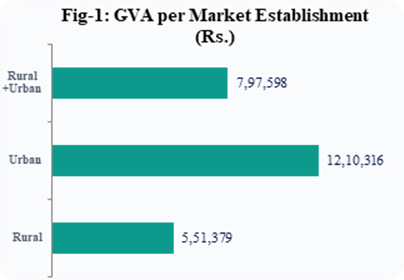
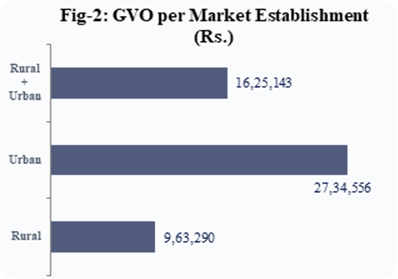
 

Title: GVA per Market Establishment (Rs.)

Financing Sources and Cost Composition of Household Construction Activities

On an average, about 97% of households reported their own income as one of the sources of fund to undertake construction activities, which accounted for approximately 77% of the total amount spent on construction.

Nearly 21% of households availed institutional (financial or non-financial) loan for financing their construction activities accounting for about 17% of the total construction expenditure. The proportion of households accessing institutional loans was higher in rural areas (23%) compared to urban areas (13%).

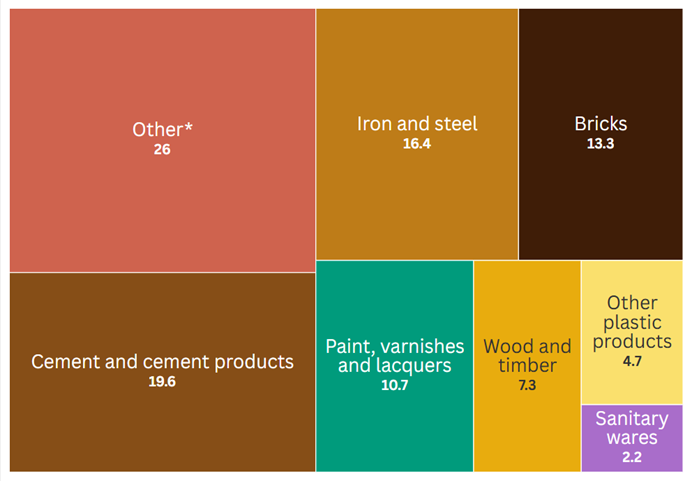
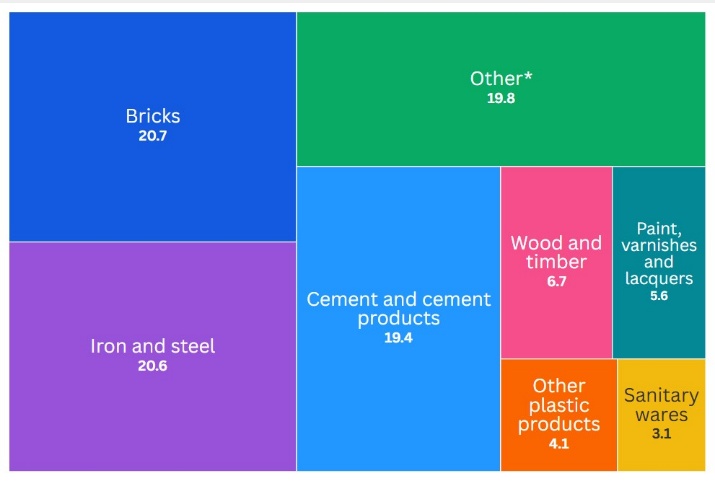
About three-fourths of household construction expenditure was on materials, with labour accounting for around 22 per cent. Within materials used for construction, bricks, cement, and iron and steel together comprised nearly 60 per cent of total expenditure.

Fig-3: Percentage Distribution of expenditure of materials: Household

*other includes petroleum, coal tar products, glass and glass products and other materials.

Fig-4: Percentage Distribution of expenditure of materials: Establishment

*other includes petroleum, coal tar products, glass and glass products and other materials.

Estimates of key indicators of the pilot study are given in Table 1 below. The detailed technical report also contains insights on major states and is available in the website of the Ministry (https://www.mospi.gov.in). Further, interactive tables and visualizations on other surveys conducted by NSO may be accessed on the Data Catalogue section of https://esankhyiki.mospi.gov.in/.

Table 1: Estimates of key indicators from Pilot Study on Construction Activities in Unincorporated Sector Establishments and Households

Indicator

Rural

Urban

Rural + Urban

(1)

(2)

(3)

(4)

Number of households undertaking own-account construction for own use

75,07,391

23,47,089

98,54,480

Number of establishments engaged in unincorporated construction activities

6,51,791

3,75,168

10,26,959

No. of Labourers engaged per household undertaking own account construction

4.2

4.4

4.3

No. of workers engaged per establishment in unincorporated construction activities

4.5

5.5

4.8

GVA per market establishment (Rs.)

5,51,379

12,10,316

7,97,598

Endnote: A brief about the coverage, sampling scheme, sample size and data collection mechanism in the Pilot Study on Construction Activities in Unincorporated Sector Establishments and Households:

A. Coverage of the pilot study:

A.1. Unincorporated Establishments: Market and non-market establishments engaged in construction activities

A.2. Households: own account construction undertaken by households for own use

A.3. Construction Activities: all activities under 2-digit NIC (2008) codes 41, 42 and 43 were considered in the definition of construction for the purpose of this pilot.

A.4.Expenditure on construction (for last 365 days or last financial year): Eligibility of establishments engaged in construction activities, as well as households undertaking own-account construction for own use, was determined based on whether their expenditure exceeded pre-specified thresholds, which varied by sector and type of sample entity. The expenditure threshold was set at ₹25,000 in rural areas and ₹50,000 in urban areas for establishments, and ₹10,000 in rural areas and ₹20,000 in urban areas for households. Any amount spent on construction below these cut-offs were not treated as construction work for this pilot study.

B. Sampling Scheme:

The survey has been conducted following a multi-stage stratified sampling scheme where first stage units (FSUs) were census villages in rural and UFS (Urban Frame Survey) blocks in urban areas.  The ultimate stage units (USU) were either establishments engaged in construction activities or households who has undertaken own account construction for own use.   

C. Sample Size:

In the pilot study, data were collected from a total of 19,154 households, 4,470 market establishments, and 717 non-market establishments pertaining to 11,981 surveyed FSUs (5,104 in rural and 6,877 in urban).

D. Data Collection Mechanism:

The pilot study has been conducted based on area frame and establishments/households have been listed in the selected FSUs of both rural and urban sector. Mostly, data were collected from the selected establishments/households through oral enquiry for the last 365 days. The data for the survey were collected in tablet using Computer Assisted Personal Interviewing (CAPI).

This pilot study has been carried out with Annual Survey of Unincorporated Sector Enterprises (ASUSE) 2025 in the same FSUs selected for the survey period July, 2025 – December, 2025. The listing schedule of ASUSE was suitably modified to accommodate the listing and selection of establishments and households undertaking construction under the coverage of the pilot study. The detailed establishment schedule was canvassed independently of ASUSE for collecting construction related information.

E. Detailed Technical Report of the Pilot Study:

For detailed understanding of the objectives, coverage, concepts, methodology and key findings from the pilot study one may refer to the Technical Report on Pilot Study on Construction Activities in Unincorporated Sector Establishments and Households published by NSO, MoSPI and available on the website of the ministry (https://www.mospi.gov.in).

Topics

Acts Income Tax