Loading...

Top
Help
×

By creating an account you can:

Logo TaxTMI
Call Us / Help / Feedback

Contact Us At :

E-mail: [email protected]

Call / WhatsApp at: +91 99117 96707

For more information, Check Contact Us

FAQs :

To know Frequently Asked Questions, Check FAQs

Most Asked Video Tutorials :

For more tutorials, Check Video Tutorials

Submit Feedback/Suggestion :

Email :
Please provide your email address so we can follow up on your feedback.
Category :
Description :
Min 15 characters 0/2000
Make Most of Text Search
  1. Checkout this video tutorial: How to search effectively on TaxTMI.
  2. Put words in double quotes for exact word search, eg: "income tax"
  3. Avoid noise words such as : 'and, of, the, a'
  4. Sort by Relevance to get the most relevant document.
  5. Press Enter to add multiple terms/multiple phrases, and then click on Search to Search.
  6. Text Search
  7. The system will try to fetch results that contains ALL your words.
  8. Once you add keywords, you'll see a new 'Search In' filter that makes your results even more precise.
  9. Text Search
Add to...
You have not created any category. Kindly create one to bookmark this item!
Create New Category
Hide
Title :
Description :
❮❮ Hide
Default View
Expand ❯❯
Close ✕
🔎 News - Adv. Search
TEXT SEARCH:

Press 'Enter' to add multiple search terms. Rules for Better Search

Search In:
Main Text + AI Text
  • Main Text
  • Main Text + AI Text
  • AI Text
Category: ?
Categorized by AI
---- All Categories ----
  • ---- All Categories ----
  • Income Tax
  • GST
  • Customs, DGFT & SEZ
  • FEMA & RBI
  • Corp. Laws, SEBI & IBC
  • PMLA, Black Money & ED
  • Budget
  • News and Press Release
  • PTI News
Month:
---- All Months ----
  • ---- All Months ----
  • January
  • February
  • March
  • April
  • May
  • June
  • July
  • August
  • September
  • October
  • November
  • December
Year:
---- All Years ----
  • ---- All Years ----
  • 2026
  • 2025
  • 2024
  • 2023
  • 2022
  • 2021
  • 2020
  • 2019
  • 2018
  • 2017
  • 2016
  • 2015
  • 2014
  • 2013
  • 2012
  • 2011
Sort By: ?
In Sort By 'Default', exact matches for text search are shown at the top, followed by the remaining results in their regular order.
Relevance Default Date
❯❯
Maximize Maximize Maximize
0 / 200
Expand Note
Add to Folder

No Folders have been created

+

Are you sure you want to delete "My most important" ?

NOTE:

News
Showing Results for :
Reset Filters
Results Found:
Show All Summaries Hide All Summaries
April 1, 2026
Show AI Summary
Tax-free spin-off leads Versigent to launch as an independent listed company with shares trading on NYSE.
Versigent PLC announced its launch as an independent, publicly traded company following separation from Aptiv PLC and commencement of trading on the New York Stock Exchange under the ticker VGNT. The separation was implemented through a distribution of Versigent ordinary shares to Aptiv shareholders of record, with cash in lieu of fractional shares, and was completed as a tax-free spin-off for Swiss and U.S. federal income tax purposes. The release also notes the use of carve-out historical financial measures and non-GAAP reporting such as Adjusted EBITDA.
April 1, 2026
Show AI Summary
Advance ruling applications through Form No. 120 govern online filing, fee slabs, admissibility limits, and binding effect on tax questions.
Form No. 120 is the online application for an advance ruling from the Board for Advance Rulings on questions of law, fact, or mixed questions relating to proposed or undertaken transactions. It specifies applicant categories, fee slabs, supporting documents, and the requirement to file only where the issue is not already pending before an income-tax authority, Tribunal, or court, subject to limited relaxation for public sector companies and GAAR matters. The ruling is binding for the specific transaction, may be appealed, may be declared void for fraud or misrepresentation, and remains effective only while facts and law remain unchanged.
April 1, 2026
Show AI Summary
Dispute resolution committee applications through Form 119 require eligibility, supporting evidence, and electronic filing for disputed tax orders.
Application to the Dispute Resolution Committee under section 379 is made in Form No. 119 by an eligible assessee aggrieved by a specified order passed by an Income-tax Authority. The form captures the applicant's particulars, the challenged order, disputed additions or disallowances, statement of facts, grounds of application, and supporting evidence. It is filed electronically through the income-tax e-filing portal with the prescribed annexures and, where applicable, payment of the application fee.
April 1, 2026
Show AI Summary
Biomass tariff revision supports continued renewable power operations and revenue visibility for a Punjab-based 6 MW plant.
A revised tariff has been fixed for DEE Development Engineers Ltd's 6 MW biomass-based Malwa Power Plant under the Punjab State Electricity Regulatory Commission, replacing the interim tariff applied during pendency of the petition. The revised arrangement includes annual escalation on the variable component and extends the plant's operating life for another 10 years after expiry of the earlier power purchase pact, supporting continued biomass-based power generation and revenue visibility.
April 1, 2026
Show AI Summary
Dispute Resolution Committee application framework under Form 119 requires electronic filing, eligibility checks, and structured disclosure.
Form 119 is the prescribed electronic application for seeking dispute resolution before the Dispute Resolution Committee under section 379 of the Income-tax Act, 2025. It is available to an eligible assessee aggrieved by a specified order passed by an Income-tax Authority, subject to statutory eligibility conditions, including payment of tax on returned income where a return has been filed. Filing is optional, separate applications are required for each tax year and each specified order, and the form must be submitted electronically and cannot be revised after submission.
April 1, 2026
Show AI Summary
Deferment of appeal for identical question of law enables later filing after the pending case is finally decided.
Form 118 is prescribed for an application to defer filing an appeal before the High Court or the Income-tax Appellate Tribunal where the relevant case involves an identical question of law already pending in another case. The appellant files the form before the appropriate forum with supporting documents showing the identical question of law and the other pending proceeding. The forum examines whether the statutory conditions for deferment are satisfied, and if accepted, filing of the appeal is deferred until the final decision on the identical question of law in the other case.
April 1, 2026
Show AI Summary
Deferred appeal on identical question of law under Form 118 requires assessee acceptance and collegium review.
Form 118 is used by the Income-tax Department to defer filing of an appeal before the Income-tax Appellate Tribunal or the High Court where the relevant case involves an identical question of law already pending in another case before the High Court or the Supreme Court. The procedure depends on collegium consideration and the assessee's acceptance that the questions are identical. The form is filed manually by the Assessing Officer on directions of the Principal Commissioner or Commissioner, cannot be revised after submission, and operates only until the identical legal issue attains finality.
April 1, 2026
Show AI Summary
GST collections rise on strong domestic demand, higher import revenues, and recovering momentum after rate rationalisation.
GST collections increased in the reported month, with gross receipts rising on the strength of both domestic supplies and import-related revenues. After adjustment for refunds, net GST revenues also recorded year-on-year growth, indicating continued buoyancy in tax mobilisation. The trend was linked to a recent GST rate rationalisation, including lower rates on many goods and a simplified slab structure, with collections initially dipping after the tax cut before recovering in later months.
April 1, 2026
Show AI Summary
Quality-controlled masterbatch manufacturing links R&D, regulatory compliance, and application-specific products across export markets.
Masterbatch and compound manufacturing is presented as a quality-controlled, export-oriented activity built on regulatory compliance, R&D support, and structured batch testing for colour consistency, dispersion, mechanical performance, and stability. The product range is described as application-specific, including laser marking masterbatches, flame retardant masterbatches meeting UL 94 ratings, long glass fibre reinforced compounds for metal replacement, and amber colour masterbatches for pharmaceutical packaging that comply with global regulatory requirements.
April 1, 2026
Show AI Summary
Identical question of law declarations under Form 117 keep pending tax disputes aligned with the final higher court decision.
Form 117 is the prescribed declaration by which an assessee states that a question of law in the assessee's pending case is identical to a question already pending before the High Court or Supreme Court in the assessee's own case for another tax year. The form is filed before the Assessing Officer or appellate authority, with supporting documents showing the related pending proceedings. If accepted, the assessee is bound by the final decision on the identical question and the pending order may later be amended to conform to that decision.
April 1, 2026
Show AI Summary
Identical question of law declaration streamlines tax disputes by binding pending cases to the higher court's final decision.
Form 117 is the optional declaration used by an assessee to state that a question of law in the relevant case is identical to a question already pending before the High Court or Supreme Court in the assessee's own case for another assessment year. It may be filed before the Assessing Officer or the appellate authority, requires prescribed particulars and supporting documents, and once admitted binds the assessee to the final decision on that identical question while not stopping the pending proceedings.
April 1, 2026
Show AI Summary
Cross-objections before the Income-tax Appellate Tribunal require timely filing, supporting documents, and structured grounds under the prescribed form.
Form 116 is the prescribed memorandum of cross-objections to the Income-tax Appellate Tribunal, enabling a respondent in an appeal to challenge any part of the order appealed against without filing a separate appeal. It may be filed by a respondent, including an assessee, deductor, or the Income-tax Department, only after an appeal has been filed and notice of that appeal has been received. The form is to be furnished within thirty days, accompanied by relevant orders and supporting documents, and may include grounds for condonation of delay where applicable.
April 1, 2026
Show AI Summary
Cross-objections before the Tribunal must be filed in the prescribed form, with separate grounds, tax effect, and timely notice-based filing.
Form 116 is the prescribed memorandum of cross-objections before the Income-tax Appellate Tribunal in response to an appeal already filed by the opposite party. It is available to a respondent such as an assessee, the Income-tax Department, or a government deductor, and must be filed within 30 days of receipt of notice. The form cannot be filed independently of an existing appeal, and each ground of cross-objection must be numbered, stated separately, and accompanied by the corresponding tax effect.
April 1, 2026
Show AI Summary
Income-tax appeal form governs Tribunal filings, prescribed time limits, supporting documents, and electronic submission requirements.
Form No. 115 is the prescribed appeal form for filing an appeal before the Income-tax Appellate Tribunal against appealable orders of income-tax authorities. It is to be filed by an aggrieved assessee or by the Income-tax Department, within two months from the end of the month in which the order is communicated, and may be accompanied by the relevant orders, grounds, statements, and supporting documents. The form is filed electronically, along with the prescribed fee, and is structured to capture appellant details, respondent details, appeal particulars, disputed amounts, grounds of appeal, and verification.
April 1, 2026
Show AI Summary
Income-tax appeal procedure: Form 115 sets out filing requirements, tax effect details, fee payment, and Tribunal jurisdiction.
Form 115 is the prescribed memorandum of appeal for filing an appeal before the Income-tax Appellate Tribunal against specified orders under the Income-tax Act and Rules. It may be filed by an aggrieved assessee or by the Income-tax Department, and must be presented before the Tribunal having jurisdiction over the case. The form requires particulars of the parties, appeal details, disputed amount, grounds of appeal, fee payment, supporting documents, signature and verification, and it is not revisable after filing.
April 1, 2026
Show AI Summary
Donation certificate form generated after donor reporting and processing of donation particulars under the Income Tax Act, 2025.
Form 114 is an acknowledgement and certificate of donation under the Income Tax Act, 2025, generated for a donor only after due filing and successful processing of Form-113 by a registered non-profit organisation. It records voluntary donations made during the relevant reporting period and contains Part A for donee information and Part B for donor information. The guidance also notes simplification of the form and alignment with the Act, including updated tax-year terminology.
April 1, 2026
Show AI Summary
Donation reporting compliance under Form 113 enables electronic filing, donor acknowledgement, and subsequent income tax claim support.
Form 113 is the electronic statement through which a registered non-profit organisation furnishes particulars of donations received during the tax year. It is filed for the reporting period by 31 May of the following tax year and contains Part A for the organisation's details and Part B for donor and donation particulars. Successful filing and processing support donor claim of the reported donation in a subsequent return of income and generation of Form 114 as the donation certificate or acknowledgement.
April 1, 2026
Show AI Summary
Donation reporting and donor certificates require mandatory electronic filing, enabling verified tax claims for voluntary contributions.
Registered non-profit organisations must electronically furnish the donation statement and issue the corresponding donor certificate within the prescribed reporting cycle. FN 113 records particulars of voluntary donations received during the tax year, while FN 114 is the acknowledgement or certificate for the donor. Filing is mandatory, requires a valid PAN, and must be done on the e-filing portal. A correction statement may be filed after submission, and a revised certificate may be issued if needed. The reporting process supports verification of donation claims and enables the donor to claim the relevant exemption or deduction in the return of income.
April 1, 2026
Show AI Summary
GST collections rise on stronger domestic and import revenues, with net receipts also showing steady year-on-year growth.
Gross Goods and Services Tax (GST) collections rose by 8.8 per cent in March 2026 to over Rs 2 lakh crore, supported by higher tax realisations from domestic sales and imports. Refund issuance increased by 13.8 per cent to Rs 22,074 crore, and net GST revenues stood at about Rs 1.78 lakh crore after adjustment for refunds. For the full 2025-26 fiscal year, gross GST revenue rose 8.3 per cent to over Rs 22.27 lakh crore, while net revenues increased 7.1 per cent to Rs 19.34 lakh crore.
April 1, 2026
Show AI Summary
Crypto tax compliance tools expand in India with INR pricing, Schedule VDA reporting, and automated filing support.
India's VDA tax compliance environment requires accurate transaction tracking, timely filing, and Schedule VDA-ready reporting, particularly in light of the flat tax on gains, transaction-level TDS, and the absence of loss offsets. A crypto tax platform has introduced INR-denominated paid plans for Indian users after an initial free rollout, while keeping a free portfolio-tracking option available without tax report downloads. The paid plans are presented as a means of enabling users to obtain filing documents, automate transaction import, and generate India-specific tax reports aligned with the Income Tax framework.

News

Back

All News

Showing Results for :
Reset Filters
No Records Found

News

Back

All News

Showing Results for : Reset Filters
News and Press Release

MoSPI Breaks New Ground: First-Ever Deep Dive into Unincorporated Construction Sector in Decades

April 11, 2026

Contents
Summary
Note

Note

-

Bookmark

Print

Print

Nearly 1 crore households built their own homes or undertook construction for self-use

10 Lakh+ Small Builders Power Economy: Unincorporated Construction Sector Comes into Focus

Snapshot:

  • MoSPI releases the technical report of pilot study on construction - marking NSO’s first such effort in decades to estimate key economic indicators of construction activities in the unincorporated sector and own-account household construction in a reference period of last 365 days.
  • During the reference period, an estimated 98.54 lakh households undertook own-account construction for their own use.
  • 10.27 lakh construction agencies (unincorporated establishments) were estimated to be engaged in this sector.
  • Approximately 77 per cent of these agencies engaged at least one hired worker on a fairly regular basis.
  • Estimated average value of fixed assets owned by such construction establishments was ₹5.21 lakh.
  • Nearly 23% of rural households undertaking own-account construction for own-use availed institutional funding reflecting increasing access to formal credit in rural areas.

The Ministry of Statistics and Programme Implementation (MoSPI) has released a technical report presenting the key findings from a Pilot study conducted on Construction Activities in Unincorporated Sector Establishments and Households. This study marks the first comprehensive attempt in decades by the National Statistics Office (NSO) to estimate key economic indicators for construction activities undertaken by unincorporated construction agencies (establishments engaged in construction activity), as well as own-account construction carried out by households for their own use. The study underscores MoSPI’s sustained efforts to bridge critical data gaps in sectors where reliable information has been limited. Data from the pilot study also served as an important input for the revised series of the national accounts statistics brought out by MoSPI. A brief overview of the pilot study in terms of coverage, sampling strategy, data collection mechanism, etc., is provided in the Endnote.

The construction sector plays a crucial role in Indian economy, serving both as a driver of growth and an indicator of economic progress. As a key engine of development, it contributes significantly to output, employment, and capital formation, while maintaining strong backward and forward linkages with various other sub-sectors of the economy. While the incorporated segment of the construction sector is to be covered under the recently launched Annual Survey of Incorporated Services Sector Enterprises (ASISSE), data remains limited for unincorporated construction enterprises and households undertaking own-account construction for own use in India. Recognizing the importance of generating robust and reliable estimates of key economic parameters in the construction sector, this pilot study was undertaken alongside Annual Survey of Unincorporated Sector Enterprises (ASUSE) 2025 in the same First Stage Units (FSUs) during the survey period from July to December 2025.

The pilot study, apart from capturing expenses and receipts, was designed to collect key information on employment and a broader set of economic parameters for construction establishments (both market and non-market), including fixed assets, outstanding loans, and various components of expenditure. For households, it focuses on capturing expenditure on construction activities, details of labour engagement, and sources of finance.

The findings of this pilot study served as a crucial input for the National Accounts Division (NAD) in updating and refining the rates and ratios used for estimating several economic indicators in the construction sector under the new series of national accounts.

Estimated number of construction activities undertaken:

It was estimated that 98.54 lakh households have undertaken construction during last 365 days (the reference period of the estimates)[1]. It was also estimated that 10.27 lakh unincorporated construction agencies were engaged in this sector which included both market and non-market establishment.

Average number of worker engaged in the construction sector:

On an average, an unincorporated builder establishment engaged in construction activities employed about five workers during the reference period. Further, approximately 77 per cent of such establishments reported engaging at least one hired worker on a fairly regular basis.

A household undertaking own-account construction for its own use during the reference period engaged around four labourers on an average.

Fixed Assets and Loan:

Fixed assets owned per unincorporated establishment engaged in construction activity has been estimated to be ₹5.21 lakh. The financial access, as reflected by the outstanding loan per establishment in the sector, was estimated to be little more than ₹1.40 lakh.

Value Addition and productivity:

The GVA per market establishment[2] for the unincorporated construction sector was estimated to be about Rs. 7.98 lakh and the corresponding output per establishment was Rs. 16.25 lakh.

The NVA and output per non-market establishment was observed to be Rs. 2.77 lakh and Rs. 5.59 lakh respectively.
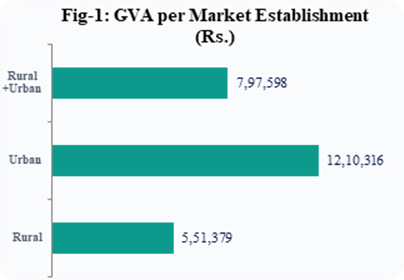
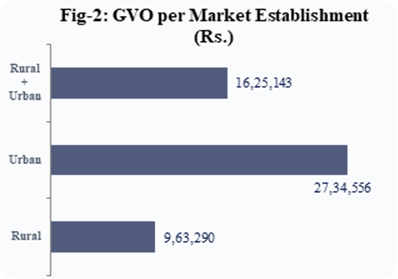
 

Title: GVA per Market Establishment (Rs.)

Financing Sources and Cost Composition of Household Construction Activities

On an average, about 97% of households reported their own income as one of the sources of fund to undertake construction activities, which accounted for approximately 77% of the total amount spent on construction.

Nearly 21% of households availed institutional (financial or non-financial) loan for financing their construction activities accounting for about 17% of the total construction expenditure. The proportion of households accessing institutional loans was higher in rural areas (23%) compared to urban areas (13%).

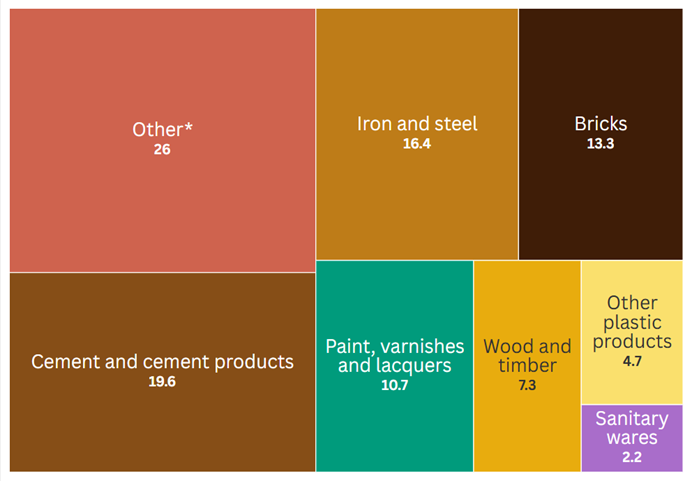
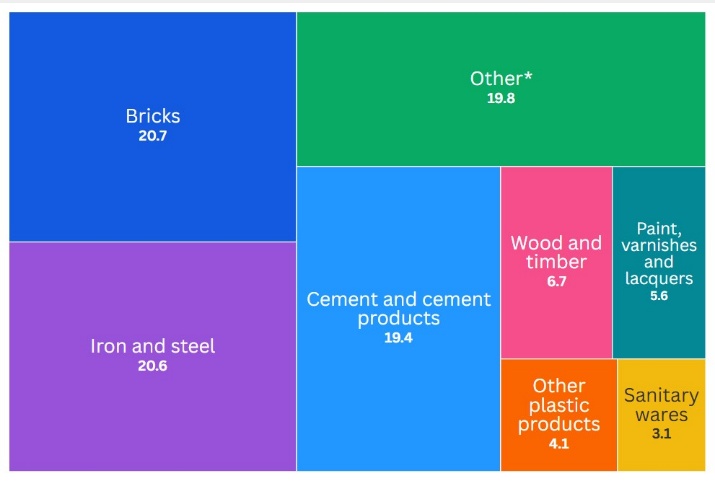
About three-fourths of household construction expenditure was on materials, with labour accounting for around 22 per cent. Within materials used for construction, bricks, cement, and iron and steel together comprised nearly 60 per cent of total expenditure.

Fig-3: Percentage Distribution of expenditure of materials: Household

*other includes petroleum, coal tar products, glass and glass products and other materials.

Fig-4: Percentage Distribution of expenditure of materials: Establishment

*other includes petroleum, coal tar products, glass and glass products and other materials.

Estimates of key indicators of the pilot study are given in Table 1 below. The detailed technical report also contains insights on major states and is available in the website of the Ministry (https://www.mospi.gov.in). Further, interactive tables and visualizations on other surveys conducted by NSO may be accessed on the Data Catalogue section of https://esankhyiki.mospi.gov.in/.

Table 1: Estimates of key indicators from Pilot Study on Construction Activities in Unincorporated Sector Establishments and Households

Indicator

Rural

Urban

Rural + Urban

(1)

(2)

(3)

(4)

Number of households undertaking own-account construction for own use

75,07,391

23,47,089

98,54,480

Number of establishments engaged in unincorporated construction activities

6,51,791

3,75,168

10,26,959

No. of Labourers engaged per household undertaking own account construction

4.2

4.4

4.3

No. of workers engaged per establishment in unincorporated construction activities

4.5

5.5

4.8

GVA per market establishment (Rs.)

5,51,379

12,10,316

7,97,598

Endnote: A brief about the coverage, sampling scheme, sample size and data collection mechanism in the Pilot Study on Construction Activities in Unincorporated Sector Establishments and Households:

A. Coverage of the pilot study:

A.1. Unincorporated Establishments: Market and non-market establishments engaged in construction activities

A.2. Households: own account construction undertaken by households for own use

A.3. Construction Activities: all activities under 2-digit NIC (2008) codes 41, 42 and 43 were considered in the definition of construction for the purpose of this pilot.

A.4.Expenditure on construction (for last 365 days or last financial year): Eligibility of establishments engaged in construction activities, as well as households undertaking own-account construction for own use, was determined based on whether their expenditure exceeded pre-specified thresholds, which varied by sector and type of sample entity. The expenditure threshold was set at ₹25,000 in rural areas and ₹50,000 in urban areas for establishments, and ₹10,000 in rural areas and ₹20,000 in urban areas for households. Any amount spent on construction below these cut-offs were not treated as construction work for this pilot study.

B. Sampling Scheme:

The survey has been conducted following a multi-stage stratified sampling scheme where first stage units (FSUs) were census villages in rural and UFS (Urban Frame Survey) blocks in urban areas.  The ultimate stage units (USU) were either establishments engaged in construction activities or households who has undertaken own account construction for own use.   

C. Sample Size:

In the pilot study, data were collected from a total of 19,154 households, 4,470 market establishments, and 717 non-market establishments pertaining to 11,981 surveyed FSUs (5,104 in rural and 6,877 in urban).

D. Data Collection Mechanism:

The pilot study has been conducted based on area frame and establishments/households have been listed in the selected FSUs of both rural and urban sector. Mostly, data were collected from the selected establishments/households through oral enquiry for the last 365 days. The data for the survey were collected in tablet using Computer Assisted Personal Interviewing (CAPI).

This pilot study has been carried out with Annual Survey of Unincorporated Sector Enterprises (ASUSE) 2025 in the same FSUs selected for the survey period July, 2025 – December, 2025. The listing schedule of ASUSE was suitably modified to accommodate the listing and selection of establishments and households undertaking construction under the coverage of the pilot study. The detailed establishment schedule was canvassed independently of ASUSE for collecting construction related information.

E. Detailed Technical Report of the Pilot Study:

For detailed understanding of the objectives, coverage, concepts, methodology and key findings from the pilot study one may refer to the Technical Report on Pilot Study on Construction Activities in Unincorporated Sector Establishments and Households published by NSO, MoSPI and available on the website of the ministry (https://www.mospi.gov.in).

Topics

Acts Income Tax