Loading...

Top
Help
×

By creating an account you can:

Logo TaxTMI
Call Us / Help / Feedback

Contact Us At :

E-mail: [email protected]

Call / WhatsApp at: +91 99117 96707

For more information, Check Contact Us

FAQs :

To know Frequently Asked Questions, Check FAQs

Most Asked Video Tutorials :

For more tutorials, Check Video Tutorials

Submit Feedback/Suggestion :

Email :
Please provide your email address so we can follow up on your feedback.
Category :
Description :
Min 15 characters 0/2000
Make Most of Text Search
  1. Checkout this video tutorial: How to search effectively on TaxTMI.
  2. Put words in double quotes for exact word search, eg: "income tax"
  3. Avoid noise words such as : 'and, of, the, a'
  4. Sort by Relevance to get the most relevant document.
  5. Press Enter to add multiple terms/multiple phrases, and then click on Search to Search.
  6. Text Search
  7. The system will try to fetch results that contains ALL your words.
  8. Once you add keywords, you'll see a new 'Search In' filter that makes your results even more precise.
  9. Text Search
Add to...
You have not created any category. Kindly create one to bookmark this item!
Create New Category
Hide
Title :
Description :
❮❮ Hide
Default View
Expand ❯❯
Close ✕
🔎 News - Adv. Search
TEXT SEARCH:

Press 'Enter' to add multiple search terms. Rules for Better Search

Search In:
Main Text + AI Text
  • Main Text
  • Main Text + AI Text
  • AI Text
Category: ?
Categorized by AI
---- All Categories ----
  • ---- All Categories ----
  • Income Tax
  • GST
  • Customs, DGFT & SEZ
  • FEMA & RBI
  • Corp. Laws, SEBI & IBC
  • PMLA, Black Money & ED
  • Budget
  • News and Press Release
  • PTI News
Month:
---- All Months ----
  • ---- All Months ----
  • January
  • February
  • March
  • April
  • May
  • June
  • July
  • August
  • September
  • October
  • November
  • December
Year:
---- All Years ----
  • ---- All Years ----
  • 2026
  • 2025
  • 2024
  • 2023
  • 2022
  • 2021
  • 2020
  • 2019
  • 2018
  • 2017
  • 2016
  • 2015
  • 2014
  • 2013
  • 2012
  • 2011
Sort By: ?
In Sort By 'Default', exact matches for text search are shown at the top, followed by the remaining results in their regular order.
Relevance Default Date
    Guidance Note – Form 124
    Form No. 124 – Frequently Asked Questions (FAQ)
    Ministry of Statistics and Programme Implementation develops India SDG Dashboard in partnership with United Nations Resident Coordinator Office which ...
    Guidance Note – Form 123
    Digitalisation and technological upgradation relates to data collection, processing, analysis and dissemination undertaken for improvement of Official...
    CBIC introduces one-time relief measure for eligible units in SEZs to sell manufactured goods in Domestic Tariff Area (DTA) at concessional customs du...
    Form No. 123 – Frequently Asked Questions (FAQ)
    Guidance Note – Form 122
    Form No. 122 – Frequently Asked Questions (FAQ)
    Guidance Note – Form 121
    Form No. 121 – Frequently Asked Questions
    Oppn playing politics on West Asia crisis, alleges Rijiju amid heated exchanges with LoP Kharge
    Guidance Note – Form 120
    Versigent Launches as New Publicly Traded Company
    FORM NO. 120 – FREQUENTLY ASKED QUESTIONS (FAQS)
    Guidance Note – Form 119
    DEE Development secures revised tariff of Rs 5.224 per unit from PSERC for biomass-based Malwa power project
    Form 119 – Frequently Asked Questions
    Guidance Note – Form 118
    Form 118 – Frequently Asked Questions
❯❯
Maximize Maximize Maximize
0 / 200
Expand Note
Add to Folder

No Folders have been created

+

Are you sure you want to delete "My most important" ?

NOTE:

News
Showing Results for :
Reset Filters
Results Found:
Show All Summaries Hide All Summaries
April 1, 2026
Show AI Summary
Tax deduction at source claims form requires employee details, supporting evidence, and annual disclosure to employer.
Form No. 124 is the employee's statement of particulars of claims for deduction of tax at source under section 392(5)(b) of the Income-tax Act, 2025 read with Rule 205 of the Income-tax Rules, 2026. It is furnished to the current employer so that deductions, exemptions and allowances may be considered for correct tax deduction from salary. The form is filed once every financial year and requires employee details, claim particulars, supporting evidence and a declaration that the particulars are correct and complete.
April 1, 2026
Show AI Summary
Employee tax benefit declarations guide salary TDS computation through Form No. 124 and supporting evidence.
Form No. 124 is the employee statement furnished to an employer for consideration of deductions, exemptions, allowances, and other tax benefits while computing taxable salary and TDS liability. It applies where the employee seeks employer recognition of claims relating to house rent allowance, leave travel allowance, interest on housing loan, and investment- or expenditure-based deductions, together with supporting evidence. The form has Part A for employee particulars and Part B for the tax benefits claimed with annexures in support of those claims.
April 1, 2026
Show AI Summary
Statistical data dissemination and SDG monitoring strengthened through a centralized dashboard, expert review, and public access tools.
MoSPI maintains a centralized digital mechanism for public access to its statistical publications and has developed the India SDG Dashboard in partnership with the United Nations Resident Coordinator Office as a centralized data platform for monitoring SDG indicators aligned with the National Indicator Framework. The Ministry's publications compile social and environmental statistics for evidence-based planning, policymaking, research, and analysis, while expert committees, the e-Sankhyiki portal, the Advance Release Calendar, and stakeholder consultations are used to improve coverage, dissemination, transparency, and usability.
April 1, 2026
Show AI Summary
Perquisites and fringe benefit reporting through Form 123 for employee salary disclosures and tax valuation compliance.
Form No. 123 is the employer-issued statement for reporting the value of perquisites, fringe benefits, amenities and profits in lieu of salary provided to an employee during a financial year. It is issued where salary paid or payable exceeds one lakh and fifty thousand rupees, and it is due by 30 April of the following year. The form captures employer and employee details, valuation of perquisites, tax deducted or paid, and a declaration certifying correctness and completeness.
April 1, 2026
Show AI Summary
Digitalisation of official statistics uses AI, machine learning and secure data systems to improve dissemination and access.
Digitalisation and technological upgradation in the Official Statistical System include modules for data collection, processing, analysis and dissemination, with a Data Innovation Lab integrating Artificial Intelligence and Machine Learning. Security by design principles, cyber security guidelines, agency-based compliance monitoring, a Chief Information Security Officer, and security audit with SSL certification support the deployment of applications. These reforms are continuous and are expected to improve data collection, validation, processing and dissemination.
April 1, 2026
Show AI Summary
Concessional customs duty relief for eligible SEZ units enables limited DTA sales with value addition and export-linked caps.
A one-time customs relief window allows eligible SEZ manufacturing units to sell manufactured goods in the Domestic Tariff Area at concessional duty rates for a limited period. Eligibility is confined to units that commenced production on or before 31 March 2025, and the goods must have undergone minimum 20% value addition over inputs. DTA sales under the relief are capped at 30% of the highest annual FOB value of exports in any of the three preceding financial years, with certain sensitive sectors excluded and faceless assessment applying to clearances.
April 1, 2026
Show AI Summary
Perquisite valuation statement under income tax rules continues to govern employee benefits, tax details, and return compliance.
Form No. 123 is the employer-issued statement of perquisites, fringe benefits or amenities, and profits in lieu of salary for an employee, replacing the earlier Form 12BA. It certifies valuation of monetary and non-monetary perquisites for income-tax return purposes and is generally required where salary exceeds the prescribed threshold. The form contains Part A with employer and employee particulars and Part B with perquisite-wise valuation and salary tax details, including tax deducted at source and remittance particulars.
April 1, 2026
Show AI Summary
Form No. 122 consolidates employee salary, perquisite and tax details from multiple employers for correct tax deduction.
Form No. 122 is a consolidated income-tax statement for an employee to furnish salary details from another employer, taxable allowances, perquisites, provident fund accretions, tax deducted, house property loss, other income and tax deducted or collected at source, so the current employer can compute the correct tax liability and deduct tax at source. It is meant for employees who have changed jobs during the same tax year and should be filed as early as possible, but not later than 31 March of the financial year. The form includes employee particulars, salary details, other income details and an annexure covering taxable perquisites and provident fund items.
April 1, 2026
Show AI Summary
Income tax declaration form helps salaried employees report multiple-employer income, house property loss, and source-based tax credits.
Form No. 122 is a consolidated declaration furnished by a salaried employee to the employer for reporting salary from another employer, house property loss, other taxable income, and tax deducted or collected at source. It is intended for employees with salary from more than one employer or other income, is beneficial rather than mandatory, and may be submitted offline or through HR/payroll without uploading to the income-tax portal or attaching it to the return of income.
April 1, 2026
Show AI Summary
Self-declaration for no TDS on specified income: consolidated Form 121 streamlines eligibility, filing, and payer reporting.
Form No. 121 is the consolidated self-declaration form for receipt of specified incomes without deduction of tax at source under section 393(6) and Rule 211. It replaces earlier Forms 15G and 15H and applies to eligible resident individuals, HUFs, and other specified entities, while excluding companies, firms, and non-residents. The declaration must be furnished before payment or credit, and the payer must verify eligibility, assign a UIN, file a monthly statement, and quote the UIN in the quarterly TDS return. The form only prevents TDS and does not exempt the income from tax.
April 1, 2026
Show AI Summary
Tax deduction at source declaration under Form No. 121 enables eligible taxpayers to avoid TDS on specified incomes.
Form No. 121 is the declaration mechanism for receiving specified incomes without deduction of tax at source where the declarant expects tax on estimated total income for the tax year to be nil. It replaces the earlier Forms 15G and 15H and is intended for resident individuals, Hindu undivided families, and other specified eligible entities, while companies, firms, and non-residents are ineligible. The declaration must be furnished separately to each payer before the scheduled transaction date, with PAN mandatory for validity, and must be filed afresh for each tax year.
April 1, 2026
Show AI Summary
Parliamentary debate on West Asia crisis and legislative agenda turns into clash over discussion, time allocation, and excise duty resolution.
Parliamentary proceedings saw a dispute over a demand for discussion on the West Asia crisis, with the opposition objecting to the absence of the Prime Minister from an all-party meeting and the government replying that the issue had already been addressed in Parliament. The government also sought extended sittings to clear its agenda, which included the Central Armed Police Forces (General Administration) Bill 2026, the Insolvency and Bankruptcy Code (Amendment) Bill, 2026, and a statutory resolution on Special Additional Excise Duty on Aviation Turbine Fuel.
April 1, 2026
Show AI Summary
Advance rulings application Form 120 streamlines online tax certainty, detailed disclosures, and unified filing for multiple applicant categories.
Form No. 120 is the unified online application for advance rulings before the Board for Advance Rulings under the Income-tax Act. It may be filed by specified classes of applicants, including non-residents, residents transacting with non-residents, residents with high-value transactions, public sector companies, and any person seeking a ruling on an impermissible avoidance arrangement. The application requires detailed disclosure of facts, legal interpretation, transaction details, ownership structure, supporting documents, and proof of fee payment, and it may be withdrawn within 30 days of filing.
April 1, 2026
Show AI Summary
Tax-free spin-off leads Versigent to launch as an independent listed company with shares trading on NYSE.
Versigent PLC announced its launch as an independent, publicly traded company following separation from Aptiv PLC and commencement of trading on the New York Stock Exchange under the ticker VGNT. The separation was implemented through a distribution of Versigent ordinary shares to Aptiv shareholders of record, with cash in lieu of fractional shares, and was completed as a tax-free spin-off for Swiss and U.S. federal income tax purposes. The release also notes the use of carve-out historical financial measures and non-GAAP reporting such as Adjusted EBITDA.
April 1, 2026
Show AI Summary
Advance ruling applications through Form No. 120 govern online filing, fee slabs, admissibility limits, and binding effect on tax questions.
Form No. 120 is the online application for an advance ruling from the Board for Advance Rulings on questions of law, fact, or mixed questions relating to proposed or undertaken transactions. It specifies applicant categories, fee slabs, supporting documents, and the requirement to file only where the issue is not already pending before an income-tax authority, Tribunal, or court, subject to limited relaxation for public sector companies and GAAR matters. The ruling is binding for the specific transaction, may be appealed, may be declared void for fraud or misrepresentation, and remains effective only while facts and law remain unchanged.
April 1, 2026
Show AI Summary
Dispute resolution committee applications through Form 119 require eligibility, supporting evidence, and electronic filing for disputed tax orders.
Application to the Dispute Resolution Committee under section 379 is made in Form No. 119 by an eligible assessee aggrieved by a specified order passed by an Income-tax Authority. The form captures the applicant's particulars, the challenged order, disputed additions or disallowances, statement of facts, grounds of application, and supporting evidence. It is filed electronically through the income-tax e-filing portal with the prescribed annexures and, where applicable, payment of the application fee.
April 1, 2026
Show AI Summary
Biomass tariff revision supports continued renewable power operations and revenue visibility for a Punjab-based 6 MW plant.
A revised tariff has been fixed for DEE Development Engineers Ltd's 6 MW biomass-based Malwa Power Plant under the Punjab State Electricity Regulatory Commission, replacing the interim tariff applied during pendency of the petition. The revised arrangement includes annual escalation on the variable component and extends the plant's operating life for another 10 years after expiry of the earlier power purchase pact, supporting continued biomass-based power generation and revenue visibility.
April 1, 2026
Show AI Summary
Dispute Resolution Committee application framework under Form 119 requires electronic filing, eligibility checks, and structured disclosure.
Form 119 is the prescribed electronic application for seeking dispute resolution before the Dispute Resolution Committee under section 379 of the Income-tax Act, 2025. It is available to an eligible assessee aggrieved by a specified order passed by an Income-tax Authority, subject to statutory eligibility conditions, including payment of tax on returned income where a return has been filed. Filing is optional, separate applications are required for each tax year and each specified order, and the form must be submitted electronically and cannot be revised after submission.
April 1, 2026
Show AI Summary
Deferment of appeal for identical question of law enables later filing after the pending case is finally decided.
Form 118 is prescribed for an application to defer filing an appeal before the High Court or the Income-tax Appellate Tribunal where the relevant case involves an identical question of law already pending in another case. The appellant files the form before the appropriate forum with supporting documents showing the identical question of law and the other pending proceeding. The forum examines whether the statutory conditions for deferment are satisfied, and if accepted, filing of the appeal is deferred until the final decision on the identical question of law in the other case.
April 1, 2026
Show AI Summary
Deferred appeal on identical question of law under Form 118 requires assessee acceptance and collegium review.
Form 118 is used by the Income-tax Department to defer filing of an appeal before the Income-tax Appellate Tribunal or the High Court where the relevant case involves an identical question of law already pending in another case before the High Court or the Supreme Court. The procedure depends on collegium consideration and the assessee's acceptance that the questions are identical. The form is filed manually by the Assessing Officer on directions of the Principal Commissioner or Commissioner, cannot be revised after submission, and operates only until the identical legal issue attains finality.

News

Back

All News

Showing Results for :
Reset Filters
No Records Found

News

Back

All News

Showing Results for : Reset Filters
News and Press Release

MoSPI Breaks New Ground: First-Ever Deep Dive into Unincorporated Construction Sector in Decades

April 11, 2026

Contents
Summary
Note

Note

-

Bookmark

Print

Print

Nearly 1 crore households built their own homes or undertook construction for self-use

10 Lakh+ Small Builders Power Economy: Unincorporated Construction Sector Comes into Focus

Snapshot:

  • MoSPI releases the technical report of pilot study on construction - marking NSO’s first such effort in decades to estimate key economic indicators of construction activities in the unincorporated sector and own-account household construction in a reference period of last 365 days.
  • During the reference period, an estimated 98.54 lakh households undertook own-account construction for their own use.
  • 10.27 lakh construction agencies (unincorporated establishments) were estimated to be engaged in this sector.
  • Approximately 77 per cent of these agencies engaged at least one hired worker on a fairly regular basis.
  • Estimated average value of fixed assets owned by such construction establishments was ₹5.21 lakh.
  • Nearly 23% of rural households undertaking own-account construction for own-use availed institutional funding reflecting increasing access to formal credit in rural areas.

The Ministry of Statistics and Programme Implementation (MoSPI) has released a technical report presenting the key findings from a Pilot study conducted on Construction Activities in Unincorporated Sector Establishments and Households. This study marks the first comprehensive attempt in decades by the National Statistics Office (NSO) to estimate key economic indicators for construction activities undertaken by unincorporated construction agencies (establishments engaged in construction activity), as well as own-account construction carried out by households for their own use. The study underscores MoSPI’s sustained efforts to bridge critical data gaps in sectors where reliable information has been limited. Data from the pilot study also served as an important input for the revised series of the national accounts statistics brought out by MoSPI. A brief overview of the pilot study in terms of coverage, sampling strategy, data collection mechanism, etc., is provided in the Endnote.

The construction sector plays a crucial role in Indian economy, serving both as a driver of growth and an indicator of economic progress. As a key engine of development, it contributes significantly to output, employment, and capital formation, while maintaining strong backward and forward linkages with various other sub-sectors of the economy. While the incorporated segment of the construction sector is to be covered under the recently launched Annual Survey of Incorporated Services Sector Enterprises (ASISSE), data remains limited for unincorporated construction enterprises and households undertaking own-account construction for own use in India. Recognizing the importance of generating robust and reliable estimates of key economic parameters in the construction sector, this pilot study was undertaken alongside Annual Survey of Unincorporated Sector Enterprises (ASUSE) 2025 in the same First Stage Units (FSUs) during the survey period from July to December 2025.

The pilot study, apart from capturing expenses and receipts, was designed to collect key information on employment and a broader set of economic parameters for construction establishments (both market and non-market), including fixed assets, outstanding loans, and various components of expenditure. For households, it focuses on capturing expenditure on construction activities, details of labour engagement, and sources of finance.

The findings of this pilot study served as a crucial input for the National Accounts Division (NAD) in updating and refining the rates and ratios used for estimating several economic indicators in the construction sector under the new series of national accounts.

Estimated number of construction activities undertaken:

It was estimated that 98.54 lakh households have undertaken construction during last 365 days (the reference period of the estimates)[1]. It was also estimated that 10.27 lakh unincorporated construction agencies were engaged in this sector which included both market and non-market establishment.

Average number of worker engaged in the construction sector:

On an average, an unincorporated builder establishment engaged in construction activities employed about five workers during the reference period. Further, approximately 77 per cent of such establishments reported engaging at least one hired worker on a fairly regular basis.

A household undertaking own-account construction for its own use during the reference period engaged around four labourers on an average.

Fixed Assets and Loan:

Fixed assets owned per unincorporated establishment engaged in construction activity has been estimated to be ₹5.21 lakh. The financial access, as reflected by the outstanding loan per establishment in the sector, was estimated to be little more than ₹1.40 lakh.

Value Addition and productivity:

The GVA per market establishment[2] for the unincorporated construction sector was estimated to be about Rs. 7.98 lakh and the corresponding output per establishment was Rs. 16.25 lakh.

The NVA and output per non-market establishment was observed to be Rs. 2.77 lakh and Rs. 5.59 lakh respectively.
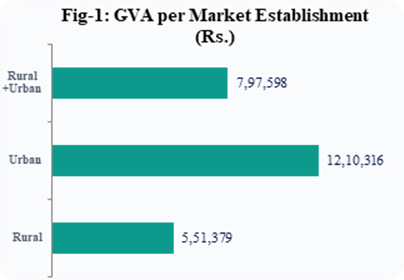
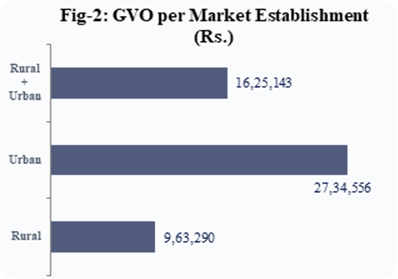
 

Title: GVA per Market Establishment (Rs.)

Financing Sources and Cost Composition of Household Construction Activities

On an average, about 97% of households reported their own income as one of the sources of fund to undertake construction activities, which accounted for approximately 77% of the total amount spent on construction.

Nearly 21% of households availed institutional (financial or non-financial) loan for financing their construction activities accounting for about 17% of the total construction expenditure. The proportion of households accessing institutional loans was higher in rural areas (23%) compared to urban areas (13%).

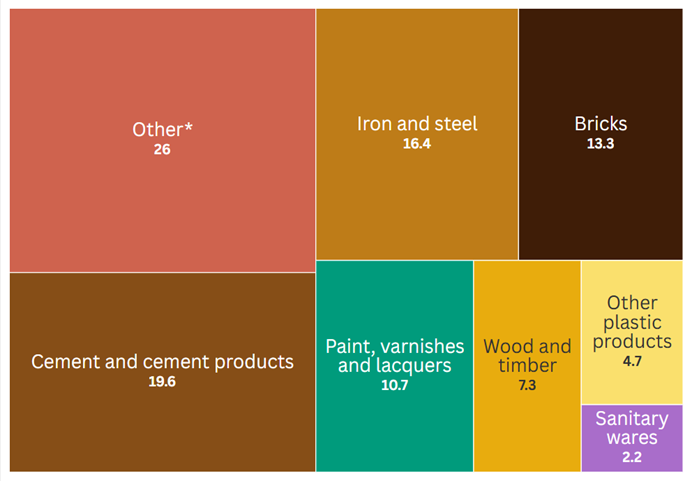
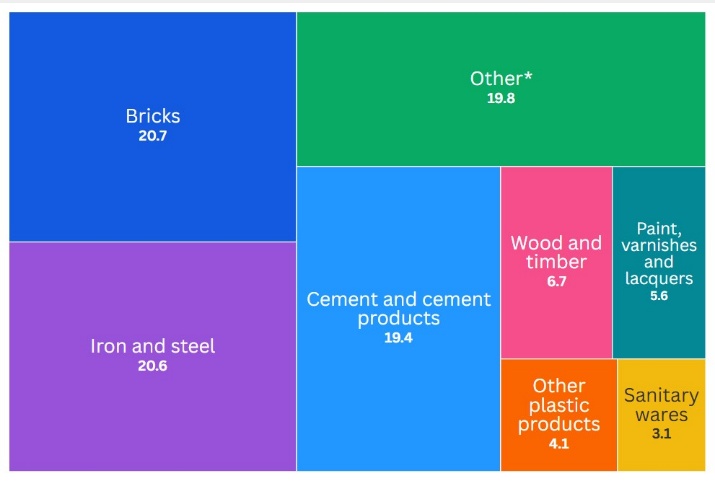
About three-fourths of household construction expenditure was on materials, with labour accounting for around 22 per cent. Within materials used for construction, bricks, cement, and iron and steel together comprised nearly 60 per cent of total expenditure.

Fig-3: Percentage Distribution of expenditure of materials: Household

*other includes petroleum, coal tar products, glass and glass products and other materials.

Fig-4: Percentage Distribution of expenditure of materials: Establishment

*other includes petroleum, coal tar products, glass and glass products and other materials.

Estimates of key indicators of the pilot study are given in Table 1 below. The detailed technical report also contains insights on major states and is available in the website of the Ministry (https://www.mospi.gov.in). Further, interactive tables and visualizations on other surveys conducted by NSO may be accessed on the Data Catalogue section of https://esankhyiki.mospi.gov.in/.

Table 1: Estimates of key indicators from Pilot Study on Construction Activities in Unincorporated Sector Establishments and Households

Indicator

Rural

Urban

Rural + Urban

(1)

(2)

(3)

(4)

Number of households undertaking own-account construction for own use

75,07,391

23,47,089

98,54,480

Number of establishments engaged in unincorporated construction activities

6,51,791

3,75,168

10,26,959

No. of Labourers engaged per household undertaking own account construction

4.2

4.4

4.3

No. of workers engaged per establishment in unincorporated construction activities

4.5

5.5

4.8

GVA per market establishment (Rs.)

5,51,379

12,10,316

7,97,598

Endnote: A brief about the coverage, sampling scheme, sample size and data collection mechanism in the Pilot Study on Construction Activities in Unincorporated Sector Establishments and Households:

A. Coverage of the pilot study:

A.1. Unincorporated Establishments: Market and non-market establishments engaged in construction activities

A.2. Households: own account construction undertaken by households for own use

A.3. Construction Activities: all activities under 2-digit NIC (2008) codes 41, 42 and 43 were considered in the definition of construction for the purpose of this pilot.

A.4.Expenditure on construction (for last 365 days or last financial year): Eligibility of establishments engaged in construction activities, as well as households undertaking own-account construction for own use, was determined based on whether their expenditure exceeded pre-specified thresholds, which varied by sector and type of sample entity. The expenditure threshold was set at ₹25,000 in rural areas and ₹50,000 in urban areas for establishments, and ₹10,000 in rural areas and ₹20,000 in urban areas for households. Any amount spent on construction below these cut-offs were not treated as construction work for this pilot study.

B. Sampling Scheme:

The survey has been conducted following a multi-stage stratified sampling scheme where first stage units (FSUs) were census villages in rural and UFS (Urban Frame Survey) blocks in urban areas.  The ultimate stage units (USU) were either establishments engaged in construction activities or households who has undertaken own account construction for own use.   

C. Sample Size:

In the pilot study, data were collected from a total of 19,154 households, 4,470 market establishments, and 717 non-market establishments pertaining to 11,981 surveyed FSUs (5,104 in rural and 6,877 in urban).

D. Data Collection Mechanism:

The pilot study has been conducted based on area frame and establishments/households have been listed in the selected FSUs of both rural and urban sector. Mostly, data were collected from the selected establishments/households through oral enquiry for the last 365 days. The data for the survey were collected in tablet using Computer Assisted Personal Interviewing (CAPI).

This pilot study has been carried out with Annual Survey of Unincorporated Sector Enterprises (ASUSE) 2025 in the same FSUs selected for the survey period July, 2025 – December, 2025. The listing schedule of ASUSE was suitably modified to accommodate the listing and selection of establishments and households undertaking construction under the coverage of the pilot study. The detailed establishment schedule was canvassed independently of ASUSE for collecting construction related information.

E. Detailed Technical Report of the Pilot Study:

For detailed understanding of the objectives, coverage, concepts, methodology and key findings from the pilot study one may refer to the Technical Report on Pilot Study on Construction Activities in Unincorporated Sector Establishments and Households published by NSO, MoSPI and available on the website of the ministry (https://www.mospi.gov.in).

Topics

Acts Income Tax