Loading...

Top
Help
×

By creating an account you can:

Logo TaxTMI
Call Us / Help / Feedback

Contact Us At :

E-mail: [email protected]

Call / WhatsApp at: +91 99117 96707

For more information, Check Contact Us

FAQs :

To know Frequently Asked Questions, Check FAQs

Most Asked Video Tutorials :

For more tutorials, Check Video Tutorials

Submit Feedback/Suggestion :

Email :
Please provide your email address so we can follow up on your feedback.
Category :
Description :
Min 15 characters 0/2000
Make Most of Text Search
  1. Checkout this video tutorial: How to search effectively on TaxTMI.
  2. Put words in double quotes for exact word search, eg: "income tax"
  3. Avoid noise words such as : 'and, of, the, a'
  4. Sort by Relevance to get the most relevant document.
  5. Press Enter to add multiple terms/multiple phrases, and then click on Search to Search.
  6. Text Search
  7. The system will try to fetch results that contains ALL your words.
  8. Once you add keywords, you'll see a new 'Search In' filter that makes your results even more precise.
  9. Text Search
Add to...
You have not created any category. Kindly create one to bookmark this item!
Create New Category
Hide
Title :
Description :
❮❮ Hide
Default View
Expand ❯❯
Close ✕
🔎 News - Adv. Search
TEXT SEARCH:

Press 'Enter' to add multiple search terms. Rules for Better Search

Search In:
Main Text + AI Text
  • Main Text
  • Main Text + AI Text
  • AI Text
Category: ?
Categorized by AI
---- All Categories ----
  • ---- All Categories ----
  • Income Tax
  • GST
  • Customs, DGFT & SEZ
  • FEMA & RBI
  • Corp. Laws, SEBI & IBC
  • PMLA, Black Money & ED
  • Budget
  • News and Press Release
  • PTI News
Month:
---- All Months ----
  • ---- All Months ----
  • January
  • February
  • March
  • April
  • May
  • June
  • July
  • August
  • September
  • October
  • November
  • December
Year:
---- All Years ----
  • ---- All Years ----
  • 2026
  • 2025
  • 2024
  • 2023
  • 2022
  • 2021
  • 2020
  • 2019
  • 2018
  • 2017
  • 2016
  • 2015
  • 2014
  • 2013
  • 2012
  • 2011
Sort By: ?
In Sort By 'Default', exact matches for text search are shown at the top, followed by the remaining results in their regular order.
Relevance Default Date
❯❯
Maximize Maximize Maximize
0 / 200
Expand Note
Add to Folder

No Folders have been created

+

Are you sure you want to delete "My most important" ?

NOTE:

News
Showing Results for :
Reset Filters
Results Found:
Show All Summaries Hide All Summaries
April 4, 2026
Show AI Summary
Global export hub logistics for Lalitpur Pharma Park strengthened through port connectivity and freight corridor integration.
Uttar Pradesh State Industrial Development Authority and Jawaharlal Nehru Port Authority have entered into a memorandum of understanding to develop the proposed Lalitpur Pharma Park as a global export hub by linking the industrial cluster to international maritime trade routes. The cooperation contemplates use of the Dadri-Khurja rail link with the Western Dedicated Freight Corridor and Eastern Dedicated Freight Corridor to create a multi-modal rail network for movement of pharmaceutical goods to JNPA, supporting import of raw materials and export of finished pharmaceutical products.
April 4, 2026
Show AI Summary
Indian pharmaceutical exports maintain growth momentum as formulations, biologicals, vaccines and Ayush products lead performance.
Indian pharmaceutical exports maintained growth momentum despite global pricing pressures and trade volatilities, with shipments reaching over USD 28 billion up to February in FY26 and registering year-on-year growth of 5.6 per cent over the corresponding period in FY25. Export performance was led by formulations, biologicals, vaccines and Ayush products.
April 4, 2026
Show AI Summary
Payroll compliance mistakes demand accurate classification, timely deductions, and automated statutory checks to prevent audits and penalties.
Payroll compliance requires accurate employee classification, timely tax deduction, and correct statutory contribution management to avoid audits, penalties, and employee disputes. Common errors include misclassifying employees and contract workers, which can cause missed PF, ESI and TDS obligations, and incorrect or delayed TDS computation arising from failed declarations, salary changes, or tax regime switches. The compliance approach relies on onboarding checks, real-time recalculation, and automated deposit scheduling to reduce errors before they enter the payroll cycle.
April 4, 2026
Show AI Summary
Bribery allegations against a CGST officer trigger a CBI trap, arrest, and continuing investigation into corruption claims.
Bribery allegations led to a CBI trap and arrest of an Assistant Commissioner, CGST, Ratlam, after a private person or middleman allegedly demanded money for not initiating GST proceedings against the complainant's firm. The accused was caught red-handed while accepting a bribe through the middleman, with searches continuing at the accused's premises and investigation still in progress.
April 4, 2026
Show AI Summary
Mutual fund approval process for subscribing to eligible public issues under the Income-tax Act framework clarified.
Approval is sought by a mutual fund to subscribe to an eligible issue of public companies under Schedule XV(1)(z)(ii) of the Income-tax Act, 2025, through Form 190. The form must be filed three months before the issue of eligible capital with the prescribed details and documents, including mutual fund and management particulars, scheme details, SEBI and custodian records, audited financial statements, and approval documents relating to the public company's share issue.
April 4, 2026
Show AI Summary
Mutual fund approval for eligible public company issues depends on timely filing of Form 190.
A mutual fund must file Form 190 to seek approval for investment in the eligible issue of public companies under Schedule XV(1)(z)(ii) of the Income-tax Act, 2025. The form corresponds to the earlier Form 59A under the Income-tax Rules, 1962, and to the corresponding rule framework under the Income-tax Rules, 2026. The application is to be filed by the mutual fund itself, together with the documents specified in the form, three months before the issue of eligible capital. Approval for subscription is granted on the basis of the particulars furnished in Form 190.
April 4, 2026
Show AI Summary
Approval for issue of eligible capital under Schedule XV depends on Form 189 details, disclosures, and supporting documents.
Form 189 is the application for approval of issue of public companies under Schedule XV(1)(z)(i) of the Income-tax Act, 2025, and is filed by the public company three months before the issue of eligible capital. The form requires company particulars, management details, bankers and auditors, issue details, project details, and supporting documents such as incorporation certificate, audited financial statements, equity details, SEBI approval and any project report. Processed Form 189 leads to approval for issue of eligible capital on the basis of the details furnished.
April 4, 2026
Show AI Summary
Public company issue approval through Form 189 governs eligible capital issues and related deduction eligibility.
Form 189 is the prescribed application for approval of issue of public companies under Schedule XV(1)(z)(i) of the Income-tax Act, 2025. It is filed by the public company with supporting documents before the issue of eligible capital, and the approval is granted on the basis of the details furnished in the form. Individual contributions to the issue are stated to qualify for deduction under the Act.
April 4, 2026
Show AI Summary
Consolidated approval form standardises gratuity and superannuation fund compliance, replacing rule-based particulars with structured filing.
Introduction of consolidated Form 188 standardises the approval process for Gratuity Fund and Superannuation Fund applications under Part B of Schedule XI by replacing the earlier text-based particulars in Rule 95 and Rule 109. The form is filed by trustees or an authorised person only for initial approval, and it requires details of the employer, the fund, eligible employees, account maintenance, fund status, trustee verification, and supporting documents such as the trust deed, fund rules, and accounts where applicable.
April 4, 2026
Show AI Summary
Approval mechanism for gratuity and superannuation funds is standardised through Form 188 with structured compliance requirements.
Form 188 provides a standardised application mechanism for approval of Gratuity Funds and Superannuation Funds, replacing earlier rule-based procedural requirements. It is filed once by the trustees or an authorised person, with prescribed particulars and supporting documents such as the trust deed, fund rules, accounts, and balance sheet where applicable. The application is examined by the jurisdictional authority, which may seek clarifications and then grant approval, issue deficiency notice, or reject the application.
April 4, 2026
Show AI Summary
Appeal against fund recognition refusal uses Form 187, with supporting documents and filing within 60 days.
Appeal against refusal to recognise or withdrawal of recognition from a recognised provident fund, and refusal to approve or withdrawal of approval from a superannuation fund or gratuity fund, is filed in Form 187 by the employer, trustee, or authorised representative within 60 days of communication of the order. The form requires appellant particulars, fund details, grounds of appeal, verification, and supporting documents such as the impugned order, original application, proof of filing, authorisation, and fee challan.
April 4, 2026
Show AI Summary
Appeals for provident, superannuation and gratuity funds require Form 187, supporting documents and filing within 60 days.
Form 187 prescribes the appellate mechanism under the Income-tax Act, 2025 for matters concerning recognised provident funds, superannuation funds and approved gratuity funds, including appeals against orders affecting recognition, approval, withdrawal, cancellation or refusal of such status. The form is to be used by trustees, employers or other authorised persons representing the fund where an adverse order has been passed by the competent income-tax authority. Appeals must be filed within 60 days from communication of the order, and filing does not by itself operate as a stay unless specifically granted.
April 4, 2026
Show AI Summary
Customs enforcement along the India-Nepal border led to seizure of undocumented soft drinks and air conditioners.
Customs enforcement along the India-Nepal border led to seizure of soft drinks and air conditioners being moved without valid customs documents. A vehicle carrying 1,575 bottles of soft drinks was intercepted after the driver tried to flee, while two split air conditioners transported on bicycles were also recovered in a separate patrol operation. The goods, vehicle and bicycles were handed over to the Customs Department.
April 4, 2026
Show AI Summary
Indian pharmaceutical exports show sustained growth as formulations, biologicals, vaccines and Ayush products drive resilience.
Indian pharmaceutical exports recorded sustained growth in FY26, reaching nearly USD 29 billion by the end of February and increasing over the corresponding period in the previous financial year. The export performance was led by formulations, biologicals, vaccines and Ayush products, and was described as resilient despite global challenges, pricing pressures and trade volatility. The sector's overall value was placed at about USD 60 billion, with projected expansion to USD 130 billion by 2030.
April 4, 2026
Show AI Summary
Recognised Provident Fund recognition process requires trust deed compliance, supporting documents, scrutiny and ongoing investment and reporting obligations.
Application under Rule 40C seeks recognition of a provident fund so it qualifies as a Recognised Provident Fund for income-tax purposes. It applies to employers, trustees and existing funds seeking recognition on formation, conversion, amendment, merger or split. The form requires trust deed details, fund rules, investment policy, financial information and supporting documents, followed by scrutiny, possible revisions, issuance of recognition and ongoing compliance with investment, audit and reporting requirements.
April 4, 2026
Show AI Summary
Recognised Provident Fund recognition through Form 186 depends on disclosure, supporting documents, and compliance with trust conditions.
Form 186 is the prescribed application for seeking recognition of a provident fund as a Recognised Provident Fund for income-tax purposes. It is filed by the employer, trustees, or an existing trust seeking recognition, and is ordinarily a one-time application subject to refiling or intimation for material changes in the trust deed or fund rules. The form requires detailed disclosures and supporting documents, and on approval the fund attains RPF status with tax treatment governed by applicable statutory limits and conditions. Recognition may later be withdrawn for non-compliance.
April 4, 2026
Show AI Summary
Recognised provident fund accounting in Form 185 requires annual subscriber-wise records of contributions, interest, withdrawals, and balances.
Rule 294 requires recognised provident fund accounts to be prepared at intervals not exceeding twelve months, with a separate account maintained for each subscriber in Form 185. The form is maintained internally by the provident fund trust or authorised officers, and records subscriber particulars, opening balance, monthly contributions, interest, withdrawals or advances, closing balance, and verification. Part A is maintained separately for each subscriber, while Part B presents the same information in consolidated annual subscriber-wise form.
April 4, 2026
Show AI Summary
Recognised Provident Fund recordkeeping requires Form 185 to track contributions, interest, withdrawals, and annual balances.
Form No. 185 is the prescribed accounting format for individual subscriber records under a Recognised Provident Fund, maintained by trustees or authorised officers under the Income-tax Rules. It records annual subscriber-wise particulars such as contributions, interest credited, withdrawals or advances, opening and closing balances, and verification details. Part-A is kept for each subscriber, while Part-B is the annual consolidated abstract filed with the Assessing Officer.
April 4, 2026
Show AI Summary
Deduction audit report for petroleum and natural gas businesses requires deposit verification, withdrawal checks, and Chartered Accountant certification.
Form No. 183 is the prescribed audit report for claiming deduction under section 49 in the business of prospecting, extracting, or producing petroleum, natural gas, or both in India. It is furnished by a Chartered Accountant and verifies audit of the relevant books, timely deposit into the specified account, permitted use of withdrawals, disallowance of inadmissible expenditure, and transfer restrictions on assets acquired under the scheme. The form is filed annually before the return due date and requires supporting records of books, deposits, withdrawals, and asset transfers.
April 4, 2026
Show AI Summary
Supply chain disruption hits Bikaner snack exports as conflict delays shipments and raises freight and input costs.
West Asia conflict has disrupted Bikaner exports and imports, causing delays in shipments of bhujia, papad, namkeen and spices to Gulf and European markets. Traders report longer transit routes, container shortages, higher freight charges, rising raw material and packaging costs, and consignments stuck at ports or in transit, affecting the city's export-driven economy.

News

Back

All News

Showing Results for :
Reset Filters
No Records Found

News

Showing Results for : Reset Filters
News and Press Release

MoSPI Breaks New Ground: First-Ever Deep Dive into Unincorporated Construction Sector in Decades

April 11, 2026

Contents
Summary
Note

Note

-

Bookmark

Print

Print

Nearly 1 crore households built their own homes or undertook construction for self-use

10 Lakh+ Small Builders Power Economy: Unincorporated Construction Sector Comes into Focus

Snapshot:

  • MoSPI releases the technical report of pilot study on construction - marking NSO’s first such effort in decades to estimate key economic indicators of construction activities in the unincorporated sector and own-account household construction in a reference period of last 365 days.
  • During the reference period, an estimated 98.54 lakh households undertook own-account construction for their own use.
  • 10.27 lakh construction agencies (unincorporated establishments) were estimated to be engaged in this sector.
  • Approximately 77 per cent of these agencies engaged at least one hired worker on a fairly regular basis.
  • Estimated average value of fixed assets owned by such construction establishments was ₹5.21 lakh.
  • Nearly 23% of rural households undertaking own-account construction for own-use availed institutional funding reflecting increasing access to formal credit in rural areas.

The Ministry of Statistics and Programme Implementation (MoSPI) has released a technical report presenting the key findings from a Pilot study conducted on Construction Activities in Unincorporated Sector Establishments and Households. This study marks the first comprehensive attempt in decades by the National Statistics Office (NSO) to estimate key economic indicators for construction activities undertaken by unincorporated construction agencies (establishments engaged in construction activity), as well as own-account construction carried out by households for their own use. The study underscores MoSPI’s sustained efforts to bridge critical data gaps in sectors where reliable information has been limited. Data from the pilot study also served as an important input for the revised series of the national accounts statistics brought out by MoSPI. A brief overview of the pilot study in terms of coverage, sampling strategy, data collection mechanism, etc., is provided in the Endnote.

The construction sector plays a crucial role in Indian economy, serving both as a driver of growth and an indicator of economic progress. As a key engine of development, it contributes significantly to output, employment, and capital formation, while maintaining strong backward and forward linkages with various other sub-sectors of the economy. While the incorporated segment of the construction sector is to be covered under the recently launched Annual Survey of Incorporated Services Sector Enterprises (ASISSE), data remains limited for unincorporated construction enterprises and households undertaking own-account construction for own use in India. Recognizing the importance of generating robust and reliable estimates of key economic parameters in the construction sector, this pilot study was undertaken alongside Annual Survey of Unincorporated Sector Enterprises (ASUSE) 2025 in the same First Stage Units (FSUs) during the survey period from July to December 2025.

The pilot study, apart from capturing expenses and receipts, was designed to collect key information on employment and a broader set of economic parameters for construction establishments (both market and non-market), including fixed assets, outstanding loans, and various components of expenditure. For households, it focuses on capturing expenditure on construction activities, details of labour engagement, and sources of finance.

The findings of this pilot study served as a crucial input for the National Accounts Division (NAD) in updating and refining the rates and ratios used for estimating several economic indicators in the construction sector under the new series of national accounts.

Estimated number of construction activities undertaken:

It was estimated that 98.54 lakh households have undertaken construction during last 365 days (the reference period of the estimates)[1]. It was also estimated that 10.27 lakh unincorporated construction agencies were engaged in this sector which included both market and non-market establishment.

Average number of worker engaged in the construction sector:

On an average, an unincorporated builder establishment engaged in construction activities employed about five workers during the reference period. Further, approximately 77 per cent of such establishments reported engaging at least one hired worker on a fairly regular basis.

A household undertaking own-account construction for its own use during the reference period engaged around four labourers on an average.

Fixed Assets and Loan:

Fixed assets owned per unincorporated establishment engaged in construction activity has been estimated to be ₹5.21 lakh. The financial access, as reflected by the outstanding loan per establishment in the sector, was estimated to be little more than ₹1.40 lakh.

Value Addition and productivity:

The GVA per market establishment[2] for the unincorporated construction sector was estimated to be about Rs. 7.98 lakh and the corresponding output per establishment was Rs. 16.25 lakh.

The NVA and output per non-market establishment was observed to be Rs. 2.77 lakh and Rs. 5.59 lakh respectively.
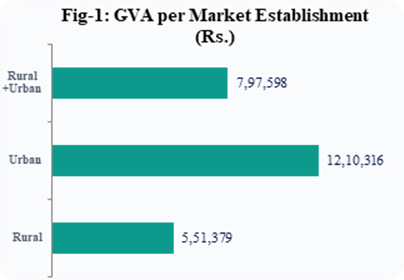
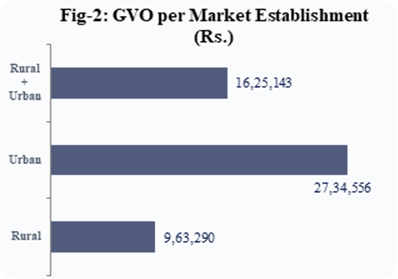
 

Title: GVA per Market Establishment (Rs.)

Financing Sources and Cost Composition of Household Construction Activities

On an average, about 97% of households reported their own income as one of the sources of fund to undertake construction activities, which accounted for approximately 77% of the total amount spent on construction.

Nearly 21% of households availed institutional (financial or non-financial) loan for financing their construction activities accounting for about 17% of the total construction expenditure. The proportion of households accessing institutional loans was higher in rural areas (23%) compared to urban areas (13%).

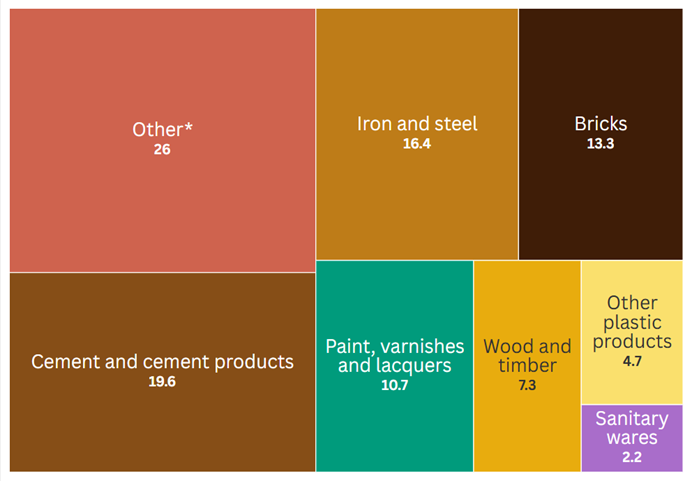
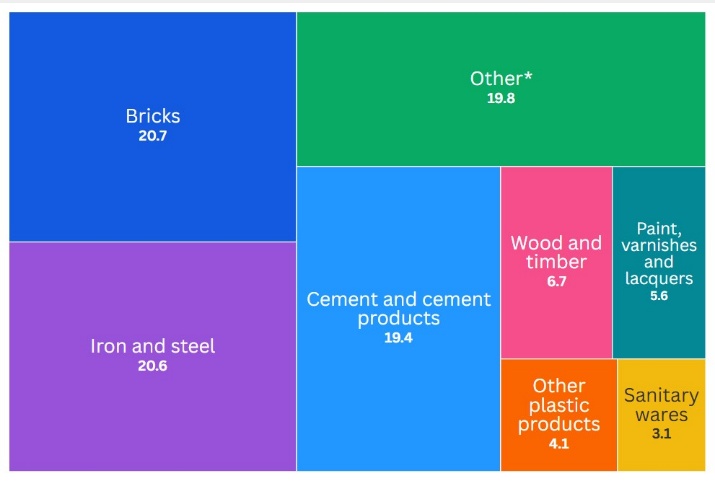
About three-fourths of household construction expenditure was on materials, with labour accounting for around 22 per cent. Within materials used for construction, bricks, cement, and iron and steel together comprised nearly 60 per cent of total expenditure.

Fig-3: Percentage Distribution of expenditure of materials: Household

*other includes petroleum, coal tar products, glass and glass products and other materials.

Fig-4: Percentage Distribution of expenditure of materials: Establishment

*other includes petroleum, coal tar products, glass and glass products and other materials.

Estimates of key indicators of the pilot study are given in Table 1 below. The detailed technical report also contains insights on major states and is available in the website of the Ministry (https://www.mospi.gov.in). Further, interactive tables and visualizations on other surveys conducted by NSO may be accessed on the Data Catalogue section of https://esankhyiki.mospi.gov.in/.

Table 1: Estimates of key indicators from Pilot Study on Construction Activities in Unincorporated Sector Establishments and Households

Indicator

Rural

Urban

Rural + Urban

(1)

(2)

(3)

(4)

Number of households undertaking own-account construction for own use

75,07,391

23,47,089

98,54,480

Number of establishments engaged in unincorporated construction activities

6,51,791

3,75,168

10,26,959

No. of Labourers engaged per household undertaking own account construction

4.2

4.4

4.3

No. of workers engaged per establishment in unincorporated construction activities

4.5

5.5

4.8

GVA per market establishment (Rs.)

5,51,379

12,10,316

7,97,598

Endnote: A brief about the coverage, sampling scheme, sample size and data collection mechanism in the Pilot Study on Construction Activities in Unincorporated Sector Establishments and Households:

A. Coverage of the pilot study:

A.1. Unincorporated Establishments: Market and non-market establishments engaged in construction activities

A.2. Households: own account construction undertaken by households for own use

A.3. Construction Activities: all activities under 2-digit NIC (2008) codes 41, 42 and 43 were considered in the definition of construction for the purpose of this pilot.

A.4.Expenditure on construction (for last 365 days or last financial year): Eligibility of establishments engaged in construction activities, as well as households undertaking own-account construction for own use, was determined based on whether their expenditure exceeded pre-specified thresholds, which varied by sector and type of sample entity. The expenditure threshold was set at ₹25,000 in rural areas and ₹50,000 in urban areas for establishments, and ₹10,000 in rural areas and ₹20,000 in urban areas for households. Any amount spent on construction below these cut-offs were not treated as construction work for this pilot study.

B. Sampling Scheme:

The survey has been conducted following a multi-stage stratified sampling scheme where first stage units (FSUs) were census villages in rural and UFS (Urban Frame Survey) blocks in urban areas.  The ultimate stage units (USU) were either establishments engaged in construction activities or households who has undertaken own account construction for own use.   

C. Sample Size:

In the pilot study, data were collected from a total of 19,154 households, 4,470 market establishments, and 717 non-market establishments pertaining to 11,981 surveyed FSUs (5,104 in rural and 6,877 in urban).

D. Data Collection Mechanism:

The pilot study has been conducted based on area frame and establishments/households have been listed in the selected FSUs of both rural and urban sector. Mostly, data were collected from the selected establishments/households through oral enquiry for the last 365 days. The data for the survey were collected in tablet using Computer Assisted Personal Interviewing (CAPI).

This pilot study has been carried out with Annual Survey of Unincorporated Sector Enterprises (ASUSE) 2025 in the same FSUs selected for the survey period July, 2025 – December, 2025. The listing schedule of ASUSE was suitably modified to accommodate the listing and selection of establishments and households undertaking construction under the coverage of the pilot study. The detailed establishment schedule was canvassed independently of ASUSE for collecting construction related information.

E. Detailed Technical Report of the Pilot Study:

For detailed understanding of the objectives, coverage, concepts, methodology and key findings from the pilot study one may refer to the Technical Report on Pilot Study on Construction Activities in Unincorporated Sector Establishments and Households published by NSO, MoSPI and available on the website of the ministry (https://www.mospi.gov.in).

Topics

Acts Income Tax