Loading...

Top
Help
×

By creating an account you can:

Logo TaxTMI
Call Us / Help / Feedback

Contact Us At :

E-mail: [email protected]

Call / WhatsApp at: +91 99117 96707

For more information, Check Contact Us

FAQs :

To know Frequently Asked Questions, Check FAQs

Most Asked Video Tutorials :

For more tutorials, Check Video Tutorials

Submit Feedback/Suggestion :

Email :
Please provide your email address so we can follow up on your feedback.
Category :
Description :
Min 15 characters 0/2000
Make Most of Text Search
  1. Checkout this video tutorial: How to search effectively on TaxTMI.
  2. Put words in double quotes for exact word search, eg: "income tax"
  3. Avoid noise words such as : 'and, of, the, a'
  4. Sort by Relevance to get the most relevant document.
  5. Press Enter to add multiple terms/multiple phrases, and then click on Search to Search.
  6. Text Search
  7. The system will try to fetch results that contains ALL your words.
  8. Once you add keywords, you'll see a new 'Search In' filter that makes your results even more precise.
  9. Text Search
Add to...
You have not created any category. Kindly create one to bookmark this item!
Create New Category
Hide
Title :
Description :
❮❮ Hide
Default View
Expand ❯❯
Close ✕
🔎 News - Adv. Search
TEXT SEARCH:

Press 'Enter' to add multiple search terms. Rules for Better Search

Search In:
Main Text + AI Text
  • Main Text
  • Main Text + AI Text
  • AI Text
Category: ?
Categorized by AI
---- All Categories ----
  • ---- All Categories ----
  • Income Tax
  • GST
  • Customs, DGFT & SEZ
  • FEMA & RBI
  • Corp. Laws, SEBI & IBC
  • PMLA, Black Money & ED
  • Budget
  • News and Press Release
  • PTI News
Month:
---- All Months ----
  • ---- All Months ----
  • January
  • February
  • March
  • April
  • May
  • June
  • July
  • August
  • September
  • October
  • November
  • December
Year:
---- All Years ----
  • ---- All Years ----
  • 2026
  • 2025
  • 2024
  • 2023
  • 2022
  • 2021
  • 2020
  • 2019
  • 2018
  • 2017
  • 2016
  • 2015
  • 2014
  • 2013
  • 2012
  • 2011
Sort By: ?
In Sort By 'Default', exact matches for text search are shown at the top, followed by the remaining results in their regular order.
Relevance Default Date
    Guidance Note - Form 23
    FORM 23 — Frequently Asked Questions (FAQs)
    Guidance Note - Form 22
    Union Minister of Commerce and Industry Shri Piyush Goyal Urges Industry to Leverage FTAs with Developed Nations through Quality Focus
    14th Ministerial Conference of the World Trade Organization to be held in Yaoundé from 26–29 March 2026 under Cameroon’s chairmanship
    DPIIT Signs MoU with a Leading Fintech Platform to Strengthen India’s Startup Ecosystem
    All India Workshop of Trainers (AIWOT) for Rapid Survey of Functional Cooperatives (RSFC)
    Flash Report on Central Sector Infrastructure Projects worth ₹150 crore and above
    FORM 22 — Frequently Asked Questions (FAQs)
    Guidance Note - Form 21
    Several 'facilitative' steps taken in Budget for middle class: Sitharaman
    The World Famous American Pan-Asian Brand, P.F. Chang's, Debuts in the Tricity with Mohali Restaurant at HLP Gallerria
    FORM 21— Frequently Asked Questions (FAQs)
    Guidance Note - Form 20
    Andhra Pradesh to see no electricity tariff hike for FY27
    Why Interest Rates Matter When Choosing a Personal Loan: Key Insights for Salaried Borrowers
    Time Use Survey (TUS) 2024
    PAIMANA PORTAL AND MANAGEMENT OF MAJOR INFRASTRUCTURE PROJECTS
    CTIL, IIFT Extends Support to International Economic Law Moot Court Competition
    FORM 20 — Frequently Asked Questions (FAQs)
❯❯
Maximize Maximize Maximize
0 / 200
Expand Note
Add to Folder

No Folders have been created

+

Are you sure you want to delete "My most important" ?

NOTE:

News
Showing Results for :
Reset Filters
Results Found:
Show All Summaries Hide All Summaries
March 25, 2026
Show AI Summary
Skill Development Project notification under income tax law links approval, audit compliance, and renewal conditions for eligible companies.
Form 23 is the CBDT notification form for an approved Skill Development Project under Section 47(1)(b) of the Income-tax Act, 2025 read with Rules 39 and 40. It is issued after Form 22 is examined and recommended by NCVET, and it specifies the approved Tax Year(s), project particulars, conditions, and validity for up to three Tax Years. The framework requires separate books, audit, prescribed reporting, compliance with notification conditions, and permits renewal or revocation depending on project performance and statutory compliance.
March 25, 2026
Show AI Summary
Skill development project notification governs approval, tax-year limits, conditions, and compliance for income-tax benefits.
Form 23 is the income-tax notification form for an approved skill development project under Section 47(1)(b) of the Income-tax Act, 2025, issued after approval under Rule 39. It notifies the project in the Official Gazette, specifies the approved tax years, and sets the terms, duration, and expenditure limits. The notification is issued by the Central Board of Direct Taxes on recommendation of NCVET, and contains the company's particulars, project details, training institute details, approved tax years, estimated expenditure, and attached conditions.
March 25, 2026
Show AI Summary
Skill Development Project approval under income tax rules requires Form 22 filing, structured disclosures, and electronic verification.
Form 22 is the prescribed Income-tax application by which an eligible company seeks approval of a Skill Development Project under Section 47(1)(b) of the Income-tax Act, 2025 read with Rule 39. The form is filed with the National Council for Vocational Education and Training for recommendation to the Central Board of Direct Taxes, and it must be submitted electronically using DSC or EVC before commencement of the project. It requires disclosure of company particulars, project particulars, training institute details, prior notifications or revocations, return of income data, penalties, outstanding tax demands, expenditure projections, and supporting annexures.
March 25, 2026
Show AI Summary
Free trade agreements and voluntary CSR are highlighted as tools for quality-led growth and inclusive development.
India's expanded free trade agreements are presented as a means of securing preferential market access for goods and services, with reduced or zero duty benefits linked to stronger export competitiveness. Indian industry, farmers, MSMEs, fishermen and artisans are urged to use these opportunities through a sustained focus on quality, higher standards and improved production and service capability. The statement also presents voluntary corporate social responsibility beyond statutory minima as an example of tangible social commitment.
March 25, 2026
Show AI Summary
Multilateral trading system priorities shape India's agenda on WTO reform, food security, digital trade, and development concerns.
The WTO Ministerial Conference agenda covers WTO reform, the e-commerce work programme and moratorium, investment facilitation for development, fisheries subsidies, and agriculture-related issues. India's priorities include a development-centric multilateral trading system, a permanent solution on Public Stockholding for food security, effective Special and Differential Treatment, and a fully functional, automatic, and binding dispute settlement mechanism. India also supports policy space in digital trade, balanced fisheries subsidy disciplines, and investment facilitation for developing countries.
March 25, 2026
Show AI Summary
Startup ecosystem partnership expands incorporation support, mentorship and financial tools for early-stage founders through a dedicated platform.
DPIIT entered into a strategic partnership with a leading fintech platform through a Memorandum of Understanding to strengthen India's startup ecosystem by supporting startups, innovators and entrepreneurs with financial tools, founder enablement programmes and ecosystem assistance. The collaboration is directed towards helping early- and growth-stage startups scale through digital payment solutions, financial infrastructure, incorporation support, mentorship and structured guidance for formalising and expanding operations. A dedicated platform, Startup Sahayak, has been launched to provide end-to-end assistance for early-stage founders, including company incorporation, access to schemes and guidance on funding opportunities.
March 25, 2026
Show AI Summary
Cooperative sector survey training strengthens data quality and prepares nationwide collection on economic contribution and employment generation.
The Rapid Survey of Functional Cooperatives is being prepared through an all-India training workshop to equip master trainers with conceptual clarity, survey methodology, technical know-how, and uniform understanding of survey concepts. The survey will be conducted nationwide from April 2026 using the National Cooperative Database as the sampling frame and a web-based data collection system to generate sector-wise estimates of economic contribution and employment generation.
March 25, 2026
Show AI Summary
Infrastructure project monitoring through PAIMANA tracks ongoing Central Sector projects, sector-wise progress, and new additions across Ministries.
Central Sector infrastructure projects worth Rs.150 crore and above are monitored through the PAIMANA portal, which standardises infrastructure tracking, auto-updates project data from Ministries and Departments, and supports timely review and data-driven decision-making. As of February 2026, the portal records 1,948 ongoing projects across 17 Central Ministries and Departments, with a revised cost of Rs.41.98 lakh crore and cumulative expenditure of Rs.19.71 lakh crore. The portfolio covers multiple sectors, led by Transport & Logistics and Energy, and includes new additions and commissioned projects during February 2026.
March 25, 2026
Show AI Summary
Skill development project approval through Form 22 requires online filing, verified disclosures, and compliance with prescribed conditions.
Form 22 is the prescribed income-tax application for an eligible company seeking approval of a skill development project under Section 47(1)(b) of the Income-tax Act, 2025, read with Rule 39. The form is filed before commencement of the project through the e-filing portal and requires disclosure of the project structure, training institute particulars, proposed expenditure, supporting documents, and compliance details. It is verified by DSC or EVC, and defects must be rectified within the prescribed time or the application may be treated as invalid.
March 25, 2026
Show AI Summary
Agricultural extension project notification under Form 21 requires approval, compliance, renewal, and revocation safeguards.
Form 21 is the notification instrument issued by the Central Board of Direct Taxes for an approved Agricultural Extension Project under Section 47(1)(a) of the Income-tax Act, 2025 read with Rule 37. It is issued after examination of Form 20, records the project particulars, approved tax years, expected expenditure, and notification conditions, and is authenticated by signature and Official Gazette publication. The notification remains valid for up to three Tax Years, is subject to compliance and renewal requirements, and may be revoked for cessation, non-genuine activities, or breach of approval conditions.
March 25, 2026
Show AI Summary
Facilitative tax and customs reform measures in the Finance Bill 2026 aim to ease compliance, support MSMEs, and promote trade.
The Finance Bill 2026 is described as a set of facilitative tax and customs measures centred on trust-based tax administration, ease of living, MSME support, trade facilitation and customs reform. The measures highlighted include lower tax collected at source on certain foreign remittances and overseas tour packages, customs duty exemption on critical drugs, duty-free import treatment for medicines and personal use articles, permission to file updated income-tax returns after reassessment proceedings begin, and a foreign asset disclosure scheme for small taxpayers. The Bill also seeks to reduce compliance burden and dispute potential through customs rationalisation and facilitation-first enforcement.
March 25, 2026
Show AI Summary
Pan-Asian dining expansion marks P.F. Chang's Tricity debut with a Mohali restaurant and signature wok-first menu.
P.F. Chang's expands its India footprint by opening its first restaurant in Mohali at HLP Gallerria, marking its Tricity debut and eighth outlet in the country. The launch is part of the brand's North India growth strategy and extends its presence beyond metro locations. The Mohali restaurant highlights the brand's wok-first cooking, scratch-made sauces, signature Pan-Asian dishes, and menu options tailored for Indian diners, including vegetarian and Jain selections, alongside MSG-free preparation and a premium casual dining experience.
March 25, 2026
Show AI Summary
Agricultural extension project notification under income-tax rules sets approval conditions, duration limits, and compliance requirements for tax benefits.
Form 21 is the prescribed income-tax notification form for an approved agricultural extension project under Section 47(1)(a) of the Income-tax Act, 2025, issued after approval under Rule 37 and published in the Official Gazette. It notifies the project, specifies the approved tax year(s), and sets out the terms, conditions, duration, expenditure limits, and beneficiary charges. The form records the applicant's particulars, project purpose, commencement date, approved period, estimated expenditure, and other conditions attached to approval.
March 25, 2026
Show AI Summary
Agricultural Extension Project approval requires Form 20 filing, prior Ministry clearance, and electronic verification before commencement.
Form 20 is the prescribed income-tax application for approval of an Agricultural Extension Project under Section 47(1)(a) read with Rule 37. It must be filed electronically before commencement of the project and before seeking notification, with prior Ministry of Agriculture approval and compliance with Rule 37 conditions. The form requires applicant and project particulars, supporting documents, and verification through DSC or EVC. Defects must be rectified within one month, approval is notified in Form 21 and published in the Official Gazette, and it remains valid for up to three tax years.
March 25, 2026
Show AI Summary
Electricity tariff stability keeps consumer burden unchanged while supporting farmers, households, industry, and power sector efficiency.
The Andhra Pradesh Electricity Regulatory Commission approved a tariff order for FY2026-27 keeping electricity tariffs unchanged across consumer categories, while also undertaking true-up/down and performance review of the distribution companies for FY2024-25 after public consultation. The order records a lower approved revenue gap than projected by the distribution companies and provides for full Government support of the approved gap, with the effect that consumers are not subjected to tariff increase or additional true-up burden.
March 25, 2026
Show AI Summary
Personal loan interest rates shape EMI burden, repayment costs, and borrowing decisions for salaried individuals.
Interest rates are a primary determinant of the affordability of personal loans for salaried borrowers, directly affecting monthly EMI outgo, total repayment burden and overall budget planning. Even small differences in the rate can materially alter long-term repayment commitments, making comparison of rates and related charges an important step before borrowing. The rate offered to a salaried borrower is described as dependent on credit score, repayment history, monthly income, job stability, existing financial obligations and employer profile.
March 25, 2026
Show AI Summary
Unpaid caregiving work shows a clear gender gap in Time Use Survey 2024, with women participating more and spending more time.
Time Use Survey 2024 measures participation in paid and unpaid activities and reports unpaid caregiving for household members among persons aged 15 to 59 years. It compares Time Use Survey 2024 with Time Use Survey 2019, noting differences in participation rates and average daily time spent on caregiving by men and women. The release highlights that women participate more in unpaid caregiving and spend more time on it than men.
March 25, 2026
Show AI Summary
Infrastructure project monitoring through PAIMANA, integrated dashboards, and escalation-based review to reduce delays and improve execution.
MoSPI monitors ongoing Central Sector infrastructure projects costing Rs. 150 crore and above through PAIMANA, a web-based monitoring system integrated with DPIIT's portal under the principle of One Data One Entry. The platform automatically fetches project data, reduces manual entry, supports evidence-based monitoring, and provides customized dashboards, monthly reviews, and analytics for stakeholders. Delay-mitigation measures also include PRAGATI reviews and DPIIT's Project Monitoring Group, which uses milestone-based monitoring and a 5-tier escalation framework for issue resolution and fast-tracking of approvals and clearances.
March 25, 2026
Show AI Summary
International trade law and WTO dispute settlement shaped CTIL's support for a regional moot court competition.
CTIL supported the 24th edition of the John H. Jackson Moot Court Competition as a Platinum Sponsor for the West and South Asia regional round. The event focused on international trade law, WTO law and dispute settlement, with CTIL research staff serving as judges and CTIL presenting its work in trade and investment law, capacity-building programmes and policy discourse.
March 25, 2026
Show AI Summary
Agricultural extension project approval governs online filing, verification, and compliance for tax-benefit eligibility under the income-tax framework.
Form 20 is the prescribed income-tax application for approval of an agricultural extension project under Section 47(1)(a) of the Income-tax Act, 2025 read with Rule 37. It is used by an assessee seeking approval for a project undertaken for training, education and guidance of farmers, with prior approval from the Ministry of Agriculture and Farmers Welfare and expected expenditure, excluding land and building, exceeding the specified threshold. The form serves to secure approval-related tax benefits and to furnish structured disclosure of the project, expenditure estimates, beneficiary details, compliance history and prior approvals.

News

Back

All News

Showing Results for :
Reset Filters
No Records Found

News

Back

All News

Showing Results for : Reset Filters

Pradhan Mantri Mudra Yojana (PMMY) — completes 11 Years of empowering Small and Micro Entrepreneurs

April 8, 2026

Contents
Summary
Note

Note

-

Bookmark

Print

Print

PMMY instrumental in reshaping the credit landscape for MSMEs and countless individual entrepreneurs in the country: Union Finance Minister Smt. Nirmala Sitharaman

PMMY provides a platform for small entrepreneurs to access loan support from banks, NBFCs, and MFIs as it drives credit inclusion: MoS Sh. Pankaj Chaudhary

Mudra Yojana facilitates seamless access to collateral-free institutional credit up to ₹20 lakh for non-corporate and non-farm income-generating activities

PMMY has disbursed over ₹40.07 lakh crore through 57.79 crore loans, strengthening the credit ecosystem for small and micro enterprises

The Pradhan Mantri MUDRA Yojana (PMMY) launched by Prime Minister Shri Narendra Modi on April 8, 2015, is marking 11 years of success in strengthening India's grassroots entrepreneurs. This initiative has been designed to bridge the gap in financial accessibility, offering streamlined, easy collateral-free loans up to ₹20 lakh to support small-scale business ventures for non-corporate and non-farm income-generating activities.

Micro, Small, and Medium Enterprises (MSMEs) serve as the backbone of the industrial ecosystem, acting as essential partners to major corporations and driving balanced economic development. By diversifying their reach into new industries and refining their output, these enterprises are effectively addressing the needs of both local consumers and global markets.

The landscape of business financing has evolved rapidly, with digital innovations and data analytics making it easier for smaller firms to secure capital. A cornerstone of this progress is PMMY, a strategic government initiative famously characterized by its mission to "Fund the Unfunded," ensuring that credit reaches those traditionally overlooked by formal banking systems.

On the occasion of the 11th successful year of PMMY, Union Minister for Finance & Corporate Affairs Smt. Nirmala Sitharaman said, “In the last decade, India witnessed a silent transformation where crores of ordinary citizens stepped into entrepreneurship with newfound confidence and agency. At its heart lies an initiative launched on April 08, 2015, by the Prime Minister, the Pradhan Mantri MUDRA Yojana (PMMY), which, by design, focused on "funding the unfunded".

“Eleven years later, the scheme has been instrumental in reshaping the credit landscape for MSMEs and countless individual entrepreneurs in the country. These were those entrepreneurs who were hitherto excluded from the formal banking system. With this initiative, entrepreneurship has become truly democratised by removing the entry barriers to credit”, Smt. Nirmala Sitharaman added.

Highlighting PMMY’s role in Empowering Millions and Fulfilling the Vision of Inclusive Growth, Union Minister of Finance remarked, “Cumulatively, more than 57.79 crore loans have been sanctioned, amounting to ₹40.07 lakh crore of disbursement. Two-thirds of the loans have been sanctioned to women entrepreneurs. Approximately one-fifth of all the loans were extended to first-time entrepreneurs. In sheer magnitude, this translates to 12.15 crore loans with an amount of 12 lakh crores extended to new entrepreneurs.”

The Union Finance Minister also appreciated the Banks, various Financial Institutions, and stakeholders for bringing the scheme to the common man and making it a resounding success.

“PM MUDRA Yojana will continue to empower entrepreneurs to become active participants in our nation's journey to become Viksit Bharat by 2047”, Smt. Nirmala Sitharaman said.

On the occasion, Union Minister of State (MoS) for Finance, Shri Pankaj Chaudhary said, “The Pradhan Mantri MUDRA Yojana (PMMY) is one of the most significant initiatives, aimed at promoting micro-entrepreneurship. Financial inclusion is one of the top priorities of the government, as it plays a vital role in achieving inclusive growth. PMMY provides a platform for small entrepreneurs to access loan support from banks, NBFCs, and MFIs as it drives credit inclusion.”

“The MUDRA Yojana was launched by the Prime Minister Shri Narendra Modi on April 8, 2015. While launching the scheme, the Prime Minister stated that supporting India's small entrepreneurs is one of the most effective ways to help the Indian economy grow and prosper. The scheme has provided crucial financial assistance to a vast number of entrepreneurs, helping them set up and operate their businesses and instilling a sense of financial security in them.”, MoS said.

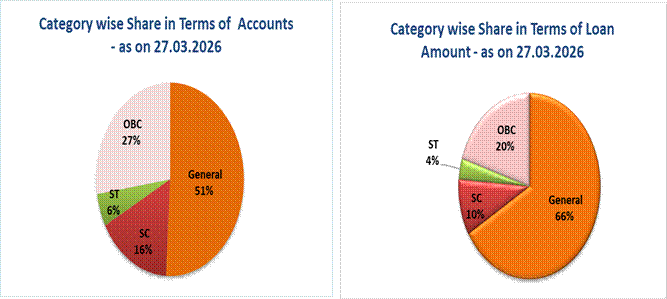
The MoS also added, “It has created self-employment opportunities across the country, especially for marginalized sections of society, including Scheduled Castes/Scheduled Tribes, Other Backward Classes (51% of loan beneficiaries), and women (67% of loan beneficiaries).”

Stressing on Mudra’s impact the MoS saidThe core objective of the MUDRA Yojana is "Funding the Unfunded." The scheme has successfully ended the exploitation of India's small entrepreneurs by informal lenders. In the past 11 years, it has extended over 40 lakh crore through 57.7 crore loans, instilling a new sense of confidence among borrowers. This clearly reflects the government's firm commitment to support their efforts and its accelerated journey toward making India a developed nation by 2047 through inclusive growth enabled by financial inclusion.”

As we commemorate eleven years of advancing financial inclusion through the core tenets of the MUDRA scheme, let us glance through some of the primary characteristics and significant milestones of the scheme:

The implementation of financial inclusion programme in the country is based on three pillars, namely,

  1. Banking the Unbanked
  2. Securing the Unsecured and
  3. Funding the Unfunded

These aforesaid three objectives are being achieved through leveraging technology and adopting multi-stakeholders’ collaborative approach, while serving the unserved and underserved as well.

One of the three pillars of FI - Funding the Unfunded, is reflected in the Financial Inclusion ecosystem through PMMY, which is being implemented with the objective to provide collateral free access to credit for small/ micro entrepreneurs.

Key Features of PMMY:

  1. MUDRA loans are being offered in four categories namely, ‘Shishu’, ‘Kishor’, ‘Tarun’ and ‘TarunPlus’ which signifies the stage of growth or development and funding needs of the borrowers: -
    • Shishu: covering loans upto Rs. 50,000/-
    • Kishor: covering loans above Rs. 50,000/- and up to Rs. 5 lakhs
    • Tarun: covering loans above Rs.5 lakh and upto Rs.10 lakhs
    • TarunPlus: covering loans above Rs.10lakh and upto Rs.20 lakhs
  2. Loans cover term financing and working capital needs across manufacturing, trading and service sectors, including activities allied to agriculture like poultry, dairy, and beekeeping, etc.
  3. The interest rate is governed by RBI guidelines, with flexible repayment terms.

Achievements under Pradhan Mantri Mudra Yojana (PMMY) as on 27.03.2026

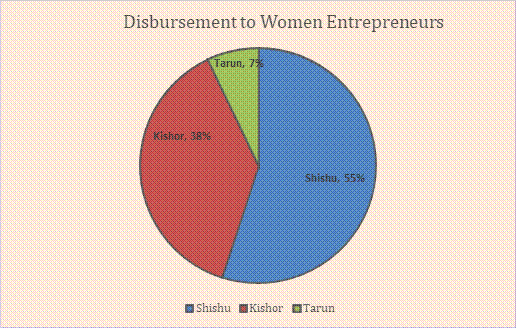
Women Borrowers: A total of ₹9.02 lakh crore was disbursed under the Shishu category, ₹ 6.22 lakh crore under Kishor, and ₹ 1.09 lakh crore under the Tarun category.  
 

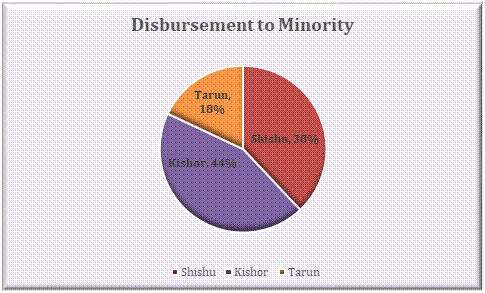
Minority Borrowers: The disbursements amounted to ₹1.33 lakh crore under Shishu, ₹1.54 lakh crore under Kishor, and ₹ 0.62 lakh crore under Tarun.
New Entrepreneurs/Accounts:

Shishu category: 8.80 crore accounts with a sanctioned amount of ₹2.47 lakh crore and disbursed amount of ₹ 2.42 lakh crore.

Kishor category: 2.79 crore accounts with ₹5.09 lakh crore sanctioned and ₹4.87 lakh crore disbursed.

Tarun category: 55 lakh accounts with a sanctioned amount of ₹4.82 lakh crore and ₹4.67 lakh crore disbursed.
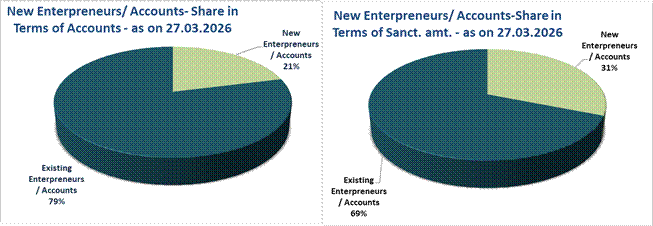
Category-wise breakup:-(Number of loans and amount sanctioned)

Category

Percentage as per No. of Loans

Percentage as per Amount Sanctioned

Shishu

74%

32%

Kishor

24%

43%

Tarun

2%

25%

TarunPlus

0.004%

0.095%

Total

100%

100%


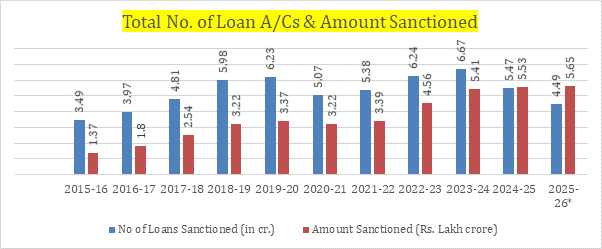
Year-wise sanction amount is as under:-

Financial Year

No. of Loans Sanctioned

(in Crore)

Amount Sanctioned

(Rs. in Lakh Crore)

2015-16

3.49

1.37

2016-17

3.97

1.80

2017-18

4.81

2.54

2018-19

5.98

3.22

2019-20

6.23

3.37

2020-21

5.07

3.22

2021-22

5.38

3.39

2022-23

6.24

4.56

2023-24

6.67

5.41

2024-25

5.47

5.53

2025-26

(as on 27.03.2026) *

4.49

5.65

Total

57.79

40.07

Marking over a decade of the PMMY, India underscores its dedicated mission to integrate the marginalized into the formal economy. By focusing on the core principles of "Banking the Unbanked," "Securing the Unsecured," and "Funding the Unfunded," the Government continues to bridge financial gaps and turn the aspirations of aspiring business owners into reality.

Topics

Acts Income Tax