Loading...

Top
Help
×

By creating an account you can:

Logo TaxTMI
Call Us / Help / Feedback

Contact Us At :

E-mail: [email protected]

Call / WhatsApp at: +91 99117 96707

For more information, Check Contact Us

FAQs :

To know Frequently Asked Questions, Check FAQs

Most Asked Video Tutorials :

For more tutorials, Check Video Tutorials

Submit Feedback/Suggestion :

Email :
Please provide your email address so we can follow up on your feedback.
Category :
Description :
Min 15 characters 0/2000
Make Most of Text Search
  1. Checkout this video tutorial: How to search effectively on TaxTMI.
  2. Put words in double quotes for exact word search, eg: "income tax"
  3. Avoid noise words such as : 'and, of, the, a'
  4. Sort by Relevance to get the most relevant document.
  5. Press Enter to add multiple terms/multiple phrases, and then click on Search to Search.
  6. Text Search
  7. The system will try to fetch results that contains ALL your words.
  8. Once you add keywords, you'll see a new 'Search In' filter that makes your results even more precise.
  9. Text Search
Add to...
You have not created any category. Kindly create one to bookmark this item!
Create New Category
Hide
Title :
Description :
❮❮ Hide
Default View
Expand ❯❯
Close ✕
🔎 News - Adv. Search
TEXT SEARCH:

Press 'Enter' to add multiple search terms. Rules for Better Search

Search In:
Main Text + AI Text
  • Main Text
  • Main Text + AI Text
  • AI Text
Category: ?
Categorized by AI
---- All Categories ----
  • ---- All Categories ----
  • Income Tax
  • GST
  • Customs, DGFT & SEZ
  • FEMA & RBI
  • Corp. Laws, SEBI & IBC
  • PMLA, Black Money & ED
  • Budget
  • News and Press Release
  • PTI News
Month:
---- All Months ----
  • ---- All Months ----
  • January
  • February
  • March
  • April
  • May
  • June
  • July
  • August
  • September
  • October
  • November
  • December
Year:
---- All Years ----
  • ---- All Years ----
  • 2026
  • 2025
  • 2024
  • 2023
  • 2022
  • 2021
  • 2020
  • 2019
  • 2018
  • 2017
  • 2016
  • 2015
  • 2014
  • 2013
  • 2012
  • 2011
Sort By: ?
In Sort By 'Default', exact matches for text search are shown at the top, followed by the remaining results in their regular order.
Relevance Default Date
    Guidance note - Form 61
    Form No. 61 – Frequently Asked Questions
    Excise duty cut on petrol, diesel; hike in export duties to cost exchequer Rs 5,500 cr in fortnight
    Guidance note - Form 60
    Guidance note - Form 59
    Guidance note - Form 58
    India's forex reserves drop USD 11.41 billion to USD 698.346 billion: RBI data
    HIGHLIGHTS
    Guidance note - Form 57
    Guidance note - Form 56
    PLI Scheme disburses ₹15,554 crore in electronics and ₹2,377.56 crore in automobile sector incentives
    PLI Schemes attract over ₹2.16 lakh crore investment, drive ₹20.41 lakh crore production and generate 14.39 lakh jobs
    India's Life Insurers Pay ₹6.30 Lakh Crore in Benefits in FY25 To Emerge as A Pillar of Household Financial Security
    Fadnavis praises PM for excise cut; warns against hoarding, rumour-mongering
    China opens investigations into US trade practices in response to Trump tariff moves
    Herbalife to Expand Its Personalized Nutritional Supplement Capabilities Through Planned Acquisition of Bioniq
    Excise duty cut on petrol, diesel with eye on elections in four states: TMC member Saket Gokhale
    National Council for Cement and Building Materials signs MoU to strengthen skill development and capacity building in construction sector
    Shri Piyush Goyal, Commerce & Industries Minister, leads the Indian delegation for the 14th Ministerial Conference of the WTO starting on March 26, 20...
    Department of Financial Services (DFS) reviews Unsatisfied closed complaints related to Banks and Insurance Companies registered on Centralised Public...
❯❯
Maximize Maximize Maximize
0 / 200
Expand Note
Add to Folder

No Folders have been created

+

Are you sure you want to delete "My most important" ?

NOTE:

News
Showing Results for :
Reset Filters
Results Found:
Show All Summaries Hide All Summaries
March 27, 2026
Show AI Summary
Tax deduction verification through Form 61 requires e-filing, irrevocable authorisation, and proof of transmission to the financial institution.
Form No. 61 is an irrevocable authorisation enabling tax authorities to obtain information and records from a financial institution in a Notified Jurisdictional Area for verifying deduction claims on payments made to that institution. It is filed once for the tax year before the income-tax return due date, through the e-filing portal, with details of the institution, payment, supporting documents, and proof that the first copy has been deposited or transmitted. The assessee must send the first copy to the institution and submit the second copy with proof to the Assessing Officer.
March 27, 2026
Show AI Summary
Notified jurisdictional area disclosures: Form 61 authorisation enables tax authorities to access financial records for deduction verification.
Form No. 61 is an irrevocable authorisation enabling the Central Board of Direct Taxes and designated income-tax authorities to obtain information and records from a financial institution located in a notified jurisdictional area for the purpose of claiming deduction in respect of payments made to such institution. The form must be filed once for the relevant tax year before the due date for filing the income-tax return, through the e-filing portal, and verified by DSC or EVC as applicable. The assessee must submit the first copy to the financial institution and the second copy with proof to the Assessing Officer, while waiving privacy, data protection and banking secrecy protections.
March 27, 2026
Show AI Summary
Excise duty reduction and export duty hike reshape fuel pricing to ease under-recoveries and protect domestic supply.
Excise duty on petrol and diesel has been reduced, while export duty on diesel and aviation turbine fuel has been increased, to address under-recoveries of oil marketing companies, support domestic fuel availability, and limit consumer price pressure amid volatility in global oil markets. The revised rates are stated to operate on a fortnightly review basis, with the policy rationale emphasising energy security, domestic supply prioritisation, and response to disrupted international crude and product markets.
March 27, 2026
Show AI Summary
International group reporting designation requires Form No. 60 for appointing the entity that files the Country-by-Country Report.
Form No. 60 is the intimation to be furnished on behalf of an international group having multiple constituent entities resident in India for designating a single constituent entity to file the Country-by-Country Report in Form No. 59. The form requires particulars of the international group, the parent entity, the designated constituent entity, and the other constituent entities resident in India, including name, address and PAN details. It is to be filed as an e-form through the income tax e-filing portal, at least 30 days before the due date for Form No. 59, followed by preview and e-verification before submission.
March 27, 2026
Show AI Summary
Country-by-Country reporting compliance for international groups, covering filing triggers, due dates, and e-form submission requirements.
Form No. 59 is the prescribed e-form for filing the Country-by-Country Report of an international group. It applies to a resident parent entity or alternate reporting entity where the consolidated group revenue exceeds the prescribed threshold, and in specified cases to a resident constituent entity where the parent is not required to report, there is no exchange arrangement with India, or a notified systemic failure exists. The report is ordinarily due within twelve months from the end of the reporting accounting year, with a shorter period in cases involving notified systemic failure. The form captures entity particulars, tax jurisdiction details, constituent entity data, and additional information.
March 27, 2026
Show AI Summary
Country-by-country reporting intimation by Indian constituent entities sets out the reporting entity and filing location for the group report.
Form No. 58 is an intimation by every constituent entity resident in India, where the parent entity of the international group is not resident in India, regarding whether it is an alternate reporting entity and, if not, the details of the parent entity or alternate reporting entity and their country or territory of residence. The form informs the income-tax authorities where the Country-by-Country Report will be filed and must be submitted two months before the due date for furnishing that report.
March 27, 2026
Show AI Summary
Foreign exchange reserves decline as gold holdings fall, while foreign currency assets rise in RBI data.
India's foreign exchange reserves declined during the week ended March 20, 2026, falling by USD 11.413 billion to USD 698.346 billion, according to RBI data. The drop was attributed mainly to a sharp reduction in gold reserves, even as foreign currency assets increased during the reporting week. The RBI data further showed that the value of gold reserves decreased significantly, Special Drawing Rights were lower, and India's reserve position with the IMF increased marginally.
March 27, 2026
Show AI Summary
Live-in relationship and judicial vacancies draw legal attention as high court and chief justice address key issues.
The Allahabad High Court stated that a married man living in a consensual live-in relationship with an adult woman does not amount to a criminal offence under law. The Bombay High Court dismissed a petition seeking a CBI probe against Reliance Industries Limited and Mukesh Ambani over alleged unlawful gas extraction. Separately, the Chief Justice of India urged high courts to expedite filling judicial vacancies, with special focus on elevating women judges.
March 27, 2026
Show AI Summary
Designated constituent entity intimation under income tax rules governs filing of Form 57 for international group reporting
Form No. 57 is an intimation by a designated constituent entity of an international group for the purposes of section 171(4), to be furnished under Rule 123 of the Income-tax Rules, 2026 when more than one constituent entity is required to file Form No. 56. The designated entity may file the form if the group has appointed it for compliance, and the intimation must be made at least 30 days before the due date for Form No. 56. The form captures particulars of the designated entity, the international group, the parent entity and the accounting year, and is filed online through the e-filing portal.
March 27, 2026
Show AI Summary
Transfer pricing master file reporting requires constituent entities to disclose group details, thresholds, and supporting information electronically.
Form No. 56 (Master File) is an income-tax reporting document prescribed under Rule 123 of the Income-tax Rules, 2026 and section 171 of the Income-tax Act, 2025 for transfer pricing transparency. It applies to a constituent entity of an international group where the consolidated group revenue exceeds INR 500 crore and the aggregate value of international transactions exceeds INR 50 crore, or international transactions involving intangible property exceed INR 10 crore. Part A must still be furnished even if those conditions are not met. The form is filed by the due date for the return of income.
March 27, 2026
Show AI Summary
Production Linked Incentive schemes strengthen domestic manufacturing, expand exports, and build supply chain resilience across key sectors.
Production Linked Incentive schemes across 14 sectors are being implemented to strengthen domestic manufacturing, attract investment, promote exports and generate employment. As of 31 December 2025, the schemes had cumulatively attracted investments of over Rs.2.16 lakh crore, generated production and sales of over Rs.20.41 lakh crore, supported exports of over Rs.8.3 lakh crore and created employment for more than 14.39 lakh persons across the covered sectors. The electronics and automobiles sectors have received incentive disbursements and reported incremental production through participating companies. The schemes are said to expand domestic manufacturing capacity, reduce import dependence and improve supply chain resilience. The policy framework is supplemented by initiatives for semiconductor development, electronics component manufacturing, logistics efficiency, rare earth magnet manufacture and critical mineral supply security.
March 27, 2026
Show AI Summary
Production Linked Incentive schemes boost manufacturing, investment and jobs across key sectors under Make in India.
Production Linked Incentive schemes under the Make in India initiative are stated to incentivize incremental production and sales across 14 sectors, expand manufacturing capacity, and attract fresh investment within a wider industrial policy framework. The schemes are stated to have generated investments exceeding Rs.2.16 lakh crore, production and sales exceeding Rs.20.41 lakh crore, and over 14.39 lakh direct and indirect jobs, while also supporting exports, reducing import dependence, and strengthening domestic manufacturing.
March 27, 2026
Show AI Summary
Life insurance strengthens household financial security as insurers pay benefits, maintain solvency, and address the protection gap.
India's life insurance sector is presented as a major pillar of household financial security, with insurers paying substantial benefits in FY25 and supporting protection, retirement planning, wealth creation, and liquidity across life stages. The text says policyholders increasingly use proceeds for lifecycle goals such as education, home purchase, travel, and reinvestment into other life insurance products, reflecting broader use of policy benefits beyond protection. It also states that insurers remain above solvency thresholds, supported by asset-liability matching and strong solvency margins, while awareness efforts continue to address the protection gap.
March 27, 2026
Show AI Summary
Excise duty cut and anti-hoarding warnings aim to protect fuel supply and prevent artificial shortages.
Excise duty on petrol and diesel was reduced to cushion consumers against rising crude prices, with oil companies said to absorb the burden without passing it on. Public warnings were issued against panic buying, hoarding, and rumour-mongering, including false claims of a nationwide lockdown, on the ground that such conduct could create an artificial shortage and disrupt supply.
March 27, 2026
Show AI Summary
Trade retaliation escalates as China opens investigations into US restrictions on goods, technology, and green energy exports.
China launched two investigations into US trade practices in response to recent tariff-related investigations announced by the United States. One probe concerns US policies restricting Chinese goods and advanced technology exports, while the other concerns barriers affecting Chinese green energy exports. The investigations are expected to last six months, with a possible three-month extension if necessary.
March 27, 2026
Show AI Summary
Personalized nutrition acquisition expands Herbalife's data-driven wellness platform through Bioniq assets, contingent on regulatory approvals.
Herbalife announced an agreement to acquire certain assets of Bioniq to expand personalized nutritional supplement capabilities and strengthen a technology-enabled, data-driven wellness platform. The transaction is expected to close in the second quarter of 2026, subject to customary closing conditions and regulatory approvals. The purchase price includes deferred and contingent payments, and Herbalife also obtained a call option relating to Bioniq LAB. The release includes a forward-looking statements disclaimer covering execution, integration, regulatory, market, operational, tax, technology, and compliance risks.
March 27, 2026
Show AI Summary
Excise duty on fuel and GST burdens draw parliamentary criticism over pricing, enforcement, and budget priorities.
Excise duty on petrol and diesel was criticised in parliamentary discussion as being politically timed, with a demand for assurance that fuel prices would not rise after voting in four states. The debate also raised whether consumers had been denied the benefit of discounted crude oil purchases, and whether the excise reduction would remain permanent rather than being offset later through higher pump prices. The discussion further addressed GST burdens, public expenditure concerns, and demands for budgetary changes.
March 27, 2026
Show AI Summary
Skill development and capacity building in construction sector through structured training and certification programmes.
A Memorandum of Understanding has been signed to strengthen skill development and capacity building in the construction sector through structured training and certification programmes. The collaboration is intended to train civil engineers, ready-mix concrete professionals, contractors, construction workers, and masons across the country, with emphasis on material quality testing, concrete mix proportioning, durability, and sustainable construction practices.
March 27, 2026
Show AI Summary
WTO reform through transparent, inclusive member-driven process with development at the core and preserved foundational principles
India's participation in the 14th Ministerial Conference of the WTO centred on support for WTO reform through a transparent, inclusive and member-driven process that keeps development at its core. The position emphasised the need to preserve the WTO's foundational principles and objectives, including non-discrimination, consensus-based decision making and equity. Bilateral discussions also addressed the conference agenda and ways to strengthen trade relations.
March 27, 2026
Show AI Summary
Grievance redress governance through CPGRAMS review meetings strengthens complaint resolution, transparency, compliance, and citizen-centric oversight.
DFS conducts periodic CPGRAMS review meetings with financial regulators, banks, insurers, institutions, and complainants to assess grievance resolution through a dip-stick survey at the senior-most level. The exercise reviews unsatisfied closed complaints, addresses systemic and pending issues, and uses citizen feedback to strengthen grievance redress, transparency, compliance, and preventive governance across banking, insurance, pension, and claim-related disputes.

News

Back

All News

Showing Results for :
Reset Filters
No Records Found

News

Back

All News

Showing Results for : Reset Filters

Pradhan Mantri Mudra Yojana (PMMY) — completes 11 Years of empowering Small and Micro Entrepreneurs

April 8, 2026

Contents
Summary
Note

Note

-

Bookmark

Print

Print

PMMY instrumental in reshaping the credit landscape for MSMEs and countless individual entrepreneurs in the country: Union Finance Minister Smt. Nirmala Sitharaman

PMMY provides a platform for small entrepreneurs to access loan support from banks, NBFCs, and MFIs as it drives credit inclusion: MoS Sh. Pankaj Chaudhary

Mudra Yojana facilitates seamless access to collateral-free institutional credit up to ₹20 lakh for non-corporate and non-farm income-generating activities

PMMY has disbursed over ₹40.07 lakh crore through 57.79 crore loans, strengthening the credit ecosystem for small and micro enterprises

The Pradhan Mantri MUDRA Yojana (PMMY) launched by Prime Minister Shri Narendra Modi on April 8, 2015, is marking 11 years of success in strengthening India's grassroots entrepreneurs. This initiative has been designed to bridge the gap in financial accessibility, offering streamlined, easy collateral-free loans up to ₹20 lakh to support small-scale business ventures for non-corporate and non-farm income-generating activities.

Micro, Small, and Medium Enterprises (MSMEs) serve as the backbone of the industrial ecosystem, acting as essential partners to major corporations and driving balanced economic development. By diversifying their reach into new industries and refining their output, these enterprises are effectively addressing the needs of both local consumers and global markets.

The landscape of business financing has evolved rapidly, with digital innovations and data analytics making it easier for smaller firms to secure capital. A cornerstone of this progress is PMMY, a strategic government initiative famously characterized by its mission to "Fund the Unfunded," ensuring that credit reaches those traditionally overlooked by formal banking systems.

On the occasion of the 11th successful year of PMMY, Union Minister for Finance & Corporate Affairs Smt. Nirmala Sitharaman said, “In the last decade, India witnessed a silent transformation where crores of ordinary citizens stepped into entrepreneurship with newfound confidence and agency. At its heart lies an initiative launched on April 08, 2015, by the Prime Minister, the Pradhan Mantri MUDRA Yojana (PMMY), which, by design, focused on "funding the unfunded".

“Eleven years later, the scheme has been instrumental in reshaping the credit landscape for MSMEs and countless individual entrepreneurs in the country. These were those entrepreneurs who were hitherto excluded from the formal banking system. With this initiative, entrepreneurship has become truly democratised by removing the entry barriers to credit”, Smt. Nirmala Sitharaman added.

Highlighting PMMY’s role in Empowering Millions and Fulfilling the Vision of Inclusive Growth, Union Minister of Finance remarked, “Cumulatively, more than 57.79 crore loans have been sanctioned, amounting to ₹40.07 lakh crore of disbursement. Two-thirds of the loans have been sanctioned to women entrepreneurs. Approximately one-fifth of all the loans were extended to first-time entrepreneurs. In sheer magnitude, this translates to 12.15 crore loans with an amount of 12 lakh crores extended to new entrepreneurs.”

The Union Finance Minister also appreciated the Banks, various Financial Institutions, and stakeholders for bringing the scheme to the common man and making it a resounding success.

“PM MUDRA Yojana will continue to empower entrepreneurs to become active participants in our nation's journey to become Viksit Bharat by 2047”, Smt. Nirmala Sitharaman said.

On the occasion, Union Minister of State (MoS) for Finance, Shri Pankaj Chaudhary said, “The Pradhan Mantri MUDRA Yojana (PMMY) is one of the most significant initiatives, aimed at promoting micro-entrepreneurship. Financial inclusion is one of the top priorities of the government, as it plays a vital role in achieving inclusive growth. PMMY provides a platform for small entrepreneurs to access loan support from banks, NBFCs, and MFIs as it drives credit inclusion.”

“The MUDRA Yojana was launched by the Prime Minister Shri Narendra Modi on April 8, 2015. While launching the scheme, the Prime Minister stated that supporting India's small entrepreneurs is one of the most effective ways to help the Indian economy grow and prosper. The scheme has provided crucial financial assistance to a vast number of entrepreneurs, helping them set up and operate their businesses and instilling a sense of financial security in them.”, MoS said.

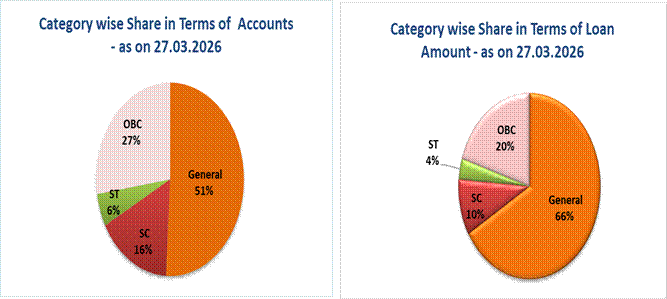
The MoS also added, “It has created self-employment opportunities across the country, especially for marginalized sections of society, including Scheduled Castes/Scheduled Tribes, Other Backward Classes (51% of loan beneficiaries), and women (67% of loan beneficiaries).”

Stressing on Mudra’s impact the MoS saidThe core objective of the MUDRA Yojana is "Funding the Unfunded." The scheme has successfully ended the exploitation of India's small entrepreneurs by informal lenders. In the past 11 years, it has extended over 40 lakh crore through 57.7 crore loans, instilling a new sense of confidence among borrowers. This clearly reflects the government's firm commitment to support their efforts and its accelerated journey toward making India a developed nation by 2047 through inclusive growth enabled by financial inclusion.”

As we commemorate eleven years of advancing financial inclusion through the core tenets of the MUDRA scheme, let us glance through some of the primary characteristics and significant milestones of the scheme:

The implementation of financial inclusion programme in the country is based on three pillars, namely,

  1. Banking the Unbanked
  2. Securing the Unsecured and
  3. Funding the Unfunded

These aforesaid three objectives are being achieved through leveraging technology and adopting multi-stakeholders’ collaborative approach, while serving the unserved and underserved as well.

One of the three pillars of FI - Funding the Unfunded, is reflected in the Financial Inclusion ecosystem through PMMY, which is being implemented with the objective to provide collateral free access to credit for small/ micro entrepreneurs.

Key Features of PMMY:

  1. MUDRA loans are being offered in four categories namely, ‘Shishu’, ‘Kishor’, ‘Tarun’ and ‘TarunPlus’ which signifies the stage of growth or development and funding needs of the borrowers: -
    • Shishu: covering loans upto Rs. 50,000/-
    • Kishor: covering loans above Rs. 50,000/- and up to Rs. 5 lakhs
    • Tarun: covering loans above Rs.5 lakh and upto Rs.10 lakhs
    • TarunPlus: covering loans above Rs.10lakh and upto Rs.20 lakhs
  2. Loans cover term financing and working capital needs across manufacturing, trading and service sectors, including activities allied to agriculture like poultry, dairy, and beekeeping, etc.
  3. The interest rate is governed by RBI guidelines, with flexible repayment terms.

Achievements under Pradhan Mantri Mudra Yojana (PMMY) as on 27.03.2026

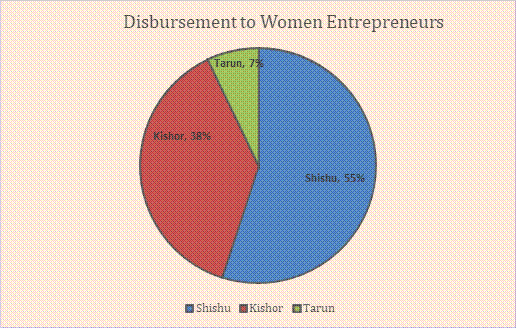
Women Borrowers: A total of ₹9.02 lakh crore was disbursed under the Shishu category, ₹ 6.22 lakh crore under Kishor, and ₹ 1.09 lakh crore under the Tarun category.  
 

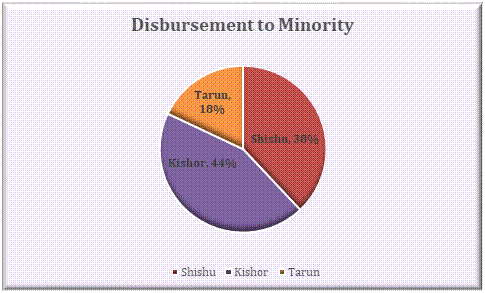
Minority Borrowers: The disbursements amounted to ₹1.33 lakh crore under Shishu, ₹1.54 lakh crore under Kishor, and ₹ 0.62 lakh crore under Tarun.
New Entrepreneurs/Accounts:

Shishu category: 8.80 crore accounts with a sanctioned amount of ₹2.47 lakh crore and disbursed amount of ₹ 2.42 lakh crore.

Kishor category: 2.79 crore accounts with ₹5.09 lakh crore sanctioned and ₹4.87 lakh crore disbursed.

Tarun category: 55 lakh accounts with a sanctioned amount of ₹4.82 lakh crore and ₹4.67 lakh crore disbursed.
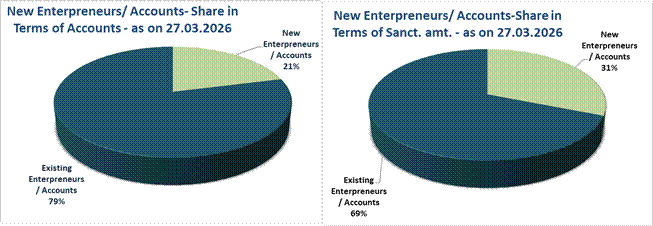
Category-wise breakup:-(Number of loans and amount sanctioned)

Category

Percentage as per No. of Loans

Percentage as per Amount Sanctioned

Shishu

74%

32%

Kishor

24%

43%

Tarun

2%

25%

TarunPlus

0.004%

0.095%

Total

100%

100%


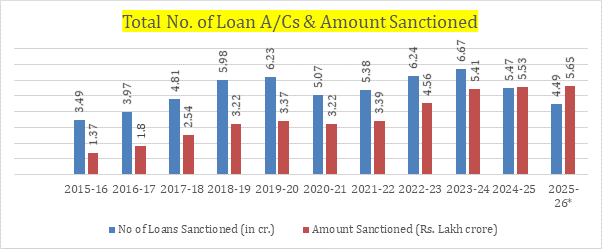
Year-wise sanction amount is as under:-

Financial Year

No. of Loans Sanctioned

(in Crore)

Amount Sanctioned

(Rs. in Lakh Crore)

2015-16

3.49

1.37

2016-17

3.97

1.80

2017-18

4.81

2.54

2018-19

5.98

3.22

2019-20

6.23

3.37

2020-21

5.07

3.22

2021-22

5.38

3.39

2022-23

6.24

4.56

2023-24

6.67

5.41

2024-25

5.47

5.53

2025-26

(as on 27.03.2026) *

4.49

5.65

Total

57.79

40.07

Marking over a decade of the PMMY, India underscores its dedicated mission to integrate the marginalized into the formal economy. By focusing on the core principles of "Banking the Unbanked," "Securing the Unsecured," and "Funding the Unfunded," the Government continues to bridge financial gaps and turn the aspirations of aspiring business owners into reality.

Topics

Acts Income Tax