Loading...

Top
Help
×

By creating an account you can:

Logo TaxTMI
Call Us / Help / Feedback

Contact Us At :

E-mail: [email protected]

Call / WhatsApp at: +91 99117 96707

For more information, Check Contact Us

FAQs :

To know Frequently Asked Questions, Check FAQs

Most Asked Video Tutorials :

For more tutorials, Check Video Tutorials

Submit Feedback/Suggestion :

Email :
Please provide your email address so we can follow up on your feedback.
Category :
Description :
Min 15 characters 0/2000
Make Most of Text Search
  1. Checkout this video tutorial: How to search effectively on TaxTMI.
  2. Put words in double quotes for exact word search, eg: "income tax"
  3. Avoid noise words such as : 'and, of, the, a'
  4. Sort by Relevance to get the most relevant document.
  5. Press Enter to add multiple terms/multiple phrases, and then click on Search to Search.
  6. Text Search
  7. The system will try to fetch results that contains ALL your words.
  8. Once you add keywords, you'll see a new 'Search In' filter that makes your results even more precise.
  9. Text Search
Add to...
You have not created any category. Kindly create one to bookmark this item!
Create New Category
Hide
Title :
Description :
❮❮ Hide
Default View
Expand ❯❯
Close ✕
🔎 News - Adv. Search
TEXT SEARCH:

Press 'Enter' to add multiple search terms. Rules for Better Search

Search In:
Main Text + AI Text
  • Main Text
  • Main Text + AI Text
  • AI Text
Category: ?
Categorized by AI
---- All Categories ----
  • ---- All Categories ----
  • Income Tax
  • GST
  • Customs, DGFT & SEZ
  • FEMA & RBI
  • Corp. Laws, SEBI & IBC
  • PMLA, Black Money & ED
  • Budget
  • News and Press Release
  • PTI News
Month:
---- All Months ----
  • ---- All Months ----
  • January
  • February
  • March
  • April
  • May
  • June
  • July
  • August
  • September
  • October
  • November
  • December
Year:
---- All Years ----
  • ---- All Years ----
  • 2026
  • 2025
  • 2024
  • 2023
  • 2022
  • 2021
  • 2020
  • 2019
  • 2018
  • 2017
  • 2016
  • 2015
  • 2014
  • 2013
  • 2012
  • 2011
Sort By: ?
In Sort By 'Default', exact matches for text search are shown at the top, followed by the remaining results in their regular order.
Relevance Default Date
❯❯
Maximize Maximize Maximize
0 / 200
Expand Note
Add to Folder

No Folders have been created

+

Are you sure you want to delete "My most important" ?

NOTE:

News
Showing Results for :
Reset Filters
Results Found:
Show All Summaries Hide All Summaries
March 31, 2026
Show AI Summary
Provisional registration and approval conditions under Form 106 cover income use, commercial activity limits, and disclosure compliance.
Form No. 106 is the order through which the Commissioner of Income Tax (CPC) grants provisional registration or provisional approval, or rejects an application made in Form No. 104. It captures applicant details, the provisional registration or approval number, the period of validity, and the authority issuing the order. The form prescribes conditions on application of income, commercial activities, maintenance of separate books, compliance with law, and true disclosure, and it may be cancelled if false information is found or electronic filing requirements are not met.
March 31, 2026
Show AI Summary
Preferential allotment of equity shares under a resolution plan supports AI expansion, technology platforms, and working capital needs.
Preferential allotment of equity shares by a listed artificial intelligence and digital transformation company pursuant to a Resolution Plan approved by the National Company Law Tribunal and in compliance with applicable SEBI Regulations, the Companies Act, 2013 and stock exchange requirements. The allotment comprised equity shares issued to strategic investors in the public non-promoter category at a premium, with participation from alternative investment funds, strategic investors and high-net-worth individuals.
March 31, 2026
Show AI Summary
Provisional registration and approval under income tax rules require timely orders, a unique registration number, and compliance with filing requirements.
Provisional registration or provisional approval is granted through Form No. 106 after receipt of Form No. 104, with an order to be passed within one month from the end of the month of application. The provisional status remains valid for three tax years or up to six months from commencement of activities, whichever is earlier. The order issues a 16-digit Unique Registration Number and may later be cancelled after hearing if the application contains false or incorrect information or fails electronic filing and verification requirements.
March 31, 2026
Show AI Summary
Form 105 governs regular registration and approval of non-profit organisations, with filing, validity, documents, and re-application rules.
Form No. 105 is the electronic application for regular registration or regular approval of specified non-profit organisations and allied funds under the Income-tax Act, 2025. It covers applicants seeking registration to claim benefits available to registered non-profit organisations, and applicants seeking approval so that donations received may qualify for donor deduction. The form requires details of identity, formation, existing registration, income, office bearers, beneficial ownership, activities, assets, liabilities, and supporting documents. It also provides for filing timelines, validity periods, re-application, withdrawal, and correction of erroneous details before the order is passed.
March 31, 2026
Show AI Summary
EMI calculators support smarter personal loan planning by helping borrowers assess repayments, tenure, and borrowing capacity in advance.
Personal loan planning increasingly depends on EMI calculators that allow borrowers to estimate monthly instalments, compare loan scenarios, adjust tenure for affordability, and assess the total cost of borrowing before applying. By entering the loan amount, tenure, and interest rate, applicants can review repayment obligations in advance and align borrowing decisions with monthly income and budget capacity, thereby supporting more disciplined financial planning and reducing the risk of over-borrowing. The personal loan product is presented as a flexible digital lending option with an online application process, minimal documentation, and fast approval features.
March 31, 2026
Show AI Summary
Income tax return forms notified for assessment year 2026-27, setting filing eligibility across taxpayer categories and updated returns.
Income Tax Department notified all income tax return forms for assessment year 2026-27, enabling individuals, businesses and other entities to file returns for income earned in financial year 2025-26. The notification covers ITR forms 1 to 7 as well as ITR-U for updated returns, with the return-filing deadline for individuals and other non-audited taxpayers stated as 31 July. ITR-1 (Sahaj) is available to resident individuals with total annual income up to Rs 50 lakh deriving income from salary, one house property, other sources and agricultural income up to Rs 5,000. ITR-4 (Sugam) applies to individuals, Hindu Undivided Families and firms other than limited liability partnerships having total annual income up to Rs 50 lakh and income from business or profession. ITR-2 is for individuals and HUFs without business or professional income but having capital gains, while ITR-3 is for individuals and HUFs with income from proprietary business or profession.
March 31, 2026
Show AI Summary
Regular registration and approval for non-profit organisations through a common online form with event-based filing rules.
Form No. 105 is the common online application for regular registration of a non-profit organisation and for regular approval of a registered non-profit organisation or specified funds so that donor deductions may be available. It is mandatory only for applicants seeking these benefits, requires PAN, must be furnished electronically to the jurisdictional Principal Commissioner or Commissioner, and is filed within the prescribed time limits depending on commencement of activities, expiry of provisional status, expiry of existing registration or approval, inoperative registration, or modification of objects. The form is generally event-based, the regular registration or approval is ordinarily valid for five tax years, and a one-time re-application, withdrawal within seven days, correction before the order, and specified supporting documents are permitted.
March 31, 2026
Show AI Summary
Provisional registration and approval for non-profit organisations under Form 104 are granted through a simplified electronic application process.
Form No. 104 is the common electronic application for provisional registration or provisional approval for eligible non-profit organisations, registered non-profit organisations, regimental funds, and non-public funds established by the armed forces. It requires prescribed identification, incorporation, registration, ownership, return-filing, and supporting document details, and must be filed with the Commissioner of Income Tax (CPC) through the e-filing portal. Provisional registration or approval is granted through a written order with a Unique Registration Number, may be cancelled for false or non-compliant filings, may be surrendered if no exemption benefits were ever claimed, and may be withdrawn within seven days of filing.
March 31, 2026
Show AI Summary
Provisional registration and approval for non-profit organisations depend on online Form No. 104, mandatory PAN, and commenced activities rules.
Form No. 104 is the common electronic application for provisional registration under section 332(3) and provisional approval under section 354(2) for applicants whose activities have not commenced. It is filed online with the Commissioner of Income Tax (CPC), who must pass an order in Form No. 106 within one month from the end of the month of filing, unless the application is non-est. The provisional registration or approval is valid for three tax years or up to six months from commencement of activities, whichever is earlier, and may be cancelled for false information or defective filing. PAN is mandatory, offline filing is not permitted, and the form cannot be edited after submission.
March 31, 2026
Show AI Summary
PAN allotment forms simplified into category-specific applications with mandatory contact details, supporting documents and improved verification.
PAN allotment applications are to be made in revised Forms 93, 94, 95 and 96 for four applicant categories: individual citizens of India, Indian entities, individuals who are not citizens of India, and foreign entities. The forms are category-specific, self-explanatory and aligned with the Income-tax Act and rules, with online or physical filing through PAN service providers, document verification, transmission to the Income Tax Department, and PAN generation with dispatch of the physical card where opted.
March 31, 2026
Show AI Summary
Permanent Account Number application rules set forms, documents, fees, and correction procedures for Indian and foreign applicants.
Permanent Account Number (PAN) application is governed through prescribed forms for different applicant categories: Form 93 for individuals being citizens of India, Form 94 for non-individual Indian entities, Form 95 for individuals not being citizens of India, and Form 96 for non-individual foreign entities. PAN is a unique taxpayer identifier required for income-tax return filing and specified financial transactions. The application process requires prescribed supporting documents, incomplete or deficient applications are treated as invalid, and correction requests may be made separately after allotment.
March 31, 2026
Show AI Summary
Corporate governance through independent director appointment and audit committee leadership to improve oversight, controls and compliance.
Appointment of an independent director and audit committee chair to strengthen corporate governance, financial oversight and compliance mechanisms. The role is stated to include supervision of financial reporting integrity, internal controls, enterprise risk management, regulatory compliance and audit processes, with the appointment intended to deepen board oversight and support disciplined, responsible and sustainable growth.
March 31, 2026
Show AI Summary
Manufacturing activity rebounds as energy costs, supply-chain risks, and weak demand cloud China's growth outlook.
China's manufacturing activity returned to expansion in March as the official purchasing managers index rose above 50, ending two months of contraction. Analysts said the outlook remains vulnerable to higher energy costs, possible supply-chain disruption, a prolonged property-sector slump, and weaker global demand, while exports continue to play a key role in supporting growth.
March 30, 2026
Show AI Summary
Asset restitution under PMLA advances recovery for PACL investors after attachment of properties in alleged investment fraud.
Assets worth more than Rs 15,000 crore have been restored under the Prevention of Money Laundering Act to a Supreme Court-appointed committee for distribution to investors allegedly defrauded in the PACL collective investment scheme. A special PMLA court ordered restitution of 455 immovable properties to the Justice Lodha Committee, reflecting the statutory remedy of restoration of attached assets to victims of fraud and proceeds of crime. The ED's action is part of an investigation into allegations of an illegal collective investment scheme and the attachment of properties held by PACL entities, family members and associates.
March 30, 2026
Show AI Summary
Rupee volatility intensifies as geopolitical tensions, dollar strength and RBI net open position caps pressure forex markets.
The rupee fell sharply in intra-day trade and briefly crossed the 95-per-US dollar level before closing at 94.70, with volatility attributed to heightened geopolitical tensions, risk-off sentiment, a firm dollar index and higher crude oil prices. The Reserve Bank of India reduced the net open position that banks may maintain overnight and capped Net Open Position (NOP-INR) at USD 100 million through a circular dated March 27, 2026, with compliance required by April 10, as part of monitoring currency exposure in a volatile foreign exchange market.
March 30, 2026
Show AI Summary
Money laundering attachment under PMLA targets immovable assets linked to alleged diversion and siphoning of company funds.
Provisional attachment under the Prevention of Money Laundering Act was issued in respect of land parcels and other immovable assets valued at more than Rs 271 crore. The attached properties included land parcels in Panvel and Shahapur talukas of Maharashtra, in connection with an ongoing money-laundering investigation concerning Rajendra Lodha, a former director of Lodha Developers. The allegations concerned diversion and siphoning of company funds and assets through unauthorised transfer of properties at undervalued prices, fabrication of Memorandums of Understanding, and misappropriation of inflated amounts.
March 30, 2026
Show AI Summary
Summons compliance in excise policy probe challenged as the agency disputes acquittal and alleges deliberate non-appearance.
The Enforcement Directorate has challenged the acquittal of Arvind Kejriwal in two summons-compliance cases arising from the excise policy matter, alleging intentional failure to appear despite repeated summonses and deliberate creation of grounds to avoid the probe. The trial court had found that the ED failed to prove intentional disobedience. The broader excise policy and money-laundering proceedings remain pending in connected forums.
March 30, 2026
Show AI Summary
Rupee depreciation and forex speculation curb as the Reserve Bank limits bank net open positions in the onshore market.
The rupee fell sharply against the US dollar in FY26 because of foreign fund outflows, high crude prices, global dollar strength, tariff pressure, geopolitical tensions, and volatile markets. The Reserve Bank of India intervened by selling dollars and later introduced a measure requiring banks to limit net open positions in the onshore currency market to curb excessive speculation and reduce one-sided bets against the rupee.
March 30, 2026
Show AI Summary
Insolvency resolution process dispute tests value maximisation, fair bidding and creditor discretion in Jaiprakash Associates acquisition plan.
Vedanta Ltd has challenged the approval of Adani Enterprises Ltd.'s resolution plan for Jaiprakash Associates Ltd. in insolvency proceedings and sought a stay on its implementation. The dispute concerns the validity of the resolution plan, the approvals granted by the Committee of Creditors and the adjudicating authority, and the application of the Insolvency and Bankruptcy Code principles of value maximisation, fair bidding, feasibility and execution. The appellate tribunal has sought a response from the Committee of Creditors and noted that implementation of the plan will remain subject to the outcome of the appeals.
March 30, 2026
Show AI Summary
Money laundering and fugitive offender laws address bank fraud attachments, confiscation, and restrictions on economic offenders abroad.
The Enforcement Directorate has investigated bank fraud matters under the Prevention of Money Laundering Act, with arrests, prosecution complaints, convictions, attachment of proceeds of crime, and confiscation and restitution of assets in some cases. The Fugitive Economic Offenders Act, 2018 is described as a measure to deter offenders from evading Indian law by staying abroad and provides for confiscation of properties, proceeds of crime and benami properties, lookout notices, and restrictions on raising capital, acquiring shares, or voting rights.

News

Back

All News

Showing Results for :
Reset Filters
No Records Found

News

Back

All News

Showing Results for : Reset Filters

Pradhan Mantri Mudra Yojana (PMMY) — completes 11 Years of empowering Small and Micro Entrepreneurs

April 8, 2026

Contents
Summary
Note

Note

-

Bookmark

Print

Print

PMMY instrumental in reshaping the credit landscape for MSMEs and countless individual entrepreneurs in the country: Union Finance Minister Smt. Nirmala Sitharaman

PMMY provides a platform for small entrepreneurs to access loan support from banks, NBFCs, and MFIs as it drives credit inclusion: MoS Sh. Pankaj Chaudhary

Mudra Yojana facilitates seamless access to collateral-free institutional credit up to ₹20 lakh for non-corporate and non-farm income-generating activities

PMMY has disbursed over ₹40.07 lakh crore through 57.79 crore loans, strengthening the credit ecosystem for small and micro enterprises

The Pradhan Mantri MUDRA Yojana (PMMY) launched by Prime Minister Shri Narendra Modi on April 8, 2015, is marking 11 years of success in strengthening India's grassroots entrepreneurs. This initiative has been designed to bridge the gap in financial accessibility, offering streamlined, easy collateral-free loans up to ₹20 lakh to support small-scale business ventures for non-corporate and non-farm income-generating activities.

Micro, Small, and Medium Enterprises (MSMEs) serve as the backbone of the industrial ecosystem, acting as essential partners to major corporations and driving balanced economic development. By diversifying their reach into new industries and refining their output, these enterprises are effectively addressing the needs of both local consumers and global markets.

The landscape of business financing has evolved rapidly, with digital innovations and data analytics making it easier for smaller firms to secure capital. A cornerstone of this progress is PMMY, a strategic government initiative famously characterized by its mission to "Fund the Unfunded," ensuring that credit reaches those traditionally overlooked by formal banking systems.

On the occasion of the 11th successful year of PMMY, Union Minister for Finance & Corporate Affairs Smt. Nirmala Sitharaman said, “In the last decade, India witnessed a silent transformation where crores of ordinary citizens stepped into entrepreneurship with newfound confidence and agency. At its heart lies an initiative launched on April 08, 2015, by the Prime Minister, the Pradhan Mantri MUDRA Yojana (PMMY), which, by design, focused on "funding the unfunded".

“Eleven years later, the scheme has been instrumental in reshaping the credit landscape for MSMEs and countless individual entrepreneurs in the country. These were those entrepreneurs who were hitherto excluded from the formal banking system. With this initiative, entrepreneurship has become truly democratised by removing the entry barriers to credit”, Smt. Nirmala Sitharaman added.

Highlighting PMMY’s role in Empowering Millions and Fulfilling the Vision of Inclusive Growth, Union Minister of Finance remarked, “Cumulatively, more than 57.79 crore loans have been sanctioned, amounting to ₹40.07 lakh crore of disbursement. Two-thirds of the loans have been sanctioned to women entrepreneurs. Approximately one-fifth of all the loans were extended to first-time entrepreneurs. In sheer magnitude, this translates to 12.15 crore loans with an amount of 12 lakh crores extended to new entrepreneurs.”

The Union Finance Minister also appreciated the Banks, various Financial Institutions, and stakeholders for bringing the scheme to the common man and making it a resounding success.

“PM MUDRA Yojana will continue to empower entrepreneurs to become active participants in our nation's journey to become Viksit Bharat by 2047”, Smt. Nirmala Sitharaman said.

On the occasion, Union Minister of State (MoS) for Finance, Shri Pankaj Chaudhary said, “The Pradhan Mantri MUDRA Yojana (PMMY) is one of the most significant initiatives, aimed at promoting micro-entrepreneurship. Financial inclusion is one of the top priorities of the government, as it plays a vital role in achieving inclusive growth. PMMY provides a platform for small entrepreneurs to access loan support from banks, NBFCs, and MFIs as it drives credit inclusion.”

“The MUDRA Yojana was launched by the Prime Minister Shri Narendra Modi on April 8, 2015. While launching the scheme, the Prime Minister stated that supporting India's small entrepreneurs is one of the most effective ways to help the Indian economy grow and prosper. The scheme has provided crucial financial assistance to a vast number of entrepreneurs, helping them set up and operate their businesses and instilling a sense of financial security in them.”, MoS said.

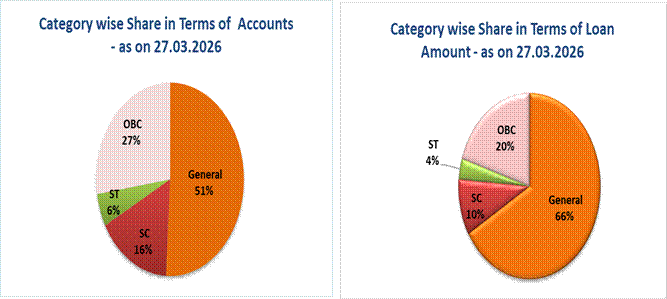
The MoS also added, “It has created self-employment opportunities across the country, especially for marginalized sections of society, including Scheduled Castes/Scheduled Tribes, Other Backward Classes (51% of loan beneficiaries), and women (67% of loan beneficiaries).”

Stressing on Mudra’s impact the MoS saidThe core objective of the MUDRA Yojana is "Funding the Unfunded." The scheme has successfully ended the exploitation of India's small entrepreneurs by informal lenders. In the past 11 years, it has extended over 40 lakh crore through 57.7 crore loans, instilling a new sense of confidence among borrowers. This clearly reflects the government's firm commitment to support their efforts and its accelerated journey toward making India a developed nation by 2047 through inclusive growth enabled by financial inclusion.”

As we commemorate eleven years of advancing financial inclusion through the core tenets of the MUDRA scheme, let us glance through some of the primary characteristics and significant milestones of the scheme:

The implementation of financial inclusion programme in the country is based on three pillars, namely,

  1. Banking the Unbanked
  2. Securing the Unsecured and
  3. Funding the Unfunded

These aforesaid three objectives are being achieved through leveraging technology and adopting multi-stakeholders’ collaborative approach, while serving the unserved and underserved as well.

One of the three pillars of FI - Funding the Unfunded, is reflected in the Financial Inclusion ecosystem through PMMY, which is being implemented with the objective to provide collateral free access to credit for small/ micro entrepreneurs.

Key Features of PMMY:

  1. MUDRA loans are being offered in four categories namely, ‘Shishu’, ‘Kishor’, ‘Tarun’ and ‘TarunPlus’ which signifies the stage of growth or development and funding needs of the borrowers: -
    • Shishu: covering loans upto Rs. 50,000/-
    • Kishor: covering loans above Rs. 50,000/- and up to Rs. 5 lakhs
    • Tarun: covering loans above Rs.5 lakh and upto Rs.10 lakhs
    • TarunPlus: covering loans above Rs.10lakh and upto Rs.20 lakhs
  2. Loans cover term financing and working capital needs across manufacturing, trading and service sectors, including activities allied to agriculture like poultry, dairy, and beekeeping, etc.
  3. The interest rate is governed by RBI guidelines, with flexible repayment terms.

Achievements under Pradhan Mantri Mudra Yojana (PMMY) as on 27.03.2026

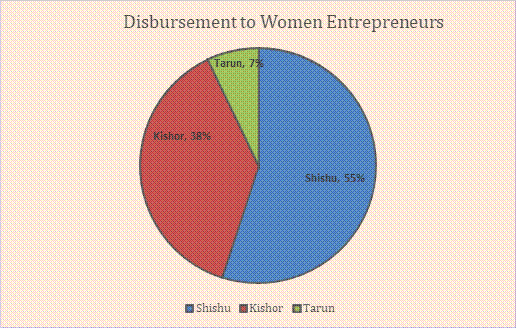
Women Borrowers: A total of ₹9.02 lakh crore was disbursed under the Shishu category, ₹ 6.22 lakh crore under Kishor, and ₹ 1.09 lakh crore under the Tarun category.  
 

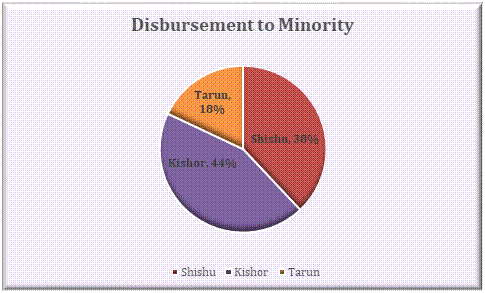
Minority Borrowers: The disbursements amounted to ₹1.33 lakh crore under Shishu, ₹1.54 lakh crore under Kishor, and ₹ 0.62 lakh crore under Tarun.
New Entrepreneurs/Accounts:

Shishu category: 8.80 crore accounts with a sanctioned amount of ₹2.47 lakh crore and disbursed amount of ₹ 2.42 lakh crore.

Kishor category: 2.79 crore accounts with ₹5.09 lakh crore sanctioned and ₹4.87 lakh crore disbursed.

Tarun category: 55 lakh accounts with a sanctioned amount of ₹4.82 lakh crore and ₹4.67 lakh crore disbursed.
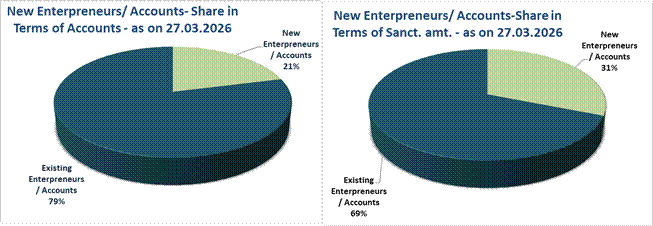
Category-wise breakup:-(Number of loans and amount sanctioned)

Category

Percentage as per No. of Loans

Percentage as per Amount Sanctioned

Shishu

74%

32%

Kishor

24%

43%

Tarun

2%

25%

TarunPlus

0.004%

0.095%

Total

100%

100%


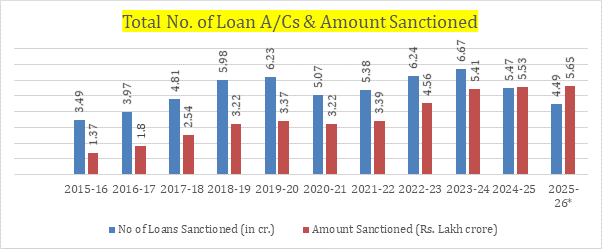
Year-wise sanction amount is as under:-

Financial Year

No. of Loans Sanctioned

(in Crore)

Amount Sanctioned

(Rs. in Lakh Crore)

2015-16

3.49

1.37

2016-17

3.97

1.80

2017-18

4.81

2.54

2018-19

5.98

3.22

2019-20

6.23

3.37

2020-21

5.07

3.22

2021-22

5.38

3.39

2022-23

6.24

4.56

2023-24

6.67

5.41

2024-25

5.47

5.53

2025-26

(as on 27.03.2026) *

4.49

5.65

Total

57.79

40.07

Marking over a decade of the PMMY, India underscores its dedicated mission to integrate the marginalized into the formal economy. By focusing on the core principles of "Banking the Unbanked," "Securing the Unsecured," and "Funding the Unfunded," the Government continues to bridge financial gaps and turn the aspirations of aspiring business owners into reality.

Topics

Acts Income Tax