Loading...

Top
Help
×

By creating an account you can:

Logo TaxTMI
Call Us / Help / Feedback

Contact Us At :

E-mail: [email protected]

Call / WhatsApp at: +91 99117 96707

For more information, Check Contact Us

FAQs :

To know Frequently Asked Questions, Check FAQs

Most Asked Video Tutorials :

For more tutorials, Check Video Tutorials

Submit Feedback/Suggestion :

Email :
Please provide your email address so we can follow up on your feedback.
Category :
Description :
Min 15 characters 0/2000
Make Most of Text Search
  1. Checkout this video tutorial: How to search effectively on TaxTMI.
  2. Put words in double quotes for exact word search, eg: "income tax"
  3. Avoid noise words such as : 'and, of, the, a'
  4. Sort by Relevance to get the most relevant document.
  5. Press Enter to add multiple terms/multiple phrases, and then click on Search to Search.
  6. Text Search
  7. The system will try to fetch results that contains ALL your words.
  8. Once you add keywords, you'll see a new 'Search In' filter that makes your results even more precise.
  9. Text Search
Add to...
You have not created any category. Kindly create one to bookmark this item!
Create New Category
Hide
Title :
Description :
❮❮ Hide
Default View
Expand ❯❯
Close ✕
🔎 News - Adv. Search
TEXT SEARCH:

Press 'Enter' to add multiple search terms. Rules for Better Search

Search In:
Main Text + AI Text
  • Main Text
  • Main Text + AI Text
  • AI Text
Category: ?
Categorized by AI
---- All Categories ----
  • ---- All Categories ----
  • Income Tax
  • GST
  • Customs, DGFT & SEZ
  • FEMA & RBI
  • Corp. Laws, SEBI & IBC
  • PMLA, Black Money & ED
  • Budget
  • News and Press Release
  • PTI News
Month:
---- All Months ----
  • ---- All Months ----
  • January
  • February
  • March
  • April
  • May
  • June
  • July
  • August
  • September
  • October
  • November
  • December
Year:
---- All Years ----
  • ---- All Years ----
  • 2026
  • 2025
  • 2024
  • 2023
  • 2022
  • 2021
  • 2020
  • 2019
  • 2018
  • 2017
  • 2016
  • 2015
  • 2014
  • 2013
  • 2012
  • 2011
Sort By: ?
In Sort By 'Default', exact matches for text search are shown at the top, followed by the remaining results in their regular order.
Relevance Default Date
    PAN Health Wins ‘Excellence in Manufacturing – Healthcare & Pharmaceuticals’ at ET Entrepreneur Awards 2026
    US report flags high import duties, non-tariff barriers in India
    Rupee rises 15 paise to 94.70 against US dollar in early trade
    CBDT signs record 219 Advance Pricing Agreements (APAs) in FY 2025–26, taking total number of APAs beyond milestone of 1000 (i.e. 1034) since incept...
    US lists India’s preference for domestic satellites for DTH, localised internet shutdown as trade barrier
    Police recover huge cash, high-end vehicles from two Bihar govt officials
    Quality of HP apple must be improved to compete with global players: Min
    India's 1st Iranian oil cargo since 2019 headed to Gujarat coast
    Guidance Note – Form 112
    Form 112 – Frequently Asked Questions
    National Council for Cement and Building Materials signs MoU with Delhi Technological University to strengthen skill development and capacity building...
    In pursuance of Union Budget 2026-27 announcement, CBIC operationalises comprehensive reforms for e-commerce exports and courier trade to enhance ease...
    Guidance Note – Form 110
    Form 110 – Frequently Asked Questions
    Guidance Note – Form 109
    Form 109 – Frequently Asked Questions
    Guidance Note – Form 108
    Form 108 – Frequently Asked Questions
    Guidance Note – Form 107
    Form No. 107 – Frequently Asked Questions
❯❯
Maximize Maximize Maximize
0 / 200
Expand Note
Add to Folder

No Folders have been created

+

Are you sure you want to delete "My most important" ?

NOTE:

News
Showing Results for :
Reset Filters
Results Found:
Show All Summaries Hide All Summaries
April 1, 2026
Show AI Summary
Manufacturing excellence drives PAN Health's recognition for scale, quality, and growth in disposable personal hygiene products.
PAN Health received the 'Excellence in Manufacturing - Healthcare & Pharmaceuticals' award at the ET Entrepreneur Awards 2026 for its manufacturing scale, quality focus, and contribution to the disposable personal hygiene sector. The company is presented as a fast-growing Indian manufacturer aligned with the Make in India vision, operating a large facility in Rajkot, Gujarat, and producing multiple categories of hygiene products under brands including Little Angel, Liberty, and Everteen.
April 1, 2026
Show AI Summary
Trade barriers and tariff flexibility in India draw fresh US concerns over market access, standards and digital restrictions.
The report says India maintains high applied import duties and wide tariff flexibility, while also using numerous non-tariff barriers such as licensing requirements, Quality Control Orders, customs barriers, testing and certification mandates, and price controls. It further criticises opaque quantitative restrictions, burdensome import licensing for remanufactured goods, discretionary tariff changes, and complex customs exemptions. The report also flags concerns over standards, government procurement, foreign equity limits, digital trade barriers and internet shutdowns affecting market access and commercial operations.
April 1, 2026
Show AI Summary
Net open position cap for banks tightened to curb foreign exchange exposure and reinforce currency risk management.
RBI capped the Net Open Position in Indian rupees for banks at USD 100 million, with compliance required by April 10, 2026. The measure requires banks to reduce currency exposure and align positions with the prescribed limit, reflecting regulatory control over foreign exchange exposure and risk management in bank dealings.
April 1, 2026
Show AI Summary
Advance Pricing Agreements boost transfer pricing certainty as safe harbour reforms streamline compliance and strengthen business certainty.
CBDT signed a record number of Advance Pricing Agreements with Indian taxpayers in FY 2025-26, including unilateral and bilateral agreements, taking the cumulative APA count beyond the 1,000-mark since inception. The APA programme is described as a mechanism for strengthening transfer pricing certainty, easing compliance, and improving ease of business. Safe Harbour Rules complement the framework by prescribing fixed margins for specified international transactions, while recent reforms consolidate technology service categories, raise the eligibility threshold, and introduce a more automated process.
April 1, 2026
Show AI Summary
Domestic satellite preference and internet shutdown controls are flagged as trade barriers affecting satellite services and digital commerce.
Preference for domestic satellites in direct-to-home television services, restrictions on direct foreign contracting, and procedural delays in accessing foreign satellite capacity are described as barriers to foreign trade. The report also urges an open skies satellite policy to expand market access. Localised internet shutdowns and increased takedown requests are said to impede the digital economy, while satellite communication providers face security instructions on interception, blocking, routing, registration, disclosure, geo-fencing, data localisation, and phased sourcing of ground infrastructure.
March 31, 2026
Show AI Summary
Disproportionate assets probe leads to recovery of cash, vehicles and property documents from senior officials.
Police action against two senior Bihar government officers for alleged possession of disproportionate assets led to searches at multiple locations and recovery of property documents, cash, luxury items and vehicle records. The Economic Offences Unit registered separate FIRs against Kishanganj SDPO Gautam Kumar and Saharsa DRDA director Vaibhav Kumar after preliminary findings indicated assets allegedly far in excess of their known income, with suspected benami properties and investments traced to family members and associates. Searches yielded documents relating to numerous land parcels, residential property, insurance and financial investments, bank deposits, cash, luxury watches, high-end vehicles and other valuables.
March 31, 2026
Show AI Summary
Free trade agreements and apple imports raise concerns over Himachal orchardists' economic interests and market competitiveness.
Himachal Pradesh's apple sector was discussed in the context of free trade agreements with the European Union, the United States, New Zealand and other countries, with concern that lower import duties on apples could affect the economic interests of local growers. A private resolution urged the central government to frame a policy to safeguard orchardists, and the government accepted the resolution. The debate also noted that Himachal apples must improve in quality to compete with imports and that the state lags behind those markets in quality standards.
March 31, 2026
Show AI Summary
Sanctions waiver revives Iranian crude trade as a cargo heads to Gujarat amid refinery inventory pressures.
India's crude oil trade may see a renewed shipment of Iranian oil after a sanctions waiver allowed oil "on the water" to be purchased for a limited period. A vessel carrying about 600,000 barrels of Iranian crude has reportedly been observed heading toward Vadinar in Gujarat, marking the first such delivery since imports stopped in 2019 after sanctions tightening. The development is linked to Indian refiners' need for cargoes amid tightening inventories, while the government has stated that any resumption of purchases will depend on techno-commercial feasibility.
March 31, 2026
Show AI Summary
Registered non-profit organisation audit reporting in Form 112 standardises income, foreign contribution, and related person disclosures.
Form 112 is the annual audit report required to be furnished electronically under section 348 for a registered non-profit organisation whose total income exceeds the maximum amount not chargeable to income-tax in the relevant tax year. The form is filed through the e-filing portal on or before 30 September of the following year, with a Chartered Accountant certificate and annexure covering audited particulars, income classification, application of income, donations, related person transactions, specified violations, loans, borrowings, and supporting schedules. The guidance also consolidates earlier audit forms into a common Form 112 with different schedules for small and large registered non-profit organisations.
March 31, 2026
Show AI Summary
Electronic audit report filing for registered non-profit organisations is mandatory, time-bound, and tied to exemption eligibility under the income-tax law.
Form 112 is the electronic audit report prescribed under section 348 of the Income-tax Act, 2025, for a registered non-profit organisation whose income exceeds the basic non-taxable limit. It must be filed annually through the e-filing portal, one month before the due date for the return of income, and cannot be edited after acknowledgment or filed offline. PAN is mandatory, and supporting documents include registration papers, audited financials, related forms, FCRA records, AIS, and TDS returns.
March 31, 2026
Show AI Summary
Research-academia collaboration in cement and construction advances joint innovation, training, and sector-wide capacity building.
Strengthening research-academia collaboration in the cement and construction sector is pursued through a Memorandum of Understanding between the National Council for Cement and Building Materials and Delhi Technological University. The arrangement is directed toward joint research and innovation in cement and concrete technologies, along with training opportunities for students, professionals and other stakeholders. It also supports skill development and capacity building across the sector, with an emphasis on sharing technical knowledge, best practices and industry-relevant expertise.
March 31, 2026
Show AI Summary
E-commerce export and courier trade reforms remove value caps, add Return to Origin processing, and simplify returns handling.
CBIC operationalised reforms for e-commerce exports and courier-based trade to improve ease of doing business, reduce logistics inefficiencies, and strengthen export competitiveness. The reforms remove the value cap on commercial courier export consignments, introduce a Return to Origin mechanism for uncleared or unclaimed imports after 15 days, and simplify re-import of returned or rejected goods through a risk-based approach and system-based processing.
March 31, 2026
Show AI Summary
Amendment to accumulated income purpose through Form 110 requires electronic filing and Assessing Officer decision.
FORM 110 is an electronic application for a registered non-profit organisation seeking approval to amend the original purpose for which income was accumulated or set apart for a particular tax-year. It is filed on the e-filing portal before expiry of the period prescribed under Form 109 and must include details of the earlier Form 109, the proposed amendment, the amount unapplied, the reasons for the change, and an undertaking. The application is then forwarded to the jurisdictional Assessing Officer for decision and order in the prescribed ITNS form under section 342(6).
March 31, 2026
Show AI Summary
Change of purpose for accumulated income requires online FN 110 filing and approval before amended utilisation.
FN 110 is the prescribed digital application for a registered non-profit organisation seeking approval to amend the original purpose stated in FN 109 for income accumulated or set apart for a particular tax year. The form is mandatory when such amendment is proposed, must be filed online through the e-filing portal, requires a valid PAN, and cannot be filed offline or edited after submission. After filing and acceptance in FN 111, the accumulated or set-apart amount may be applied toward the amended purpose as approved.
March 31, 2026
Show AI Summary
Accumulation or set-aside of income by non-profit organisations requires annual electronic disclosure in Form 109.
Form 109 is an annual electronic statement for a registered non-profit organisation to report regular income accumulated or set apart under section 342(1) of the Income Tax Act, 2025. It must be furnished on the e-filing portal before the due date for filing the return of income and includes details of the amount, purpose, period of accumulation, prior-year accumulations, and any non-application due to injunction or court order. The reported amount may be claimed in a subsequent return for application within five tax years.
March 31, 2026
Show AI Summary
Accumulation of income by non-profit organisations requires timely electronic filing of FN 109 with a valid PAN.
Registered non-profit organisations may furnish FN 109 electronically or digitally to indicate accumulation or setting apart of regular income under section 342(1) of the Income-tax Act, 2025, for application in subsequent tax years for a period not exceeding five tax years. The form is mandatory for claiming the accumulated or set-apart amount, must be filed by the return due date, requires a valid PAN, and is submitted online to the Commissioner of Income Tax (CPC) through the e-filing portal. It cannot be edited after submission or filed offline.
March 31, 2026
Show AI Summary
Deemed application for non-profit income requires electronic filing of Form 108 before the return due date.
Form 108 requires a registered non-profit organisation to electronically furnish a statement exercising the option under section 341(7) for treating regular income as deemed application under section 341(5). The annual filing is due before the return of income due date and covers computation of the shortfall in application and the reasons for that shortfall. A reported shortfall may be claimed as deemed application in the subsequent return of income.
March 31, 2026
Show AI Summary
Deemed application of income under FN 108 requires timely online filing by registered non-profit organisations.
Registered non-profit organisations may use FN 108 as the electronic statement for exercising the option to treat a shortfall in application of income as deemed application where income could not be applied because it was not received during the relevant tax year. The form is mandatory for such a claim, must be filed online by the return filing due date, requires a valid PAN, and cannot be edited after submission.
March 31, 2026
Show AI Summary
Registration and approval conditions under Form 107 govern validity, disclosure, commercial activity, and cancellation safeguards.
Form No. 107 is the written order passed by the jurisdictional Principal Commissioner or Commissioner on an application in Form No. 105 for regular registration or approval, rejection of the application, cancellation of registration or approval, or a mixed order granting one section code while rejecting another. It records applicant particulars, the unique registration or approval number, the section, date, nature of activity, validity period and relevant tax years, and where applicable the reasons for rejection or cancellation. The form also sets out conditions on application of income, commercial activities, books of account, compliance with law, and true and complete disclosure.
March 31, 2026
Show AI Summary
Registration and approval orders under Form 107 govern grant, rejection, cancellation, and validity periods for eligible applicants.
Form No. 107 is the written order by which the jurisdictional Principal Commissioner or Commissioner grants regular registration or approval, rejects the application, cancels registration or approval, or grants one section code while rejecting the other. It is passed on receipt of Form No. 105, ordinarily within six months from the end of the quarter in which the application is made. The order may issue a 16 digit alphanumeric Unique Registration Number, and the validity of regular registration or approval is generally five tax years, with stated exceptions extending validity in specified cases.

News

Back

All News

Showing Results for :
Reset Filters
No Records Found

News

Back

All News

Showing Results for : Reset Filters

Pradhan Mantri Mudra Yojana (PMMY) — completes 11 Years of empowering Small and Micro Entrepreneurs

April 8, 2026

Contents
Summary
Note

Note

-

Bookmark

Print

Print

PMMY instrumental in reshaping the credit landscape for MSMEs and countless individual entrepreneurs in the country: Union Finance Minister Smt. Nirmala Sitharaman

PMMY provides a platform for small entrepreneurs to access loan support from banks, NBFCs, and MFIs as it drives credit inclusion: MoS Sh. Pankaj Chaudhary

Mudra Yojana facilitates seamless access to collateral-free institutional credit up to ₹20 lakh for non-corporate and non-farm income-generating activities

PMMY has disbursed over ₹40.07 lakh crore through 57.79 crore loans, strengthening the credit ecosystem for small and micro enterprises

The Pradhan Mantri MUDRA Yojana (PMMY) launched by Prime Minister Shri Narendra Modi on April 8, 2015, is marking 11 years of success in strengthening India's grassroots entrepreneurs. This initiative has been designed to bridge the gap in financial accessibility, offering streamlined, easy collateral-free loans up to ₹20 lakh to support small-scale business ventures for non-corporate and non-farm income-generating activities.

Micro, Small, and Medium Enterprises (MSMEs) serve as the backbone of the industrial ecosystem, acting as essential partners to major corporations and driving balanced economic development. By diversifying their reach into new industries and refining their output, these enterprises are effectively addressing the needs of both local consumers and global markets.

The landscape of business financing has evolved rapidly, with digital innovations and data analytics making it easier for smaller firms to secure capital. A cornerstone of this progress is PMMY, a strategic government initiative famously characterized by its mission to "Fund the Unfunded," ensuring that credit reaches those traditionally overlooked by formal banking systems.

On the occasion of the 11th successful year of PMMY, Union Minister for Finance & Corporate Affairs Smt. Nirmala Sitharaman said, “In the last decade, India witnessed a silent transformation where crores of ordinary citizens stepped into entrepreneurship with newfound confidence and agency. At its heart lies an initiative launched on April 08, 2015, by the Prime Minister, the Pradhan Mantri MUDRA Yojana (PMMY), which, by design, focused on "funding the unfunded".

“Eleven years later, the scheme has been instrumental in reshaping the credit landscape for MSMEs and countless individual entrepreneurs in the country. These were those entrepreneurs who were hitherto excluded from the formal banking system. With this initiative, entrepreneurship has become truly democratised by removing the entry barriers to credit”, Smt. Nirmala Sitharaman added.

Highlighting PMMY’s role in Empowering Millions and Fulfilling the Vision of Inclusive Growth, Union Minister of Finance remarked, “Cumulatively, more than 57.79 crore loans have been sanctioned, amounting to ₹40.07 lakh crore of disbursement. Two-thirds of the loans have been sanctioned to women entrepreneurs. Approximately one-fifth of all the loans were extended to first-time entrepreneurs. In sheer magnitude, this translates to 12.15 crore loans with an amount of 12 lakh crores extended to new entrepreneurs.”

The Union Finance Minister also appreciated the Banks, various Financial Institutions, and stakeholders for bringing the scheme to the common man and making it a resounding success.

“PM MUDRA Yojana will continue to empower entrepreneurs to become active participants in our nation's journey to become Viksit Bharat by 2047”, Smt. Nirmala Sitharaman said.

On the occasion, Union Minister of State (MoS) for Finance, Shri Pankaj Chaudhary said, “The Pradhan Mantri MUDRA Yojana (PMMY) is one of the most significant initiatives, aimed at promoting micro-entrepreneurship. Financial inclusion is one of the top priorities of the government, as it plays a vital role in achieving inclusive growth. PMMY provides a platform for small entrepreneurs to access loan support from banks, NBFCs, and MFIs as it drives credit inclusion.”

“The MUDRA Yojana was launched by the Prime Minister Shri Narendra Modi on April 8, 2015. While launching the scheme, the Prime Minister stated that supporting India's small entrepreneurs is one of the most effective ways to help the Indian economy grow and prosper. The scheme has provided crucial financial assistance to a vast number of entrepreneurs, helping them set up and operate their businesses and instilling a sense of financial security in them.”, MoS said.

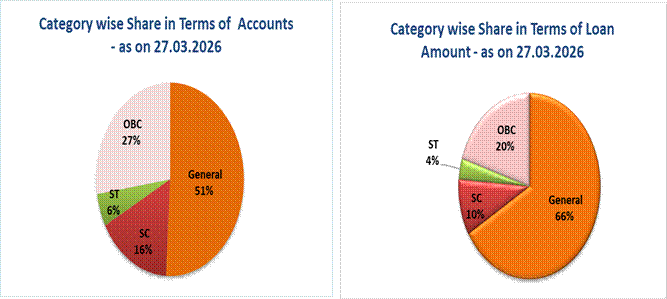
The MoS also added, “It has created self-employment opportunities across the country, especially for marginalized sections of society, including Scheduled Castes/Scheduled Tribes, Other Backward Classes (51% of loan beneficiaries), and women (67% of loan beneficiaries).”

Stressing on Mudra’s impact the MoS saidThe core objective of the MUDRA Yojana is "Funding the Unfunded." The scheme has successfully ended the exploitation of India's small entrepreneurs by informal lenders. In the past 11 years, it has extended over 40 lakh crore through 57.7 crore loans, instilling a new sense of confidence among borrowers. This clearly reflects the government's firm commitment to support their efforts and its accelerated journey toward making India a developed nation by 2047 through inclusive growth enabled by financial inclusion.”

As we commemorate eleven years of advancing financial inclusion through the core tenets of the MUDRA scheme, let us glance through some of the primary characteristics and significant milestones of the scheme:

The implementation of financial inclusion programme in the country is based on three pillars, namely,

  1. Banking the Unbanked
  2. Securing the Unsecured and
  3. Funding the Unfunded

These aforesaid three objectives are being achieved through leveraging technology and adopting multi-stakeholders’ collaborative approach, while serving the unserved and underserved as well.

One of the three pillars of FI - Funding the Unfunded, is reflected in the Financial Inclusion ecosystem through PMMY, which is being implemented with the objective to provide collateral free access to credit for small/ micro entrepreneurs.

Key Features of PMMY:

  1. MUDRA loans are being offered in four categories namely, ‘Shishu’, ‘Kishor’, ‘Tarun’ and ‘TarunPlus’ which signifies the stage of growth or development and funding needs of the borrowers: -
    • Shishu: covering loans upto Rs. 50,000/-
    • Kishor: covering loans above Rs. 50,000/- and up to Rs. 5 lakhs
    • Tarun: covering loans above Rs.5 lakh and upto Rs.10 lakhs
    • TarunPlus: covering loans above Rs.10lakh and upto Rs.20 lakhs
  2. Loans cover term financing and working capital needs across manufacturing, trading and service sectors, including activities allied to agriculture like poultry, dairy, and beekeeping, etc.
  3. The interest rate is governed by RBI guidelines, with flexible repayment terms.

Achievements under Pradhan Mantri Mudra Yojana (PMMY) as on 27.03.2026

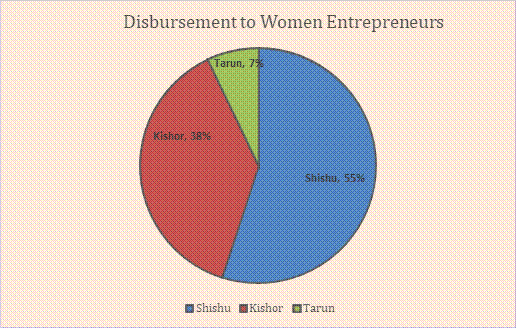
Women Borrowers: A total of ₹9.02 lakh crore was disbursed under the Shishu category, ₹ 6.22 lakh crore under Kishor, and ₹ 1.09 lakh crore under the Tarun category.  
 

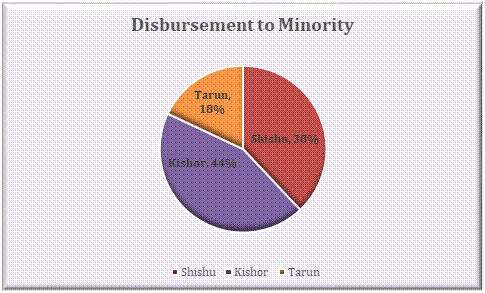
Minority Borrowers: The disbursements amounted to ₹1.33 lakh crore under Shishu, ₹1.54 lakh crore under Kishor, and ₹ 0.62 lakh crore under Tarun.
New Entrepreneurs/Accounts:

Shishu category: 8.80 crore accounts with a sanctioned amount of ₹2.47 lakh crore and disbursed amount of ₹ 2.42 lakh crore.

Kishor category: 2.79 crore accounts with ₹5.09 lakh crore sanctioned and ₹4.87 lakh crore disbursed.

Tarun category: 55 lakh accounts with a sanctioned amount of ₹4.82 lakh crore and ₹4.67 lakh crore disbursed.
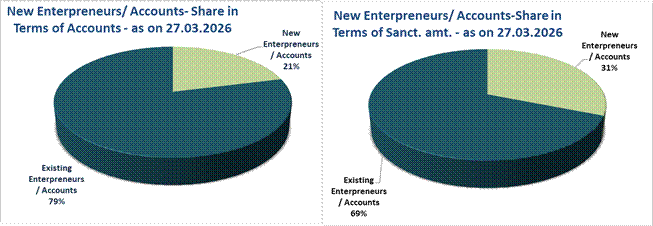
Category-wise breakup:-(Number of loans and amount sanctioned)

Category

Percentage as per No. of Loans

Percentage as per Amount Sanctioned

Shishu

74%

32%

Kishor

24%

43%

Tarun

2%

25%

TarunPlus

0.004%

0.095%

Total

100%

100%


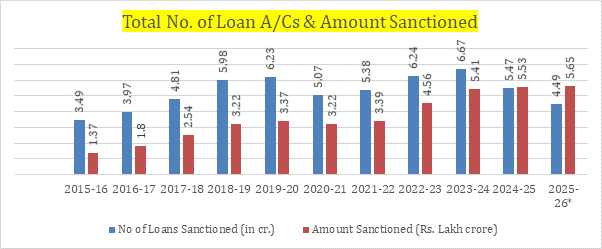
Year-wise sanction amount is as under:-

Financial Year

No. of Loans Sanctioned

(in Crore)

Amount Sanctioned

(Rs. in Lakh Crore)

2015-16

3.49

1.37

2016-17

3.97

1.80

2017-18

4.81

2.54

2018-19

5.98

3.22

2019-20

6.23

3.37

2020-21

5.07

3.22

2021-22

5.38

3.39

2022-23

6.24

4.56

2023-24

6.67

5.41

2024-25

5.47

5.53

2025-26

(as on 27.03.2026) *

4.49

5.65

Total

57.79

40.07

Marking over a decade of the PMMY, India underscores its dedicated mission to integrate the marginalized into the formal economy. By focusing on the core principles of "Banking the Unbanked," "Securing the Unsecured," and "Funding the Unfunded," the Government continues to bridge financial gaps and turn the aspirations of aspiring business owners into reality.

Topics

Acts Income Tax