Loading...

Top
Help
×

By creating an account you can:

Logo TaxTMI
Call Us / Help / Feedback

Contact Us At :

E-mail: [email protected]

Call / WhatsApp at: +91 99117 96707

For more information, Check Contact Us

FAQs :

To know Frequently Asked Questions, Check FAQs

Most Asked Video Tutorials :

For more tutorials, Check Video Tutorials

Submit Feedback/Suggestion :

Email :
Please provide your email address so we can follow up on your feedback.
Category :
Description :
Min 15 characters 0/2000
Make Most of Text Search
  1. Checkout this video tutorial: How to search effectively on TaxTMI.
  2. Put words in double quotes for exact word search, eg: "income tax"
  3. Avoid noise words such as : 'and, of, the, a'
  4. Sort by Relevance to get the most relevant document.
  5. Press Enter to add multiple terms/multiple phrases, and then click on Search to Search.
  6. Text Search
  7. The system will try to fetch results that contains ALL your words.
  8. Once you add keywords, you'll see a new 'Search In' filter that makes your results even more precise.
  9. Text Search
Add to...
You have not created any category. Kindly create one to bookmark this item!
Create New Category
Hide
Title :
Description :
❮❮ Hide
Default View
Expand ❯❯
Close ✕
🔎 News - Adv. Search
TEXT SEARCH:

Press 'Enter' to add multiple search terms. Rules for Better Search

Search In:
Main Text + AI Text
  • Main Text
  • Main Text + AI Text
  • AI Text
Category: ?
Categorized by AI
---- All Categories ----
  • ---- All Categories ----
  • Income Tax
  • GST
  • Customs, DGFT & SEZ
  • FEMA & RBI
  • Corp. Laws, SEBI & IBC
  • PMLA, Black Money & ED
  • Budget
  • News and Press Release
  • PTI News
Month:
---- All Months ----
  • ---- All Months ----
  • January
  • February
  • March
  • April
  • May
  • June
  • July
  • August
  • September
  • October
  • November
  • December
Year:
---- All Years ----
  • ---- All Years ----
  • 2026
  • 2025
  • 2024
  • 2023
  • 2022
  • 2021
  • 2020
  • 2019
  • 2018
  • 2017
  • 2016
  • 2015
  • 2014
  • 2013
  • 2012
  • 2011
Sort By: ?
In Sort By 'Default', exact matches for text search are shown at the top, followed by the remaining results in their regular order.
Relevance Default Date
❯❯
Maximize Maximize Maximize
0 / 200
Expand Note
Add to Folder

No Folders have been created

+

Are you sure you want to delete "My most important" ?

NOTE:

News
Showing Results for :
Reset Filters
Results Found:
Show All Summaries Hide All Summaries
April 2, 2026
Show AI Summary
TDS certificate Form No. 130 formalises tax credit for salary, pension, and specified senior-citizen interest income.
Form No. 130 is the annual TDS certificate issued to salaried employees, pensioners, and specified senior citizens in relation to salary, pension, or eligible interest income on which tax has been deducted and deposited. It replaces Form 16 and serves as proof of deduction and deposit of tax, enabling the deductee to claim credit for TDS. The certificate is issued by the employer or specified bank through the TRACES system, after processing of quarterly TDS statements, and issuance is mandatory once tax has been deducted and deposited.
April 2, 2026
Show AI Summary
Tax deduction before remittance governs Form 129 applications to determine taxable income and treaty-based withholding for non-resident payments.
Form No. 129 is the electronic application used by a payer remitting sums, other than salary, to a non-resident individual or a foreign company to obtain a certificate determining the amount chargeable to tax before remittance and to authorise deduction of tax on that amount. The form applies before remittance, may be withdrawn before an order is passed, and requires payer and payee particulars, transaction details, supporting documents, and treaty-based or domestic taxability details for assessment by the Assessing Officer.
April 2, 2026
Show AI Summary
GST revenue collections and refund adjustments for March 2026 show provisional gross, net and cess figures across domestic and import streams.
Gross and net GST revenue collections for March 2026 are reported on a provisional basis, with separate disclosure of domestic and import collections, refunds, net revenue and compensation cess. The statement presents gross GST revenue by CGST, SGST and IGST, shows domestic refunds and export-linked GST refunds through ICEGATE, and derives net domestic revenue, net customs revenue and total net GST revenue after refund adjustments. It also notes that compensation cess is a transitory arrangement until the loan and interest liability is discharged, and that the figures may vary on finalisation.
April 2, 2026
Show AI Summary
Tax deduction at lower or nil rate through Form No. 129 for non-resident payments and remittances.
Form No. 129 is an online application by a payer to obtain a certificate for deduction of tax at a lower or nil rate on payments to a non-resident or foreign company. It is filed before remittance, requires supporting documents and verification through prescribed electronic methods, and may be withdrawn before the Assessing Officer passes an order. If eligibility and compliance requirements are satisfied, the Assessing Officer issues a certificate valid for the specified tax year; otherwise, tax is deducted at the applicable rate.
April 2, 2026
Show AI Summary
Income-tax simplification and modernisation as the new Act replaces the old regime with streamlined compliance measures.
The Income-tax Act, 2025 comes into force from 1 April 2026 and replaces the long-standing Income-tax Act, 1961. The reform is presented as a comprehensive simplification and modernisation of India's direct tax framework, aimed at improving clarity, ease of compliance, and reader-friendly presentation without altering the underlying tax policy. The Income-tax Rules, 2026 have been notified to operationalise the new Act, and the corresponding forms have also been issued to make compliance simpler.
April 2, 2026
Show AI Summary
Export obligation discharge certificates see accelerated disposal under a special drive to clear backlog and ease exporter compliance.
The Directorate General of Foreign Trade conducted a time-bound special drive for expeditious issuance of Export Obligation Discharge Certificates under the Advance Authorisation and Export Promotion Capital Goods schemes, with daily monitoring by senior officials to accelerate closure of export obligations and improve trade facilitation. The drive was designed to support an exporter-friendly ecosystem by enabling release of bank guarantees and bonds, reducing grievance burden, and strengthening compliance monitoring under the foreign trade framework. In view of the campaign's results, the special drive was extended for a further two months with fresh guidelines. The extension continues the administrative effort to expedite EODC disposal, support timely closure of export obligations, and reduce the operational burden on exporters.
April 2, 2026
Show AI Summary
Conditional customs duty concessions for SEZ to DTA clearances impose value addition, cap limits, and anti-double-benefit safeguards.
Conditional customs duty concessions are notified for clearance of goods manufactured in Special Economic Zones to the Domestic Tariff Area, subject to a ceiling of 30 per cent of the highest annual Free on Board export value in the preceding three financial years. Eligible units must satisfy minimum 20 per cent value addition, obtain a Development Commissioner's certificate, and comply with audit requirements, while export benefits such as duty drawback on inputs are barred to prevent double benefits.
April 2, 2026
Show AI Summary
Lower or nil tax deduction certificate process under income tax law through electronic Form 128 filing and approval.
Form No. 128 is the electronic application under the Income-tax Act, 2025 for a certificate authorising lower or nil deduction of tax at source and lower collection of tax under section 395(1) and section 395(3). It may be filed by resident or non-resident applicants seeking reduced TDS or TCS on specified income, and requires applicant details, tax liability particulars, income estimates, supporting financial information, and payer/TAN details where applicable. The form is processed electronically, and any approved certificate can be shared with the payer for application of the authorised rate during its validity.
April 2, 2026
Show AI Summary
Lower or nil tax deduction certificate through TRACES requires advance electronic filing, PAN, and supporting documents.
Form No. 128 is the electronic application for a certificate authorising lower or nil deduction of income-tax and lower collection of income-tax under section 395(1) and section 395(3) of the Income-tax Act, 2025. The form is optional, must be filed through the TRACES portal before the relevant transaction, and cannot be processed once the TDS/TCS transaction is completed. It requires PAN, supporting documents, and electronic submission with e-verification.
April 2, 2026
Show AI Summary
Tax collection at source declaration for non-trading use of goods enables buyers to obtain goods without TCS.
Form No. 127 is the declaration required from a buyer to obtain goods without collection of tax at source where the goods are intended for manufacturing, processing, production, or generation of power and are not meant for trading. The buyer must furnish the declaration to the seller at or before the purchase or payment event, and the seller must verify the declaration, upload monthly details to the e-filing portal by the 7th of the following month, and forward the declaration to the tax authority.
April 2, 2026
Show AI Summary
TCS exemption declaration for specified goods requires PAN, timely filing, and seller reporting obligations.
Form No. 127 is a buyer's declaration under section 394(2) of the Income-tax Act, 2025 for obtaining specified goods without collection of tax at source. A resident buyer may furnish the declaration to the seller where the goods are intended for manufacturing, processing, producing articles or things, or generating power, and not for trading. PAN is mandatory, the declaration must be furnished on or before the date of transaction, and once received the seller must report the particulars and include the transactions in the quarterly TCS statement.
April 2, 2026
Show AI Summary
Tax deduction relief for non-resident branch operations through a unified Form No. 126 compliance framework.
Form No. 126 is a unified self-declaration and treaty-benefit request for specified non-residents carrying on business or profession in India through a branch to obtain a certificate for receipt of certain sums without deduction of tax at source. Banking companies and insurers, and other eligible non-resident persons, must satisfy the conditions in Rule 209, including tax compliance, branch-based receipt on own account, and, for non-banking applicants, continuous business in India for five years and prescribed fixed assets. The application is filed electronically, processed by the Assessing Officer, and the certificate remains valid for the relevant tax year unless cancelled earlier.
April 2, 2026
Show AI Summary
Rupee recovery follows RBI cap on banks' net open position amid capital outflows and crude-driven pressure.
Rupee recovered in early trade after the Reserve Bank of India capped banks' net open position in the onshore forward delivery market and required compliance by April 10, 2026. The currency remained under pressure from foreign capital outflows, a stronger dollar, rising crude oil prices, geopolitical volatility, widening trade deficit, declining remittances and sustained foreign portfolio investor selling.
April 2, 2026
Show AI Summary
Customs duty exemption on critical petrochemical imports aims to stabilise supply chains and ease cost pressures.
Full customs duty exemption has been granted on specified critical petrochemical imports as a temporary and targeted measure to protect supply stability amid disruptions in global supply chains caused by the West Asia crisis. The exemption is intended to ensure continued availability of essential petrochemical inputs for domestic industry, reduce cost pressures on downstream sectors, and provide relief to consumers of final products. The exemption remains valid until June 30 and covers Methanol, Anhydrous ammonia, Toluene, Styrene, Dichloromethane, Vinyl chloride monomer, Poly butadiene, Styrene butadiene and Unsaturated polyester resins.
April 2, 2026
Show AI Summary
GST fraud through fake firms and fake invoices exposed alleged illegal input tax credit claims and circular trading.
GST fraud involving fake firms, shell companies, fake invoices and circular trading was detected during a police investigation. The alleged racket used fake Aadhaar and PAN details to unlawfully avail input tax credit and underreported sales in GST returns, causing an estimated loss of around Rs 3 crore to the government exchequer, with the total involvement suspected to be higher. One accused was arrested, while efforts continued to trace other persons involved.
April 1, 2026
Show AI Summary
GST revenues rise on stronger imports and domestic sales, marking one of the highest monthly collections this fiscal.
GST revenues rose about 9 per cent in March to over two lakh crore rupees, reaching the third highest monthly collection in the 2025-26 fiscal. The increase was supported by higher receipts from imports as well as domestic sales and purchases, reflecting a recovery in tax mop-ups after earlier tax cuts.
April 1, 2026
Show AI Summary
State GST collection growth in Haryana leads the country, driven by stronger compliance, economic activity and taxpayer base expansion.
State GST collection growth in Haryana was reported as the highest among all states in FY26, with post-settlement SGST collection rising to Rs 48,289 crore from Rs 39,743 crore in FY25. The increase of 21.5 per cent exceeded the national average SGST growth of 5.7 per cent. Total GST collection in the State also grew by 8.6 per cent, placing Haryana fifth among states and Union Territories in gross domestic GST collection.
April 1, 2026
Show AI Summary
Insolvency resolution framework tightened to speed up admissions, reduce delays, and support rescue of viable businesses.
Parliament has amended the Insolvency and Bankruptcy Code to speed up admission and resolution of insolvency cases, reduce backlog, and preserve enterprise value. The changes introduce stricter timelines, greater reliance on information utilities, stronger liquidation oversight, and an enabling framework for group and cross-border insolvency. The bill also replaces the underused fast-track process with a creditor-initiated framework, exempts MSMEs from disqualification under specified provisions, and requires insolvency applications to be admitted within 14 days once default is established.
April 1, 2026
Show AI Summary
Tax devolution dispute intensifies as Karnataka alleges unfair GST returns, denied compensation, and shrinking fiscal share.
Karnataka Chief Minister Siddaramaiah alleged that the Union Government's tax devolution and fiscal policy towards Karnataka amounted to tax terrorism or tax plunder, saying the state receives only a small share in return for its tax contribution. He said Karnataka has repeatedly raised concerns about unfair distribution of taxes, cess, surcharge revenues, GST compensation, and central funding, and claimed these issues have weakened the state's finances and increased dependence on borrowing. He also described GST implementation as flawed and unscientific, leading to significant financial losses.
April 1, 2026
Show AI Summary
Money laundering probe leads to searches, cash seizure and firearm recovery in Kolkata-linked premises.
Money laundering investigation under the Prevention of Money Laundering Act led to searches at multiple premises in Kolkata linked to an alleged criminal syndicate, including the residence and commercial premises of an accused history-sheeter, a business entity, and associated persons. During the raids, the Enforcement Directorate seized about Rs 1.2 crore cash from a location linked to one associate and recovered a country-made pistol from the accused's premises.

News

Back

All News

Showing Results for :
Reset Filters
No Records Found

News

Showing Results for : Reset Filters

Pradhan Mantri Mudra Yojana (PMMY) — completes 11 Years of empowering Small and Micro Entrepreneurs

April 8, 2026

Contents
Summary
Note

Note

-

Bookmark

Print

Print

PMMY instrumental in reshaping the credit landscape for MSMEs and countless individual entrepreneurs in the country: Union Finance Minister Smt. Nirmala Sitharaman

PMMY provides a platform for small entrepreneurs to access loan support from banks, NBFCs, and MFIs as it drives credit inclusion: MoS Sh. Pankaj Chaudhary

Mudra Yojana facilitates seamless access to collateral-free institutional credit up to ₹20 lakh for non-corporate and non-farm income-generating activities

PMMY has disbursed over ₹40.07 lakh crore through 57.79 crore loans, strengthening the credit ecosystem for small and micro enterprises

The Pradhan Mantri MUDRA Yojana (PMMY) launched by Prime Minister Shri Narendra Modi on April 8, 2015, is marking 11 years of success in strengthening India's grassroots entrepreneurs. This initiative has been designed to bridge the gap in financial accessibility, offering streamlined, easy collateral-free loans up to ₹20 lakh to support small-scale business ventures for non-corporate and non-farm income-generating activities.

Micro, Small, and Medium Enterprises (MSMEs) serve as the backbone of the industrial ecosystem, acting as essential partners to major corporations and driving balanced economic development. By diversifying their reach into new industries and refining their output, these enterprises are effectively addressing the needs of both local consumers and global markets.

The landscape of business financing has evolved rapidly, with digital innovations and data analytics making it easier for smaller firms to secure capital. A cornerstone of this progress is PMMY, a strategic government initiative famously characterized by its mission to "Fund the Unfunded," ensuring that credit reaches those traditionally overlooked by formal banking systems.

On the occasion of the 11th successful year of PMMY, Union Minister for Finance & Corporate Affairs Smt. Nirmala Sitharaman said, “In the last decade, India witnessed a silent transformation where crores of ordinary citizens stepped into entrepreneurship with newfound confidence and agency. At its heart lies an initiative launched on April 08, 2015, by the Prime Minister, the Pradhan Mantri MUDRA Yojana (PMMY), which, by design, focused on "funding the unfunded".

“Eleven years later, the scheme has been instrumental in reshaping the credit landscape for MSMEs and countless individual entrepreneurs in the country. These were those entrepreneurs who were hitherto excluded from the formal banking system. With this initiative, entrepreneurship has become truly democratised by removing the entry barriers to credit”, Smt. Nirmala Sitharaman added.

Highlighting PMMY’s role in Empowering Millions and Fulfilling the Vision of Inclusive Growth, Union Minister of Finance remarked, “Cumulatively, more than 57.79 crore loans have been sanctioned, amounting to ₹40.07 lakh crore of disbursement. Two-thirds of the loans have been sanctioned to women entrepreneurs. Approximately one-fifth of all the loans were extended to first-time entrepreneurs. In sheer magnitude, this translates to 12.15 crore loans with an amount of 12 lakh crores extended to new entrepreneurs.”

The Union Finance Minister also appreciated the Banks, various Financial Institutions, and stakeholders for bringing the scheme to the common man and making it a resounding success.

“PM MUDRA Yojana will continue to empower entrepreneurs to become active participants in our nation's journey to become Viksit Bharat by 2047”, Smt. Nirmala Sitharaman said.

On the occasion, Union Minister of State (MoS) for Finance, Shri Pankaj Chaudhary said, “The Pradhan Mantri MUDRA Yojana (PMMY) is one of the most significant initiatives, aimed at promoting micro-entrepreneurship. Financial inclusion is one of the top priorities of the government, as it plays a vital role in achieving inclusive growth. PMMY provides a platform for small entrepreneurs to access loan support from banks, NBFCs, and MFIs as it drives credit inclusion.”

“The MUDRA Yojana was launched by the Prime Minister Shri Narendra Modi on April 8, 2015. While launching the scheme, the Prime Minister stated that supporting India's small entrepreneurs is one of the most effective ways to help the Indian economy grow and prosper. The scheme has provided crucial financial assistance to a vast number of entrepreneurs, helping them set up and operate their businesses and instilling a sense of financial security in them.”, MoS said.

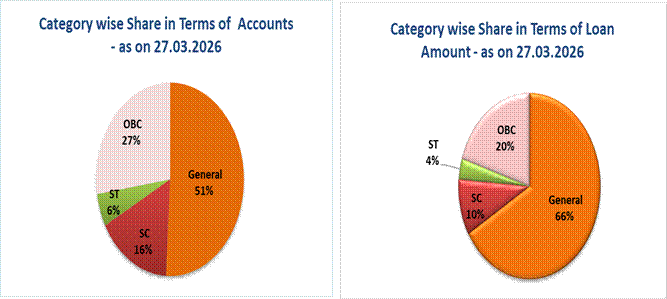
The MoS also added, “It has created self-employment opportunities across the country, especially for marginalized sections of society, including Scheduled Castes/Scheduled Tribes, Other Backward Classes (51% of loan beneficiaries), and women (67% of loan beneficiaries).”

Stressing on Mudra’s impact the MoS saidThe core objective of the MUDRA Yojana is "Funding the Unfunded." The scheme has successfully ended the exploitation of India's small entrepreneurs by informal lenders. In the past 11 years, it has extended over 40 lakh crore through 57.7 crore loans, instilling a new sense of confidence among borrowers. This clearly reflects the government's firm commitment to support their efforts and its accelerated journey toward making India a developed nation by 2047 through inclusive growth enabled by financial inclusion.”

As we commemorate eleven years of advancing financial inclusion through the core tenets of the MUDRA scheme, let us glance through some of the primary characteristics and significant milestones of the scheme:

The implementation of financial inclusion programme in the country is based on three pillars, namely,

  1. Banking the Unbanked
  2. Securing the Unsecured and
  3. Funding the Unfunded

These aforesaid three objectives are being achieved through leveraging technology and adopting multi-stakeholders’ collaborative approach, while serving the unserved and underserved as well.

One of the three pillars of FI - Funding the Unfunded, is reflected in the Financial Inclusion ecosystem through PMMY, which is being implemented with the objective to provide collateral free access to credit for small/ micro entrepreneurs.

Key Features of PMMY:

  1. MUDRA loans are being offered in four categories namely, ‘Shishu’, ‘Kishor’, ‘Tarun’ and ‘TarunPlus’ which signifies the stage of growth or development and funding needs of the borrowers: -
    • Shishu: covering loans upto Rs. 50,000/-
    • Kishor: covering loans above Rs. 50,000/- and up to Rs. 5 lakhs
    • Tarun: covering loans above Rs.5 lakh and upto Rs.10 lakhs
    • TarunPlus: covering loans above Rs.10lakh and upto Rs.20 lakhs
  2. Loans cover term financing and working capital needs across manufacturing, trading and service sectors, including activities allied to agriculture like poultry, dairy, and beekeeping, etc.
  3. The interest rate is governed by RBI guidelines, with flexible repayment terms.

Achievements under Pradhan Mantri Mudra Yojana (PMMY) as on 27.03.2026

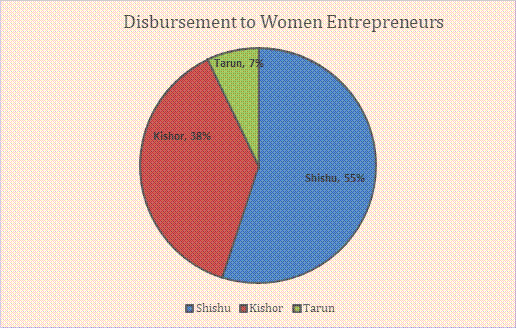
Women Borrowers: A total of ₹9.02 lakh crore was disbursed under the Shishu category, ₹ 6.22 lakh crore under Kishor, and ₹ 1.09 lakh crore under the Tarun category.  
 

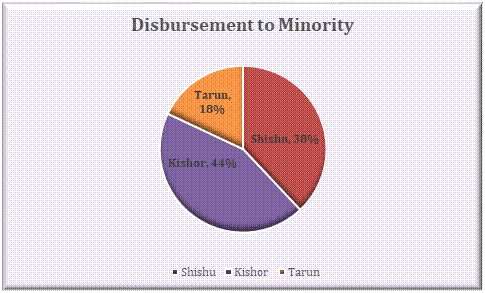
Minority Borrowers: The disbursements amounted to ₹1.33 lakh crore under Shishu, ₹1.54 lakh crore under Kishor, and ₹ 0.62 lakh crore under Tarun.
New Entrepreneurs/Accounts:

Shishu category: 8.80 crore accounts with a sanctioned amount of ₹2.47 lakh crore and disbursed amount of ₹ 2.42 lakh crore.

Kishor category: 2.79 crore accounts with ₹5.09 lakh crore sanctioned and ₹4.87 lakh crore disbursed.

Tarun category: 55 lakh accounts with a sanctioned amount of ₹4.82 lakh crore and ₹4.67 lakh crore disbursed.
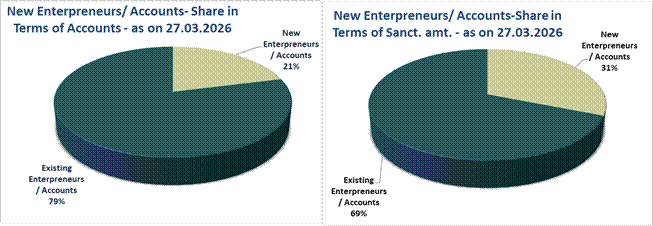
Category-wise breakup:-(Number of loans and amount sanctioned)

Category

Percentage as per No. of Loans

Percentage as per Amount Sanctioned

Shishu

74%

32%

Kishor

24%

43%

Tarun

2%

25%

TarunPlus

0.004%

0.095%

Total

100%

100%


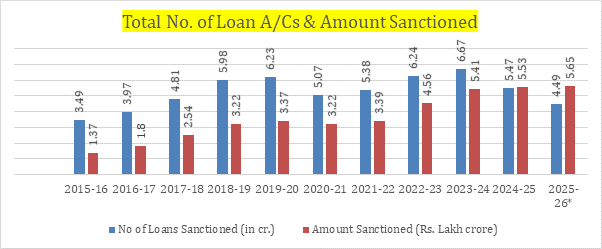
Year-wise sanction amount is as under:-

Financial Year

No. of Loans Sanctioned

(in Crore)

Amount Sanctioned

(Rs. in Lakh Crore)

2015-16

3.49

1.37

2016-17

3.97

1.80

2017-18

4.81

2.54

2018-19

5.98

3.22

2019-20

6.23

3.37

2020-21

5.07

3.22

2021-22

5.38

3.39

2022-23

6.24

4.56

2023-24

6.67

5.41

2024-25

5.47

5.53

2025-26

(as on 27.03.2026) *

4.49

5.65

Total

57.79

40.07

Marking over a decade of the PMMY, India underscores its dedicated mission to integrate the marginalized into the formal economy. By focusing on the core principles of "Banking the Unbanked," "Securing the Unsecured," and "Funding the Unfunded," the Government continues to bridge financial gaps and turn the aspirations of aspiring business owners into reality.

Topics

Acts Income Tax