Loading...

Top
Help
×

By creating an account you can:

Logo TaxTMI
Call Us / Help / Feedback

Contact Us At :

E-mail: [email protected]

Call / WhatsApp at: +91 99117 96707

For more information, Check Contact Us

FAQs :

To know Frequently Asked Questions, Check FAQs

Most Asked Video Tutorials :

For more tutorials, Check Video Tutorials

Submit Feedback/Suggestion :

Email :
Please provide your email address so we can follow up on your feedback.
Category :
Description :
Min 15 characters 0/2000
Make Most of Text Search
  1. Checkout this video tutorial: How to search effectively on TaxTMI.
  2. Put words in double quotes for exact word search, eg: "income tax"
  3. Avoid noise words such as : 'and, of, the, a'
  4. Sort by Relevance to get the most relevant document.
  5. Press Enter to add multiple terms/multiple phrases, and then click on Search to Search.
  6. Text Search
  7. The system will try to fetch results that contains ALL your words.
  8. Once you add keywords, you'll see a new 'Search In' filter that makes your results even more precise.
  9. Text Search
Add to...
You have not created any category. Kindly create one to bookmark this item!
Create New Category
Hide
Title :
Description :
❮❮ Hide
Default View
Expand ❯❯
Close ✕
🔎 News - Adv. Search
TEXT SEARCH:

Press 'Enter' to add multiple search terms. Rules for Better Search

Search In:
Main Text + AI Text
  • Main Text
  • Main Text + AI Text
  • AI Text
Category: ?
Categorized by AI
---- All Categories ----
  • ---- All Categories ----
  • Income Tax
  • GST
  • Customs, DGFT & SEZ
  • FEMA & RBI
  • Corp. Laws, SEBI & IBC
  • PMLA, Black Money & ED
  • Budget
  • News and Press Release
  • PTI News
Month:
---- All Months ----
  • ---- All Months ----
  • January
  • February
  • March
  • April
  • May
  • June
  • July
  • August
  • September
  • October
  • November
  • December
Year:
---- All Years ----
  • ---- All Years ----
  • 2026
  • 2025
  • 2024
  • 2023
  • 2022
  • 2021
  • 2020
  • 2019
  • 2018
  • 2017
  • 2016
  • 2015
  • 2014
  • 2013
  • 2012
  • 2011
Sort By: ?
In Sort By 'Default', exact matches for text search are shown at the top, followed by the remaining results in their regular order.
Relevance Default Date
    Arkel invests RS.100 Cr in Phase 1, Opens Advanced Lift Control Manufacturing Facility
    Two-day Workshop by DFS on Reservation Policy of Government of India and Accessibility for PwDs concludes
    Central Board of Indirect Taxes and Customs (CBIC) introduces deferred Customs Duty payment facility for Eligible Manufacturer Importers as announced ...
    US futures, Asian shares open lower, oil prices soar as US and Israeli attack Iran
    Rupee falls 21 paise to 91.29 against US dollar in early trade
    Oil prices rise sharply after attacks in Middle East disrupt global energy supply
    Oil prices rise sharply in market trading after attacks in Middle East disrupt global energy supply
    OPEC+ boosts oil production after attacks on Iran and throughout region
    Iran crisis: No immediate oil disruption for India; price volatility, macro impact seen
    HIGHLIGHTS
    Haryana records 22 pc growth in gross SGST collection in FY 2025-26, beats all states, UTs
    Andhra records highest GST collection in February at Rs 3,061 cr
    Rice exporters cautioned against CIF contracts to Iran, Gulf countries amid West Asia conflict
    GST collection grows 8.1 pc to over Rs 1.83 lakh cr in Feb
    Iran crisis: Rice exporters stare at shipment disruptions, payment delays
    GST mop-up grows 8.1 pc to over Rs 1.83 lakh cr in Feb
    Iran Crisis: No immediate oil disruption for India; Russia pivot possible if conflict drags on
    HC grants bail to ex-CMO official in 2 cases of Chhattisgarh liquor 'scam'
    Chhattisgarh liquor 'scam': HC grants bail to former CMO official Chaurasia in ED, EOW cases
    Maharashtra AI policy for agriculture laudable but implementation weak, says NCP (SP) leader
❯❯
Maximize Maximize Maximize
0 / 200
Expand Note
Add to Folder

No Folders have been created

+

Are you sure you want to delete "My most important" ?

NOTE:

News
Showing Results for :
Reset Filters
Results Found:
Show All Summaries Hide All Summaries
March 2, 2026
Show AI Summary
Compliance with IS-17900 drives local manufacturing of advanced lift control systems, reducing import dependence and strengthening supply chains.
A Phase 1 manufacturing facility invests in local production of advanced lift electronic control systems designed to comply with IS-17900, reduce import dependency, and enable component to finished product localisation. The plant will operate automated PCB and semi automatic panel lines to produce MR, MRL and Slim Panels, emphasise controlled environment quality, IoT features, and support supply chain resilience and national industrial policy objectives under the Make in India framework.
March 2, 2026
Show AI Summary
Reservation policy implementation strengthened across public financial institutions to improve accessibility and uniform compliance measures.
Strengthening institutional capacity for uniform implementation of the Government of India's reservation policy across public financial institutions and enhancing accessibility for Persons with Disabilities were the primary objectives. The programme combined a Sugamya Bharat sensitisation session on accessibility standards and compliance requirements, a roundtable on legal provisions and practical challenges, exchange of best practices, and an interactive question-and-answer session to identify operational measures for inclusivity, accessibility and reservation policy compliance.
March 2, 2026
Show AI Summary
Deferred Customs Duty payment enables qualified manufacturers to clear imports and pay duties monthly, subject to compliance and eligibility.
A Deferred Customs Duty payment facility allows Eligible Manufacturer Importers to clear imports without immediate duty payment and to pay applicable customs duties monthly under the Deferred Payment of Import Duty Rules, 2016, subject to prescribed Customs and GST compliance, turnover, financial standing and track record; existing AEO T1 entities meeting eligibility may participate and applications are to be submitted via the AEO portal.
March 2, 2026
Show AI Summary
Energy supply disruption risks trigger global market selloff and safe-haven flows, lifting oil and gold while bond yields fall.
Global markets moved to risk-off after US and Israeli attacks on Iran: equities opened lower while gold and government bonds rallied and oil prices surged on fears that strikes and incidents in the Strait of Hormuz could restrict oil and LNG exports, raising the prospect of higher energy and production costs; higher-than-expected wholesale inflation readings were identified as a factor that may affect the central bank's timing for interest-rate cuts.
March 2, 2026
Show AI Summary
Rupee depreciation driven by crude price surge, dollar strength and foreign fund outflows pressures local currency lower.
Rupee depreciation in early trade reflected external pressures-higher crude prices, a stronger US dollar, and escalated Middle East tensions-compounded by negative domestic equity sentiment and significant foreign institutional outflows. Market indicators included a firmer dollar index, rising Brent crude futures, and a recent dip in forex reserves, while analysts warned of increased import bill risk due to India's reliance on fuel imports.
March 2, 2026
Show AI Summary
Energy supply disruption threatens global oil flows, driving sharp price increases and straining fuel and goods markets worldwide.
Attacks and retaliatory strikes in the Middle East disrupted flows through the Strait of Hormuz and regional export infrastructure, triggering sharp crude price rises and heightened risk of sustained supply constraints; OPEC+ announced production increases, but analysts stress that constrained export routes limit the immediate effectiveness of added output.
March 2, 2026
Show AI Summary
Maritime chokepoint security threatened, risking oil export disruptions and limiting the relief from increased production.
Attacks and military strikes in the Middle East disrupted maritime traffic through the Strait of Hormuz, risking restrictions on regional crude exports and driving upward pressure on oil and gasoline prices. Because the strait is a critical global oil chokepoint, market concerns focus on whether barrels can physically move; consequently, OPEC+ announcements of increased production may provide limited immediate relief if export routes remain constrained.
March 2, 2026
Show AI Summary
Oil supply security: production increases meet limited relief when export routes through the Strait of Hormuz are disrupted.
OPEC+ announced an April increase in crude production intended to augment available supply while regional military attacks and disruptions to tanker movements - particularly through the Strait of Hormuz - threaten export routes. The notice underscores that interruptions to transit can limit the relief additional output provides and that access to export channels will be decisive for near-term market stability and price direction.
March 1, 2026
Show AI Summary
Energy security measures cushion supply shocks but elevate price volatility and macroeconomic pressures for oil importers.
Escalating tensions around Iran and the Strait of Hormuz create near-term energy security risks for India manifested chiefly as price volatility and macroeconomic pressure rather than immediate physical shortages. Layered inventory buffers - commercial stocks, in transit cargoes and Strategic Petroleum Reserves - combined with diversified sourcing options (including Atlantic suppliers and Russian optionality) reduce the likelihood of sustained supply disruption, though longer transit times and LNG contractual rigidity limit rapid substitution and increase vulnerability to prolonged closures.
March 1, 2026
Show AI Summary
GST revenue growth signals strengthened tax receipts driven by import collections and improved domestic sales affecting fiscal enforcement.
A court ordered continued judicial custody for eight alleged Lashkar-e-Taiba operatives accused of illegal entry and procuring forged identity documents while another court directed the immediate release of 14 student protesters arrested after a campus demonstration. Separately, gross Goods and Services Tax collections rose year-on-year, led by higher import receipts and improved domestic sales, reflecting stronger enforcement and compliance dynamics within the indirect tax regime.
March 1, 2026
Show AI Summary
SGST growth reflects strengthened tax administration and compliance following GST rate rationalisation, bolstering state revenues.
Haryana reports marked year on year expansion in State Goods and Services Tax (SGST) receipts for 2025-26, attributing the improvement to strengthened tax administration, enhanced compliance stemming from departmental reforms and better tax analysis, facilitation via district GST Suvidha Kendras, and the GST Council's September 2025 rate rationalisation as complementary drivers of revenue growth.
March 1, 2026
Show AI Summary
GST revenue growth maintained despite rate reductions; enhanced compliance and AI-driven analytics strengthened state collections effectively.
Andhra Pradesh achieves record net Goods and Services Tax receipts for February, with SGST and IGST growth offsetting marginal gross GST decline. Revenue momentum is supported by higher professional tax and petroleum VAT receipts. The state credits strengthened compliance-targeted audits, stricter return filing, coordinated IGST settlements, and performance based officer deployment-and advanced data analytics and AI oversight that detect evasion and reverse ineligible input tax credit claims for measurable recoveries.
March 1, 2026
Show AI Summary
Shipping risk allocation: exporters urged to avoid CIF and prefer FOB as geopolitical risks raise freight and insurance exposure.
Advises exporters to avoid new Cost, Insurance and Freight (CIF) commitments to Iran and Gulf destinations and to conclude sales on Free-On-Board (FOB) terms where feasible so freight, insurance and related risks rest with the buyer. Notes that West Asia instability may sharply increase bunker prices, disrupt vessel availability, raise freight and insurance premiums, and produce price volatility; urges restraint, avoidance of open-ended unhedged positions, and monitoring of consignments in transit or awaiting clearance.
March 1, 2026
Show AI Summary
GST rate restructuring boosts revenues as import and domestic consumption support post cut recovery in collections.
GST collections rose year on year following a statutory GST rate restructuring that reduced rates on numerous items and consolidated slabs; import revenue and domestic consumption supported recovery after an initial post cut dip. The pattern includes higher refunds, lower cess receipts, and divergent state level growth, raising considerations for revenue forecasting, state fiscal impacts, and the operational stability of the restructured indirect tax framework.
March 1, 2026
Show AI Summary
Export disruptions to Iran risk shipment halts and payment delays for rice exporters amid regional conflict.
Shipments to Iran and consignments to Afghanistan via Bandar Abbas have been held up following military strikes, causing immediate shipment disruptions and likely payment delays until the security situation improves; exporters warn the impact depends on conflict duration and note heightened commercial risk from lack of war-risk insurance for vessels.
March 1, 2026
Show AI Summary
Goods and Services Tax collections rose driven by import revenue growth, with higher refunds and lower cess receipts.
Gross collections under the Goods and Services Tax increased year on year, driven mainly by a stronger rise in import related GST receipts; domestic GST rose more modestly. Total refunds increased, and net GST receipts were higher year on year, while cess receipts declined markedly compared with the prior year period.
March 1, 2026
Show AI Summary
Energy supply resilience mitigates immediate oil disruption risk, though prolonged Hormuz closure heightens price and supply concerns.
India's layered inventory buffers - commercial stocks, in-transit crude and strategic petroleum reserves - and full refinery tanks reduce the likelihood of immediate physical disruption from a short-term Strait of Hormuz closure, shifting the principal near-term impact to price, freight and insurance volatility; prolonged closure would more severely affect LNG and LPG due to contract rigidity and transit dependence, prompting reliance on diversified sourcing, Russian optionality, longer transit planning and strategic reserve drawdowns.
March 1, 2026
Show AI Summary
Bail parity: Former CMO official released after court found investigation substantially complete and parity with other accused.
The court evaluated bail petitions in parallel Economic Offences Wing and Enforcement Directorate inquiries alleging a syndicate diverted liquor to government shops and laundered proceeds; it found the investigation substantially complete, trial unlikely to conclude soon, and that continued detention would not serve justice. Prosecution relied on asserted digital communications and co-accused statements alleging supervisory role and receipt/handling of proceeds; defence disputed incriminating material, reliance on statements, selective arrests and urged parity and repeated prior incarcerations. The court held evidentiary weight requires trial testing and noted parity with other released accused.
February 28, 2026
Show AI Summary
Bail parity principle applied where investigational delay and statement based evidence affect custodial necessity in money laundering cases.
High Court review of bail in concurrent EOW criminal and ED money laundering investigations centred on investigational stage, evidentiary weight of digital material and co accused statements, and parity with released principal accused. The court noted protracted investigation timelines, contested allegations about supervisory involvement and receipt of alleged proceeds, and held that inferential and statement based evidence must be evaluated at trial, making the stage of probe and likelihood of prolonged proceedings relevant to custodial decisions.
February 28, 2026
Show AI Summary
AI policy implementation: ensure agricultural AI delivers to farmers via infrastructure, governance and data protection.
Maharashtra's agricultural AI policy promises institutional development, digital public infrastructure, financial support and capacity building, but implementation is lagging: allocated funds remain unspent, innovation centres and leadership appointments are pending, and summit activities have not translated into grassroots adoption. Addressing the rural digital divide, establishing data protection safeguards, auditing the crop insurance scheme, stabilising price support and export policy, and creating a concrete roadmap with oversight are identified as necessary to ensure AI tools benefit ordinary farmers.

News

Back

All News

Showing Results for :
Reset Filters
No Records Found

News

Back

All News

Showing Results for : Reset Filters
News and Press Release

Annual Survey of Unincorporated Sector Enterprises (ASUSE) Results for 2025 (Survey period: January 2025 to December 2025)

March 24, 2026

Contents
Summary
Note

Note

-

Bookmark

Print

Print

Snapshot:

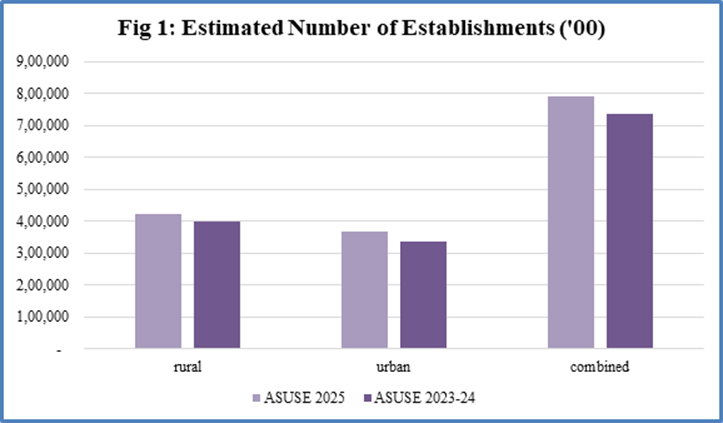
  • The estimated number of establishments increased from 7.34 crore in ASUSE 2023–24 (October 2023–September 2024) to 7.92 crore during in ASUSE 2025 (January–December 2025), reflecting a growth of about 7.97 per cent during the period.
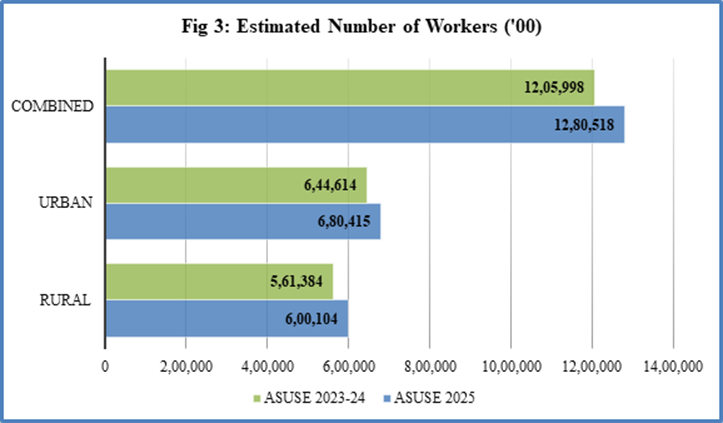
  • Employment in the sector grew by 6.18%, with more than 74.52 lakh new jobs being added during the period.
  • Gross value Added (GVA) also grew by 10.87% (at current price) during this period over ASUSE 2023-24. This growth has been primarily driven by 16.77% growth in trade sector followed by 8.52% growth in manufacturing and 7.36% growth in other services sectors.
  •  The emolument per hired worker increased by 3.88% in 2025 compared to the previous ASUSE 2023-24, signalling improvements in wage levels.
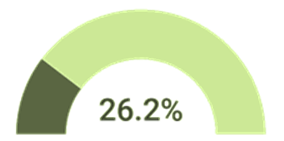
  • Women-owned proprietary establishments remained substantial at 27%, up from 26.2% in the previous round (ASUSE 2023-24).
  • The share of establishments using internet increased significantly from 26.7% in ASUSE 2023–24 to 39.4% in ASUSE 2025, highlighting the growing digital integration of the sector.

The Ministry of Statistics and Programme Implementation (MoSPI) has released the results of Annual Survey of Unincorporated Sector Enterprises (ASUSE) for 2025 for the reference period January, 2025 - December, 2025 referred to as ASUSE 2025 in this press note. A brief overview of the survey in terms of coverage, sampling strategy, data collection mechanism, etc., is provided in the Endnote.

The unincorporated non-agricultural sector is an important pillar of the Indian economy, contributing significantly to employment generation and Gross Domestic Product (GDP). The sector sustains livelihoods for millions of people and supports the production and distribution of goods and services across the country. By complementing the activities of the incorporated sector and strengthening domestic value chains, it plays a crucial role in the overall socio-economic development of the country.

The Annual Survey of Unincorporated Sector Enterprises (ASUSE) is conducted with the primary objective of measuring the economic and operational characteristics of unincorporated non-agricultural establishments engaged in manufacturing, trade and other services sectors (excluding construction). The survey collects information on key economic indicators such as number of workers, Gross Value Added (GVA), emoluments paid, fixed assets owned and outstanding loans, along with operational characteristics such as type of ownership, nature of operation, registration status and use of Information and Communication Technology (ICT).

The survey data serves as an important input for policymaking, supporting compilation of National Accounts Statistics, and meets the information needs of Ministries such as Micro, Small and Medium Enterprises (MSME), Textiles, etc., while enabling stakeholders to make informed decisions.

Key highlights from the ASUSE 2025 results:

The ASUSE 2025 results highlight a steady expansion of the unincorporated non-agricultural sector reflected in growth in establishments, employment, and productivity, indicating the sector's resilience and sustained momentum.

Growth in Establishments, Gross Value Added and Productivity Metrics:

The total number of establishments in the sector increased substantially from 7.34 crore in ASUSE 2023-24 (Oct 23 – Sept 24) to 7.92 crore in ASUSE 2025 (Jan 25 -Dec 25), representing a healthy 7.97% growth. Among the broad sectors covered, the number of establishments in the "Other Services’ sector recorded a robust growth of 10.29% followed by a 6.48% increase witnessed by the Manufacturing sector and 6.18% by Trade sector. This increase reflects broad-based expansion across sectors and highlights the steady growth of the unincorporated non-agricultural sector.
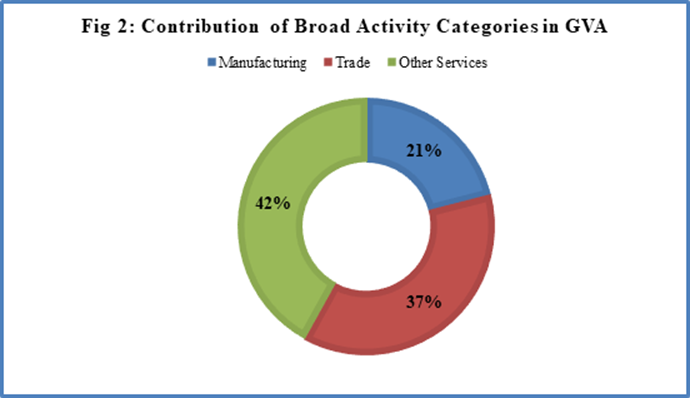
During the same period, the Gross Value Added (GVA) which is a key indicator of economic performance rose by 10.87% driven by 16.77% growth in trade sector followed by 8.52% growth in manufacturing and 7.36% growth in other services sectors. Among the broad sectors, however, other services sector had the highest share in GVA (42%) followed by trade (37%) and manufacturing (21%).
Gross Value Added (GVA) per worker which is a measure of labour productivity of the sector, rose to Rs. 1,56,539 in 2025 from. Rs. 1,49,742 in 2023-24 in current prices showing a 4.54% increase. During the same period, the Gross Value Added (GVA) per establishment also increased from Rs. 2,45,687 to  Rs. 2,52,699.

Strong Labour Market Performance

The sector employed about 12.81 crore workers during January-December 2025, adding more than 74.52 lakh jobs from 2023-24 (Oct 23 – Sept 24) reflecting robust labour market expansion. Among the broad activities, "Other Services" sector showed the highest growth of 7.40% generating about 35 lakh new employment.
Women-Led Enterprises Rise as Worker Earnings Improve

The percentage of female-owned proprietary establishments increased marginally from 26.2 per cent in 2023–24 to 27.0 per cent in ASUSE 2025 pointing to an encouraging trend in women-led enterprises.

The emolument per hired worker increased by 3.88% in 2025 compared to the previous ASUSE 2023-24, signalling improvements in wage levels. The highest increase in this metric was observed in trade sector which recorded a growth of about 8.5%.

Better Digital Penetration

Percentage of establishments using internet has also grown significantly from 26.7% in 2023-24 to 39.4% in ASUSE 2025. This substantial growth reflects a strong trend toward digital adoption among establishments, highlighting the increasing reliance on the internet for business operations.

Fig 4: Key Operational Indicators

Percentage of Establishments using Internet

ASUSE 2023-24

ASUSE 2025

Percentage of Female Owned Proprietary Establishments

ASUSE 2023-24

ASUSE 2025

Annual estimates of key indicators (value figures in current price), of ASUSE 2022-23, ASUSE 2023-24 and ASUSE 2025 are given in Table 1 below. The annual estimates for ASUSE 2025 for the broad activity categories are provided in the factsheet which is available in the website of the Ministry (https://www.mospi.gov.in). Further, interactive tables and visualizations on ASUSE results may be accessed on the Data Catalogue section of https://esankhyiki.mospi.gov.in/. Report of ASUSE 2025 as well as unit level data will be released in April, 2026 with detailed insights from the survey.

Table 1: Key indicators of ASUSE 2022-23, ASUSE 2023-24 and ASUSE 2025

all-India

Indicator

ASUSE 2022-23

(October,2022 – September, 2023)

ASUSE 2023-24

(October,2023 – September, 2024)

ASUSE 2025 (January, 2025 – December, 2025)

(1)

(2)

(3)

(4)

Number of Establishments (in ’00)

6,50,484

7,33,995

7,92,465

Number of Workers (in ’00)

10,96,260

12,05,998

12,80,518

Gross Value Added (Rs. Crore)*

15,42,409

17,97,278

19,92,577

GVA per establishment*(Rs.)

2,38,168

2,45,687

       2,52,699

GVA per worker* (Rs.)

1,41,769

1,49,742

       1,56,539

Emolument per Hired Worker (Rs.)

         1,24,842

1,41,071

       1,46,550

           *pertaining to market establishments

Endnote: A brief about the coverage, sampling scheme, sample size and data collection mechanism in the Annual Survey of Unincorporated Sector Enterprises (ASUSE):

A. Coverage of ASUSE:

A.1. Geographically, ASUSE covers the rural and urban areas of whole of India (except the villages in Andaman and Nicobar Islands, which are difficult to access).

A.2. Sector-wise, this survey captures unincorporated non-agricultural establishments belonging to three sectors viz., Manufacturing, Trade and Other Services.

A.3. Ownership-wise, unincorporated non-agricultural establishments pertaining to proprietorship, partnership (excluding Limited Liability Partnerships), co-operatives, societies/trusts etc. have been covered in ASUSE.

B. Sampling Scheme:

The survey has been conducted following a multi-stage stratified sampling scheme, where first stage units (FSUs) are census villages in rural area (except for rural Kerala, where Panchayat wards have been taken as FSUs) and UFS (Urban Frame Survey) blocks in urban areas.  The ultimate stage units (USUs) are establishments for both the sectors. In the case of large FSUs, one intermediate stage of sampling has been done in the form of hamlet groups in rural and sub-blocks in urban. 

The sampling design of ASUSE 2025 has been revised to enable quarterly selection of sample units. To facilitate this shift, the sample size has been increased by approximately 1.5 times over the previous survey. This improvement also makes it possible to produce quarterly estimates in addition to annual results. By adopting districts within a state as the basic strata, the design also allows participating states to generate annual estimates at the district level.

C. Sample Size:

In ASUSE 2025, data were collected from a total of 6,70,289 establishments (2,94,144 in rural and 3,76,145 in urban) pertaining to 24,153 surveyed FSUs (10,219 in rural and 13,934 in urban).

D. Data Collection Mechanism:

ASUSE 2025 has been conducted based on area frame and establishments have been listed in the selected FSUs of both rural and urban sector. Mostly, data were collected from the selected establishments through oral enquiry pertaining to the ‘monthly’ reference period barring a few big establishments, which had provided annual data from their audited Books of Accounts. The data for the survey were collected in tablet using Computer Assisted Personal Interviewing (CAPI).

E. Know your Survey- ASUSE:

The Factsheet of ASUSE 2025 (January, 2025 – December, 2025) is available on the website of the Ministry (https://www.mospi.gov.in)

Scan QR code to access MoSPI Publications/ Reports


For more detailed understanding of the objectives, coverage, concepts, methodology and data quality practices of ASUSE in a simple, transparent, user-friendly language, one may refer to the Know Your Survey: A User Guide to the Annual Survey of Unincorporated Sector Enterprises (ASUSE) published by NSO, MOSPI and available on the website of the ministry (https://www.mospi.gov.in).

****

Topics

Acts Income Tax