Loading...

Top
Help
×

By creating an account you can:

Logo TaxTMI
Call Us / Help / Feedback

Contact Us At :

E-mail: [email protected]

Call / WhatsApp at: +91 99117 96707

For more information, Check Contact Us

FAQs :

To know Frequently Asked Questions, Check FAQs

Most Asked Video Tutorials :

For more tutorials, Check Video Tutorials

Submit Feedback/Suggestion :

Email :
Please provide your email address so we can follow up on your feedback.
Category :
Description :
Min 15 characters 0/2000
Make Most of Text Search
  1. Checkout this video tutorial: How to search effectively on TaxTMI.
  2. Put words in double quotes for exact word search, eg: "income tax"
  3. Avoid noise words such as : 'and, of, the, a'
  4. Sort by Relevance to get the most relevant document.
  5. Press Enter to add multiple terms/multiple phrases, and then click on Search to Search.
  6. Text Search
  7. The system will try to fetch results that contains ALL your words.
  8. Once you add keywords, you'll see a new 'Search In' filter that makes your results even more precise.
  9. Text Search
Add to...
You have not created any category. Kindly create one to bookmark this item!
Create New Category
Hide
Title :
Description :
❮❮ Hide
Default View
Expand ❯❯
Close ✕
🔎 News - Adv. Search
TEXT SEARCH:

Press 'Enter' to add multiple search terms. Rules for Better Search

Search In:
Main Text + AI Text
  • Main Text
  • Main Text + AI Text
  • AI Text
Category: ?
Categorized by AI
---- All Categories ----
  • ---- All Categories ----
  • Income Tax
  • GST
  • Customs, DGFT & SEZ
  • FEMA & RBI
  • Corp. Laws, SEBI & IBC
  • PMLA, Black Money & ED
  • Budget
  • News and Press Release
  • PTI News
Month:
---- All Months ----
  • ---- All Months ----
  • January
  • February
  • March
  • April
  • May
  • June
  • July
  • August
  • September
  • October
  • November
  • December
Year:
---- All Years ----
  • ---- All Years ----
  • 2026
  • 2025
  • 2024
  • 2023
  • 2022
  • 2021
  • 2020
  • 2019
  • 2018
  • 2017
  • 2016
  • 2015
  • 2014
  • 2013
  • 2012
  • 2011
Sort By: ?
In Sort By 'Default', exact matches for text search are shown at the top, followed by the remaining results in their regular order.
Relevance Default Date
    UIDAI covers mandatory biometric update for students in over 1 lakh schools
    Modi exhorts industry to ramp up investment, focus on research to scale up manufacturing
    Terms of Reference Signed for India–Canada Comprehensive Economic Partnership Agreement
    Modi urges industry to ramp up investment, prioritise research to scale up manufacturing
    Focus on rural growth, Haryana budget proposes 'Agri Discom'; 20 pc reservation for Agniveers in state police
    West Asia crisis: Exporters seek support measures; govt ensures all facilitation
    Rupee crashes 41 paise to settle at 91.49 against US dollar
    India, Canada launch negotiations for free trade pact
    No petrol, diesel price hike despite global oil prices spiking to USD 80
    West Asia crisis: TCS, Wipro halt travel to Middle East, Nasscom urges remote work
    Mizoram to intensify crackdown on areca nuts smuggling, 468 cases registered since 2019: Minister
    Global markets roiled as conflict in Middle East spreads, energy prices soar
    Department of Commerce convenes Stakeholder Consultation to ensure trade continuity amid evolving geopolitical developments
    CAD widens to USD 13.2 bn in Q3 on higher trade deficit: RBI
    Gross and Net GST revenue collections for the month of Feb, 2026
    Govt discusses potential impact of West Asia crisis on trade; ensures all facilitation
    Rupee crashes 42 paise to settle at 91.50 against US dollar
    J&K to import 4 elite foreign breeds of sheep, goat
    Oil prices soar and stock prices fall as US-Israel war with Iran rattles markets
    India's manufacturing sector activity growth jumps to 4-month high in Feb: PMI
❯❯
Maximize Maximize Maximize
0 / 200
Expand Note
Add to Folder

No Folders have been created

+

Are you sure you want to delete "My most important" ?

NOTE:

News
Showing Results for :
Reset Filters
Results Found:
Show All Summaries Hide All Summaries
March 3, 2026
Show AI Summary
Mandatory biometric update for children enables Aadhaar authentication for benefits, scholarships and examinations.
The UIDAI has implemented a mandatory biometric update (MBU) programme for school children aged 7-15, delivered through in-school camps and enrolment centres, with MBU made free for a limited period. Integration with UDISE+ enables identification of students due for updates and monitoring of MBU status. Initial enrolment below age five records demographic data only; fingerprints and iris biometrics are captured later via the MBU process once children reach the prescribed ages, enabling subsequent Aadhaar authentication for benefits, scholarships and examinations.
March 3, 2026
Show AI Summary
Free trade agreements prompt industry to boost investment, research, and quality to expand manufacturing exports and access markets.
India aims to use free trade agreements to expand manufacturing exports by urging industry to increase investment, adopt new technologies, and prioritise research and quality to meet global standards. The budget supports this through record capital expenditure for infrastructure and logistics, reforms in MSME classification to improve credit and technology access, and sectoral missions including the BioPharma Shakti Mission and the Carbon Capture, Utilization, and Storage Mission to boost advanced manufacturing and sustainability-linked market access.
March 3, 2026
Show AI Summary
Comprehensive Economic Partnership Agreement negotiations launched to set a negotiation framework and pursue an ambitious, balanced trade pact.
Terms of Reference for the India-Canada Comprehensive Economic Partnership Agreement establish the negotiation framework-setting format, frequency and approach-to guide talks toward an ambitious, balanced and mutually beneficial CEPA covering trade in goods, services and other mutually agreed policy areas, reflecting prior leader-level direction to advance negotiations.
March 3, 2026
Show AI Summary
Quality standards and R&D investment urged to align industry with free trade agreement opportunities and export growth.
Industry is urged to accelerate investment and prioritise research and development to meet global quality standards and fully exploit opportunities from free trade agreements; early adoption of clean technologies, including carbon capture initiatives, and expanded infrastructure and logistics spending are presented as necessary complements to enhance export readiness and supply chain resilience.
March 2, 2026
Show AI Summary
Reservation for Agniveers in police expands recruitment priority while a new Agri Discom targets uninterrupted farm power supply.
The budget creates a dedicated Haryana Agri Discom to deliver uninterrupted, reliable electricity and expedited services to all agricultural feeders and consumers, alongside biomass power projects and cropping incentives. Concurrently, it provides reserved recruitment access for returning defence personnel in the state police, forms a State Disaster Response Force with Agniveer participation, establishes an Anti Terrorist Squad under IG rank, and commits funds to rural employment guarantees, PACS reform, a Green Climate Resilience Fund, and enhanced crop compensation schemes.
March 2, 2026
Show AI Summary
Trade facilitation to protect exporters amid West Asia crisis, focusing on logistics continuity and insurer coordination.
Government coordination aims to maintain continuity of export import logistics amid the West Asia crisis by monitoring routes, capacity, surcharges and equipment availability, directing facilitative measures including procedural flexibility in export authorisations, customs coordination, engagement with financial and insurance institutions, and targeted support for time sensitive exports; exporters sought restoration of higher RoDTEP rates, restraint on insurance premium increases by ECGC, broader insurance cover and sector specific timeline relief.
March 2, 2026
Show AI Summary
Currency depreciation worsened as geopolitical strikes and oil price surge prompted safe-haven flows and foreign fund outflows.
The rupee sharply depreciated against the US dollar due to geopolitical escalation and a crude oil price spike, which triggered safe-haven dollar demand and foreign institutional equity outflows. Higher oil prices threaten to widen India's import bill and current account pressures, producing defensive market positioning and a negative bias for the currency, even as the Reserve Bank of India intervened in the interbank market to limit further depreciation.
March 2, 2026
Show AI Summary
Comprehensive Economic Partnership Agreement negotiations launched to cover goods and services and pursue an ambitious bilateral trade pact.
Launch of negotiations for a Comprehensive Economic Partnership Agreement (CEPA) between India and Canada, with signed Terms of Reference to set the format, frequency and approach for talks covering trade in goods, services and other policy areas. The ToR aim to guide negotiators toward an ambitious, balanced pact, resuming talks from the start after a prior pause. Negotiations target expanded market access and increased bilateral trade, identifying key goods and services sectors and naming chief negotiators for each country.
March 2, 2026
Show AI Summary
Fuel pricing policy shields consumers by using company-held margins to stabilize retail petrol and diesel amid global crude spikes.
India's fuel pricing policy freezes retail petrol and diesel prices by allowing public sector oil companies to absorb losses when international crude prices rise and build margins when prices fall; this cushion-based approach, overseen by the Oil Ministry, will continue unless a sustained, very large spike in crude or prolonged disruptions (notably via the Strait of Hormuz) make it untenable, exposing vulnerabilities from high import dependence and increased procurement, freight, and insurance costs.
March 2, 2026
Show AI Summary
Travel suspension to Middle East prompts IT firms to enforce employee safety measures and remote work arrangements.
Indian IT firms have suspended or deferred travel to the Middle East and implemented employee safety measures: TCS suspended all incoming and outgoing travel, advised associates to stay indoors, activated a call tree, and is coordinating with local authorities and embassies; Wipro issued a no travel advisory for multiple countries and directed regional staff to follow local guidance. Nasscom advised members to defer travel and enable work from home arrangements as a precaution while monitoring operations and preparing further measures if required.
March 2, 2026
Show AI Summary
Customs enforcement against areca nut smuggling intensified, emphasising prosecution under prohibitory orders and strengthened border surveillance.
Intensified enforcement targets areca nut smuggling from Myanmar due to evasion of import duties and market harm to local growers. Authorities have registered numerous cases and made arrests under prohibitory-order offences prosecuted via the Indian Penal Code and the Bharatiya Nagarik Suraksha Sanhita, and separate prosecutions under the Customs Act. The government affirms continued prohibition, enhanced border surveillance, and a zero-tolerance stance including probes into alleged official complicity.
March 2, 2026
Show AI Summary
Energy supply disruption risks push global markets lower as oil and gas price spikes strain trade and inflation expectations.
Energy supply disruptions from Middle East hostilities sharply pushed up oil, gas and fuel prices, driving marketwide volatility as investors rotated into safe havens. Attacks affecting transit through the Strait of Hormuz threaten continuity of crude and LNG exports, prompting buyers to seek alternate sources and tightening physical markets. Higher wholesale inflation readings increase the prospect of delayed monetary easing, reinforcing downward pressure on risk assets and elevating short term downside risk to trade and investment flows.
March 2, 2026
Show AI Summary
Trade continuity secured through coordinated facilitation and procedural flexibility to protect exporters and sustain EXIM logistics.
The Department of Commerce convened a multi stakeholder consultation to coordinate regulatory and operational measures for EXIM logistics amid geopolitical developments, focusing on real time monitoring of routing, capacity, surcharges and equipment availability, and strengthening facilitation at ports and ICDs to prevent congestion. The Government emphasised a facilitative, coordinated approach prioritising supply chain resilience and exporter interests, agreeing measures including procedural flexibility for export authorisations, Customs coordination for smooth clearance, financial and insurance engagement, and prioritisation of time sensitive export segments.
March 2, 2026
Show AI Summary
Current account deficit rises due to widening trade deficit; services surplus partially offsets external imbalance.
Current account deficit widened to USD 13.2 billion in the December quarter, driven mainly by a larger merchandise trade deficit, while net services receipts rose and partially offset the deterioration; the April-December current account deficit moderated compared with the prior year, reflecting goods and services flow dynamics within the balance of payments.
March 2, 2026
Show AI Summary
GST revenue collections: gross receipts, refunds and net receipts reported, with state settlements and cess treatment noted.
Statement of February 2026 GST revenues detailing gross receipts by CGST, SGST and IGST (domestic and import), reported refunds (domestic and export/ICEGATE) and resulting net GST revenue split into net domestic and net customs receipts. It separately reports compensation and import cess inflows and refunds, noting compensation cess remains transitory until loan liabilities are discharged. State/UT pre- and post-settlement SGST distributions and Apr-Feb collection breakdowns by Central and State formations are included for inter-year comparison.
March 2, 2026
Show AI Summary
Trade facilitation measures to mitigate West Asia crisis impact on exports, including customs coordination and logistical support.
The consultation assessed risks to EXIM cargo flows from West Asian hostilities and committed a facilitative, coordinated response focused on preserving trade continuity. Agreed measures include real-time monitoring of routing, capacity, surcharges and equipment availability; strengthened port/ICD facilitation to avoid congestion; targeted support for time-sensitive exports such as perishables and pharmaceuticals; procedural flexibility for export authorisations in genuine disruption; Customs coordination for smooth clearance; and engagement with financial and insurance institutions to protect exporter interests, with emphasis on MSMEs and essential imports.
March 2, 2026
Show AI Summary
Exchange rate pressure intensified as geopolitical conflict, crude price spikes and capital outflows pushed the currency lower despite central bank support.
Severe exchange rate pressure drove the rupee sharply lower amid geopolitical conflict, FII outflows and rising crude prices, increasing India's import bill vulnerability; the Reserve Bank of India's visible market presence capped deeper intraday depreciation while analysts warned that geopolitical developments, crude trends, capital flows and key US data will determine near term exchange rate direction.
March 2, 2026
Show AI Summary
Genetic upgrade initiative boosts local mutton and wool production via import of elite sheep and goat breeds.
Importation of Romanov and Finn sheep and Boer and Swiss Alpine goats aims to implement a genetic upgrade of Jammu and Kashmir's small ruminant population to improve growth rates, carcass yield, reproductive efficiency and overall flock productivity. Imported germplasm will be multiplied at government breeding farms and progeny distributed to farmers in phases, with farmer-level distribution starting in the third quarter of 2026-27, as part of Project 24 under the Holistic Agriculture Development Programme alongside complementary livestock and rural productivity measures.
March 2, 2026
Show AI Summary
Oil supply disruption risk drives markets as geopolitical attacks push energy prices up and equities downward.
Attacks on Iran caused equity declines and sharp rises in oil and gold as traders priced in disruption to energy flows through the Strait of Hormuz; sustained interruptions to Iranian exports and regional shipping could tighten global supply, elevate fuel and production costs, affect major importers' sourcing strategies, and influence inflation dynamics and central bank rate decisions.
March 2, 2026
Show AI Summary
Manufacturing activity growth driven by stronger domestic demand despite slower export orders, prompting higher input buying and hiring.
Manufacturing activity accelerated to a four-month high as stronger domestic demand supported faster output growth and higher new business intakes; firms increased input purchasing, inventories and hiring. New export orders continued to slow, somewhat constraining employment creation. Cost pressures remained moderate, and forward-looking sentiment was positive with many manufacturers expecting higher output over the year ahead.

News

Back

All News

Showing Results for :
Reset Filters
No Records Found

News

Back

All News

Showing Results for : Reset Filters
News and Press Release

Annual Survey of Unincorporated Sector Enterprises (ASUSE) Results for 2025 (Survey period: January 2025 to December 2025)

March 24, 2026

Contents
Summary
Note

Note

-

Bookmark

Print

Print

Snapshot:

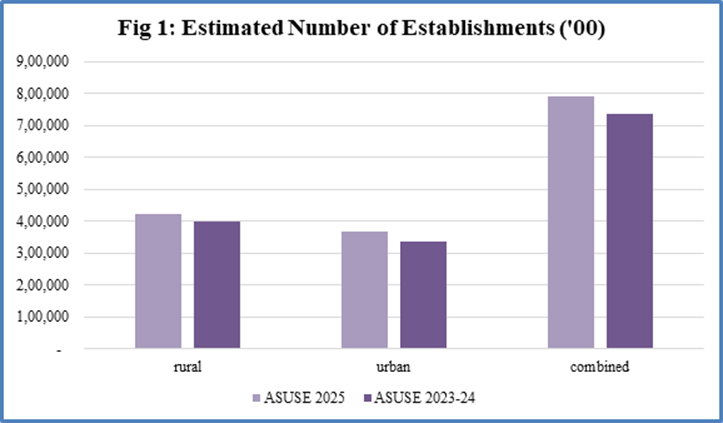
  • The estimated number of establishments increased from 7.34 crore in ASUSE 2023–24 (October 2023–September 2024) to 7.92 crore during in ASUSE 2025 (January–December 2025), reflecting a growth of about 7.97 per cent during the period.
  • Employment in the sector grew by 6.18%, with more than 74.52 lakh new jobs being added during the period.
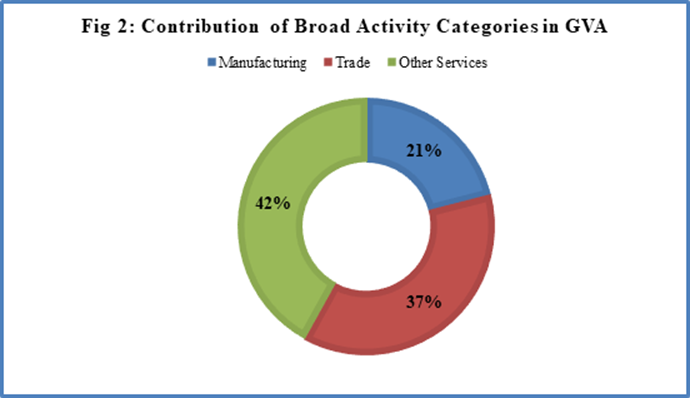
  • Gross value Added (GVA) also grew by 10.87% (at current price) during this period over ASUSE 2023-24. This growth has been primarily driven by 16.77% growth in trade sector followed by 8.52% growth in manufacturing and 7.36% growth in other services sectors.
  •  The emolument per hired worker increased by 3.88% in 2025 compared to the previous ASUSE 2023-24, signalling improvements in wage levels.
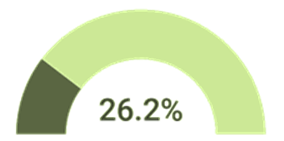
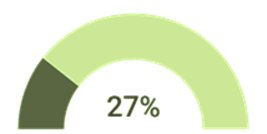
  • Women-owned proprietary establishments remained substantial at 27%, up from 26.2% in the previous round (ASUSE 2023-24).
  • The share of establishments using internet increased significantly from 26.7% in ASUSE 2023–24 to 39.4% in ASUSE 2025, highlighting the growing digital integration of the sector.

The Ministry of Statistics and Programme Implementation (MoSPI) has released the results of Annual Survey of Unincorporated Sector Enterprises (ASUSE) for 2025 for the reference period January, 2025 - December, 2025 referred to as ASUSE 2025 in this press note. A brief overview of the survey in terms of coverage, sampling strategy, data collection mechanism, etc., is provided in the Endnote.

The unincorporated non-agricultural sector is an important pillar of the Indian economy, contributing significantly to employment generation and Gross Domestic Product (GDP). The sector sustains livelihoods for millions of people and supports the production and distribution of goods and services across the country. By complementing the activities of the incorporated sector and strengthening domestic value chains, it plays a crucial role in the overall socio-economic development of the country.

The Annual Survey of Unincorporated Sector Enterprises (ASUSE) is conducted with the primary objective of measuring the economic and operational characteristics of unincorporated non-agricultural establishments engaged in manufacturing, trade and other services sectors (excluding construction). The survey collects information on key economic indicators such as number of workers, Gross Value Added (GVA), emoluments paid, fixed assets owned and outstanding loans, along with operational characteristics such as type of ownership, nature of operation, registration status and use of Information and Communication Technology (ICT).

The survey data serves as an important input for policymaking, supporting compilation of National Accounts Statistics, and meets the information needs of Ministries such as Micro, Small and Medium Enterprises (MSME), Textiles, etc., while enabling stakeholders to make informed decisions.

Key highlights from the ASUSE 2025 results:

The ASUSE 2025 results highlight a steady expansion of the unincorporated non-agricultural sector reflected in growth in establishments, employment, and productivity, indicating the sector's resilience and sustained momentum.

Growth in Establishments, Gross Value Added and Productivity Metrics:

The total number of establishments in the sector increased substantially from 7.34 crore in ASUSE 2023-24 (Oct 23 – Sept 24) to 7.92 crore in ASUSE 2025 (Jan 25 -Dec 25), representing a healthy 7.97% growth. Among the broad sectors covered, the number of establishments in the "Other Services’ sector recorded a robust growth of 10.29% followed by a 6.48% increase witnessed by the Manufacturing sector and 6.18% by Trade sector. This increase reflects broad-based expansion across sectors and highlights the steady growth of the unincorporated non-agricultural sector.
During the same period, the Gross Value Added (GVA) which is a key indicator of economic performance rose by 10.87% driven by 16.77% growth in trade sector followed by 8.52% growth in manufacturing and 7.36% growth in other services sectors. Among the broad sectors, however, other services sector had the highest share in GVA (42%) followed by trade (37%) and manufacturing (21%).
Gross Value Added (GVA) per worker which is a measure of labour productivity of the sector, rose to Rs. 1,56,539 in 2025 from. Rs. 1,49,742 in 2023-24 in current prices showing a 4.54% increase. During the same period, the Gross Value Added (GVA) per establishment also increased from Rs. 2,45,687 to  Rs. 2,52,699.

Strong Labour Market Performance

The sector employed about 12.81 crore workers during January-December 2025, adding more than 74.52 lakh jobs from 2023-24 (Oct 23 – Sept 24) reflecting robust labour market expansion. Among the broad activities, "Other Services" sector showed the highest growth of 7.40% generating about 35 lakh new employment.
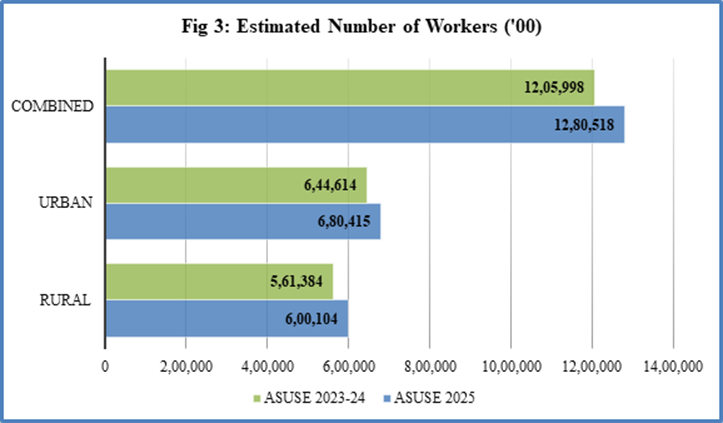
Women-Led Enterprises Rise as Worker Earnings Improve

The percentage of female-owned proprietary establishments increased marginally from 26.2 per cent in 2023–24 to 27.0 per cent in ASUSE 2025 pointing to an encouraging trend in women-led enterprises.

The emolument per hired worker increased by 3.88% in 2025 compared to the previous ASUSE 2023-24, signalling improvements in wage levels. The highest increase in this metric was observed in trade sector which recorded a growth of about 8.5%.

Better Digital Penetration

Percentage of establishments using internet has also grown significantly from 26.7% in 2023-24 to 39.4% in ASUSE 2025. This substantial growth reflects a strong trend toward digital adoption among establishments, highlighting the increasing reliance on the internet for business operations.

Fig 4: Key Operational Indicators

Percentage of Establishments using Internet

ASUSE 2023-24

ASUSE 2025

Percentage of Female Owned Proprietary Establishments

ASUSE 2023-24

ASUSE 2025

Annual estimates of key indicators (value figures in current price), of ASUSE 2022-23, ASUSE 2023-24 and ASUSE 2025 are given in Table 1 below. The annual estimates for ASUSE 2025 for the broad activity categories are provided in the factsheet which is available in the website of the Ministry (https://www.mospi.gov.in). Further, interactive tables and visualizations on ASUSE results may be accessed on the Data Catalogue section of https://esankhyiki.mospi.gov.in/. Report of ASUSE 2025 as well as unit level data will be released in April, 2026 with detailed insights from the survey.

Table 1: Key indicators of ASUSE 2022-23, ASUSE 2023-24 and ASUSE 2025

all-India

Indicator

ASUSE 2022-23

(October,2022 – September, 2023)

ASUSE 2023-24

(October,2023 – September, 2024)

ASUSE 2025 (January, 2025 – December, 2025)

(1)

(2)

(3)

(4)

Number of Establishments (in ’00)

6,50,484

7,33,995

7,92,465

Number of Workers (in ’00)

10,96,260

12,05,998

12,80,518

Gross Value Added (Rs. Crore)*

15,42,409

17,97,278

19,92,577

GVA per establishment*(Rs.)

2,38,168

2,45,687

       2,52,699

GVA per worker* (Rs.)

1,41,769

1,49,742

       1,56,539

Emolument per Hired Worker (Rs.)

         1,24,842

1,41,071

       1,46,550

           *pertaining to market establishments

Endnote: A brief about the coverage, sampling scheme, sample size and data collection mechanism in the Annual Survey of Unincorporated Sector Enterprises (ASUSE):

A. Coverage of ASUSE:

A.1. Geographically, ASUSE covers the rural and urban areas of whole of India (except the villages in Andaman and Nicobar Islands, which are difficult to access).

A.2. Sector-wise, this survey captures unincorporated non-agricultural establishments belonging to three sectors viz., Manufacturing, Trade and Other Services.

A.3. Ownership-wise, unincorporated non-agricultural establishments pertaining to proprietorship, partnership (excluding Limited Liability Partnerships), co-operatives, societies/trusts etc. have been covered in ASUSE.

B. Sampling Scheme:

The survey has been conducted following a multi-stage stratified sampling scheme, where first stage units (FSUs) are census villages in rural area (except for rural Kerala, where Panchayat wards have been taken as FSUs) and UFS (Urban Frame Survey) blocks in urban areas.  The ultimate stage units (USUs) are establishments for both the sectors. In the case of large FSUs, one intermediate stage of sampling has been done in the form of hamlet groups in rural and sub-blocks in urban. 

The sampling design of ASUSE 2025 has been revised to enable quarterly selection of sample units. To facilitate this shift, the sample size has been increased by approximately 1.5 times over the previous survey. This improvement also makes it possible to produce quarterly estimates in addition to annual results. By adopting districts within a state as the basic strata, the design also allows participating states to generate annual estimates at the district level.

C. Sample Size:

In ASUSE 2025, data were collected from a total of 6,70,289 establishments (2,94,144 in rural and 3,76,145 in urban) pertaining to 24,153 surveyed FSUs (10,219 in rural and 13,934 in urban).

D. Data Collection Mechanism:

ASUSE 2025 has been conducted based on area frame and establishments have been listed in the selected FSUs of both rural and urban sector. Mostly, data were collected from the selected establishments through oral enquiry pertaining to the ‘monthly’ reference period barring a few big establishments, which had provided annual data from their audited Books of Accounts. The data for the survey were collected in tablet using Computer Assisted Personal Interviewing (CAPI).

E. Know your Survey- ASUSE:

The Factsheet of ASUSE 2025 (January, 2025 – December, 2025) is available on the website of the Ministry (https://www.mospi.gov.in)

Scan QR code to access MoSPI Publications/ Reports


For more detailed understanding of the objectives, coverage, concepts, methodology and data quality practices of ASUSE in a simple, transparent, user-friendly language, one may refer to the Know Your Survey: A User Guide to the Annual Survey of Unincorporated Sector Enterprises (ASUSE) published by NSO, MOSPI and available on the website of the ministry (https://www.mospi.gov.in).

****

Topics

Acts Income Tax