

Loading...

Top
Help
×

By creating an account you can:

Logo TaxTMI
Call Us / Help / Feedback

Contact Us At :

E-mail: [email protected]

Call / WhatsApp at: +91 99117 96707

For more information, Check Contact Us

FAQs :

To know Frequently Asked Questions, Check FAQs

Most Asked Video Tutorials :

For more tutorials, Check Video Tutorials

Submit Feedback/Suggestion :

Email :
Please provide your email address so we can follow up on your feedback.
Category :
Description :
Min 15 characters 0/2000
Make Most of Text Search
  1. Checkout this video tutorial: How to search effectively on TaxTMI.
  2. Put words in double quotes for exact word search, eg: "income tax"
  3. Avoid noise words such as : 'and, of, the, a'
  4. Sort by Relevance to get the most relevant document.
  5. Press Enter to add multiple terms/multiple phrases, and then click on Search to Search.
  6. Text Search
  7. The system will try to fetch results that contains ALL your words.
  8. Once you add keywords, you'll see a new 'Search In' filter that makes your results even more precise.
  9. Text Search
Add to...
You have not created any category. Kindly create one to bookmark this item!
Create New Category
Hide
Title :
Description :
❮❮ Hide
Default View
Expand ❯❯
Close ✕
🔎 News - Adv. Search
TEXT SEARCH:

Press 'Enter' to add multiple search terms. Rules for Better Search

Search In:
Main Text + AI Text
  • Main Text
  • Main Text + AI Text
  • AI Text
Category: ?
Categorized by AI
---- All Categories ----
  • ---- All Categories ----
  • Income Tax
  • GST
  • Customs, DGFT & SEZ
  • FEMA & RBI
  • Corp. Laws, SEBI & IBC
  • PMLA, Black Money & ED
  • Budget
  • News and Press Release
  • PTI News
Month:
---- All Months ----
  • ---- All Months ----
  • January
  • February
  • March
  • April
  • May
  • June
  • July
  • August
  • September
  • October
  • November
  • December
Year:
---- All Years ----
  • ---- All Years ----
  • 2026
  • 2025
  • 2024
  • 2023
  • 2022
  • 2021
  • 2020
  • 2019
  • 2018
  • 2017
  • 2016
  • 2015
  • 2014
  • 2013
  • 2012
  • 2011
Sort By: ?
In Sort By 'Default', exact matches for text search are shown at the top, followed by the remaining results in their regular order.
Relevance Default Date
    Rupee crashes 42 paise to settle at 91.50 against US dollar
    J&K to import 4 elite foreign breeds of sheep, goat
    Oil prices soar and stock prices fall as US-Israel war with Iran rattles markets
    India's manufacturing sector activity growth jumps to 4-month high in Feb: PMI
    Arkel invests RS.100 Cr in Phase 1, Opens Advanced Lift Control Manufacturing Facility
    Two-day Workshop by DFS on Reservation Policy of Government of India and Accessibility for PwDs concludes
    Central Board of Indirect Taxes and Customs (CBIC) introduces deferred Customs Duty payment facility for Eligible Manufacturer Importers as announced ...
    US futures, Asian shares open lower, oil prices soar as US and Israeli attack Iran
    Rupee falls 21 paise to 91.29 against US dollar in early trade
    Oil prices rise sharply after attacks in Middle East disrupt global energy supply
    Oil prices rise sharply in market trading after attacks in Middle East disrupt global energy supply
    OPEC+ boosts oil production after attacks on Iran and throughout region
    Iran crisis: No immediate oil disruption for India; price volatility, macro impact seen
    HIGHLIGHTS
    Haryana records 22 pc growth in gross SGST collection in FY 2025-26, beats all states, UTs
    Andhra records highest GST collection in February at Rs 3,061 cr
    Rice exporters cautioned against CIF contracts to Iran, Gulf countries amid West Asia conflict
    GST collection grows 8.1 pc to over Rs 1.83 lakh cr in Feb
    Iran crisis: Rice exporters stare at shipment disruptions, payment delays
    GST mop-up grows 8.1 pc to over Rs 1.83 lakh cr in Feb
❯❯
Maximize Maximize Maximize
0 / 200
Expand Note
Add to Folder

No Folders have been created

+

Are you sure you want to delete "My most important" ?

NOTE:

News
Showing Results for :
Reset Filters
Results Found:
Show All Summaries Hide All Summaries
March 2, 2026
Show AI Summary
Exchange rate pressure intensified as geopolitical conflict, crude price spikes and capital outflows pushed the currency lower despite central bank support.
Severe exchange rate pressure drove the rupee sharply lower amid geopolitical conflict, FII outflows and rising crude prices, increasing India's import bill vulnerability; the Reserve Bank of India's visible market presence capped deeper intraday depreciation while analysts warned that geopolitical developments, crude trends, capital flows and key US data will determine near term exchange rate direction.
March 2, 2026
Show AI Summary
Genetic upgrade initiative boosts local mutton and wool production via import of elite sheep and goat breeds.
Importation of Romanov and Finn sheep and Boer and Swiss Alpine goats aims to implement a genetic upgrade of Jammu and Kashmir's small ruminant population to improve growth rates, carcass yield, reproductive efficiency and overall flock productivity. Imported germplasm will be multiplied at government breeding farms and progeny distributed to farmers in phases, with farmer-level distribution starting in the third quarter of 2026-27, as part of Project 24 under the Holistic Agriculture Development Programme alongside complementary livestock and rural productivity measures.
March 2, 2026
Show AI Summary
Oil supply disruption risk drives markets as geopolitical attacks push energy prices up and equities downward.
Attacks on Iran caused equity declines and sharp rises in oil and gold as traders priced in disruption to energy flows through the Strait of Hormuz; sustained interruptions to Iranian exports and regional shipping could tighten global supply, elevate fuel and production costs, affect major importers' sourcing strategies, and influence inflation dynamics and central bank rate decisions.
March 2, 2026
Show AI Summary
Manufacturing activity growth driven by stronger domestic demand despite slower export orders, prompting higher input buying and hiring.
Manufacturing activity accelerated to a four-month high as stronger domestic demand supported faster output growth and higher new business intakes; firms increased input purchasing, inventories and hiring. New export orders continued to slow, somewhat constraining employment creation. Cost pressures remained moderate, and forward-looking sentiment was positive with many manufacturers expecting higher output over the year ahead.
March 2, 2026
Show AI Summary
Compliance with IS-17900 drives local manufacturing of advanced lift control systems, reducing import dependence and strengthening supply chains.
A Phase 1 manufacturing facility invests in local production of advanced lift electronic control systems designed to comply with IS-17900, reduce import dependency, and enable component to finished product localisation. The plant will operate automated PCB and semi automatic panel lines to produce MR, MRL and Slim Panels, emphasise controlled environment quality, IoT features, and support supply chain resilience and national industrial policy objectives under the Make in India framework.
March 2, 2026
Show AI Summary
Reservation policy implementation strengthened across public financial institutions to improve accessibility and uniform compliance measures.
Strengthening institutional capacity for uniform implementation of the Government of India's reservation policy across public financial institutions and enhancing accessibility for Persons with Disabilities were the primary objectives. The programme combined a Sugamya Bharat sensitisation session on accessibility standards and compliance requirements, a roundtable on legal provisions and practical challenges, exchange of best practices, and an interactive question-and-answer session to identify operational measures for inclusivity, accessibility and reservation policy compliance.
March 2, 2026
Show AI Summary
Deferred Customs Duty payment enables qualified manufacturers to clear imports and pay duties monthly, subject to compliance and eligibility.
A Deferred Customs Duty payment facility allows Eligible Manufacturer Importers to clear imports without immediate duty payment and to pay applicable customs duties monthly under the Deferred Payment of Import Duty Rules, 2016, subject to prescribed Customs and GST compliance, turnover, financial standing and track record; existing AEO T1 entities meeting eligibility may participate and applications are to be submitted via the AEO portal.
March 2, 2026
Show AI Summary
Energy supply disruption risks trigger global market selloff and safe-haven flows, lifting oil and gold while bond yields fall.
Global markets moved to risk-off after US and Israeli attacks on Iran: equities opened lower while gold and government bonds rallied and oil prices surged on fears that strikes and incidents in the Strait of Hormuz could restrict oil and LNG exports, raising the prospect of higher energy and production costs; higher-than-expected wholesale inflation readings were identified as a factor that may affect the central bank's timing for interest-rate cuts.
March 2, 2026
Show AI Summary
Rupee depreciation driven by crude price surge, dollar strength and foreign fund outflows pressures local currency lower.
Rupee depreciation in early trade reflected external pressures-higher crude prices, a stronger US dollar, and escalated Middle East tensions-compounded by negative domestic equity sentiment and significant foreign institutional outflows. Market indicators included a firmer dollar index, rising Brent crude futures, and a recent dip in forex reserves, while analysts warned of increased import bill risk due to India's reliance on fuel imports.
March 2, 2026
Show AI Summary
Energy supply disruption threatens global oil flows, driving sharp price increases and straining fuel and goods markets worldwide.
Attacks and retaliatory strikes in the Middle East disrupted flows through the Strait of Hormuz and regional export infrastructure, triggering sharp crude price rises and heightened risk of sustained supply constraints; OPEC+ announced production increases, but analysts stress that constrained export routes limit the immediate effectiveness of added output.
March 2, 2026
Show AI Summary
Maritime chokepoint security threatened, risking oil export disruptions and limiting the relief from increased production.
Attacks and military strikes in the Middle East disrupted maritime traffic through the Strait of Hormuz, risking restrictions on regional crude exports and driving upward pressure on oil and gasoline prices. Because the strait is a critical global oil chokepoint, market concerns focus on whether barrels can physically move; consequently, OPEC+ announcements of increased production may provide limited immediate relief if export routes remain constrained.
March 2, 2026
Show AI Summary
Oil supply security: production increases meet limited relief when export routes through the Strait of Hormuz are disrupted.
OPEC+ announced an April increase in crude production intended to augment available supply while regional military attacks and disruptions to tanker movements - particularly through the Strait of Hormuz - threaten export routes. The notice underscores that interruptions to transit can limit the relief additional output provides and that access to export channels will be decisive for near-term market stability and price direction.
March 1, 2026
Show AI Summary
Energy security measures cushion supply shocks but elevate price volatility and macroeconomic pressures for oil importers.
Escalating tensions around Iran and the Strait of Hormuz create near-term energy security risks for India manifested chiefly as price volatility and macroeconomic pressure rather than immediate physical shortages. Layered inventory buffers - commercial stocks, in transit cargoes and Strategic Petroleum Reserves - combined with diversified sourcing options (including Atlantic suppliers and Russian optionality) reduce the likelihood of sustained supply disruption, though longer transit times and LNG contractual rigidity limit rapid substitution and increase vulnerability to prolonged closures.
March 1, 2026
Show AI Summary
GST revenue growth signals strengthened tax receipts driven by import collections and improved domestic sales affecting fiscal enforcement.
A court ordered continued judicial custody for eight alleged Lashkar-e-Taiba operatives accused of illegal entry and procuring forged identity documents while another court directed the immediate release of 14 student protesters arrested after a campus demonstration. Separately, gross Goods and Services Tax collections rose year-on-year, led by higher import receipts and improved domestic sales, reflecting stronger enforcement and compliance dynamics within the indirect tax regime.
March 1, 2026
Show AI Summary
SGST growth reflects strengthened tax administration and compliance following GST rate rationalisation, bolstering state revenues.
Haryana reports marked year on year expansion in State Goods and Services Tax (SGST) receipts for 2025-26, attributing the improvement to strengthened tax administration, enhanced compliance stemming from departmental reforms and better tax analysis, facilitation via district GST Suvidha Kendras, and the GST Council's September 2025 rate rationalisation as complementary drivers of revenue growth.
March 1, 2026
Show AI Summary
GST revenue growth maintained despite rate reductions; enhanced compliance and AI-driven analytics strengthened state collections effectively.
Andhra Pradesh achieves record net Goods and Services Tax receipts for February, with SGST and IGST growth offsetting marginal gross GST decline. Revenue momentum is supported by higher professional tax and petroleum VAT receipts. The state credits strengthened compliance-targeted audits, stricter return filing, coordinated IGST settlements, and performance based officer deployment-and advanced data analytics and AI oversight that detect evasion and reverse ineligible input tax credit claims for measurable recoveries.
March 1, 2026
Show AI Summary
Shipping risk allocation: exporters urged to avoid CIF and prefer FOB as geopolitical risks raise freight and insurance exposure.
Advises exporters to avoid new Cost, Insurance and Freight (CIF) commitments to Iran and Gulf destinations and to conclude sales on Free-On-Board (FOB) terms where feasible so freight, insurance and related risks rest with the buyer. Notes that West Asia instability may sharply increase bunker prices, disrupt vessel availability, raise freight and insurance premiums, and produce price volatility; urges restraint, avoidance of open-ended unhedged positions, and monitoring of consignments in transit or awaiting clearance.
March 1, 2026
Show AI Summary
GST rate restructuring boosts revenues as import and domestic consumption support post cut recovery in collections.
GST collections rose year on year following a statutory GST rate restructuring that reduced rates on numerous items and consolidated slabs; import revenue and domestic consumption supported recovery after an initial post cut dip. The pattern includes higher refunds, lower cess receipts, and divergent state level growth, raising considerations for revenue forecasting, state fiscal impacts, and the operational stability of the restructured indirect tax framework.
March 1, 2026
Show AI Summary
Export disruptions to Iran risk shipment halts and payment delays for rice exporters amid regional conflict.
Shipments to Iran and consignments to Afghanistan via Bandar Abbas have been held up following military strikes, causing immediate shipment disruptions and likely payment delays until the security situation improves; exporters warn the impact depends on conflict duration and note heightened commercial risk from lack of war-risk insurance for vessels.
March 1, 2026
Show AI Summary
Goods and Services Tax collections rose driven by import revenue growth, with higher refunds and lower cess receipts.
Gross collections under the Goods and Services Tax increased year on year, driven mainly by a stronger rise in import related GST receipts; domestic GST rose more modestly. Total refunds increased, and net GST receipts were higher year on year, while cess receipts declined markedly compared with the prior year period.

News

Back

All News

Showing Results for :
Reset Filters
No Records Found

News

Back

All News

Showing Results for : Reset Filters
Corp. Laws, SEBI & IBC

CCI Organises 11th Edition of National Conference on Economics of Competition Law

March 17, 2026

Contents
Summary
Note

Note

-

Bookmark

Print

Print

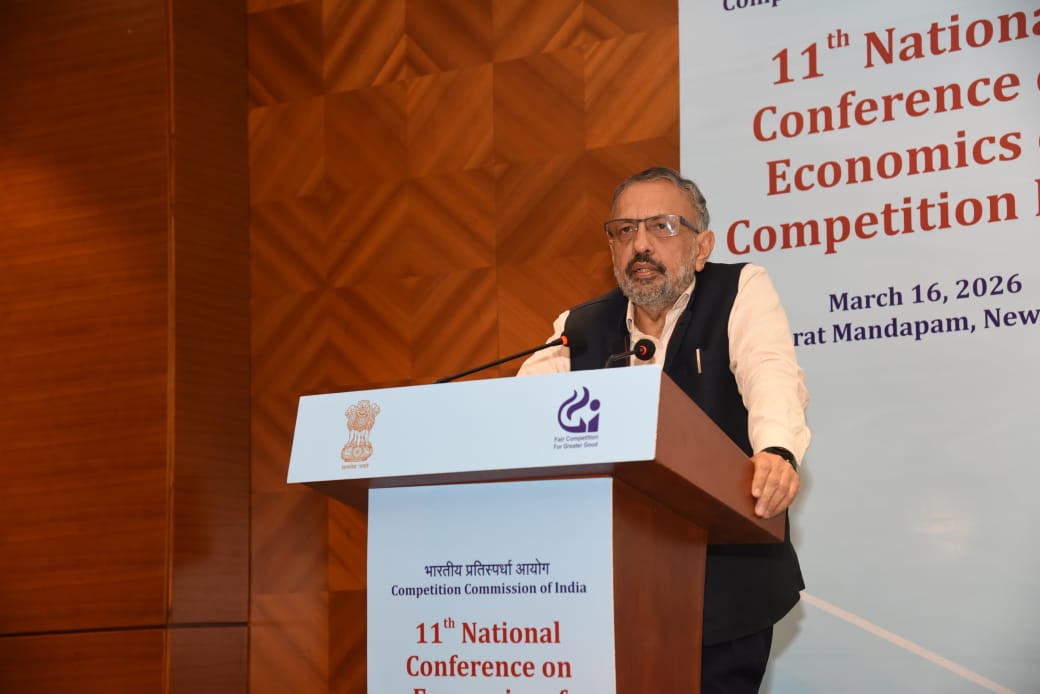
Shri Rajiv Gauba, Member, NITI Aayog delivers the Keynote address at the CCI Conference

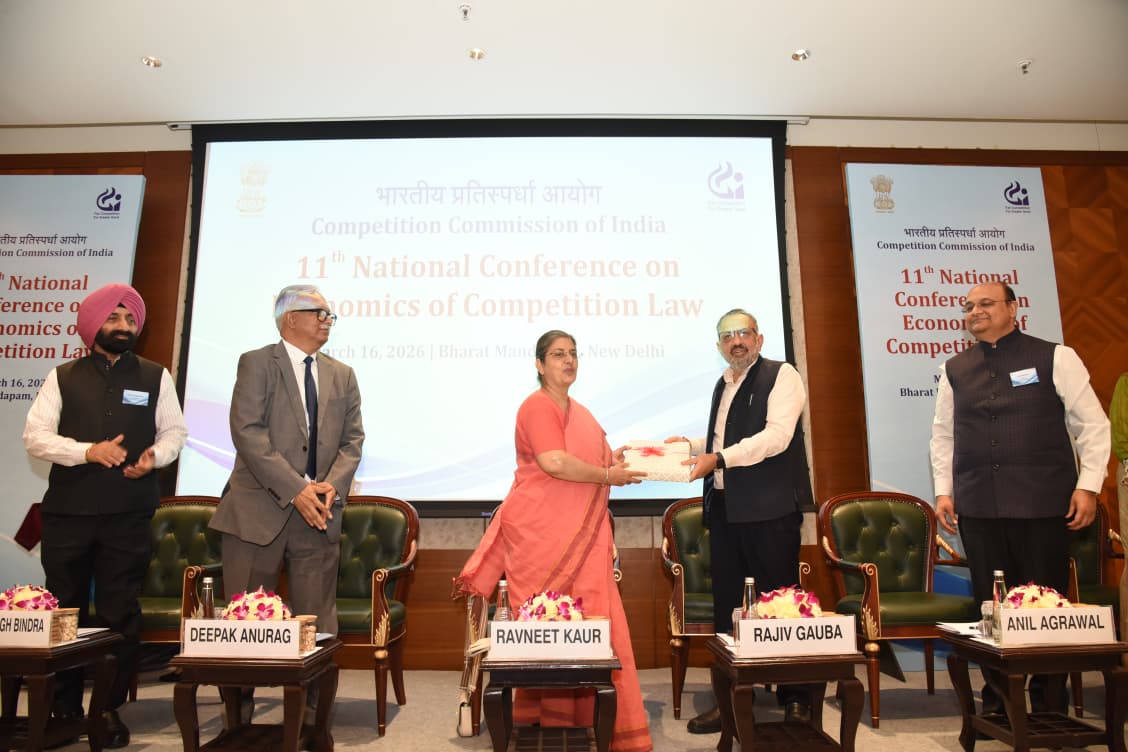
The Competition Commission of India (CCI) organised the 11th National Conference on Economics of Competition Law in New Delhi today. Shri Rajiv Gauba, Member, NITI Aayog was the Keynote Speaker at the Conference, while Smt. Ravneet Kaur, Chairperson, CCI delivered the Special Address at the Inaugural Session of the Conference.

The Conference, which brings together scholars, practitioners, and experts working in the area of economics of competition law, has been organised by the CCI every year since 2016.

Shri Rajiv Gauba, Hon'ble Member, NITI Aayog, in his Keynote Address referred to competition as one of the most potent engines of human progress. Left to their own devices without robust policy and oversight, markets can breed concentration, collusion and exclusion, he said.
He added that well designed competition laws create moral architecture of markets. He noted that in an emerging economy like India, competition law and regulations serve multiple development and governance goals, by preventing entrenched monopolies, promoting open entry and opportunities for small businesses and by helping integrate the economy into global value chains.

Tracing the evolution of the competition paradigm in India in the context of the structural transformation that the Indian economy underwent over decades post-independence, he underscored the importance of optimal regulation through actions and forbearance, to benefit from the invigorating push of competition.
Referring to the Prime Minister's vision of Viksit Bharat 2047, he said that it would entail ensuring markets are truly competitive, both domestically and globally. In this context, he highlighted four institutional pillars for well-functioning markets, viz.,  contestability - firms must be able to enter and exit without prohibitive regulatory or practical obstacles; information symmetry - buyers, sellers and regulators need timely access to reliable market data so that choices are meaningful and markets are receptive; non-discriminatory access to all infrastructure including physical, digital & financial infrastructure; and independent and predictable dispute resolution and enforcement institutions.

Referring to the rise of digital economy as a structural break in market dynamics and given the features of digital economy that create winner-takes-most scenarios, he commended the Competition Commission of India for establishing a dedicated Digital Markets Division.

Shri Gauba stated that India is aligning its regulatory posture with global peers with the aim to ensure that the Digital Highway remains open to all, not just the few who built the road. With the emergence of the new frontier of AI, he stressed on the need for our competition toolkit to evolve to address the novel risks posed by AI. “We must guard against ecosystem entrenchment and ensure data portability and interoperability,” he added. 

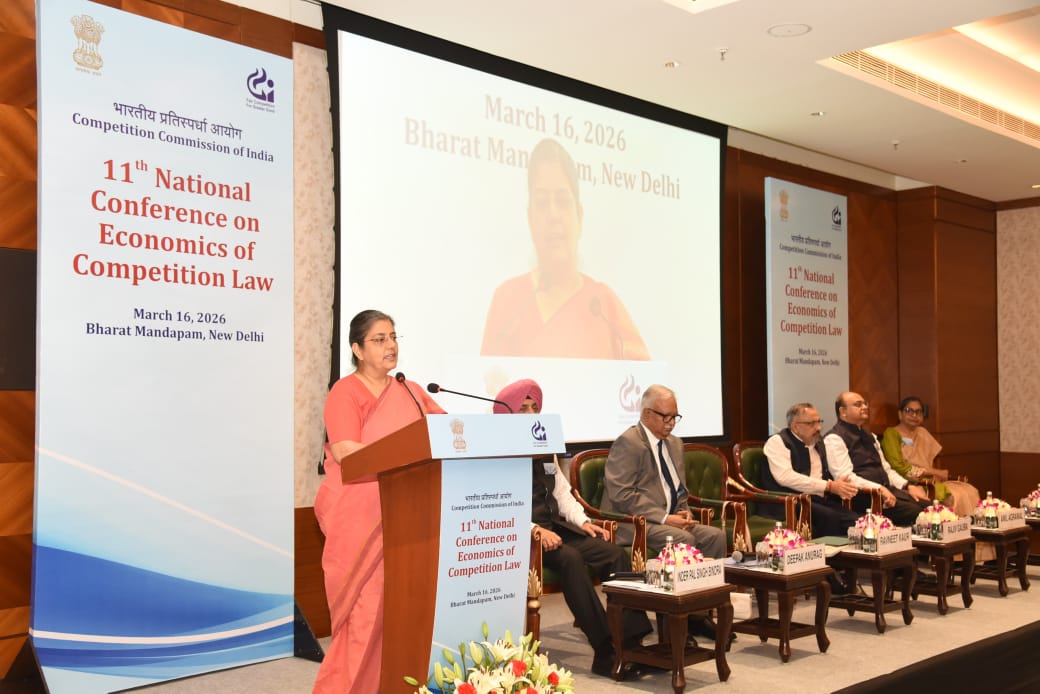
Smt. Ravneet Kaur, Chairperson, CCI, in her Special Address, highlighted that the Competition Act is an interdisciplinary Act with economic principles embedded in it. Economics is therefore placed at the centre of Commission’ work and the Commission’s analysis and decisions are based on rigorous economic analysis in order to establish any potential appreciable adverse effects on competition. The aim is to ensure that competition and business success is based on merit and not on exclusionary, exploitative or anti-competitive conduct.

Chairperson, CCI highlighted that over the course of the last year, CCI has notified and implemented all regulations for operationalising the 2023 amendment to the Competition Act, 2023. She said, in 2025, a revised regulation on cost of production was brought in with a view to provide a consistent and transparent framework on determination of predatory pricing.

Referring to the first settlement proposal in the Android Smart TV ecosystem processed by the CCI in 2025, she highlighted that settlement mechanism allows to enforce quick market correction while closing the chapter for further litigation.
She further mentioned that the Commission throughout the past one year has dealt with antitrust matters across various sectors including cartelisation and bid rigging cases in the sectors of defence procurement, liquor and solid waste management. During the past one year, based on the Informations and investigations undertaken, matters were decided across multiple sectors, leading to cease and desist orders, penalties and other suitable remedies.

On the combinations front, the Commission has followed a proactive and systematic consistent approach with a disposal rate of more than 99%. The Commission’s approach has been positive and solution oriented, she added

Referring to the CCI market study on AI and competition completed in October 2025, Chairperson CCI said that there are huge benefits of AI, including efficiency gains, greater market access for MSMEs, but the potential anti-competitive actions also need to be watched.

She mentioned that CCI has issued a guidance note which provides self-audit mechanism by the stakeholders, by the boards, management and the decision makers in the organisations as to how they can ensure that at the stage of development, deployment, monitoring of AI applications, there are not any hidden anti-competitive outcomes which may be happening.

Shri Deepak Anurag, Member, CCI made the welcome remarks and Shri Anil Agrawal, Member, CCI proposed the vote of thanks during the Inaugural Session.

The Conference, in addition to the Inaugural Session, featured two technical sessions on ‘Competition and Firm Conduct: Evidence and Policy Implications’ and ‘Ownership, Market Power, and Consumer Welfare’, where researchers presented papers on the economics of competition law. The first session was chaired by Dr. Saptarshi Mukherjee, Professor, Humanities and Social Science, IIT Delhi. Dr. Biswajit Dhar, Vice President, Council for Social Development, chaired the second session.

The National Conference concluded with a Plenary Session on ‘Competition and AI: Technical Developments, Regulatory Experience, and Business Impact’ which was chaired by Ms. Sweta Kakkad, Member, CCI, and moderated by Ms. Shweta Rajpal Kohli, President and CEO, Startup Policy Forum.

Topics

Acts Income Tax