

Loading...

Top
Help
×

By creating an account you can:

Logo TaxTMI
Call Us / Help / Feedback

Contact Us At :

E-mail: [email protected]

Call / WhatsApp at: +91 99117 96707

For more information, Check Contact Us

FAQs :

To know Frequently Asked Questions, Check FAQs

Most Asked Video Tutorials :

For more tutorials, Check Video Tutorials

Submit Feedback/Suggestion :

Email :
Please provide your email address so we can follow up on your feedback.
Category :
Description :
Min 15 characters 0/2000
Make Most of Text Search
  1. Checkout this video tutorial: How to search effectively on TaxTMI.
  2. Put words in double quotes for exact word search, eg: "income tax"
  3. Avoid noise words such as : 'and, of, the, a'
  4. Sort by Relevance to get the most relevant document.
  5. Press Enter to add multiple terms/multiple phrases, and then click on Search to Search.
  6. Text Search
  7. The system will try to fetch results that contains ALL your words.
  8. Once you add keywords, you'll see a new 'Search In' filter that makes your results even more precise.
  9. Text Search
Add to...
You have not created any category. Kindly create one to bookmark this item!
Create New Category
Hide
Title :
Description :
❮❮ Hide
Default View
Expand ❯❯
Close ✕
🔎 News - Adv. Search
TEXT SEARCH:

Press 'Enter' to add multiple search terms. Rules for Better Search

Search In:
Main Text + AI Text
  • Main Text
  • Main Text + AI Text
  • AI Text
Category: ?
Categorized by AI
---- All Categories ----
  • ---- All Categories ----
  • Income Tax
  • GST
  • Customs, DGFT & SEZ
  • FEMA & RBI
  • Corp. Laws, SEBI & IBC
  • PMLA, Black Money & ED
  • Budget
  • News and Press Release
  • PTI News
Month:
---- All Months ----
  • ---- All Months ----
  • January
  • February
  • March
  • April
  • May
  • June
  • July
  • August
  • September
  • October
  • November
  • December
Year:
---- All Years ----
  • ---- All Years ----
  • 2026
  • 2025
  • 2024
  • 2023
  • 2022
  • 2021
  • 2020
  • 2019
  • 2018
  • 2017
  • 2016
  • 2015
  • 2014
  • 2013
  • 2012
  • 2011
Sort By: ?
In Sort By 'Default', exact matches for text search are shown at the top, followed by the remaining results in their regular order.
Relevance Default Date
❯❯
Maximize Maximize Maximize
0 / 200
Expand Note
Add to Folder

No Folders have been created

+

Are you sure you want to delete "My most important" ?

NOTE:

News
Showing Results for :
Reset Filters
Results Found:
Show All Summaries Hide All Summaries
March 27, 2026
Show AI Summary
Bilateral trade agreement negotiations advance as India and the US discuss WTO issues, tariffs, and next steps in talks.
India and the United States continued discussions on the next steps in the bilateral trade agreement negotiations, covering the WTO agenda, the India-US BTA, and ways to deepen bilateral economic cooperation and trade ties. A framework for the first phase has been finalised, but the legal text remains unsigned, and the chief negotiators' meeting was postponed because of changes in the US tariff architecture and the need to await the revised global tariff framework before the interim trade agreement is signed.
March 27, 2026
Show AI Summary
Energy supply stability assured as government rules out lockdown, citing adequate fuel stocks and anti-hoarding measures.
The government ruled out any lockdown and said India has adequate stocks of petrol, diesel and LPG, with fuel retail operations continuing normally despite energy supply disruptions linked to the war in West Asia. Officials said rumours have caused panic buying, while alternative sourcing, higher domestic LPG production, excise duty cuts, export levies, export diversion directions and intensified anti-hoarding enforcement are being used to stabilise supplies and protect consumers.
March 27, 2026
Show AI Summary
Excise duty cut on petrol and diesel aims to shield consumers from global fuel price volatility.
The Union Government reduced excise duty on petrol and diesel by Rs 10 per litre to prevent a retail price increase caused by rising global oil prices. The move was described as a people-centric measure intended to shield consumers from fuel price volatility and wider shortages linked to global instability.
March 27, 2026
Show AI Summary
State borrowing costs harden as bond yields rise, forcing partial bids and higher returns in volatile fixed-income markets.
States' borrowing costs hardened in a State Development Loan auction as cut-off yields rose across long-term maturities, with several securities moving above 8 per cent. The increase tracked a broader rise in government bond yields amid global oil price pressures, inflationary concerns and weakness in the rupee, causing some states to accept only partial borrowing amounts or reject bids. The report notes that higher bond yields may keep borrowing costs elevated and increase volatility in fixed-income markets.
March 27, 2026
Show AI Summary
Money laundering proceedings over bank loan fraud allegations include diversion of proceeds through offshore entities and property transactions.
Money laundering proceedings under the Prevention of Money Laundering Act concern a former senior executive of Reliance Communications and another accused in an alleged bank loan fraud case. The allegations include concealment, layering and diversion of proceeds of crime through foreign subsidiaries and offshore entities, purchase and sale of a Manhattan condominium during the insolvency process, and routing of sale proceeds through an asserted sham investment arrangement. The allegations also include personal diversion of funds for overseas education-related payments.
March 27, 2026
Show AI Summary
Minimum alternate tax and book profit reporting through Form 66, with CA certification, exemptions, and MAT credit rules.
Form No. 66 is the prescribed electronic statement for furnishing details of book profit and minimum alternate tax under section 206(1) of the Income-tax Act, 2025. It applies to companies where normal tax is lower than the minimum tax, must be filed along with the return of income, and requires certification by an Accountant/Chartered Accountant. The FAQ explains book-profit adjustments, MAT credit, exemptions, Ind-AS transition amounts, and the consequences of incorrect or missing filing.
March 27, 2026
Show AI Summary
Patent box regime filing through Form 65 enables eligible resident assessees to opt for concessional royalty taxation.
Form 65 is the prescribed application for an eligible resident assessee to exercise the option under Section 194(1) of the Income-tax Act, 2025 for royalty income from a patent developed and registered in India. It relates to the concessional 10% tax rate under the patent box regime and requires the assessee to forgo deductions or allowances against such royalty income. The form is filed electronically by the return-filing due date, with patent details, royalty particulars, expenditure information and verification requirements.
March 27, 2026
Show AI Summary
Concessional royalty taxation under Form 65 requires resident eligibility, electronic filing, and a five-year lock-in period.
Form 65 is the prescribed income-tax application by which a resident assessee opts for concessional taxation on royalty income from a patent developed and registered in India. The form enables taxation at a flat 10% rate on gross royalty, with surcharge and cess, subject to conditions including denial of deductions, Indian patent registration, and development in India. The option must be filed electronically by the return due date, cannot be revised or withdrawn for that year, and carries a five-tax-year lock-in.
March 27, 2026
Show AI Summary
Tax deduction verification through Form 61 requires e-filing, irrevocable authorisation, and proof of transmission to the financial institution.
Form No. 61 is an irrevocable authorisation enabling tax authorities to obtain information and records from a financial institution in a Notified Jurisdictional Area for verifying deduction claims on payments made to that institution. It is filed once for the tax year before the income-tax return due date, through the e-filing portal, with details of the institution, payment, supporting documents, and proof that the first copy has been deposited or transmitted. The assessee must send the first copy to the institution and submit the second copy with proof to the Assessing Officer.
March 27, 2026
Show AI Summary
Notified jurisdictional area disclosures: Form 61 authorisation enables tax authorities to access financial records for deduction verification.
Form No. 61 is an irrevocable authorisation enabling the Central Board of Direct Taxes and designated income-tax authorities to obtain information and records from a financial institution located in a notified jurisdictional area for the purpose of claiming deduction in respect of payments made to such institution. The form must be filed once for the relevant tax year before the due date for filing the income-tax return, through the e-filing portal, and verified by DSC or EVC as applicable. The assessee must submit the first copy to the financial institution and the second copy with proof to the Assessing Officer, while waiving privacy, data protection and banking secrecy protections.
March 27, 2026
Show AI Summary
Excise duty reduction and export duty hike reshape fuel pricing to ease under-recoveries and protect domestic supply.
Excise duty on petrol and diesel has been reduced, while export duty on diesel and aviation turbine fuel has been increased, to address under-recoveries of oil marketing companies, support domestic fuel availability, and limit consumer price pressure amid volatility in global oil markets. The revised rates are stated to operate on a fortnightly review basis, with the policy rationale emphasising energy security, domestic supply prioritisation, and response to disrupted international crude and product markets.
March 27, 2026
Show AI Summary
International group reporting designation requires Form No. 60 for appointing the entity that files the Country-by-Country Report.
Form No. 60 is the intimation to be furnished on behalf of an international group having multiple constituent entities resident in India for designating a single constituent entity to file the Country-by-Country Report in Form No. 59. The form requires particulars of the international group, the parent entity, the designated constituent entity, and the other constituent entities resident in India, including name, address and PAN details. It is to be filed as an e-form through the income tax e-filing portal, at least 30 days before the due date for Form No. 59, followed by preview and e-verification before submission.
March 27, 2026
Show AI Summary
Country-by-Country reporting compliance for international groups, covering filing triggers, due dates, and e-form submission requirements.
Form No. 59 is the prescribed e-form for filing the Country-by-Country Report of an international group. It applies to a resident parent entity or alternate reporting entity where the consolidated group revenue exceeds the prescribed threshold, and in specified cases to a resident constituent entity where the parent is not required to report, there is no exchange arrangement with India, or a notified systemic failure exists. The report is ordinarily due within twelve months from the end of the reporting accounting year, with a shorter period in cases involving notified systemic failure. The form captures entity particulars, tax jurisdiction details, constituent entity data, and additional information.
March 27, 2026
Show AI Summary
Country-by-country reporting intimation by Indian constituent entities sets out the reporting entity and filing location for the group report.
Form No. 58 is an intimation by every constituent entity resident in India, where the parent entity of the international group is not resident in India, regarding whether it is an alternate reporting entity and, if not, the details of the parent entity or alternate reporting entity and their country or territory of residence. The form informs the income-tax authorities where the Country-by-Country Report will be filed and must be submitted two months before the due date for furnishing that report.
March 27, 2026
Show AI Summary
Foreign exchange reserves decline as gold holdings fall, while foreign currency assets rise in RBI data.
India's foreign exchange reserves declined during the week ended March 20, 2026, falling by USD 11.413 billion to USD 698.346 billion, according to RBI data. The drop was attributed mainly to a sharp reduction in gold reserves, even as foreign currency assets increased during the reporting week. The RBI data further showed that the value of gold reserves decreased significantly, Special Drawing Rights were lower, and India's reserve position with the IMF increased marginally.
March 27, 2026
Show AI Summary
Live-in relationship and judicial vacancies draw legal attention as high court and chief justice address key issues.
The Allahabad High Court stated that a married man living in a consensual live-in relationship with an adult woman does not amount to a criminal offence under law. The Bombay High Court dismissed a petition seeking a CBI probe against Reliance Industries Limited and Mukesh Ambani over alleged unlawful gas extraction. Separately, the Chief Justice of India urged high courts to expedite filling judicial vacancies, with special focus on elevating women judges.
March 27, 2026
Show AI Summary
Designated constituent entity intimation under income tax rules governs filing of Form 57 for international group reporting
Form No. 57 is an intimation by a designated constituent entity of an international group for the purposes of section 171(4), to be furnished under Rule 123 of the Income-tax Rules, 2026 when more than one constituent entity is required to file Form No. 56. The designated entity may file the form if the group has appointed it for compliance, and the intimation must be made at least 30 days before the due date for Form No. 56. The form captures particulars of the designated entity, the international group, the parent entity and the accounting year, and is filed online through the e-filing portal.
March 27, 2026
Show AI Summary
Transfer pricing master file reporting requires constituent entities to disclose group details, thresholds, and supporting information electronically.
Form No. 56 (Master File) is an income-tax reporting document prescribed under Rule 123 of the Income-tax Rules, 2026 and section 171 of the Income-tax Act, 2025 for transfer pricing transparency. It applies to a constituent entity of an international group where the consolidated group revenue exceeds INR 500 crore and the aggregate value of international transactions exceeds INR 50 crore, or international transactions involving intangible property exceed INR 10 crore. Part A must still be furnished even if those conditions are not met. The form is filed by the due date for the return of income.
March 27, 2026
Show AI Summary
Production Linked Incentive schemes strengthen domestic manufacturing, expand exports, and build supply chain resilience across key sectors.
Production Linked Incentive schemes across 14 sectors are being implemented to strengthen domestic manufacturing, attract investment, promote exports and generate employment. As of 31 December 2025, the schemes had cumulatively attracted investments of over Rs.2.16 lakh crore, generated production and sales of over Rs.20.41 lakh crore, supported exports of over Rs.8.3 lakh crore and created employment for more than 14.39 lakh persons across the covered sectors. The electronics and automobiles sectors have received incentive disbursements and reported incremental production through participating companies. The schemes are said to expand domestic manufacturing capacity, reduce import dependence and improve supply chain resilience. The policy framework is supplemented by initiatives for semiconductor development, electronics component manufacturing, logistics efficiency, rare earth magnet manufacture and critical mineral supply security.
March 27, 2026
Show AI Summary
Production Linked Incentive schemes boost manufacturing, investment and jobs across key sectors under Make in India.
Production Linked Incentive schemes under the Make in India initiative are stated to incentivize incremental production and sales across 14 sectors, expand manufacturing capacity, and attract fresh investment within a wider industrial policy framework. The schemes are stated to have generated investments exceeding Rs.2.16 lakh crore, production and sales exceeding Rs.20.41 lakh crore, and over 14.39 lakh direct and indirect jobs, while also supporting exports, reducing import dependence, and strengthening domestic manufacturing.

News

Back

All News

Showing Results for :
Reset Filters
No Records Found

News

Showing Results for : Reset Filters
Corp. Laws, SEBI & IBC

CCI Organises 11th Edition of National Conference on Economics of Competition Law

March 17, 2026

Contents
Summary
Note

Note

-

Bookmark

Print

Print

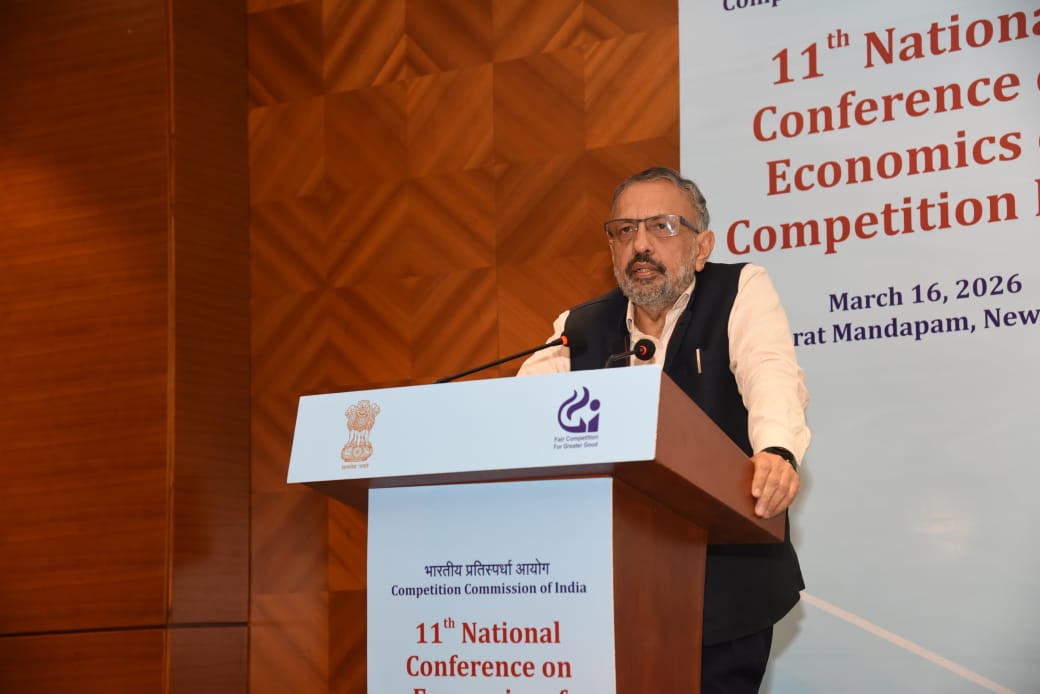
Shri Rajiv Gauba, Member, NITI Aayog delivers the Keynote address at the CCI Conference

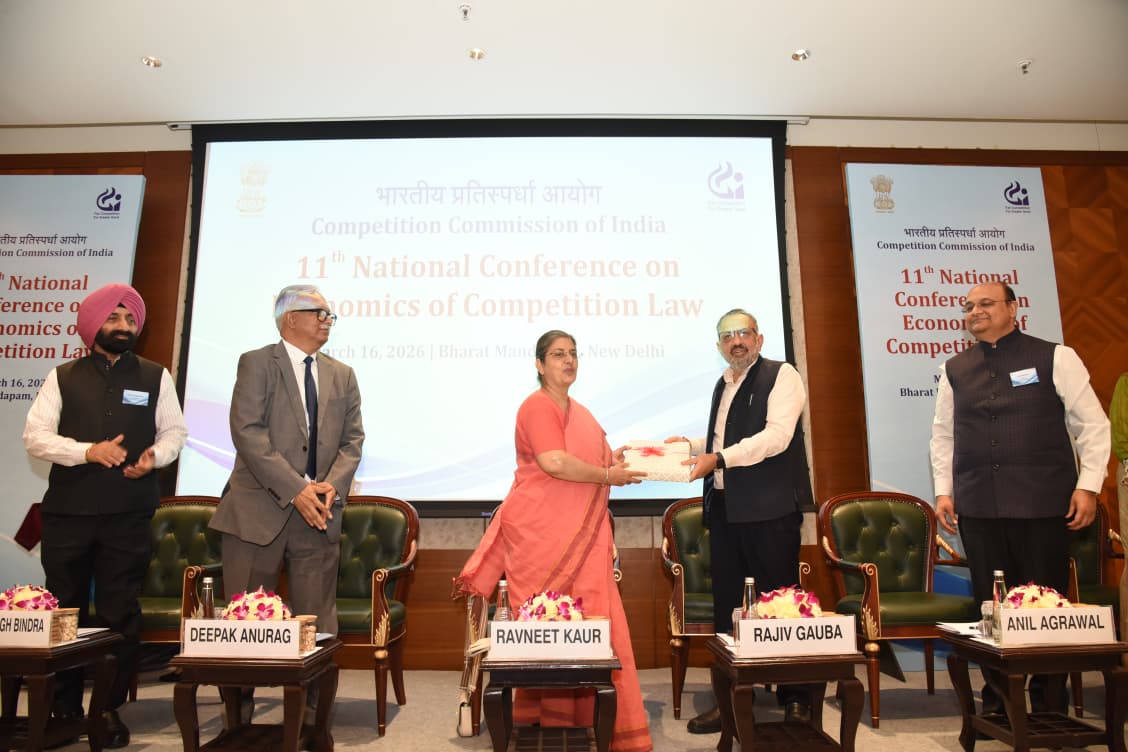
The Competition Commission of India (CCI) organised the 11th National Conference on Economics of Competition Law in New Delhi today. Shri Rajiv Gauba, Member, NITI Aayog was the Keynote Speaker at the Conference, while Smt. Ravneet Kaur, Chairperson, CCI delivered the Special Address at the Inaugural Session of the Conference.

The Conference, which brings together scholars, practitioners, and experts working in the area of economics of competition law, has been organised by the CCI every year since 2016.

Shri Rajiv Gauba, Hon'ble Member, NITI Aayog, in his Keynote Address referred to competition as one of the most potent engines of human progress. Left to their own devices without robust policy and oversight, markets can breed concentration, collusion and exclusion, he said.
He added that well designed competition laws create moral architecture of markets. He noted that in an emerging economy like India, competition law and regulations serve multiple development and governance goals, by preventing entrenched monopolies, promoting open entry and opportunities for small businesses and by helping integrate the economy into global value chains.

Tracing the evolution of the competition paradigm in India in the context of the structural transformation that the Indian economy underwent over decades post-independence, he underscored the importance of optimal regulation through actions and forbearance, to benefit from the invigorating push of competition.
Referring to the Prime Minister's vision of Viksit Bharat 2047, he said that it would entail ensuring markets are truly competitive, both domestically and globally. In this context, he highlighted four institutional pillars for well-functioning markets, viz.,  contestability - firms must be able to enter and exit without prohibitive regulatory or practical obstacles; information symmetry - buyers, sellers and regulators need timely access to reliable market data so that choices are meaningful and markets are receptive; non-discriminatory access to all infrastructure including physical, digital & financial infrastructure; and independent and predictable dispute resolution and enforcement institutions.

Referring to the rise of digital economy as a structural break in market dynamics and given the features of digital economy that create winner-takes-most scenarios, he commended the Competition Commission of India for establishing a dedicated Digital Markets Division.

Shri Gauba stated that India is aligning its regulatory posture with global peers with the aim to ensure that the Digital Highway remains open to all, not just the few who built the road. With the emergence of the new frontier of AI, he stressed on the need for our competition toolkit to evolve to address the novel risks posed by AI. “We must guard against ecosystem entrenchment and ensure data portability and interoperability,” he added. 

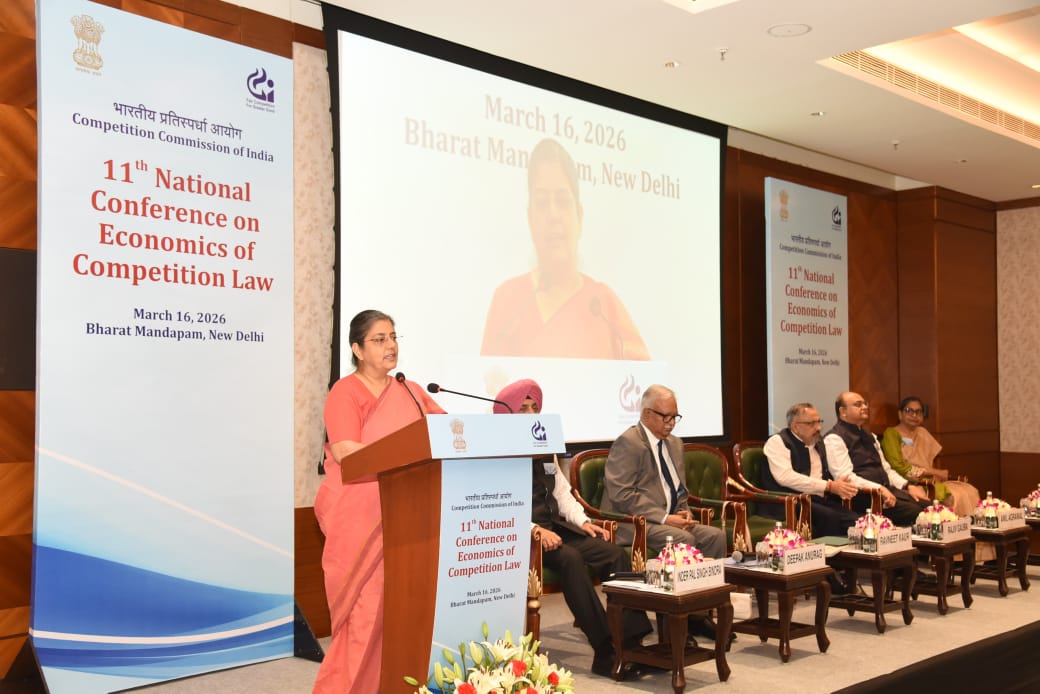
Smt. Ravneet Kaur, Chairperson, CCI, in her Special Address, highlighted that the Competition Act is an interdisciplinary Act with economic principles embedded in it. Economics is therefore placed at the centre of Commission’ work and the Commission’s analysis and decisions are based on rigorous economic analysis in order to establish any potential appreciable adverse effects on competition. The aim is to ensure that competition and business success is based on merit and not on exclusionary, exploitative or anti-competitive conduct.

Chairperson, CCI highlighted that over the course of the last year, CCI has notified and implemented all regulations for operationalising the 2023 amendment to the Competition Act, 2023. She said, in 2025, a revised regulation on cost of production was brought in with a view to provide a consistent and transparent framework on determination of predatory pricing.

Referring to the first settlement proposal in the Android Smart TV ecosystem processed by the CCI in 2025, she highlighted that settlement mechanism allows to enforce quick market correction while closing the chapter for further litigation.
She further mentioned that the Commission throughout the past one year has dealt with antitrust matters across various sectors including cartelisation and bid rigging cases in the sectors of defence procurement, liquor and solid waste management. During the past one year, based on the Informations and investigations undertaken, matters were decided across multiple sectors, leading to cease and desist orders, penalties and other suitable remedies.

On the combinations front, the Commission has followed a proactive and systematic consistent approach with a disposal rate of more than 99%. The Commission’s approach has been positive and solution oriented, she added

Referring to the CCI market study on AI and competition completed in October 2025, Chairperson CCI said that there are huge benefits of AI, including efficiency gains, greater market access for MSMEs, but the potential anti-competitive actions also need to be watched.

She mentioned that CCI has issued a guidance note which provides self-audit mechanism by the stakeholders, by the boards, management and the decision makers in the organisations as to how they can ensure that at the stage of development, deployment, monitoring of AI applications, there are not any hidden anti-competitive outcomes which may be happening.

Shri Deepak Anurag, Member, CCI made the welcome remarks and Shri Anil Agrawal, Member, CCI proposed the vote of thanks during the Inaugural Session.

The Conference, in addition to the Inaugural Session, featured two technical sessions on ‘Competition and Firm Conduct: Evidence and Policy Implications’ and ‘Ownership, Market Power, and Consumer Welfare’, where researchers presented papers on the economics of competition law. The first session was chaired by Dr. Saptarshi Mukherjee, Professor, Humanities and Social Science, IIT Delhi. Dr. Biswajit Dhar, Vice President, Council for Social Development, chaired the second session.

The National Conference concluded with a Plenary Session on ‘Competition and AI: Technical Developments, Regulatory Experience, and Business Impact’ which was chaired by Ms. Sweta Kakkad, Member, CCI, and moderated by Ms. Shweta Rajpal Kohli, President and CEO, Startup Policy Forum.

Topics

Acts Income Tax
