

Loading...

Top
Help
×

By creating an account you can:

Logo TaxTMI
Call Us / Help / Feedback

Contact Us At :

E-mail: [email protected]

Call / WhatsApp at: +91 99117 96707

For more information, Check Contact Us

FAQs :

To know Frequently Asked Questions, Check FAQs

Most Asked Video Tutorials :

For more tutorials, Check Video Tutorials

Submit Feedback/Suggestion :

Email :
Please provide your email address so we can follow up on your feedback.
Category :
Description :
Min 15 characters 0/2000
Make Most of Text Search
  1. Checkout this video tutorial: How to search effectively on TaxTMI.
  2. Put words in double quotes for exact word search, eg: "income tax"
  3. Avoid noise words such as : 'and, of, the, a'
  4. Sort by Relevance to get the most relevant document.
  5. Press Enter to add multiple terms/multiple phrases, and then click on Search to Search.
  6. Text Search
  7. The system will try to fetch results that contains ALL your words.
  8. Once you add keywords, you'll see a new 'Search In' filter that makes your results even more precise.
  9. Text Search
Add to...
You have not created any category. Kindly create one to bookmark this item!
Create New Category
Hide
Title :
Description :
❮❮ Hide
Default View
Expand ❯❯
Close ✕
🔎 News - Adv. Search
TEXT SEARCH:

Press 'Enter' to add multiple search terms. Rules for Better Search

Search In:
Main Text + AI Text
  • Main Text
  • Main Text + AI Text
  • AI Text
Category: ?
Categorized by AI
---- All Categories ----
  • ---- All Categories ----
  • Income Tax
  • GST
  • Customs, DGFT & SEZ
  • FEMA & RBI
  • Corp. Laws, SEBI & IBC
  • PMLA, Black Money & ED
  • Budget
  • News and Press Release
  • PTI News
Month:
---- All Months ----
  • ---- All Months ----
  • January
  • February
  • March
  • April
  • May
  • June
  • July
  • August
  • September
  • October
  • November
  • December
Year:
---- All Years ----
  • ---- All Years ----
  • 2026
  • 2025
  • 2024
  • 2023
  • 2022
  • 2021
  • 2020
  • 2019
  • 2018
  • 2017
  • 2016
  • 2015
  • 2014
  • 2013
  • 2012
  • 2011
Sort By: ?
In Sort By 'Default', exact matches for text search are shown at the top, followed by the remaining results in their regular order.
Relevance Default Date
❯❯
Maximize Maximize Maximize
0 / 200
Expand Note
Add to Folder

No Folders have been created

+

Are you sure you want to delete "My most important" ?

NOTE:

News
Showing Results for :
Reset Filters
Results Found:
Show All Summaries Hide All Summaries
April 4, 2026
Show AI Summary
Approval for issue of eligible capital under Schedule XV depends on Form 189 details, disclosures, and supporting documents.
Form 189 is the application for approval of issue of public companies under Schedule XV(1)(z)(i) of the Income-tax Act, 2025, and is filed by the public company three months before the issue of eligible capital. The form requires company particulars, management details, bankers and auditors, issue details, project details, and supporting documents such as incorporation certificate, audited financial statements, equity details, SEBI approval and any project report. Processed Form 189 leads to approval for issue of eligible capital on the basis of the details furnished.
April 4, 2026
Show AI Summary
Public company issue approval through Form 189 governs eligible capital issues and related deduction eligibility.
Form 189 is the prescribed application for approval of issue of public companies under Schedule XV(1)(z)(i) of the Income-tax Act, 2025. It is filed by the public company with supporting documents before the issue of eligible capital, and the approval is granted on the basis of the details furnished in the form. Individual contributions to the issue are stated to qualify for deduction under the Act.
April 4, 2026
Show AI Summary
Consolidated approval form standardises gratuity and superannuation fund compliance, replacing rule-based particulars with structured filing.
Introduction of consolidated Form 188 standardises the approval process for Gratuity Fund and Superannuation Fund applications under Part B of Schedule XI by replacing the earlier text-based particulars in Rule 95 and Rule 109. The form is filed by trustees or an authorised person only for initial approval, and it requires details of the employer, the fund, eligible employees, account maintenance, fund status, trustee verification, and supporting documents such as the trust deed, fund rules, and accounts where applicable.
April 4, 2026
Show AI Summary
Approval mechanism for gratuity and superannuation funds is standardised through Form 188 with structured compliance requirements.
Form 188 provides a standardised application mechanism for approval of Gratuity Funds and Superannuation Funds, replacing earlier rule-based procedural requirements. It is filed once by the trustees or an authorised person, with prescribed particulars and supporting documents such as the trust deed, fund rules, accounts, and balance sheet where applicable. The application is examined by the jurisdictional authority, which may seek clarifications and then grant approval, issue deficiency notice, or reject the application.
April 4, 2026
Show AI Summary
Appeal against fund recognition refusal uses Form 187, with supporting documents and filing within 60 days.
Appeal against refusal to recognise or withdrawal of recognition from a recognised provident fund, and refusal to approve or withdrawal of approval from a superannuation fund or gratuity fund, is filed in Form 187 by the employer, trustee, or authorised representative within 60 days of communication of the order. The form requires appellant particulars, fund details, grounds of appeal, verification, and supporting documents such as the impugned order, original application, proof of filing, authorisation, and fee challan.
April 4, 2026
Show AI Summary
Appeals for provident, superannuation and gratuity funds require Form 187, supporting documents and filing within 60 days.
Form 187 prescribes the appellate mechanism under the Income-tax Act, 2025 for matters concerning recognised provident funds, superannuation funds and approved gratuity funds, including appeals against orders affecting recognition, approval, withdrawal, cancellation or refusal of such status. The form is to be used by trustees, employers or other authorised persons representing the fund where an adverse order has been passed by the competent income-tax authority. Appeals must be filed within 60 days from communication of the order, and filing does not by itself operate as a stay unless specifically granted.
April 4, 2026
Show AI Summary
Customs enforcement along the India-Nepal border led to seizure of undocumented soft drinks and air conditioners.
Customs enforcement along the India-Nepal border led to seizure of soft drinks and air conditioners being moved without valid customs documents. A vehicle carrying 1,575 bottles of soft drinks was intercepted after the driver tried to flee, while two split air conditioners transported on bicycles were also recovered in a separate patrol operation. The goods, vehicle and bicycles were handed over to the Customs Department.
April 4, 2026
Show AI Summary
Indian pharmaceutical exports show sustained growth as formulations, biologicals, vaccines and Ayush products drive resilience.
Indian pharmaceutical exports recorded sustained growth in FY26, reaching nearly USD 29 billion by the end of February and increasing over the corresponding period in the previous financial year. The export performance was led by formulations, biologicals, vaccines and Ayush products, and was described as resilient despite global challenges, pricing pressures and trade volatility. The sector's overall value was placed at about USD 60 billion, with projected expansion to USD 130 billion by 2030.
April 4, 2026
Show AI Summary
Recognised Provident Fund recognition process requires trust deed compliance, supporting documents, scrutiny and ongoing investment and reporting obligations.
Application under Rule 40C seeks recognition of a provident fund so it qualifies as a Recognised Provident Fund for income-tax purposes. It applies to employers, trustees and existing funds seeking recognition on formation, conversion, amendment, merger or split. The form requires trust deed details, fund rules, investment policy, financial information and supporting documents, followed by scrutiny, possible revisions, issuance of recognition and ongoing compliance with investment, audit and reporting requirements.
April 4, 2026
Show AI Summary
Recognised Provident Fund recognition through Form 186 depends on disclosure, supporting documents, and compliance with trust conditions.
Form 186 is the prescribed application for seeking recognition of a provident fund as a Recognised Provident Fund for income-tax purposes. It is filed by the employer, trustees, or an existing trust seeking recognition, and is ordinarily a one-time application subject to refiling or intimation for material changes in the trust deed or fund rules. The form requires detailed disclosures and supporting documents, and on approval the fund attains RPF status with tax treatment governed by applicable statutory limits and conditions. Recognition may later be withdrawn for non-compliance.
April 4, 2026
Show AI Summary
Recognised provident fund accounting in Form 185 requires annual subscriber-wise records of contributions, interest, withdrawals, and balances.
Rule 294 requires recognised provident fund accounts to be prepared at intervals not exceeding twelve months, with a separate account maintained for each subscriber in Form 185. The form is maintained internally by the provident fund trust or authorised officers, and records subscriber particulars, opening balance, monthly contributions, interest, withdrawals or advances, closing balance, and verification. Part A is maintained separately for each subscriber, while Part B presents the same information in consolidated annual subscriber-wise form.
April 4, 2026
Show AI Summary
Recognised Provident Fund recordkeeping requires Form 185 to track contributions, interest, withdrawals, and annual balances.
Form No. 185 is the prescribed accounting format for individual subscriber records under a Recognised Provident Fund, maintained by trustees or authorised officers under the Income-tax Rules. It records annual subscriber-wise particulars such as contributions, interest credited, withdrawals or advances, opening and closing balances, and verification details. Part-A is kept for each subscriber, while Part-B is the annual consolidated abstract filed with the Assessing Officer.
April 4, 2026
Show AI Summary
Deduction audit report for petroleum and natural gas businesses requires deposit verification, withdrawal checks, and Chartered Accountant certification.
Form No. 183 is the prescribed audit report for claiming deduction under section 49 in the business of prospecting, extracting, or producing petroleum, natural gas, or both in India. It is furnished by a Chartered Accountant and verifies audit of the relevant books, timely deposit into the specified account, permitted use of withdrawals, disallowance of inadmissible expenditure, and transfer restrictions on assets acquired under the scheme. The form is filed annually before the return due date and requires supporting records of books, deposits, withdrawals, and asset transfers.
April 4, 2026
Show AI Summary
Supply chain disruption hits Bikaner snack exports as conflict delays shipments and raises freight and input costs.
West Asia conflict has disrupted Bikaner exports and imports, causing delays in shipments of bhujia, papad, namkeen and spices to Gulf and European markets. Traders report longer transit routes, container shortages, higher freight charges, rising raw material and packaging costs, and consignments stuck at ports or in transit, affecting the city's export-driven economy.
April 4, 2026
Show AI Summary
Audit report for petroleum and natural gas deduction claims requires certification, supporting records, and online filing compliance.
Form No. 183 is the prescribed audit report under Rule 291 read with Section 49 of the Income-tax Act, 2025 for an assessee engaged in the business of prospecting, extracting, or producing petroleum, natural gas, or both in India. It is mandatory where the deduction is claimed and must be certified by an Accountant. The form requires supporting books, financial statements, evidence of deposits and withdrawals from the specified account, and a computation showing that the deduction remains within the permissible limit.
April 4, 2026
Show AI Summary
Deduction claim audit report for tea, coffee and rubber businesses requires Chartered Accountant certification and compliance with deposit rules.
Form No. 182 is a statutory audit report for assessees engaged in growing and manufacturing tea, coffee or rubber who claim deduction under section 48. It must be furnished by a Chartered Accountant annually before the return due date and certifies audit of books, timely deposit in the specified account or approved scheme, withdrawal utilisation, disallowable amounts, asset transfers, and the deduction permissible. The form is now a smart, tabulated e-form with mandatory professional identifiers and standardised fields for e-filing and validation.
April 4, 2026
Show AI Summary
Tax deduction audit report rules require prescribed certification, verified deposits, and portal filing for tea, coffee and rubber businesses.
Form No. 182 is the prescribed audit report for assessees engaged in growing and manufacturing tea, coffee or rubber in India who claim deduction under section 48. It must be certified by an Accountant and furnished annually before the return due date. The report is mandatory for the deduction claim, supports verification of deposits, withdrawals, utilisation and deduction computation, and is completed through the e-filing portal with digital signing and assessee acceptance.
April 4, 2026
Show AI Summary
Electoral trust audit reporting through Form 181 requires electronic disclosure of contributions, distributions, and administration expenses.
Form 181 is the annual audit report for electoral trusts, to be furnished electronically by an accountant through the e-filing portal before the return due date. It requires disclosure of voluntary contributions received and distributed, application for the benefit of persons or interested persons, and expenditure on administration or management of the trust. The form has been simplified and aligned with the Income-tax Act, 2025.
April 4, 2026
Show AI Summary
Digital audit report requirements govern electoral trusts claiming exclusion of voluntary contributions from total income.
FN 181 is a mandatory digital audit report for an electoral trust seeking exclusion of reported voluntary contributions from total income. It must be prepared by an accountant, filed electronically with the Commissioner of Income Tax (CPC) through the e-filing portal, and submitted on or before the due date for filing the return of income. The form cannot be filed offline or edited after submission, and a valid PAN is mandatory for filing.
April 4, 2026
Show AI Summary
Employee welfare fund approval under income tax rules depends on notified purposes, verified disclosure, and hearing before rejection.
Form 180 is the electronic application for approval or renewal of an employee welfare fund established for notified purposes under section 11(3) read with Schedule VII, to be filed by the trust or fund before the jurisdictional PCIT/CIT and verified by the trustee or principal officer. The form requires details of the trust or fund, employer organisation, objects, trustees, employee membership, contributions, income, application or accumulation of funds, along with the trust deed, activity notes and accounts. Approval is granted only if the prescribed conditions are satisfied, for a period not exceeding three tax years, and rejection requires recorded reasons and an opportunity of hearing.

News

Back

All News

Showing Results for :
Reset Filters
No Records Found

News

Back

All News

Showing Results for : Reset Filters
Corp. Laws, SEBI & IBC

CCI Organises 11th Edition of National Conference on Economics of Competition Law

March 17, 2026

Contents
Summary
Note

Note

-

Bookmark

Print

Print

Shri Rajiv Gauba, Member, NITI Aayog delivers the Keynote address at the CCI Conference

The Competition Commission of India (CCI) organised the 11th National Conference on Economics of Competition Law in New Delhi today. Shri Rajiv Gauba, Member, NITI Aayog was the Keynote Speaker at the Conference, while Smt. Ravneet Kaur, Chairperson, CCI delivered the Special Address at the Inaugural Session of the Conference.

The Conference, which brings together scholars, practitioners, and experts working in the area of economics of competition law, has been organised by the CCI every year since 2016.

Shri Rajiv Gauba, Hon'ble Member, NITI Aayog, in his Keynote Address referred to competition as one of the most potent engines of human progress. Left to their own devices without robust policy and oversight, markets can breed concentration, collusion and exclusion, he said.
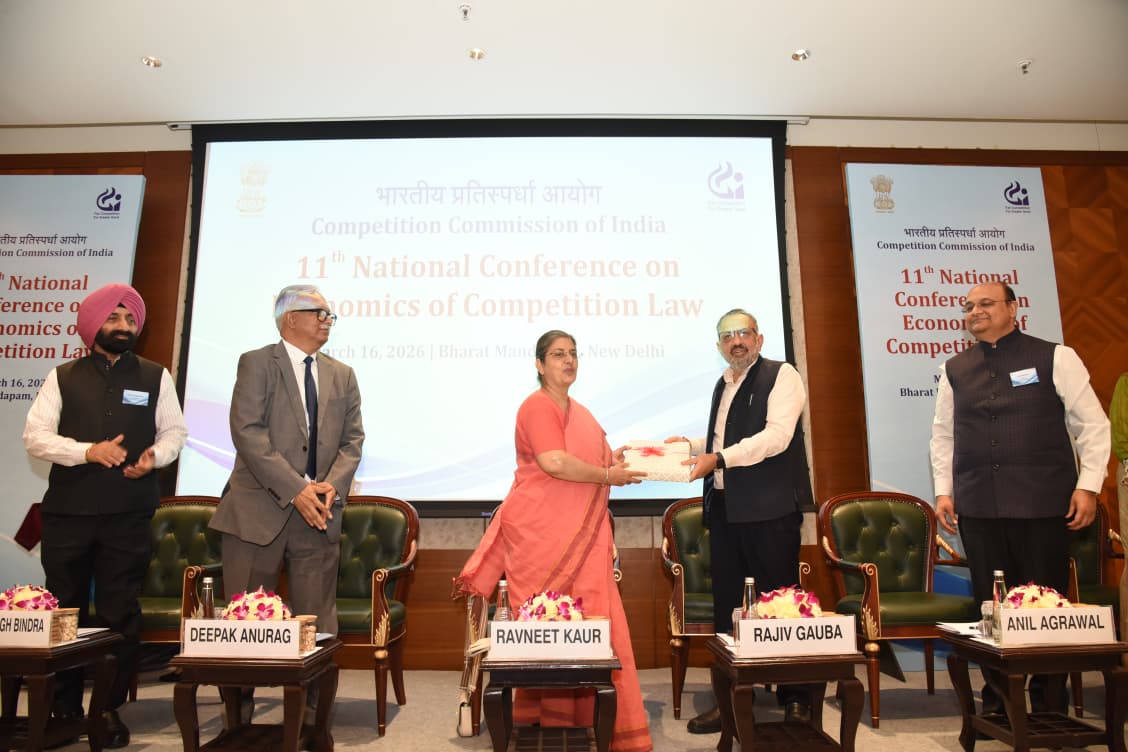
He added that well designed competition laws create moral architecture of markets. He noted that in an emerging economy like India, competition law and regulations serve multiple development and governance goals, by preventing entrenched monopolies, promoting open entry and opportunities for small businesses and by helping integrate the economy into global value chains.

Tracing the evolution of the competition paradigm in India in the context of the structural transformation that the Indian economy underwent over decades post-independence, he underscored the importance of optimal regulation through actions and forbearance, to benefit from the invigorating push of competition.
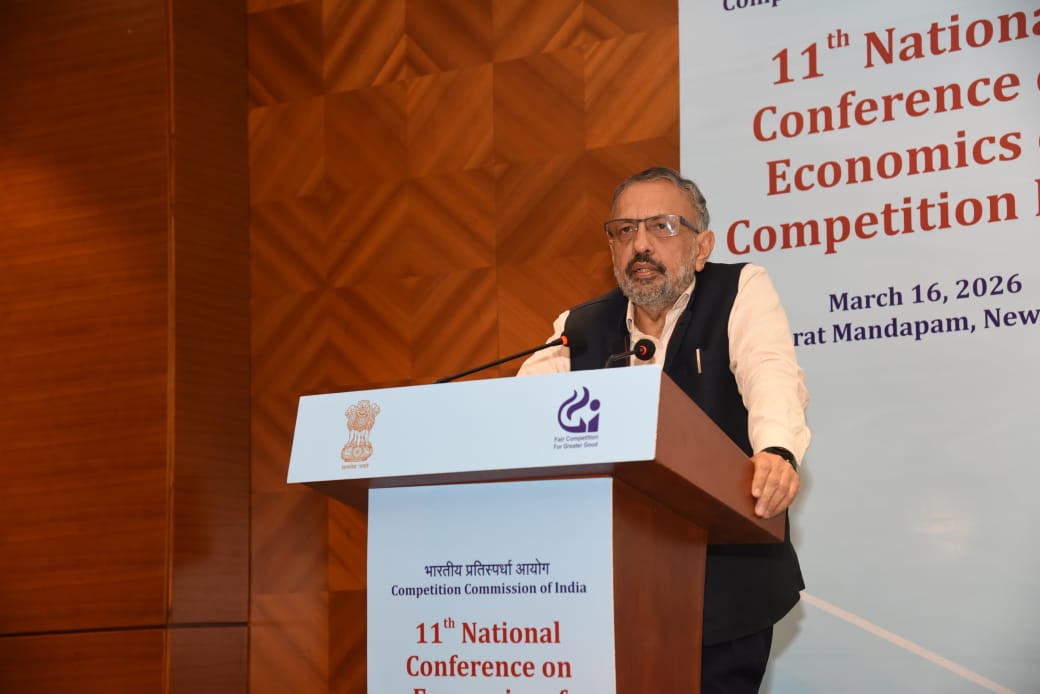
Referring to the Prime Minister's vision of Viksit Bharat 2047, he said that it would entail ensuring markets are truly competitive, both domestically and globally. In this context, he highlighted four institutional pillars for well-functioning markets, viz.,  contestability - firms must be able to enter and exit without prohibitive regulatory or practical obstacles; information symmetry - buyers, sellers and regulators need timely access to reliable market data so that choices are meaningful and markets are receptive; non-discriminatory access to all infrastructure including physical, digital & financial infrastructure; and independent and predictable dispute resolution and enforcement institutions.

Referring to the rise of digital economy as a structural break in market dynamics and given the features of digital economy that create winner-takes-most scenarios, he commended the Competition Commission of India for establishing a dedicated Digital Markets Division.

Shri Gauba stated that India is aligning its regulatory posture with global peers with the aim to ensure that the Digital Highway remains open to all, not just the few who built the road. With the emergence of the new frontier of AI, he stressed on the need for our competition toolkit to evolve to address the novel risks posed by AI. “We must guard against ecosystem entrenchment and ensure data portability and interoperability,” he added. 

Smt. Ravneet Kaur, Chairperson, CCI, in her Special Address, highlighted that the Competition Act is an interdisciplinary Act with economic principles embedded in it. Economics is therefore placed at the centre of Commission’ work and the Commission’s analysis and decisions are based on rigorous economic analysis in order to establish any potential appreciable adverse effects on competition. The aim is to ensure that competition and business success is based on merit and not on exclusionary, exploitative or anti-competitive conduct.

Chairperson, CCI highlighted that over the course of the last year, CCI has notified and implemented all regulations for operationalising the 2023 amendment to the Competition Act, 2023. She said, in 2025, a revised regulation on cost of production was brought in with a view to provide a consistent and transparent framework on determination of predatory pricing.

Referring to the first settlement proposal in the Android Smart TV ecosystem processed by the CCI in 2025, she highlighted that settlement mechanism allows to enforce quick market correction while closing the chapter for further litigation.
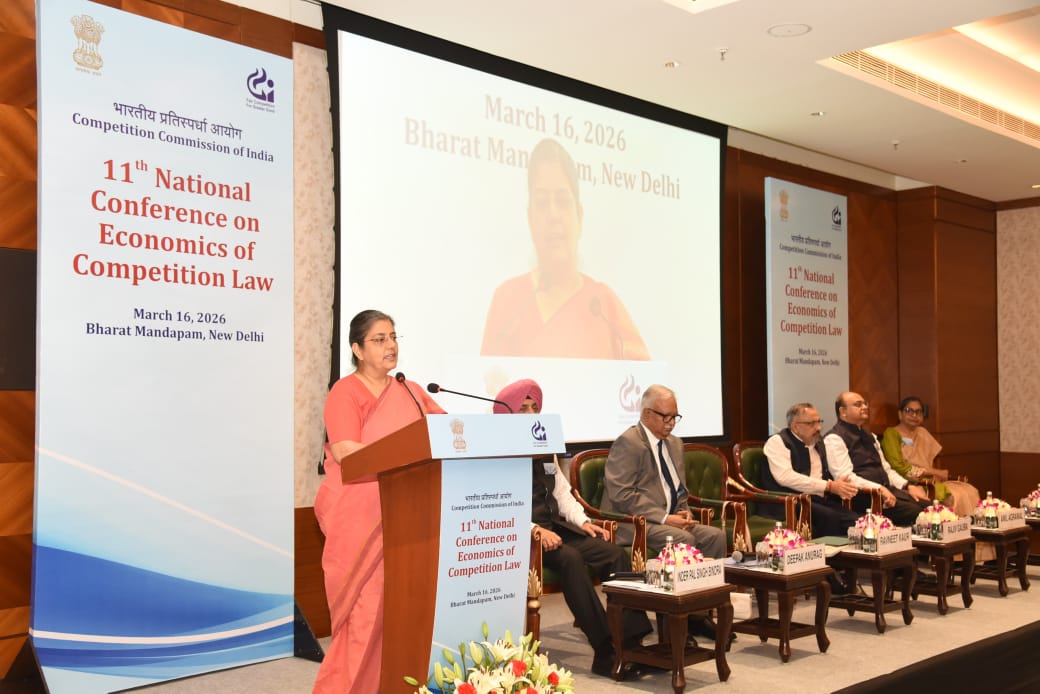
She further mentioned that the Commission throughout the past one year has dealt with antitrust matters across various sectors including cartelisation and bid rigging cases in the sectors of defence procurement, liquor and solid waste management. During the past one year, based on the Informations and investigations undertaken, matters were decided across multiple sectors, leading to cease and desist orders, penalties and other suitable remedies.

On the combinations front, the Commission has followed a proactive and systematic consistent approach with a disposal rate of more than 99%. The Commission’s approach has been positive and solution oriented, she added

Referring to the CCI market study on AI and competition completed in October 2025, Chairperson CCI said that there are huge benefits of AI, including efficiency gains, greater market access for MSMEs, but the potential anti-competitive actions also need to be watched.

She mentioned that CCI has issued a guidance note which provides self-audit mechanism by the stakeholders, by the boards, management and the decision makers in the organisations as to how they can ensure that at the stage of development, deployment, monitoring of AI applications, there are not any hidden anti-competitive outcomes which may be happening.

Shri Deepak Anurag, Member, CCI made the welcome remarks and Shri Anil Agrawal, Member, CCI proposed the vote of thanks during the Inaugural Session.

The Conference, in addition to the Inaugural Session, featured two technical sessions on ‘Competition and Firm Conduct: Evidence and Policy Implications’ and ‘Ownership, Market Power, and Consumer Welfare’, where researchers presented papers on the economics of competition law. The first session was chaired by Dr. Saptarshi Mukherjee, Professor, Humanities and Social Science, IIT Delhi. Dr. Biswajit Dhar, Vice President, Council for Social Development, chaired the second session.

The National Conference concluded with a Plenary Session on ‘Competition and AI: Technical Developments, Regulatory Experience, and Business Impact’ which was chaired by Ms. Sweta Kakkad, Member, CCI, and moderated by Ms. Shweta Rajpal Kohli, President and CEO, Startup Policy Forum.

Topics

Acts Income Tax