

Loading...

Top
Help
×

By creating an account you can:

Logo TaxTMI
Call Us / Help / Feedback

Contact Us At :

E-mail: [email protected]

Call / WhatsApp at: +91 99117 96707

For more information, Check Contact Us

FAQs :

To know Frequently Asked Questions, Check FAQs

Most Asked Video Tutorials :

For more tutorials, Check Video Tutorials

Submit Feedback/Suggestion :

Email :
Please provide your email address so we can follow up on your feedback.
Category :
Description :
Min 15 characters 0/2000
Make Most of Text Search
  1. Checkout this video tutorial: How to search effectively on TaxTMI.
  2. Put words in double quotes for exact word search, eg: "income tax"
  3. Avoid noise words such as : 'and, of, the, a'
  4. Sort by Relevance to get the most relevant document.
  5. Press Enter to add multiple terms/multiple phrases, and then click on Search to Search.
  6. Text Search
  7. The system will try to fetch results that contains ALL your words.
  8. Once you add keywords, you'll see a new 'Search In' filter that makes your results even more precise.
  9. Text Search
Add to...
You have not created any category. Kindly create one to bookmark this item!
Create New Category
Hide
Title :
Description :
❮❮ Hide
Default View
Expand ❯❯
Close ✕
🔎 News - Adv. Search
TEXT SEARCH:

Press 'Enter' to add multiple search terms. Rules for Better Search

Search In:
Main Text + AI Text
  • Main Text
  • Main Text + AI Text
  • AI Text
Category: ?
Categorized by AI
---- All Categories ----
  • ---- All Categories ----
  • Income Tax
  • GST
  • Customs, DGFT & SEZ
  • FEMA & RBI
  • Corp. Laws, SEBI & IBC
  • PMLA, Black Money & ED
  • Budget
  • News and Press Release
  • PTI News
Month:
---- All Months ----
  • ---- All Months ----
  • January
  • February
  • March
  • April
  • May
  • June
  • July
  • August
  • September
  • October
  • November
  • December
Year:
---- All Years ----
  • ---- All Years ----
  • 2026
  • 2025
  • 2024
  • 2023
  • 2022
  • 2021
  • 2020
  • 2019
  • 2018
  • 2017
  • 2016
  • 2015
  • 2014
  • 2013
  • 2012
  • 2011
Sort By: ?
In Sort By 'Default', exact matches for text search are shown at the top, followed by the remaining results in their regular order.
Relevance Default Date
    President Trump wants to impose 15 pc tariff, up from 10 pc he announced after Supreme Court decision
    Modi, Lula discuss US supreme court striking down reciprocal tariffs; set USD 30 bn annual trade target
    Global leaders, businesses pore over fallout of more US tariff swoons
    MP Congress targets Chouhan over Indo-US deal
    India now faces 10 pc tariffs in US for 150 days; govt says studying implications
    Working to expand preferential trade agreement with Mercosur bloc: Piyush Goyal
    Put India-US trade deal on hold, renegotiate terms: Congress
    Trade deal with US compromises India's interests in agriculture sector; farmers to suffer: Kejriwal
    Pharma exports up 9.4 pc in FY25; industry aims for double-digit expansion in 2026-27
    Vikas Coal and Minerals wins bid to operate Jalna dry port
    Indian govt weighs impact of US Supreme Court tariff ruling: Comm Min
    Govt studying developments on US tariff: Commerce min
    Best Crypto To Buy Now: DeepSnitch AI Teases Working AI Dashboard, Strengthening the Community’s 100x Bets, BNB and XRP Log Small Recoveries
    Facility for Withdrawal from Rule 14A
    India-US tariffs after Supreme Court verdict: An explainer
    Directorate General of Commercial Intelligence and Statistics Revises Base Year of Merchandise Trade Indices to FY 2022–23 to Reflect Current Trade ...
    MoSPI to Convene National Level Consultative Workshop on "Using Administrative Data for Governance: Harmonizing Departmental Data at State Level" on 2...
    Congress claims US trade deal has become an 'ordeal', Rahul says 'PM compromised'
    Murky outlook for businesses after tariff ruling prompts countermoves by Trump
❯❯
Maximize Maximize Maximize
0 / 200
Expand Note
Add to Folder

No Folders have been created

+

Are you sure you want to delete "My most important" ?

NOTE:

News
Showing Results for :
Reset Filters
Results Found:
Show All Summaries Hide All Summaries
February 21, 2026
Show AI Summary
Presidential tariff authority contested; executive order raises global import tariff after review of recent legal limitation.
After a judicial ruling that his emergency powers did not authorize sweeping tariffs, the President signed an executive order bypassing Congress to impose a temporary global import tax limited to 150 days unless extended by legislation; following review of the court decision he announced an upward adjustment to the proposed global tariff rate.
February 21, 2026
Show AI Summary
Reciprocal tariffs: leaders agree to study implications and adopt a wait-and-watch approach while boosting strategic trade ties.
Discussion focused on the trade-policy implications of a major US decision affecting reciprocal tariffs, with both leaders adopting a "wait-and-watch" posture to study potential US administrative responses. Parallel measures included a pact on critical minerals to build resilient supply chains, a joint digital partnership declaration, and multiple MoUs covering mining, MSMEs, healthcare, defence maintenance cooperation, and technology and energy collaboration.
February 21, 2026
Show AI Summary
Tariff invalidation prompts review of affected duties, potential refund claims, and continued uncertainty from proposed new tariff measures.
Invalidation of certain executive-era import duties removes the legal basis for specified tariff measures and creates potential refund claims by importers and foreign suppliers, while other tariffs tied to distinct statutory or product-specific authorities remain in force. Governments and businesses must distinguish between invalidated and continuing duties when reviewing compliance, pursuing restitution, and adapting contractual and supply chain plans amid the added uncertainty of proposed new tariff measures under alternative rules.
February 21, 2026
Show AI Summary
Trade agreement criticised as threatening farmers' livelihoods and spurring nationwide farmer protests and political agitation.
The state Congress contends the interim Indo US trade agreement will expose Indian farmers to damaging import competition-particularly in soybean and cotton-depress domestic prices, threaten small traders and related industries, and amount to a surrender of national agricultural interests. It has announced coordinated protests and gatherings (Kisan Sammelans, chaupals, marches) in Bhopal, Budhni and Vidisha, blaming the Union Agriculture Minister for failing to defend farmers and urging mobilisation to protect rural livelihoods.
February 21, 2026
Show AI Summary
Temporary import surcharge alters global trade rules, reshaping US-India tariff calculus and prompting reassessment of bilateral negotiations.
A temporary import surcharge has been proclaimed under Section 122 of the Trade Act of 1974 as a time limited global ad valorem levy effective February 24, operating in addition to existing MFN and import duties and excluding specified products. The measure alters the tariff calculus for India by reducing the immediate reciprocal tariff burden relative to prior higher levies while creating uncertainty about post period tariffs; the Indian government is studying implications as bilateral trade talks continue and stakeholders call for renegotiation and sectoral protections.
February 21, 2026
Show AI Summary
Preferential trade agreement expansion aims to broaden tariff coverage and deepen investment, technology and critical minerals cooperation India Mercosur
Expansion of the India Mercosur preferential trade agreement aims to convert a limited pact covering 450 tariff lines into a full agreement to improve market access, grow bilateral investment and foster technology partnerships. The parties set an enhanced annual trade target and signed a cooperation pact on critical minerals to support downstream processing and collaboration. Priority sectors include defense, energy and renewables, agri and agrochemicals, health and pharma, aerospace, automotive, semiconductors and digital technology, alongside measures to attract investment and ease business through visa facilitation and domestic reforms.
February 21, 2026
Show AI Summary
Trade Agreement Suspension: call to halt and renegotiate interim India-US deal to protect farmers after US tariff invalidation.
The article demands suspension and renegotiation of the interim India-US trade framework to protect farmers, asserting the Framework cannot be implemented following judicial invalidation of presidential tariff powers and the administration's subsequent reliance on alternative tariff measures; it requires the government to commit to no import liberalisation on agricultural products, to review the agreement's haste and sustainability, and to safeguard non tariff protections and domestic livelihoods pending clarifications.
February 21, 2026
Show AI Summary
Trade tariff changes threaten agricultural export competitiveness and expose domestic farmers to cheaper foreign imports.
An interim trade agreement reduces previously higher reciprocal US duties on Indian imports to a lower tariff level while lowering or eliminating duties on certain US agricultural imports into India, a realignment presented as likely to raise prices of Indian farm exports in the US and to increase competitiveness of US products domestically, threatening export opportunities for maize, soybean, dairy, peanut and cotton producers and exposing domestic farmers to cheaper US imports.
February 21, 2026
Show AI Summary
Pharma exports: government and industry focus on market access and trade engagement to boost competitiveness and growth.
The commerce ministry and industry discussed measures to sustain and accelerate pharmaceutical exports, focusing on enabling conditions, resolving trade bottlenecks, and coordinated engagement with exporters, regulators, and Indian Missions. Strategic trade engagements with major partners were identified to improve market access, competitiveness, and regulatory compliance, supporting industry aims for double-digit expansion.
February 21, 2026
Show AI Summary
Customs port status enables Jalna dry port to commence import-export operations after award of long-term operating mandate.
The National Highway Authority accepted Vikas Coal and Minerals Pvt. Ltd.'s bid to operate the Jalna Dry Port under a long-term operating mandate, subject to completion of administrative approvals and bank guarantee formalities; the operator will pay an annual, turnover-based fee. The facility has received customs port status, enabling import-export and customs processing, and essential infrastructure including a cargo terminal and a dedicated rail connection is operational, supporting imminent commencement of operations.
February 21, 2026
Show AI Summary
Presidential tariff authority curtailed; temporary import surcharge imposed alters bilateral tariff treatment and prompts trade talks.
Presidential tariff authority was found to have been exceeded when broad import levies were imposed; an executive proclamation subsequently announced a temporary import surcharge that modifies effective tariffs and operates in addition to existing MFN or import duties, prompting review of legal and commercial consequences and informing ongoing bilateral trade negotiations.
February 21, 2026
Show AI Summary
Tariff ruling prompts government review of international trade measures and potential policy implications for exporters and customs operations.
The government is assessing recent developments on US tariff measures after a judicial decision and an executive statement, and is studying announced administrative steps to evaluate implications for trade policy, tariff administration, and customs procedures.
February 21, 2026
Show AI Summary
Global tariffs may trigger market sell-offs, increasing interest in presale crypto assets with perceived volatility protection.
Announcement of renewed global tariffs and the Supreme Court's limitation on tariff authority are presented as macro drivers likely to increase market volatility, prompting traders to seek presale tokens. The article promotes DeepSnitch AI-citing reported presale funds raised, a preview of a dashboard powered by five AI agents, and an LLM-style DYOR risk-assessment tool-as a presale asset positioned to mitigate short-term swings; it contrasts this with BNB and XRP, which show modest recoveries but remain vulnerable to downside scenarios.
February 21, 2026
Show AI Summary
Withdrawal from Rule 14A registration: online opt out with Aadhaar authentication and specified return conditions required.
Enables electronic withdrawal from Rule 14A by filing Form GST REG-32 on the GST Portal: eligible active taxpayers must select the opt out option, state a reason, and complete Aadhaar authentication for the primary authorised signatory and at least one promoter/partner; ARN is issued only after successful authentication. Filing requires meeting return filing preconditions and completion of draft submission and authentication within specified timelines. While REG 32 is pending, certain amendments and self cancellation are barred. After issuance of Form GST REG-33, taxpayers must report output tax liability on supplies to registered persons exceeding the prescribed threshold.
February 21, 2026
Show AI Summary
Trade tariffs: US issues new global import levy after court ruling, altering reciprocal duties and exporter compliance obligations.
The Supreme Court's invalidation of the prior tariff framework prompted an executive proclamation establishing a new global import surcharge, producing a uniform temporary levy that recalibrates reciprocal duties on foreign exporters and requires exporters and advisors to reassess customs, contractual and compliance implications under the revised tariff regime.
February 21, 2026
Show AI Summary
Reciprocal tariffs transformed into temporary import surcharge, altering tariff exposure and prompting reassessment of bilateral trade concessions.
The US proclamation replaces varied reciprocal tariffs with a uniform temporary import surcharge of 10 per cent ad valorem applied in addition to MFN duties on goods previously covered under reciprocal tariffs. Indian exports will therefore bear MFN duties plus the temporary surcharge rather than the earlier country specific reciprocal or punitive levies; certain sectoral tariffs remain in force and specified categories of goods are exempted from the temporary surcharge. The change is contemporaneous with negotiations on an initial bilateral trade agreement, prompting a reevaluation of tariff concessions.
February 21, 2026
Show AI Summary
Merchandise trade indices base year revision updates weights, classifications and methodology to reflect current trade structure and improve comparability.
DGCI&S has revised the merchandise trade indices to base FY 2022-23 to reflect current trade composition, updating commodity baskets and month-specific weights based on base-year trade values. The revised series incorporates monthly, quarterly and annual Export/Import Unit Value and Quantity Indices, Principal Commodity, SITC and BEC classifications, bilateral and region-wise indices for top partners, and Gross, Net and Income Terms of Trade. Methodological refinements cover common commodity-basket selection, imputation of missing unit values and Laspeyres-type weighted averaging; comparability is meaningful mainly for same-month comparisons across years. Detailed methods and data will be published by DGCI&S.
February 21, 2026
Show AI Summary
Administrative data harmonization to inform a national agenda and prepare states for coordinated governance reforms.
The Ministry of Statistics and Programme Implementation is convening a national consultative workshop on using administrative data for governance to brief States/UTs, Central ministries and other stakeholders on objectives, scope and key issues, as a preparatory step for a national summit. The workshop will gather expert deliberations, showcase use cases, and collate inputs from State level workshops to identify priority reform areas for strengthening administrative data systems and enabling responsible harmonization across departments.
February 21, 2026
Show AI Summary
Presidential tariff authority reversed, trade deal's tariff basis challenged; India-US agreement's viability questioned, prompting political backlash domestically.
Following a judicial curtailment of presidential power to impose global tariffs under emergency authority, the US administration invoked an alternative statute to impose a temporary import surcharge to preserve an existing India-US interim trade framework; this shift alters the tariff basis of the deal and raises questions about the surcharge's applicability to India and the deal's implications for market access, subsidy withdrawal, agricultural protections, energy security, and data safeguards.
February 21, 2026
Show AI Summary
Presidential tariff authority limited by court; administration seeks alternative statutory paths to maintain import duties, prolonging business uncertainty.
The Supreme Court ruled the president lacked authority under the emergency-powers framework to impose import tariffs, voiding tariffs imposed on that basis while leaving open the administration's use of other statutory authorities to impose duties; the decision narrows one executive route for tariffs but creates complex refund and recovery issues and leaves many existing tariffs under different authorities intact.

News

Back

All News

Showing Results for :
Reset Filters
No Records Found

News

Back

All News

Showing Results for : Reset Filters
Corp. Laws, SEBI & IBC

IICA Convenes Fifth Inter-Ministerial Consultation on Responsible Business Conduct and Social Dimension of ESG

March 16, 2026

Contents
Acts
Summary
Note

Note

-

Bookmark

Print

Print

The Indian Institute of Corporate Affairs (IICA), under Ministry of Corporate Affairs, Government of India, convened the Fifth Inter-Ministerial Consultation on Responsible Business Conduct (RBC) and the Social Dimension of Environmental, Social and Governance (ESG) recently in New Delhi.

The consultation was organised by the School of Business Environment (SoBE), IICA, in collaboration with the International Labour Organisation (ILO) to strengthen policy coherence and institutional coordination on responsible business conduct and sustainability governance in India.

The Workshop commenced under the chairmanship of Shri Gyaneshwar Kumar Singh, Director General and CEO, Indian Institute of Corporate Affairs, who highlighted the growing significance of responsible business conduct in the context of evolving global supply chains and sustainability expectations. Mr Singh noted that responsible business practices today extend beyond corporate reporting frameworks and are increasingly linked to economic competitiveness, sustainable development, and international trade integration. 

Shri Shantanu Mitra, Senior Economic Advisor, Ministry of Corporate Affairs, delivered an address that highlighted the policy significance of responsible business conduct within India’s corporate governance ecosystem and its growing relevance for businesses operating within global value chains. Shri. Mitra concluded that the mandate of responsible business is inbuilt in various provisions of the Companies Act 2013 and Ministry of Corporate Affairs is steadfast in ensuring that the statutory framework remains conducive for new age businesses and serves as a global benchmark for statutory and regulatory compliance.
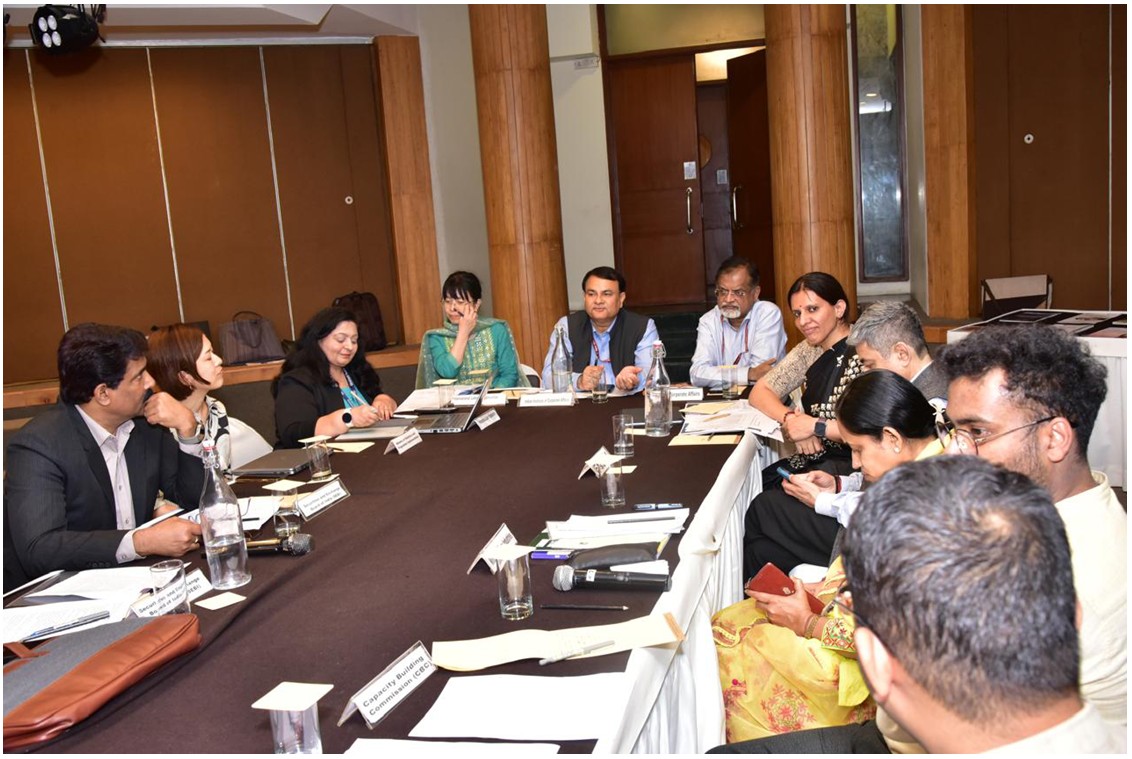
The consultation also featured a special address by Ms. Michiko Miyamoto, Director, International Labour Organisation (ILO) Decent Work Technical Support Team for South Asia and Country Office for India, he shared global perspectives and laid emphasis on India’s championing progress in responsible business conduct. Ms. Miyamoto’s address further elucidated the importance of promoting decent work, labour standards, and inclusive growth within evolving corporate sustainability frameworks.

Prof. Garima Dadhich, Head, School of Business Environment, IICA, in her presentation outlined the evolution of India’s Responsible Business Conduct (RBC) journey, highlighting key policy milestones and regulatory developments that have shaped the country’s responsible business framework. She also shared insights from IICA’s ongoing research mapping national initiatives and policy measures to the nine principles of the National Guidelines on Responsible Business Conduct (NGRBC).

The participating representatives highlighted key initiatives of the their respective ministries and governmental bodies in the deliberations:

CEO of FSSAI, Shri Ranjit Punhani, drew attention to the parallel challenges faced by the food sector in balancing responsible product standards with compliance burden, particularly around front-of-pack nutrition labelling regulations.

Shri. Rajesh Dangeti, the Chief General Manager of SEBI, noted that the BRSR Core has rationalised disclosures to the most essential social, environmental and governance indicators, and underscored that as India aspires toward a USD 30 trillion economy, sustainability disclosures may be positioned not as a compliance burden but as a tool for market differentiation and access to capital.

Further, Shri. Shiv Anant Shanker, Chief General Manager of IBBI, highlighted the unique feature of the IBC that prioritises employee wage dues in liquidation, and proposed exploring how ESG considerations can be embedded into the resolution framework to incentivise responsible business conduct.

Shri. Prashant Baijal, Joint Director, Ministry of Labour and Employment highlighted the significant structural changes being introduced through the four Labour Codes, particularly on minimum wages, appointment letters, and social security coverage. He noted that the Social Security Code abolishes the area-specific notification system for ESIC, extending coverage on a PAN India basis, and making ESIC applicable to hazardous industries regardless of workforce size.

Dr. Renuka Mishra, Economic Advisor to the Ministry of Heavy Industries, indicated that a rolling review on global supply chains for auto components is already in pipeline, and that sector-specific guidelines under the PLI scheme can play an important role in embedding responsible business standards progressively across the auto and advanced manufacturing sector.

Secretary of the Capacity Building Commission, Shri. Jaydeep Gupta, flagged that public sector entities, given their scale and visibility, can serve as important early adopters and demonstration cases for responsible business practices, creating demonstration effects for private sector supply chains.

Shri. Arvind Kumar, Senior Consultant at Ministry of MSME, Shri. Jeevan Kumar Jethani, Scientist at Ministry of New and Renewable Energy, Shri. Arindam, Director at Ministry of External Affairs, Shri. Chinnaraja Naidu, Additional Legislative Counsel at Ministry of Law and Justice, Shri. Vinod Kumar, Deputy Secretary at Ministry of Home Affairs and Shri. Samir Kumar, Joint Secretary, National Human Rights Commission collectively reflected on the cross-sectoral nature of responsible business and sustainability governance, and identified key areas for follow-up action.

Like, including the embedment of social safeguards within PLI and sectoral policy design, integration of labour data from PLFS, ESIC, and EPFO with SEBI’s BRSR disclosure framework, development of tiered and voluntary RBC compliance mechanisms for micro and small enterprises, strengthening of access to remedy mechanisms for informal and migrant workers, and the incorporation of ESG considerations into insolvency and restructuring proceedings under the IBC.

It was noted that India has made significant progress in building a robust framework for responsible business conduct through initiatives such as the National Guidelines on Responsible Business Conduct (NGRBC), SEBI’s Business Responsibility and Sustainability Reporting (BRSR) framework, the Labour Codes, and evolving sustainable finance and due-diligence mechanisms.

Insights emerging from the consultation will contribute to ongoing research and policy work being undertaken by IICA on responsible business conduct and decent work, aimed at strengthening India’s responsible business ecosystem and supporting the continued evolution of sustainability governance frameworks.

Topics

Acts Income Tax