

Loading...

Top
Help
×

By creating an account you can:

Logo TaxTMI
Call Us / Help / Feedback

Contact Us At :

E-mail: [email protected]

Call / WhatsApp at: +91 99117 96707

For more information, Check Contact Us

FAQs :

To know Frequently Asked Questions, Check FAQs

Most Asked Video Tutorials :

For more tutorials, Check Video Tutorials

Submit Feedback/Suggestion :

Email :
Please provide your email address so we can follow up on your feedback.
Category :
Description :
Min 15 characters 0/2000
Make Most of Text Search
  1. Checkout this video tutorial: How to search effectively on TaxTMI.
  2. Put words in double quotes for exact word search, eg: "income tax"
  3. Avoid noise words such as : 'and, of, the, a'
  4. Sort by Relevance to get the most relevant document.
  5. Press Enter to add multiple terms/multiple phrases, and then click on Search to Search.
  6. Text Search
  7. The system will try to fetch results that contains ALL your words.
  8. Once you add keywords, you'll see a new 'Search In' filter that makes your results even more precise.
  9. Text Search
Add to...
You have not created any category. Kindly create one to bookmark this item!
Create New Category
Hide
Title :
Description :
❮❮ Hide
Default View
Expand ❯❯
Close ✕
🔎 News - Adv. Search
TEXT SEARCH:

Press 'Enter' to add multiple search terms. Rules for Better Search

Search In:
Main Text + AI Text
  • Main Text
  • Main Text + AI Text
  • AI Text
Category: ?
Categorized by AI
---- All Categories ----
  • ---- All Categories ----
  • Income Tax
  • GST
  • Customs, DGFT & SEZ
  • FEMA & RBI
  • Corp. Laws, SEBI & IBC
  • PMLA, Black Money & ED
  • Budget
  • News and Press Release
  • PTI News
Month:
---- All Months ----
  • ---- All Months ----
  • January
  • February
  • March
  • April
  • May
  • June
  • July
  • August
  • September
  • October
  • November
  • December
Year:
---- All Years ----
  • ---- All Years ----
  • 2026
  • 2025
  • 2024
  • 2023
  • 2022
  • 2021
  • 2020
  • 2019
  • 2018
  • 2017
  • 2016
  • 2015
  • 2014
  • 2013
  • 2012
  • 2011
Sort By: ?
In Sort By 'Default', exact matches for text search are shown at the top, followed by the remaining results in their regular order.
Relevance Default Date
    Rupee crashes 41 paise to settle at 91.49 against US dollar
    India, Canada launch negotiations for free trade pact
    No petrol, diesel price hike despite global oil prices spiking to USD 80
    West Asia crisis: TCS, Wipro halt travel to Middle East, Nasscom urges remote work
    Mizoram to intensify crackdown on areca nuts smuggling, 468 cases registered since 2019: Minister
    Global markets roiled as conflict in Middle East spreads, energy prices soar
    Department of Commerce convenes Stakeholder Consultation to ensure trade continuity amid evolving geopolitical developments
    CAD widens to USD 13.2 bn in Q3 on higher trade deficit: RBI
    Gross and Net GST revenue collections for the month of Feb, 2026
    Govt discusses potential impact of West Asia crisis on trade; ensures all facilitation
    Rupee crashes 42 paise to settle at 91.50 against US dollar
    J&K to import 4 elite foreign breeds of sheep, goat
    Oil prices soar and stock prices fall as US-Israel war with Iran rattles markets
    India's manufacturing sector activity growth jumps to 4-month high in Feb: PMI
    Arkel invests RS.100 Cr in Phase 1, Opens Advanced Lift Control Manufacturing Facility
    Two-day Workshop by DFS on Reservation Policy of Government of India and Accessibility for PwDs concludes
    Central Board of Indirect Taxes and Customs (CBIC) introduces deferred Customs Duty payment facility for Eligible Manufacturer Importers as announced ...
    US futures, Asian shares open lower, oil prices soar as US and Israeli attack Iran
    Rupee falls 21 paise to 91.29 against US dollar in early trade
    Oil prices rise sharply after attacks in Middle East disrupt global energy supply
❯❯
Maximize Maximize Maximize
0 / 200
Expand Note
Add to Folder

No Folders have been created

+

Are you sure you want to delete "My most important" ?

NOTE:

News
Showing Results for :
Reset Filters
Results Found:
Show All Summaries Hide All Summaries
March 2, 2026
Show AI Summary
Currency depreciation worsened as geopolitical strikes and oil price surge prompted safe-haven flows and foreign fund outflows.
The rupee sharply depreciated against the US dollar due to geopolitical escalation and a crude oil price spike, which triggered safe-haven dollar demand and foreign institutional equity outflows. Higher oil prices threaten to widen India's import bill and current account pressures, producing defensive market positioning and a negative bias for the currency, even as the Reserve Bank of India intervened in the interbank market to limit further depreciation.
March 2, 2026
Show AI Summary
Comprehensive Economic Partnership Agreement negotiations launched to cover goods and services and pursue an ambitious bilateral trade pact.
Launch of negotiations for a Comprehensive Economic Partnership Agreement (CEPA) between India and Canada, with signed Terms of Reference to set the format, frequency and approach for talks covering trade in goods, services and other policy areas. The ToR aim to guide negotiators toward an ambitious, balanced pact, resuming talks from the start after a prior pause. Negotiations target expanded market access and increased bilateral trade, identifying key goods and services sectors and naming chief negotiators for each country.
March 2, 2026
Show AI Summary
Fuel pricing policy shields consumers by using company-held margins to stabilize retail petrol and diesel amid global crude spikes.
India's fuel pricing policy freezes retail petrol and diesel prices by allowing public sector oil companies to absorb losses when international crude prices rise and build margins when prices fall; this cushion-based approach, overseen by the Oil Ministry, will continue unless a sustained, very large spike in crude or prolonged disruptions (notably via the Strait of Hormuz) make it untenable, exposing vulnerabilities from high import dependence and increased procurement, freight, and insurance costs.
March 2, 2026
Show AI Summary
Travel suspension to Middle East prompts IT firms to enforce employee safety measures and remote work arrangements.
Indian IT firms have suspended or deferred travel to the Middle East and implemented employee safety measures: TCS suspended all incoming and outgoing travel, advised associates to stay indoors, activated a call tree, and is coordinating with local authorities and embassies; Wipro issued a no travel advisory for multiple countries and directed regional staff to follow local guidance. Nasscom advised members to defer travel and enable work from home arrangements as a precaution while monitoring operations and preparing further measures if required.
March 2, 2026
Show AI Summary
Customs enforcement against areca nut smuggling intensified, emphasising prosecution under prohibitory orders and strengthened border surveillance.
Intensified enforcement targets areca nut smuggling from Myanmar due to evasion of import duties and market harm to local growers. Authorities have registered numerous cases and made arrests under prohibitory-order offences prosecuted via the Indian Penal Code and the Bharatiya Nagarik Suraksha Sanhita, and separate prosecutions under the Customs Act. The government affirms continued prohibition, enhanced border surveillance, and a zero-tolerance stance including probes into alleged official complicity.
March 2, 2026
Show AI Summary
Energy supply disruption risks push global markets lower as oil and gas price spikes strain trade and inflation expectations.
Energy supply disruptions from Middle East hostilities sharply pushed up oil, gas and fuel prices, driving marketwide volatility as investors rotated into safe havens. Attacks affecting transit through the Strait of Hormuz threaten continuity of crude and LNG exports, prompting buyers to seek alternate sources and tightening physical markets. Higher wholesale inflation readings increase the prospect of delayed monetary easing, reinforcing downward pressure on risk assets and elevating short term downside risk to trade and investment flows.
March 2, 2026
Show AI Summary
Trade continuity secured through coordinated facilitation and procedural flexibility to protect exporters and sustain EXIM logistics.
The Department of Commerce convened a multi stakeholder consultation to coordinate regulatory and operational measures for EXIM logistics amid geopolitical developments, focusing on real time monitoring of routing, capacity, surcharges and equipment availability, and strengthening facilitation at ports and ICDs to prevent congestion. The Government emphasised a facilitative, coordinated approach prioritising supply chain resilience and exporter interests, agreeing measures including procedural flexibility for export authorisations, Customs coordination for smooth clearance, financial and insurance engagement, and prioritisation of time sensitive export segments.
March 2, 2026
Show AI Summary
Current account deficit rises due to widening trade deficit; services surplus partially offsets external imbalance.
Current account deficit widened to USD 13.2 billion in the December quarter, driven mainly by a larger merchandise trade deficit, while net services receipts rose and partially offset the deterioration; the April-December current account deficit moderated compared with the prior year, reflecting goods and services flow dynamics within the balance of payments.
March 2, 2026
Show AI Summary
GST revenue collections: gross receipts, refunds and net receipts reported, with state settlements and cess treatment noted.
Statement of February 2026 GST revenues detailing gross receipts by CGST, SGST and IGST (domestic and import), reported refunds (domestic and export/ICEGATE) and resulting net GST revenue split into net domestic and net customs receipts. It separately reports compensation and import cess inflows and refunds, noting compensation cess remains transitory until loan liabilities are discharged. State/UT pre- and post-settlement SGST distributions and Apr-Feb collection breakdowns by Central and State formations are included for inter-year comparison.
March 2, 2026
Show AI Summary
Trade facilitation measures to mitigate West Asia crisis impact on exports, including customs coordination and logistical support.
The consultation assessed risks to EXIM cargo flows from West Asian hostilities and committed a facilitative, coordinated response focused on preserving trade continuity. Agreed measures include real-time monitoring of routing, capacity, surcharges and equipment availability; strengthened port/ICD facilitation to avoid congestion; targeted support for time-sensitive exports such as perishables and pharmaceuticals; procedural flexibility for export authorisations in genuine disruption; Customs coordination for smooth clearance; and engagement with financial and insurance institutions to protect exporter interests, with emphasis on MSMEs and essential imports.
March 2, 2026
Show AI Summary
Exchange rate pressure intensified as geopolitical conflict, crude price spikes and capital outflows pushed the currency lower despite central bank support.
Severe exchange rate pressure drove the rupee sharply lower amid geopolitical conflict, FII outflows and rising crude prices, increasing India's import bill vulnerability; the Reserve Bank of India's visible market presence capped deeper intraday depreciation while analysts warned that geopolitical developments, crude trends, capital flows and key US data will determine near term exchange rate direction.
March 2, 2026
Show AI Summary
Genetic upgrade initiative boosts local mutton and wool production via import of elite sheep and goat breeds.
Importation of Romanov and Finn sheep and Boer and Swiss Alpine goats aims to implement a genetic upgrade of Jammu and Kashmir's small ruminant population to improve growth rates, carcass yield, reproductive efficiency and overall flock productivity. Imported germplasm will be multiplied at government breeding farms and progeny distributed to farmers in phases, with farmer-level distribution starting in the third quarter of 2026-27, as part of Project 24 under the Holistic Agriculture Development Programme alongside complementary livestock and rural productivity measures.
March 2, 2026
Show AI Summary
Oil supply disruption risk drives markets as geopolitical attacks push energy prices up and equities downward.
Attacks on Iran caused equity declines and sharp rises in oil and gold as traders priced in disruption to energy flows through the Strait of Hormuz; sustained interruptions to Iranian exports and regional shipping could tighten global supply, elevate fuel and production costs, affect major importers' sourcing strategies, and influence inflation dynamics and central bank rate decisions.
March 2, 2026
Show AI Summary
Manufacturing activity growth driven by stronger domestic demand despite slower export orders, prompting higher input buying and hiring.
Manufacturing activity accelerated to a four-month high as stronger domestic demand supported faster output growth and higher new business intakes; firms increased input purchasing, inventories and hiring. New export orders continued to slow, somewhat constraining employment creation. Cost pressures remained moderate, and forward-looking sentiment was positive with many manufacturers expecting higher output over the year ahead.
March 2, 2026
Show AI Summary
Compliance with IS-17900 drives local manufacturing of advanced lift control systems, reducing import dependence and strengthening supply chains.
A Phase 1 manufacturing facility invests in local production of advanced lift electronic control systems designed to comply with IS-17900, reduce import dependency, and enable component to finished product localisation. The plant will operate automated PCB and semi automatic panel lines to produce MR, MRL and Slim Panels, emphasise controlled environment quality, IoT features, and support supply chain resilience and national industrial policy objectives under the Make in India framework.
March 2, 2026
Show AI Summary
Reservation policy implementation strengthened across public financial institutions to improve accessibility and uniform compliance measures.
Strengthening institutional capacity for uniform implementation of the Government of India's reservation policy across public financial institutions and enhancing accessibility for Persons with Disabilities were the primary objectives. The programme combined a Sugamya Bharat sensitisation session on accessibility standards and compliance requirements, a roundtable on legal provisions and practical challenges, exchange of best practices, and an interactive question-and-answer session to identify operational measures for inclusivity, accessibility and reservation policy compliance.
March 2, 2026
Show AI Summary
Deferred Customs Duty payment enables qualified manufacturers to clear imports and pay duties monthly, subject to compliance and eligibility.
A Deferred Customs Duty payment facility allows Eligible Manufacturer Importers to clear imports without immediate duty payment and to pay applicable customs duties monthly under the Deferred Payment of Import Duty Rules, 2016, subject to prescribed Customs and GST compliance, turnover, financial standing and track record; existing AEO T1 entities meeting eligibility may participate and applications are to be submitted via the AEO portal.
March 2, 2026
Show AI Summary
Energy supply disruption risks trigger global market selloff and safe-haven flows, lifting oil and gold while bond yields fall.
Global markets moved to risk-off after US and Israeli attacks on Iran: equities opened lower while gold and government bonds rallied and oil prices surged on fears that strikes and incidents in the Strait of Hormuz could restrict oil and LNG exports, raising the prospect of higher energy and production costs; higher-than-expected wholesale inflation readings were identified as a factor that may affect the central bank's timing for interest-rate cuts.
March 2, 2026
Show AI Summary
Rupee depreciation driven by crude price surge, dollar strength and foreign fund outflows pressures local currency lower.
Rupee depreciation in early trade reflected external pressures-higher crude prices, a stronger US dollar, and escalated Middle East tensions-compounded by negative domestic equity sentiment and significant foreign institutional outflows. Market indicators included a firmer dollar index, rising Brent crude futures, and a recent dip in forex reserves, while analysts warned of increased import bill risk due to India's reliance on fuel imports.
March 2, 2026
Show AI Summary
Energy supply disruption threatens global oil flows, driving sharp price increases and straining fuel and goods markets worldwide.
Attacks and retaliatory strikes in the Middle East disrupted flows through the Strait of Hormuz and regional export infrastructure, triggering sharp crude price rises and heightened risk of sustained supply constraints; OPEC+ announced production increases, but analysts stress that constrained export routes limit the immediate effectiveness of added output.

News

Back

All News

Showing Results for :
Reset Filters
No Records Found

News

Back

All News

Showing Results for : Reset Filters
Corp. Laws, SEBI & IBC

IICA Convenes Fifth Inter-Ministerial Consultation on Responsible Business Conduct and Social Dimension of ESG

March 16, 2026

Contents
Acts
Summary
Note

Note

-

Bookmark

Print

Print

The Indian Institute of Corporate Affairs (IICA), under Ministry of Corporate Affairs, Government of India, convened the Fifth Inter-Ministerial Consultation on Responsible Business Conduct (RBC) and the Social Dimension of Environmental, Social and Governance (ESG) recently in New Delhi.

The consultation was organised by the School of Business Environment (SoBE), IICA, in collaboration with the International Labour Organisation (ILO) to strengthen policy coherence and institutional coordination on responsible business conduct and sustainability governance in India.

The Workshop commenced under the chairmanship of Shri Gyaneshwar Kumar Singh, Director General and CEO, Indian Institute of Corporate Affairs, who highlighted the growing significance of responsible business conduct in the context of evolving global supply chains and sustainability expectations. Mr Singh noted that responsible business practices today extend beyond corporate reporting frameworks and are increasingly linked to economic competitiveness, sustainable development, and international trade integration. 

Shri Shantanu Mitra, Senior Economic Advisor, Ministry of Corporate Affairs, delivered an address that highlighted the policy significance of responsible business conduct within India’s corporate governance ecosystem and its growing relevance for businesses operating within global value chains. Shri. Mitra concluded that the mandate of responsible business is inbuilt in various provisions of the Companies Act 2013 and Ministry of Corporate Affairs is steadfast in ensuring that the statutory framework remains conducive for new age businesses and serves as a global benchmark for statutory and regulatory compliance.
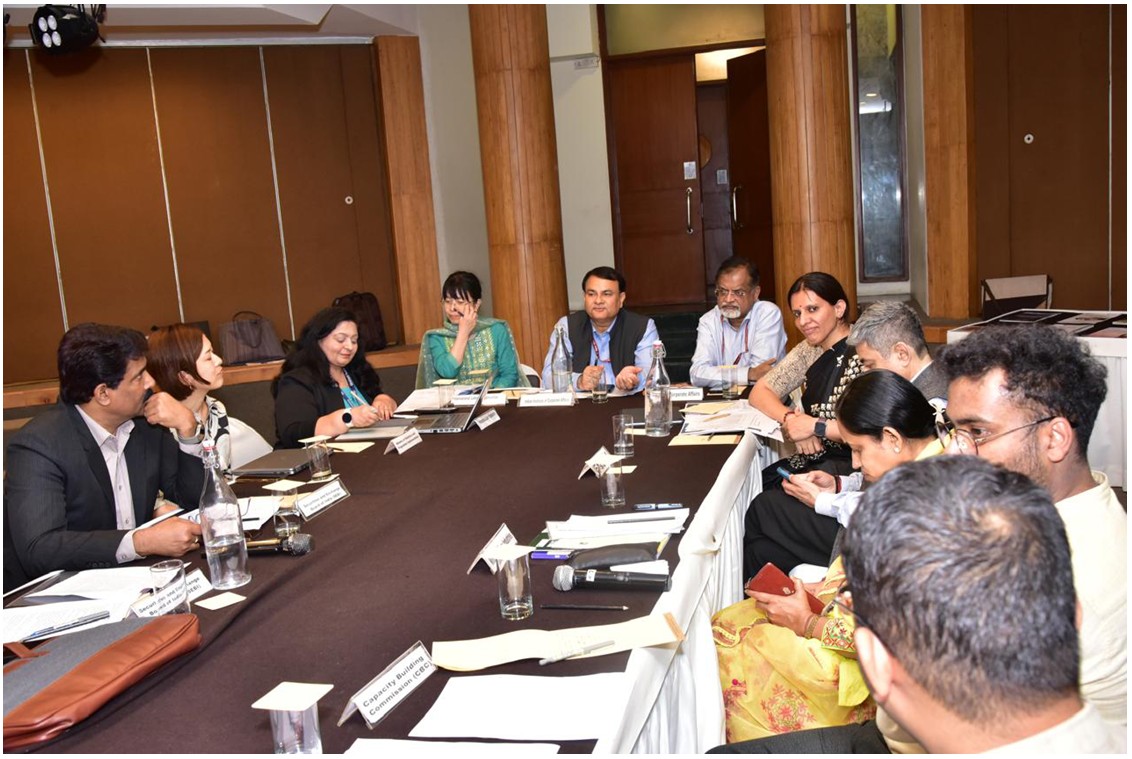
The consultation also featured a special address by Ms. Michiko Miyamoto, Director, International Labour Organisation (ILO) Decent Work Technical Support Team for South Asia and Country Office for India, he shared global perspectives and laid emphasis on India’s championing progress in responsible business conduct. Ms. Miyamoto’s address further elucidated the importance of promoting decent work, labour standards, and inclusive growth within evolving corporate sustainability frameworks.

Prof. Garima Dadhich, Head, School of Business Environment, IICA, in her presentation outlined the evolution of India’s Responsible Business Conduct (RBC) journey, highlighting key policy milestones and regulatory developments that have shaped the country’s responsible business framework. She also shared insights from IICA’s ongoing research mapping national initiatives and policy measures to the nine principles of the National Guidelines on Responsible Business Conduct (NGRBC).

The participating representatives highlighted key initiatives of the their respective ministries and governmental bodies in the deliberations:

CEO of FSSAI, Shri Ranjit Punhani, drew attention to the parallel challenges faced by the food sector in balancing responsible product standards with compliance burden, particularly around front-of-pack nutrition labelling regulations.

Shri. Rajesh Dangeti, the Chief General Manager of SEBI, noted that the BRSR Core has rationalised disclosures to the most essential social, environmental and governance indicators, and underscored that as India aspires toward a USD 30 trillion economy, sustainability disclosures may be positioned not as a compliance burden but as a tool for market differentiation and access to capital.

Further, Shri. Shiv Anant Shanker, Chief General Manager of IBBI, highlighted the unique feature of the IBC that prioritises employee wage dues in liquidation, and proposed exploring how ESG considerations can be embedded into the resolution framework to incentivise responsible business conduct.

Shri. Prashant Baijal, Joint Director, Ministry of Labour and Employment highlighted the significant structural changes being introduced through the four Labour Codes, particularly on minimum wages, appointment letters, and social security coverage. He noted that the Social Security Code abolishes the area-specific notification system for ESIC, extending coverage on a PAN India basis, and making ESIC applicable to hazardous industries regardless of workforce size.

Dr. Renuka Mishra, Economic Advisor to the Ministry of Heavy Industries, indicated that a rolling review on global supply chains for auto components is already in pipeline, and that sector-specific guidelines under the PLI scheme can play an important role in embedding responsible business standards progressively across the auto and advanced manufacturing sector.

Secretary of the Capacity Building Commission, Shri. Jaydeep Gupta, flagged that public sector entities, given their scale and visibility, can serve as important early adopters and demonstration cases for responsible business practices, creating demonstration effects for private sector supply chains.

Shri. Arvind Kumar, Senior Consultant at Ministry of MSME, Shri. Jeevan Kumar Jethani, Scientist at Ministry of New and Renewable Energy, Shri. Arindam, Director at Ministry of External Affairs, Shri. Chinnaraja Naidu, Additional Legislative Counsel at Ministry of Law and Justice, Shri. Vinod Kumar, Deputy Secretary at Ministry of Home Affairs and Shri. Samir Kumar, Joint Secretary, National Human Rights Commission collectively reflected on the cross-sectoral nature of responsible business and sustainability governance, and identified key areas for follow-up action.

Like, including the embedment of social safeguards within PLI and sectoral policy design, integration of labour data from PLFS, ESIC, and EPFO with SEBI’s BRSR disclosure framework, development of tiered and voluntary RBC compliance mechanisms for micro and small enterprises, strengthening of access to remedy mechanisms for informal and migrant workers, and the incorporation of ESG considerations into insolvency and restructuring proceedings under the IBC.

It was noted that India has made significant progress in building a robust framework for responsible business conduct through initiatives such as the National Guidelines on Responsible Business Conduct (NGRBC), SEBI’s Business Responsibility and Sustainability Reporting (BRSR) framework, the Labour Codes, and evolving sustainable finance and due-diligence mechanisms.

Insights emerging from the consultation will contribute to ongoing research and policy work being undertaken by IICA on responsible business conduct and decent work, aimed at strengthening India’s responsible business ecosystem and supporting the continued evolution of sustainability governance frameworks.

Topics

Acts Income Tax