

Loading...

Top
Help
×

By creating an account you can:

Logo TaxTMI
Call Us / Help / Feedback

Contact Us At :

E-mail: [email protected]

Call / WhatsApp at: +91 99117 96707

For more information, Check Contact Us

FAQs :

To know Frequently Asked Questions, Check FAQs

Most Asked Video Tutorials :

For more tutorials, Check Video Tutorials

Submit Feedback/Suggestion :

Email :
Please provide your email address so we can follow up on your feedback.
Category :
Description :
Min 15 characters 0/2000
Make Most of Text Search
  1. Checkout this video tutorial: How to search effectively on TaxTMI.
  2. Put words in double quotes for exact word search, eg: "income tax"
  3. Avoid noise words such as : 'and, of, the, a'
  4. Sort by Relevance to get the most relevant document.
  5. Press Enter to add multiple terms/multiple phrases, and then click on Search to Search.
  6. Text Search
  7. The system will try to fetch results that contains ALL your words.
  8. Once you add keywords, you'll see a new 'Search In' filter that makes your results even more precise.
  9. Text Search
Add to...
You have not created any category. Kindly create one to bookmark this item!
Create New Category
Hide
Title :
Description :
❮❮ Hide
Default View
Expand ❯❯
Close ✕
🔎 News - Adv. Search
TEXT SEARCH:

Press 'Enter' to add multiple search terms. Rules for Better Search

Search In:
Main Text + AI Text
  • Main Text
  • Main Text + AI Text
  • AI Text
Category: ?
Categorized by AI
---- All Categories ----
  • ---- All Categories ----
  • Income Tax
  • GST
  • Customs, DGFT & SEZ
  • FEMA & RBI
  • Corp. Laws, SEBI & IBC
  • PMLA, Black Money & ED
  • Budget
  • News and Press Release
  • PTI News
Month:
---- All Months ----
  • ---- All Months ----
  • January
  • February
  • March
  • April
  • May
  • June
  • July
  • August
  • September
  • October
  • November
  • December
Year:
---- All Years ----
  • ---- All Years ----
  • 2026
  • 2025
  • 2024
  • 2023
  • 2022
  • 2021
  • 2020
  • 2019
  • 2018
  • 2017
  • 2016
  • 2015
  • 2014
  • 2013
  • 2012
  • 2011
Sort By: ?
In Sort By 'Default', exact matches for text search are shown at the top, followed by the remaining results in their regular order.
Relevance Default Date
❯❯
Maximize Maximize Maximize
0 / 200
Expand Note
Add to Folder

No Folders have been created

+

Are you sure you want to delete "My most important" ?

NOTE:

News
Showing Results for :
Reset Filters
Results Found:
Show All Summaries Hide All Summaries
March 25, 2026
Show AI Summary
Specified business notification for semiconductor wafer fabrication units through Form 19 and electronic filing requirements.
Form 19 is prescribed for an application seeking notification of a semiconductor wafer fabrication manufacturing unit as a specified business under the Income-tax law. It is used by an assessee carrying on, or proposing to carry on, semiconductor wafer fabrication manufacturing, and the application captures particulars of the assessee, the unit, and fulfilment of prescribed conditions to enable verification of eligibility for notification. The completed form, together with supporting approval documents where applicable, is filed electronically and examined for compliance with the statutory and rule-based requirements.
March 25, 2026
Show AI Summary
Insolvency resolution delays and tribunal capacity constraints dominate debate on insolvency law amendments.
Debate on the Insolvency and Bankruptcy Code (Amendment) Bill, 2025 highlighted concerns that insolvency resolution and liquidation suffer from delay, value deterioration and low recoveries. Opposition members said limited capacity of the National Company Law Tribunal hampers timely disposal of cases and weakens the resolution framework, while also criticising the insolvency ecosystem for facilitating stripping of corporate assets. The discussion noted efforts to address timelines, capacity constraints and creditor recovery through the select committee report.
March 25, 2026
Show AI Summary
Semiconductor wafer fabrication notification governs specified business status, mandatory filing, and tax benefits under the prescribed form.
Form 19 is the prescribed application for notification of a semiconductor wafer fabrication manufacturing unit as a specified business under section 46 of the Income-tax Act, 2025. It is required for assessee carrying on or proposing to carry on semiconductor wafer fabrication activity and is mandatory for claiming the associated tax benefits. The form seeks particulars of the assessee, the specified business, the proposed unit, commencement details, prescribed approvals, and confirmation that the unit is exclusively for semiconductor wafer fabrication, located in India, and operating under the required conditions.
March 25, 2026
Show AI Summary
Specified business notification for affordable housing projects requires electronic filing, supporting documents, and compliance verification.
Form 18 is the prescribed application for notification of an affordable housing project as a specified business under section 46. It is required to be furnished electronically by an assessee seeking such notification and captures particulars of the assessee, the specified business, the proposed project, and compliance with prescribed conditions. Supporting documents such as the development agreement, sanction letter, and layout approval are attached to assist verification. The application is examined for compliance before notification may be granted.
March 25, 2026
Show AI Summary
Affordable housing project notification through Form 18 is mandatory for claiming tax benefits under the specified business regime.
Form 18 is the prescribed application for notification of an affordable housing project as a specified business under section 46 of the Income-tax Act, 2025, and filing it is mandatory for availing the tax benefits available under that provision. The form requires the assessee to furnish particulars of the assessee, the specified business, the proposed project, compliance with prescribed conditions, and other project-related details, including project location, unit-wise area particulars, investment, title to land, development agreements, and a declaration certifying correctness of the information furnished.
March 25, 2026
Show AI Summary
Approval for research-linked income-tax benefits through Form No. 17 requires detailed filing, verification, and ongoing annual compliance.
Form No. 17 is the prescribed electronic application for an Indian company and for a research association, university, college or other institution seeking approval under the relevant income-tax framework. It requires verified filing within the prescribed time, detailed particulars of the applicant, research activities, income, expenditure, donations, and supporting documents. The prescribed authority may issue a deficiency notice, and after approval the entity must furnish annual research-related compliance details.
March 25, 2026
Show AI Summary
Form No. 17 approval applications require detailed disclosures, electronic filing, and ongoing compliance for research-related tax recognition.
Form No. 17 is the prescribed electronic application for approval under section 45(3)(b) for a company and section 45(4)(b) for a research association, university, college or other institution. The form requires disclosure of incorporation details, key persons, beneficial owners, registrations, research facilities, research projects, income and expenditure, together with prescribed enclosures and declarations. Approval remains subject to maintenance of books, audit and reporting obligations, compliance with conditions of approval, and the possibility of withdrawal if activities cease, become non-genuine, or are not carried out as required.
March 25, 2026
Show AI Summary
Scientific research donation certificates streamline deduction verification through annual donor-wise reporting, Form 16 linkage, and corrected issuance.
Form 16 serves as the annual donor-wise certificate for contributions made to prescribed institutions for scientific research and is used to support verification of deductions claimed under the Income-tax Act, 2025. The certificate records aggregate donations received during the tax year, is not a receipt for individual transactions, and operates separately from transaction-level acknowledgments issued by the institution. It is linked to Form 15, must be issued once in each tax year on or before 31 May, and may be corrected if errors are found.
March 25, 2026
Show AI Summary
Finance Bill 2026 advances budgetary approval as Lok Sabha passes the measure with government amendments.
Lok Sabha passed the Finance Bill 2026 with 32 government amendments, completing its role in the Budgetary approval process for 2026-27 and sending the Bill to the Rajya Sabha for further consideration. The Budget framework for 2026-27 provides for substantial expenditure and capital outlay, along with projected gross tax revenue, gross borrowing, and a lower fiscal deficit than the current fiscal year.
March 25, 2026
Show AI Summary
Annual donor certificate for scientific research requires electronic FORM 16, separate from receipts and subject to deduction conditions.
Prescribed undertakings or institutions covered by section 45(3) must issue FORM 16 as an annual certificate to donors for sums received for scientific research. The certificate is issued once for the relevant tax year, on or before 31 May immediately following that year, and records the aggregate donation, donor particulars, the institution's approval details, and the relevant clause of section 45(3). FORM 16 is distinct from FORM 15, may be corrected or revised, and does not by itself guarantee deduction to the donor.
March 25, 2026
Show AI Summary
Scientific research donation reporting under Form 15 requires annual filing, donor-wise particulars, and cross-verification of deductions.
Form 15 is a statutory annual information statement for prescribed undertakings or institutions receiving sums for scientific research, social science research or statistical research under the Income-tax Act, 2025. It must be furnished annually by the recipient institution and verified by the person authorised to verify its return of income, on or before 31st May following the relevant tax year. The form captures donor-wise and donation-wise particulars and serves as a primary data source for cross-verification of deductions claimed by donors, without itself conferring any deduction.
March 25, 2026
Show AI Summary
Scientific research donation reporting under FORM 15 requires annual electronic furnishing by the recipient institution.
FORM 15 is a prescribed annual statement to be furnished by a prescribed undertaking or institution in respect of sums received for scientific research during a tax year. It applies to eligible sums received for scientific, social science or statistical research, and not to charitable donations. The obligation lies with the recipient institution, the statement is to be furnished annually on or before 31st May, and it must include donor-wise particulars, approval details, and receipt information. Non-furnishing or incorrect furnishing may affect the donor's deduction and attract statutory consequences.
March 25, 2026
Show AI Summary
In-house R&D approval under Form 14 conditions tax deduction eligibility and links scientific recognition with compliance oversight.
Proposed Form 14 is the statutory approval order for an in-house research and development facility under section 45(2) of the Income-tax Act, 2025. Issued by the Department of Scientific and Industrial Research under Rule 29, it records the company's particulars, the facility details, DSIR recognition, and the grant of approval for the deduction framework. The approval is facility-specific, depends on continued DSIR recognition, and does not by itself establish deduction entitlement.
March 25, 2026
Show AI Summary
In-house research and development approval governs deduction claims subject to DSIR recognition and statutory compliance.
FORM 14 is the prescribed approval order issued by DSIR for a company's in-house research and development facility under section 45(2) read with Rule 29. It formally grants approval, records the scientific research to be undertaken, links the approval with DSIR recognition and the company's application, and supports a deduction claim subject to compliance with statutory conditions. The form is facility-specific, not a filing form, and may be withdrawn for non-compliance or withdrawal of DSIR recognition.
March 25, 2026
Show AI Summary
Scientific research and development audit reporting supports deduction claims through mandatory independent certification and account verification.
Proposed FORM 13 is the annual statutory audit report for an approved in-house scientific research and development facility under section 45(2) of the Income-tax Act, 2025. It is furnished by the company through an independent accountant and provides independent assurance on maintenance of separate accounts, correctness of capital and revenue expenditure, conformity with DSIR guidelines, and linkage with audited financial statements. FORM 13 is a mandatory supporting document for deduction claims and operates with FORM 11, FORM 14 and FORM 12 in the compliance framework.
March 25, 2026
Show AI Summary
In-house R&D audit report defines compliance for deduction claims through separate accounts and certified expenditure.
FORM 13 is the accountant's annual audit report for an approved in-house scientific research and development facility claimed under section 45(2). It certifies maintenance of separate accounts, correctness of expenditure, and conformity with DSIR guidelines, and must be attached with or furnished in support of the company's return of income. The form is a mandatory compliance requirement, but deduction remains subject to verification and assessment.
March 25, 2026
Show AI Summary
Research and development deduction reporting through Form 12 supports technical certification, expenditure verification, and compliance oversight.
Proposed Form 12 is the statutory reporting form through which the prescribed authority, acting under Rule 29, submits findings and certification regarding an approved in-house research and development facility to the jurisdictional Chief Commissioner of Income-tax. It operates within the compliance framework for deduction of expenditure on approved in-house R&D facilities under section 45(2) of the Income-tax Act, 2025 and records evaluation details, eligible expenditure and asset movements for verification of deduction claims.
March 25, 2026
Show AI Summary
Research and development deduction reporting through FORM 12 supports verification of eligible expenditure and compliance oversight.
FORM 12 is a statutory report furnished by the prescribed authority under section 45(2) read with Rule 29 for an approved in-house research and development facility. It is filed with the Chief Commissioner of Income-tax and records the facility's examination, recognition status, and eligible capital and revenue expenditure for verifying deduction claims. The form is not filed by the company and does not itself determine final allowability of deduction, which remains subject to departmental verification during processing or assessment.
March 25, 2026
Show AI Summary
In-house R&D facility approval framework under income tax law requires DSIR cooperation, audit compliance, and ongoing reporting.
FORM 11 sets out the statutory application and agreement framework for approval of in-house research and development facilities under section 45(2) of the Income-tax Act, 2025, read with Rule 29. It applies to eligible companies maintaining or proposing to maintain an in-house R&D facility and requires disclosure of company particulars, a DSIR agreement, and binding undertakings on audit, reporting, asset use, and compliance. Approval is facility-specific and remains subject to continued compliance, with DSIR serving as the prescribed authority for evaluation and oversight.
March 25, 2026
Show AI Summary
In-house research and development approval requires disclosure, audit, and ongoing compliance before deduction can be considered.
Form 11 is the prescribed application under Rule 29 for a company seeking to enter into an agreement with the Department of Scientific and Industrial Research for an in-house research and development facility under section 45(2). It requires disclosure of company particulars, R&D expenditure, facility details, research objectives, and undertakings on maintenance and audit of accounts. The form is generally a one-time approval application, but annual compliance continues through progress reports, audited accounts, and expenditure details. Approval does not itself secure deduction, which depends on statutory conditions, the agreement, and verification.

News

Back

All News

Showing Results for :
Reset Filters
No Records Found

News

Showing Results for : Reset Filters
Corp. Laws, SEBI & IBC

IICA Convenes Fifth Inter-Ministerial Consultation on Responsible Business Conduct and Social Dimension of ESG

March 16, 2026

Contents
Acts
Summary
Note

Note

-

Bookmark

Print

Print

The Indian Institute of Corporate Affairs (IICA), under Ministry of Corporate Affairs, Government of India, convened the Fifth Inter-Ministerial Consultation on Responsible Business Conduct (RBC) and the Social Dimension of Environmental, Social and Governance (ESG) recently in New Delhi.

The consultation was organised by the School of Business Environment (SoBE), IICA, in collaboration with the International Labour Organisation (ILO) to strengthen policy coherence and institutional coordination on responsible business conduct and sustainability governance in India.

The Workshop commenced under the chairmanship of Shri Gyaneshwar Kumar Singh, Director General and CEO, Indian Institute of Corporate Affairs, who highlighted the growing significance of responsible business conduct in the context of evolving global supply chains and sustainability expectations. Mr Singh noted that responsible business practices today extend beyond corporate reporting frameworks and are increasingly linked to economic competitiveness, sustainable development, and international trade integration. 

Shri Shantanu Mitra, Senior Economic Advisor, Ministry of Corporate Affairs, delivered an address that highlighted the policy significance of responsible business conduct within India’s corporate governance ecosystem and its growing relevance for businesses operating within global value chains. Shri. Mitra concluded that the mandate of responsible business is inbuilt in various provisions of the Companies Act 2013 and Ministry of Corporate Affairs is steadfast in ensuring that the statutory framework remains conducive for new age businesses and serves as a global benchmark for statutory and regulatory compliance.
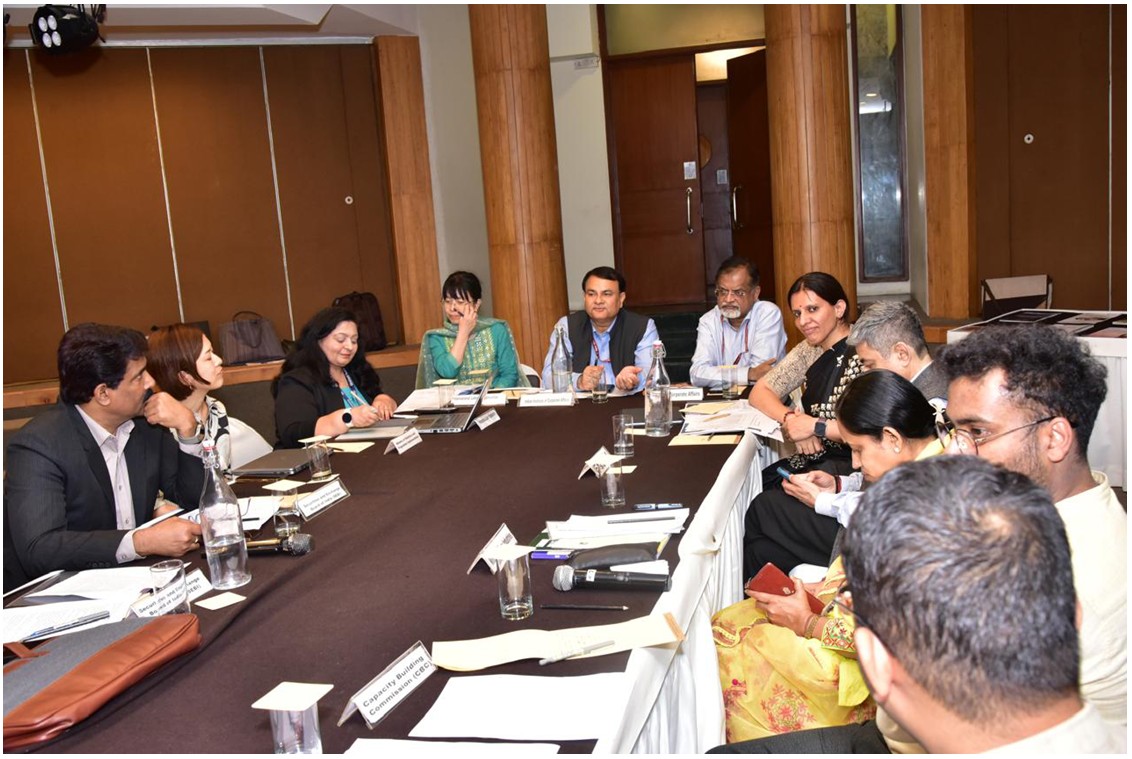
The consultation also featured a special address by Ms. Michiko Miyamoto, Director, International Labour Organisation (ILO) Decent Work Technical Support Team for South Asia and Country Office for India, he shared global perspectives and laid emphasis on India’s championing progress in responsible business conduct. Ms. Miyamoto’s address further elucidated the importance of promoting decent work, labour standards, and inclusive growth within evolving corporate sustainability frameworks.

Prof. Garima Dadhich, Head, School of Business Environment, IICA, in her presentation outlined the evolution of India’s Responsible Business Conduct (RBC) journey, highlighting key policy milestones and regulatory developments that have shaped the country’s responsible business framework. She also shared insights from IICA’s ongoing research mapping national initiatives and policy measures to the nine principles of the National Guidelines on Responsible Business Conduct (NGRBC).

The participating representatives highlighted key initiatives of the their respective ministries and governmental bodies in the deliberations:

CEO of FSSAI, Shri Ranjit Punhani, drew attention to the parallel challenges faced by the food sector in balancing responsible product standards with compliance burden, particularly around front-of-pack nutrition labelling regulations.

Shri. Rajesh Dangeti, the Chief General Manager of SEBI, noted that the BRSR Core has rationalised disclosures to the most essential social, environmental and governance indicators, and underscored that as India aspires toward a USD 30 trillion economy, sustainability disclosures may be positioned not as a compliance burden but as a tool for market differentiation and access to capital.

Further, Shri. Shiv Anant Shanker, Chief General Manager of IBBI, highlighted the unique feature of the IBC that prioritises employee wage dues in liquidation, and proposed exploring how ESG considerations can be embedded into the resolution framework to incentivise responsible business conduct.

Shri. Prashant Baijal, Joint Director, Ministry of Labour and Employment highlighted the significant structural changes being introduced through the four Labour Codes, particularly on minimum wages, appointment letters, and social security coverage. He noted that the Social Security Code abolishes the area-specific notification system for ESIC, extending coverage on a PAN India basis, and making ESIC applicable to hazardous industries regardless of workforce size.

Dr. Renuka Mishra, Economic Advisor to the Ministry of Heavy Industries, indicated that a rolling review on global supply chains for auto components is already in pipeline, and that sector-specific guidelines under the PLI scheme can play an important role in embedding responsible business standards progressively across the auto and advanced manufacturing sector.

Secretary of the Capacity Building Commission, Shri. Jaydeep Gupta, flagged that public sector entities, given their scale and visibility, can serve as important early adopters and demonstration cases for responsible business practices, creating demonstration effects for private sector supply chains.

Shri. Arvind Kumar, Senior Consultant at Ministry of MSME, Shri. Jeevan Kumar Jethani, Scientist at Ministry of New and Renewable Energy, Shri. Arindam, Director at Ministry of External Affairs, Shri. Chinnaraja Naidu, Additional Legislative Counsel at Ministry of Law and Justice, Shri. Vinod Kumar, Deputy Secretary at Ministry of Home Affairs and Shri. Samir Kumar, Joint Secretary, National Human Rights Commission collectively reflected on the cross-sectoral nature of responsible business and sustainability governance, and identified key areas for follow-up action.

Like, including the embedment of social safeguards within PLI and sectoral policy design, integration of labour data from PLFS, ESIC, and EPFO with SEBI’s BRSR disclosure framework, development of tiered and voluntary RBC compliance mechanisms for micro and small enterprises, strengthening of access to remedy mechanisms for informal and migrant workers, and the incorporation of ESG considerations into insolvency and restructuring proceedings under the IBC.

It was noted that India has made significant progress in building a robust framework for responsible business conduct through initiatives such as the National Guidelines on Responsible Business Conduct (NGRBC), SEBI’s Business Responsibility and Sustainability Reporting (BRSR) framework, the Labour Codes, and evolving sustainable finance and due-diligence mechanisms.

Insights emerging from the consultation will contribute to ongoing research and policy work being undertaken by IICA on responsible business conduct and decent work, aimed at strengthening India’s responsible business ecosystem and supporting the continued evolution of sustainability governance frameworks.

Topics

Acts Income Tax
