

Loading...

Top
Help
×

By creating an account you can:

Logo TaxTMI
Call Us / Help / Feedback

Contact Us At :

E-mail: [email protected]

Call / WhatsApp at: +91 99117 96707

For more information, Check Contact Us

FAQs :

To know Frequently Asked Questions, Check FAQs

Most Asked Video Tutorials :

For more tutorials, Check Video Tutorials

Submit Feedback/Suggestion :

Email :
Please provide your email address so we can follow up on your feedback.
Category :
Description :
Min 15 characters 0/2000
Make Most of Text Search
  1. Checkout this video tutorial: How to search effectively on TaxTMI.
  2. Put words in double quotes for exact word search, eg: "income tax"
  3. Avoid noise words such as : 'and, of, the, a'
  4. Sort by Relevance to get the most relevant document.
  5. Press Enter to add multiple terms/multiple phrases, and then click on Search to Search.
  6. Text Search
  7. The system will try to fetch results that contains ALL your words.
  8. Once you add keywords, you'll see a new 'Search In' filter that makes your results even more precise.
  9. Text Search
Add to...
You have not created any category. Kindly create one to bookmark this item!
Create New Category
Hide
Title :
Description :
❮❮ Hide
Default View
Expand ❯❯
Close ✕
🔎 News - Adv. Search
TEXT SEARCH:

Press 'Enter' to add multiple search terms. Rules for Better Search

Search In:
Main Text + AI Text
  • Main Text
  • Main Text + AI Text
  • AI Text
Category: ?
Categorized by AI
---- All Categories ----
  • ---- All Categories ----
  • Income Tax
  • GST
  • Customs, DGFT & SEZ
  • FEMA & RBI
  • Corp. Laws, SEBI & IBC
  • PMLA, Black Money & ED
  • Budget
  • News and Press Release
  • PTI News
Month:
---- All Months ----
  • ---- All Months ----
  • January
  • February
  • March
  • April
  • May
  • June
  • July
  • August
  • September
  • October
  • November
  • December
Year:
---- All Years ----
  • ---- All Years ----
  • 2026
  • 2025
  • 2024
  • 2023
  • 2022
  • 2021
  • 2020
  • 2019
  • 2018
  • 2017
  • 2016
  • 2015
  • 2014
  • 2013
  • 2012
  • 2011
Sort By: ?
In Sort By 'Default', exact matches for text search are shown at the top, followed by the remaining results in their regular order.
Relevance Default Date
❯❯
Maximize Maximize Maximize
0 / 200
Expand Note
Add to Folder

No Folders have been created

+

Are you sure you want to delete "My most important" ?

NOTE:

News
Showing Results for :
Reset Filters
Results Found:
Show All Summaries Hide All Summaries
March 28, 2026
Show AI Summary
Alternate Minimum Tax compliance through Form 67 requires CA certification, electronic filing, and timely submission with the return.
Form 67 is prescribed for furnishing details relating to the computation of Adjusted Total Income and Alternate Minimum Tax (AMT) under section 206(2) of the Income-tax Act, 2025. It applies to persons other than companies, subject to stated exceptions, and is not required for certain specified taxpayers where adjusted total income does not exceed twenty lakh rupees. The form is used to determine AMT on adjusted total income, with tax payable at the higher of the regular tax or AMT, and it incorporates adjustments such as depreciation and other specified items.
March 28, 2026
Show AI Summary
Minimum Alternate Tax reporting through Form 66 demands Chartered Accountant certification, digital filing, and return-linked book profit verification.
Companies liable to Minimum Alternate Tax must furnish Form 66, a Chartered Accountant-certified report on book profit and MAT computation, annually with the income tax return. The form is digitally signed, accepted by the company through the e-filing portal, and linked to the return for processing. It contains company particulars, profit adjustments, transition amount, final MAT computation, auditor certification, and supporting financial and tax documents.
March 27, 2026
Show AI Summary
Access to unrelied ED documents denied at pre-cognisance stage in an ongoing money-laundering investigation.
Access to documents seized by the Enforcement Directorate but not relied upon in the chargesheet was refused at the pre-cognisance stage in an ongoing Prevention of Money Laundering Act matter. The court held that the accused had already been supplied with the prosecution complaint and relied-upon documents, and that disclosure of unrelied material was not required before cognisance when the investigation remained pending.
March 27, 2026
Show AI Summary
Trade agreement framework balances market access with farmer safeguards, calibrated tariff concessions, and export opportunities across key sectors.
India and the United States have agreed on a framework for an interim trade agreement intended to expand reciprocal and mutually beneficial trade while protecting domestic sensitivities, particularly in agriculture and dairy. The framework contemplates improved market access, rules of origin, action on non-tariff barriers, and cooperation on standards, digital trade, economic security, technology, supply chain resilience, energy and manufacturing. Limited and calibrated tariff concessions have been offered on select agricultural products through quota-based mechanisms, phased concessions and partial duty reductions, with the quotas kept within existing import levels to avoid adverse impact on domestic farmers.
March 27, 2026
Show AI Summary
Rupee weakness deepens as higher crude prices, dollar strength and foreign selling weigh on currency and reserves.
The rupee weakened sharply to a historic low against the US dollar amid sustained pressure from higher crude oil prices, a stronger greenback, foreign investor selling, and energy-led inflation concerns. India's foreign exchange reserves also declined during the reporting week, driven by a fall in gold reserves. The government indicated plans to mobilise substantial borrowing through dated securities in the April-September period, while noting a reduction in gross market borrowing after G-Sec switches.
March 27, 2026
Show AI Summary
Government borrowing calendar set for dated securities, green bonds, retail bidding and flexible issuance management.
The Centre plans to raise gross market borrowings through dated securities in the first half of FY 2026-27 to finance the fiscal deficit, with borrowing spread across weekly auctions and multiple maturities. The borrowing calendar includes sovereign green bonds, non-competitive bidding for specified retail investors, and flexibility to modify issuance amounts, maturities, instruments and timing in consultation with the Reserve Bank of India, depending on funding needs and market conditions.
March 27, 2026
Show AI Summary
Bilateral trade agreement negotiations advance as India and the US discuss WTO issues, tariffs, and next steps in talks.
India and the United States continued discussions on the next steps in the bilateral trade agreement negotiations, covering the WTO agenda, the India-US BTA, and ways to deepen bilateral economic cooperation and trade ties. A framework for the first phase has been finalised, but the legal text remains unsigned, and the chief negotiators' meeting was postponed because of changes in the US tariff architecture and the need to await the revised global tariff framework before the interim trade agreement is signed.
March 27, 2026
Show AI Summary
Energy supply stability assured as government rules out lockdown, citing adequate fuel stocks and anti-hoarding measures.
The government ruled out any lockdown and said India has adequate stocks of petrol, diesel and LPG, with fuel retail operations continuing normally despite energy supply disruptions linked to the war in West Asia. Officials said rumours have caused panic buying, while alternative sourcing, higher domestic LPG production, excise duty cuts, export levies, export diversion directions and intensified anti-hoarding enforcement are being used to stabilise supplies and protect consumers.
March 27, 2026
Show AI Summary
Excise duty cut on petrol and diesel aims to shield consumers from global fuel price volatility.
The Union Government reduced excise duty on petrol and diesel by Rs 10 per litre to prevent a retail price increase caused by rising global oil prices. The move was described as a people-centric measure intended to shield consumers from fuel price volatility and wider shortages linked to global instability.
March 27, 2026
Show AI Summary
State borrowing costs harden as bond yields rise, forcing partial bids and higher returns in volatile fixed-income markets.
States' borrowing costs hardened in a State Development Loan auction as cut-off yields rose across long-term maturities, with several securities moving above 8 per cent. The increase tracked a broader rise in government bond yields amid global oil price pressures, inflationary concerns and weakness in the rupee, causing some states to accept only partial borrowing amounts or reject bids. The report notes that higher bond yields may keep borrowing costs elevated and increase volatility in fixed-income markets.
March 27, 2026
Show AI Summary
Money laundering proceedings over bank loan fraud allegations include diversion of proceeds through offshore entities and property transactions.
Money laundering proceedings under the Prevention of Money Laundering Act concern a former senior executive of Reliance Communications and another accused in an alleged bank loan fraud case. The allegations include concealment, layering and diversion of proceeds of crime through foreign subsidiaries and offshore entities, purchase and sale of a Manhattan condominium during the insolvency process, and routing of sale proceeds through an asserted sham investment arrangement. The allegations also include personal diversion of funds for overseas education-related payments.
March 27, 2026
Show AI Summary
Minimum alternate tax and book profit reporting through Form 66, with CA certification, exemptions, and MAT credit rules.
Form No. 66 is the prescribed electronic statement for furnishing details of book profit and minimum alternate tax under section 206(1) of the Income-tax Act, 2025. It applies to companies where normal tax is lower than the minimum tax, must be filed along with the return of income, and requires certification by an Accountant/Chartered Accountant. The FAQ explains book-profit adjustments, MAT credit, exemptions, Ind-AS transition amounts, and the consequences of incorrect or missing filing.
March 27, 2026
Show AI Summary
Patent box regime filing through Form 65 enables eligible resident assessees to opt for concessional royalty taxation.
Form 65 is the prescribed application for an eligible resident assessee to exercise the option under Section 194(1) of the Income-tax Act, 2025 for royalty income from a patent developed and registered in India. It relates to the concessional 10% tax rate under the patent box regime and requires the assessee to forgo deductions or allowances against such royalty income. The form is filed electronically by the return-filing due date, with patent details, royalty particulars, expenditure information and verification requirements.
March 27, 2026
Show AI Summary
Concessional royalty taxation under Form 65 requires resident eligibility, electronic filing, and a five-year lock-in period.
Form 65 is the prescribed income-tax application by which a resident assessee opts for concessional taxation on royalty income from a patent developed and registered in India. The form enables taxation at a flat 10% rate on gross royalty, with surcharge and cess, subject to conditions including denial of deductions, Indian patent registration, and development in India. The option must be filed electronically by the return due date, cannot be revised or withdrawn for that year, and carries a five-tax-year lock-in.
March 27, 2026
Show AI Summary
Tax deduction verification through Form 61 requires e-filing, irrevocable authorisation, and proof of transmission to the financial institution.
Form No. 61 is an irrevocable authorisation enabling tax authorities to obtain information and records from a financial institution in a Notified Jurisdictional Area for verifying deduction claims on payments made to that institution. It is filed once for the tax year before the income-tax return due date, through the e-filing portal, with details of the institution, payment, supporting documents, and proof that the first copy has been deposited or transmitted. The assessee must send the first copy to the institution and submit the second copy with proof to the Assessing Officer.
March 27, 2026
Show AI Summary
Notified jurisdictional area disclosures: Form 61 authorisation enables tax authorities to access financial records for deduction verification.
Form No. 61 is an irrevocable authorisation enabling the Central Board of Direct Taxes and designated income-tax authorities to obtain information and records from a financial institution located in a notified jurisdictional area for the purpose of claiming deduction in respect of payments made to such institution. The form must be filed once for the relevant tax year before the due date for filing the income-tax return, through the e-filing portal, and verified by DSC or EVC as applicable. The assessee must submit the first copy to the financial institution and the second copy with proof to the Assessing Officer, while waiving privacy, data protection and banking secrecy protections.
March 27, 2026
Show AI Summary
Excise duty reduction and export duty hike reshape fuel pricing to ease under-recoveries and protect domestic supply.
Excise duty on petrol and diesel has been reduced, while export duty on diesel and aviation turbine fuel has been increased, to address under-recoveries of oil marketing companies, support domestic fuel availability, and limit consumer price pressure amid volatility in global oil markets. The revised rates are stated to operate on a fortnightly review basis, with the policy rationale emphasising energy security, domestic supply prioritisation, and response to disrupted international crude and product markets.
March 27, 2026
Show AI Summary
International group reporting designation requires Form No. 60 for appointing the entity that files the Country-by-Country Report.
Form No. 60 is the intimation to be furnished on behalf of an international group having multiple constituent entities resident in India for designating a single constituent entity to file the Country-by-Country Report in Form No. 59. The form requires particulars of the international group, the parent entity, the designated constituent entity, and the other constituent entities resident in India, including name, address and PAN details. It is to be filed as an e-form through the income tax e-filing portal, at least 30 days before the due date for Form No. 59, followed by preview and e-verification before submission.
March 27, 2026
Show AI Summary
Country-by-Country reporting compliance for international groups, covering filing triggers, due dates, and e-form submission requirements.
Form No. 59 is the prescribed e-form for filing the Country-by-Country Report of an international group. It applies to a resident parent entity or alternate reporting entity where the consolidated group revenue exceeds the prescribed threshold, and in specified cases to a resident constituent entity where the parent is not required to report, there is no exchange arrangement with India, or a notified systemic failure exists. The report is ordinarily due within twelve months from the end of the reporting accounting year, with a shorter period in cases involving notified systemic failure. The form captures entity particulars, tax jurisdiction details, constituent entity data, and additional information.
March 27, 2026
Show AI Summary
Country-by-country reporting intimation by Indian constituent entities sets out the reporting entity and filing location for the group report.
Form No. 58 is an intimation by every constituent entity resident in India, where the parent entity of the international group is not resident in India, regarding whether it is an alternate reporting entity and, if not, the details of the parent entity or alternate reporting entity and their country or territory of residence. The form informs the income-tax authorities where the Country-by-Country Report will be filed and must be submitted two months before the due date for furnishing that report.

News

Back

All News

Showing Results for :
Reset Filters
No Records Found

News

Back

All News

Showing Results for : Reset Filters
Corp. Laws, SEBI & IBC

IICA Convenes Fifth Inter-Ministerial Consultation on Responsible Business Conduct and Social Dimension of ESG

March 16, 2026

Contents
Acts
Summary
Note

Note

-

Bookmark

Print

Print

The Indian Institute of Corporate Affairs (IICA), under Ministry of Corporate Affairs, Government of India, convened the Fifth Inter-Ministerial Consultation on Responsible Business Conduct (RBC) and the Social Dimension of Environmental, Social and Governance (ESG) recently in New Delhi.

The consultation was organised by the School of Business Environment (SoBE), IICA, in collaboration with the International Labour Organisation (ILO) to strengthen policy coherence and institutional coordination on responsible business conduct and sustainability governance in India.

The Workshop commenced under the chairmanship of Shri Gyaneshwar Kumar Singh, Director General and CEO, Indian Institute of Corporate Affairs, who highlighted the growing significance of responsible business conduct in the context of evolving global supply chains and sustainability expectations. Mr Singh noted that responsible business practices today extend beyond corporate reporting frameworks and are increasingly linked to economic competitiveness, sustainable development, and international trade integration. 

Shri Shantanu Mitra, Senior Economic Advisor, Ministry of Corporate Affairs, delivered an address that highlighted the policy significance of responsible business conduct within India’s corporate governance ecosystem and its growing relevance for businesses operating within global value chains. Shri. Mitra concluded that the mandate of responsible business is inbuilt in various provisions of the Companies Act 2013 and Ministry of Corporate Affairs is steadfast in ensuring that the statutory framework remains conducive for new age businesses and serves as a global benchmark for statutory and regulatory compliance.
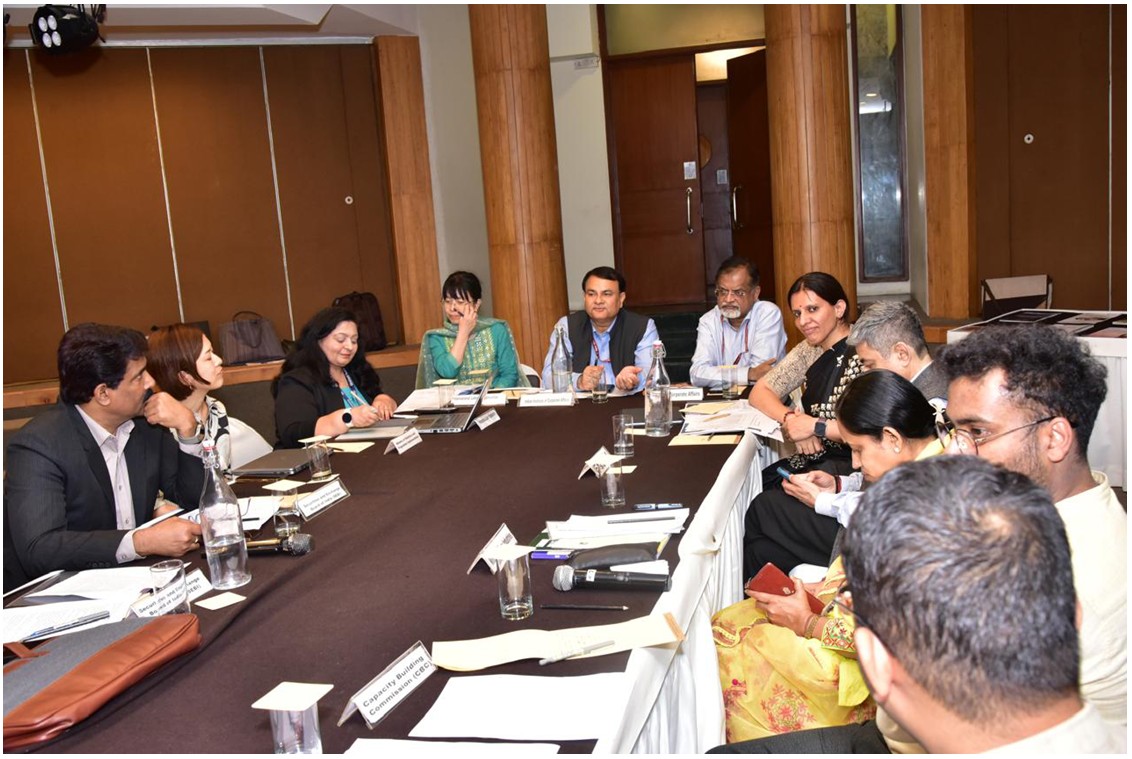
The consultation also featured a special address by Ms. Michiko Miyamoto, Director, International Labour Organisation (ILO) Decent Work Technical Support Team for South Asia and Country Office for India, he shared global perspectives and laid emphasis on India’s championing progress in responsible business conduct. Ms. Miyamoto’s address further elucidated the importance of promoting decent work, labour standards, and inclusive growth within evolving corporate sustainability frameworks.

Prof. Garima Dadhich, Head, School of Business Environment, IICA, in her presentation outlined the evolution of India’s Responsible Business Conduct (RBC) journey, highlighting key policy milestones and regulatory developments that have shaped the country’s responsible business framework. She also shared insights from IICA’s ongoing research mapping national initiatives and policy measures to the nine principles of the National Guidelines on Responsible Business Conduct (NGRBC).

The participating representatives highlighted key initiatives of the their respective ministries and governmental bodies in the deliberations:

CEO of FSSAI, Shri Ranjit Punhani, drew attention to the parallel challenges faced by the food sector in balancing responsible product standards with compliance burden, particularly around front-of-pack nutrition labelling regulations.

Shri. Rajesh Dangeti, the Chief General Manager of SEBI, noted that the BRSR Core has rationalised disclosures to the most essential social, environmental and governance indicators, and underscored that as India aspires toward a USD 30 trillion economy, sustainability disclosures may be positioned not as a compliance burden but as a tool for market differentiation and access to capital.

Further, Shri. Shiv Anant Shanker, Chief General Manager of IBBI, highlighted the unique feature of the IBC that prioritises employee wage dues in liquidation, and proposed exploring how ESG considerations can be embedded into the resolution framework to incentivise responsible business conduct.

Shri. Prashant Baijal, Joint Director, Ministry of Labour and Employment highlighted the significant structural changes being introduced through the four Labour Codes, particularly on minimum wages, appointment letters, and social security coverage. He noted that the Social Security Code abolishes the area-specific notification system for ESIC, extending coverage on a PAN India basis, and making ESIC applicable to hazardous industries regardless of workforce size.

Dr. Renuka Mishra, Economic Advisor to the Ministry of Heavy Industries, indicated that a rolling review on global supply chains for auto components is already in pipeline, and that sector-specific guidelines under the PLI scheme can play an important role in embedding responsible business standards progressively across the auto and advanced manufacturing sector.

Secretary of the Capacity Building Commission, Shri. Jaydeep Gupta, flagged that public sector entities, given their scale and visibility, can serve as important early adopters and demonstration cases for responsible business practices, creating demonstration effects for private sector supply chains.

Shri. Arvind Kumar, Senior Consultant at Ministry of MSME, Shri. Jeevan Kumar Jethani, Scientist at Ministry of New and Renewable Energy, Shri. Arindam, Director at Ministry of External Affairs, Shri. Chinnaraja Naidu, Additional Legislative Counsel at Ministry of Law and Justice, Shri. Vinod Kumar, Deputy Secretary at Ministry of Home Affairs and Shri. Samir Kumar, Joint Secretary, National Human Rights Commission collectively reflected on the cross-sectoral nature of responsible business and sustainability governance, and identified key areas for follow-up action.

Like, including the embedment of social safeguards within PLI and sectoral policy design, integration of labour data from PLFS, ESIC, and EPFO with SEBI’s BRSR disclosure framework, development of tiered and voluntary RBC compliance mechanisms for micro and small enterprises, strengthening of access to remedy mechanisms for informal and migrant workers, and the incorporation of ESG considerations into insolvency and restructuring proceedings under the IBC.

It was noted that India has made significant progress in building a robust framework for responsible business conduct through initiatives such as the National Guidelines on Responsible Business Conduct (NGRBC), SEBI’s Business Responsibility and Sustainability Reporting (BRSR) framework, the Labour Codes, and evolving sustainable finance and due-diligence mechanisms.

Insights emerging from the consultation will contribute to ongoing research and policy work being undertaken by IICA on responsible business conduct and decent work, aimed at strengthening India’s responsible business ecosystem and supporting the continued evolution of sustainability governance frameworks.

Topics

Acts Income Tax