

Loading...

Top
Help
×

By creating an account you can:

Logo TaxTMI
Call Us / Help / Feedback

Contact Us At :

E-mail: [email protected]

Call / WhatsApp at: +91 99117 96707

For more information, Check Contact Us

FAQs :

To know Frequently Asked Questions, Check FAQs

Most Asked Video Tutorials :

For more tutorials, Check Video Tutorials

Submit Feedback/Suggestion :

Email :
Please provide your email address so we can follow up on your feedback.
Category :
Description :
Min 15 characters 0/2000
Make Most of Text Search
  1. Checkout this video tutorial: How to search effectively on TaxTMI.
  2. Put words in double quotes for exact word search, eg: "income tax"
  3. Avoid noise words such as : 'and, of, the, a'
  4. Sort by Relevance to get the most relevant document.
  5. Press Enter to add multiple terms/multiple phrases, and then click on Search to Search.
  6. Text Search
  7. The system will try to fetch results that contains ALL your words.
  8. Once you add keywords, you'll see a new 'Search In' filter that makes your results even more precise.
  9. Text Search
Add to...
You have not created any category. Kindly create one to bookmark this item!
Create New Category
Hide
Title :
Description :
❮❮ Hide
Default View
Expand ❯❯
Close ✕
🔎 News - Adv. Search
TEXT SEARCH:

Press 'Enter' to add multiple search terms. Rules for Better Search

Search In:
Main Text + AI Text
  • Main Text
  • Main Text + AI Text
  • AI Text
Category: ?
Categorized by AI
---- All Categories ----
  • ---- All Categories ----
  • Income Tax
  • GST
  • Customs, DGFT & SEZ
  • FEMA & RBI
  • Corp. Laws, SEBI & IBC
  • PMLA, Black Money & ED
  • Budget
  • News and Press Release
  • PTI News
Month:
---- All Months ----
  • ---- All Months ----
  • January
  • February
  • March
  • April
  • May
  • June
  • July
  • August
  • September
  • October
  • November
  • December
Year:
---- All Years ----
  • ---- All Years ----
  • 2026
  • 2025
  • 2024
  • 2023
  • 2022
  • 2021
  • 2020
  • 2019
  • 2018
  • 2017
  • 2016
  • 2015
  • 2014
  • 2013
  • 2012
  • 2011
Sort By: ?
In Sort By 'Default', exact matches for text search are shown at the top, followed by the remaining results in their regular order.
Relevance Default Date
    Women's Savings Account: Features that make opening one worth it
    Best Pension Plans and Annuity Plans in India 2026: A Full Comparison
    Rupee rises 4 paise to 95.40 against US dollar in early trade
    Minister of State for Commerce and Industry and Electronics & Information Technology Shri Jitin Prasada Concludes Official Visit to Morocco; Co-Chairs...
    Hyderabad police caution citizens against ''Hybrid Cyber Fraud''
    Hoping to work towards further expanding scope of India-Japan trade pact: Goyal
    Bajaj Finance Personal Loan Offers Limited-Time Rewards During Loan Utsav 2026
    Commerce and Industry Minister Shri Piyush Goyal Highlights India’s Growing Startup Ecosystem at India–Japan Startup Roundtable in Tokyo
    Sugar prices rise again by Re 1 per kg to Rs 65 in retail market
    SIDBI organizes a conclave of the Heads of Regional Rural Banks (RRBs) on expanding SIDBI-RRB MSME Co-Lending arrangement
    SC sets aside show cause notice to Tata Steel over input tax credit availed during FY19-23
    HC flags fraudulent use of Aadhaar by infiltrators to get Indian citizenship; calls for action
    IVCA Welcomes Consultative Approach on Draft FEMA NDI Rules
    India to be among top 5 Nestle markets in coming years, a major export hub : Global CEO
    Build Credit Awareness with a Free Credit Score Check from Bajaj Finance
    CARD91 Introduces Five-Point Credit Lifecycle Consistency Framework for Credit Line on UPI
    RBI's Proposed Shift from Revolving Credit to Term Loans: SwiffyLabs Lending Platform Already Supports the New Construct
    The US and Canada could pull back from an all-out trade war. It's not clear that they will
    Indian Community in Japan Playing Key Role in Strengthening India-Japan Ties: Commerce and Industry Minister Shri Piyush Goyal
❯❯
Maximize Maximize Maximize
0 / 200
Expand Note
Add to Folder

No Folders have been created

+

Are you sure you want to delete "My most important" ?

NOTE:

News
Showing Results for :
Reset Filters
Results Found:
Show All Summaries Hide All Summaries
August 27, 2026
Show AI Summary
Women's savings account selection depends on practical benefits, charges, eligibility, and banking needs rather than the account label.
Women's Savings Accounts may provide standard banking facilities together with additional services or benefits for eligible women. Their suitability depends on practical use of digital banking, transfers, payments, alerts, debit-card facilities, accessibility, security features, charges, and minimum-balance conditions. Since regular Savings Accounts may offer comparable facilities, the additional benefits should be assessed against associated costs and conditions. Selection should be based on comparison of eligibility, facilities, balance requirements, benefits, customer support, and authentication safeguards rather than the account's women-focused label alone.
August 27, 2026
Show AI Summary
Retirement annuity selection prioritises payout structure, taxation, insurer strength and flexibility over brand comparison for informed retirement decisions.
Retirement planning may combine market-linked accumulation during working years, deferred annuities that lock future guaranteed income, and immediate annuities that convert retirement savings into regular payments. Annuity choice depends on whether the priority is higher income, continuation for a surviving spouse, or return of capital on death. Product comparison should consider market-linked growth versus income certainty, taxation of annuity income at applicable slab rates, insurer strength, and flexibility in deferment, payout frequency and policy loans.
August 27, 2026
Show AI Summary
Foreign exchange inflows through deposit and borrowing measures provided near-term rupee support amid lower crude prices.
Reserve Bank special measures relating to FCNR(B) deposits, Overseas Foreign Currency Borrowings and External Commercial Borrowings were identified as attracting foreign-exchange inflows and providing near-term support to the rupee. The Reserve Bank became a net dollar buyer in June after two months of sales to support the rupee. The FCNR(B) window remained open until August 31, while the market outlook anticipated broader rupee depreciation over subsequent weeks.
August 27, 2026
Show AI Summary
Preferential trade agreement exploration advances bilateral market access, pharmaceutical cooperation, investment partnerships, and diversified trade.
India-Morocco economic cooperation is expanded through the seventh Joint Commission framework, targeting deeper and more diversified trade, investment, industrial collaboration and market access across goods and services. An India-Morocco Joint Working Group is to examine bilateral trade opportunities and the feasibility of a preferential trade agreement, including tariff and non-tariff barriers, improved market access and trade facilitation. Cooperation also addresses pharmaceutical market authorisation and approval timelines, food safety, sustainable agriculture, renewable energy, artificial intelligence, healthcare, and phosphates and fertilisers.
August 26, 2026
Show AI Summary
Hybrid cyber fraud exploits stolen smartphones and intercepted verification codes to compromise digital banking and payment accounts.
Hybrid cyber fraud combines physical smartphone theft with digital financial exploitation. Offenders obtain screen-lock credentials, steal devices and use control of the active SIM card to intercept verification codes and reset UPI and digital banking credentials. Preventive measures include withholding PINs, passwords and OTPs; avoiding storage of financial and identity records on phones; and immediately blocking the SIM card and freezing digital banking and UPI services after a theft.
August 26, 2026
Show AI Summary
CEPA review aims to expand bilateral trade engagement, address export barriers, and support regulatory registrations for exporters.
India and Japan are considering a review of the Comprehensive Economic Partnership Agreement to make the bilateral trade framework more contemporary and expand its scope, scale and commercial opportunities. The review is linked to balanced trade and to identifying export barriers arising from procedural requirements, language issues and time involved in market access. Regulatory compliance assistance may support product registrations required for overseas markets, including costly chemical registrations and pharmaceutical registrations.
August 26, 2026
Show AI Summary
Personal loan reward eligibility depends on successful campaign-period disbursal, alongside review of borrowing costs and repayment capacity.
Loan Utsav 2026 provides a limited-period reward bundle to eligible customers whose personal loan is successfully disbursed during the campaign period, subject to applicable terms and conditions. Personal loans are collateral-free and available subject to eligibility, customer profile, documentation and applicable loan terms. Applicants may choose a loan amount and repayment tenure based on their requirements. Extended tenures can reduce monthly EMI obligations but may increase total interest payable. Customers should review interest rates, EMI, processing charges, other loan costs and repayment capacity before accepting a loan offer.
August 26, 2026
Show AI Summary
Deep-tech investment cooperation advances through capital corridors, innovation bridges, manufacturing integration and startup pitching platforms for cross-border growth.
India-Japan startup cooperation is proposed to advance through a deep-tech capital corridor, a two-way innovation bridge, manufacturing and technology integration, and joint startup pitching platforms. Collaboration is directed towards patient capital, early-stage research, deep-tech commercialisation, technology validation, precision manufacturing, investment and market access. The partnership also emphasises MSME integration with startups and global supply chains, co-investment mechanisms, plug-and-play infrastructure, and institutional links among universities, research institutions, incubators and industry.
August 26, 2026
Show AI Summary
Sugar price-control measures combine raw-sugar imports, stockholding limits and export restrictions to curb retail price pressures.
Sugar price-control measures combine authorised raw-sugar imports, stockholding limits for dealers and bulk consumers, and an existing export prohibition to address elevated domestic prices. Imports are permitted within the specified period, while stockholding restrictions seek to curb speculation and hoarding. Retail prices continued to rise despite lower ex-mill prices, and the regulatory approach focuses on augmenting supply, limiting stock accumulation, and preventing export-related pressure on domestic availability.
August 26, 2026
Show AI Summary
Alternative dispute resolution enabled settlement of long-pending disputes, alongside reporting on court administration and regulatory compliance concerns.
Legal developments include resolution of long-pending tenancy, commercial and property disputes through a special Lok Adalat mechanism, including a digitally signed international settlement. Other matters concern a challenge to a riot-related murder conviction, allegations of administrative irregularities and selective case listing, fast-track court pendency, cancellation of a recruitment process following suspected examination malpractice, fraudulent identity documents used to claim citizenship, medical-qualification standards, and opposition to uranium exploration and mining.
August 26, 2026
Show AI Summary
MSME co-lending supports digital paperless credit delivery through rural banks for underserved rural and semi-urban enterprises.
SIDBI-RRB MSME co-lending arrangement is proposed for expansion to increase credit access for micro, small and medium enterprises in rural and semi-urban areas. The arrangement combines SIDBI's understanding of MSME credit requirements with Regional Rural Banks' local reach. SIDBI's Co-Lending Origination Platform provides an end-to-end digital credit process intended to enable faster, paperless loan processing, in-principle sanction communication, documentation and direct account disbursement without branch visits.
August 26, 2026
Show AI Summary
Input tax credit mismatch alone cannot support fraud-based GST demand without an assessing officer's recorded satisfaction of fraud or suppression.
Section 74 GST demand proceedings require the assessing officer's independent satisfaction of fraud, wilful misstatement or suppression of facts. An input tax credit mismatch or alleged short payment alone cannot establish these conditions. Unsupported assertions of suppression for invoking extended limitation are insufficient, and audit objections cannot replace the assessing officer's satisfaction. A show cause-cum-demand notice lacking factual allegations of a deliberate device to evade tax or avail excess input tax credit is vulnerable.
August 26, 2026
Show AI Summary
Fraudulent Aadhaar procurement exposes identity-verification gaps and prompts disclosure, expedited investigation, deportation, and statutory review measures.
Fraudulent procurement of Aadhaar and other identity documents by foreign nationals who infiltrate borders may undermine identity verification, immigration control and national security. Coordinated action is required to trace and deport such persons, prevent re-entry, strengthen document verification, and complete investigations without delay. Amendments to the Aadhaar Act are to be considered to assist investigating agencies, while a dedicated procedure is required to address border infiltration and human trafficking. Aadhaar enrolment records are to be supplied to police, followed by timely deportation proceedings.
August 26, 2026
Show AI Summary
Foreign investment liberalisation proposals receive industry support, subject to preserving AIF treatment, grandfathering, and prospective application.
Proposed foreign-investment liberalisation, including treatment of stakes below 10 per cent and a greater role for market forces in valuation, is welcomed. Preservation of the existing treatment of Alternative Investment Funds under the IOCC framework is emphasised, together with grandfathering of transactions and funds undertaken under the current regulatory position. Newly introduced requirements should operate prospectively to support a simpler, predictable and investment-friendly foreign-investment framework.
August 26, 2026
Show AI Summary
India market expansion guides Nestle 's volume-led growth, export-hub development and long-term investment without compromising product quality.
Nestle 's India strategy focuses on volume-led growth, wider consumer reach, portfolio development, efficiency improvements and sustained long-term investment. Growth is intended to combine increased household penetration with pricing, premiumisation, affordability and value offerings. India is also intended to develop further as a production and export hub for global markets, supported by manufacturing capacity and expanding overseas supplies. Product quality and consumer interests remain constraints on the pace of expansion.
August 26, 2026
Show AI Summary
Credit awareness through regular score and report review supports responsible borrowing, error detection, and informed credit management.
Free online access to the Credit Pulse Report is available through the Bajaj Finance website. Users verify their registered mobile number through OTP authentication, provide identifying particulars including PAN and date of birth, and then view the available credit score. The report may be reviewed and downloaded to examine repayment history, active credit accounts, recent enquiries and other recorded credit information. Periodic review can help identify unfamiliar accounts, inaccurate repayment records, overdue amounts, unupdated information and changes in credit utilisation.
August 26, 2026
Show AI Summary
Credit lifecycle consistency requires facility-specific treatment so UPI-linked credit records, repayments and customer obligations remain aligned.
CARD91's Credit Lifecycle Consistency Framework calls for facility-specific treatment of Credit Line on UPI transactions and continuing credit events. Credit limits, outstanding balances, repayments, refunds, reversals and EMI conversions should be accurately connected to the relevant customer account and applied according to the underlying facility's terms. Bank policy, customer consent, transaction controls and portfolio actions should remain aligned. Customer-facing applications, statements and alerts should consistently reflect available credit, outstanding obligations and repayment schedules, while disputes and manual corrections follow documented, reviewable processes.
August 26, 2026
Show AI Summary
Non-revolving credit lines require term-loan structures supporting multiple drawdowns without replenishing sanctioned limits for NBFC lending products.
Proposed restrictions on revolving credit facilities for most NBFCs would generally require credit products to operate as term loans, rather than facilities in which principal repayment automatically restores the available borrowing limit. Compliance may require technology capable of managing multiple drawdowns within an approved sanction, separate repayment schedules, amortisation and servicing workflows, while preventing repaid principal from replenishing the sanctioned limit.
August 26, 2026
Show AI Summary
Reciprocal trade tariffs intensify as negotiations confront market access, cultural protections, industrial safeguards, and sovereignty concerns.
US-Canada tariff escalation involves reciprocal import duties following failed negotiations over market access and trade in dairy, alcoholic beverages, automobiles, steel, aluminium and softwood lumber. United States tariff action relies on a rarely used trade-law power permitting duties against countries considered to discriminate against American businesses, without a prior investigation or stated time limit. Negotiations also raised concerns about protection of major industries, cultural protections and Canada's freedom to conclude trade agreements with other countries.
August 26, 2026
Show AI Summary
Diaspora engagement supports skilled mobility, investment links, remittances, and citizen welfare while encouraging compliance with local laws.
Indian diaspora engagement in Japan supports bilateral goodwill, business links, investment opportunities and people-to-people ties. Skilled Indian professionals are encouraged to understand local requirements, learn Japanese language and culture, and pursue opportunities in healthcare, trades, engineering, artificial intelligence, accountancy and maritime work. Diaspora members are also encouraged to maintain connections with India, contribute through digital education and knowledge-sharing, and comply with local laws and regulations. Remittances and government support for citizens' welfare, safety and crisis assistance abroad are recognised as important aspects of diaspora engagement.

News

Back

All News

Showing Results for :
Reset Filters
No Records Found

News

Showing Results for : Reset Filters
Corp. Laws, SEBI & IBC

IICA Convenes Fifth Inter-Ministerial Consultation on Responsible Business Conduct and Social Dimension of ESG

March 16, 2026

Contents
Acts
Summary
Note

Note

-

Bookmark

Print

Print

The Indian Institute of Corporate Affairs (IICA), under Ministry of Corporate Affairs, Government of India, convened the Fifth Inter-Ministerial Consultation on Responsible Business Conduct (RBC) and the Social Dimension of Environmental, Social and Governance (ESG) recently in New Delhi.

The consultation was organised by the School of Business Environment (SoBE), IICA, in collaboration with the International Labour Organisation (ILO) to strengthen policy coherence and institutional coordination on responsible business conduct and sustainability governance in India.

The Workshop commenced under the chairmanship of Shri Gyaneshwar Kumar Singh, Director General and CEO, Indian Institute of Corporate Affairs, who highlighted the growing significance of responsible business conduct in the context of evolving global supply chains and sustainability expectations. Mr Singh noted that responsible business practices today extend beyond corporate reporting frameworks and are increasingly linked to economic competitiveness, sustainable development, and international trade integration. 

Shri Shantanu Mitra, Senior Economic Advisor, Ministry of Corporate Affairs, delivered an address that highlighted the policy significance of responsible business conduct within India’s corporate governance ecosystem and its growing relevance for businesses operating within global value chains. Shri. Mitra concluded that the mandate of responsible business is inbuilt in various provisions of the Companies Act 2013 and Ministry of Corporate Affairs is steadfast in ensuring that the statutory framework remains conducive for new age businesses and serves as a global benchmark for statutory and regulatory compliance.
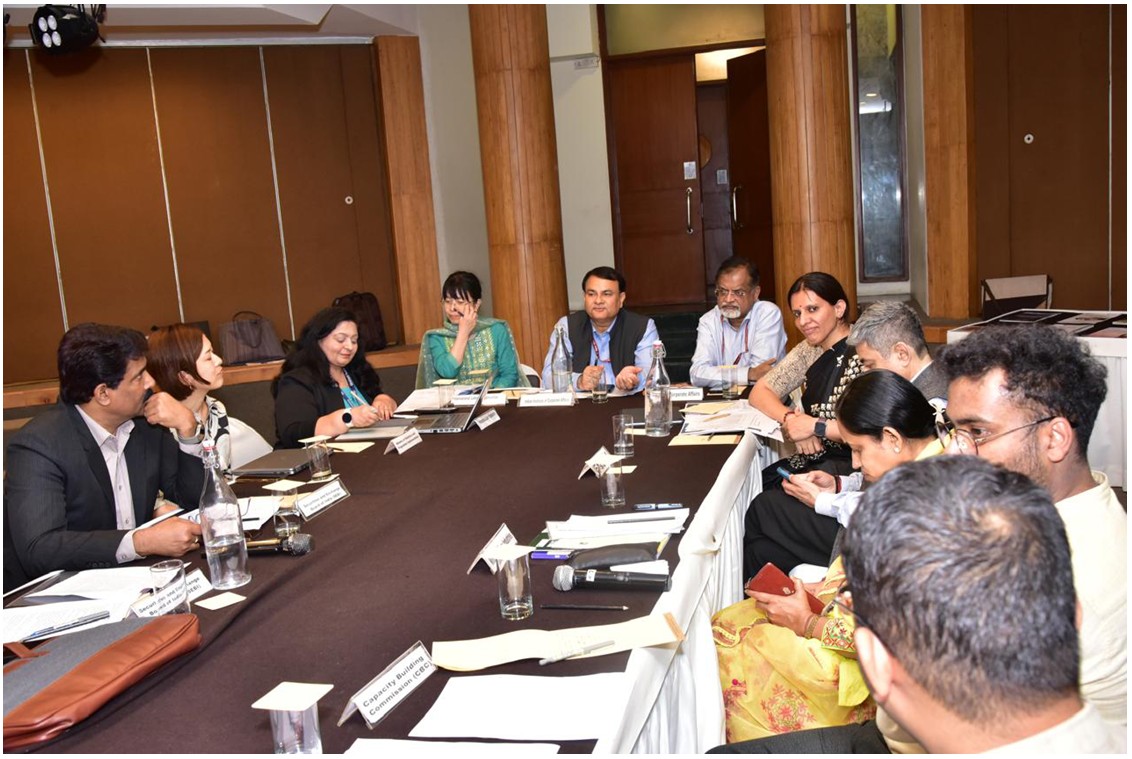
The consultation also featured a special address by Ms. Michiko Miyamoto, Director, International Labour Organisation (ILO) Decent Work Technical Support Team for South Asia and Country Office for India, he shared global perspectives and laid emphasis on India’s championing progress in responsible business conduct. Ms. Miyamoto’s address further elucidated the importance of promoting decent work, labour standards, and inclusive growth within evolving corporate sustainability frameworks.

Prof. Garima Dadhich, Head, School of Business Environment, IICA, in her presentation outlined the evolution of India’s Responsible Business Conduct (RBC) journey, highlighting key policy milestones and regulatory developments that have shaped the country’s responsible business framework. She also shared insights from IICA’s ongoing research mapping national initiatives and policy measures to the nine principles of the National Guidelines on Responsible Business Conduct (NGRBC).

The participating representatives highlighted key initiatives of the their respective ministries and governmental bodies in the deliberations:

CEO of FSSAI, Shri Ranjit Punhani, drew attention to the parallel challenges faced by the food sector in balancing responsible product standards with compliance burden, particularly around front-of-pack nutrition labelling regulations.

Shri. Rajesh Dangeti, the Chief General Manager of SEBI, noted that the BRSR Core has rationalised disclosures to the most essential social, environmental and governance indicators, and underscored that as India aspires toward a USD 30 trillion economy, sustainability disclosures may be positioned not as a compliance burden but as a tool for market differentiation and access to capital.

Further, Shri. Shiv Anant Shanker, Chief General Manager of IBBI, highlighted the unique feature of the IBC that prioritises employee wage dues in liquidation, and proposed exploring how ESG considerations can be embedded into the resolution framework to incentivise responsible business conduct.

Shri. Prashant Baijal, Joint Director, Ministry of Labour and Employment highlighted the significant structural changes being introduced through the four Labour Codes, particularly on minimum wages, appointment letters, and social security coverage. He noted that the Social Security Code abolishes the area-specific notification system for ESIC, extending coverage on a PAN India basis, and making ESIC applicable to hazardous industries regardless of workforce size.

Dr. Renuka Mishra, Economic Advisor to the Ministry of Heavy Industries, indicated that a rolling review on global supply chains for auto components is already in pipeline, and that sector-specific guidelines under the PLI scheme can play an important role in embedding responsible business standards progressively across the auto and advanced manufacturing sector.

Secretary of the Capacity Building Commission, Shri. Jaydeep Gupta, flagged that public sector entities, given their scale and visibility, can serve as important early adopters and demonstration cases for responsible business practices, creating demonstration effects for private sector supply chains.

Shri. Arvind Kumar, Senior Consultant at Ministry of MSME, Shri. Jeevan Kumar Jethani, Scientist at Ministry of New and Renewable Energy, Shri. Arindam, Director at Ministry of External Affairs, Shri. Chinnaraja Naidu, Additional Legislative Counsel at Ministry of Law and Justice, Shri. Vinod Kumar, Deputy Secretary at Ministry of Home Affairs and Shri. Samir Kumar, Joint Secretary, National Human Rights Commission collectively reflected on the cross-sectoral nature of responsible business and sustainability governance, and identified key areas for follow-up action.

Like, including the embedment of social safeguards within PLI and sectoral policy design, integration of labour data from PLFS, ESIC, and EPFO with SEBI’s BRSR disclosure framework, development of tiered and voluntary RBC compliance mechanisms for micro and small enterprises, strengthening of access to remedy mechanisms for informal and migrant workers, and the incorporation of ESG considerations into insolvency and restructuring proceedings under the IBC.

It was noted that India has made significant progress in building a robust framework for responsible business conduct through initiatives such as the National Guidelines on Responsible Business Conduct (NGRBC), SEBI’s Business Responsibility and Sustainability Reporting (BRSR) framework, the Labour Codes, and evolving sustainable finance and due-diligence mechanisms.

Insights emerging from the consultation will contribute to ongoing research and policy work being undertaken by IICA on responsible business conduct and decent work, aimed at strengthening India’s responsible business ecosystem and supporting the continued evolution of sustainability governance frameworks.

Topics

Acts Income Tax
