

Loading...

Top
Help
×

By creating an account you can:

Logo TaxTMI
Call Us / Help / Feedback

Contact Us At :

E-mail: [email protected]

Call / WhatsApp at: +91 99117 96707

For more information, Check Contact Us

FAQs :

To know Frequently Asked Questions, Check FAQs

Most Asked Video Tutorials :

For more tutorials, Check Video Tutorials

Submit Feedback/Suggestion :

Email :
Please provide your email address so we can follow up on your feedback.
Category :
Description :
Min 15 characters 0/2000
Make Most of Text Search
  1. Checkout this video tutorial: How to search effectively on TaxTMI.
  2. Put words in double quotes for exact word search, eg: "income tax"
  3. Avoid noise words such as : 'and, of, the, a'
  4. Sort by Relevance to get the most relevant document.
  5. Press Enter to add multiple terms/multiple phrases, and then click on Search to Search.
  6. Text Search
  7. The system will try to fetch results that contains ALL your words.
  8. Once you add keywords, you'll see a new 'Search In' filter that makes your results even more precise.
  9. Text Search
Add to...
You have not created any category. Kindly create one to bookmark this item!
Create New Category
Hide
Title :
Description :
❮❮ Hide
Default View
Expand ❯❯
Close ✕
🔎 News - Adv. Search
TEXT SEARCH:

Press 'Enter' to add multiple search terms. Rules for Better Search

Search In:
Main Text + AI Text
  • Main Text
  • Main Text + AI Text
  • AI Text
Category: ?
Categorized by AI
---- All Categories ----
  • ---- All Categories ----
  • Income Tax
  • GST
  • Customs, DGFT & SEZ
  • FEMA & RBI
  • Corp. Laws, SEBI & IBC
  • PMLA, Black Money & ED
  • Budget
  • News and Press Release
  • PTI News
Month:
---- All Months ----
  • ---- All Months ----
  • January
  • February
  • March
  • April
  • May
  • June
  • July
  • August
  • September
  • October
  • November
  • December
Year:
---- All Years ----
  • ---- All Years ----
  • 2026
  • 2025
  • 2024
  • 2023
  • 2022
  • 2021
  • 2020
  • 2019
  • 2018
  • 2017
  • 2016
  • 2015
  • 2014
  • 2013
  • 2012
  • 2011
Sort By: ?
In Sort By 'Default', exact matches for text search are shown at the top, followed by the remaining results in their regular order.
Relevance Default Date
    West Bengal tourist missing near Kupwara LoC amid fake Aadhaar probe
    From machines to brands, Indians should control lab-grown diamond ecosystem, says Amit Shah
    Eliminating non-tariff barriers, smooth payment mechanism key to boosting BRICS trade: EEPC India
    7 years on, insurer ordered to pay Rs 8.06 cr to Swiss firm subsidiary in fire claim dispute
    Delhi HC to pass order on Monday on Vimal Elaichi makers’ plea seeking to quash show-cause notices against actors
    BRICS adopts landmark declaration as PM Modi calls to replace 'pyramid of privilege' in global governance
    Following are the top foreign stories at 2030 hours
    RBI rejects Tata Sons' bid to surrender NBFC licence, setting stage for mandatory listing
    BRICS adopts New Delhi Declaration with consensus, skips mentioning US attack on Iran
    RBI rejects Tatas'€™ bid to surrender NBFC licence, group will have to list on bourses: Sources
    BRICS leaders oppose 'punitive, discriminatory’ carbon border taxes
    RBI rejects Tata Sons' bid to surrender NBFC licence, say sources
    US finalises levies on solar cell imports from India, Indonesia, Laos
    BRICS hits unilateral tariffs, CBAM as protectionist, demands fairer global trade rules
    BRICS adopts New Delhi Declaration with consensus, skips mentioning US on West Asia crisis
    BRICS urges IMF, World Bank reforms, hits unilateral tariffs and sanctions
    BRICS finance chiefs push for deeper financial cooperation; IMF, World Bank reforms
    India-China trade: A snapshot
    RBI invites comments on the Draft “Reserve Bank of India (Know Your Customer) Amendment Directions, 2026”
    Parbhani civic staffers suspend strike after agreement on pending salaries of two months
❯❯
Maximize Maximize Maximize
0 / 200
Expand Note
Add to Folder

No Folders have been created

+

Are you sure you want to delete "My most important" ?

NOTE:

News
Showing Results for :
Reset Filters
Results Found:
Show All Summaries Hide All Summaries
September 13, 2026
Show AI Summary
Identity verification concerns arose after a tourist disappeared near the border, triggering missing-person search and phone tracking.
Identity verification concerns arose after a tourist went missing from Teetwal near the Line of Control. His Aadhaar card was allegedly found to be fake after he left it and other belongings at a guest house. Local authorities registered a missing-person report and initiated a search. Cellphone tracking indicated that his phone was active elsewhere along the Jammu-Srinagar highway.
September 13, 2026
Show AI Summary
Lab-grown diamond ecosystem policy promotes domestic control, global branding, and incentives for rough diamond trading.
Lab-grown diamond sector development is directed toward Indian control of the full value chain, including machinery, production, jewellery, brands and overseas retail. Central and state-level policy support is contemplated to expand domestic capacity, exports and global market participation. Rough diamond trading companies operating in special notified zones are stated to receive a 15-year income-tax exemption, supporting the objective of establishing India as a rough diamond trading hub. Infrastructure, jewellery parks, stamp-duty waivers, affordable electricity, connectivity and free trade agreements are identified as supporting measures.
September 13, 2026
Show AI Summary
Non-tariff barrier elimination and efficient national-currency payments are identified as central measures for expanding BRICS engineering trade.
BRICS trade facilitation is proposed through elimination of non-tariff barriers, adoption of mutually agreed standards, and efficient payment mechanisms in individual national currencies. EEPC India advocates a common agreement among BRICS members to simplify regulatory procedures and move discussions on non-tariff measures towards implementation. Reducing such barriers is presented as capable of increasing BRICS participation in cross-border trade and supporting engineering exports.
September 13, 2026
Show AI Summary
Technical repudiation of fire insurance claims is unsustainable where assessed loss and compliance evidence remain undisputed.
Technical repudiation of a fire insurance claim was treated as legally unsustainable where the insurer had assessed the fire loss, did not dispute its occurrence or quantum, and relied only on alleged procedural non-compliance. Email records and virtual conferences showed repeated efforts by the insured to provide requested material. In the absence of substantive disagreement regarding the assessed fire loss or fraudulent intent, rejection solely for procedural shortcomings was characterised as an unfair trade practice and a deficiency in service.
September 13, 2026
Show AI Summary
Territorial jurisdiction over surrogate advertising notices is contested where regulatory directions target brand ambassadors rather than the advertiser.
Territorial jurisdiction over show-cause notices alleging surrogate advertising of Vimal Pan Masala through Vimal Elaichi endorsements is contested before the Delhi High Court. PB Agro LLP maintains that directions to provide documentation, stop the campaign and remove digital promotional material were issued only to brand ambassadors, without hearing the company. It disputes the state regulator's jurisdiction and asserts that Vimal Elaichi is distinct from pan masala. The Centre and the Central Consumer Protection Authority contend that the Bombay High Court has territorial jurisdiction.
September 12, 2026
Show AI Summary
Global governance reform prioritises representation, responsiveness and rule-making while addressing trade restrictions, conflict, terrorism and seafarer protection.
Global governance reform is pursued through a BRICS roadmap focused on representation, responsiveness and rule-making, with greater participation for the Global South. BRICS also raises concerns about tariffs, non-tariff measures, protectionism, unilateral sanctions and coercive measures that may disrupt trade, supply chains and energy security. The agenda supports dialogue and diplomacy in West Asia, zero tolerance for terrorism, and a Seafarers' Emergency Support Network to coordinate distress alerts, medical aid, family notifications and evacuations.
September 12, 2026
Show AI Summary
Trade sanctions and import duties shape proposed Russia measures and solar import restrictions affecting India and other trading partners.
Trade-related developments include proposed sanctions on Russia coupled with tariffs on its trading partners, including India, and final anti-dumping and countervailing duties on solar-cell and panel imports from India, Indonesia and Laos. The duties are linked to allegations of unfair government subsidies and injury to domestic industry. Cross-border cooperation also concerns repatriation of trafficked orangutans, climate security, trade, infrastructure and resumed passenger air connectivity between Guangzhou and New Delhi.
September 12, 2026
Show AI Summary
Upper Layer NBFC Classification Triggers Mandatory Listing After Deregistration Request Is Rejected for a Private Holding Company.
Rejection of the application to surrender Core Investment Company registration reportedly keeps Tata Sons within the NBFC framework as an Upper Layer NBFC. The classification imposes enhanced regulatory obligations, including mandatory stock-exchange listing for privately held entities. Revised norms provide for automatic Upper Layer inclusion where an NBFC meets the prescribed asset threshold. Any listing would entail regular public disclosures and greater scrutiny of finances, investments and capital allocation. Enhanced Upper Layer requirements continue for at least five years after listing, even if qualifying thresholds are later no longer met.
September 12, 2026
Show AI Summary
Trade-restrictive actions and unilateral sanctions are opposed as members promote lawful commerce, diplomacy, and counterterrorism cooperation.
Trade policy commitments express concern over trade-restrictive actions inconsistent with WTO rules, including indiscriminate tariffs, unilateral tariff and non-tariff measures, and protectionism presented as environmental action. Unilateral coercive measures, including unilateral economic and secondary sanctions contrary to international law, are condemned for adverse human-rights implications, with a call for their elimination. Counterterrorism cooperation requires zero tolerance, rejection of double standards, accountability for terrorist activity and support, and compliance with international-law obligations.
September 12, 2026
Show AI Summary
Upper-layer NBFC listing requirements apply after licence-surrender rejection, making public market listing mandatory for the holding company.
Reported rejection of Tata Sons' application to surrender its NBFC licence leaves it classified as an upper-layer NBFC and subject to mandatory public listing. The deregistration application was reportedly declined because necessary criteria were not met. The upper-layer NBFC framework identifies entities requiring compulsory listing and automatically includes NBFCs with assets above the prescribed threshold.
September 12, 2026
Show AI Summary
Carbon border adjustment mechanisms are criticised as unilateral, discriminatory trade measures affecting carbon-intensive imports from developing economies.
Carbon border adjustment mechanisms are characterised as unilateral, punitive, discriminatory and protectionist measures inconsistent with international law, with concern that they may undermine developing countries' climate-change adaptation and resilience efforts. Such mechanisms impose additional import duties on carbon-intensive goods according to emissions generated in manufacture and may affect iron and steel, cement, fertiliser and aluminium exports.
September 12, 2026
Show AI Summary
Upper-layer NBFC listing requirements may require Tata Sons to pursue public markets after deregistration request rejection.
Reported rejection of Tata Sons' application to surrender its non-banking financial company licence is attributed to failure to satisfy applicable deregistration criteria. The company is consequently described as remaining classified as an upper-layer NBFC, a classification carrying a mandatory public-markets listing requirement. The reported position makes a listing of the holding company imminent.
September 12, 2026
Show AI Summary
Anti-dumping and countervailing duties on solar imports await final injury findings before duty orders or investigation termination.
United States final affirmative determinations in anti-dumping and countervailing duty investigations concerning crystalline silicon photovoltaic cells and panels imported from India, Indonesia and Laos establish dumping margins and countervailing duty rates. A final injury determination remains necessary before duty orders may be issued. An affirmative injury determination will lead to anti-dumping and countervailing duty orders based on the established rates, while a negative determination will terminate the investigations.
September 12, 2026
Show AI Summary
Multilateral trade reform challenges unilateral tariffs, carbon border measures, and sanctions while advancing equitable market access.
BRICS opposes unilateral tariff and non-tariff measures that distort trade, disrupt supply chains and widen economic disparities. It also rejects unilateral, punitive, discriminatory or protectionist carbon border adjustment mechanisms that can restrict developing countries' market access and undermine climate-adaptation and resilience efforts. BRICS supports an open, equitable and rules-based multilateral trading system, including restoration of an accessible two-tier binding dispute-settlement mechanism. Its wider agenda links trade reform with resilient supply chains, sovereign control over critical minerals, higher-value manufacturing participation, and improved finance for export-oriented small businesses.
September 12, 2026
Show AI Summary
Consensus-based multilateral cooperation urges West Asia diplomacy, civilian protection, counterterrorism coordination, and WTO-consistent trade without unilateral restrictions.
The consensus New Delhi Declaration calls for maximum restraint in West Asia, civilian protection, and dialogue and diplomacy for lasting regional peace. It urges cooperation to maintain global trade, supply chains and energy flows under applicable international law. It also commits members to zero tolerance for terrorism, including cross-border terrorism, terrorism financing and safe havens, while rejecting double standards. Unilateral tariff and non-tariff measures, indiscriminate tariff increases, and environmental protectionism are criticised where inconsistent with WTO rules or trade-distorting.
September 12, 2026
Show AI Summary
Multilateral trade governance faces calls for restored binding dispute settlement, opposition to unilateral tariffs and sanctions, and financial institution reform.
BRICS supports a rules-based multilateral trading system and seeks restoration of an accessible, effective, fully functioning two-tier binding dispute-settlement mechanism, including prompt appointment of Appellate Body members. It opposes unilateral tariff and non-tariff measures, trade restrictions, and economic or secondary sanctions not authorised by the UN Security Council. It also seeks reform of International Monetary Fund and World Bank governance through greater representation, quota and shareholding realignment, and increased voting power for emerging markets and developing economies.
September 12, 2026
Show AI Summary
Global financial governance reform seeks greater emerging-economy representation, alongside expanded development finance, liquidity support and payment cooperation.
BRICS finance ministers and central bank governors seek reform of global financial governance to increase emerging-market and developing-economy representation in the International Monetary Fund and World Bank. The agenda includes quota realignment, transparent leadership selection and correction of developing-country underrepresentation. Cooperation also supports expanded New Development Bank financing, local-currency lending, a multilateral guarantees mechanism, and a more flexible Contingent Reserve Arrangement for liquidity support during balance-of-payments pressures.
September 12, 2026
Show AI Summary
Cross-border supply-chain dependence shapes imports of industrial inputs, while foreign investment screening remains stricter for land-border linked entities.
India-China trade reflects a widening deficit driven by imports of industrial raw materials, intermediate goods and capital goods used in manufacturing. Dependence is concentrated in electronics, machinery, computers, organic chemicals, electronic components, batteries, solar modules, active pharmaceutical ingredients and specialty chemicals. Foreign direct investment norms are relaxed for certain companies outside land-border countries where beneficial ownership from such countries remains below the specified threshold and non-controlling. Entities registered in China, Hong Kong and other land-border countries remain excluded from that relaxation.
September 12, 2026
Show AI Summary
Temporary debit holds for suspected money-mule and cyber-fraud accounts are proposed through a standardised banking procedure.
Draft Reserve Bank of India (Know Your Customer) Amendment Directions, 2026 propose a Standard Operating Procedure for banks to place temporary debit holds on amounts or accounts linked to money-mule activity and cyber-enabled financial fraud. The consolidated draft applies to commercial banks, including small finance banks, payments banks, regional rural banks and local area banks, and to urban cooperative banks. Feedback may be submitted through the Reserve Bank's Connect 2 Regulate portal or by email before final directions are issued separately.
September 11, 2026
Show AI Summary
Municipal salary arrears and GST grant demands prompted temporary strike suspension after payment and committee assurances.
Municipal employees temporarily suspended their strike after the administration committed to pay two months' pending salaries by September 15 and arrange clearance of remaining salary arrears within 30 days. The employees had sought payment of salary arrears, increased GST grants to the civic body, and release of the outstanding difference in GST grants. A committee is to pursue the pending GST grant proposals at the government level.

News

Back

All News

Showing Results for :
Reset Filters
No Records Found

News

Back

All News

Showing Results for : Reset Filters

INDIA’S GDP GROWTH FOR FY26 IS ESTIMATED AT 7.4 PER CENT DRIVEN BY THE DOUBLE ENGINE OF CONSUMPTION AND INVESTMENT

January 29, 2026

Contents
Summary
Note

Note

-

Bookmark

Print

Print

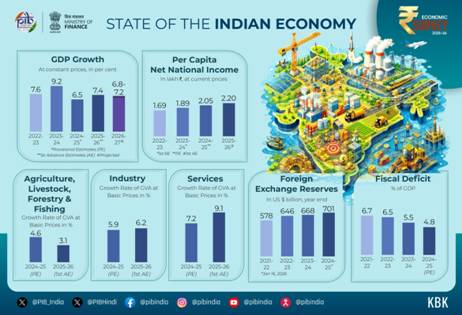
REAL GDP GROWTH FOR FY27 IS PROJECTED AT 6.8-7.2 PER CENT

PRIVATE FINAL CONSUMPTION EXPENDITURE IN GDP RISES TO 61.5 PER CENT IN FY26

AGRICULTURE AND ALLIED SERVICES ARE ESTIMATED TO GROW BY 3.1 PER CENT IN FY26

INDUSTRIAL SECTOR SHOWING SIGNS OF STRENGTH, WITH MANUFACTURING GROWING BY 8.4 PER CENT IN THE FIRST HALF OF FY26

GROSS VALUE ADDED FOR SERVICES INCREASES BY 9.3 PER CENT IN FIRST HALF OF FY 26

GROSS NON-PERFORMING ASSET RATIOS DECLINES TO MULTI-DECADE LOW OF 2.2 PER CENT

INDIA’S TOTAL EXPORTS (MERCHANDISE AND SERVICES) REACH A RECORD USD 825.3 BILLION IN FY25

INDIA CONCLUDES FREE TRADE AGREEMENT WITH THE EUROPEAN UNION AFTER THREE YEARS OF NEGOTIATIONS


India’s GDP growth for FY26 is estimated at 7.4 per cent driven by the double engine of consumption and investment. It reaffirms India’s status as the fastest-growing major economy for the fourth consecutive year. This was highlight of the Economic Survey 2025-26 tabled by the Union Minister for Finance and Corporate Affairs, Smt. Nirmala Sitharaman in Parliament today.

The Survey says the real GDP growth for FY27 is projected at 6.8-7.2 per cent, while the potential growth for India is estimated at around 7 per cent.

The Survey points out that the domestic demand continues to underpin economic growth in FY26. According to the First Advanced Estimate, the share of final private consumption expenditure (PFCE) in GDP rose to 61.5 per cent in FY26. This strength in consumption reflects a supportive macroeconomic environment, characterised by low inflation, stable employment conditions, and rising real purchasing power. Moreover, steady rural consumption, bolstered by strong agricultural performance, and the gradual improvement in urban consumption, aided by the rationalisation of direct and indirect taxes, reaffirm that the momentum in consumption demand is broad-based.

Along with consumption, investment has continued to anchor growth in FY26, with the share of gross fixed capital formation (GFCF) estimated at 30.0 per cent. Investment activity strengthened in the first half of the year, with, GFCF expanding by 7.6 per cent, exceeding the pace recorded in the corresponding period last year and remaining above the pre-pandemic average of 7.1 per cent.
State-of-the-Indian-Economy.jpg

The Survey highlights that Agriculture and allied services are estimated to grow by 3.1 per cent in FY26. Agricultural activity in first half of FY26 was supported by a favourable monsoon. Agricultural GVA grew by 3.6 per cent, higher than the 2.7 per cent growth recorded in first half of FY25, but remained below the long-term average of 4.5 per cent. Allied activities, particularly livestock and fisheries, have grown at relatively stable rates of around 5-6 per cent. As their share in agricultural GVA has increased, aggregate agricultural growth has increasingly reflected a weighted outcome of volatile crop performance and a relatively stable expansion in allied sectors.

The Economic Survey mentions that the industrial sector is showing signs of strength, with manufacturing growing by 8.4 per cent in the first half of FY26, surpassing the FY26 estimate of 7.0 per cent. Additionally, the construction industry has remained resilient, underpinned by sustained public capital expenditure and ongoing momentum in infrastructure projects. The manufacturing sector share has remained steady at around 17-18 per cent in real (constant) price terms. Manufacturing’s gross value of output (GVO) has remained broadly stable at around 38 per cent, comparable to services, indicating that output has been sustained. Moreover, in FY26, the industrial sector is expected to gain momentum, growing at 6.2 per cent, up from 5.9 per cent in FY25. The high-frequency indicators for Q3 of FY26, including the PMI manufacturing, IIP manufacturing, and e-way bill generation, signal a strengthening of manufacturing activity underpinned by robust demand. Construction indicators, such as steel consumption and cement production, have witnessed a steady growth. Looking ahead, momentum in industrial activity is expected to remain buoyant, boosted by the rationalisation of GST and a favourable demand outlook.

The Economic Survey highlights that on the supply side, services remain the main driver of growth. In the first half of FY26, the Gross Value Added (GVA) for services increased by 9.3 per cent, with an estimated 9.1 per cent growth for the entire fiscal year. This trend indicates a broad-based expansion across the sector. Within the service sector, all sub-segments have grown past 9 per cent, save for the heavily Covid-impacted ‘trade, hospitality, transport, communication and related services, which is still 50 basis points away from the pre-pandemic average.

The Economic Survey mentions demand-led growth in the economy has unfolded alongside a marked easing of inflation, which has improved real purchasing power and supported consumption. Domestic inflation dynamics in FY26 (April-December) reflect a broad-based easing in price pressures, led by a sharp disinflation in food prices. Headline CPI inflation declined to 1.7 per cent, driven primarily by corrections in vegetable and pulse prices, supported by favourable farm conditions, supply-side interventions, and a strong base effect. While core inflation has exhibited persistence, this has been largely influenced by price spikes in precious metals; adjusting for these, underlying inflation pressures appear materially softer, indicating limited demand-side overheating. Looking ahead, the inflation outlook remains benign, supported by favourable supply side conditions and the gradual pass-through of GST rate rationalisation.

The Survey states that the momentum in domestic demand and capital formation observed in FY26 has been underpinned by a prudent fiscal policy strategy, characterised by steady revenue mobilisation and calibrated expenditure rationalisation. The gross tax revenue collection has progressed resiliently during the year, with direct tax collections reaching nearly 53 per cent of the budgeted annual target (as on November 2025). Indirect tax collections also remained robust despite lower inflation and import volatility, with gross GST collections in absolute terms recording multiple all-time highs during the year. Recent tax policy reforms, including the restructuring of personal income tax and the rationalisation of the GST rate, have supported consumption demand while sustaining revenues in absolute terms. On the expenditure side, capital outlays recorded a strong year-over-year increase, reaching nearly 60 per cent of the budgeted allocation by November 2025. Also, the growth in revenue expenditure remained contained, reinforcing the quality of public spending.

Markets have acknowledged and rewarded the government’s commitment to fiscal discipline through lower sovereign bond yields, with the spread over U.S. bonds declining by more than half . Alongside a lower repo rate, these declining yields, which serve as benchmarks for borrowing costs across the economy, will itself act as a fiscal stimulus. Credit ratings agency, S&P Ratings, has acknowledged the credibility of and the commitment to the fiscal glide path, while upgrading India’s rating from ‘BBB-’ to ‘BBB’. CareEdge Global, in initiating its coverage of India, too assigned a ‘BBB+’ rating, underscoring India’s robust economic performance and fiscal discipline.

Alongside the fiscal stimulus provided by higher public capital expenditure and tax reductions, monetary support was delivered through a cumulative reduction of 125 basis points in the policy repo rate since February 2025 (as inflationary pressures moderated), complemented by an injection of durable liquidity via cash reserve ratio cuts (₹ 2.5 lakh crore), open market operations (₹6.95 lakh crore) and forex swap of around $25 billion. These measures have been effectively transmitted to the banking system. The weighted average lending rate (WALR) on fresh Rupee loans by scheduled commercial banks declined by 59 basis points (bps), while the WALR on outstanding Rupee loans declined by 69 bps between February and November 2025. Concurrently, the banking sector has further strengthened its balance sheets, with gross non-performing asset (NPA) ratios declining to multi-decade lows of 2.2 per cent, the half-yearly slippage ratio remaining stable at 0.7 per cent, and profitability improving, supported by higher profit after tax and robust net interest margins.

The Economic Survey mentions that against a backdrop of global trade uncertainty, India’s total exports (merchandise and services) reached a record USD 825.3 billion in FY25, with continued momentum in FY26. Despite heightened tariffs imposed by the United States, merchandise exports grew by 2.4 per cent (April–December 2025), while services exports increased by 6.5 per cent. Merchandise imports for April-December 2025 increased by 5.9 per cent. Following the trends in previous years, the rise in merchandise trade deficit has been counterbalanced by an increase in services trade surplus, while the growth in remittances has bolstered this balance. In most years, remittances have surpassed gross FDI inflows, underscoring their importance as a key source of external funding. As a result, the current account deficit remains moderate at 0.8 per cent of GDP in H1 FY26.

India’s external sector is placed comfortably in the short run. Forex reserves cover over 11 months of imports as of 16 January 2026 and approximately 94.0 per cent of the external debt outstanding as of the end of September 2025, offering a comfortable liquidity cushion. The pursuit of a diversified trade strategy, as evidenced by the signing of trade agreements with the UK, Oman, and New Zealand, and the recently concluded free trade agreement with the European Union after three years of negotiations, which will now require ratification by the European Parliament. Moreover, the active negotiations with the US, bodes well for India’s exports.

The Union government’s landmark step of notifying the implementation of the Labour Codes marks a significant reform in the regulatory framework. The consolidation of 29 central laws into four Labour Codes aims to simplify compliance, enhance labour market flexibility, and extend security to a broader section of the workforce, while maintaining safeguards for wages, occupational safety, and social security.

The FY26 was an unusually challenging year for the economy on the external front. Heightened uncertainty in global trade and the imposition of high, penal tariffs created stress for manufacturers, particularly exporters, and affected business confidence. The government responded by using this crisis as an opportunity to push through key measures such as GST rationalisation, faster progress on deregulation, and further simplification of compliance requirements across sectors. FY27 is therefore expected to be a year of adjustment, as firms and households adapt to these changes, with domestic demand and investment gaining strength. That said, it must be acknowledged that the external environment remains uncertain, which shapes the overall outlook.

The outlook for the global economy remains dim over the medium-term, with downside risks dominating. At the global level, growth is expected to remain modest, leading to broadly stable commodity price trends. Inflation across economies has trended downward, and monetary policies are therefore expected to become more accommodative and supportive of growth.

The Survey points out that the global environment remains fragile, with growth holding up better than expected but risks elevated amid intensifying geopolitical tensions, trade fragmentation and financial vulnerabilities. The impact of these shocks may still surface with a lag. For India, the global conditions translate into external uncertainties rather than immediate macroeconomic stress. Slower growth in key trading partners, tariff induced disruptions to trade and volatility in capital flows could intermittently weigh on exports and investor sentiment. At the same time, ongoing trade negotiations with the United States are expected to conclude during the year, which could help reduce uncertainty on the external front. While these risks remain manageable, they reinforce the importance of maintaining adequate buffers and policy credibility.

Against this backdrop, the domestic economy remains on a stable footing. Inflation has moderated to historically low levels, although some firming is expected to occur going forward. Balance sheets across households, firms and banks are healthier, and public investment continues to support activity. Consumption demand remains resilient, and private investment intentions are improving. These conditions provide resilience against external shocks and support the continuation of growth momentum. The forthcoming rebasing of the CPI series in the coming year will also have implications for inflation assessment and warrant careful interpretation of price dynamics.

Importantly, the cumulative impact of policy reforms over recent years appears to have lifted the economy’s medium-term growth potential closer to 7 per cent. With domestic drivers playing a dominant role and macroeconomic stability well anchored, the balance of risks around growth remains broadly even. Taking these considerations together, the Economic Survey projects real GDP growth in FY27 in the range of 6.8 to 7.2 per cent. The outlook, therefore, is one of steady growth amid global uncertainty, requiring caution, but not pessimism.

Topics

Acts Income Tax