

Loading...

Top
Help
×

By creating an account you can:

Logo TaxTMI
Call Us / Help / Feedback

Contact Us At :

E-mail: [email protected]

Call / WhatsApp at: +91 99117 96707

For more information, Check Contact Us

FAQs :

To know Frequently Asked Questions, Check FAQs

Most Asked Video Tutorials :

For more tutorials, Check Video Tutorials

Submit Feedback/Suggestion :

Email :
Please provide your email address so we can follow up on your feedback.
Category :
Description :
Min 15 characters 0/2000
Make Most of Text Search
  1. Checkout this video tutorial: How to search effectively on TaxTMI.
  2. Put words in double quotes for exact word search, eg: "income tax"
  3. Avoid noise words such as : 'and, of, the, a'
  4. Sort by Relevance to get the most relevant document.
  5. Press Enter to add multiple terms/multiple phrases, and then click on Search to Search.
  6. Text Search
  7. The system will try to fetch results that contains ALL your words.
  8. Once you add keywords, you'll see a new 'Search In' filter that makes your results even more precise.
  9. Text Search
Add to...
You have not created any category. Kindly create one to bookmark this item!
Create New Category
Hide
Title :
Description :
❮❮ Hide
Default View
Expand ❯❯
Close ✕
🔎 News - Adv. Search
TEXT SEARCH:

Press 'Enter' to add multiple search terms. Rules for Better Search

Search In:
Main Text + AI Text
  • Main Text
  • Main Text + AI Text
  • AI Text
Category: ?
Categorized by AI
---- All Categories ----
  • ---- All Categories ----
  • Income Tax
  • GST
  • Customs, DGFT & SEZ
  • FEMA & RBI
  • Corp. Laws, SEBI & IBC
  • PMLA, Black Money & ED
  • Budget
  • News and Press Release
  • PTI News
Month:
---- All Months ----
  • ---- All Months ----
  • January
  • February
  • March
  • April
  • May
  • June
  • July
  • August
  • September
  • October
  • November
  • December
Year:
---- All Years ----
  • ---- All Years ----
  • 2026
  • 2025
  • 2024
  • 2023
  • 2022
  • 2021
  • 2020
  • 2019
  • 2018
  • 2017
  • 2016
  • 2015
  • 2014
  • 2013
  • 2012
  • 2011
Sort By: ?
In Sort By 'Default', exact matches for text search are shown at the top, followed by the remaining results in their regular order.
Relevance Default Date
    Sugar prices soar to Rs 70 per kg ahead of festive season in Bengal, jaggery also dearer
    Rupee gains 9 paise to 95.65 against US dollar in early trade
    Union Minister of State for Finance Shri Pankaj Chaudhary participated virtually in 21st Award Ceremony of Security Printing and Minting Corporation o...
    Over 745 gram gold paste seized at IGI; Customs nab carrier, receiver
    Quebec remains cautious on Canada-US trade deal as Ottawa pushes to restore US alcohol
    No cases of foreigners getting Aadhaar, other govt benefits reported during SIR in K'taka: Minister
    Govt allows free imports of 10 lakh tn raw sugar until Oct 31; caps sugar stock for bulk consumers
    Govt allows free imports of 10 lakh tn raw sugar until Oct 31
    DFS Organises Workshop to Strengthen Implementation of Reservation Policy Across Public Financial Institutions
    DPIIT Signs MoUs with PhonePe and Shell India to Strengthen Startup Ecosystem and Drive Innovation
    Union Minister of Commerce and Industry Shri Piyush Goyal Strengthens India-Singapore Economic Partnership through High-Level Bilateral and Business E...
    A Vision for Responsible AI, Resilient Banking - Keynote Address [Contributions by RBI colleagues Ms. Chandni Trehan Saluja and Ms. Kavita Gangwal, De...
    Razorpay Launches Multi-Currency Account, Helping Exporters Retain International Earnings in Foreign Currencies
    DB HiTek to Make Debut at electronica India 2026, Targeting Growth in Indian Market
    BJP demands Vijayan’s resignation from Keralam LoP post over ED findings in CMRL case
    Pakistan seeks USD 10 bn US facility to bolster forex stability
    DRI busts a wildlife trafficking syndicate involved in illicit trade of ivory artefacts
    Japan reports record exports, imports for July as energy costs climb
    Five held in UP's Bareilly for alleged fake Ayushman cards racket
    MSMEs are the true builders of India’s economic resilience: LG Sinha
❯❯
Maximize Maximize Maximize
0 / 200
Expand Note
Add to Folder

No Folders have been created

+

Are you sure you want to delete "My most important" ?

NOTE:

News
Showing Results for :
Reset Filters
Results Found:
Show All Summaries Hide All Summaries
August 21, 2026
Show AI Summary
Sugar supply pressures drive festive-season price increases as imports, stockholding limits and ethanol diversion shape market conditions.
Sugar prices in Bengal have risen sharply ahead of the festive season, with higher prices also affecting jaggery and other sugar-derived products. Supply constraints, mill stock releases, lower production in Brazil, ethanol diversion and possible hoarding have been identified as contributing factors. Raw-sugar imports have been permitted to augment availability, while stockholding restrictions limit inventories of specified bulk consumers. Lower projected closing stocks and possible future production effects from El Nino may sustain pressure on sugar availability and increase costs for sweetmeat producers.
August 21, 2026
Show AI Summary
Foreign currency inflows and FCNR(B) deposits supported rupee sentiment, while oil prices and geopolitical risks constrained currency strength.
The rupee strengthened marginally against the US dollar as the dollar index softened, but elevated crude oil prices, geopolitical uncertainty, reduced foreign participation and net foreign equity outflows constrained currency sentiment. RBI measures to attract foreign currency inflows, including FCNR(B) deposits, were expected to generate substantial inflows, although these had not produced meaningful rupee strength. Energy-market disruption and restrictions on fuel exports through the Strait of Hormuz added to external-sector pressures.
August 21, 2026
Show AI Summary
Sovereign security production priorities emphasise compliance, modernisation, employee innovation and operational excellence across currency, passport and coinage manufacturing.
SPMCIL performs a sovereign production mandate covering secure currency, coinage, passports and other products of national importance through its mints, currency presses, security presses and paper mill. Modernisation, compliance, transparency, efficiency, productivity, quality and corporate governance support the fulfilment of sovereign requirements. Individual employees and units were recognised for performance in productivity, environment and safety, energy conservation, knowledge and development, vigilance, and official-language implementation.
August 20, 2026
Show AI Summary
Customs enforcement against suspected gold smuggling leads to baggage seizure and apprehension of the alleged intended receiver.
Customs officers intercepted an arriving passenger at the green channel on intelligence inputs and examined baggage after X-ray screening indicated suspicious images. The examination recovered two oval capsules containing gold paste concealed in the baggage. Interrogation indicated that an alleged receiver was waiting outside the airport to collect the suspected smuggled gold. Customs officers apprehended the alleged receiver, and further investigation remains underway.
August 20, 2026
Show AI Summary
Provincial alcohol sales restrictions remain subject to economic impact assessment under proposed bilateral trade agreement negotiations.
Provincial control over alcohol distribution remains distinct from federal trade-making authority. Quebec retains authority over whether United States alcohol is offered through its government-controlled liquor distribution system, despite lacking a veto over a bilateral trade agreement. Federal requests to restore United States alcohol to retail shelves cannot compel provincial action. Proposed trade commitments also concern restrictions on United States agricultural products and Canada's dairy import regime, which applies lower tariffs within designated import volumes and higher duties beyond those volumes.
August 20, 2026
Show AI Summary
Electoral-roll verification found no reported cases of specified foreign nationals receiving identity-linked benefits or voter registration.
Electoral-roll special intensive revision recorded no reported cases of Pakistani, Bangladeshi or Iranian nationals obtaining Aadhaar cards, ration cards, other government benefits, or voter registration. Illegal immigrants are identified through police monitoring, intelligence measures, specialised operations and a Special Task Force. Overstayers are recorded through the District Police Module and Foreigners Identification Portal and produced before Foreigners Regional Registration Officer authorities. Persons found to be residing illegally are reported to the concerned central divisions, proceeded against through registered cases, retained pending case disposal and exit permits, and subjected to deportation steps.
August 20, 2026
Show AI Summary
Raw sugar tariff-rate quota permits duty-free imports while bulk consumers face consumption-based sugar stockholding limits.
Raw sugar imports are permitted duty-free under a tariff rate quota until 31 October 2026, with online allocation to eligible millers and refiners having functional refining capacity. Applicants must provide a refining-capacity declaration and supporting Consent to Operate; preference applies to importers undertaking timely completion of imports, while non-utilisation or failure to surrender allocations constitutes non-compliance. Bulk sugar consumers meeting the prescribed consumption threshold are subject to a stock cap of 15 days' consumption from 1 September to 30 November 2026.
August 20, 2026
Show AI Summary
Duty-free raw sugar imports under tariff rate quota seek to improve domestic supply and contain rising sugar prices.
Duty-free import of 10 lakh metric tonnes of raw sugar is permitted under a tariff rate quota until 31 October 2026. The import-policy measure seeks to increase domestic raw-sugar availability and restrain rising local prices amid reduced opening stocks. Price-containment measures also include a stockholding limit for bulk consumers using more than 10 tonnes of sugar monthly, restricting holdings to 15 days' consumption.
August 20, 2026
Show AI Summary
Reservation policy implementation is strengthened through capacity building, uniform institutional practices, welfare measures, and improved financial accessibility for Divyangjans.
Reservation policy implementation across Public Sector Banks, Public Sector Insurance Companies, sectoral regulators and Public Financial Institutions is being strengthened through a capacity-building workshop. The programme seeks uniform and effective application of Government reservation policies and related welfare measures. Senior human-resource functionaries and Chief Liaison Officers considered practical implementation issues, actionable measures for consistency, and operational concerns. It also focuses on improving accessibility of financial services for Divyangjans.
August 20, 2026
Show AI Summary
Startup ecosystem support expands through digital infrastructure, mentorship, market linkages and specialised assistance for energy and climate-tech innovation.
DPIIT's collaborations with PhonePe and Shell India create support mechanisms for DPIIT-recognised startups through technology access, digital infrastructure, mentorship, market opportunities and industry networks. PhonePe will provide transaction credits, access to the Indus AppStore, onboarding support, brand visibility, and training on fintech, sales, go-to-market strategy and business scaling. Shell India will assist energy and climate-tech startups through mentorship, strategic guidance, investor and incubator connections, participation opportunities, and knowledge-sharing materials on innovation and best practices.
August 20, 2026
Show AI Summary
India-Singapore economic cooperation advances through trade, investment, technology and business linkages, including agriculture, fintech and sustainable infrastructure collaboration.
India-Singapore economic cooperation was advanced through ministerial, business and government-to-business engagements focused on deepening bilateral trade, investment, technology and commercial linkages. Discussions addressed agri-exports, GCC-based commercial parks, fintech and sustainable infrastructure, alongside expanding agricultural market linkages. The engagements reinforced commitment to strengthening trade, investment, technology and business-to-business cooperation.
August 20, 2026
Show AI Summary
Responsible AI banking requires human oversight, explainable customer decisions, fair conduct, resilient systems and inclusive credit access.
Responsible AI in banking must promote inclusion, resilience and customer trust while preserving human judgement, governance accountability and clear responsibility. AI and alternative data may widen access to credit where data is obtained with consent, tested for reliability and bias, and used prudently. Banks must maintain capacity to challenge models, oversee providers, test systems under adverse conditions and intervene when automation fails. Material customer decisions must be explainable, clearly communicated and subject to review by an authorised person. Fair conduct, meaningful disclosure, impartial complaint review and transparent communication remain essential throughout the customer relationship.
August 20, 2026
Show AI Summary
Multi-Currency EEFC settlements let exporters retain foreign earnings and choose conversion timing for overseas payment obligations.
Multi-Currency EEFC Account settlements enable exporters and international businesses to receive payment settlements directly into Exchange Earners' Foreign Currency accounts in the original transaction currency without immediate conversion into Indian rupees. Retention of foreign currency earnings permits businesses to choose when conversion is required, reducing repeated foreign-exchange conversion cycles and supporting management of foreign-currency cash flows and overseas obligations.
August 20, 2026
Show AI Summary
Power semiconductor foundry expansion targets Indian fabless customers through technology showcasing, process development, and collaboration in the growing semiconductor market.
DB HiTek seeks to expand foundry business with Indian fabless semiconductor companies by showcasing power semiconductor and specialised process technologies. Its commercial focus includes BCD processes for automotive and industrial applications, together with silicon-carbide and gallium-nitride process development and planned volume production. Product-performance evaluations are underway with strategic customers. Customer expansion also covers X-ray, global-shutter, single-photon avalanche diode, specialty CIS, and mixed-signal/RF processes, supported by collaboration with local fabless firms.
August 20, 2026
Show AI Summary
Money-laundering allegations over payments without services raise concerns about overseas transfers, identity-linked communications, and mineral smuggling.
Money-laundering allegations concern claimed payments by Cochin Minerals and Rutile Ltd. to Exalogic Solutions Pvt. Ltd., a company promoted by Veena T., without corresponding services. Searches reportedly yielded handwritten material referring to fund transfers to Dubai and digital material relating to a SIM card obtained in another person's name. Further allegations included overseas fund movement, hawala transfers, and possible thorium or monazite smuggling, all presented as allegations requiring examination.
August 20, 2026
Show AI Summary
Exchange stabilisation support aims to strengthen foreign-exchange resilience, reduce rollover dependence and restore access to longer-term market financing.
Pakistan has sought a proposed Exchange Stabilisation Support Facility to reinforce foreign-exchange stability and signal currency resilience to international capital markets. The strategy seeks to reduce reliance on short-term bilateral loans, deposits and rollovers by moving towards market-based financing with longer repayment periods. Improving sovereign creditworthiness through engagement with credit-rating agencies is intended to facilitate international market access, lower borrowing costs and enable longer-maturity debt raising.
August 20, 2026
Show AI Summary
Elephant ivory trade prohibition supports enforcement against wildlife trafficking, seizure of carved ivory articles, and further investigation.
Illicit trade in elephant ivory and articles manufactured from it is prohibited under the Wildlife (Protection) Act, 1972, supporting India's CITES obligations. Enforcement action against a wildlife-trafficking syndicate resulted in the interception of four persons and seizure of 54 carved ivory artefacts. The seized articles and apprehended persons were transferred to the State Forest Department for further investigation. The action forms part of continuing measures against unlawful trade in wildlife derivatives and biodiversity threats.
August 20, 2026
Show AI Summary
Trade deficit pressures persist as energy-import costs and currency weakness offset record automobile and electronics export growth.
Japan recorded its highest July import and export values since comparable statistics began, but continued to experience a trade deficit as rising energy costs increased import expenditure. Higher crude oil prices and disruption to Middle East supply routes affected an economy reliant on imported oil, while a weak yen raised the cost of fuel, food and raw materials. Strong automobile, semiconductor and electronics exports benefited from currency weakness, which also increased the yen value of overseas earnings.
August 19, 2026
Show AI Summary
Forged health-scheme cards allegedly enabled ineligible treatment and misuse of public healthcare funds through false beneficiary details.
Alleged misuse of Ayushman health-scheme cards involved collecting identity and ration-card details by promising free treatment, then creating forged beneficiary cards with false particulars. The alleged scheme enabled treatment for ineligible persons and purported claims of government health-scheme funds. Police arrested five persons, recovered purported forged identity and beneficiary cards, and are investigating possible involvement of hospital and medical-office personnel, the scale of card forgery, and alleged diversion of public funds.
August 19, 2026
Show AI Summary
MSME competitiveness requires affordable credit, technology adoption, formalisation, sustainable trade and stronger export-market access for inclusive growth.
MSME development is identified as central to employment generation, exports, entrepreneurship, economic resilience and self-reliance. Key priorities include affordable credit, technology upgradation, supply-chain integration, market access, brand-building and reduced red tape. Formalisation of micro industries is emphasised to expand institutional credit access, while sustainable trade is promoted through green technologies and renewable energy. Export competitiveness is to be strengthened through regional production capabilities and the "One District, One Export Hub" initiative.

News

Back

All News

Showing Results for :
Reset Filters
No Records Found

News

Back

All News

Showing Results for : Reset Filters

A CALIBERATED FISCAL STRATEGY HAS ANCHORED ECONOMIC STABILITY AMID GLOBAL ECONOMIC TURBULENCE: ECONOMIC SURVEY 2025-26

January 29, 2026

Contents
Summary
Note

Note

-

Bookmark

Print

Print

SUSTAINED INCREASE IN CAPEX AND RESILIENT REVENUE MOBILISATION KEY TO FISCAL CONSOLIDATION

SASCI SCHEME HELPS STATES TO MAINTAIN MAINTAIN CAPITAL EXPENDITURE AT 2.4%; ₹4.5 LAKH CRORES ALLOCATED TO STATES IN LAST 5 YEARS

FISCAL DEFICIT BUDGETED AT 4.4% OF GDP IN FY26, DOWN FROM 4.8% IN FY25

REVENUE DEFICIT AT ITS LOWEST SINCE FY09, BUDGETED AT 0.8 % IN FY26

BETTER COLLECTION EFFICIENCY AND CURBING LEAKAGES THROUGH TECHNOLOGY-DRIVEN MEASURES HELPS INCREASE REVENUE RECEIPTS TO 11.6% IN FY25

REVENUE EXPENDITURE MODERATES FROM 13.6 % OF GDP IN FY22 TO 10.9% IN FY25

EFFECTIVE CAPITAL EXPENDITURE INCREASES FROM 2.7 % IN PRE-COVID PERIOD TO 4.3% IN FY26

DEBT TO GDP RATIO DOWN TO 55.7% IN FY25, ON TARGET TO ACHIEVE AROUND 50% BY FY31

INCOME TAX FIILING RISES TO 9.2 CRORE IN FY25 FROM 6.9 CRORE IN FY22

SHARE OF DIRECT TAX IN TOTAL TAX INCREASES TO 58.2% IN FY25 FROM 51.9 % DURING PRE-COVID PERIOD

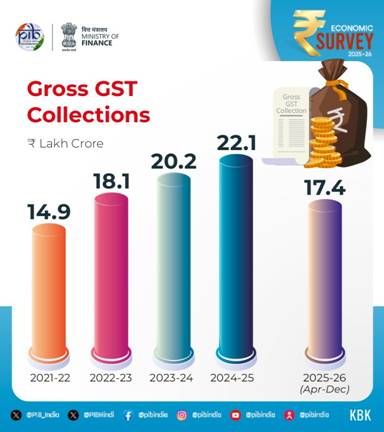
GROSS GST REVENUE AT ₹17.4 LAKH CRORE IN FY26 (APR-DEC) AGAINST ₹16.3 LAKH CRORE IN FY25 (APR-DEC)


Economic Survey 2025-26 tabled in parliament today by the Union Minister for Finance and Corporate Affairs, Smt. Nirmala Sitharaman, highlights that India’s Economy stands out in the present era of global economic turbulence due to its macroeconomic stability. It has been possible due to our calibrated fiscal strategy, reduction in fiscal and revenue deficits. Resilient revenue mobilization and reorientation of revenue towards capital expenditure further added to our economic strength. Centre’s prudent fiscal management has strengthened credibility and reinforced confidence in India’s macroeconomic and fiscal framework. States are a major partner in this journey of economic consolidation.

A predictable and credible fiscal trajectory by the Centre over the past years has anchored overall macroeconomic stability by balancing growth imperatives with fiscal sustainability. Centre’s fiscal consolidation experience underscores the value of clearly defined fiscal targets alongside retained flexibility, thereby allowing fiscal policy to support rather than constrain growth during periods of uncertainty. States are a major partner in this journey of economic consolidation. The scheme of Special Assistance to States for Capital Expenditure (SASCI) is helping create long term assets on interest free loans. The scheme strikes balance between reform linked investments and investments based on state’s priority, enabling a sustained CAPEX environment in the country.

Fiscal prudence sustaining economic stability

The fiscal deficit is budgeted at 4.4% of GDP in FY26 down from 4.8% in the previous financial year. Over the same period, the revenue deficit as a proportion of GDP narrowed steadily, reaching its lowest level of 0.8% in FY26, since FY09, thereby leaving a greater allocation for capital expenditure and reflecting a sustained improvement in the quality of expenditure. The Revenue expenditure moderated from 13.6% of GDP in FY22 to 10.9% in FY25, thereby creating space for more productive capital expenditure. Expenditure on major subsidies was rationalized from 1.9 % in FY22 to 1.1% in FY26, even as food security was ensured by the Centre to about 78.9 crore beneficiaries as of October 2025. The direct tax base expanded steadily, with income tax return filing increasing from 6.9 crore in FY22 to 9.2 crore in FY25. Higher return filings reflect improved compliance, greater use of technology in tax administration, and a growing number of individuals entering the tax net as their incomes rise.
Trends-in-Deficit.jpg

Sustained revenue mobilization

Centre’s revenue receipts strengthened from an average of about 8.5% of GDP in FY16–FY20 to around 9.1% in FY22–FY25 (PA). This improvement was driven by buoyant non-corporate tax collections, which rose from about 2.4% of GDP pre-pandemic to around 3.3 % post-pandemic. By enhancing collection efficiency and curbing revenue leakages through technology-driven measures, the Centre’s revenue receipts rose to 9.2% of GDP in FY25 (PA). Non-intrusive Usage of Data to Guide and Enable (NUDGE), a data driven behavioral change measure of Income Tax Department, focused on influencing taxpayer behavior through data-driven insights and information rather than litigation or coercive enforcement. This has emerged as a powerful tool for improving tax compliance.

GST 2.0: Making Trade Competitive

The underlying strength of GST revenue is reflected in steady expansion of the tax base with taxpayer numbers increasing from 60 Lakh in 2017 to over 1.5 Crore at present. Gross GST collections during April–December 2025 stood at ₹17.4 lakh crore, registering a year-on-year growth of 6.7 %. GST revenue growth is broadly aligned with prevailing nominal GDP growth conditions. In parallel, high-frequency indicators suggest robust transaction volumes, with cumulative e-way bill volumes during April-December 2025 growing by 21% YoY. The transition to a simplified two-rate structure under GST 2.0 is expected to reduce compliance costs, streamline transactions, and incentivize formalization among small businesses, while enhancing trade competitiveness and supporting domestic manufacturing. It could also lower the cost of living and bolster household consumption.
GST-Collection.jpg

Non-tax revenues buoyed by rising dividends and profits

The non-tax revenues of the centre, as a percentage of GDP, have broadly remained stable around 1.4% of GDP in post-pandemic period in line with pre-pandemic average, thereby providing steady support to the centre’s revenue receipts. The improved performance of Central Public Sector Enterprises (CPSEs) has also contributed to the Centre’s non-tax revenue. Between FY20 and FY25, net profits and dividends per CPSE increased by 174 % and 69 %, respectively, underscoring improved operational efficiency and prudent capital management, which in turn strengthened the government’s non-tax revenue stream.

Sustained Capital Expenditure Momentum

Giving an impetus to Prime Minister Shri Narendra Modi’s vision of Viksit Bharat, the effective capital expenditure of the Central government increased from an average of 2.7 % of GDP in the pre-pandemic period to about 3.9 % post-pandemic, and to a higher 4% of GDP in FY25. Key infrastructure sectors like Road Transport and Highways, Railways, Airways and Waterways continue to account for over half of the total capital expenditure emphasizing asset creation. Allocation in FY25 towards transfer to states (34.9%), Telecom (24.4%), and Housing and Urban Affairs (19.6%) recorded robust double digit growth YoY.

Expanding centre-states transfers through Tax Devolution and Finance commission grants

In the post-COVID era, Centre launched a scheme to incentivize Capital Expenditure of States by giving them long term interest free loans, recognizing its higher multiplier effect and role in crowding in private investments. Through Special Assistance to States for Capital Expenditure (SASCI), the Centre has incentivized States to maintain capital spending at around 2.4% of GDP in FY25 and has allocated total uptake of 4,49,845 crore in last five years. The combined fiscal deficit of State Governments stayed broadly stable at around 2.8 % of GDP in the post-pandemic period, similar to pre-pandemic levels, but has edged up in recent years to 3.2 % in FY25, reflecting emerging pressures on State finances.

The Economic Survey cautions that while the Centre’s incentives are supporting higher State capital outlays in recent years, sustaining growth will depend on complementary discipline within revenue expenditure. The survey points to careful reprioritisation of State’s expenditure and ensure that short-term income support does not erode the investments on which inclusive, medium-term prosperity will rely on.
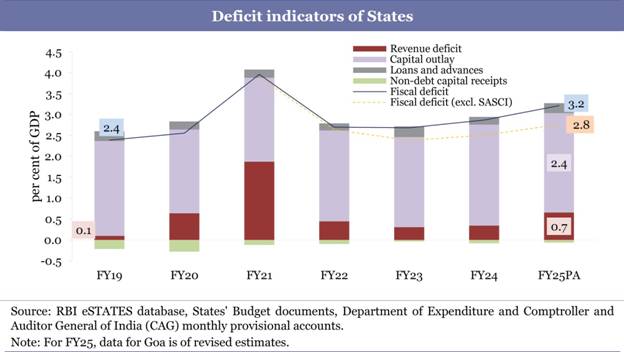
Chart II - 9 Deficit indicators of States.jpg

Debt Profile of the Government

Centre’s public debt management strategy has reinforced the credibility of fiscal policy, even as the global public debt levels have continued to rise. The Government’s medium-term goal to achieve a debt-to-GDP ratio of 50±1% by FY31 reflects a deliberate effort to strengthen overall debt sustainability while preserving policy flexibility in an uncertain global environment. Presently, the debt-to-GDP ratio stands at 55.7 % for FY25, a reduction of 7.1 percentage points since 2020, even while maintaining high public investment.

India’s fiscal model stands out particularly when assessed through the lens of public investment efficiency. In FY24, general government investment was 4 % of GDP, amounting to about one-fifth of total government revenue, much higher than in most peer economies. Any fiscal indiscipline at the State level also casts a shadow on the sovereign borrowing costs. Thus, as the Centre continues fiscal consolidation over the medium term, the general government is also expected to remain on a consolidation trajectory.

The Way Forward

The survey proposes reform to reduce cross-subsidies, stabilize the pipeline for equity monetization by revising the definition of government companies, advance the trust and nudge theory in e-way billing, reap efficiencies in spending, and for effective management of short-term surpluses to achieve further fiscal consolidation.

Looking ahead, ongoing reforms in taxation, including GST 2.0 and personal income tax, are expected to enhance the efficiency of the tax system by simplifying structures, reducing compliance costs, and broadening the tax base, with implications for both economic activity and revenue mobilization.

Topics

Acts Income Tax