

Loading...

Top
Help
×

By creating an account you can:

Logo TaxTMI
Call Us / Help / Feedback

Contact Us At :

E-mail: [email protected]

Call / WhatsApp at: +91 99117 96707

For more information, Check Contact Us

FAQs :

To know Frequently Asked Questions, Check FAQs

Most Asked Video Tutorials :

For more tutorials, Check Video Tutorials

Submit Feedback/Suggestion :

Email :
Please provide your email address so we can follow up on your feedback.
Category :
Description :
Min 15 characters 0/2000
Make Most of Text Search
  1. Checkout this video tutorial: How to search effectively on TaxTMI.
  2. Put words in double quotes for exact word search, eg: "income tax"
  3. Avoid noise words such as : 'and, of, the, a'
  4. Sort by Relevance to get the most relevant document.
  5. Press Enter to add multiple terms/multiple phrases, and then click on Search to Search.
  6. Text Search
  7. The system will try to fetch results that contains ALL your words.
  8. Once you add keywords, you'll see a new 'Search In' filter that makes your results even more precise.
  9. Text Search
Add to...
You have not created any category. Kindly create one to bookmark this item!
Create New Category
Hide
Title :
Description :
❮❮ Hide
Default View
Expand ❯❯
Close ✕
🔎 News - Adv. Search
TEXT SEARCH:

Press 'Enter' to add multiple search terms. Rules for Better Search

Search In:
Main Text + AI Text
  • Main Text
  • Main Text + AI Text
  • AI Text
Category: ?
Categorized by AI
---- All Categories ----
  • ---- All Categories ----
  • Income Tax
  • GST
  • Customs, DGFT & SEZ
  • FEMA & RBI
  • Corp. Laws, SEBI & IBC
  • PMLA, Black Money & ED
  • Budget
  • News and Press Release
  • PTI News
Month:
---- All Months ----
  • ---- All Months ----
  • January
  • February
  • March
  • April
  • May
  • June
  • July
  • August
  • September
  • October
  • November
  • December
Year:
---- All Years ----
  • ---- All Years ----
  • 2026
  • 2025
  • 2024
  • 2023
  • 2022
  • 2021
  • 2020
  • 2019
  • 2018
  • 2017
  • 2016
  • 2015
  • 2014
  • 2013
  • 2012
  • 2011
Sort By: ?
In Sort By 'Default', exact matches for text search are shown at the top, followed by the remaining results in their regular order.
Relevance Default Date
    IFSCA Grants Nexent Capital GIFT City Investment Banking License
    India's exports rise 19.63 pc to USD 44.24 bn in Jul; trade deficit widens to $31.98 bn
    Vizhinjam port to commence EXIM operations from Aug 18: Kerala CM Satheesan
    Ratul Puri: Beyond Low-Cost Power to Clean Energy Reliability
    PMS Bazaar Collaborates with NSDL Database Management Limited (NDML Accreditation Agency) to Expand Access to SEBI Accredited Investor Certification
    Compounded annual growth rate of Manufacturing GVA at constant prices (2022-23 base) as per revised series during 2022-23 to 2025-26 is 10.88%
    National Company Law Tribunal (NCLT) Launches e-Inspection and e-Certified Copy Services
    The Government of India to launch the Central Bank Digital Currency (CBDC)-based Direct Benefit Transfer (DBT) in the Union Territories of Chandigarh ...
    India and the Southern African Customs Union (SACU) sign Terms of Reference (ToR) for negotiations towards a Preferential Trade Agreement
    Airtel ends all prepaid mobile plans offering 1.5 GB data per day with unlimited calls
    ED arrests IBC resolution professional
    Mumbai cops bust fake documents racket; four arrested
    After nine years at helm, N Chandra to exit Tata Sons amid expansion, governance standoff
    RBI invites comments on the Draft “Reserve Bank of India (Interest Rates on Loans and Advances) Directions, 2026”
    Sensex falls 188 pts amid elevated crude oil prices; Tata Group stocks decline after N Chandra's exit
    SJM urges govt to stand firm against US tariff pressure, calls for boycott of American products
    Union Minister of Commerce and Industry Shri Piyush Goyal Calls for Fair Trading Practices and Taking ‘Make in India’ from Local to Global
    Union Minister for Finance & Corporate Affairs Smt. Nirmala Sitharaman delivers keynote address at Seminar on “Role of the New Development Bank in M...
    Delhi HC halts processing of IT-returns of Supreme Court, high court judges
    Over 36,000 firms shut operations in Maharashtra in 5 yrs; Oppn claims graft, govt interference
❯❯
Maximize Maximize Maximize
0 / 200
Expand Note
Add to Folder

No Folders have been created

+

Are you sure you want to delete "My most important" ?

NOTE:

News
Showing Results for :
Reset Filters
Results Found:
Show All Summaries Hide All Summaries
August 13, 2026
Show AI Summary
Investment banking registration enables regulated cross-border offerings, listings, debt transactions and capital-market advisory through GIFT City.
IFSCA registration under the IFSCA (Capital Market Intermediaries) Regulations, 2025 authorises Nexent Capital IFSC Private Limited to operate as an investment banker from GIFT City. Permitted activities include management of initial and follow-on public offerings, SPAC and secondary listings, depository receipt issuances, debt capital-market transactions, and other capital-market advisory mandates. The firm proposes to provide transaction structuring, listing-readiness, execution and post-listing capital-markets support for companies seeking capital raising and listing opportunities through GIFT City's exchanges.
August 13, 2026
Show AI Summary
Merchandise export growth was driven by petroleum, electronics, engineering and marine goods, while rising imports widened the trade deficit.
India's merchandise exports increased in July, while imports also rose and widened the trade deficit. Export growth was attributed to higher overseas shipments of petroleum products, electronics, engineering goods and marine goods. Exports and imports both recorded growth during the April-July fiscal period, and exports to West Asian countries increased in July.
August 13, 2026
Show AI Summary
EXIM operations at international seaport to commence after customs clearance, bonded-area establishment, and temporary highway connectivity.
Vizhinjam International Seaport is scheduled to commence EXIM operations after Customs clearance, issuance of Customs notifications, establishment of a Customs-bonded area, and temporary connectivity to NH-66. The port had previously handled transshipment operations. A proposed transfer of a stake in the port concessionaire to a foreign shipping company remains under committee examination and requires Central Government consideration of strategic and security aspects.
August 13, 2026
Show AI Summary
Renewable energy reliability requires storage, grid readiness and ancillary service markets alongside competitive clean-power procurement.
Renewable energy procurement is shifting beyond lowest tariffs towards dependable, dispatchable and affordable clean power, assessed through capacity value, balancing capability and system economics. Storage-backed renewable and hybrid projects can improve renewable utilisation, reduce variability and curtailment, and support peak demand. Higher renewable penetration also requires supportive storage policies, timely approvals, aligned intrastate transmission planning, stronger distribution infrastructure, and market mechanisms for ramping reserves, frequency response and fast-response balancing services.
August 13, 2026
Show AI Summary
Accredited Investor certification facilitates eligible investors' access to alternative investment products, lower thresholds and applicable regulatory flexibilities.
SEBI's Accredited Investor framework enables eligible investors and entities to obtain certification that may allow lower minimum investment thresholds for Portfolio Management Services, Alternative Investment Funds and other alternative investment products, along with applicable regulatory flexibilities. PMS Bazaar and NSDL Database Management Limited's Accreditation Agency facilitate end-to-end applications, subject to required documentation and prescribed payment. Assistance is available to individual investors and eligible clients of investment providers without additional platform, service or processing charges, while prescribed certification fees remain payable.
August 13, 2026
Show AI Summary
Manufacturing GVA growth under the revised national accounts series highlights stable sectoral contribution and resilience-focused industrial measures.
Manufacturing performance is assessed under the revised National Accounts Statistics series using 2022-23 as the base year. Manufacturing's share of total Gross Value Added at current prices remained broadly stable through 2025-26, and Manufacturing GVA at constant prices achieved a compounded annual growth rate of 10.88% from 2022-23 to 2025-26. Production Linked Incentive schemes, logistics and industrial-corridor measures, semiconductor initiatives, and MSME support seek to strengthen domestic manufacturing, diversify supply chains, reduce import dependence, and improve resilience.
August 13, 2026
Show AI Summary
Electronic inspection and certified copies expand digital access to judicial records while supporting efficient case management and reduced delays.
NCLT has launched e-Inspection and e-Certified Copy Services for faster and more convenient access to judicial records and certified copies by advocates, litigants and other stakeholders. The services support a technology-enabled Registry framework and transparent, efficient justice delivery. Pendency monitoring, workload redistribution, Special Benches, maximisation of court time, and registration and listing guidelines are intended to improve case management, optimise limited judicial resources and reduce avoidable delays.
August 13, 2026
Show AI Summary
CBDC-based food subsidy transfers enable eligible beneficiaries to use Digital Rupee wallet credits for traceable foodgrain purchases.
CBDC-based Direct Benefit Transfer under the Pradhan Mantri Garib Kalyan Anna Yojana will credit eligible beneficiaries' food subsidies as programmable Digital Rupee tokens directly into CBDC wallets. Beneficiaries may use these credits to purchase foodgrains from empanelled merchants through secure, real-time and traceable payments, replacing conventional bank-account transfers. The model is intended to improve traceability, reduce leakages and cash handling, enable real-time monitoring of subsidy use, and provide a scalable framework for CBDC integration with welfare schemes.
August 13, 2026
Show AI Summary
Preferential trade agreement negotiations begin under agreed terms covering market access, origin rules, trade remedies and dispute settlement.
India and the Southern African Customs Union have signed Terms of Reference to commence negotiations for a Preferential Trade Agreement. Negotiations are envisaged on trade in goods and market access, rules of origin, customs procedures and trade facilitation, trade remedies including bilateral safeguards, sanitary and phytosanitary measures, technical barriers to trade, dispute settlement, and legal and horizontal provisions. The Terms of Reference establish the negotiating framework only; preferential tariff treatment and other operative commitments depend on conclusion of a final agreement.
August 12, 2026
Show AI Summary
Prepaid plan restructuring eliminates mid-tier daily-data options and channels subscribers toward higher-priced plans with expanded data access.
Bharti Airtel has discontinued prepaid plans combining 1.5 GB daily data allowances with unlimited calling, directing subscribers towards higher-priced plans with expanded data access, including unlimited 5G data. The restructuring reduces low-priced unlimited-data offerings and changes the pricing architecture for customers using discontinued mid-tier plans. Management links tariff repair to differentiated mobile-plan categories and sustained average revenue per user growth.
August 12, 2026
Show AI Summary
Insolvency professional conduct faces money-laundering allegations over re-admitted claims, creditor committee changes, and a connected resolution applicant.
Enforcement action under the Prevention of Money Laundering Act concerns allegations that an insolvency professional re-admitted claims earlier rejected as spurious and fraudulent during the Corporate Insolvency Resolution Process. The alleged re-admission altered the Committee of Creditors' composition and facilitated consideration of a resolution plan allegedly submitted for, and funded through an entity controlled by, a company promoter under investigation for diversion of bank-loan funds. Adverse findings reportedly included acting beyond authority by relying on fabricated and improperly submitted material.
August 12, 2026
Show AI Summary
Identity document forgery allegations prompt investigation into fraudulent Aadhaar updates and falsified government and educational certificates.
Alleged forgery and misuse of identity-related records are under investigation following operations at Aadhaar centres. Seized materials reportedly include forged birth, educational, residence, caste and citizenship certificates, records bearing forged signatures and seals, and equipment used for Aadhaar updates. Four persons were arrested in two operations for allegedly preparing forged records and using them to update Aadhaar cards. Cases have been registered under relevant provisions of the Bharatiya Nyay Sanhita, with investigation continuing into the extent of the alleged network.
August 12, 2026
Show AI Summary
Holding-company governance succession follows leadership departure, requiring transition planning amid unresolved strategy, capital allocation, board representation and listing questions.
Tata Sons' leadership succession and governance framework have become central following the chairman's decision not to seek reappointment when his term ends in February 2027. The board has been asked to decide on a successor promptly. Unresolved matters include the strategic roadmap, losses and capital requirements in newer businesses, board representation, capital allocation, an exit route for the Shapoorji Pallonji Group, and the possible listing of Tata Sons. Future leadership must manage these issues while improving returns from investment-intensive businesses and maintaining established operations.
August 12, 2026
Show AI Summary
Interest-rate regulation for loans and advances proposes harmonised fixed and floating loan-pricing principles across regulated entities.
Interest-rate regulation for loans and advances is proposed to be harmonised across all regulated entities through a principles-based framework for fixed-rate and floating-rate loans. The framework would be calibrated to each entity's nature, complexity and scale, while supporting monetary policy transmission, credit-risk-based pricing, and fair, non-discriminatory borrower treatment. It addresses divergent commercial-bank practices in determining the marginal cost of funds-based lending rate and its components, alongside limited regulatory coverage of fixed-rate loans. Separate final directions are intended for each category of regulated entity after consideration of feedback.
August 12, 2026
Show AI Summary
Elevated crude oil prices and Tata leadership transition drove broad equity market selling amid inflation concerns.
Indian equity markets declined amid elevated crude oil prices, inflation concerns and broad risk-off selling. Tata Group shares, particularly TCS, came under pressure after N. Chandrasekaran announced that he would not seek reappointment as Tata Sons Chairman when his current term ends. Crude oil prices approaching the USD 90-per-barrel level affected investor confidence because of potential inflationary effects, while uncertainty over United States-Iran negotiations and Strait of Hormuz shipping disruptions added to global energy market concerns.
August 12, 2026
Show AI Summary
Trade sovereignty and energy security underpin calls to resist tariff pressure and protect sensitive sectors in bilateral negotiations.
Trade sovereignty and energy security are advanced as grounds for resisting tariff pressure linked to Indian purchases of Russian crude. Bilateral trade negotiations should proceed through equality, reciprocity and mutual respect without compromising agriculture, dairy, energy security or strategic autonomy. Concerns are also raised over removal of e-commerce inventory restrictions for foreign direct investment and over proposed Merchant Discount Rate charges on UPI transactions. Withdrawal of the inventory measure and opposition to payment-provider charges are urged, alongside possible restrictions on United States technology and social-media companies and consumer boycotts of American goods and services.
August 12, 2026
Show AI Summary
Fair trading practices and circular production are promoted to strengthen Make in India and expand global market participation.
Trade and industrial policy messaging encourages businesses to digitise operations, adopt good manufacturing practices, follow fair trading practices, and promote recycling, reuse and a circular economy. Nine free trade agreements are identified as creating preferential market-access opportunities for Indian industry and businesses. MSMEs, entrepreneurs, farmers, fishermen, workers and the services sector are encouraged to expand Indian products and services globally, improve competitiveness through scale, and strengthen the quality, design and brand value associated with Make in India.
August 12, 2026
Show AI Summary
Private capital mobilisation requires credible long-term frameworks, risk-sharing mechanisms, and multilateral partnerships to strengthen infrastructure investment.
Private capital mobilisation in infrastructure and development finance depends on credible long-term frameworks, investor confidence, project bankability, and balanced risk allocation. Public capital is intended to catalyse rather than replace private investment. Key financing mechanisms include Viability Gap Funding, the Hybrid Annuity Model, credit enhancement, and Infrastructure Investment Trusts. Long-term investment visibility and coordinated connectivity are supported through the National Infrastructure Pipeline and PM Gati Shakti framework, alongside investment measures for freight, rail, waterways, and coastal cargo.
August 12, 2026
Show AI Summary
Judicial allowance exemptions under the new tax regime remain disputed, with return processing and resulting demands kept in abeyance.
Tax treatment of specified judicial allowances under the new income-tax regime is disputed. Statutory service-condition provisions are asserted to exclude allowances, including official residence, conveyance, sumptuary allowance and leave travel concession, from income computation and to override the Income-tax Act. Pending consideration, affected judges may show these amounts as receipts not in the nature of income, and their returns are not to be processed further. Any resulting demand remains in abeyance, while refundable amounts are withheld subject to the pending proceedings.
August 12, 2026
Show AI Summary
Corporate closure data highlights worker-claim treatment through insolvency adjudication and liquidation priority, while affected-worker information remains unmaintained.
Corporate closure data recorded 36,211 private companies in Maharashtra as liquidated, dissolved or struck off during the preceding five financial years. Central information is not maintained on workers affected by closures or special rehabilitation packages. In corporate insolvency resolution, employee and worker claims are adjudicated under orders of the adjudicating authority. In winding-up or liquidation, the liquidator deals with pending wages and other admissible statutory dues, subject to available funds and the statutory order of priority.

News

Back

All News

Showing Results for :
Reset Filters
No Records Found

News

Back

All News

Showing Results for : Reset Filters

INDIA SHOULD PRIORITISE DECENTRALISED, APPLICATION-DRIVEN SYSTEMS OVER CAPITAL-INTENSIVE FRONTIER MODELS TO AVOID FRAGILE DEPENDENCIES IN ARTIFICIAL INTELLIGENCE: ECONOMIC SURVEY

January 29, 2026

Contents
Summary
Note

Note

-

Bookmark

Print

Print

ECONOMIC SURVEY 2025-26 ADVOCATES AIMING FOR FRUGAL, REAL-WORLD DEPLOYMENT AT SCALE

INDIA’S APPROACH INTENDS TO ALIGN AI ADOPTION WITH STRUCTURAL REALITIES-CAPITAL, ENERGY, INSTITUTIONAL CAPACITY AND MARKET DEPTH

THE NATIONAL AI MISSION CAN SCALE DIVERSE AI-SOLUTIONS BY PROVIDING SHARED INFRASTRUCTURE, STANDARDS, GOVERNANCE FRAMEWORKS AND FUNDING WITHOUT DILUTING LOCAL CREATIVITY

LOCAL INNOVATORS, MUNICIPAL BODIES, START-UPS, AND COMMUNITY INSTITUTIONS DEPLOYING AI TO SOLVE IMMEDIATE AND CONTEXTUAL PROBLEMS

LANGUAGE AND VOICE-FIRST AI SYSTEMS EXTENDING REACH OF DIGITAL SERVICES TO POPULATIONS HISTORICALLY EXCLUDED

THE ECONOMIC SURVEY 2025-26 ENVISIONS THE WAY FORWARD FOR INDIA’S AI ECOSYSTEM

The Economic Survey 2025-26 tabled by the Union Minister of Finance and Corporate Affairs, Smt. Nirmala Sitharaman in the Parliament today, recognizes Artificial Intelligence (AI) as an economic strategy rather than a prestige technology race. The Survey examines the way AI is reshaping global economy and outlines a pragmatic strategy for India in an environment marked by rapid technological change and persistent uncertainty.

The Economic survey in its dedicated chapter highlights that AI deployment in India to be economically grounded and socially responsive. It makes a case for a bottom up, multiple sector-specific approaches grounded in open and interoperable systems to promote collaboration and shared innovation. This aligns with India’s strengths in human capital, data diversity and institutional coordination. 

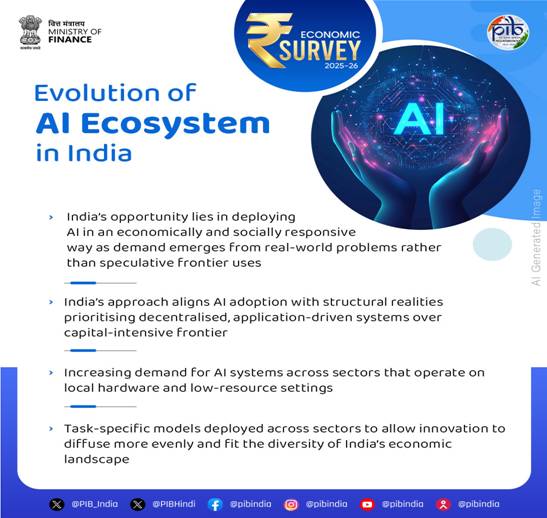
India’s demand for AI is emerging from real-world problems rather than speculative frontier uses. Citing examples across healthcare, agriculture, urban management, education, disaster preparedness, and public administration, the survey highlights the growing appetite for AI systems that work on local hardware and operate in low-resource settings. From early disease screening and precision water management to farmer market access, classroom analytics, and regional language interfaces, adoption is emerging where AI lowers costs and compensates for structural shortcomings. These uses signal a large and scalable market for frugal, application-focused AI solutions tailored to India’s economic and social landscape.

The Survey focuses on aligning AI adoption with India’s structural realities, such as capital availability, energy constraints, institutional capacity, and market depth, so that technology choices reinforce long-term growth instead of creating fragile dependencies.

As the Global AI development is being shaped by structural asymmetries in access to compute, finance, data, and standards-setting power, the Survey recognizes these imbalances as essential for crafting realistic policy. In this context, the preferred pathway emphasizes decentralized and application-driven AI rather than large, centralized systems. Smaller, task-specific models deployed across sectors allow innovation to diffuse more evenly, reduce entry barriers for firms, and better fit the diversity of India’s economic landscape. The Survey calls Open and interoperable AI systems as a force multiplier.

Further elaborating upon the Education and training priorities in the AI-era, the survey underscores the need to shift away from narrow technical specialization towards essential foundational capabilities such as reasoning, reading, judgment, communication, and adaptability. This shall integrate AI into workplaces and public systems.

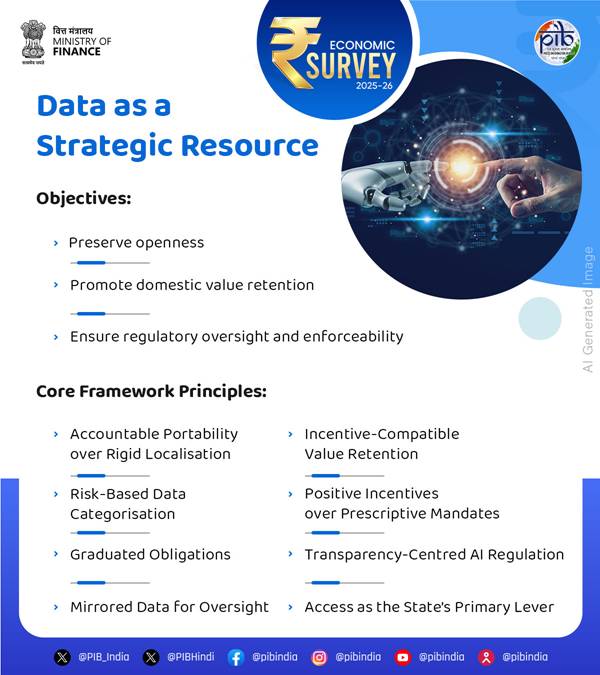
Adding on the Data governance of AI, the survey emphasizes over the need for it to be framed around accountability and value creation rather than isolation. Trusted data flows, combined with transparency and auditability, are seen as more effective than rigid localization in ensuring that economic benefits accrue domestically while maintaining global interoperability. The regulatory design favors proportionate, risk-based approaches over prescriptive control. Obligations scale with potential harm and systemic importance, allowing innovation to continue while aligning private incentives with broader economic and social objectives.

The survey reiterates that the India’s AI strategy must be sequenced carefully to avoid premature lock-in or regulatory overreach so that to build coordination first, capacity next and binding policy leverage last, allowing institutions and markets to co-evolve.

The survey in this chapter further elaborates upon Artificial Intelligence in India’s economic context, a development-oriented approach to AI, role of human capital for AI, AI-safety and risks along with the governance, institutional architecture and data as a strategic resource, followed with a phased roadmap for India’s AI Future.
ARTIFICIAL INTELIIGENCE ECOSYSTEM

The Survey deliberates upon asymmetries and trade-offs in the AI ecosystem across countries, firms, capabilities, and stages of the value chain. These asymmetries do not imply structural disadvantage but identifies the constraints within which a viable and sustainable AI strategy must be formulated to maximize economic and social returns from AI while remaining mindful of the trade-offs.

Capability Asymmetries between frontier model development and application-led development calls for India to deploy resources more effectively towards domain-specific AI systems aligned with domestic economic priorities. The capital-labour tradeoff elaborates upon the debate between scale versus inclusion which recognizes challenge - how to pace diffusion of AI to facilitate labour augmentation, choosing inclusive approach over scaling.

The cost, control, dependence of open or proprietary models ponders upon the ownership and governance of AI models. The survey underscores the need to strike a balance between openness and stewardship, leveraging shared innovation while ensuring that the economic value created from domestic data and intellectual property accrues within India rather than being captured abroad. The tradeoff between centralized scale and distributed efficiency strengthens the case for smaller, task-specific models that can run on limited hardware and decentralized compute networks. It lays emphasis on strategic autonomy and continued integration with global innovation networks to preserve openness where it enhances capability while insulating critical functions from external shocks.

LOCAL INGENUITY AND FRUGAL AI IN INDIA

India’s AI story is already evolving from the bottom-up. Local innovators, municipal bodies, start-ups, and community institutions are deploying AI to solve problems that are immediate and contextual to the communities they reside in. AI has multi-sectoral applications in health, agriculture, education, urban management, and disaster preparedness.

  • Non-invasive AI-enabled thermal imaging tools in southern India are enabling early breast cancer screening in low-resource settings.
  • Portable and low-cost AI-assisted oral cancer screening devices are bringing early detection to primary healthcare centers in eastern India.
  •  AI-enabled agricultural networks are improving market access, price discovery, and logistical efficiency for 1.8 million farmers across 12 States.
  • India’s approach to AI adoption also includes initiatives such as Bhashini under MEiTY, and AI4Bharat developed by IIT Madras. Language and voice-first AI systems are extending the reach of digital services.

Furthering interactions in native languages and functioning effectively on low-cost devices, such frugal AI pathways align scale with inclusion along with being decentralized, problem-driven, and embedded in local needs.

The National AI Mission can help scale diverse AI-solutions by providing shared infrastructure, standards, governance frameworks and funding without diluting local creativity.

A DEVELOPMENT-ORIENTED APPROACH TO AI

The Survey highlights the necessity of India’s own indigenous AI development. The AI ecosystem remaining sufficiently young creates an opening for India to shape a more value-creating and dignified employment opportunity for its workforce.

Further, the Survey highlights developments in global GPU supply chains to play a meaningful role in shaping the long-run pace of AI infrastructure expansion. The measures that enhance supply-side resilience in access to advanced compute need to complement the conventional policy levers to expand access to finance and incentivize domestic development of AI. India needs to rely on diversified and resilience access to global compute.

A government hosted, community-curated platform under IndiaAI Mission umbrella would provide secure and transparent space where developers, researchers and enterprises collaborate. Private sector participation may also to be encouraged promoting indigenous development of sector specific AI and transforming India from world’s IT sector back office to one of the AI front offices. The Bottom-up approach can be spearheaded under ‘AI-OS’ initiative. India ranks among the top global contributors to AI research output and possess a deep pool of technical talent in the field of artificial intelligence, the country also has a highly AI-literate labour force.

The heterogeneity and scale of the country suggests the possibility of curating diverse domestic datasets across various sectors, including health, agriculture, finance, education, and public administration.

GOVERNANCE, INSTITUTIONAL ARCHITECTURE AND DATA

AN AI ECONOMIC COUNCIL FOR INDIA

The AI Economic Council, separate from the Governance Council, is intended to operate, not just with a technological imperative, but with moral imperatives, but with imperatives that are sensitive to India’s socio-economic realities. They will operate as a coordinating authority that is responsible for aligning technology deployment with the evolution of India’s education and skilling infrastructure, while navigating resource constraints and development priorities. The core governance principles for such an institution would involve the following:

  1. Human Primacy and Economic Purpose
  2. Labour-Market  Sensitivity by Design
  3. Sequencing over Speed
  4. Co-evolution of  Technology and Human Capital
  5. Public Interest Safeguards and Ethical Non-Negotiable

By embedding labour realities and social stability priorities into AI policy, the institution will ensure that AI advances productivity without eroding employment and the dignity of work.

As innovations and applications are rapidly outpacing regulatory developments, the Survey calls upon a measured and swift response from policymakers. The regulatory design for AI adoption in India must seek to integrate AI within the broader socio-economic context of India, with special consideration for our labour market realities. It must ensure that AI serves humanity, rather than supplanting it.
Data-as-a-Strategic-Resource.jpg

HUMAN CAPITAL FOR AI

The Survey emphasizes experiential learning, early exposure to experience building, flexible education pathways and strengthening human-centric skills. The survey calls upon that ‘formal education and work experience’ need not be seen as mutually exclusive setup. To nurture India’s demographic dividend into a competent workforce, need for institutionalizing systems such as ‘Earn and Learn Initiative’. This pathway can be co-designed by the private sector and academic institutions. The National Education Policy 2020 aligns with the above vision.

Furthermore, a comprehensive sectoral mapping of jobs outside the white-collar workspace needs to be undertaken. For instance, nursing and geriatric care being understaffed highlights the potential for additional demand for skilled labour in the sectors.

AI SAFETY AND RISKS

The survey highlights an ‘AI Safety Institute’ as proposed under MeitY Governance Guidelines which shall analyze emerging risks, potential regulatory gaps, coordination on AI safety issues, and conducting training programmes to build awareness, among others. A Periodic, scenario-based testing and red-teaming of AI models must become institutionalized.

The survey suggests that International cooperation of institutes such as United Kingdom’s AI Security Institute and USA’s National Institute Standards and Technology shall enable joint evaluations of high risk models and shared access to completing infrastructure which will enhance global interoperability AI Safety Standards. The survey further acknowledges that no conception of safe or human-centric AI is credible without placing the protection of individual rights at its core.

ROADMAP FOR INDIA’s ‘AI’ FUTURE

The survey describes a central challenges for India - what it builds domestically, what it sources globally, what it regulates early, and what it deliberately allows to evolve. The benefit of hindsight allows India to design AI systems that are more resource-efficient and aligned with public objectives from the outset, sequencing regulation alongside deployment. It offers the country the opportunity to pursue a more resilient and inclusive AI trajectory.

India’s strengths lie in application-led innovation, the productive use of domestic data, human capital depth and the ability of public institutions to coordinate distributed efforts. A bottom-up strategy anchored in open and interoperable systems, sector-specific models, and shared physical and digital infrastructure offers a more credible pathway to value creation than a narrow pursuit of scale for its own sake.

Regulation, data governance and safety will have to evolve in parallel with deployment, not in its aftermath. Depending on the choices made, AI can be a tool for broad-based productivity and dignified work. India’s task is to ensure that AI development remains aligned with its developmental priorities and its long-term ambition to achieve economic resilience.

Topics

Acts Income Tax