

Loading...

Top
Help
×

By creating an account you can:

Logo TaxTMI
Call Us / Help / Feedback

Contact Us At :

E-mail: [email protected]

Call / WhatsApp at: +91 99117 96707

For more information, Check Contact Us

FAQs :

To know Frequently Asked Questions, Check FAQs

Most Asked Video Tutorials :

For more tutorials, Check Video Tutorials

Submit Feedback/Suggestion :

Email :
Please provide your email address so we can follow up on your feedback.
Category :
Description :
Min 15 characters 0/2000
Make Most of Text Search
  1. Checkout this video tutorial: How to search effectively on TaxTMI.
  2. Put words in double quotes for exact word search, eg: "income tax"
  3. Avoid noise words such as : 'and, of, the, a'
  4. Sort by Relevance to get the most relevant document.
  5. Press Enter to add multiple terms/multiple phrases, and then click on Search to Search.
  6. Text Search
  7. The system will try to fetch results that contains ALL your words.
  8. Once you add keywords, you'll see a new 'Search In' filter that makes your results even more precise.
  9. Text Search
Add to...
You have not created any category. Kindly create one to bookmark this item!
Create New Category
Hide
Title :
Description :
❮❮ Hide
Default View
Expand ❯❯
Close ✕
🔎 News - Adv. Search
TEXT SEARCH:

Press 'Enter' to add multiple search terms. Rules for Better Search

Search In:
Main Text + AI Text
  • Main Text
  • Main Text + AI Text
  • AI Text
Category: ?
Categorized by AI
---- All Categories ----
  • ---- All Categories ----
  • Income Tax
  • GST
  • Customs, DGFT & SEZ
  • FEMA & RBI
  • Corp. Laws, SEBI & IBC
  • PMLA, Black Money & ED
  • Budget
  • News and Press Release
  • PTI News
Month:
---- All Months ----
  • ---- All Months ----
  • January
  • February
  • March
  • April
  • May
  • June
  • July
  • August
  • September
  • October
  • November
  • December
Year:
---- All Years ----
  • ---- All Years ----
  • 2026
  • 2025
  • 2024
  • 2023
  • 2022
  • 2021
  • 2020
  • 2019
  • 2018
  • 2017
  • 2016
  • 2015
  • 2014
  • 2013
  • 2012
  • 2011
Sort By: ?
In Sort By 'Default', exact matches for text search are shown at the top, followed by the remaining results in their regular order.
Relevance Default Date
    Union Minister for Finance and Corporate Affairs Smt. Nirmala Sitharaman chairs 3rd Meeting of Apex Monitoring Authority of NICDIT and reviews the pro...
    NBCC moves SC for RERA exemptions to complete 16 stalled Supertech projects
    DFS Hosts PSB Confluence 2026: Day 1 Deliberations focus on Four themes- Deposit Mobilisation, Banking for Youth, Supporting the Investment Cycle and ...
    Govt to soon announce high-level panel on 'Banking for Viksit Bharat': FM
    Rupee falls 19 paise to close at 95.61 against US dollar
    Govt to soon announce high-level panel on 'Banking for Viksit Bharat'
    Union Minister of Finance and Corporate Affairs interacts with interns from PM Internship Scheme in New Delhi
    DRI uncovers large-scale illegal use of SAFTA agreement in areca imports
    Rupee falls 17 paise to 95.59 against US dollar in early trade
    Colombian president asks Trump to suspend tariffs to help earthquake recovery
    Mission Samudra to be launched alongside Vizhinjam’s EXIM operations
    Europe emerges top destination for India's electric car shipments in Q1
    Govt sets LPG production targets for refiners; Reliance gets largest quota
    PM urges MSMEs to tap opportunities from FTAs
    PM urges farmers to adopt 'chemical-free farming' to tap rising global demand for such food items
    Govt rolls out foreign asset disclosure scheme for small taxpayers
    Need one or two Indian pharma firms to be among global top 5: PM Modi
    Small taxpayers with€™ foreign assets to face 30 pc tax plus penalty; disclosure scheme opens till Dec 31
    PM urges MSMEs to tap opportunities from FTAs
    Govt cuts windfall gains tax on petrol, diesel, ATF exports
❯❯
Maximize Maximize Maximize
0 / 200
Expand Note
Add to Folder

No Folders have been created

+

Are you sure you want to delete "My most important" ?

NOTE:

News
Showing Results for :
Reset Filters
Results Found:
Show All Summaries Hide All Summaries
August 18, 2026
Show AI Summary
Industrial corridor development prioritises empowered SPVs, integrated infrastructure and investor-ready parks to accelerate manufacturing investment and operations.
National Industrial Corridor Development Programme implementation prioritises timely infrastructure completion, land allotment, investment mobilisation and commencement of manufacturing. PM GatiShakti-aligned planning requires integrated connectivity, utilities and social infrastructure, while States should resolve land, clearance and SPV-power bottlenecks. BHAVYA proposes investment-ready, plug-and-play industrial parks appraised for ready land, credible demand, connectivity, utilities, realistic phasing and early investor attraction. NICDIT routes Government participation and equity support for BHAVYA project SPVs, and NICDC coordinates implementation and monitoring.
August 17, 2026
Show AI Summary
RERA compliance exemption for stalled housing projects raises whether statutory obligations may be waived to enable phased project completion.
RERA compliance exemption is sought for completion of 16 stalled residential projects by a public sector construction entity appointed under a project-completion arrangement. The appellate insolvency tribunal declined to direct a waiver, considering itself incompetent to exempt compliance with statutory provisions. The arrangement requires phased completion, award and commencement of construction work, and oversight through an apex committee and project-wise committees. The projects remain incomplete owing to the developer's financial crisis.
August 17, 2026
Show AI Summary
Deposit mobilisation and youth banking guide strategies for stronger public financial institutions, investment financing and Global Capability Centre opportunities.
PSB Confluence 2026 considers strategic priorities for Public Sector Banks and Public Financial Institutions across deposit mobilisation, banking for youth, investment-cycle financing and Global Capability Centres. Discussions seek practical, scalable strategies to strengthen customer engagement, youth-responsive banking propositions, institutional financing capabilities and participation in the expanding Global Capability Centre ecosystem. Youth engagement may use the MY Bharat platform to strengthen links with the formal financial system and awareness of education finance, entrepreneurship, internships and financial-sector careers. Further themes include value-chain infrastructure, priority sector lending and credit card business reform.
August 17, 2026
Show AI Summary
Banking-sector reform will guide lender capacity, financial stability, inclusion, consumer protection, deposit growth and responsible credit-card expansion.
Banking-sector reform is proposed through a high-level committee on Banking for Viksit Bharat to review the sector and align it with growth needs while safeguarding financial stability, financial inclusion and consumer protection. Key themes include deposit mobilisation, youth banking, investment support, global capability centres, value-chain infrastructure, credit cards and priority-sector lending. Public-sector banks are expected to improve competitiveness through technology, sectoral expertise, product adaptation and customer-focused deposit growth. Credit-card development must maintain responsible underwriting, customer protection and appropriate risk controls.
August 17, 2026
Show AI Summary
FCNR(B) concessional swap facility availability narrows to timely mobilised deposits amid rupee depreciation and foreign currency inflow concerns.
Foreign-exchange conditions reflected rupee depreciation amid weak domestic equity markets and higher crude oil prices. FCNR(B) concessional swap facility availability is confined to foreign currency deposits mobilised by banks within the revised cut-off period, replacing the previously longer mobilisation window. The facility is intended to encourage foreign currency inflows, while banks use the FCNR(B) scheme to mobilise foreign currency deposits through attractive interest rates.
August 17, 2026
Show AI Summary
Banking sector review panel will align future growth with financial stability, inclusion and consumer protection through government recommendations.
High Level Committee on Banking for Viksit Bharat is proposed to comprehensively review the banking sector and align it with India's next phase of growth. It is intended to safeguard financial stability, financial inclusion and consumer protection, while providing views and recommendations to the Government on banking-sector development and reform.
August 17, 2026
Show AI Summary
Prime Minister Internship Scheme enhances youth employability through paid industry exposure, cross-field learning, workplace readiness and potential full-time employment.
The Prime Minister Internship Scheme provides paid internships with leading companies across India to improve youth employability through practical workplace exposure, industry experience and skills development. It addresses the gap between classroom learning and employers' expectations of workplace readiness. Participation is not confined to academic qualifications, allowing youth to pursue fields of interest and gain hands-on professional learning. Strong internship performance may lead to full-time roles, while the scheme stresses responsible work where errors may affect quality, consumer safety and organisational reputation.
August 17, 2026
Show AI Summary
SAFTA origin fraud in areca imports allegedly enabled improper duty exemption through false Bangladeshi-origin declarations.
SAFTA preferential duty treatment for areca-nut imports was allegedly misused by falsely declaring goods originating in South-East Asian countries as Bangladeshi origin. Since areca nuts normally attract 100% basic customs duty, the scheme sought to obtain the full SAFTA exemption reserved for qualifying Bangladeshi goods meeting Rules of Origin requirements. The alleged mechanism included routing goods through Bangladesh, changing containers and bags, using improperly obtained Certificates of Origin, and facilitating clearance through importers, Customs Brokers and IEC holders. Investigative findings also indicated cash proceeds, hawala channels and dummy entities.
August 17, 2026
Show AI Summary
FCNR(B) concessional swap facility closure may reduce temporary foreign-currency inflow support and heighten rupee weakness concerns.
The Reserve Bank of India restricted its concessional swap facility for FCNR(B) deposits to deposits mobilised by August 31, advancing the earlier cut-off date. The facility was intended to encourage foreign-currency inflows, while banks mobilise such deposits through attractive interest rates. Market commentary indicated that existing inflows may support the rupee in the near term, but the curtailed availability of the facility could reduce this temporary cushion and increase depreciation risk.
August 16, 2026
Show AI Summary
Temporary tariff suspension for earthquake recovery is sought to ease pressure on affected Colombian businesses.
Temporary suspension of high tariffs on Colombian products has been sought to support business recovery following a severe earthquake declared a natural disaster. The request links tariff relief to economic disruption affecting businesses amid extensive destruction, injuries and missing persons. United States emergency assistance has been provided through food, shelter and health supplies, while no response to the tariff-suspension request had been reported.
August 16, 2026
Show AI Summary
Port-led industrial development and direct export operations aim to expand logistics infrastructure, market access and trade connectivity.
Mission Samudra is proposed as a port-led industrial and logistics development programme linked to the commencement of export-import operations at Vizhinjam seaport. It covers industrial clusters, new cities, port connectivity, logistics, development initiatives, programme management and capacity building. Direct export shipments are intended to improve overseas-market access and reduce transit time and logistics costs, particularly for small and medium enterprises. The framework also anticipates growth in warehousing, cold storage, container freight stations and logistics parks, supported by private participation and road and rail connectivity.
August 16, 2026
Show AI Summary
Electric vehicle export diversification strengthens India's presence across European, Asia-Pacific and Latin American markets through expanding overseas demand.
India's electric motor car exports expanded sharply in the first quarter of 2026-27, reflecting increased international acceptance and competitiveness of India-manufactured electric vehicles. Europe became the principal export destination, led by Spain and the United Kingdom, with further demand across several European markets. Exports also reached Asia-Pacific markets, Nepal and emerging Latin American destinations. This wider market presence reflects improving quality and safety standards, stronger integration into global electric-vehicle supply chains, and diversification of India's electric-vehicle export profile.
August 16, 2026
Show AI Summary
LPG production preparedness requires refiners and upstream producers to maintain capacity and increase output during supply constraints.
Government has established a standing LPG production preparedness framework under which refining companies, oil marketing companies and upstream producers may be directed to increase production during supply constraints. Companies must maintain adequate LPG storage, evacuation and transportation infrastructure and pursue technically and economically feasible production-enhancing measures. Written directions may prescribe production quantities and periods, including restrictions on alternative uses of input streams required for LPG. The production schedule is updated twice yearly to reflect new facilities and added capacity from infrastructure, technology and distribution improvements.
August 16, 2026
Show AI Summary
Free trade agreement market access requires MSMEs, farmers and exporters to meet global quality standards.
Free trade agreements expand market-access opportunities for Indian MSMEs, exporters and producers through reduced or eliminated import duties on traded goods. Textiles, machinery, medicines, seafood and agricultural products can access international markets where they meet global standards and remain competitively priced. Farmers and producers are encouraged to develop export-oriented products, including chemical-free agricultural produce, while MSMEs may use preferential trade access to support manufacturing, exports, employment and growth.
August 15, 2026
Show AI Summary
Chemical-free farming can strengthen agricultural exports by meeting global standards and responding to rising international demand.
Chemical-free farming is urged to meet growing global demand and expand agricultural exports. Agricultural products must meet global parameters to facilitate access to international markets, including markets opened through free trade agreements. Food processing, export-oriented farm production, and global branding of traditional cuisine, millets, spices, fruits and flowers are identified as important elements of agriculture and food production policy.
August 15, 2026
Show AI Summary
Voluntary foreign asset disclosure allows eligible taxpayers to regularise overseas holdings with immunity from further tax, penalties and prosecution.
FAST-DS permits eligible taxpayers to disclose specified undisclosed foreign assets, foreign income, and foreign assets omitted from return schedules. Undisclosed assets or income not previously offered to tax may be declared up to Rs 1 crore on payment of an effective 60 per cent levy, based on fair market value as of 31 March 2026. Assets already offered to tax, or acquired during non-resident status but omitted from the return schedule, may be declared up to Rs 5 crore on payment of a fee. Valid declarations provide immunity from further tax, penalty and prosecution, while declared amounts are excluded from total income.
August 15, 2026
Show AI Summary
Global pharmaceutical leadership is urged through Indian firms achieving top-five status, supported by generic manufacturing and export capacity.
Indian pharmaceutical companies are urged to attain representation among the world's five leading pharmaceutical firms, despite India's established position as a major producer of generic medicines. India has a broad manufacturing base, supplies generic medicines across numerous therapeutic categories, and exports to worldwide markets including highly regulated jurisdictions. Although pharmaceutical exports and the domestic market have expanded, Indian firms have not yet secured positions among the largest global companies. Greater international scale may be supported through acquisitions and expanded established-brand and branded-generic operations.
August 15, 2026
Show AI Summary
Foreign asset voluntary disclosure permits eligible small taxpayers to regularise qualifying assets through tax, additional levy, and statutory immunity.
FAST-DS permits eligible small taxpayers to voluntarily disclose specified foreign assets or foreign income. It covers undisclosed foreign assets or income not offered to tax, subject to an aggregate value threshold of Rs 1 crore, and certain foreign assets omitted from the relevant return schedule, subject to a Rs 5 crore threshold and prescribed fee. Payment comprises 30 per cent tax and an additional equal amount. Disclosed income or investment is excluded from total income, with immunity from further tax, penalty and prosecution under the Black Money Act for the disclosed asset or income.
August 15, 2026
Show AI Summary
Free trade agreement opportunities require MSMEs to meet global standards and expand exports across textiles, machinery, medicines and seafood.
Free trade agreements are presented as export-market opportunities for Indian MSMEs because they reduce or eliminate import duties on a substantial range of traded goods. MSMEs are urged to expand exports of textiles, machinery, medicines and seafood, including shrimp, by meeting global quality standards and offering products competitively. Their export role is linked to self-reliance and their significant contribution to manufacturing, exports, GDP and employment.
August 15, 2026
Show AI Summary
Windfall gains tax on petroleum exports was reduced to support domestic fuel availability and limit export price advantages.
Special additional excise duty (windfall gains tax) on exports of petrol, diesel and aviation turbine fuel was reduced from 15 August 2026. Petrol export duty was reduced to nil, and export-duty rates on diesel and ATF were lowered. Duty rates for petrol and diesel cleared for domestic consumption remained unchanged. The export-duty framework seeks to maintain domestic petroleum-product availability and limit export advantages arising from higher global crude oil prices amid West Asia tensions.

News

Back

All News

Showing Results for :
Reset Filters
No Records Found

News

Back

All News

Showing Results for : Reset Filters

INDIA SHOULD PRIORITISE DECENTRALISED, APPLICATION-DRIVEN SYSTEMS OVER CAPITAL-INTENSIVE FRONTIER MODELS TO AVOID FRAGILE DEPENDENCIES IN ARTIFICIAL INTELLIGENCE: ECONOMIC SURVEY

January 29, 2026

Contents
Summary
Note

Note

-

Bookmark

Print

Print

ECONOMIC SURVEY 2025-26 ADVOCATES AIMING FOR FRUGAL, REAL-WORLD DEPLOYMENT AT SCALE

INDIA’S APPROACH INTENDS TO ALIGN AI ADOPTION WITH STRUCTURAL REALITIES-CAPITAL, ENERGY, INSTITUTIONAL CAPACITY AND MARKET DEPTH

THE NATIONAL AI MISSION CAN SCALE DIVERSE AI-SOLUTIONS BY PROVIDING SHARED INFRASTRUCTURE, STANDARDS, GOVERNANCE FRAMEWORKS AND FUNDING WITHOUT DILUTING LOCAL CREATIVITY

LOCAL INNOVATORS, MUNICIPAL BODIES, START-UPS, AND COMMUNITY INSTITUTIONS DEPLOYING AI TO SOLVE IMMEDIATE AND CONTEXTUAL PROBLEMS

LANGUAGE AND VOICE-FIRST AI SYSTEMS EXTENDING REACH OF DIGITAL SERVICES TO POPULATIONS HISTORICALLY EXCLUDED

THE ECONOMIC SURVEY 2025-26 ENVISIONS THE WAY FORWARD FOR INDIA’S AI ECOSYSTEM

The Economic Survey 2025-26 tabled by the Union Minister of Finance and Corporate Affairs, Smt. Nirmala Sitharaman in the Parliament today, recognizes Artificial Intelligence (AI) as an economic strategy rather than a prestige technology race. The Survey examines the way AI is reshaping global economy and outlines a pragmatic strategy for India in an environment marked by rapid technological change and persistent uncertainty.

The Economic survey in its dedicated chapter highlights that AI deployment in India to be economically grounded and socially responsive. It makes a case for a bottom up, multiple sector-specific approaches grounded in open and interoperable systems to promote collaboration and shared innovation. This aligns with India’s strengths in human capital, data diversity and institutional coordination. 

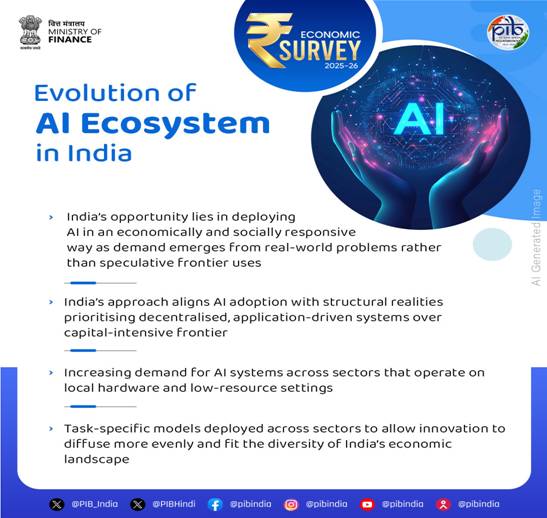
India’s demand for AI is emerging from real-world problems rather than speculative frontier uses. Citing examples across healthcare, agriculture, urban management, education, disaster preparedness, and public administration, the survey highlights the growing appetite for AI systems that work on local hardware and operate in low-resource settings. From early disease screening and precision water management to farmer market access, classroom analytics, and regional language interfaces, adoption is emerging where AI lowers costs and compensates for structural shortcomings. These uses signal a large and scalable market for frugal, application-focused AI solutions tailored to India’s economic and social landscape.

The Survey focuses on aligning AI adoption with India’s structural realities, such as capital availability, energy constraints, institutional capacity, and market depth, so that technology choices reinforce long-term growth instead of creating fragile dependencies.

As the Global AI development is being shaped by structural asymmetries in access to compute, finance, data, and standards-setting power, the Survey recognizes these imbalances as essential for crafting realistic policy. In this context, the preferred pathway emphasizes decentralized and application-driven AI rather than large, centralized systems. Smaller, task-specific models deployed across sectors allow innovation to diffuse more evenly, reduce entry barriers for firms, and better fit the diversity of India’s economic landscape. The Survey calls Open and interoperable AI systems as a force multiplier.

Further elaborating upon the Education and training priorities in the AI-era, the survey underscores the need to shift away from narrow technical specialization towards essential foundational capabilities such as reasoning, reading, judgment, communication, and adaptability. This shall integrate AI into workplaces and public systems.

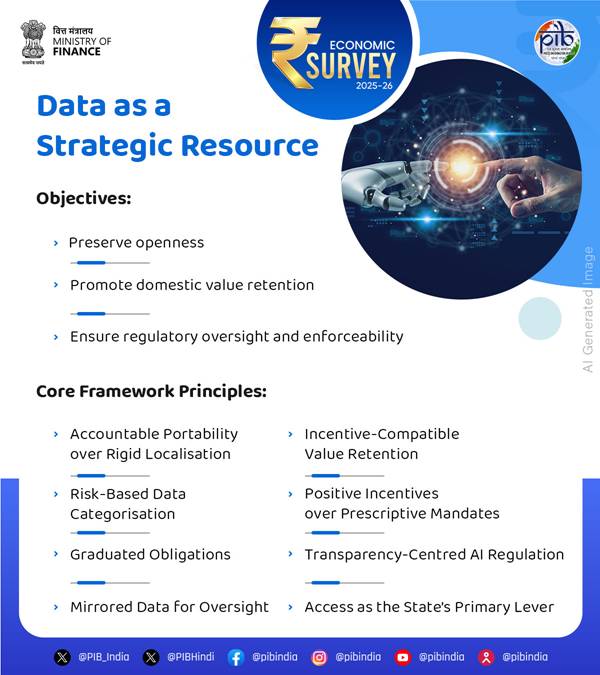
Adding on the Data governance of AI, the survey emphasizes over the need for it to be framed around accountability and value creation rather than isolation. Trusted data flows, combined with transparency and auditability, are seen as more effective than rigid localization in ensuring that economic benefits accrue domestically while maintaining global interoperability. The regulatory design favors proportionate, risk-based approaches over prescriptive control. Obligations scale with potential harm and systemic importance, allowing innovation to continue while aligning private incentives with broader economic and social objectives.

The survey reiterates that the India’s AI strategy must be sequenced carefully to avoid premature lock-in or regulatory overreach so that to build coordination first, capacity next and binding policy leverage last, allowing institutions and markets to co-evolve.

The survey in this chapter further elaborates upon Artificial Intelligence in India’s economic context, a development-oriented approach to AI, role of human capital for AI, AI-safety and risks along with the governance, institutional architecture and data as a strategic resource, followed with a phased roadmap for India’s AI Future.
ARTIFICIAL INTELIIGENCE ECOSYSTEM

The Survey deliberates upon asymmetries and trade-offs in the AI ecosystem across countries, firms, capabilities, and stages of the value chain. These asymmetries do not imply structural disadvantage but identifies the constraints within which a viable and sustainable AI strategy must be formulated to maximize economic and social returns from AI while remaining mindful of the trade-offs.

Capability Asymmetries between frontier model development and application-led development calls for India to deploy resources more effectively towards domain-specific AI systems aligned with domestic economic priorities. The capital-labour tradeoff elaborates upon the debate between scale versus inclusion which recognizes challenge - how to pace diffusion of AI to facilitate labour augmentation, choosing inclusive approach over scaling.

The cost, control, dependence of open or proprietary models ponders upon the ownership and governance of AI models. The survey underscores the need to strike a balance between openness and stewardship, leveraging shared innovation while ensuring that the economic value created from domestic data and intellectual property accrues within India rather than being captured abroad. The tradeoff between centralized scale and distributed efficiency strengthens the case for smaller, task-specific models that can run on limited hardware and decentralized compute networks. It lays emphasis on strategic autonomy and continued integration with global innovation networks to preserve openness where it enhances capability while insulating critical functions from external shocks.

LOCAL INGENUITY AND FRUGAL AI IN INDIA

India’s AI story is already evolving from the bottom-up. Local innovators, municipal bodies, start-ups, and community institutions are deploying AI to solve problems that are immediate and contextual to the communities they reside in. AI has multi-sectoral applications in health, agriculture, education, urban management, and disaster preparedness.

  • Non-invasive AI-enabled thermal imaging tools in southern India are enabling early breast cancer screening in low-resource settings.
  • Portable and low-cost AI-assisted oral cancer screening devices are bringing early detection to primary healthcare centers in eastern India.
  •  AI-enabled agricultural networks are improving market access, price discovery, and logistical efficiency for 1.8 million farmers across 12 States.
  • India’s approach to AI adoption also includes initiatives such as Bhashini under MEiTY, and AI4Bharat developed by IIT Madras. Language and voice-first AI systems are extending the reach of digital services.

Furthering interactions in native languages and functioning effectively on low-cost devices, such frugal AI pathways align scale with inclusion along with being decentralized, problem-driven, and embedded in local needs.

The National AI Mission can help scale diverse AI-solutions by providing shared infrastructure, standards, governance frameworks and funding without diluting local creativity.

A DEVELOPMENT-ORIENTED APPROACH TO AI

The Survey highlights the necessity of India’s own indigenous AI development. The AI ecosystem remaining sufficiently young creates an opening for India to shape a more value-creating and dignified employment opportunity for its workforce.

Further, the Survey highlights developments in global GPU supply chains to play a meaningful role in shaping the long-run pace of AI infrastructure expansion. The measures that enhance supply-side resilience in access to advanced compute need to complement the conventional policy levers to expand access to finance and incentivize domestic development of AI. India needs to rely on diversified and resilience access to global compute.

A government hosted, community-curated platform under IndiaAI Mission umbrella would provide secure and transparent space where developers, researchers and enterprises collaborate. Private sector participation may also to be encouraged promoting indigenous development of sector specific AI and transforming India from world’s IT sector back office to one of the AI front offices. The Bottom-up approach can be spearheaded under ‘AI-OS’ initiative. India ranks among the top global contributors to AI research output and possess a deep pool of technical talent in the field of artificial intelligence, the country also has a highly AI-literate labour force.

The heterogeneity and scale of the country suggests the possibility of curating diverse domestic datasets across various sectors, including health, agriculture, finance, education, and public administration.

GOVERNANCE, INSTITUTIONAL ARCHITECTURE AND DATA

AN AI ECONOMIC COUNCIL FOR INDIA

The AI Economic Council, separate from the Governance Council, is intended to operate, not just with a technological imperative, but with moral imperatives, but with imperatives that are sensitive to India’s socio-economic realities. They will operate as a coordinating authority that is responsible for aligning technology deployment with the evolution of India’s education and skilling infrastructure, while navigating resource constraints and development priorities. The core governance principles for such an institution would involve the following:

  1. Human Primacy and Economic Purpose
  2. Labour-Market  Sensitivity by Design
  3. Sequencing over Speed
  4. Co-evolution of  Technology and Human Capital
  5. Public Interest Safeguards and Ethical Non-Negotiable

By embedding labour realities and social stability priorities into AI policy, the institution will ensure that AI advances productivity without eroding employment and the dignity of work.

As innovations and applications are rapidly outpacing regulatory developments, the Survey calls upon a measured and swift response from policymakers. The regulatory design for AI adoption in India must seek to integrate AI within the broader socio-economic context of India, with special consideration for our labour market realities. It must ensure that AI serves humanity, rather than supplanting it.
Data-as-a-Strategic-Resource.jpg

HUMAN CAPITAL FOR AI

The Survey emphasizes experiential learning, early exposure to experience building, flexible education pathways and strengthening human-centric skills. The survey calls upon that ‘formal education and work experience’ need not be seen as mutually exclusive setup. To nurture India’s demographic dividend into a competent workforce, need for institutionalizing systems such as ‘Earn and Learn Initiative’. This pathway can be co-designed by the private sector and academic institutions. The National Education Policy 2020 aligns with the above vision.

Furthermore, a comprehensive sectoral mapping of jobs outside the white-collar workspace needs to be undertaken. For instance, nursing and geriatric care being understaffed highlights the potential for additional demand for skilled labour in the sectors.

AI SAFETY AND RISKS

The survey highlights an ‘AI Safety Institute’ as proposed under MeitY Governance Guidelines which shall analyze emerging risks, potential regulatory gaps, coordination on AI safety issues, and conducting training programmes to build awareness, among others. A Periodic, scenario-based testing and red-teaming of AI models must become institutionalized.

The survey suggests that International cooperation of institutes such as United Kingdom’s AI Security Institute and USA’s National Institute Standards and Technology shall enable joint evaluations of high risk models and shared access to completing infrastructure which will enhance global interoperability AI Safety Standards. The survey further acknowledges that no conception of safe or human-centric AI is credible without placing the protection of individual rights at its core.

ROADMAP FOR INDIA’s ‘AI’ FUTURE

The survey describes a central challenges for India - what it builds domestically, what it sources globally, what it regulates early, and what it deliberately allows to evolve. The benefit of hindsight allows India to design AI systems that are more resource-efficient and aligned with public objectives from the outset, sequencing regulation alongside deployment. It offers the country the opportunity to pursue a more resilient and inclusive AI trajectory.

India’s strengths lie in application-led innovation, the productive use of domestic data, human capital depth and the ability of public institutions to coordinate distributed efforts. A bottom-up strategy anchored in open and interoperable systems, sector-specific models, and shared physical and digital infrastructure offers a more credible pathway to value creation than a narrow pursuit of scale for its own sake.

Regulation, data governance and safety will have to evolve in parallel with deployment, not in its aftermath. Depending on the choices made, AI can be a tool for broad-based productivity and dignified work. India’s task is to ensure that AI development remains aligned with its developmental priorities and its long-term ambition to achieve economic resilience.

Topics

Acts Income Tax