

Loading...

Top
Help
×

By creating an account you can:

Logo TaxTMI
Call Us / Help / Feedback

Contact Us At :

E-mail: [email protected]

Call / WhatsApp at: +91 99117 96707

For more information, Check Contact Us

FAQs :

To know Frequently Asked Questions, Check FAQs

Most Asked Video Tutorials :

For more tutorials, Check Video Tutorials

Submit Feedback/Suggestion :

Email :
Please provide your email address so we can follow up on your feedback.
Category :
Description :
Min 15 characters 0/2000
Make Most of Text Search
  1. Checkout this video tutorial: How to search effectively on TaxTMI.
  2. Put words in double quotes for exact word search, eg: "income tax"
  3. Avoid noise words such as : 'and, of, the, a'
  4. Sort by Relevance to get the most relevant document.
  5. Press Enter to add multiple terms/multiple phrases, and then click on Search to Search.
  6. Text Search
  7. The system will try to fetch results that contains ALL your words.
  8. Once you add keywords, you'll see a new 'Search In' filter that makes your results even more precise.
  9. Text Search
Add to...
You have not created any category. Kindly create one to bookmark this item!
Create New Category
Hide
Title :
Description :
❮❮ Hide
Default View
Expand ❯❯
Close ✕
🔎 News - Adv. Search
TEXT SEARCH:

Press 'Enter' to add multiple search terms. Rules for Better Search

Search In:
Main Text + AI Text
  • Main Text
  • Main Text + AI Text
  • AI Text
Category: ?
Categorized by AI
---- All Categories ----
  • ---- All Categories ----
  • Income Tax
  • GST
  • Customs, DGFT & SEZ
  • FEMA & RBI
  • Corp. Laws, SEBI & IBC
  • PMLA, Black Money & ED
  • Budget
  • News and Press Release
  • PTI News
Month:
---- All Months ----
  • ---- All Months ----
  • January
  • February
  • March
  • April
  • May
  • June
  • July
  • August
  • September
  • October
  • November
  • December
Year:
---- All Years ----
  • ---- All Years ----
  • 2026
  • 2025
  • 2024
  • 2023
  • 2022
  • 2021
  • 2020
  • 2019
  • 2018
  • 2017
  • 2016
  • 2015
  • 2014
  • 2013
  • 2012
  • 2011
Sort By: ?
In Sort By 'Default', exact matches for text search are shown at the top, followed by the remaining results in their regular order.
Relevance Default Date
    CCI approves acquisition of certain equity shareholding in Bharti Life Insurance Company by Prudential Corporation Holdings
    Suspicious foreign remittances under I-T department scanner
    Delhi tightens rules for ration shops, makes big stock discrepancies an FIR offence
    Regional Rural Banks (RRBs) Record Strong Growth in Credit Delivery during FY 2025–26
    METSTO Delivers Adjustable Pallet Racking System Solutions for Warehouses
    China rolls out new measures to boost consumption in counties, smaller cities
    Strengthening Collaboration to Preserve Sovereignty: Collaborative Cash Ecosystems - Global Strategies to Preserve Trust and Sovereignty - Keynote Add...
    SC asks CBI to examine all six allegations of dubious transactions involving Indiabulls
    Cyber fraudsters invent 'boss' scam to target companies; Ahmedabad cops bust international network
    Personal Loan Prepayment Charges: What RBI Rules Say in 2026
    Zeeba Revamps Packaging and Announces Chef Vikas Khanna as Its Global Brand Ambassador
    Paul Merchants Finance Launches Loan Against Silver, Becomes India’s First NBFC to Set Up Exclusive Silver Loan Branches
    CarePass Launches This Independence Day, Bringing Healthcare Savings Across India's Top and Premium Hospitals
    Keralam CM flags off containers from Vizhinjam, marking start of EXIM operations
    Kerala: Fresh ED raids in CMRL-Exalogic Solutions case
    ED raids KPSC office, ex-chairman in veterinary officers hiring 'scam' case
    Keralam CM reviews operational preparedness at Vizhinjam port
    Union Minister for Finance and Corporate Affairs Smt. Nirmala Sitharaman chairs 3rd Meeting of Apex Monitoring Authority of NICDIT and reviews the pro...
    NBCC moves SC for RERA exemptions to complete 16 stalled Supertech projects
    DFS Hosts PSB Confluence 2026: Day 1 Deliberations focus on Four themes- Deposit Mobilisation, Banking for Youth, Supporting the Investment Cycle and ...
❯❯
Maximize Maximize Maximize
0 / 200
Expand Note
Add to Folder

No Folders have been created

+

Are you sure you want to delete "My most important" ?

NOTE:

News
Showing Results for :
Reset Filters
Results Found:
Show All Summaries Hide All Summaries
August 18, 2026
Show AI Summary
Competition approval for Prudential's acquisition of equity shareholding in an Indian life insurer supports the proposed insurance-sector combination.
Competition approval has been granted for Prudential Corporation Holdings Limited to acquire certain equity shareholding in Bharti Life Insurance Company Limited. The acquirer is the holding company for its group's insurance and asset-management operations in Asia and supports operations in Asia and Africa. The target is an IRDAI-licensed Indian life insurer.
August 18, 2026
Show AI Summary
Foreign remittance certification due diligence faces nationwide verification targeting shell entities, their controllers, and certifying professionals.
Nationwide verification of suspicious outward foreign remittances targets entities with little or no reported business activity, their controllers, and professionals issuing tax determination certificates. Scrutiny concerns remittances disproportionate to reported turnover, inconsistent with stated purposes, or linked to entities not operating from declared addresses. Form 15CB, or Form 146 under the corresponding framework, requires certifying accountants to assess taxability from books of account and relevant records, supporting tax deduction at source and treaty compliance through due care, diligence and professional judgment.
August 18, 2026
Show AI Summary
Fair Price Shop regulation introduces graded stock-shortage penalties, mandatory FIRs for major discrepancies, and restructured licensing requirements.
Fair Price Shop regulation introduces quantity-based penalties for stock discrepancies, ranging from performance-guarantee forfeiture and replenishment obligations to interim suspension, cancellation-related action and mandatory FIR registration for major shortages. Repeated or deliberate diversion or manipulation of public distribution supplies may lead to cancellation, blacklisting and FIR registration. Licensing now includes continuing regular licences and short-term temporary licences, with wider eligibility, points-based selection, card-linked performance guarantees and compulsory approved e-PoS, weighing-scale and iris-scanner use.
August 18, 2026
Show AI Summary
Priority sector lending strengthened rural credit access through agricultural, micro-enterprise and weaker-section finance, reinforcing financial inclusion and sustainable development.
Regional Rural Banks expanded rural credit delivery while maintaining strong Priority Sector Lending performance during FY 2025-26. Almost all Regional Rural Banks met the prescribed overall priority-sector target. Agriculture and allied activities remained the largest priority-sector component, with farm credit accounting for nearly all agricultural lending. MSME finance predominantly supported micro enterprises, rural entrepreneurs, artisans and small businesses. Lending to weaker sections and finance for housing, education, renewable energy and social infrastructure promoted inclusive access to institutional credit and sustainable rural development.
August 18, 2026
Show AI Summary
Adjustable pallet racking systems support customised, scalable warehouse storage through configurable layouts, safety assessment, installation and lifecycle support.
Adjustable pallet racking systems are configurable warehouse-storage solutions for varied inventory dimensions, weights and product types. They support bulk pallet storage, multi-level picking and high-density configurations through adjustable beams and shelves, load-bearing capacity, structural durability and space-efficient layouts. Storage configurations are customised after assessing inventory dimensions, payload requirements, available space and material-movement frequency, with support for design, installation, inspections and after-sales service.
August 18, 2026
Show AI Summary
Domestic consumption expansion targets lower-tier markets through improved retail channels, distribution networks, employment support and household income opportunities.
China has introduced measures to strengthen domestic consumption in counties, smaller cities, townships and rural areas. The measures include upgrading township commercial centres, rural markets and local fairs; encouraging domestic and international brands to establish regional debut stores; and reusing existing land resources to improve services. They also seek better services for elderly persons and children, stronger urban-rural distribution networks, county-level employment and resident income channels. The strategy supports a shift towards household consumption amid weak domestic demand, property-sector pressures and subdued consumer sentiment.
August 18, 2026
Show AI Summary
Currency management preserves monetary sovereignty through clean notes, secure logistics, decentralised distribution, durable banknotes, and sustainable cash-cycle operations.
Currency management supports trust in cash and monetary sovereignty through demand planning, secure production, distribution, replacement, and disposal. The Clean Note Policy requires good-quality banknotes to be available in required denominations and locations, with unfit notes continuously withdrawn and replaced. A decentralised Currency Chest network distributes fresh currency, processes returned notes, supports linked bank branches, and operates under licensing, real-time reporting, inspection, and audit requirements. Current priorities include managing uncertain cash demand, improving note durability, and reducing the carbon footprint of the cash cycle.
August 18, 2026
Show AI Summary
Independent investigation of alleged dubious transactions requires examination of all six allegations despite prior police conclusions.
Investigation into alleged dubious transactions involving Indiabulls Housing Finance Limited and related entities must cover all six allegations identified by the Enforcement Directorate. The CBI must independently examine five allegations previously reviewed by the Delhi Police Economic Offence Wing, irrespective of its conclusion, and submit a comprehensive report. Further investigation into the sixth allegation depends on the special PMLA court deciding the CBI's pending application, after which the CBI must provide a progress or status report.
August 18, 2026
Show AI Summary
Boss scam prevention requires independent verification of payment requests and avoidance of malicious WhatsApp attachments that enable executive impersonation.
Boss scam, or CEO impersonation fraud, uses malicious WhatsApp attachments and impersonation of regulatory officials or company executives to obtain control of WhatsApp sessions and issue fraudulent payment instructions. The alleged network supplied SIM cards, dummy SIMs, WhatsApp accounts and one-time passwords to cyber-fraud operators, illustrating a Cybercrime as a Service model. Preventive measures include avoiding suspicious ZIP, executable, library and APK files and independently verifying all financial-transfer requests.
August 18, 2026
Show AI Summary
Floating-rate personal loan prepayment protections prohibit charges and compulsory lock-ins for qualifying individual non-business borrowers from 2026.
Prepayment charges are prohibited for part or full repayment of qualifying floating-rate loans availed by individual borrowers for non-business purposes and sanctioned or renewed on or after 1 January 2026. Compulsory lock-in periods cannot restrict prepayment of such loans. Fixed-rate personal loans may still attract prepayment or foreclosure charges under lender policy and contractual terms. Borrowers should check the loan's rate type, sanction letter, loan agreement and key fact statement, where applicable, and compare applicable charges with potential interest savings before early repayment.
August 18, 2026
Show AI Summary
Premium Basmati rice positioning drives Zeeba's packaging refresh and ambassador-led campaign focused on quality, authenticity and domestic expansion.
Zeeba has refreshed its packaging and appointed Chef Vikas Khanna as global brand ambassador to support expansion in India. Its "Aisa Basmati Nahi Dekha" campaign positions the brand around export-quality Basmati rice, consistency, authenticity and a superior culinary experience. Promotional activity will extend across digital, retail and consumer touchpoints. The premium Basmati range is described as carefully sourced, naturally aged and processed according to global quality standards, with emphasis on grain quality, authentic taste, purity and consistency.
August 18, 2026
Show AI Summary
Silver-collateral lending creates a formal secured-credit channel for eligible borrowers, subject to regulatory requirements and lender policies.
Loans against silver collateral have been introduced following the Reserve Bank of India's Lending Against Gold and Silver Collateral Directions, 2025, enabling eligible regulated lenders to accept silver as security. The offering provides a formal and transparent credit channel against eligible silver jewellery, ornaments and approved silver coins. It is intended for individuals, proprietors and MSMEs requiring liquidity for personal, business and other legitimate financial needs, subject to lending policies and applicable regulatory requirements.
August 18, 2026
Show AI Summary
Healthcare discount membership provides instant savings on out-of-pocket care at participating premium providers without insurance claims or paperwork.
CarePass is a healthcare savings membership card providing instant point-of-billing discounts at participating premium healthcare providers across India. It covers out-of-pocket spending on hospital treatment, diagnostics, dental, vision, dermatology, hair and skin care, and IVF and maternity services, without claim processing, waiting periods or paperwork. Members present a digital CarePass at a participating provider to receive the applicable discount. Four membership tiers offer differing benefits, with higher tiers including tele-consultations and annual health checks. CarePass is a discount membership and not an insurance product.
August 18, 2026
Show AI Summary
EXIM operations at Vizhinjam commence with container movement, supported by investor facilitation, infrastructure backing and port-led logistics development.
EXIM operations at Vizhinjam international seaport commenced with the flagging off of two containers after a successful trial export shipment. The state government proposes investor engagement, regulatory facilitation and infrastructure support to expand global export activities through the port. Mission Samudra is to operate as a port-led industrial and logistics development scheme. The deep-water port was developed under a public-private partnership model and had received commercial commissioning certification.
August 18, 2026
Show AI Summary
Money-laundering investigation under PMLA expands through searches into alleged consultancy payments linked to CMRL and Exalogic Solutions.
Money-laundering investigation under the Prevention of Money Laundering Act involves fresh searches connected with Cochin Minerals and Rutile Ltd and Exalogic Solutions. The inquiry concerns alleged fraudulent payments made under the guise of IT consultancy services and a purported money trail involving persons allegedly connected with those transactions. The action follows earlier searches and questioning in relation to the same matter.
August 18, 2026
Show AI Summary
Recruitment examination irregularities trigger money-laundering investigation into alleged bribery, paper leaks, answer-sheet tampering, and preferential veterinary officer selections.
Money-laundering investigation under the Prevention of Money Laundering Act concerns alleged irregularities in veterinary officers' final selection through a public recruitment examination. Searches covered premises linked to commission officials, alleged intermediaries, the digital evaluation entity, and selected candidates. Allegations include bribery demands, examination-paper leakage, OMR answer-sheet tampering, and facilitation of selection for relatives of commission officials.
August 18, 2026
Show AI Summary
Export-import operations advance through operational preparedness review and planned port-led industrial and logistics development initiatives.
Operational preparedness for full land-based export-import operations at Vizhinjam Seaport was reviewed, including the Vehicle Traffic Management System. EXIM cargo operations follow a trial shipment of the port's first export container to Valencia. Mission Samudra is proposed to support port-led industrial and logistics development alongside these operations. The deep-water port was developed through a public-private partnership model and had obtained commercial commissioning certification before its dedication to the nation.
August 18, 2026
Show AI Summary
Industrial corridor development prioritises empowered SPVs, integrated infrastructure and investor-ready parks to accelerate manufacturing investment and operations.
National Industrial Corridor Development Programme implementation prioritises timely infrastructure completion, land allotment, investment mobilisation and commencement of manufacturing. PM GatiShakti-aligned planning requires integrated connectivity, utilities and social infrastructure, while States should resolve land, clearance and SPV-power bottlenecks. BHAVYA proposes investment-ready, plug-and-play industrial parks appraised for ready land, credible demand, connectivity, utilities, realistic phasing and early investor attraction. NICDIT routes Government participation and equity support for BHAVYA project SPVs, and NICDC coordinates implementation and monitoring.
August 17, 2026
Show AI Summary
RERA compliance exemption for stalled housing projects raises whether statutory obligations may be waived to enable phased project completion.
RERA compliance exemption is sought for completion of 16 stalled residential projects by a public sector construction entity appointed under a project-completion arrangement. The appellate insolvency tribunal declined to direct a waiver, considering itself incompetent to exempt compliance with statutory provisions. The arrangement requires phased completion, award and commencement of construction work, and oversight through an apex committee and project-wise committees. The projects remain incomplete owing to the developer's financial crisis.
August 17, 2026
Show AI Summary
Deposit mobilisation and youth banking guide strategies for stronger public financial institutions, investment financing and Global Capability Centre opportunities.
PSB Confluence 2026 considers strategic priorities for Public Sector Banks and Public Financial Institutions across deposit mobilisation, banking for youth, investment-cycle financing and Global Capability Centres. Discussions seek practical, scalable strategies to strengthen customer engagement, youth-responsive banking propositions, institutional financing capabilities and participation in the expanding Global Capability Centre ecosystem. Youth engagement may use the MY Bharat platform to strengthen links with the formal financial system and awareness of education finance, entrepreneurship, internships and financial-sector careers. Further themes include value-chain infrastructure, priority sector lending and credit card business reform.

News

Back

All News

Showing Results for :
Reset Filters
No Records Found

News

Back

All News

Showing Results for : Reset Filters

INDIA SHOULD PRIORITISE DECENTRALISED, APPLICATION-DRIVEN SYSTEMS OVER CAPITAL-INTENSIVE FRONTIER MODELS TO AVOID FRAGILE DEPENDENCIES IN ARTIFICIAL INTELLIGENCE: ECONOMIC SURVEY

January 29, 2026

Contents
Summary
Note

Note

-

Bookmark

Print

Print

ECONOMIC SURVEY 2025-26 ADVOCATES AIMING FOR FRUGAL, REAL-WORLD DEPLOYMENT AT SCALE

INDIA’S APPROACH INTENDS TO ALIGN AI ADOPTION WITH STRUCTURAL REALITIES-CAPITAL, ENERGY, INSTITUTIONAL CAPACITY AND MARKET DEPTH

THE NATIONAL AI MISSION CAN SCALE DIVERSE AI-SOLUTIONS BY PROVIDING SHARED INFRASTRUCTURE, STANDARDS, GOVERNANCE FRAMEWORKS AND FUNDING WITHOUT DILUTING LOCAL CREATIVITY

LOCAL INNOVATORS, MUNICIPAL BODIES, START-UPS, AND COMMUNITY INSTITUTIONS DEPLOYING AI TO SOLVE IMMEDIATE AND CONTEXTUAL PROBLEMS

LANGUAGE AND VOICE-FIRST AI SYSTEMS EXTENDING REACH OF DIGITAL SERVICES TO POPULATIONS HISTORICALLY EXCLUDED

THE ECONOMIC SURVEY 2025-26 ENVISIONS THE WAY FORWARD FOR INDIA’S AI ECOSYSTEM

The Economic Survey 2025-26 tabled by the Union Minister of Finance and Corporate Affairs, Smt. Nirmala Sitharaman in the Parliament today, recognizes Artificial Intelligence (AI) as an economic strategy rather than a prestige technology race. The Survey examines the way AI is reshaping global economy and outlines a pragmatic strategy for India in an environment marked by rapid technological change and persistent uncertainty.

The Economic survey in its dedicated chapter highlights that AI deployment in India to be economically grounded and socially responsive. It makes a case for a bottom up, multiple sector-specific approaches grounded in open and interoperable systems to promote collaboration and shared innovation. This aligns with India’s strengths in human capital, data diversity and institutional coordination. 

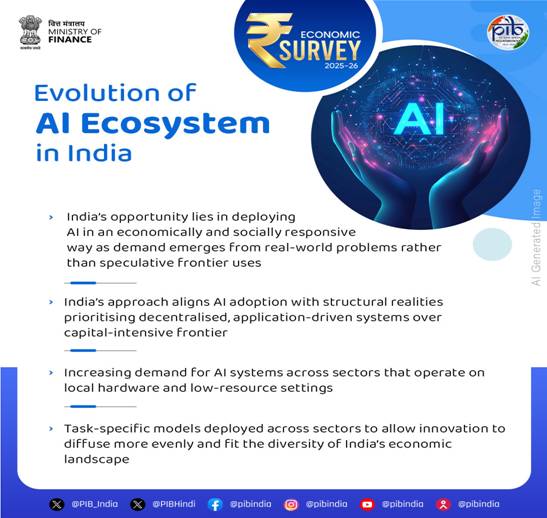
India’s demand for AI is emerging from real-world problems rather than speculative frontier uses. Citing examples across healthcare, agriculture, urban management, education, disaster preparedness, and public administration, the survey highlights the growing appetite for AI systems that work on local hardware and operate in low-resource settings. From early disease screening and precision water management to farmer market access, classroom analytics, and regional language interfaces, adoption is emerging where AI lowers costs and compensates for structural shortcomings. These uses signal a large and scalable market for frugal, application-focused AI solutions tailored to India’s economic and social landscape.

The Survey focuses on aligning AI adoption with India’s structural realities, such as capital availability, energy constraints, institutional capacity, and market depth, so that technology choices reinforce long-term growth instead of creating fragile dependencies.

As the Global AI development is being shaped by structural asymmetries in access to compute, finance, data, and standards-setting power, the Survey recognizes these imbalances as essential for crafting realistic policy. In this context, the preferred pathway emphasizes decentralized and application-driven AI rather than large, centralized systems. Smaller, task-specific models deployed across sectors allow innovation to diffuse more evenly, reduce entry barriers for firms, and better fit the diversity of India’s economic landscape. The Survey calls Open and interoperable AI systems as a force multiplier.

Further elaborating upon the Education and training priorities in the AI-era, the survey underscores the need to shift away from narrow technical specialization towards essential foundational capabilities such as reasoning, reading, judgment, communication, and adaptability. This shall integrate AI into workplaces and public systems.

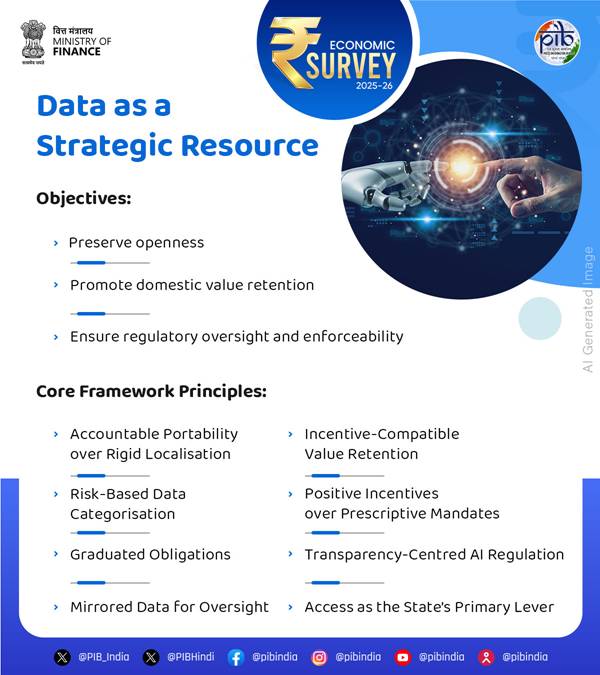
Adding on the Data governance of AI, the survey emphasizes over the need for it to be framed around accountability and value creation rather than isolation. Trusted data flows, combined with transparency and auditability, are seen as more effective than rigid localization in ensuring that economic benefits accrue domestically while maintaining global interoperability. The regulatory design favors proportionate, risk-based approaches over prescriptive control. Obligations scale with potential harm and systemic importance, allowing innovation to continue while aligning private incentives with broader economic and social objectives.

The survey reiterates that the India’s AI strategy must be sequenced carefully to avoid premature lock-in or regulatory overreach so that to build coordination first, capacity next and binding policy leverage last, allowing institutions and markets to co-evolve.

The survey in this chapter further elaborates upon Artificial Intelligence in India’s economic context, a development-oriented approach to AI, role of human capital for AI, AI-safety and risks along with the governance, institutional architecture and data as a strategic resource, followed with a phased roadmap for India’s AI Future.
ARTIFICIAL INTELIIGENCE ECOSYSTEM

The Survey deliberates upon asymmetries and trade-offs in the AI ecosystem across countries, firms, capabilities, and stages of the value chain. These asymmetries do not imply structural disadvantage but identifies the constraints within which a viable and sustainable AI strategy must be formulated to maximize economic and social returns from AI while remaining mindful of the trade-offs.

Capability Asymmetries between frontier model development and application-led development calls for India to deploy resources more effectively towards domain-specific AI systems aligned with domestic economic priorities. The capital-labour tradeoff elaborates upon the debate between scale versus inclusion which recognizes challenge - how to pace diffusion of AI to facilitate labour augmentation, choosing inclusive approach over scaling.

The cost, control, dependence of open or proprietary models ponders upon the ownership and governance of AI models. The survey underscores the need to strike a balance between openness and stewardship, leveraging shared innovation while ensuring that the economic value created from domestic data and intellectual property accrues within India rather than being captured abroad. The tradeoff between centralized scale and distributed efficiency strengthens the case for smaller, task-specific models that can run on limited hardware and decentralized compute networks. It lays emphasis on strategic autonomy and continued integration with global innovation networks to preserve openness where it enhances capability while insulating critical functions from external shocks.

LOCAL INGENUITY AND FRUGAL AI IN INDIA

India’s AI story is already evolving from the bottom-up. Local innovators, municipal bodies, start-ups, and community institutions are deploying AI to solve problems that are immediate and contextual to the communities they reside in. AI has multi-sectoral applications in health, agriculture, education, urban management, and disaster preparedness.

  • Non-invasive AI-enabled thermal imaging tools in southern India are enabling early breast cancer screening in low-resource settings.
  • Portable and low-cost AI-assisted oral cancer screening devices are bringing early detection to primary healthcare centers in eastern India.
  •  AI-enabled agricultural networks are improving market access, price discovery, and logistical efficiency for 1.8 million farmers across 12 States.
  • India’s approach to AI adoption also includes initiatives such as Bhashini under MEiTY, and AI4Bharat developed by IIT Madras. Language and voice-first AI systems are extending the reach of digital services.

Furthering interactions in native languages and functioning effectively on low-cost devices, such frugal AI pathways align scale with inclusion along with being decentralized, problem-driven, and embedded in local needs.

The National AI Mission can help scale diverse AI-solutions by providing shared infrastructure, standards, governance frameworks and funding without diluting local creativity.

A DEVELOPMENT-ORIENTED APPROACH TO AI

The Survey highlights the necessity of India’s own indigenous AI development. The AI ecosystem remaining sufficiently young creates an opening for India to shape a more value-creating and dignified employment opportunity for its workforce.

Further, the Survey highlights developments in global GPU supply chains to play a meaningful role in shaping the long-run pace of AI infrastructure expansion. The measures that enhance supply-side resilience in access to advanced compute need to complement the conventional policy levers to expand access to finance and incentivize domestic development of AI. India needs to rely on diversified and resilience access to global compute.

A government hosted, community-curated platform under IndiaAI Mission umbrella would provide secure and transparent space where developers, researchers and enterprises collaborate. Private sector participation may also to be encouraged promoting indigenous development of sector specific AI and transforming India from world’s IT sector back office to one of the AI front offices. The Bottom-up approach can be spearheaded under ‘AI-OS’ initiative. India ranks among the top global contributors to AI research output and possess a deep pool of technical talent in the field of artificial intelligence, the country also has a highly AI-literate labour force.

The heterogeneity and scale of the country suggests the possibility of curating diverse domestic datasets across various sectors, including health, agriculture, finance, education, and public administration.

GOVERNANCE, INSTITUTIONAL ARCHITECTURE AND DATA

AN AI ECONOMIC COUNCIL FOR INDIA

The AI Economic Council, separate from the Governance Council, is intended to operate, not just with a technological imperative, but with moral imperatives, but with imperatives that are sensitive to India’s socio-economic realities. They will operate as a coordinating authority that is responsible for aligning technology deployment with the evolution of India’s education and skilling infrastructure, while navigating resource constraints and development priorities. The core governance principles for such an institution would involve the following:

  1. Human Primacy and Economic Purpose
  2. Labour-Market  Sensitivity by Design
  3. Sequencing over Speed
  4. Co-evolution of  Technology and Human Capital
  5. Public Interest Safeguards and Ethical Non-Negotiable

By embedding labour realities and social stability priorities into AI policy, the institution will ensure that AI advances productivity without eroding employment and the dignity of work.

As innovations and applications are rapidly outpacing regulatory developments, the Survey calls upon a measured and swift response from policymakers. The regulatory design for AI adoption in India must seek to integrate AI within the broader socio-economic context of India, with special consideration for our labour market realities. It must ensure that AI serves humanity, rather than supplanting it.
Data-as-a-Strategic-Resource.jpg

HUMAN CAPITAL FOR AI

The Survey emphasizes experiential learning, early exposure to experience building, flexible education pathways and strengthening human-centric skills. The survey calls upon that ‘formal education and work experience’ need not be seen as mutually exclusive setup. To nurture India’s demographic dividend into a competent workforce, need for institutionalizing systems such as ‘Earn and Learn Initiative’. This pathway can be co-designed by the private sector and academic institutions. The National Education Policy 2020 aligns with the above vision.

Furthermore, a comprehensive sectoral mapping of jobs outside the white-collar workspace needs to be undertaken. For instance, nursing and geriatric care being understaffed highlights the potential for additional demand for skilled labour in the sectors.

AI SAFETY AND RISKS

The survey highlights an ‘AI Safety Institute’ as proposed under MeitY Governance Guidelines which shall analyze emerging risks, potential regulatory gaps, coordination on AI safety issues, and conducting training programmes to build awareness, among others. A Periodic, scenario-based testing and red-teaming of AI models must become institutionalized.

The survey suggests that International cooperation of institutes such as United Kingdom’s AI Security Institute and USA’s National Institute Standards and Technology shall enable joint evaluations of high risk models and shared access to completing infrastructure which will enhance global interoperability AI Safety Standards. The survey further acknowledges that no conception of safe or human-centric AI is credible without placing the protection of individual rights at its core.

ROADMAP FOR INDIA’s ‘AI’ FUTURE

The survey describes a central challenges for India - what it builds domestically, what it sources globally, what it regulates early, and what it deliberately allows to evolve. The benefit of hindsight allows India to design AI systems that are more resource-efficient and aligned with public objectives from the outset, sequencing regulation alongside deployment. It offers the country the opportunity to pursue a more resilient and inclusive AI trajectory.

India’s strengths lie in application-led innovation, the productive use of domestic data, human capital depth and the ability of public institutions to coordinate distributed efforts. A bottom-up strategy anchored in open and interoperable systems, sector-specific models, and shared physical and digital infrastructure offers a more credible pathway to value creation than a narrow pursuit of scale for its own sake.

Regulation, data governance and safety will have to evolve in parallel with deployment, not in its aftermath. Depending on the choices made, AI can be a tool for broad-based productivity and dignified work. India’s task is to ensure that AI development remains aligned with its developmental priorities and its long-term ambition to achieve economic resilience.

Topics

Acts Income Tax