

Loading...

Top
Help
×

By creating an account you can:

Logo TaxTMI
Call Us / Help / Feedback

Contact Us At :

E-mail: [email protected]

Call / WhatsApp at: +91 99117 96707

For more information, Check Contact Us

FAQs :

To know Frequently Asked Questions, Check FAQs

Most Asked Video Tutorials :

For more tutorials, Check Video Tutorials

Submit Feedback/Suggestion :

Email :
Please provide your email address so we can follow up on your feedback.
Category :
Description :
Min 15 characters 0/2000
Make Most of Text Search
  1. Checkout this video tutorial: How to search effectively on TaxTMI.
  2. Put words in double quotes for exact word search, eg: "income tax"
  3. Avoid noise words such as : 'and, of, the, a'
  4. Sort by Relevance to get the most relevant document.
  5. Press Enter to add multiple terms/multiple phrases, and then click on Search to Search.
  6. Text Search
  7. The system will try to fetch results that contains ALL your words.
  8. Once you add keywords, you'll see a new 'Search In' filter that makes your results even more precise.
  9. Text Search
Add to...
You have not created any category. Kindly create one to bookmark this item!
Create New Category
Hide
Title :
Description :
❮❮ Hide
Default View
Expand ❯❯
Close ✕
🔎 News - Adv. Search
TEXT SEARCH:

Press 'Enter' to add multiple search terms. Rules for Better Search

Search In:
Main Text + AI Text
  • Main Text
  • Main Text + AI Text
  • AI Text
Category: ?
Categorized by AI
---- All Categories ----
  • ---- All Categories ----
  • Income Tax
  • GST
  • Customs, DGFT & SEZ
  • FEMA & RBI
  • Corp. Laws, SEBI & IBC
  • PMLA, Black Money & ED
  • Budget
  • News and Press Release
  • PTI News
Month:
---- All Months ----
  • ---- All Months ----
  • January
  • February
  • March
  • April
  • May
  • June
  • July
  • August
  • September
  • October
  • November
  • December
Year:
---- All Years ----
  • ---- All Years ----
  • 2026
  • 2025
  • 2024
  • 2023
  • 2022
  • 2021
  • 2020
  • 2019
  • 2018
  • 2017
  • 2016
  • 2015
  • 2014
  • 2013
  • 2012
  • 2011
Sort By: ?
In Sort By 'Default', exact matches for text search are shown at the top, followed by the remaining results in their regular order.
Relevance Default Date
    Goyal says India negotiating FTAs with 8-9 more blocs, aims to cover 75 pc of global trade
    Rupee rises 7 paise to 95.64 against US dollar in early trade
    Woman passenger from Sharjah held with undeclared gold chain at Ahmedabad airport
    Delhi: Retired railway employee put under 'digital arrest', duped of Rs 30 lakh; one held
    CPI(M) accuses ED of ‘politically targeting’ Pinarayi Vijayan in CMRL case
    ED arrests ex-Andhra minister K Nageswara Rao in liquor transport 'scam'
    Orris Infrastructure MD Amit Gupta arrested in cheating case
    In a knot: Surat weaving units take voluntary two-day holiday as yarn prices shoot up
    Canada will impose retaliatory tariffs on US goods beginning Sept 8 as trade negotiations collapse
    Trade war between Canada, US deepens rupture in what had been close and durable alliance
    Canada will impose retaliatory tariffs on US good beginning Sept 8
    J-K parties oppose hike in power tarrif
    IAS officer Gangwar not ‘missing’, away in UP over father’s health: Karnataka minister
    J-K Dy CM terms ED case against his brother 'selective targeting'
    T'gana HC CJ calls for timely, expert dispute resolution in telecom, broadcasting, airport sectors
    Latur CA booked for issuing certificates to facilitate remittance of hundreds of crores abroad
    Stock Market for Beginners: How to Start Investing Without Feeling Overwhelmed
    CGST Zone detects clandestine pan masala, tobacco unit, detects tax evasion of Rs 160 cr
    Korea Industry Expo (KoINDEX) 2026 Opens at Yashobhoomi on 27 August
    Protection in predicate offence doesn't automatically extend to PMLA case: Delhi HC
❯❯
Maximize Maximize Maximize
0 / 200
Expand Note
Add to Folder

No Folders have been created

+

Are you sure you want to delete "My most important" ?

NOTE:

News
Showing Results for :
Reset Filters
Results Found:
Show All Summaries Hide All Summaries
August 24, 2026
Show AI Summary
Free trade agreement strategy expands preferential market access and supports India's integration into global value chains and investment partnerships.
India's free trade agreement strategy seeks to expand preferential market access and integrate the country into global value chains as a trusted trading partner. Negotiations with additional country groups and individual nations are intended to extend agreement coverage to a substantial share of global trade. Investment opportunities are identified in data centres, manufacturing and artificial intelligence, alongside an objective of developing more balanced trade relations between India and Japan.
August 24, 2026
Show AI Summary
Foreign exchange market conditions supported rupee appreciation, but crude prices, importer demand and geopolitical sanctions concerns limited gains.
Foreign exchange market conditions supported a modest early appreciation of the rupee against the US dollar due to relative dollar softness. The gain was limited by elevated crude oil prices, importer demand for dollars, and caution over anticipated sanctions affecting Iranian oil trade, banking networks and shipping routes. Currency markets remained sensitive to geopolitical uncertainty and possible wider trade effects.
August 23, 2026
Show AI Summary
Undeclared gold importation led to customs interception, seizure, arrest and continuing investigation after concealment inside passenger clothing.
Customs enforcement against undeclared gold importation involved interception of a passenger arriving from Sharjah at Ahmedabad airport following passenger profiling. A gold chain concealed inside clothing was recovered after it was not declared for customs purposes. The chain was seized and the passenger was arrested under the Customs Act, 1962, before being released on bail, with further investigation continuing.
August 23, 2026
Show AI Summary
Digital arrest cyber fraud used impersonation, forged notices and coercive video calls to obtain transfers through mule accounts.
Digital arrest cyber fraud allegedly used impersonation of law-enforcement and central banking officials, fabricated notices, threats of arrest and continuous video communications to coerce a retired railway employee into disclosing financial details and transferring funds for purported verification. The alleged proceeds were routed through mule and shell accounts. Banking records, KYC details, digital evidence and transaction trails allegedly connected a recipient account with suspicious transactions and multiple cyber-fraud cases; part of the cheated amount was recovered or refunded.
August 23, 2026
Show AI Summary
Political targeting allegations challenge money-laundering enforcement actions, searches, questioning, and public disclosures in the CMRL investigation.
CPI(M) alleges that enforcement action under the Prevention of Money Laundering Act in the CMRL matter is politically motivated targeting of Pinarayi Vijayan, family members and party associates. It contends that searches, questioning and public communications during the investigation were used to create suspicion without incriminating evidence, and characterises references to hawala as a new investigative narrative. The party also alleges selective anti-money-laundering enforcement against opposition leaders and states that the company will address the CMRL-related matter.
August 23, 2026
Show AI Summary
Money-laundering investigation into alleged liquor transport irregularities results in arrests connected with claimed loss to the government exchequer.
Money-laundering proceedings concerning alleged financial irregularities in liquor transport led to the arrest of former Andhra Pradesh minister Karumuri Nageswara Rao under the Prevention of Money Laundering Act. The inquiry concerns alleged wrongful loss to the government exchequer arising from liquor-transport operations. Investigative measures included raids and the arrest of Rao's son, along with arrests of a former state beverages corporation managing director and the person described as the principal accused.
August 23, 2026
Show AI Summary
Alleged LLP record forgery raises cheating, breach of trust and conspiracy concerns over unauthorised partnership interest changes.
Alleged forgery, cheating, criminal breach of trust and conspiracy concern purported unauthorised changes to LLP statutory records filed with the Registrar of Companies. The allegations include use of false documents to remove a nominated partner, substitute another person as partner and transfer a partner's interest in the LLP. The matter also draws attention to separate land-collaboration allegations and delayed possession claims by homebuyers in a halted housing project.
August 23, 2026
Show AI Summary
Voluntary production curtailment addresses polyester yarn cost volatility as weaving units seek customs-duty relief on inputs.
Voluntary production curtailment by weaving units is being adopted in response to increased polyester yarn and related input costs. Units may reduce shifts or observe periodic holidays according to individual commercial feasibility to limit yarn consumption until prices and fabric-market conditions stabilise. Industry representatives allege that yarn-price increases exceed corresponding input-cost movements and seek examination of possible artificial pricing, along with customs-duty relief on yarn and relevant inputs.
August 22, 2026
Show AI Summary
Retaliatory tariffs escalate trade restrictions as historic tariff authority enables duties without prior investigation or a prescribed duration.
Retaliatory tariffs are set to escalate bilateral trade restrictions after the United States imposed tariffs of up to 50 per cent on specified Canadian imports. Canada proposes dollar-for-dollar countermeasures covering sectors including steel, dairy, appliances, agricultural equipment, pulp and paper and electronics. Section 338 of the Tariff Act of 1930 is invoked as the legal basis for the United States measures, permitting presidential import duties up to 50 per cent without a prior investigation or prescribed maximum duration. Escalation creates uncertainty for supply chains and renewal of the United States-Mexico-Canada Agreement.
August 22, 2026
Show AI Summary
Reciprocal tariffs reshape Canada-United States trade relations, increasing supply-chain risks and accelerating Canadian trade diversification beyond its primary export market.
Canada-United States trade relations are described as entering a confrontational phase after tariff negotiations collapsed. The United States imposed tariffs on specified Canadian goods, while Canada committed to reciprocal import taxes and suspended negotiations. The dispute marks a retreat from preferential market access and continental integration. Canada's export dependence on the United States may limit retaliation and increase risks to output, employment, investment and integrated supply chains. Trade diversification, non-United States investment and expanded Pacific export infrastructure are identified as responses to a potentially enduring protectionist bilateral relationship.
August 22, 2026
Show AI Summary
Retaliatory tariffs on United States goods will target key sectors after trade negotiations failed and reciprocal tariff relief was unavailable.
Retaliatory tariffs on United States goods will take effect from 8 September in response to United States tariffs on Canadian products and unsuccessful negotiations. The dollar-for-dollar measures will cover steel, dairy, appliances, agricultural equipment, pulp and paper, and electronics, with product-specific details to follow. Canada had been willing to remove certain retaliatory tariffs if corresponding United States tariffs were substantially reduced, but considered the final demands unacceptable.
August 22, 2026
Show AI Summary
Power tariff revision faces political opposition over increased consumer electricity costs and conflict with prior free-electricity commitments.
Power tariff regulation in Jammu and Kashmir and Ladakh has been revised through approval of an average tariff increase, effective from 1 September 2026. Political representatives have opposed the increase on the ground that it adds to consumer hardship amid unemployment, inflation, and sectoral difficulties. The criticism also contrasts the revised tariff with prior commitments concerning free domestic electricity and gas.
August 22, 2026
Show AI Summary
Recruitment examination integrity prompted enforcement scrutiny and proposed disciplinary inquiry, while an officer's absence was attributed to family emergency.
Reported absence of an IAS officer was attributed to a family medical emergency and a pending leave request, rather than enforcement searches concerning an alleged recruitment-examination scam. The officer denied any connection with those searches and expressed willingness to face an inquiry. Enforcement searches at the Karnataka Public Service Commission concerned a money-laundering investigation into alleged recruitment irregularities. The State Cabinet decided to advise suspension of the commission chairperson and initiation of an inquiry after an earlier suspension was set aside for lacking the Cabinet's aid and advice.
August 22, 2026
Show AI Summary
Money-laundering and benami asset allegations prompt enforcement proceedings, while the accused officer's brother calls the action selective targeting.
Enforcement proceedings under the Prevention of Money Laundering Act concern allegations that suspended police officer Vijay Choudhary managed numerous assets through benami transactions and engaged in money laundering. An Anti-Corruption Bureau FIR had already been registered in relation to the allegations. Surinder Choudhary characterised the action as selective targeting but maintained that investigating agencies and the judiciary should address and decide matters concerning his family.
August 22, 2026
Show AI Summary
Specialised dispute resolution requires technical expertise, timely proceedings, mediation support, and human oversight to safeguard natural justice.
Specialised, timely and effective dispute-resolution mechanisms are necessary for technically complex disputes in telecom, broadcasting, airport tariffs and cyber sectors. Technology may assist legal reasoning but cannot replace judicial reasoning, requiring verification, professional responsibility and meaningful human oversight. Effective specialised adjudication should combine domain expertise with judicial discipline, respond to technical complexity, and protect natural justice, transparency and reasoned decision-making. Mediation and other consensual mechanisms can support dispute resolution.
August 22, 2026
Show AI Summary
Form 15CB certification faces scrutiny where inadequate verification allegedly enables foreign remittances through shell companies and false certificates.
Alleged misuse of Form 15CB certification has resulted in criminal proceedings concerning certificates issued for foreign remittances without verification of underlying documents. Form 15CB requires certification of applicable taxability and tax-deduction particulars for specified remittances to non-residents before processing by an authorised dealer. The allegations concern certificates that potentially enabled cross-border transfers through shell or non-existent companies, involving cheating, false certification, false evidence and common intention.
August 22, 2026
Show AI Summary
Beginner stock market investing requires regulated accounts, risk-aware financial planning, diversification and informed company assessment before purchasing securities.
Beginner stock market investing requires a bank account, a trading or broking account with a SEBI-registered broker, and a Demat account for electronic holding of securities. Investments involve risk of loss and should align with financial goals, time horizon and loss-bearing capacity. Investors should understand primary and secondary markets, distinguish long-term investing from short-term trading, assess companies before purchase, diversify holdings, consider charges, maintain records and avoid borrowed-money investing, rumours and momentum-driven decisions.
August 22, 2026
Show AI Summary
Capacity-based tobacco taxation targets undeclared packing machinery used for clandestine production and clearance without indirect tax payment.
Clandestine manufacture and clearance of pan masala, scented jarda and tobacco products without registration or payment of GST, HSNS Cess and central excise duty was detected through an intelligence-led search. Undeclared Form-Fill-Seal packing machines, workers, finished goods, raw materials, transport vehicles, packing materials and records indicated unaccounted production and clearance. Capacity-based monthly HSNS Cess for pan masala is computed according to the number, type and capacity of installed packing machines, while a corresponding capacity-based central excise levy applies to chewing tobacco, jarda and gutkha.
August 22, 2026
Show AI Summary
Trade exhibition connects Korean exporters with Indian buyers through sector-specific consultations and certification guidance for market entry.
KoINDEX 2026 is a business-to-business trade exhibition bringing Korean manufacturers and exporters together with buyers in India and South Asia. It focuses on beauty and personal-care products, processed and functional foods, and construction, building and safety products. Commercial engagement includes pre-matched export consultations with project owners, contractors, distributors, wholesalers, e-commerce platforms and food distribution businesses. A seminar addresses Bureau of Indian Standards certification and market-entry requirements for Korean products entering the Indian market.
August 22, 2026
Show AI Summary
Independent PMLA proceedings require separate anticipatory bail assessment; predicate-offence protection alone cannot establish pre-arrest protection.
Protection in a predicate-offence FIR does not automatically extend to independent PMLA proceedings. Anticipatory bail in a money-laundering investigation must be assessed under the applicable PMLA condition and on the material connecting the applicant to alleged proceeds of crime. Relevant considerations include the financial trail, recorded statements, bank-account analysis, compliance with summonses, cooperation with inquiry, and the need for personal participation in evidence collection and confrontation with documentary and digital material.

News

Back

All News

Showing Results for :
Reset Filters
No Records Found

News

Back

All News

Showing Results for : Reset Filters

“INDIA’S MOVEMENT FROM SWADESHI TO STRATEGIC RESILIENCE, AND FROM RESILIENCE TO STRATEGIC INDISPENSABILITY, CANNOT BE ACHIEVED THROUGH INSULATION ALONE”: ECONOMIC SURVEY 2025-26

January 29, 2026

Contents
Summary
Note

Note

-

Bookmark

Print

Print

STRATEGIC INDISPENSABILITY DEMANDS MAKING INDIA A SOURCE OF STABILITY AND VALUE RATHER THAN ONLY A PARTICIPANT IN GLOBAL MARKETS, STATES ECONOMIC SURVEY

“INSTITUTIONAL INCENTIVE STRUCTURE THAT ENCOURAGES ACTION, EXPERIMENTATION, AND LEARNING UNDER UNCERTAINTY IS INDIA’S OVERARCHING PRIORITY”: ECONOMIC SURVEY 2025-26

THE NEW ‘COMPLIANCE REDUCTION AND DEREGULATION INITIATIVE’ HAS IDENTIFIED 23 PRIORITY AREAS ACROSS FIVE BROAD SECTORS FOR STATE LEVEL DEREGULATION;76% OF ACTIONABLE REFORMS ALREADY IMPLEMENTED

Economic Survey 2025-26 states that India’s transition from Swadeshi to strategic resilience, and ultimately to strategic indispensability, will be determined not only by how fast the economy grows, but by whether domestic capabilities become embedded in global production systems in ways that enhance reliability, learning, and external stability. It further states that strategic resilience rests on the State’s ability to anticipate vulnerabilities, coordinate across institutions, and respond under stress without disorder. Strategic indispensability demands more: the capacity to build capabilities that others depend upon, making India a source of stability and value rather than only a participant in global markets.

The Survey also notes that a world of deep uncertainty requires a shift towards an entrepreneurial state, not to replace markets, but to act under uncertainty, structure risk, and learn systematically.  Hence it argues for institutional incentive structure that encourages action, experimentation, and learning under uncertainty as India’s overarching priority. It also adds that no country that has successfully navigated structural transformation attempted to make its entire bureaucracy entrepreneurial. Equally, it may not be possible for the bureaucracy to be entrepreneurial all the time, because stability and predictability too are necessary traits of good administration. Instead, successful states created bounded institutional spaces - zones where experimentation was permitted, accountability rules were differentiated, and learning was explicit.

Economic Survey says that policies that operate in uncharted terrain, whether in industrial strategy, financial regulation, technology governance, or social policy, cannot be optimised beforehand. They must be tested, revised, and sometimes abandoned. Political leadership must send consistent signals that reversible failure is acceptable, experimentation is necessary, and course correction is a mark of competence rather than weakness. Institutional forgiveness becomes meaningful only when it is paired with a clear distinction between good-faith error and malfeasance.

Economic Survey adds that in the decades ahead, India will face decisions for which there are no manuals. In each case, outcomes will depend less on the correctness of initial choices and more on the State’s capacity to learn, revise, and act with confidence under uncertainty. It also states that the ability of the State to learn, correct course, and act with confidence under uncertainty ultimately depends on how responsibilities, authority, and ownership are organised within its institutions. India’s most consequential constraint today is no longer the absence of policy intent, ideas, or resources, but the incentive structures within institutions that shape how decisions are taken under uncertainty. It cautions that in a world defined by uncertainty, it is not the most controlling states that will succeed, but those that learn fastest, adapt most intelligently, and retain the confidence to correct course.

The Survey notes that a State’s capacity is not a single reform agenda, but a composite outcome shaped by how decisions are taken, how risk and failure are processed, how administration is organised around outcomes, how regulation is designed and delivered, and how incentives shape the behaviour of officials, firms, and citizens.

State capability is also a function of the human systems through which public authority is exercised in practice. As governance challenges become more complex, the quality of public outcomes increasingly depends on how civil servants interpret roles, exercise judgment, and engage with citizens. State capacity is the foundation on which strategic resilience is built and the pathway through which strategic indispensability becomes possible. Capacity is therefore not built by proclamation, but through steady alignment across institutional systems. It is co-created through the everyday behaviour of the State, firms, and citizens, and rests on a shared obligation and a reciprocal contract across the three.

Economic Survey also says that Regulation is one of the most consequential interfaces between the state and the economy. Regulatory capacity is a question of institutional design as much as it is of intent or effort, spanning rule-making, enforcement, accountability, and the structuring of delegated authority. Regulatory capacity depends on how formal powers granted to regulators are structured, exercised, and constrained through institutional design. Some important considerations in the institutional design choices are Clarity in rulemaking and guidance, Separation within authority, Regulatory boards that anchor accountability, Proportionality and discipline in enforcement, Due process as an operational norm, Democratic anchoring and transparency and Democratic anchoring and transparency.

It stresses that Regulators need experts capable of balancing freedom with oversight, while businesses require professionals who can harness this freedom to drive growth while adhering to regulations. The Survey suggests that Schools of Regulatory Studies could be established either as new stand-alone institutions or as additions to existing institutions to provide for these talents. It also states that delays in most regulatory processes, including approvals, investigations, enforcement actions, disputes, and appeals, impose real economic costs. To address this, decisions must be subject to strict timelines, with provisions for deemed approvals when authorities fail to act within prescribed periods.

The Survey notes that in India, the private corporate sector is not merely a subject of regulation; it is a structural participant in the incentive environment that determines whether the state upgrades its capacity or governs through discretion. When firms compete on productivity, quality, and performance, they develop a direct interest in strong, predictable, and impartial public institutions.

If the private corporate sector co-shapes the incentive environment in which state capacity evolves, citizens shape it even more pervasively through the daily norms that determine whether public systems must rely on enforcement or can function through internalised responsibility. When citizens internalise norms of responsibility in shared spaces, treat learning as a habit, respect physical and technical work, use technology without becoming captive to it, and understand that today’s comfort can sometimes become tomorrow’s burden, they will reduce the state's need for constant enforcement, and create the trust on which institutional capacity grows.

The Survey notes that competing in the global big league, whether in manufacturing, logistics, institutions, or elite sports, requires incurring near-term costs for returns that are uncertain, delayed, and often invisible in the short term. Where delayed gratification weakens, systems begin to substitute shortcuts for capability, visibility for depth, and speed for learning.
Screenshot 2026-01-28 143615.png

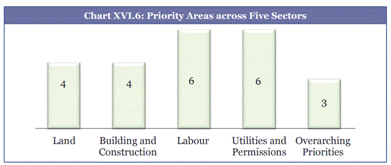
The Survey adds that the ongoing Compliance Reduction and Deregulation Initiative identified 23 Priority Areas across five broad sectors for State level deregulation. These Priority Areas were identified through extensive consultations with Central Ministries, States, industry associations, and knowledge partners. Deregulation, when pursued as a continuous and coordinated governance process, is not a retreat of the State but a strengthening of it. What distinguishes this exercise from earlier deregulation drives is not only the number of reforms, but the institutional process: cross-agency coordination, iterative problem-solving with States, and real-time learning, which touch the core elements of state capacity.

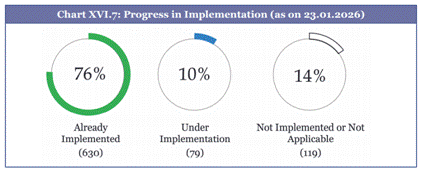
With 36 States and Union Territories expected to implement 23 Priority Areas each, the total number of actionable reforms across the country amounts to 828.
Screenshot 2026-01-28 143713.png

As of 23 January 2026, 630 Priority Areas, representing 76 per cent of the total, have already been implemented. Another 79 Priority Areas, accounting for 10 per cent, are under active implementation.

Economic Survey concludes that the nature of the challenge now facing India is changing and its recent economic performance has demonstrated that macroeconomic stability and growth can be sustained even in a turbulent global environment. In a more uncertain world, risk is unavoidable. The advantage lies in managing it better. Countries that can act before certainty emerges, correct course without paralysis, and align incentives across the State, firms, and citizens are better placed to convert growth into influence. State capacity is therefore not an administrative concern at the margin. It is the foundation on which strategic resilience is built and the pathway through which strategic indispensability becomes possible.

Topics

Acts Income Tax