

Loading...

Top
Help
×

By creating an account you can:

Logo TaxTMI
Call Us / Help / Feedback

Contact Us At :

E-mail: [email protected]

Call / WhatsApp at: +91 99117 96707

For more information, Check Contact Us

FAQs :

To know Frequently Asked Questions, Check FAQs

Most Asked Video Tutorials :

For more tutorials, Check Video Tutorials

Submit Feedback/Suggestion :

Email :
Please provide your email address so we can follow up on your feedback.
Category :
Description :
Min 15 characters 0/2000
Make Most of Text Search
  1. Checkout this video tutorial: How to search effectively on TaxTMI.
  2. Put words in double quotes for exact word search, eg: "income tax"
  3. Avoid noise words such as : 'and, of, the, a'
  4. Sort by Relevance to get the most relevant document.
  5. Press Enter to add multiple terms/multiple phrases, and then click on Search to Search.
  6. Text Search
  7. The system will try to fetch results that contains ALL your words.
  8. Once you add keywords, you'll see a new 'Search In' filter that makes your results even more precise.
  9. Text Search
Add to...
You have not created any category. Kindly create one to bookmark this item!
Create New Category
Hide
Title :
Description :
❮❮ Hide
Default View
Expand ❯❯
Close ✕
🔎 News - Adv. Search
TEXT SEARCH:

Press 'Enter' to add multiple search terms. Rules for Better Search

Search In:
Main Text + AI Text
  • Main Text
  • Main Text + AI Text
  • AI Text
Category: ?
Categorized by AI
---- All Categories ----
  • ---- All Categories ----
  • Income Tax
  • GST
  • Customs, DGFT & SEZ
  • FEMA & RBI
  • Corp. Laws, SEBI & IBC
  • PMLA, Black Money & ED
  • Budget
  • News and Press Release
  • PTI News
Month:
---- All Months ----
  • ---- All Months ----
  • January
  • February
  • March
  • April
  • May
  • June
  • July
  • August
  • September
  • October
  • November
  • December
Year:
---- All Years ----
  • ---- All Years ----
  • 2026
  • 2025
  • 2024
  • 2023
  • 2022
  • 2021
  • 2020
  • 2019
  • 2018
  • 2017
  • 2016
  • 2015
  • 2014
  • 2013
  • 2012
  • 2011
Sort By: ?
In Sort By 'Default', exact matches for text search are shown at the top, followed by the remaining results in their regular order.
Relevance Default Date
    FDA suspends licences of five food outlets on Mumbai Cricket Association premises
    Govt appoints ex-diplomat Akbaruddin, 2 other new members to RBI central board
    'Only 6.83 per cent after 4 years': Omar Abdullah defends J&K power tariff hike
    No sugar shortage in India, prices to ease in coming days following govt's measures: ISMA
    Govt lifts export ban on wheat and its products
    ED raids several places in UP, Haryana in GST fraud case; over Rs 1 crore cash seized
    From Syrup Diversion to Sugar Production: SED's Integrated Process House Solution for Shivshakti Sugars' 7,500 TCD Plant
    Chandigarh University Provides In-House Training for Civil Services, Defence, Management, Banking & PSUs
    ICSI inaugurates new Chapter Office in Hyderabad
    Curis Lifesciences Charts a New Growth Path with Uninova, Export Markets and Branded Pharma Expansion
    IBC @ Crossroads: A Decade of Evolution, The Road Ahead
    Union Minister for Finance & Corporate Affairs Smt. Nirmala Sitharaman will embark on official visit to Canada and USA from 25th August to 2nd Septemb...
    UPI Completes 10 Years of Digital Payments Revolution- Globally Recognised as World’s Largest Real‑Time Payment System
    PROVISIONAL ESTIMATES OF SERVICE PRODUCER PRICE INDICES (BASE YEAR 2022-23) FOR Q1 OF FY 2026-27 AND FINAL INDICES FOR Q4 OF FY 2025-26.
    Minister of State for Commerce and Industry and Electronics & Information Technology Shri Jitin Prasada on Official Visit to Morocco.
    Rupee falls 3 paise to close at 95.74 against US dollar
    HSBC INDIA OPENS NEW BRANCH IN NASHIK TO SUPPORT WEALTH EXPANSION
    Commerce and Industry Minister Shri Piyush Goyal Leads A 200-Member Business Delegation to Japan.
    CBN busts inter-state heroin syndicate in ‘Op Black Hawk’; seizes over 18.6 kg crude heroin - Three members of inter-state trafficking network arr...
    Bank unions threaten nationwide strike on Sep 11 to press for 5-day banking, other demands
❯❯
Maximize Maximize Maximize
0 / 200
Expand Note
Add to Folder

No Folders have been created

+

Are you sure you want to delete "My most important" ?

NOTE:

News
Showing Results for :
Reset Filters
Results Found:
Show All Summaries Hide All Summaries
August 24, 2026
Show AI Summary
Food safety compliance failures trigger licence suspensions for deficient hygiene, storage, refrigeration, sanitation and valid licensing practices.
Food safety enforcement measures resulted in suspension of food licences or registrations where establishments failed hygiene, food handling, storage, refrigeration, sanitation and licensing requirements. Deficiencies included unsafe temperature control, unclean refrigeration equipment, improper food storage and thawing, inadequate sanitisation, deteriorated or expired materials, deficient oil-quality checks, artificial colouring, pest infestation, cross-contamination risks and inadequate drainage. One outlet was also found to be operating under the name of an establishment without a valid food licence, resulting in suspension of its registration certificate.
August 24, 2026
Show AI Summary
Central Board Governance expands through appointments of part-time non-official directors for defined terms, alongside central bank and government representatives.
Appointments to the Reserve Bank of India's Central Board expand its part-time, non-official director membership. Syed Akbaruddin, Annie George Mathew and Janmejaya Kumar Sinha have been appointed for four years from 24 August 2026, or until further orders, whichever occurs earlier. The Central Board also includes the Governor, deputy governors, the economic affairs secretary and the financial services secretary.
August 24, 2026
Show AI Summary
Electricity tariff adjustment is linked to inflation and transmission losses, while free household units remain separately implemented.
Electricity tariff increase of 6.83 per cent after four years is presented as necessary in light of inflation and rising costs. Reducing transmission and distribution losses is identified as a means of limiting future tariff increases. Provision of 200 units of free electricity for poor and needy households through solar panels under the Muft Bijli Yojana is treated as distinct from tariff revisions.
August 24, 2026
Show AI Summary
Sugar supply management measures target speculative stockpiling through imports, stockholding limits and earlier crushing to moderate prices.
Sugar supply is characterised as adequate, and higher prices are attributed principally to speculative buying and advance stockpiling, alongside lower output, seasonal demand and global price pressures rather than an actual shortage. Duty-free raw sugar imports and stockholding limits are intended to augment availability, curb speculative accumulation and stabilise market sentiment. Imports, existing stocks, special crushing and an earlier crushing season are expected to moderate prices and improve festive-period supply. Ethanol diversion is not identified as a cause of the price movement.
August 24, 2026
Show AI Summary
Wheat export policy shifts to free trade, lifting restrictions on wheat flour, maida, semolina and wholemeal atta exports.
Wheat export policy has been revised from prohibited to free with immediate effect, lifting the export ban on wheat and related wheat products. The liberalised export treatment extends to wheat flour, maida, semolina and wholemeal atta. The restriction had been imposed to address rising domestic prices, and its removal is expected to improve international wheat availability.
August 24, 2026
Show AI Summary
Bogus input tax credit fraud investigation examines fabricated invoices, circular transactions, layered funds and alleged proceeds of crime.
Investigation into alleged bogus input tax credit fraud involved searches under the anti-money-laundering framework. The alleged scheme involved fabricated invoices and e-way bills without actual movement of goods, circular transactions, layered funds, cash withdrawals and bogus or non-existent entities. GST authorities identified fraudulent availment of input tax credit causing wrongful loss to the government exchequer. The investigation focused on tracing alleged proceeds of crime, identifying beneficiaries, and securing documentary and digital evidence.
August 24, 2026
Show AI Summary
Sugar crystallization process integration combines evaporator upgrades, continuous boiling, heat recovery and automation for efficient plantation white sugar production.
Sugar manufacturing process integration is proposed through strengthening an existing evaporator station and adding a sugar crystallization section to convert syrup production into plantation white sugar production. The scope covers design, engineering, equipment supply, erection and commissioning of condensate heaters, falling film evaporators, heat-recovery systems, continuous pans, vacuum systems and crystallizers. Continuous massecuite boiling will use chamber-specific control, while evaporator recirculation and online chemical-cleaning provisions support process control and low-grade vapour utilisation.
August 24, 2026
Show AI Summary
Competitive examination preparation supports career pathways in civil services, public employment, management, defence, research and international higher education.
Career-development and competitive-examination preparation is offered alongside academic programmes for civil services, government and public-sector employment, banking, engineering higher education, management, defence, teaching, research and overseas education. UPSC, SSC-CGL, Bank PO, GATE, CAT, CDS, UGC-NET, GRE, GMAT and IELTS preparation includes courses, workshops, mentorship, expert guidance and examination-specific resources. Access to examinations, admissions and career opportunities remains subject to applicable eligibility, selection and institutional criteria.
August 24, 2026
Show AI Summary
Corporate governance professionals gain expanded training infrastructure as Hyderabad's new Chapter Office supports Company Secretaries and students.
Institute of Company Secretaries of India has inaugurated a Chapter Office in Hyderabad to expand infrastructure for professional education, training, examinations, meetings, capacity-building programmes and stakeholder engagement. The facility is intended to support Company Secretaries and students and enable wider professional and educational activities. Company Secretaries are identified as corporate governance professionals, with expanding regulatory requirements and the formalisation and listing of micro, small and medium enterprises creating potential demand for qualified professionals.
August 24, 2026
Show AI Summary
Diversified pharmaceutical growth combines branded portfolio expansion, contract manufacturing, merchant exports, and regulatory registrations for international market development.
Curis Lifesciences Limited plans a diversified pharmaceutical strategy spanning domestic branded products, contract manufacturing and international market development. Its majority acquisition of Uninova Lifesciences is intended to strengthen own-brand marketing, distribution and portfolio expansion, including injectable products through third-party manufacturing. International initiatives include merchant exports in Kenya and a Nigerian joint venture pursuing own-brand regulatory registrations alongside contract-manufacturing and export opportunities. Commercial development in Nigeria remains contingent on relevant licences and purchase orders, while projections are subject to regulatory, market and other business factors.
August 24, 2026
Show AI Summary
Insolvency framework reform prioritises efficient resolution, value maximisation, stakeholder coordination, institutional strengthening and technology-enabled asset recovery.
Insolvency and Bankruptcy Code, 2016, entered its tenth year amid deliberations on legislative amendments, resolution timelines, stakeholder interests and value maximisation. Key areas included resolution plans and tax implications, liquidation processes, recent judicial developments, stakeholder coordination, and the roles of insolvency professionals, regulators, banking institutions and adjudicatory processes. Technological innovation, including artificial intelligence for asset tracing and recovery, alongside regulatory strengthening, capacity building and stakeholder collaboration, was emphasised for the future development of the insolvency ecosystem.
August 24, 2026
Show AI Summary
Bilateral economic and financial cooperation will advance through investment dialogues, business engagement, financial-sector partnerships, and global economic discussions.
Official visits to Canada and the United States are scheduled to strengthen bilateral economic and financial partnerships, deepen investment linkages, and advance cooperation on global economic priorities. Engagements include an Economic and Financial Dialogue, investment and business roundtables, corporate meetings, and discussions on financial-sector cooperation, technology, innovation, critical minerals, resilient supply chains, and a Comprehensive Economic Partnership Agreement. Participation in the G20 Finance Ministers and Central Bank Governors Meeting will address global economic growth, stability, and international financial cooperation.
August 24, 2026
Show AI Summary
Interoperable real-time payments enable inclusive retail transactions, bank participation, and cross-border digital payment expansion through UPI.
Unified Payments Interface (UPI) operates as an interoperable, real-time digital payments platform for peer-to-peer and person-to-merchant transactions. Its network includes varied banking institutions acting as remitter and beneficiary payment service providers, with performance monitoring across participants. Person-to-merchant payments drive transaction volume through routine small-ticket retail use, while person-to-person payments represent a larger share of transaction value. UPI also supports cross-border digital payments, with future growth linked to technological advancement, broader adoption, policy support, and financial inclusion.
August 24, 2026
Show AI Summary
Service Producer Price Indices track quarterly price movements across financial, transport, telecom and insurance services using sub-service weights.
Service Producer Price Indices based on 2022-23 set out provisional first-quarter estimates for FY 2026-27 and final fourth-quarter estimates for FY 2025-26 across financial, insurance, telecom, railway and air-passenger services. Latest quarterly data show negative year-on-year inflation for securities transaction and banking services, while banking service contribution, pension-fund management, insurance, telecom and railway services record positive inflation. Aggregate weights are not assigned because the covered services do not represent the entire service sector; sub-service weights are used to derive service-level PPIs.
August 24, 2026
Show AI Summary
Food safety cooperation supports imported-food quality information exchange and technical collaboration within broader bilateral economic and trade engagement.
India-Morocco economic cooperation is being advanced through discussions on trade diversification, market access, investment, industrial cooperation, customs, agriculture, food safety, energy, digital transformation and logistics. A proposed food safety Memorandum of Understanding would support exchanges on imported-food safety and quality, testing laboratories, analytical methods, import procedures, quality control, sampling, testing, packaging and labelling. Proposed cultural cooperation would promote professional exchanges, heritage conservation and institutional linkages.
August 24, 2026
Show AI Summary
Foreign-exchange market conditions pressured the rupee as dollar strength, crude concerns and geopolitical uncertainty shaped narrow USD/INR trading.
Foreign-exchange market conditions led the rupee to close marginally lower against the US dollar after reversing initial gains. The USD/INR pair traded within a narrow range amid a stronger dollar index, weak domestic equity markets, importer demand, crude-oil concerns and geopolitical uncertainty. Market commentary indicated a slight negative bias for the rupee, although possible US-dollar weakness could provide support at lower levels. India's foreign-exchange reserves increased during the referenced reporting week.
August 24, 2026
Show AI Summary
Branch expansion for wealth and cross-border banking services targets emerging commercial centres and affluent customer segments across India.
HSBC India's branch expansion is directed at extending wealth, international banking, and corporate banking services to affluent, high-net-worth, ultra-high-net-worth, and non-resident Indian customers in emerging commercial centres. The Nashik opening forms part of a broader branch-expansion programme undertaken after Reserve Bank of India approval to establish additional branches in key cities. The programme is intended to expand delivery of banking and financial services, including support for cross-border wealth management, overseas investment by Indian companies, and foreign investment into India.
August 24, 2026
Show AI Summary
Bilateral trade and investment cooperation advances through business engagement in high-technology manufacturing, clean energy, innovation and industrial collaboration.
India's commerce and industry engagement with Japan is structured around a business delegation visit to deepen bilateral trade, investment, technology and industrial collaboration. Sector-focused discussions cover semiconductors, artificial intelligence, start-ups, automotive manufacturing, steel, electronics, industrial and consumer markets. Business roadshows and investor interactions are directed at presenting opportunities in India's manufacturing, clean-energy and consumer sectors, while advancing cooperation in high-technology manufacturing and next-generation industries.
August 24, 2026
Show AI Summary
Inter-state heroin trafficking enforcement uncovered concealed narcotics in transport vehicles, triggering arrests, confiscation, and continuing supply-chain investigations.
Operation Black Hawk targeted an alleged inter-state heroin trafficking network moving crude heroin from the North-East region towards Uttar Pradesh. Intelligence-led vehicle tracking and highway interceptions resulted in the seizure of over 18.6 kg of crude heroin and the arrest of three suspected network members under the Narcotic Drugs and Psychotropic Substances Act, 1985. The narcotics were detected in specially fabricated concealed compartments within a passenger vehicle fuel tank and a heavy commercial vehicle body frame. Both vehicles and the contraband were confiscated, while financial and logistical investigations continue into suppliers and distribution channels.
August 24, 2026
Show AI Summary
Five-day banking and uniform performance incentives drive proposed bank union action over unresolved pension and employment demands.
Banking labour relations are affected by proposed nationwide industrial action over five-day banking, performance-linked incentives, and pension-related demands. Five-day banking remains pending despite a bipartite arrangement for extended weekday hours. Unions dispute an incentive scheme that differentiates awards by seniority and individual performance, contending that it departs from bank-level performance linkage and uniformity across cadres. They also allege that implementation during pending conciliation breaches a status quo obligation, while pension revision, uniform dearness allowance, and a pension-scheme switch option remain unresolved.

News

Back

All News

Showing Results for :
Reset Filters
No Records Found

News

Back

All News

Showing Results for : Reset Filters

“INDIA’S MOVEMENT FROM SWADESHI TO STRATEGIC RESILIENCE, AND FROM RESILIENCE TO STRATEGIC INDISPENSABILITY, CANNOT BE ACHIEVED THROUGH INSULATION ALONE”: ECONOMIC SURVEY 2025-26

January 29, 2026

Contents
Summary
Note

Note

-

Bookmark

Print

Print

STRATEGIC INDISPENSABILITY DEMANDS MAKING INDIA A SOURCE OF STABILITY AND VALUE RATHER THAN ONLY A PARTICIPANT IN GLOBAL MARKETS, STATES ECONOMIC SURVEY

“INSTITUTIONAL INCENTIVE STRUCTURE THAT ENCOURAGES ACTION, EXPERIMENTATION, AND LEARNING UNDER UNCERTAINTY IS INDIA’S OVERARCHING PRIORITY”: ECONOMIC SURVEY 2025-26

THE NEW ‘COMPLIANCE REDUCTION AND DEREGULATION INITIATIVE’ HAS IDENTIFIED 23 PRIORITY AREAS ACROSS FIVE BROAD SECTORS FOR STATE LEVEL DEREGULATION;76% OF ACTIONABLE REFORMS ALREADY IMPLEMENTED

Economic Survey 2025-26 states that India’s transition from Swadeshi to strategic resilience, and ultimately to strategic indispensability, will be determined not only by how fast the economy grows, but by whether domestic capabilities become embedded in global production systems in ways that enhance reliability, learning, and external stability. It further states that strategic resilience rests on the State’s ability to anticipate vulnerabilities, coordinate across institutions, and respond under stress without disorder. Strategic indispensability demands more: the capacity to build capabilities that others depend upon, making India a source of stability and value rather than only a participant in global markets.

The Survey also notes that a world of deep uncertainty requires a shift towards an entrepreneurial state, not to replace markets, but to act under uncertainty, structure risk, and learn systematically.  Hence it argues for institutional incentive structure that encourages action, experimentation, and learning under uncertainty as India’s overarching priority. It also adds that no country that has successfully navigated structural transformation attempted to make its entire bureaucracy entrepreneurial. Equally, it may not be possible for the bureaucracy to be entrepreneurial all the time, because stability and predictability too are necessary traits of good administration. Instead, successful states created bounded institutional spaces - zones where experimentation was permitted, accountability rules were differentiated, and learning was explicit.

Economic Survey says that policies that operate in uncharted terrain, whether in industrial strategy, financial regulation, technology governance, or social policy, cannot be optimised beforehand. They must be tested, revised, and sometimes abandoned. Political leadership must send consistent signals that reversible failure is acceptable, experimentation is necessary, and course correction is a mark of competence rather than weakness. Institutional forgiveness becomes meaningful only when it is paired with a clear distinction between good-faith error and malfeasance.

Economic Survey adds that in the decades ahead, India will face decisions for which there are no manuals. In each case, outcomes will depend less on the correctness of initial choices and more on the State’s capacity to learn, revise, and act with confidence under uncertainty. It also states that the ability of the State to learn, correct course, and act with confidence under uncertainty ultimately depends on how responsibilities, authority, and ownership are organised within its institutions. India’s most consequential constraint today is no longer the absence of policy intent, ideas, or resources, but the incentive structures within institutions that shape how decisions are taken under uncertainty. It cautions that in a world defined by uncertainty, it is not the most controlling states that will succeed, but those that learn fastest, adapt most intelligently, and retain the confidence to correct course.

The Survey notes that a State’s capacity is not a single reform agenda, but a composite outcome shaped by how decisions are taken, how risk and failure are processed, how administration is organised around outcomes, how regulation is designed and delivered, and how incentives shape the behaviour of officials, firms, and citizens.

State capability is also a function of the human systems through which public authority is exercised in practice. As governance challenges become more complex, the quality of public outcomes increasingly depends on how civil servants interpret roles, exercise judgment, and engage with citizens. State capacity is the foundation on which strategic resilience is built and the pathway through which strategic indispensability becomes possible. Capacity is therefore not built by proclamation, but through steady alignment across institutional systems. It is co-created through the everyday behaviour of the State, firms, and citizens, and rests on a shared obligation and a reciprocal contract across the three.

Economic Survey also says that Regulation is one of the most consequential interfaces between the state and the economy. Regulatory capacity is a question of institutional design as much as it is of intent or effort, spanning rule-making, enforcement, accountability, and the structuring of delegated authority. Regulatory capacity depends on how formal powers granted to regulators are structured, exercised, and constrained through institutional design. Some important considerations in the institutional design choices are Clarity in rulemaking and guidance, Separation within authority, Regulatory boards that anchor accountability, Proportionality and discipline in enforcement, Due process as an operational norm, Democratic anchoring and transparency and Democratic anchoring and transparency.

It stresses that Regulators need experts capable of balancing freedom with oversight, while businesses require professionals who can harness this freedom to drive growth while adhering to regulations. The Survey suggests that Schools of Regulatory Studies could be established either as new stand-alone institutions or as additions to existing institutions to provide for these talents. It also states that delays in most regulatory processes, including approvals, investigations, enforcement actions, disputes, and appeals, impose real economic costs. To address this, decisions must be subject to strict timelines, with provisions for deemed approvals when authorities fail to act within prescribed periods.

The Survey notes that in India, the private corporate sector is not merely a subject of regulation; it is a structural participant in the incentive environment that determines whether the state upgrades its capacity or governs through discretion. When firms compete on productivity, quality, and performance, they develop a direct interest in strong, predictable, and impartial public institutions.

If the private corporate sector co-shapes the incentive environment in which state capacity evolves, citizens shape it even more pervasively through the daily norms that determine whether public systems must rely on enforcement or can function through internalised responsibility. When citizens internalise norms of responsibility in shared spaces, treat learning as a habit, respect physical and technical work, use technology without becoming captive to it, and understand that today’s comfort can sometimes become tomorrow’s burden, they will reduce the state's need for constant enforcement, and create the trust on which institutional capacity grows.

The Survey notes that competing in the global big league, whether in manufacturing, logistics, institutions, or elite sports, requires incurring near-term costs for returns that are uncertain, delayed, and often invisible in the short term. Where delayed gratification weakens, systems begin to substitute shortcuts for capability, visibility for depth, and speed for learning.
Screenshot 2026-01-28 143615.png

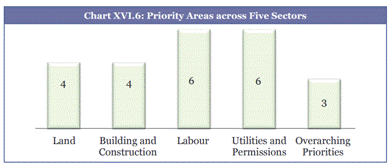
The Survey adds that the ongoing Compliance Reduction and Deregulation Initiative identified 23 Priority Areas across five broad sectors for State level deregulation. These Priority Areas were identified through extensive consultations with Central Ministries, States, industry associations, and knowledge partners. Deregulation, when pursued as a continuous and coordinated governance process, is not a retreat of the State but a strengthening of it. What distinguishes this exercise from earlier deregulation drives is not only the number of reforms, but the institutional process: cross-agency coordination, iterative problem-solving with States, and real-time learning, which touch the core elements of state capacity.

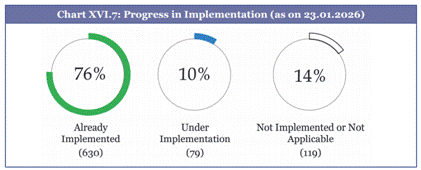
With 36 States and Union Territories expected to implement 23 Priority Areas each, the total number of actionable reforms across the country amounts to 828.
Screenshot 2026-01-28 143713.png

As of 23 January 2026, 630 Priority Areas, representing 76 per cent of the total, have already been implemented. Another 79 Priority Areas, accounting for 10 per cent, are under active implementation.

Economic Survey concludes that the nature of the challenge now facing India is changing and its recent economic performance has demonstrated that macroeconomic stability and growth can be sustained even in a turbulent global environment. In a more uncertain world, risk is unavoidable. The advantage lies in managing it better. Countries that can act before certainty emerges, correct course without paralysis, and align incentives across the State, firms, and citizens are better placed to convert growth into influence. State capacity is therefore not an administrative concern at the margin. It is the foundation on which strategic resilience is built and the pathway through which strategic indispensability becomes possible.

Topics

Acts Income Tax