

Loading...

Top
Help
×

By creating an account you can:

Logo TaxTMI
Call Us / Help / Feedback

Contact Us At :

E-mail: [email protected]

Call / WhatsApp at: +91 99117 96707

For more information, Check Contact Us

FAQs :

To know Frequently Asked Questions, Check FAQs

Most Asked Video Tutorials :

For more tutorials, Check Video Tutorials

Submit Feedback/Suggestion :

Email :
Please provide your email address so we can follow up on your feedback.
Category :
Description :
Min 15 characters 0/2000
Make Most of Text Search
  1. Checkout this video tutorial: How to search effectively on TaxTMI.
  2. Put words in double quotes for exact word search, eg: "income tax"
  3. Avoid noise words such as : 'and, of, the, a'
  4. Sort by Relevance to get the most relevant document.
  5. Press Enter to add multiple terms/multiple phrases, and then click on Search to Search.
  6. Text Search
  7. The system will try to fetch results that contains ALL your words.
  8. Once you add keywords, you'll see a new 'Search In' filter that makes your results even more precise.
  9. Text Search
Add to...
You have not created any category. Kindly create one to bookmark this item!
Create New Category
Hide
Title :
Description :
❮❮ Hide
Default View
Expand ❯❯
Close ✕
🔎 News - Adv. Search
TEXT SEARCH:

Press 'Enter' to add multiple search terms. Rules for Better Search

Search In:
Main Text + AI Text
  • Main Text
  • Main Text + AI Text
  • AI Text
Category: ?
Categorized by AI
---- All Categories ----
  • ---- All Categories ----
  • Income Tax
  • GST
  • Customs, DGFT & SEZ
  • FEMA & RBI
  • Corp. Laws, SEBI & IBC
  • PMLA, Black Money & ED
  • Budget
  • News and Press Release
  • PTI News
Month:
---- All Months ----
  • ---- All Months ----
  • January
  • February
  • March
  • April
  • May
  • June
  • July
  • August
  • September
  • October
  • November
  • December
Year:
---- All Years ----
  • ---- All Years ----
  • 2026
  • 2025
  • 2024
  • 2023
  • 2022
  • 2021
  • 2020
  • 2019
  • 2018
  • 2017
  • 2016
  • 2015
  • 2014
  • 2013
  • 2012
  • 2011
Sort By: ?
In Sort By 'Default', exact matches for text search are shown at the top, followed by the remaining results in their regular order.
Relevance Default Date
    Good corporate governance central to India's development: Jitendra Singh
    DHFL case: ED freezes bank deposits worth Rs 51.75 crore
    Comprehensive set of reforms undertaken to simplify defence export SOP: MoD
    Jio Platforms gets Sebi nod for $3.8-bn IPO, set to be India's biggest
    Gold declines for 3rd day, prices tumble Rs 3,300 as US dollar gains strength
    Rs 53 lakh cr transferred to govt beneficiaries through DBT, mostly to Jan Dhan accounts in 12 years
    Forex kitty jumps USD 12.42 bn to all-time high of USD 729.3 bn
    Jio Platforms gets Sebi nod to launch IPO
    PM Jan Dhan Yojana has had unparalleled impact, transformative outcomes: PM Modi
    Bajaj Finance Personal Loan Offers Flexible Repayment Options with Loan Utsav 2026 Benefits
    ED arrests 3 more people in pan-India digital arrest case
    Rupee rises 6 paise to settle at 95.39 against US dollar
    Senior citizen threatened with terror funding case probe, duped of Rs 7.2 crore
    Rupee declines 10 paise to 95.55 against US dollar in early trade
    UK’s PG Paper welcomes SEBI review of fraud allegations against Indian firm
    'Neta-Company Loot Tribunal': Cong on NCLT haircut approval for Subhash Chandra
    S&P affirms India's 'BBB' sovereign rating; cites dynamic economy, policy stability
    Sugar prices ease marginally to Rs 64.33 per kg on Thursday
    ED freezes assets worth Rs 33 crore after raids against Gurugram realty group
❯❯
Maximize Maximize Maximize
0 / 200
Expand Note
Add to Folder

No Folders have been created

+

Are you sure you want to delete "My most important" ?

NOTE:

News
Showing Results for :
Reset Filters
Results Found:
Show All Summaries Hide All Summaries
August 28, 2026
Show AI Summary
Corporate governance requires company secretaries to promote ethical practices, transparency, responsibility and institutional accountability across economic ecosystems.
Good corporate governance is central to development and depends on responsible governance, ethical practices, transparency, institutional accountability and professional excellence. Company Secretaries have an expanding role in strengthening governance practices through professional expertise. Professional institutions should promote governance standards, support institutional excellence, and evolve their practices in response to changing requirements. Their wider contribution lies in fostering a culture of ethical entrepreneurship, responsibility, transparency and sound governance.
August 28, 2026
Show AI Summary
Proceeds-of-crime tracing prompts freezing of deposits linked to structured disposal of foreign property in a bank-loan fraud investigation.
Money-laundering investigation into alleged bank-loan fraud involving DHFL has resulted in the freezing of bank deposits held by Al Jalore Trading FZE under the Prevention of Money Laundering Act. A United Kingdom property was allegedly disposed of through a purported loan arrangement that created an encumbrance to settle an Indian liability. Sale proceeds were credited to Al Jalore Trading FZE's Indian bank account rather than to the registered owner, indicating alleged dissipation of proceeds of crime through a structured foreign-property transaction.
August 28, 2026
Show AI Summary
Defence export authorisation reform streamlines consultations, expands unified licences, and facilitates eligible exporters' access to international markets.
Open General Export Licence arrangements permit eligible exporters to self-generate authorisations for multiple consignments of specified defence items without obtaining separate authorisation for each consignment. Three existing licence procedures are consolidated into a unified framework. Licence validity is extended to three years, and territorial coverage is expanded to all countries other than negative or sensitive nations and destinations subject to United Nations Security Council sanctions or arms embargoes. Eligible companies with long-term foreign original equipment manufacturer agreements may obtain licences aligned with the underlying contract, subject to prescribed conditions.
August 28, 2026
Show AI Summary
IPO approval enables Jio Platforms to issue fresh equity shares, with proceeds earmarked for subsidiary debt repayment and corporate purposes.
SEBI's final observations enable Jio Platforms Ltd to proceed with an initial public offering comprising up to 27 crore newly issued equity shares. The transaction is structured as a fresh issue of shares. Offer proceeds are primarily allocated towards repayment or prepayment of outstanding borrowings of Reliance Jio Infocomm Ltd, Jio Platforms' material subsidiary, with the balance designated for general corporate purposes.
August 28, 2026
Show AI Summary
Gold price volatility intensified as dollar strength, profit-booking, and customs-duty-cut reports pressured domestic bullion markets.
Domestic bullion prices declined for a third consecutive session as a stronger US dollar and sustained profit-booking after a recent rally weakened gold and silver. Gold fell sharply in the national capital and silver also declined in domestic trading, with the three-day movement reflecting ongoing price volatility in the bullion market. International spot gold remained marginally lower while investors awaited policy-related remarks concerning inflation and elevated yields.
August 28, 2026
Show AI Summary
Direct benefit transfer strengthens welfare delivery through Jan Dhan accounts, digital payments, reduced intermediaries, and expanded financial inclusion.
Direct Benefit Transfer has transferred welfare benefits directly to beneficiaries, largely through Jan Dhan accounts, reducing intermediaries and supporting transparent delivery. The Pradhan Mantri Jan Dhan Yojana provides unbanked adults basic accounts without minimum-balance or maintenance-charge requirements, along with RuPay debit cards, accident insurance coverage, and emergency overdraft access. Banking outlets, digital-payment infrastructure, and Bank Mitras extend formal financial services to women, rural and semi-urban communities, strengthening financial inclusion and participation in the formal economy.
August 28, 2026
Show AI Summary
Foreign exchange reserves reached a record level, supported by increases in foreign currency assets and gold holdings.
India's foreign exchange reserves increased by USD 12.422 billion to an all-time high of USD 729.328 billion for the week ended 21 August. Foreign currency assets and gold reserves recorded the principal increases, while special drawing rights and the reserve position with the IMF also rose. Foreign currency asset valuation reflects movements in non-US currencies held in the reserves. FCNR(B) and concessional swap arrangements were introduced to attract additional foreign-exchange inflows.
August 28, 2026
Show AI Summary
IPO regulatory approval enables Jio Platforms to advance preparations for its proposed fresh equity share public offering.
Jio Platforms Ltd. has obtained Sebi's final observations for its proposed initial public offering. This key regulatory stage enables further preparations for the public issue, subject to applicable regulatory requirements. The proposed offering comprises up to 27 crore fresh equity shares and is expected to account for approximately 2.9 per cent of the company's post-issue equity base.
August 28, 2026
Show AI Summary
Financial inclusion through basic bank accounts expands banking access with no-balance accounts, debit cards, and emergency overdraft support.
Pradhan Mantri Jan Dhan Yojana enables unbanked adults to open basic bank accounts without minimum-balance or maintenance-charge requirements. Accounts include a free RuPay debit card with accident insurance coverage and eligibility for an overdraft facility during emergencies. The scheme promotes digital transactions, financial security and participation in the formal economy, while extending banking access to rural and semi-urban communities and increasing women's financial inclusion.
August 28, 2026
Show AI Summary
Flexible personal loan repayment enables eligible borrowers to select longer tenures, subject to eligibility, terms, verification, and repayment capacity.
Bajaj Finance personal loans offer eligible customers collateral-free borrowing with flexible repayment tenures of 12 to 108 months, subject to eligibility, applicable terms, verification and documentation. A longer tenure may reduce monthly EMIs by spreading repayment over more months, but can increase total interest payable. Borrowers should compare the interest rate, tenure, EMI, processing charges and other costs, while considering their income, existing commitments and repayment capacity. Loan Utsav 2026 provides limited-period rewards for eligible customers whose loans are successfully disbursed during the campaign period, subject to applicable terms.
August 28, 2026
Show AI Summary
Digital arrest money laundering investigation tracks cyber-fraud proceeds through layered bank accounts, cash withdrawals, and foreign-exchange conversion.
Arrests under the Prevention of Money Laundering Act form part of an investigation into alleged digital arrest cyber fraud and laundering of fraud proceeds. Funds were reportedly routed through numerous bank accounts, withdrawn in cash, and converted into foreign currency through licensed money changers. The financial trail is linked to commodity trading, travel and foreign-exchange entities allegedly connected with cyber-fraud complaints and first information reports. The inquiry also identified alleged shell or dummy companies using proxy directors to conceal control and facilitate fund movement.
August 28, 2026
Show AI Summary
Foreign exchange intervention and lower crude prices supported rupee appreciation despite a stronger dollar and foreign institutional investor outflows.
Foreign exchange market conditions supported a six-paise appreciation of the rupee against the US dollar at the close of trading. Lower global crude oil prices and Reserve Bank of India intervention to limit significant rupee depreciation contributed to the movement. A marginal strengthening of the US dollar and foreign institutional investor equity outflows continued to exert pressure, while FCNR(B) scheme inflows supported the currency.
August 28, 2026
Show AI Summary
Cyber fraud impersonating enforcement officials coerced a senior citizen into bank and cryptocurrency transfers through terror-funding threats.
Cyber fraudsters allegedly impersonated public officials and threatened a senior citizen with implication in money laundering, terror funding and cybercrime. Using WhatsApp video calls and purported official notices, they allegedly induced the victim to transfer funds to multiple bank accounts and a cryptocurrency wallet on the pretext of proving innocence. The victim reportedly liquidated fixed deposits and mutual fund investments before identifying the deception and reporting it through the cybercrime helpline. A cyber police case was registered for further investigation.
August 28, 2026
Show AI Summary
Rupee depreciation against US dollar reflects foreign investor outflows and crude supply disruptions, moderated by weaker dollar and oil prices.
Foreign institutional investor outflows and disruptions in global crude oil supplies placed downward pressure on the rupee against the US dollar. A weaker dollar index and lower Brent crude prices moderated the decline. Market commentary anticipated a narrow trading range, with expected Reserve Bank of India protection at the upper end and oil importer, month-end, and importer demand supporting the lower end. Participants also monitored the US Federal Reserve Chair's Jackson Hole speech.
August 27, 2026
Show AI Summary
Emergency flood response measures coordinate rescues, suspend cross-border transport, and address risks to public safety.
Severe flash floods in Nepal and along the Nepal-Tibet border prompted cross-border rescue coordination for missing and stranded persons, warnings of continued downstream flood risk, and international relief support. Preventive public-safety measures included temporary suspension of an Indo-Nepal bus service. Separate developments included disruption of public services during an employee strike, investigation of an aircraft crash, market measures affecting sugar and onion prices, and proposed trade engagement for greater market access for basmati rice and processed food exports.
August 27, 2026
Show AI Summary
Regulatory review of fraud allegations requires timely consideration of representations while merits and standing remain undecided.
SEBI must consider and decide, within two weeks, representations alleging fraud by an Indian logistics company and its subsidiary. The allegations concern systematic over-invoicing of freight charges and forged documentation, with a parallel criminal investigation based on an FIR registered by the Delhi Police Economic Offences Wing. No determination has been made on the merits of the allegations or the complainant's standing to approach SEBI. The allegations and criminal proceedings were disclosed in IPO offer documents.
August 27, 2026
Show AI Summary
Personal insolvency repayment plans test creditor voting thresholds, valuation safeguards, and limits on commercial review under insolvency law.
Personal insolvency resolution under the Insolvency and Bankruptcy Code involved approval of a repayment plan providing for payment of Rs 6.25 crore to creditors and Rs 25 lakh towards process costs against admitted creditor claims of about Rs 22,006.57 crore. Objections by dissenting creditors were rejected because they held less than 20 per cent of voting share, while the plan received 80.81 per cent support. Valuation indicated that the personal estate was worth less than the amount offered, and the tribunal declined to replace creditor commercial wisdom or assess settlement adequacy.
August 27, 2026
Show AI Summary
Sovereign credit rating stability reflects policy continuity, infrastructure investment, external strength, and fiscal consolidation pressures.
India's sovereign credit rating retained a BBB stable outlook, supported by strong growth, an external balance sheet, stable institutions, policy predictability, and infrastructure investment. Public investment and consumer demand are expected to sustain growth and assist fiscal consolidation. Constraints include weak fiscal performance, elevated government debt and interest burdens, and low per-capita income. Long-term rating support depends on financing infrastructure investment without materially widening the current-account deficit and on reducing the fiscal deficit through stable fiscal and monetary policies.
August 27, 2026
Show AI Summary
Sugar import liberalisation and stockholding limits seek to moderate retail prices amid constrained domestic supply and restricted exports.
Sugar price-control measures combine duty-free raw sugar imports, stockholding limits for dealers and bulk consumers, and an export prohibition to address elevated retail prices and curb hoarding. Domestic supply remains constrained by reduced sugarcane output, prior exports and diversion of sugar to ethanol. Net production is estimated below projected domestic demand, while closing stocks are expected to remain limited. Import access, inventory restrictions and export controls therefore operate as market-stabilisation mechanisms.
August 27, 2026
Show AI Summary
Money-laundering investigation into alleged homebuyer fraud led to searches and freezing of assets linked to realty promoters.
Money-laundering proceedings were initiated under the Prevention of Money Laundering Act on the basis of police FIRs alleging fraudulent inducement and non-delivery of residential plots. Searches at premises linked to real estate promoters resulted in the seizure or freezing of luxury vehicles, jewellery, bank accounts and securities. The investigation alleges that substantial upfront payments for residential plots were received, but a significant portion of promised plots remained undelivered, and certain plots were allegedly sold to third parties without consent.

News

Back

All News

Showing Results for :
Reset Filters
No Records Found

News

Back

All News

Showing Results for : Reset Filters

INDIA ADOPTS A DEVELOPMENT-CENTRED, WHOLE-OF-ECONOMY CLIMATE STRATEGY: INTEGRATES ADAPTATION, MITIGATION AND BEHAVIOURAL CHANGE WITHIN ITS DEVELOPMENT MODEL, SAYS ECONOMIC SURVEY 2025-26

January 29, 2026

Contents
Summary
Note

Note

-

Bookmark

Print

Print

INDIA’S ADAPTATION AND RESILIENCE-RELATED DOMESTIC SPENDING SURGED FROM 3.7 PER CENT OF THE GDP IN FY16 TO 5.6 PER CENT OF THE GDP IN FY22

FY 26 SAW ACCELERATED CLEAN ENERGY AND STRATEGIC TRANSITIONS THROUGH RAPID RENEWABLE CAPACITY ADDITION, DIVERSIFICATION INTO GREEN HYDROGEN AND NUCLEAR SECTORS

SHARE OF INSTALLED POWER CAPACITY FROM NON-FOSSIL FUEL SOURCES STANDS AT 51.93% AS ON END OF DECEMBER 2025

CRITICAL MINERALS ALONG WITH TECHNOLOGY ARE DETERMINING FACTORS IN GLOBAL ENERGY TRANSITION: ECONOMIC SURVEY 2025-26

INDIA’S STRATEGY FOR CRITICAL MINERALS REFLECTS A BALANCED FOCUS ON DOMESTIC CAPABILITIES AND INTERNATIONAL PARTNERSHIPS

STRONG GOVERNANCE FRAMEWORKS NECESSARY TO ENSURE CLIMATE FINANCE SUPPORTS GROWTH WITHOUT COMPROMISING MACROECONOMIC STABILITY

The global climate change agenda has reached an inflexion point, what was once framed as a straightforward moral and technological transition toward a net-zero future is today marked by complex trade-offs, capacity constraints and a widening gap between ambition and operational reality stated the Economic Survey 2025-26 tabled in Parliament today by Union Minister for Finance and Corporate Affairs, Smt Nirmala Sitharaman.

The Economic Survey highlights that introduction of complex systems too quickly without buffers, redundancy and institutional capacity, the system is likely to become fragile instead of thriving. Stating that climate policy should prioritise human welfare, particularly for poorer and climate vulnerable societies, the Survey observes that development is, in itself, a form of adaptation. The Economic Survey therefore identifies adaptation central to India’s climate strategy.

For India, achieving sustained growth and rising living standards will require a substantial expansion in the supply of affordable and reliable electricity. Renewable energy will play a major and growing role in this expansion; however, capacity additions alone do not automatically translate into a dependable supply – the Survey says. India must, therefore, approach the coming decade not as a climate policy problem in isolation, but as a broader energy system strategy.

Adaptation: Strengthening climate resilience

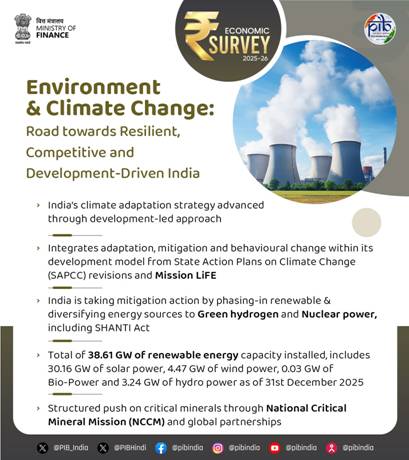
Integrating climate adaptation and resilience into development plans is essential for sustainable growth. India’s climate adaptation strategy is predominantly advanced through a development-led approach, utilising domestic public investment in core development sectors, the Survey observes. India’s adaptation and resilience-related domestic spending surged from 3.7 per cent of the GDP in FY16 to 5.6 per cent of the GDP in FY22.

The National Action Plan on Climate Change (NAPCC) spearheads climate action through nine missions. Many of these are focused on adaptation. While The National Mission on Sustainable Agriculture promotes climate resilient farming, the National Water Mission emphasises conservation and fair access through integrated resource management. The Survey also takes examples of other missions too, to highlight how they have been part of the adaptation efforts.

National frameworks and programmes provide policy coherence, financial support, and institutional mechanisms, while States contextualise and operationalise these interventions through sectoral policies, public programmes, and local institutions, the Survey says. The State Action Plans on Climate Change (SAPCCs) are crucial tools for translating NAPCC's broader objectives into actionable steps. The Survey highlights that as Indian cities continue to grow at a rapid pace, internalising climate risk into the fabric of urban planning, means considering how climate change affects land use, infrastructure, and the services provided to residents.
Chapter-10---Environment-and-Climate-Change---English.jpg

Mitigation: Transition to a low-carbon economy

India is adopting a multifaceted approach to mitigate global warming by diversifying its energy sources and enhancing access while also increasing the share of non-fossil fuels, improving energy efficiency, and promoting stability across its energy systems. The Economic Survey highlights some examples from European countries such as Netherlands, Germany, Spain etc to show the risks associated with transitions that outpace investments in baseload generation, transmission, and system flexibility. India’s energy transition is being pursued through a combination of initiatives across various sectors, including nuclear, solar, and wind energy, green hydrogen, battery storage, and critical minerals, which help address both energy security and transition imperatives simultaneously. The Survey also provides some of the recent examples of such measures.

India has already surpassed the goal of 50 per cent installed power capacity from non-fossil fuel sources, which stood at 51.93% at the end of December 2025, supported by record annual additions of renewable energy capacity. The progress in expanding non-fossil fuel-based power capacity has been supported by a wide variety of initiatives to boost renewable energy systems. Additionally, new measures are being taken to support other clean sources of energy such as the National Nuclear Mission, the Green Hydrogen Mission, and the Bio Energy Programme. Despite the progress in expanding non-fossil fuel energy, challenges remain. The Survey identifies material and storage requirements as two roadblocks to greater utilisation of these energy sources.

Critical Minerals as a Determinant of Energy Transition

The Economic Survey says that the global energy transition is no longer solely determined by technology; it is increasingly constrained by who controls critical minerals. Metals like Lithium, cobalt, nickel, copper, and rare earth elements have become the new strategic chokepoints in shaping the contours of a low-carbon economy. As demand accelerates, advanced economies are responding by promoting standards-based critical mineral markets, emphasising sustainability, traceability, and governance.

India’s strategy reflects the balance with a focus on domestic capabilities through the National Critical Mineral Mission along with suitable incentive mechanism, while engaging in international partnerships like the Minerals Security Partnership and the Indo-Pacific Economic Framework. The Government of India has launched the National Critical Mineral Mission as a strategic initiative to secure the supply chain of minerals essential for renewable energy and storage technologies. Meanwhile, the government's joint venture, Khanij Bidesh India Ltd. (KABIL), has acquired 15,703 hectares in Argentina for lithium mining, alongside partnerships in Australia and Chile.

India has adopted the landmark Sustainable Harnessing and Advancement of Nuclear Energy for Transforming India (SHANTI) Act in December 2025. The new framework enables private sector participation in key activities, including plant operations, power generation, equipment manufacturing and carrying out research and innovations in the field of peaceful uses of atomic energy.

Carbon Credit Trading Scheme: from framework to implementation

The government adopted the Carbon Credit Trading Scheme (CCTS) in June 2023, operating through a dual mechanism that incorporates mandatory compliance and voluntary offset approaches. This framework leverages the existing Perform, Achieve and Trade (PAT) scheme infrastructure, gradually transitioning it into a fully operational compliance carbon market. Under the Offset Mechanism, Non-Obligated Entities may voluntarily register projects that reduce, remove, or avoid greenhouse gas emissions to earn CCCs. This mechanism enables mitigation outcomes from entities outside the compliance framework and incentivises climate action in these areas.

Mission LiFE

The Mission LiFE - Lifestyle for Environment, an initiative introduced in 2021, at COP26 in Glasgow, connects individual and community behaviour change with efforts to deal with climate change. The Economic Survey terms Mission LiFE as an integral part of India’s Nationally Determined Contributions. Majority of India’s climate-oriented schemes are fundamentally aligned with the ethos of Mission LiFE, as they combine government interventions with behavioural and lifestyle shifts at the household, community and enterprise levels. India’s climate strategy is not confined to emissions targets or technologies alone, but is deliberately designed to reshape consumption patterns, social norms and daily choices, making Mission LiFE not a parallel initiative but the behavioural foundation underlying most climate policies in the country, the Survey says.

Climate Finance

The current levels of climate finance fall short of the requirements of developing countries to meet their climate ambitions.The Economic Survey highlights that despite sustained global efforts, the gap between sustainable development ambitions and available financing has continued to widen—particularly for developing countries—reaching an estimated USD 4 trillion. International public finance to developing economies remains limited, and domestic actors continue to dominate global climate finance, accounting for nearly 80 per cent of total flows. These patterns embedded in the international financial architecture reflect a persistent and clear bias in favour of developed countries.

The Survey states that India faces global challenges in climate finance which remains skewed towards mature sectors such as solar, wind energy and energy efficiency. Critical areas, including adaptation, financing for MSMEs, urban infrastructure, and hard-to-abate industries, remain underfunded. Currently, around 83 per cent of India’s finance for mitigation and 98 per cent of finance for adaptation is sourced domestically.

Bridging the Finance Gap in the Indian Context

India has adopted a two-pronged strategy for scaling up finance for climate action from both domestic and international sources.

Strengthening the Domestic Financial System

Specialised Institutions such as IREDA, NABARD, SIDBI, Power Finance Corporation Ltd., and Rural Electrification Corporation Ltd. are already working in the low-carbon/renewable energy space, promoting the adoption of sustainability practices and encouraging green investments through key initiatives and schemes. These institutions support climate project preparation and augment the bankability of projects through catalytic capital, which closely intersect with India’s development priorities including climate action.

SEBI’s Business Responsibility and Sustainability Reporting (BRSR) framework, green bond guidelines and IFSCA's guidance on sustainability-linked lending have improved disclosure quality and investor confidence in climate-related investments.

Deep and Liquid Bond Markets

Bond markets are crucial for financing climate infrastructure, which requires substantial upfront capital and extended repayment horizons. Deeper, more liquid bond markets can provide long-term, stable, and scalable financing at predictable costs.

Sovereign green bonds (SGBs) have been issued to fund low-carbon public infrastructure, providing policy signalling and market benchmarks.

On one hand, mature markets are important for attracting investments from institutional investors, which have long-term capital at their disposal. On the other hand, bond markets provide an important platform for local administrative bodies to raise local-currency finance for climate-aligned functions, such as water supply, waste management, and green energy, tailored to area-specific adaptation and resilience needs. The Survey highlights that urban local bodies in Indore, Ghaziabad, Ahmedabad, and Vadodara have issued green bonds in line with SEBI’s green bond framework. Municipal green bonds can unlock USD 2.5–6.9 billion for local bodies driven climate action over the next 5–10 years. Besides, government of India has now issued sovereign green bonds worth ₹15,000 crore in FY26, with the cumulative issuance reaching ₹72,697 crore since FY23.

The Survey also mentions Greenium—the yield advantage of green bonds over comparable conventional bonds—has been observed across several sovereign issuers, but its magnitude and persistence vary significantly by market. Cross-country experience shows that greenium outcomes depend less on investor intent alone and more on market design, liquidity, credibility, and reporting frameworks. India’s Greenium is categorised as Intermittent (0-6 bps) on the basis of clear sovereign green bond framework; strong domestic institutional demand; policy signalling value.

International Climate Finance and the Role of Multilateral Development Banks

The Survey clearly mentions that Global capital markets are flush with funds, yet flows to sustainable development and climate projects in the Global South remain constrained by entrenched risk aversion embedded in the architecture of global finance. This is most evident in the operating models of Multilateral Development Banks (MDBs) and in the prudential regulations of developed countries. MDBs continue to prioritise low-risk, sovereign-backed lending and the preservation of AAA ratings, limiting balance-sheet recycling and private capital mobilisation. A shift toward balance-sheet optimisation—from “originate-to-hold” to “originate-to-share”—is essential to reposition MDBs as global risk managers, utilising guarantees, insurance, and blended finance to attract private investment.

Topics

Acts Income Tax