

Loading...

Top
Help
×

By creating an account you can:

Logo TaxTMI
Call Us / Help / Feedback

Contact Us At :

E-mail: [email protected]

Call / WhatsApp at: +91 99117 96707

For more information, Check Contact Us

FAQs :

To know Frequently Asked Questions, Check FAQs

Most Asked Video Tutorials :

For more tutorials, Check Video Tutorials

Submit Feedback/Suggestion :

Email :
Please provide your email address so we can follow up on your feedback.
Category :
Description :
Min 15 characters 0/2000
Make Most of Text Search
  1. Checkout this video tutorial: How to search effectively on TaxTMI.
  2. Put words in double quotes for exact word search, eg: "income tax"
  3. Avoid noise words such as : 'and, of, the, a'
  4. Sort by Relevance to get the most relevant document.
  5. Press Enter to add multiple terms/multiple phrases, and then click on Search to Search.
  6. Text Search
  7. The system will try to fetch results that contains ALL your words.
  8. Once you add keywords, you'll see a new 'Search In' filter that makes your results even more precise.
  9. Text Search
Add to...
You have not created any category. Kindly create one to bookmark this item!
Create New Category
Hide
Title :
Description :
❮❮ Hide
Default View
Expand ❯❯
Close ✕
🔎 News - Adv. Search
TEXT SEARCH:

Press 'Enter' to add multiple search terms. Rules for Better Search

Search In:
Main Text + AI Text
  • Main Text
  • Main Text + AI Text
  • AI Text
Category: ?
Categorized by AI
---- All Categories ----
  • ---- All Categories ----
  • Income Tax
  • GST
  • Customs, DGFT & SEZ
  • FEMA & RBI
  • Corp. Laws, SEBI & IBC
  • PMLA, Black Money & ED
  • Budget
  • News and Press Release
  • PTI News
Month:
---- All Months ----
  • ---- All Months ----
  • January
  • February
  • March
  • April
  • May
  • June
  • July
  • August
  • September
  • October
  • November
  • December
Year:
---- All Years ----
  • ---- All Years ----
  • 2026
  • 2025
  • 2024
  • 2023
  • 2022
  • 2021
  • 2020
  • 2019
  • 2018
  • 2017
  • 2016
  • 2015
  • 2014
  • 2013
  • 2012
  • 2011
Sort By: ?
In Sort By 'Default', exact matches for text search are shown at the top, followed by the remaining results in their regular order.
Relevance Default Date
    NABARD sanctions Rs 15,056 cr for 6,175 rural infrastructure projects in Haryana
    SUPREME COURT HIGHLIGHTS
    Government and RBI Strengthen Digital Lending Ecosystem Through New Regulatory Framework, Digital Lending App Directory and Enhanced Customer Safeguar...
    A First for India: EbixCash World Money's Perpetual RBI Licence Brings Trade and Family Remittances Within Reach of Millions - Unlocking Opportunities...
    Rationalisation of Foreign Exchange Management (Non-Debt Instruments) Rules, 2019 – Draft Rules for Comments
    CARD91 offers its comprehensive PPI Suite to Indian Overseas Bank with RuPay NCMC Capability
    Government Expands FTAs, Export Promotion Measures to Diversify Export Markets
    PLI Schemes Attract Over ₹2.40 Lakh Crore Investment, Generate More Than 14.15 Lakh Jobs
    SC issues notice on Venugopal Dhoot's plea against order upholding separate insolvency for VIL, VOVL
    Russian Technology Leaders Visit AVPL Drone City to Foster Industrial Collaboration
    India’s 8th Trade Policy Review at WTO Scheduled on 21 and 23 July 2026
    India Becomes a Party to the WTO Agreement on Fisheries Subsidies by Depositing its Instrument of Acceptance
    FIRST PRESS RELEASE OF INDEX OF CORE INDUSTRIES OF NEW SERIES WITH BASE YEAR 2022-23
    Central Bureau of Narcotics (CBN) India thwarts illegal trafficking of 12 crore Tramadol Hydrochloride, a.k.a. “fighter drug” tablets under “Ope...
    Trump imposes 50 per cent tariffs on Canadian goods, citing disputes over autos, alcohol and cheese
    Rupee falls 6 paise to close 96.36 against US dollar
    India gets USD 20.72 bn forex inflows under swap facility since Jun: RBI
    J'khand aiming to increase GI-tagged products to 25, Atthe Mutton among those in pipeline: official
    Sensex declines by 443 pts on heavy selling in HDFC Bank, Axis Bank
    Strengthening Customer Grievance Redress: The Role of the Internal Ombudsman - Keynote address by Shri Swaminathan J, Deputy Governor at the Internal ...
❯❯
Maximize Maximize Maximize
0 / 200
Expand Note
Add to Folder

No Folders have been created

+

Are you sure you want to delete "My most important" ?

NOTE:

News
Showing Results for :
Reset Filters
Results Found:
Show All Summaries Hide All Summaries
July 21, 2026
Show AI Summary
Rural infrastructure financing under RIDF supports irrigation, roads, water supply, cooperative digitisation, producer organisations and climate-resilient livelihoods.
Rural Infrastructure Development Fund financing supports rural infrastructure in Haryana, including irrigation, roads and drinking-water assets. Rural cooperative strengthening includes digitisation and financial viability of Primary Agricultural Credit Societies, alongside promotion and financial support for Farmer Producer Organisations. Climate-resilient measures include watershed development, groundwater management, micro-irrigation, direct seeding of rice and vegetable clusters, supplemented by livelihood training for rural women and agricultural lending and project-appraisal support.
July 21, 2026
Show AI Summary
Supreme Court proceedings address juvenile adult trials, insolvency, electoral representation, environmental funds and foreign-exchange complaint requirements.
Supreme Court proceedings covered election representation, criminal justice, insolvency and regulatory compliance. The Court considered challenges concerning political-party merger approval, separate insolvency proceedings for group entities, and espionage charges. It sought responses on an appeal mechanism for persons excluded from the National Register of Citizens and alleged non-utilisation of environmental relief funds. Criminal matters included medical assessment for interim bail, a fresh trial in a blast case, and the principle that a juvenile accused of murder may face adult trial where statutory conditions for a heinous offence are met.
July 21, 2026
Show AI Summary
Digital lending safeguards require verified app associations, responsible recovery, data privacy, grievance redressal and reporting channels against illegal loan apps.
Digital lending safeguards include a public directory enabling customers to verify a digital lending app's association with a regulated entity. The Digital Lending Directions, 2025 impose mandatory requirements on recovery practices, data privacy and customer grievance redressal for regulated entities, lending service providers and digital lending apps. Measures also include blocking illegal loan applications following due process, cybercrime reporting channels, complaint facilities for unlawful money collection, and public awareness programmes on fraud prevention and risk mitigation.
July 21, 2026
Show AI Summary
Authorised Dealer Category-II remittances expand to specified trade and family-maintenance payments under the revised FEMA framework.
FEMA framework revisions described as effective from May 2026 expand Authorised Dealer Category-II activities to include specified trade remittances and family-maintenance remittances, subject to the applicable RBI and FEMA framework. EbixCash World Money Limited states that its perpetual AD-II licence carries this expanded scope. The release describes a non-bank channel for MSME and SME cross-border payments, supported by Nostro-account settlement, remittance and travel-card services, and technology-enabled compliance measures including document verification, sanctions screening, fraud detection and transaction monitoring.
July 21, 2026
Show AI Summary
Foreign investment regulation: Draft rules propose simpler, principle-based compliance and clearer separation of procedural requirements from investment policy.
Draft Foreign Exchange Management (Foreign Investment) Rules, 2026 propose a simplified, principle-based foreign investment framework. The proposals rationalise provisions, harmonise definitions, and separate procedural foreign-exchange requirements from foreign direct investment policy and sector-specific conditions. They aim to streamline procedures, reduce compliance burdens, enhance operational flexibility, and apply investor-neutral and investee-neutral provisions while preserving regulatory safeguards. The draft Rules remain subject to public consultation before finalisation.
July 21, 2026
Show AI Summary
Prepaid payment instrument programme adds mobility and gift card capabilities with digital servicing subject to applicable programme conditions.
Prepaid payment instrument programme launched for Indian Overseas Bank through CARD91's technology stack, incorporating RuPay National Common Mobility Card and Gift Card capabilities. The programme was implemented following requisite approvals, testing and compliance validation. The RuPay NCMC facility supports prepaid, tap-based payments for metro, bus and parking transactions, subject to the bank's programme conditions and user eligibility. Digital card servicing may include balance enquiry, transaction history, reload or top-up functions, and customer support, subject to applicable programme terms.
July 21, 2026
Show AI Summary
Free trade agreements and e-commerce export reforms expand preferential market access, address non-tariff barriers, and support small exporters.
Export market diversification is advanced through trade agreements, export-promotion measures and capacity building. Free Trade Agreements seek preferential market access, increased trade and investment, and support for labour-intensive exports, while technical barriers to trade provisions and engagement mechanisms address standards, regulatory requirements and non-tariff barriers. Cross-border e-commerce exports are supported through trade-finance and compliance assistance, E-Commerce Export Hubs, District Export Hubs, simplified courier-export procedures, reverse-logistics facilitation, logistics planning, duty-and-tax remission, and MSME export facilitation.
July 21, 2026
Show AI Summary
Production Linked Incentive Schemes strengthen domestic manufacturing through investment support, export growth, employment generation, monitoring and eligibility reforms.
Production Linked Incentive Schemes for 14 sectors promote domestic manufacturing, investment, exports, employment and global competitiveness. Overall coordination and monitoring rests with the Department for Promotion of Industry and Internal Trade, while sector-specific implementation is undertaken by the relevant ministries and departments. Implementation is periodically reviewed, with scheme modifications, rationalised guidelines, relaxation of specified eligibility conditions, project monitoring, stakeholder consultation and inter-ministerial issue resolution used to improve uptake and strengthen domestic manufacturing ecosystems.
July 21, 2026
Show AI Summary
Separate corporate insolvency processes remain contested over foreign asset treatment, specialised resolution needs, and creditors' commercial decision-making.
Separate corporate insolvency resolution processes for VIL and VOVL are disputed following reversal of an earlier consolidation direction. Independent processes were preferred because the entities operate in distinct sectors and may require specialised resolution, while creditors' choice was treated as commercial wisdom not ordinarily open to tribunal interference. The dispute also concerns whether foreign oil and gas assets should be treated as VIL assets, against the background of VIL's conversion from co-obligor to corporate guarantor to ring-fence those assets from domestic business liabilities.
July 21, 2026
Show AI Summary
Drone technology collaboration promotes joint manufacturing, technology transfer, rural entrepreneurship and global market access through an integrated industrial ecosystem.
India-Russia industrial collaboration in drone technology is proposed through engagement on technology transfer, joint manufacturing, research collaboration, investment, exports and global market access. Drone City is presented as an integrated ecosystem covering manufacturing, research and development, testing, certification support, skill development, incubation, warehousing, startup acceleration and international technology partnerships. Its expansion and panchayat-level entrepreneurship programme are expected to create rural drone enterprises and employment in manufacturing, component production, quality control, maintenance, logistics and technical support.
July 21, 2026
Show AI Summary
WTO trade policy review will assess India's trade measures, transparency framework, reforms, and responses to member questions.
India's eighth Trade Policy Review under the World Trade Organization framework examines its trade policies and developments during the 2021-2025 review period. The process uses a Government Report and a Secretariat Report and provides a comprehensive peer examination of border and behind-the-border trade measures to promote transparency, predictability and understanding. The review addresses trade agreements, Goods and Services Tax rationalisation, digital trade-facilitation measures, and Member questions on digitisation, MSMEs, women's economic participation, Viksit Bharat and the Atmanirbhar Bharat Abhiyan.
July 21, 2026
Show AI Summary
Fisheries subsidy disciplines promote sustainable marine resource use while excluding aquaculture and inland fisheries from their scope.
The WTO Agreement on Fisheries Subsidies disciplines subsidies concerning marine wild-capture fishing and fishing-related activities at sea. It prohibits subsidies linked to illegal, unreported and unregulated fishing and fishing of overfished stocks, promoting conservation and sustainable use of marine resources. Aquaculture and inland fisheries remain outside its scope. India's fisheries management framework is identified as supporting implementation while preserving policy space and safeguarding the interests of traditional and small-scale fishers.
July 21, 2026
Show AI Summary
Revised Index of Core Industries adopts a new base year, adds iron ore, and revises sector measurement methodology.
The revised Index of Core Industries series adopts 2022-23 as its base year, replaces the former series and expands coverage to nine industries by including iron ore. Steel is measured using gross production data, while only raw coal is retained to avoid double counting. Weights are derived from the corresponding Index of Industrial Production series and normalised to 100. A geometric-mean linking methodology connects the former and revised series. June 2026 provisional estimates show overall year-on-year ICI growth, led principally by iron ore and electricity.
July 21, 2026
Show AI Summary
Risk-based export controls exposed alleged pharmaceutical diversion, prompting NDPS enforcement against transnational illicit opioid trafficking networks.
Risk-based export controls and intelligence-led enforcement under the NDPS Act, 1985 addressed an alleged attempt to divert an export consignment of high-strength Tramadol Hydrochloride tablets into illicit international channels. Enquiries with the International Narcotics Control Board and competent authorities indicated that the declared destination had been misrepresented. The action involved seizure of the consignment and arrests of persons alleged to be connected with the export arrangement and conspiracy. The operation emphasises risk-based profiling, export-control scrutiny, intelligence sharing, and international coordination against pharmaceutical diversion and transnational drug trafficking.
July 21, 2026
Show AI Summary
Trade tariffs on Canadian goods target alleged discrimination against American automobiles, alcohol and dairy products under trade law.
United States trade action imposes tariffs on most Canadian goods, citing alleged discriminatory treatment of American automobiles, alcoholic beverages and dairy products. The measures apply to goods previously protected under the United States-Mexico-Canada Agreement, subject to exclusions for energy products, potash, fish and critical minerals. The stated grounds include Canadian retaliatory tariffs, restrictions on American alcohol sales, treatment of dairy imports, and tariffs on certain United States motor vehicles outside preferential trade treatment.
July 20, 2026
Show AI Summary
Foreign exchange market movement saw rupee depreciation amid geopolitical risk, higher crude prices, stronger dollar conditions and equity outflows.
Foreign exchange market movement saw the rupee depreciate by 6 paise to close at 96.36 against the US dollar, amid global risk aversion, higher crude oil prices, escalating US-Iran tensions and rising US Treasury yields. Market commentary indicated that anticipated Reserve Bank of India intervention could limit further downside. The report also noted a stronger dollar index, domestic equity-market declines, foreign institutional equity outflows, and an increase in India's foreign exchange reserves.
July 20, 2026
Show AI Summary
Concessional foreign-exchange swaps incentivise fresh FCNR(B) deposits and foreign borrowings to strengthen balance-of-payments liquidity.
The concessional foreign-exchange swap facility incentivises fresh FCNR(B) deposits, overseas foreign-currency borrowings and external commercial borrowings to strengthen the balance of payments and support foreign-exchange liquidity. Its availability is time-limited, with FCNR(B) deposits eligible until September 2026 and OFCB and ECB inflows eligible until December 2026. Reported inflows were primarily mobilised through FCNR(B) deposits.
July 20, 2026
Show AI Summary
Geographical indication recognition protects traditional product identity while supporting rural entrepreneurship, quality maintenance, digital access and artisan market opportunities.
Geographical Indication recognition is being pursued for additional traditional products from Jharkhand to protect product identity and expand protected regional products. GI recognition supports cultural heritage, rural entrepreneurship and market access for artisans and primary producers. Post-registration measures emphasise product-quality maintenance and digital e-commerce access, alongside skill development, marketing initiatives, rural haats and support for non-farm sectors.
July 20, 2026
Show AI Summary
Banking sector earnings concerns and geopolitical tensions pressured benchmark equities, while broader markets and selected defensive sectors gained.
Indian benchmark equity indices declined following heavy selling in major private-sector banking shares amid concerns over weaker net interest margins and quarterly earnings. Banking and financial sector indices were the principal laggards. Renewed United States-Iran tensions, crude-oil concerns, global market weakness and reported foreign institutional investor equity sales added to investor caution. Broader domestic market indices nevertheless closed higher, with selected defensive and infrastructure-linked sectors recording gains.
July 20, 2026
Show AI Summary
Internal Ombudsman independence strengthens fair customer grievance resolution, prevents escalation, and drives institutional learning from recurring complaint patterns.
Internal Ombudsmen should independently review qualifying customer grievances to ensure fair, reasonable and timely internal resolution rather than mechanically affirming earlier decisions. Regulated entities should prevent eligible complaints from bypassing Internal Ombudsman review and should assess redress by the quality, transparency and fairness of outcomes, not merely complaint closure. Complaint patterns should be used for root cause analysis and institutional improvements, with Boards and senior management empowering Internal Ombudsmen and treating complaint trends as early-warning information. Technology may support analytics and faster processes but cannot replace judgment, empathy and impartiality.

News

Back

All News

Showing Results for :
Reset Filters
No Records Found

News

Back

All News

Showing Results for : Reset Filters

MoSPI organized a National Workshop on “Using Alternate Data Sources and Frontier Technologies for Policy Making” during 5-6 June 2025

June 7, 2025

Contents
Summary
Note

Note

-

Bookmark

Print

Print

Need of the best policy which blends both traditional and alternative data sources, says Prof. Ajay Kumar Sood, PSA to GoI

Need for institutionalized hybrid data ecosystem which has equal place for traditional & alternate data sources: Prof. Abhay Karandikar, Secretary, DST

Alternate data sources can be used in real time to supplement traditional data sources for policy making: Dr. Saurabh Garg, Secretary, MoSPI

The Ministry of Statistics and Programme Implementation (MoSPI), in collaboration with NITI Aayog and the World Bank as knowledge partner, conducted a two-day National Workshop on ‘Using Alternate Data Sources and Frontier Technologies for Policy Making’ at Bharat Mandapam, New Delhi during 5-6 June, 2025.

The National Workshop concluded with a Valedictory Session on 6 June, 2025.  The Valedictory Session was graced by Prof. Ajay Kumar Sood, Principal Scientific Advisor (PSA) to GoI as the Chief Guest; Prof. Abhay Karandikar, Secretary, D/o Science and Technology; Dr. Saurabh GargSecretary, MoSPI and Shri P.R. Meshram, Director General, MoSPI.  The two-day workshop was attended by over 450 participants from central ministries, state governments, international organisations including the World Bank, academic and research institutions, and private sector entities.

In his address, Prof. Ajay Kumar Sood, Principal Scientific Advisor to GoI and the Chief Guest of the event emphasized that alternate data sources and frontier technologies are increasingly becoming critical for policy making. These high frequency indicators are more dynamic and offer timely insights, enabling policies to be more agile and responsive. While traditional data sources reflect where we have been, the alternate data sources indicate where we are heading. He added that though alternate data sources provide real time information at a much granular level, they cannot replace tradition data sources. He emphasized the need for the best policy which blends both traditional and alternative data sources. He highlighted various use-cases where alternate data sources have been effectively used. He stressed on the need for collaboration between Government, academia, researchers, industry and international organizations for effective use of new technologies. He also called for ethical deployment of AI and said that data security and privacy concerns cannot be compromised. Further, he asserted that the development of techno-legal framework for Digital Public Infrastructure is a gift of India to the World.
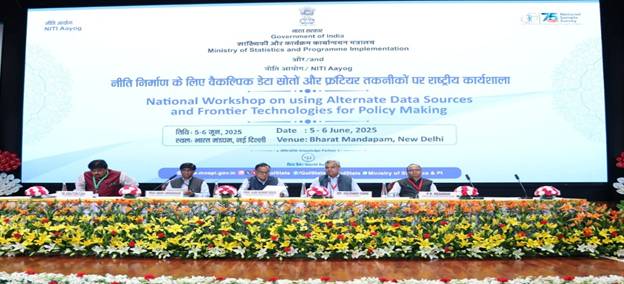
Prof. Abhay Karandikar, Secretary, D/o Science and Technology in his address remarked that the policy making process is a complex exercise which involve gathering of data, consultation with stakeholders and drawing insights. AI/ML has facilitated timely processing of data for designing actionable policies. In this age and time, challenge is not to collect data but how to make sense of the data. The real challenge lies in addressing issues relating to data privacy, data security, regulatory framework, and institutional readiness. He emphasized on the need for institutionalized hybrid data ecosystem which has equal place for both traditional and alternate data sources.  

Dr. Saurabh Garg, Secretary, MoSPI, in his address emphasized on the need of fostering collaboration with various stakeholders for developing a robust statistical system to address the data needs for policy making. He opined that as survey data becomes available with a time lag; alternate data sources can be used to supplement traditional data sources for policy making in real time. While quoting the United Nations Fundamental Principles of Official Statistics, he emphasized that for statistical purposes best combination of the four data sources, namely surveys, censuses, administrative records and alternate data sources may be drawn with quality and timeliness along with limiting cost and respondent burden. He expected that in next 3-6 months, MoSPI will be able to implement some of the use cases that have been identified to harness alternate data sources and the application of frontier technologies.  He thanked World Bank for conceptualizing and NITI Aayog for collaborating with MoSPI in organizing this workshop and expressed that India will be at the forefront of integrating alternate data sources and frontier technologies in the National Statistical Frameworks.

In the welcome address, Shri P.R. Meshram, Director General (Data Governance) expressed gratitude to NITI Aayog, World Bank, and other participants for their active involvement during the course of two-days event. He added that the workshop has not only deepened our understanding of the challenges in integration of alternate data sources in the statistical system of the country, but also helped charting out the solutions to the challenges.
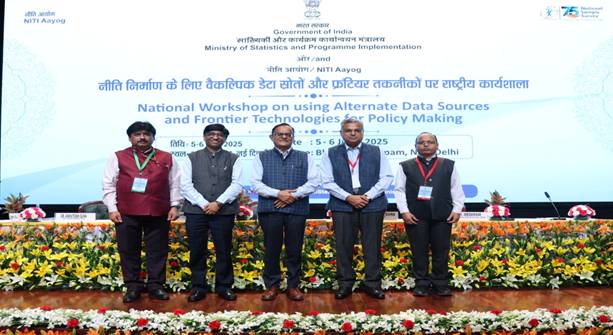
The key highlights of the four technical sessions on the subjects, viz, AI and Data Science for Official Statistics; Mobile Phone Data for Tourism Statistics; Geo-spatial Data for Sampling, Ocean Accounting and Data Dissemination and Scanner data for CPI compilation held during Workshop were also discussed during the valedictory session along with key takeaways. Some of the salient points of the technical sessions are as under:

(i)  AI and Data Science for Official Statistics:

Technical sessions on the subject started with setting the context for use of AI and data science in official statistics and identifying key stakeholders. Way forward for National Statistics Office considering the stage it is in i.e. from pilot stage to production stage was discussed during the session. Shri Abhishek Singh, CEO India AI and Ms Debjani Ghosh, Chief Architect, Frontier Tech Hub, NITI Aayog, Shri Ankit Bose, Head AI, NASSCOM, Prof. Balaraman Ravindran, IIT-Madras, Mr. Richard Campbell, UK ONS; and Mr. Thomas Danielewitz, Ms. Malar Veerappan, Ms. Shreya Dutt from World Bank were among the key speakers.

(ii)  Mobile Phone Data for Tourism Statistics:

Technical Sessions on the subject focused on discussion to devise a methodological framework using mobile phone data for tourism statistics tailored to Indian needs and covered relevant issues like data privacy and regulatory challenges. Use-cases from other countries for tourism, urban mobility and infrastructure assessment were discussed during the technical session. Shri Safi A. Rizvi Advisor, NDMA, Mr. Siim Esko, International Project Development Lead, Positium, Ms. Esperanza Magpantay, Senior Statistician, International Telecommunication Union, Ms. Titi Kanti Lestari, Atma Jaya University, Indonesia, Mr. Asit Kadyan, D/o Telecommunication, GoI and Mr. Sagar Mathur, Vice President, Airtel were among the key speakers.

(iii)  Geo-spatial Data for Sampling, Ocean Accounting and Data Dissemination:

Technical Sessions on Geo-spatial Data for Sampling, Ocean Accounting and Data Dissemination of the workshop highlighted the transformative potential of geospatial technologies in enhancing official statistics, with a focus on updating sampling frames in urban areas, improving data collection, integration, and dissemination. The latter part of the technical session was devoted for exploring the application of geospatial data in ocean accounting. The session featured enriching presentations and discussions by Mr. Richard Campbell, Deputy Director, UK Office for National Statistics; Ms. Kate Hess, Solution Engineer, ESRI; Shri Srikant Shastri, Chairperson, Geospatial Data Promotion & Development Committee; and Ms. Anija Shukla, Environment Specialist, World Bank, Ms. Rashmi Verma, Co-Founder, MapMyIndia along with experts from NRSC, INCOIS, NCCR and various academic and research institutions. Speakers demonstrated advanced geospatial tools integrated with AI techniques for feature extraction, change detection, and spatial stratification, showcasing use cases that illustrated the value of GIS-AI convergence for dynamic visualizations, real-time dashboards, and evidence-based policymaking.

(iv)  Scanner data for CPI compilation:

Technical sessions on the subject covered concepts and methodologies related to scanner data, web scraping techniques, requisite IT infrastructure and other available alternative data sources for integration in Consumer Price Index (CPI). Key speakers in the session were Mr. Federico Polidoro, World Bank; Mr. Luigi Palumbo from Bank of Italy, Prof. Himanshu from JNU, Dr. Aditi Chaubal from IIT Bombay, Shri Anand Agarwal from V-Mart, Ms. Sonu Shah from Nielsen IQ and many others from industry and academic organisations. Sessions provided valuable insights for accelerating MoSPI’s ongoing efforts for integration of alternative data sources, particularly scanner data and e-commerce data in CPI compilation methodology.

The workshop concluded with the vote of thanks by Dr. Ashutosh Ojha, DDG, MoSPI. He expressed gratitude to the Chief Guest, other dignitaries, participants from Multilateral agencies, industries, academia, researchers as well as officers from both central and state governments for gracing the event.

Topics

Acts Income Tax