

Loading...

Top
Help
×

By creating an account you can:

Logo TaxTMI
Call Us / Help / Feedback

Contact Us At :

E-mail: [email protected]

Call / WhatsApp at: +91 99117 96707

For more information, Check Contact Us

FAQs :

To know Frequently Asked Questions, Check FAQs

Most Asked Video Tutorials :

For more tutorials, Check Video Tutorials

Submit Feedback/Suggestion :

Email :
Please provide your email address so we can follow up on your feedback.
Category :
Description :
Min 15 characters 0/2000
Make Most of Text Search
  1. Checkout this video tutorial: How to search effectively on TaxTMI.
  2. Put words in double quotes for exact word search, eg: "income tax"
  3. Avoid noise words such as : 'and, of, the, a'
  4. Sort by Relevance to get the most relevant document.
  5. Press Enter to add multiple terms/multiple phrases, and then click on Search to Search.
  6. Text Search
  7. The system will try to fetch results that contains ALL your words.
  8. Once you add keywords, you'll see a new 'Search In' filter that makes your results even more precise.
  9. Text Search
Add to...
You have not created any category. Kindly create one to bookmark this item!
Create New Category
Hide
Title :
Description :
❮❮ Hide
Default View
Expand ❯❯
Close ✕
🔎 News - Adv. Search
TEXT SEARCH:

Press 'Enter' to add multiple search terms. Rules for Better Search

Search In:
Main Text + AI Text
  • Main Text
  • Main Text + AI Text
  • AI Text
Category: ?
Categorized by AI
---- All Categories ----
  • ---- All Categories ----
  • Income Tax
  • GST
  • Customs, DGFT & SEZ
  • FEMA & RBI
  • Corp. Laws, SEBI & IBC
  • PMLA, Black Money & ED
  • Budget
  • News and Press Release
  • PTI News
Month:
---- All Months ----
  • ---- All Months ----
  • January
  • February
  • March
  • April
  • May
  • June
  • July
  • August
  • September
  • October
  • November
  • December
Year:
---- All Years ----
  • ---- All Years ----
  • 2026
  • 2025
  • 2024
  • 2023
  • 2022
  • 2021
  • 2020
  • 2019
  • 2018
  • 2017
  • 2016
  • 2015
  • 2014
  • 2013
  • 2012
  • 2011
Sort By: ?
In Sort By 'Default', exact matches for text search are shown at the top, followed by the remaining results in their regular order.
Relevance Default Date
    Final US Section 301 Measures on Forced Labour: India Placed in Lower Tariff Tier at 10%
    Department of Commerce Reviews Flue-Cured Virginia (FCV) Tobacco Market Situation in Andhra Pradesh
    Ministry of Corporate Affairs’ ‘Corporate Mitra Scheme’ Awareness Webinar Successfully Organized by IICA Shillong for the youth and enterprises ...
    FM Sitharaman directs Income Tax dept to work for benefit of common people
    Crime Branch chargesheets 10 accused in separate fraud & forgery cases in Jammu
    ED chargesheets 3 founders of Gameskraft under PMLA
    IDFC FIRST Bank Q1FY27 Results: Highest Ever PAT of ₹1,075 Crore, Up 132.4% YoY
    India placed in lower 10 pc US tariff bracket; reaffirms commitment to BTA
    Ratnaveer Precision Engineering Reports 20% Revenue Growth and 21% PAT Growth in Q1 FY27
    India placed in lower tariff tier at 10 pc under US Section 301 measures on forced labour: Govt
    ED report says CMRL ex-MD cited Veena’s ties to then Kerala CM for payments
    Union Minister for Finance & Corporate Affairs Smt. Nirmala Sitharaman outlines 5Rs of responsive tax governance; Calls for greater tax certainty and ...
    Trump says US will investigate EU trade practices, claiming bloc unfairly fined tech giants
    World shares are mixed and oil prices fall, markets in Asia skid in sell-off of AI-related shares
    Sitharaman ask I-T officials to go after tax evaders, ensure convenience for honest taxpayers
    HIGHLIGHTS
    Rupee recovers 20 paise to settle at 96.53 against US dollar
    Sri Lanka welcomes US tariff reduction
    DPIIT's One District One Product Initiative Promotes 1,244 Unique Products Across 773 Districts
    India's Services Exports Rise to USD 421.3 Billion in FY 2025-26, Led by Telecommunications, Computer and Information Services and Business Services
❯❯
Maximize Maximize Maximize
0 / 200
Expand Note
Add to Folder

No Folders have been created

+

Are you sure you want to delete "My most important" ?

NOTE:

News
Showing Results for :
Reset Filters
Results Found:
Show All Summaries Hide All Summaries
July 27, 2026
Show AI Summary
Section 301 forced-labour measures place Indian imports in a lower tariff tier while preserving specified product exclusions.
Section 301 forced-labour import measures impose an additional ad valorem duty on imports from India, with India placed in a lower additional-tariff tier than initially proposed. Specified exports that attract no additional duties, and goods already subject to Section 232 measures, remain outside the Section 301 additional duty. A substantial portion of Indian exports is therefore excluded, while the remaining exports are subject to the additional duty. The textile-specific mechanism has not yet been operationalised, and engagement continues in relation to that mechanism and bilateral trade agreement negotiations.
July 27, 2026
Show AI Summary
FCV tobacco market stability remains under review through coordinated measures to protect growers and maintain transparent auction operations.
FCV tobacco market stability was reviewed with emphasis on protecting growers' interests and considering long-term measures for the sector. The delegation inspected Tobacco Board auction operations, interacted with growers on prevailing market conditions, and noted the transparent and orderly conduct of auctions. The Government is monitoring developments and examining appropriate measures with the State Government, Tobacco Board and stakeholders to safeguard FCV tobacco farmers' interests.
July 27, 2026
Show AI Summary
Corporate Mitra Scheme supports MSMEs through accredited professionals delivering affordable compliance, financial, taxation, accounting and governance assistance.
The Corporate Mitra Scheme seeks to strengthen MSMEs by connecting them with accredited para-professionals providing affordable compliance and business-support services. Corporate Mitras are envisaged to assist with regulatory compliance, finance, taxation, accounting and governance, allowing enterprises to focus on growth. The scheme also trains young graduates in industry-relevant skills and creates employment opportunities. IICA Shillong serves as the nodal agency for coordination, stakeholder liaison, promotion and awareness in the North Eastern Region.
July 26, 2026
Show AI Summary
Tax administration must deliver timely lawful service, protect public assets, and uphold integrity in tax collection.
Tax administration should assist common citizens by handling matters within departmental authority without unnecessary delay, while remaining within applicable rules. Government departments should protect public land from illegal occupation and expedite lawful land transfers, permissions, construction arrangements and procurement for departmental premises and accommodation. Integrity is the essential principle for officials performing tax-collection functions.
July 26, 2026
Show AI Summary
Investment fraud and forged residence certificates prompted chargesheets over alleged misappropriation, fabricated revenue records, land purchases and employment access.
Criminal chargesheets concerned alleged investment fraud through false promises of high returns and alleged misappropriation of investor funds, involving a company stated to be unregistered with SEBI, RBI and the relevant Registrar of Companies. A separate chargesheet concerned alleged conspiracy to procure permanent resident certificates using forged revenue records, with the certificates allegedly used for land purchases and government employment. Forensic examination reportedly found that the relevant revenue documents were not genuine according to official records.
July 25, 2026
Show AI Summary
Money-laundering allegations in online rummy gaming prompt prosecution proceedings and asset attachment over suspected cheating of users.
Money-laundering proceedings concerning online real-money rummy operations include a prosecution complaint against Gameskraft Technologies, RummyTime Technologies, founder-directors and associated persons. The allegations concern proceeds of crime said to arise from cheating users through rummy applications and from an addictive environment encouraging repeated wagering. The proceedings also involve provisional attachment, seizure and freezing of financial holdings, equity interests and immovable properties alleged to be connected with suspected proceeds of crime. The founder-directors' arrests were declared invalid by the Karnataka High Court, while the investigating agency proposes to challenge that order.
July 25, 2026
Show AI Summary
Banking financial performance reflected loan and deposit growth, improved asset quality, stronger margins and prudent contingency provisioning.
Quarterly financial performance reflected growth in customer business, loans and deposits, expansion in lending portfolios, an improved CASA ratio and lower cost of funds. Asset quality improved through reductions in gross and net non-performing assets, while profitability indicators improved in relation to net interest margin, cost efficiency, provisions, net profit and return on assets. The bank received credit-guarantee claims for its microfinance portfolio and created a contingency provision for macroeconomic and geopolitical uncertainty. Capital adequacy and common equity tier-one ratios were also reported.
July 25, 2026
Show AI Summary
Forced-labour import tariffs place Indian goods under an additional duty while exemptions preserve access for specified exports.
A 10 per cent Section 301 additional import duty applies to specified Indian goods over and above ordinary most-favoured-nation duty, following a forced-labour-related investigation. Generic pharmaceuticals, smartphones, other specified products, and goods already subject to Section 232 sectoral duties remain outside the additional levy. The textile-specific mechanism has not yet been operationalised for India, while tariff-rate quota concessions using US-origin cotton and fibre were announced for certain other economies. India continues engagement on a bilateral trade agreement and tariff access for garments using American inputs.
July 25, 2026
Show AI Summary
Copper Clad Laminate expansion advances through policy and rights-issue approvals, supporting domestic electronics manufacturing and strategic growth initiatives.
The company reported progress on a proposed Copper Clad Laminate manufacturing project, including in-principle approval under the Gujarat Electronics Policy and substantial project completion. The facility is intended to support domestic electronics manufacturing and reduce import dependence. It also reported upgraded credit ratings, enhanced rated bank facilities, and stock-exchange in-principle approvals for a proposed rights issue supporting expansion and strategic growth initiatives.
July 25, 2026
Show AI Summary
US forced-labour tariffs place India in a lower tier while preserving exclusions for specified imports and Section 232 products.
US Section 301 forced-labour measures impose an additional 10 per cent tariff on imports from India, with India placed in a lower tariff tier than initially proposed. Generic pharmaceuticals, smartphones and certain specified products outside additional duties remain excluded, as do products already covered by Section 232 measures, including steel, aluminium and auto parts. The textile-specific mechanism has not yet been established or operationalised, and engagement continues in connection with bilateral trade agreement negotiations.
July 25, 2026
Show AI Summary
Money-laundering investigation examines alleged fictitious expenses, circular vendor payments, and consultancy payments without services or deliverables.
A money-laundering investigation alleges misappropriation through fictitious expense entries, unsupported vouchers, and inflated vendor invoices used to withdraw funds in cash. The Enforcement Directorate further alleges that payments described as software or IT consultancy expenses were made to Exalogic Solutions Pvt Ltd and Veena T without services or deliverables. The report cites statements concerning the alleged sham payments, Exalogic's dependence on company funds, and subsequent transfers from its account. The PMLA case is based on a prosecution complaint concerning suspected financial irregularities.
July 25, 2026
Show AI Summary
Tax certainty and taxpayer-centric administration drive simplified compliance, reduced litigation, digital service delivery, and stronger voluntary tax compliance.
Tax administration reform under the Income-tax Act, 2025, rules and forms is directed toward a simpler, transparent and taxpayer-centric system. Key priorities include reducing compliance costs and litigation through tax certainty, faster return processing, refunds, grievance redressal, voluntary compliance and timely appeal disposal. Digital initiatives, including PAN 2.0, ITBA 2.0, IEC 3.0, Kar Saathi and SAKSHAM NUDGE, are intended to simplify compliance and improve taxpayer experience. Capacity building in technology, international taxation, transfer pricing, digital assets and cybersecurity supports this reform agenda.
July 24, 2026
Show AI Summary
Trade Practice Investigation: Tech-company antitrust fines prompt proposed tariffs and trade sanctions under federal trade law mechanisms.
A formal investigation into alleged unfair trade practices has been announced in response to European regulatory fines imposed on major United States technology companies. The stated concern is that digital antitrust penalties are unfairly directed at United States businesses, with possible tariffs on European Union imports indicated. The proposed response is linked to Section 301 of the Trade Act of 1974, permitting import taxes and other sanctions against unjustifiable, unreasonable or discriminatory trade practices.
July 24, 2026
Show AI Summary
Import tariffs and energy costs heighten inflation risks, pressuring consumers, corporate profits and monetary-policy expectations amid market volatility.
Fresh tariffs on imports, rising energy prices and Middle East conflict are identified as concurrent pressures on global financial markets. The tariff measures apply to nearly all imports into the United States and are paid by importing companies, which typically pass the additional costs to consumers. Higher energy costs and tariffs may increase inflationary pressure, reduce household discretionary spending and affect corporate profitability, while influencing monetary-policy expectations. Investors also questioned whether substantial artificial-intelligence investment can support technology-sector valuations.
July 24, 2026
Show AI Summary
Responsive tax governance promotes taxpayer convenience, correction of bona fide errors, tax certainty, prompt refunds and prevention of avoidable litigation.
Responsive tax governance requires convenience for honest taxpayers, correction of bona fide errors and firm consequences for deliberate tax evasion. The Income Tax Act, 2025 is intended to simplify the legal framework, reduce uncertainty and lower compliance costs, supported by stronger electronic filing infrastructure and prompt refund processing. Tax certainty should promote voluntary compliance and shift the focus from litigation management to litigation prevention through consistent guidance, simplified procedures, technology, standardised processes, effective grievance resolution and reduction of recurring taxpayer difficulties.
July 24, 2026
Show AI Summary
Examination integrity safeguards prompt monitoring, enforcement action and proposed stricter penalties for paper leaks and institutional failures.
Examination integrity measures include reported termination of agency officials, contemplated legal and criminal action, proposed stricter punishment for paper leaks, and Supreme Court monitoring of preventive steps. The Supreme Court also prohibited unauthorised posting or uploading of audio-video court proceedings on social media and digital platforms without prior administrative permission. The updates further address taxpayer facilitation alongside firm action against evasion, trade measures connected with forced-labour concerns, and potential legal action concerning university communications to students.
July 24, 2026
Show AI Summary
Foreign exchange market stabilisation supported rupee recovery as investor outflows, geopolitical tensions and elevated crude prices maintained currency pressure.
Foreign exchange market conditions saw the rupee recover against the US dollar amid reports of Reserve Bank of India intervention and dollar sales by public-sector banks to limit further depreciation. Foreign institutional investor outflows, weak domestic equity sentiment, geopolitical tensions, and elevated crude oil prices continued to pressure the currency. A decline in crude prices, diplomatic engagement, and central-bank intervention were identified as potential stabilising factors.
July 24, 2026
Show AI Summary
Forced-labour import prohibition enabled lower tariff treatment for Sri Lankan goods, supporting export competitiveness and responsible trade practices.
Tariff treatment for Sri Lankan goods entering the United States was reduced after Sri Lanka prohibited imports of goods produced using forced labour. The prohibition placed Sri Lanka within the lower tariff category under the stated US framework. The reduction is described as supporting exporter competitiveness while reflecting commitments to fair trade, responsible business practices, internationally accepted labour standards, and sustainable economic reforms.
July 24, 2026
Show AI Summary
One District One Product strengthens district product branding, market access, food-processing support and export-oriented value chains.
The One District One Product initiative supports district-identified products through branding, market access, exhibitions, capacity building and Government e-Marketplace onboarding. States and Union Territories select products and may leverage Central and State schemes, as no district-specific allocation is made. PM Ekta Malls and the PMFME Scheme support sales, food-processing projects, common infrastructure, branding, packaging, quality standardisation and food-safety compliance. Districts as Export Hubs promotes export-potential products through export committees, action plans and value-chain coordination.
July 24, 2026
Show AI Summary
Services export promotion expands market access, professional mobility, qualification recognition and trade outreach for Indian service suppliers.
Services export promotion combines targeted market and sector strategies, removal of domestic impediments, trade agreements and export-promotion activity. Free Trade Agreements secure market access and national treatment for Indian service suppliers, support transparent and time-bound authorisation processes, and facilitate temporary mobility of skilled professionals. Mutual Recognition Agreement provisions seek recognition of qualifications and licensing requirements. The framework also addresses social-security coordination, student mobility, traditional medicine and double-taxation commitments for IT services. The Services Export Promotion Council supports market development, trade facilitation, capacity building and international outreach.

News

Back

All News

Showing Results for :
Reset Filters
No Records Found

News

Back

All News

Showing Results for : Reset Filters

Results of Comprehensive Modular Survey: Telecom, 2025 (January – March, 2025)

May 30, 2025

Contents
Summary
Note

Note

-

Bookmark

Print

Print

Key highlights:

  • In rural areas, approximately 96.8 percent of persons in the age group 15-29 years used mobile phones at least once during the last three months for making personal calls and/ or accessing the internet. The use of mobile phones is estimated at 97.6 percent in urban areas.
  • In the age group 15-29 years, around 95.5 percent of persons own a smartphone among those persons who own a mobile phone (including smart phone) in rural areas. In urban areas, about 97.6 percent persons own a smartphone in the same age group.  
  • In rural areas, approximately 92.7 percent persons in the age group 15-29 years used the internet at least once during last three months. Whereas, in urban areas, about 95.7 percent persons of the same age group used the internet.
  • Among the persons in the age group 15-29 years who reported the ability to perform online banking transactions, about 99.5 percent persons reported to have the ability to perform online banking transactions through UPI.
  • In India, approximately 85.5 percent of households possessed at least one smartphone.   
  • Around 86.3 percent households in India have access to internet within the household premises.

Among the individuals in the age group 15-29 years, approximately 97.1 percent persons reported using a mobile phone (including smartphones) during the last three months from the date of survey.

As a part of the 80th round of the National Sample Survey (NSS), the Comprehensive Modular Survey: Telecom (CMS: T) was conducted from January to March, 2025. This initiative marks a significant step by National Statistics Office (NSO) towards implementing short-duration, focused surveys. This survey was undertaken with the primary objective to meet the requirements of the line ministry/ department of Government of India and there was no State participation in CMS: T. This survey was conducted along with the ongoing ‘Household Social Consumption: Health’ survey of NSS 80th round. The survey collected data on various aspects of mobile and internet usage at both the household and individual levels. Additionally, information on selected ICT skills was also captured. In this survey, data was collected through CAPI (Computer-Assisted Personal Interviews). The report is available on the Ministry’s website (http://www.mospi.gov.in).

Sample Design:

In this survey, a two-stage stratified sampling design was used, where First Stage Units (FSU) were villages/sub-units/sub-divisions in rural areas and Urban Frame Survey (UFS) blocks/sub-units/ sub-divisions in urban areas. The FSUs were allocated to States and UTs in proportion to the projected population figures as on 1st October 2024 as available from the report, ‘Population Projections for India and States 2011-2036’ of the Technical Group on Population Projections, Ministry of Health and Family Welfare, Government of India. The Second Stage Units (SSUs) were households in both rural and urban areas. The selection of FSUs and SSUs was done using Simple Random Sampling without Replacement (SRSWOR).

Survey Coverage:

The survey covered the whole of the India Union except for some villages of Andaman and Nicobar Islands which were difficult to access. At the all-India level, the total number of first-stage units (FSUs) surveyed was 4,382 (2,395 in rural areas and 1,987 in urban areas). The total number of households surveyed was 34,950 (19,071 in rural areas and 15,879 in urban areas) and the total number of persons enumerated was 1,42,065 (82,573 in rural areas and 59,492 in urban areas).

Important Caveat:

In rural area, around 92.7 percent persons in the age group 15-29 years used internet during last three months preceding the date of survey. In urban areas the use of internet, in the same age group, estimated at 95.7 percentage.

The primary objective of the CMS: T was to generate national-level estimates of telecom and ICT skills related indicators. However, state-level estimates based on the available sample observations have been generated and presented in this report. Therefore, users should interpret the survey results at the sub-national level with careful consideration of the associated sample size in the domain and Relative Standard Error (RSE). The information on the execution/ability to perform the ICT skills was collected based on the reporting of the informant only. While collecting this information, no tests of the ICT skills of the informants were performed. Furthermore, with reference to the information collected on online purchases, only goods have been taken into account, while services have been excluded.

It is also important to note that the survey-based estimated totals were used exclusively for calculating rates and ratios. These totals are not intended to serve as definitive population-level counts. Therefore, using these totals to directly interpret the estimates in absolute terms or for extrapolation, may lead to misleading conclusions and is not recommended. Users of the data are requested to interpret the findings with due consideration of these statistical limitations.

Major findings of the survey:

  1. Use of mobile telephone:

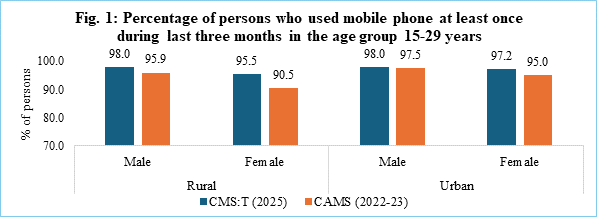
In CMS: T, a person was considered as ‘used a mobile phone (smartphone as well as mobile phone other than smartphone)’ if s/he used it for the purpose of making personal calls and/or accessing the internet at least once during the last three months preceding the date of survey. Among youth aged 15–29 years, approximately 97.1 percent reported the mobile phone usage in the last three months. As per the findings of the Comprehensive Annual Modular Survey (CAMS), 2022–23, conducted as part of the NSS 79th Round, the corresponding figure for this age group was estimated at 94.2[1] percent. Gender-sector-wise comparative estimates of percentage of persons used mobile in the age group 15-29 years are shown in Figure 1.     
  1. Mobile ownership:

In rural area around 79.2 percent males and 75.6 percent females in the age group ‘15 years and above’ own a smartphone among those who own a mobile phone. Whereas, in urban area the percentage estimated at around 89.4 and 86.2 percent for male and female, respectively, for the same age group.

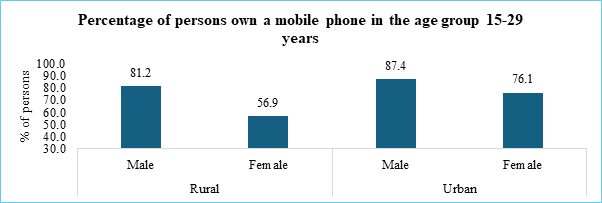
In this survey, mobile phone ownership was defined as having a device with an active SIM card for personal use, including employer-provided phones and those not registered in the user’s name. Individuals with only SIM cards were excluded. While determining ownership, joint ownership of a single mobile phone is not considered; in such cases, ownership is determined based on the majority use criterion. At the all-India level, in the age group 15-29 years, approximately 73.4 percent persons own a mobile phone. Gender-sector-wise estimates of mobile ownership for the persons in the age group 15-29 years are shown in Figure 2.
  1. Use of internet:   

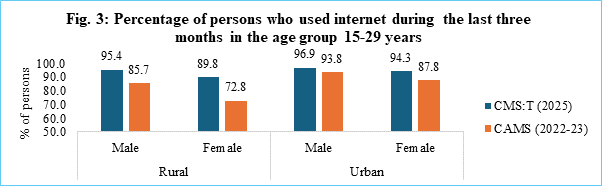
In the survey, a person was considered as ‘used internet’ if s/he accessed internet at least once during last 3 months, from any location, for any purpose and using any type of device (e.g. mobile, desktop, laptop, tablet, etc.). In the age group 15-29 years, around 94.3 percent persons used the internet at least once during last 3 months preceding the date of survey. Gender-sector-wise comparative estimates with CAMS, 2022-23 for the percentage of persons used internet in the age group 15-29 years are shown in Figure 3.
(iv) Sent messages with attached files

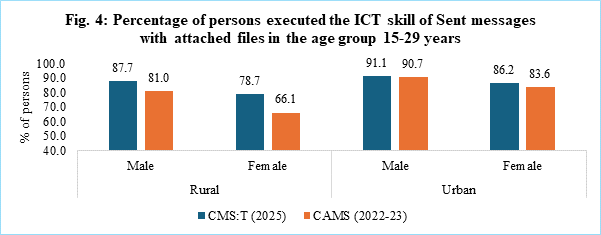
About 85.1 percent persons in the age group 15-29 years reported execution of the skill of ‘sent messages (e.g., e-mail, messaging service, SMS) with attached files (e.g., documents, pictures, video)’, using mobile or computer-like devices, during the last three months preceding the date of survey.

Whereas, 77.7 percent persons in the same age group reported execution of the skill during 2022-23 (CAMS, NSS 79th Round). Figure 4 gives gender-sector-wise comparative estimates of the percentage of persons executed the ICT skill in the age group 15-29 years during 2025 and 2022-23.


Indicator

Rural

Urban

Male

Female

Male

Female

15-24 years

Percentage persons used mobile during last three months preceding the date of survey

98.0

95.7

97.6

96.9

Percentage of persons own a mobile phone

74.8

51.7

82.7

69.5

Percentage of persons used the internet during last three months preceding the date of survey

95.7

91.1

97.0

95.0

Percentage of persons sent messages with attached files during last three months preceding the date of survey

87.7

80.4

91.9

87.7

15 years and

above

Percentage persons used mobile during last three months preceding the date of survey

89.5

76.3

95.0

86.8

Percentage of persons own a mobile phone

80.7

48.4

90.0

71.8

Percentage of persons used the internet during last three months preceding the date of survey

72.1

57.6

85.5

74.0

Percentage of persons sent messages with attached files during last three months preceding the date of survey

67.2

50.9

79.1

65.8

households

Percentage of households possessed at least one smartphone

82.1

91.3

Percentage of households have access to internet facility within household premises

83.3

91.6


Topics

Acts Income Tax