

Loading...

Top
Help
×

By creating an account you can:

Logo TaxTMI
Call Us / Help / Feedback

Contact Us At :

E-mail: [email protected]

Call / WhatsApp at: +91 99117 96707

For more information, Check Contact Us

FAQs :

To know Frequently Asked Questions, Check FAQs

Most Asked Video Tutorials :

For more tutorials, Check Video Tutorials

Submit Feedback/Suggestion :

Email :
Please provide your email address so we can follow up on your feedback.
Category :
Description :
Min 15 characters 0/2000
Make Most of Text Search
  1. Checkout this video tutorial: How to search effectively on TaxTMI.
  2. Put words in double quotes for exact word search, eg: "income tax"
  3. Avoid noise words such as : 'and, of, the, a'
  4. Sort by Relevance to get the most relevant document.
  5. Press Enter to add multiple terms/multiple phrases, and then click on Search to Search.
  6. Text Search
  7. The system will try to fetch results that contains ALL your words.
  8. Once you add keywords, you'll see a new 'Search In' filter that makes your results even more precise.
  9. Text Search
Add to...
You have not created any category. Kindly create one to bookmark this item!
Create New Category
Hide
Title :
Description :
❮❮ Hide
Default View
Expand ❯❯
Close ✕
🔎 News - Adv. Search
TEXT SEARCH:

Press 'Enter' to add multiple search terms. Rules for Better Search

Search In:
Main Text + AI Text
  • Main Text
  • Main Text + AI Text
  • AI Text
Category: ?
Categorized by AI
---- All Categories ----
  • ---- All Categories ----
  • Income Tax
  • GST
  • Customs, DGFT & SEZ
  • FEMA & RBI
  • Corp. Laws, SEBI & IBC
  • PMLA, Black Money & ED
  • Budget
  • News and Press Release
  • PTI News
Month:
---- All Months ----
  • ---- All Months ----
  • January
  • February
  • March
  • April
  • May
  • June
  • July
  • August
  • September
  • October
  • November
  • December
Year:
---- All Years ----
  • ---- All Years ----
  • 2026
  • 2025
  • 2024
  • 2023
  • 2022
  • 2021
  • 2020
  • 2019
  • 2018
  • 2017
  • 2016
  • 2015
  • 2014
  • 2013
  • 2012
  • 2011
Sort By: ?
In Sort By 'Default', exact matches for text search are shown at the top, followed by the remaining results in their regular order.
Relevance Default Date
    Punjab extends deadline of one-time scheme for settling tax dues of pre-GST period till Sept 30
    PM Modi speaks to UK counterpart Burnham
    Bank credit to industry records robust growth of 19.2 pc in June: RBI data
    Delhi protesters' fingerprints collected from stones for identification via Aadhaar: BJP minister
    Cabinet approves Rs 84,084-cr offshore exploration scheme; govt to fund up to Rs 650 cr per well
    India's forex reserves jump USD 6.12 bn to USD 682.35 bn
    Jharkhand signs pact with CSC eStore to make SHG products made by women available online
    APEDA Facilitates First-Ever Air Shipment of Karnataka's Neelam and Totapuri Mangoes to the Maldives
    Favara-UPI Cross-Border Payment Corridor Goes Live Between Maldives and India
    SC upholds NCLAT order setting aside CCI's Rs 301.6-cr penalty on Grasim Industries
    China's factory activity unexpectedly slips into contraction in July
    PM Modi to inaugurate Bhogapuram Airport on Aug 1 in Andhra Pradesh
    Rupee rises 20 paise to 95.30 against US dollar in early trade
    APEDA Facilitates First-Ever Sea Shipment of Value-Added Flavoured Makhana from Bihar to Canada
    Indian envoy meets Chinese commerce ministry official; Calls for enhanced market access
    ED attaches Rs 94 crore in foreign bank account in fraud case against Delhi-based rice firm
    Ensure uniform deposit rates across all branches: RBI tells banks
    PM takes stock of geo-political situation, safety of seafarers, supply chain constraints
    Delhi govt to provide property Aadhaar cards; bring Land Records Bill: CM Rekha Gupta
    CCS discusses global security situation, supply chain constraints
❯❯
Maximize Maximize Maximize
0 / 200
Expand Note
Add to Folder

No Folders have been created

+

Are you sure you want to delete "My most important" ?

NOTE:

News
Showing Results for :
Reset Filters
Results Found:
Show All Summaries Hide All Summaries
July 31, 2026
Show AI Summary
One-Time Settlement Scheme offers final pre-GST tax dispute resolution relief before stricter recovery action against defaulters begins.
The One-Time Settlement Scheme 2025 for pre-GST tax dues has been extended until September 30. Eligible taxpayers may resolve pending legacy tax disputes with full waiver of interest and penalties and slab-wise relief in principal tax. After the deadline, recovery action may be intensified under applicable tax laws and the Punjab Land Revenue Act, including property attachment, auction and freezing of bank accounts. The department also supports amicable settlement of tax disputes through the SAMADHAN initiative.
July 31, 2026
Show AI Summary
Bilateral trade agreement implementation supports expanded trade, investment and strategic cooperation through technology, security, clean energy and community links.
The India-UK Comprehensive Economic and Trade Agreement was identified as a framework for expanding bilateral trade and investment opportunities following its operationalisation. The two governments proposed closer cooperation to use the agreement for shared prosperity, while advancing their comprehensive strategic partnership through technology, innovation, defence, security, clean energy, education and people-to-people links.
July 31, 2026
Show AI Summary
Sectoral bank credit growth reflects broad-based expansion across industry, services, agriculture and personal loans, with slower credit-card growth.
Sectoral bank credit growth accelerated across non-food lending, agriculture, industry, services and personal loans. Industrial credit expanded across micro and small, medium and large enterprises, with strong lending to infrastructure, engineering, food processing, textiles, construction, metals, petroleum-related products and chemical products. Services lending was supported by non-banking financial companies, commercial real estate and trade. Vehicle and housing loans maintained double-digit growth, while credit-card outstanding growth decelerated.
July 31, 2026
Show AI Summary
Biometric identification of protesters through alleged fingerprint-Aadhaar linkage was described alongside criminal-background profiling and database creation.
Biometric identification of protesters through fingerprints recovered from alleged stone-pelting evidence was publicly described as a proposed investigative method. A minister stated that fingerprints allegedly found on stones would be linked with Aadhaar numbers to identify participants and examine their prior records. The account also referred to analysis and categorisation of detained protesters' criminal backgrounds, creation of a separate database, and proposed action against participants described as anti-social elements or persons with criminal records.
July 31, 2026
Show AI Summary
Offshore hydrocarbon exploration support funds high-risk deepwater drilling, shared infrastructure and data acquisition to strengthen domestic energy production.
The National Offshore Exploration Scheme provides public support for deepwater and ultra-deepwater oil and gas exploration, including seismic and offshore data acquisition, exploratory drilling in frontier basins, and common production and evacuation infrastructure. It addresses the high cost and geological uncertainty of offshore drilling and includes technology adoption, digital programme management, capacity building and collaboration measures. The scheme seeks to expand domestic hydrocarbon discoveries and production, attract investment across the exploration and production value chain, and reduce reliance on imported oil and gas.
July 31, 2026
Show AI Summary
Foreign exchange reserves increased as foreign currency assets and gold holdings rose, alongside measures to attract forex inflows.
India's foreign exchange reserves increased during the reporting week, principally because foreign currency assets and gold reserves rose. Foreign currency assets, expressed in United States dollar terms, include valuation effects from movements in currencies such as the euro, pound and yen. Special Drawing Rights and the reserve position with the International Monetary Fund declined. Measures including the FCNR(B) measure were reported as efforts to attract foreign-exchange inflows following rupee pressure and dollar-sales intervention.
July 31, 2026
Show AI Summary
Digital marketplace access for women's self-help group products expands e-commerce opportunities while panchayat-level citizen services are strengthened.
Digital marketplace access for women's self-help group products is proposed through a memorandum of understanding between CSC eStore and the Jharkhand State Livelihood Promotion Society. Products marketed under the 'Palash' and 'Adiva' brands are intended to be offered through an e-commerce network to widen market access, support rural women's income and entrepreneurship, and strengthen the rural economy. Digital panchayat services are also being expanded through Common Service Centres, including banking, e-governance and Aadhaar-related services.
July 31, 2026
Show AI Summary
Agricultural export facilitation expands market access for late-season mangoes through farmer aggregation and direct global market linkages.
Agricultural export facilitation enabled an air shipment of late-season Neelam and Totapuri mangoes to an international market, expanding market access and extending the mango export season. Direct sourcing through a Farmer Producer Company supported organised aggregation, quality produce, and export-oriented supply chains. Direct procurement and export market linkages enabled participating farmers to realise higher returns than conventional market channels while promoting horticultural export diversification.
July 31, 2026
Show AI Summary
Cross-border digital payment integration enables real-time Favara transfers from Maldives mobile banking applications to UPI-enabled accounts in India.
Cross-border digital payment integration between Favara and UPI enables individuals in the Maldives to make real-time person-to-person transfers to UPI-enabled bank accounts in India through mobile banking applications. Transfers are initiated in Maldivian Rufiyaa and credited in Indian Rupees. The initial service is available through participating Maldivian banks. Permitted remittances include family-maintenance transfers under foreign inward and outward remittance categories, and gift-related transfers under foreign outward remittance. Future phases are intended to introduce QR-based merchant payments and other digital payment services.
July 31, 2026
Show AI Summary
Procedural Fair Hearing in competition inquiries requires notice when the Commission departs from investigative findings before imposing action.
Competition law procedure requires the Competition Commission to notify and hear an opposite party when departing from the Director General's findings. The penalty order concerning alleged abuse of dominance in viscose staple fibre supply was set aside because Grasim Industries was not given an opportunity to respond to the Commission's disagreement with the investigative findings. The matter was remanded for fresh, time-bound consideration without a finding on the merits.
July 31, 2026
Show AI Summary
Manufacturing contraction highlights weak domestic demand, property-sector pressure and continued reliance on technology-related exports for economic growth.
Manufacturing activity in China contracted in July, as the official purchasing managers' index fell below the expansion threshold and new orders and production declined. Weak domestic demand, lower building activity and possible typhoon-related disruptions contributed to the slowdown. Consumer spending, investment and property-sector weakness continue to affect confidence, while technology-related exports support growth. Policy commitments include strengthening domestic consumption amid continued reliance on exports.
July 31, 2026
Show AI Summary
Public-private partnership airport development strengthens aviation, cargo logistics, export infrastructure and sustainable connectivity through an integrated international airport project.
The Bhogapuram airport project is being implemented under a Public-Private Partnership through the Design, Build, Finance, Operate and Transfer framework. It has obtained required aerodrome, safety, fire and environmental clearances and includes infrastructure for domestic and international aviation, passenger processing and airport security. Cargo and cold-chain facilities are intended to support exports and logistics integration, while recycled-water use and LEED Platinum standards form part of the project's sustainability features.
July 31, 2026
Show AI Summary
Rupee appreciation against the US dollar continued as foreign inflows and lower crude prices supported domestic currency markets.
Rupee appreciation against the US dollar continued in early trading, supported by foreign capital inflows and lower global crude oil prices. A stronger US dollar constrained further appreciation, while expectations of continued Reserve Bank of India intervention were cited as supporting the rupee. Declining Brent crude prices, gains in domestic equity indices and net foreign institutional investment in equities were also identified as relevant market factors.
July 31, 2026
Show AI Summary
Value-added Makhana exports expand international market access, support quality compliance, and improve farmer returns through processing and branding.
Agricultural export facilitation supported the first sea shipment of value-added flavoured Makhana from Bihar to Canada. Processed and packaged to international quality and food-safety standards, the export demonstrates the role of processing, value addition and export-oriented manufacturing in expanding overseas market access. The initiative is stated to improve farmer returns through value addition, while capacity building, export infrastructure, quality compliance, market linkages and stakeholder collaboration support the agri-export ecosystem.
July 30, 2026
Show AI Summary
Market access for Indian pharmaceuticals remains central to bilateral efforts to promote sustainable trade and economic cooperation.
Enhanced market access for Indian products, particularly pharmaceuticals, was raised in discussions aimed at strengthening bilateral trade and economic ties. The discussions addressed sustainable trade, and the sides agreed to increase mutual cooperation and communication. India continues to seek greater access to China's information technology, pharmaceutical and agricultural sectors, while pursuing increased pharmaceutical exports and Chinese investment. Bilateral trade increased, but India's trade deficit widened, reflecting an ongoing imbalance in trade flows.
July 30, 2026
Show AI Summary
Money laundering asset attachment targets overseas bank deposits linked to alleged loan fraud and fugitive economic offenders.
Provisional attachment under the Prevention of Money Laundering Act was reported against Singapore bank deposits held by a company promoter and associated entities in an alleged loan-fraud and money-laundering investigation. The underlying case arises from allegations of fraud, criminal misappropriation, criminal breach of trust and cheating affecting a consortium of lending banks. Service of the attachment order was reported through mutual legal-assistance arrangements, and the promoters had reportedly been declared fugitive economic offenders.
July 30, 2026
Show AI Summary
Deposit interest rate uniformity requires equal rates for similar deposits, while allowing risk-based differentiation for bulk deposits.
Banks must apply uniform deposit interest rates across branches and customers for similar deposit amounts accepted on the same date, without discrimination. Rates payable, including for bulk deposits, must strictly follow schedules disclosed in advance on bank websites. Bulk deposit rates must be published each business day at 10:00 am, subject to a short permitted delay. Differentiated bulk-deposit rates may be offered based on applicable differential run-off rates under the Liquidity Coverage Ratio framework.
July 30, 2026
Show AI Summary
Supply-chain continuity measures prioritise energy, fertiliser and seafarer protection amid conflict-driven disruptions across critical maritime transit routes.
Supply-chain continuity and energy security measures were reviewed in response to geopolitical conflicts disrupting maritime transit routes and imports. Measures included diversification of LPG procurement, maintenance of petroleum stocks, expansion of PNG, gas-grid, LNG and city-gas infrastructure, and pipeline connectivity approvals. Fertiliser requirements and alternative procurement sources were considered to ensure uninterrupted supply. A unified monitoring mechanism and support arrangements for seafarers, including timely information, emergency assistance and counselling, were directed to protect citizens, economic interests and the Indian diaspora.
July 30, 2026
Show AI Summary
Property digital identity framework proposed through comprehensive surveys, floor-level records, and unique cards to improve ownership verification.
The proposed Delhi Land Records Bill, 2026 contemplates a digital land-records framework requiring scientific surveys of every property, comprehensive authenticated digital records and a unique Property Aadhaar Card. The proposed system would cover rural and urban residential, commercial and other properties, including floor-level records for buildings. It is intended to improve ownership verification, property transactions, inheritance, loan access, building-plan approvals and transparency in land records.
July 30, 2026
Show AI Summary
Supply-chain resilience amid maritime conflict drives measures to protect energy imports, fertiliser supplies, seafarers and overseas citizens.
Supply-chain continuity was reviewed in response to conflicts affecting maritime routes through the Strait of Hormuz, the Black Sea, the Red Sea and the Gulf of Aden. The concerns included disruptions to imports of petroleum, natural gas, fertilisers and other essential goods, risks to ships and seafarers, and the safety of Indian citizens in conflict areas. Measures were considered to maintain uninterrupted imports, protect economic interests and address constraints affecting critical energy and trade corridors.

News

Back

All News

Showing Results for :
Reset Filters
No Records Found

News

Back

All News

Showing Results for : Reset Filters

Results of Comprehensive Modular Survey: Telecom, 2025 (January – March, 2025)

May 30, 2025

Contents
Summary
Note

Note

-

Bookmark

Print

Print

Key highlights:

  • In rural areas, approximately 96.8 percent of persons in the age group 15-29 years used mobile phones at least once during the last three months for making personal calls and/ or accessing the internet. The use of mobile phones is estimated at 97.6 percent in urban areas.
  • In the age group 15-29 years, around 95.5 percent of persons own a smartphone among those persons who own a mobile phone (including smart phone) in rural areas. In urban areas, about 97.6 percent persons own a smartphone in the same age group.  
  • In rural areas, approximately 92.7 percent persons in the age group 15-29 years used the internet at least once during last three months. Whereas, in urban areas, about 95.7 percent persons of the same age group used the internet.
  • Among the persons in the age group 15-29 years who reported the ability to perform online banking transactions, about 99.5 percent persons reported to have the ability to perform online banking transactions through UPI.
  • In India, approximately 85.5 percent of households possessed at least one smartphone.   
  • Around 86.3 percent households in India have access to internet within the household premises.

Among the individuals in the age group 15-29 years, approximately 97.1 percent persons reported using a mobile phone (including smartphones) during the last three months from the date of survey.

As a part of the 80th round of the National Sample Survey (NSS), the Comprehensive Modular Survey: Telecom (CMS: T) was conducted from January to March, 2025. This initiative marks a significant step by National Statistics Office (NSO) towards implementing short-duration, focused surveys. This survey was undertaken with the primary objective to meet the requirements of the line ministry/ department of Government of India and there was no State participation in CMS: T. This survey was conducted along with the ongoing ‘Household Social Consumption: Health’ survey of NSS 80th round. The survey collected data on various aspects of mobile and internet usage at both the household and individual levels. Additionally, information on selected ICT skills was also captured. In this survey, data was collected through CAPI (Computer-Assisted Personal Interviews). The report is available on the Ministry’s website (http://www.mospi.gov.in).

Sample Design:

In this survey, a two-stage stratified sampling design was used, where First Stage Units (FSU) were villages/sub-units/sub-divisions in rural areas and Urban Frame Survey (UFS) blocks/sub-units/ sub-divisions in urban areas. The FSUs were allocated to States and UTs in proportion to the projected population figures as on 1st October 2024 as available from the report, ‘Population Projections for India and States 2011-2036’ of the Technical Group on Population Projections, Ministry of Health and Family Welfare, Government of India. The Second Stage Units (SSUs) were households in both rural and urban areas. The selection of FSUs and SSUs was done using Simple Random Sampling without Replacement (SRSWOR).

Survey Coverage:

The survey covered the whole of the India Union except for some villages of Andaman and Nicobar Islands which were difficult to access. At the all-India level, the total number of first-stage units (FSUs) surveyed was 4,382 (2,395 in rural areas and 1,987 in urban areas). The total number of households surveyed was 34,950 (19,071 in rural areas and 15,879 in urban areas) and the total number of persons enumerated was 1,42,065 (82,573 in rural areas and 59,492 in urban areas).

Important Caveat:

In rural area, around 92.7 percent persons in the age group 15-29 years used internet during last three months preceding the date of survey. In urban areas the use of internet, in the same age group, estimated at 95.7 percentage.

The primary objective of the CMS: T was to generate national-level estimates of telecom and ICT skills related indicators. However, state-level estimates based on the available sample observations have been generated and presented in this report. Therefore, users should interpret the survey results at the sub-national level with careful consideration of the associated sample size in the domain and Relative Standard Error (RSE). The information on the execution/ability to perform the ICT skills was collected based on the reporting of the informant only. While collecting this information, no tests of the ICT skills of the informants were performed. Furthermore, with reference to the information collected on online purchases, only goods have been taken into account, while services have been excluded.

It is also important to note that the survey-based estimated totals were used exclusively for calculating rates and ratios. These totals are not intended to serve as definitive population-level counts. Therefore, using these totals to directly interpret the estimates in absolute terms or for extrapolation, may lead to misleading conclusions and is not recommended. Users of the data are requested to interpret the findings with due consideration of these statistical limitations.

Major findings of the survey:

  1. Use of mobile telephone:

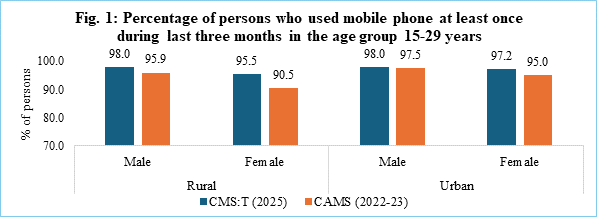
In CMS: T, a person was considered as ‘used a mobile phone (smartphone as well as mobile phone other than smartphone)’ if s/he used it for the purpose of making personal calls and/or accessing the internet at least once during the last three months preceding the date of survey. Among youth aged 15–29 years, approximately 97.1 percent reported the mobile phone usage in the last three months. As per the findings of the Comprehensive Annual Modular Survey (CAMS), 2022–23, conducted as part of the NSS 79th Round, the corresponding figure for this age group was estimated at 94.2[1] percent. Gender-sector-wise comparative estimates of percentage of persons used mobile in the age group 15-29 years are shown in Figure 1.     
  1. Mobile ownership:

In rural area around 79.2 percent males and 75.6 percent females in the age group ‘15 years and above’ own a smartphone among those who own a mobile phone. Whereas, in urban area the percentage estimated at around 89.4 and 86.2 percent for male and female, respectively, for the same age group.

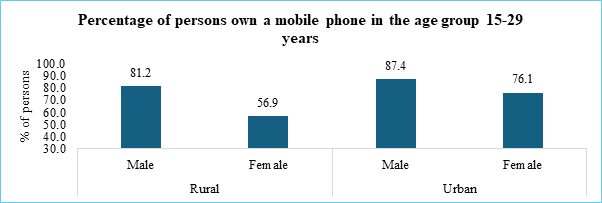
In this survey, mobile phone ownership was defined as having a device with an active SIM card for personal use, including employer-provided phones and those not registered in the user’s name. Individuals with only SIM cards were excluded. While determining ownership, joint ownership of a single mobile phone is not considered; in such cases, ownership is determined based on the majority use criterion. At the all-India level, in the age group 15-29 years, approximately 73.4 percent persons own a mobile phone. Gender-sector-wise estimates of mobile ownership for the persons in the age group 15-29 years are shown in Figure 2.
  1. Use of internet:   

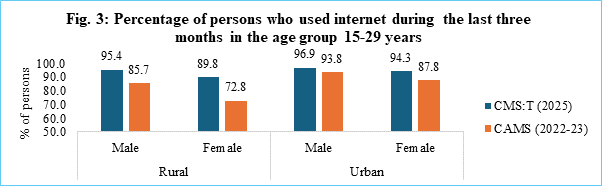
In the survey, a person was considered as ‘used internet’ if s/he accessed internet at least once during last 3 months, from any location, for any purpose and using any type of device (e.g. mobile, desktop, laptop, tablet, etc.). In the age group 15-29 years, around 94.3 percent persons used the internet at least once during last 3 months preceding the date of survey. Gender-sector-wise comparative estimates with CAMS, 2022-23 for the percentage of persons used internet in the age group 15-29 years are shown in Figure 3.
(iv) Sent messages with attached files

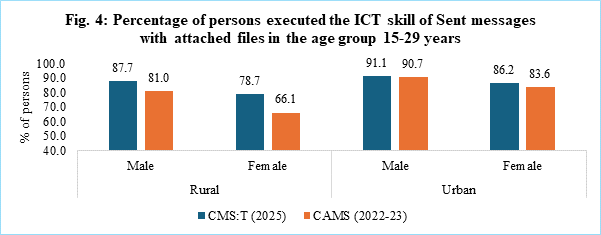
About 85.1 percent persons in the age group 15-29 years reported execution of the skill of ‘sent messages (e.g., e-mail, messaging service, SMS) with attached files (e.g., documents, pictures, video)’, using mobile or computer-like devices, during the last three months preceding the date of survey.

Whereas, 77.7 percent persons in the same age group reported execution of the skill during 2022-23 (CAMS, NSS 79th Round). Figure 4 gives gender-sector-wise comparative estimates of the percentage of persons executed the ICT skill in the age group 15-29 years during 2025 and 2022-23.


Indicator

Rural

Urban

Male

Female

Male

Female

15-24 years

Percentage persons used mobile during last three months preceding the date of survey

98.0

95.7

97.6

96.9

Percentage of persons own a mobile phone

74.8

51.7

82.7

69.5

Percentage of persons used the internet during last three months preceding the date of survey

95.7

91.1

97.0

95.0

Percentage of persons sent messages with attached files during last three months preceding the date of survey

87.7

80.4

91.9

87.7

15 years and

above

Percentage persons used mobile during last three months preceding the date of survey

89.5

76.3

95.0

86.8

Percentage of persons own a mobile phone

80.7

48.4

90.0

71.8

Percentage of persons used the internet during last three months preceding the date of survey

72.1

57.6

85.5

74.0

Percentage of persons sent messages with attached files during last three months preceding the date of survey

67.2

50.9

79.1

65.8

households

Percentage of households possessed at least one smartphone

82.1

91.3

Percentage of households have access to internet facility within household premises

83.3

91.6


Topics

Acts Income Tax