

Loading...

Top
Help
×

By creating an account you can:

Logo TaxTMI
Call Us / Help / Feedback

Contact Us At :

E-mail: [email protected]

Call / WhatsApp at: +91 99117 96707

For more information, Check Contact Us

FAQs :

To know Frequently Asked Questions, Check FAQs

Most Asked Video Tutorials :

For more tutorials, Check Video Tutorials

Submit Feedback/Suggestion :

Email :
Please provide your email address so we can follow up on your feedback.
Category :
Description :
Min 15 characters 0/2000
Make Most of Text Search
  1. Checkout this video tutorial: How to search effectively on TaxTMI.
  2. Put words in double quotes for exact word search, eg: "income tax"
  3. Avoid noise words such as : 'and, of, the, a'
  4. Sort by Relevance to get the most relevant document.
  5. Press Enter to add multiple terms/multiple phrases, and then click on Search to Search.
  6. Text Search
  7. The system will try to fetch results that contains ALL your words.
  8. Once you add keywords, you'll see a new 'Search In' filter that makes your results even more precise.
  9. Text Search
Add to...
You have not created any category. Kindly create one to bookmark this item!
Create New Category
Hide
Title :
Description :
❮❮ Hide
Default View
Expand ❯❯
Close ✕
🔎 News - Adv. Search
TEXT SEARCH:

Press 'Enter' to add multiple search terms. Rules for Better Search

Search In:
Main Text + AI Text
  • Main Text
  • Main Text + AI Text
  • AI Text
Category: ?
Categorized by AI
---- All Categories ----
  • ---- All Categories ----
  • Income Tax
  • GST
  • Customs, DGFT & SEZ
  • FEMA & RBI
  • Corp. Laws, SEBI & IBC
  • PMLA, Black Money & ED
  • Budget
  • News and Press Release
  • PTI News
Month:
---- All Months ----
  • ---- All Months ----
  • January
  • February
  • March
  • April
  • May
  • June
  • July
  • August
  • September
  • October
  • November
  • December
Year:
---- All Years ----
  • ---- All Years ----
  • 2026
  • 2025
  • 2024
  • 2023
  • 2022
  • 2021
  • 2020
  • 2019
  • 2018
  • 2017
  • 2016
  • 2015
  • 2014
  • 2013
  • 2012
  • 2011
Sort By: ?
In Sort By 'Default', exact matches for text search are shown at the top, followed by the remaining results in their regular order.
Relevance Default Date
    RBI issues Draft (Securitisation Transactions) Amendment Directions
    Rupee rises 5 paise to 95.77 against US dollar in early trade
    Woman GST officer, consultant caught taking Rs 60,000 bribe in Maharashtra's Jalna
    Zelenskyy has 'good meeting' with Trump at White House as he seeks more cooperation with US
    Creation of separate ministry infused new energy in India's cooperative movement: Amit Shah
    Railways operates first-ever direct freight train from Kolkata Port to Nepal's Biratnagar
    Haryana Cabinet approves housing, EV, MSME and governance reforms
    SC slams CBI, Delhi Police EoW over silence in Indiabulls probe, calls their conduct 'shocking'
    Govt introduces Bill in RS to tackle payment delays faced by MSMEs
    Regional Rural Banks (RRBs) Post Highest-Ever Net Profit of Rs. 10,177 Crore in FY 2025–26, show consistent improvement in other key financial param...
    Gross Non-Performing Assets (GNPA) of Public Sector Banks (PSBs) at historic low of 1.9% in FY 2025-26, achieve highest-ever net profit of ₹ 1.9...
    India's Toy Exports Soar 89.1%, Reflecting Strong Growth in Domestic Manufacturing
    India's Exports Scale Record US$ 863.1 Billion in FY 2025–26, Driven by Strong Trade with UAE, UK and Australia
    India's FTAs Deepen Global Market Access, Boost Export Diversification and Labour-Intensive Sectors.
    73 Sports Medal Winners of Chandigarh University get government jobs in 2025-26
    Centre orders sugar dealers to limit stocks to 30 days; stock limit at 4,000 quintals
    5 Credit Profile Checks That Can Improve Financial Health
    Gold Loan EMI or Bullet Repayment: Muthoot Finance Helps Choose Right in 2026
    EU-ASEAN Business Council Calls for stronger action on Illicit Trade, highlights India''s Strategic role
    Union Minister of Commerce & Industry Shri Piyush Goyal Announces Task Force to Support Toy Sector, Targets 5% Global Market Share by 2032.
❯❯
Maximize Maximize Maximize
0 / 200
Expand Note
Add to Folder

No Folders have been created

+

Are you sure you want to delete "My most important" ?

NOTE:

News
Showing Results for :
Reset Filters
Results Found:
Show All Summaries Hide All Summaries
July 29, 2026
Show AI Summary
Securitisation Note amendments seek stronger issuance efficiency, liquidity and transparency, with stakeholder consultation invited on proposed directions.
Draft amendments to securitisation transaction directions seek to improve the efficiency, liquidity and transparency of issuing and subsequently transferring Securitisation Notes. The proposals apply to commercial banks, small finance banks, non-banking financial companies and all India financial institutions. Public and stakeholder comments are invited through the designated regulatory consultation platform or alternatively by post or email.
July 29, 2026
Show AI Summary
Rupee appreciation reflected weaker dollar conditions, equity inflows, crude oil movements and positive domestic market sentiment.
Foreign exchange market conditions supported an early appreciation of the rupee against the US dollar. A weaker US dollar, lower crude oil prices relative to earlier levels, positive domestic equity sentiment, and foreign institutional investors' net purchase of Indian equities were identified as key influences. The dollar index weakened ahead of a monetary policy announcement, while crude prices rose amid renewed geopolitical tensions. Domestic benchmark equity indices also advanced in early trade.
July 29, 2026
Show AI Summary
Input Tax Credit unblocking allegedly involved illegal gratification, prompting a trap operation and apprehension of the officer and consultant.
Alleged bribery connected with unblocking Input Tax Credit arose after an electronics trader received a show-cause notice and had its ITC blocked. A private tax consultant allegedly conveyed that a State GST officer demanded illegal gratification for unblocking the credit and encouraged the trader to settle the demand. Following a complaint, a trap operation allegedly led to the apprehension of the officer and consultant, with further legal action in progress.
July 29, 2026
Show AI Summary
Defence production licensing and Russian energy sanctions shaped discussions on Ukraine's security capacity, missile supply and diplomatic engagement.
Ukraine-US discussions addressed licences for domestic Patriot defence-system production, wider defence-production cooperation, technology exchange and missile supply funded through European resources. Ukraine also sought support for a sanctions bill designed to increase economic pressure on Russia by imposing tariffs on goods from major purchasers of Russian oil and gas and by sanctioning Russian leaders, financial institutions and energy projects. The proposed defence-production licence was identified as a longer-term measure, alongside calls for renewed diplomatic engagement.
July 29, 2026
Show AI Summary
Cooperative-sector modernisation strengthens rural finance through expanded credit societies, online audits, institutional connectivity and technology-enabled cooperative banking.
Cooperative-sector modernisation is presented as a mechanism for strengthening rural institutions, farmer prosperity and the rural economy. The separate Ministry of Cooperation provides an administrative, legal and policy framework for the cooperative movement. Key initiatives include establishing new primary agricultural credit societies and dairy cooperative societies, expanding business activities for primary agricultural credit societies, online auditing, and connecting cooperative institutions. District cooperative banks are described as important institutions for meeting the financial requirements of expanding service and dairy cooperative societies.
July 28, 2026
Show AI Summary
Direct containerised rail freight movement enables seamless Kolkata Port-to-Biratnagar cargo transport without border transshipment under revised transit arrangements.
Direct containerised rail freight movement between Kolkata Port and Biratnagar Customs Yard has commenced under the revised India-Nepal Rail Transit Protocol. The service enables end-to-end commercial rail carriage without border transshipment through the Jogbani-Biratnagar broad-gauge connection. Implementation of the revised Letter of Exchange operationalises direct commercial rail access, intended to reduce transit time, logistics costs and cargo handling while improving supply-chain efficiency, reliability and cross-border trade.
July 28, 2026
Show AI Summary
State governance reforms expand housing relief, local audits, MSME support, property records, welfare measures and clean-vehicle tax incentives.
The reforms provide concessional stamp duty and registration charges for eligible Economically Weaker Section housing beneficiaries, a statutory local-audit framework, and incentives for MSMEs and exports. They also establish rules for ownership records in Lal Dora areas and introduce a formula-based urban property-tax assessment framework with exemptions. Welfare measures cover compensation for specified unnatural custodial deaths, ex-Agniveer reservation, and compassionate appointments. Motor-vehicle tax measures provide a rebate for qualifying vehicles registered in women's names and exemptions for new electric vehicles.
July 28, 2026
Show AI Summary
Investigation into alleged fund diversion faced scrutiny as agencies were required to disclose progress and decide on regular cases.
Investigation into alleged dubious transactions and fund diversion involving Indiabulls Housing Finance Limited remained under scrutiny because investigating agencies did not provide an updated status or take a final decision on registration of regular cases. The Central Bureau of Investigation and Delhi Police Economic Offences Wing were required to file a comprehensive affidavit and status report. The allegations concern loans allegedly routed through corporate entities to promoter-linked companies, alongside inquiries involving financial, corporate-fraud and market-regulatory agencies.
July 28, 2026
Show AI Summary
MSME payment-delay reforms propose faster dispute resolution, enforceable settlement recovery, and invoice discounting to strengthen supplier liquidity.
The proposed amendment strengthens delayed-payment dispute resolution for micro and small enterprise suppliers through prescribed adjudication timelines and possible interim payment of at least half the awarded amount where a setting-aside application remains pending beyond six months. Mediated settlements and arbitral awards may be recovered as arrears of land revenue and are proposed to be legally enforceable debts under the insolvency framework. Central public sector enterprises would be required to route MSME invoice settlements through the Trade Receivables Discounting System.
July 28, 2026
Show AI Summary
Regional rural bank oversight strengthens financial performance, technology adoption, diversified lending and financial inclusion in remote communities.
Regional Rural Banks are regularly reviewed for financial performance, technology upgradation, MSME lending, loan diversification and financial inclusion in rural and remote areas. Their financial health improved over recent years, with growth in deposits, loans, credit-deposit ratio, net worth and capital adequacy, alongside improved asset-quality indicators. Financial-inclusion targets for bank-account access, micro-credit, insurance and pension schemes are set and periodically monitored to extend formal financial services.
July 28, 2026
Show AI Summary
Emergency credit guarantee support addresses business liquidity mismatches while public sector banks report stronger asset quality and sectoral lending growth.
Public sector banks reported improved balance-sheet health, rising business and lending, higher profits, stronger capital adequacy, and lower gross non-performing assets through FY 2025-26. Credit expanded across retail, agriculture, MSME, and infrastructure segments. Emergency Credit Line Guarantee Scheme 5.0 provides guarantee coverage to member lending institutions for eligible additional credit facilities addressing short-term liquidity mismatches, with full coverage for MSMEs and differentiated coverage for non-MSMEs and scheduled passenger airlines. Airline assistance is linked to peak credit outstanding and may require proportionate promoter or owner equity contribution above the applicable threshold.
July 28, 2026
Show AI Summary
Toy quality regulation and export support strengthen domestic manufacturing, safety compliance, market access, and competitiveness in the Indian toy sector.
Toy-sector measures combine quality regulation, import-duty changes, domestic manufacturing support, export facilitation, and promotional initiatives. The National Action Plan for Toys covers toy design, learning-oriented toys, quality monitoring, restrictions on unsafe imports, indigenous clusters, and domestic production. A Quality Control Order and BIS licensing framework support compliance with toy-safety standards. Cluster assistance, startup recognition, export-duty remission support, and zero-duty market access under specified trade agreements seek to strengthen competitiveness, while stated measures are associated with improved quality conformity, lower imports, and increased exports.
July 28, 2026
Show AI Summary
Preferential market access under free trade agreements supports export diversification, labour-intensive sectors, and exporter use of tariff concessions.
India's FTA framework is used to promote preferential tariff utilisation, export diversification and expanded market access. The Government monitors recently operationalised agreements through Certificates of Origin and partner-country trade data. Agreements with the UAE, Australia, Mauritius, Oman and EFTA are associated with increased product-line coverage, tariff preference utilisation and export opportunities. Labour-intensive sectors receive priority through preferential access, while calibrated tariff liberalisation and transition arrangements seek to protect sensitive domestic sectors. Trade e-Connect and the Trade Intelligence and Analytics Portal support exporters with market intelligence, rules of origin guidance, trade data and export-performance monitoring.
July 28, 2026
Show AI Summary
Preferential Market Access under free trade agreements supports export diversification, labour-intensive sectors, tariff utilisation and data-driven trade facilitation.
Preferential tariff utilisation under recently operationalised trade agreements is monitored through Certificates of Origin and partner-country trade data. Increased certificate issuance and expansion in exported HS-level tariff lines are treated as indicators of export diversification and market penetration. Labour-intensive sectors receive improved market-access opportunities under FTAs, while calibrated tariff liberalisation and transition arrangements preserve policy space for sensitive domestic sectors. Trade e-Connect and the Trade Intelligence and Analytics Portal provide exporters and policymakers with market intelligence, Rules of Origin guidance, FTA advisory services and trade-performance analytics.
July 28, 2026
Show AI Summary
Sports-quota government recruitment recognised medal-winning student-athletes for public employment across defence, policing, railways and other government institutions.
Sports-quota recruitment enabled medal-winning student-athletes to obtain government employment on the basis of sporting performances at state, national and international levels. Appointments covered armed forces, central armed police and paramilitary organisations, railways, police, the Income Tax Department, a public-sector bank, sports departments and other government institutions. The described sports framework provides scholarships, coaching, infrastructure, dietary support, travel, accommodation, equipment and selection-oriented physical, mental and personality-development training.
July 28, 2026
Show AI Summary
Sugar stock controls require dealers to limit inventory duration and quantity, declare holdings, and curb speculative buying.
Sugar dealers may not retain stock beyond thirty days from receipt or hold sugar above 4,000 quintals at any time or place. Government-account stocks and authorised Public Distribution System stocks are excluded. State Governments and Union territory administrations may prescribe limits only within the national ceiling and holding period. Dealers must declare and regularly update stock positions on the designated portal. The temporary restrictions are intended to maintain domestic availability, discourage speculative buying and contain sugar prices.
July 28, 2026
Show AI Summary
Credit Profile Management requires timely repayments, controlled utilisation, selective borrowing and prompt correction of credit-report inaccuracies.
A healthy credit profile depends on timely repayment of EMIs and credit-card dues, controlled credit utilisation and selective applications for new credit. Missed payments, sustained high utilisation and multiple hard enquiries may affect credit health and lender assessment. Individuals should periodically review credit reports for inaccurate personal details, closed loans recorded as active, missing repayment updates, duplicate loan entries or incorrect payment status, and promptly seek correction of discrepancies. Regular monitoring of credit score, repayment history, active accounts and enquiries supports informed credit-management decisions.
July 28, 2026
Show AI Summary
Gold loan repayment structures require borrowers to weigh EMI interest savings against bullet repayment cash-flow flexibility and maturity obligations.
Gold loans may be repaid through EMIs, which reduce principal and interest through periodic instalments, or through Bullet Repayment, which defers principal and accrued interest until maturity. The stated framework imposes tiered loan-to-value limits and caps consumption-purpose bullet loans at 12 months, with bullet-loan collateral assessment including projected interest. EMI repayment may reduce overall interest cost for borrowers with predictable income, while bullet repayment may preserve cash flow for borrowers expecting a defined future inflow. Borrowers should compare costs and review the Key Fact Statement before choosing a structure.
July 28, 2026
Show AI Summary
Illicit trade prevention requires coordinated intelligence sharing, risk-based shipment controls and public-private cooperation to protect supply-chain integrity.
Illicit trade prevention requires coordinated regional action through institutional intelligence-sharing, joint enforcement, regulatory alignment and public-private engagement. Proposed measures include risk-based pre-export assurance, shipment controls, digital customs tools and common principles adaptable to sector-specific risks. India is identified as a dialogue partner that can support secure regional trade through enforcement cooperation, intelligence exchange and risk-based governance. Analytical research, market intelligence, product-identification awareness and voluntary track-and-trace initiatives may assist in addressing illicit tobacco trade and strengthening lawful trade integrity.
July 28, 2026
Show AI Summary
Toy-sector competitiveness is advanced through a task force and playbook focused on manufacturing, innovation, quality compliance and exports.
Toy-sector competitiveness is proposed to be advanced through a dedicated task force and a playbook addressing manufacturing ecosystems, value chains, standards and compliance, skills, innovation, intellectual property and exports. The task force is intended to strengthen manufacturing capability, resolve value-chain bottlenecks, enable design and innovation, develop employment and skills, improve ease of doing business and support global value-chain integration. The roadmap emphasises domestic production, quality standards, localisation, branding, cluster development and support for MSMEs and startups.

News

Back

All News

Showing Results for :
Reset Filters
No Records Found

News

Back

All News

Showing Results for : Reset Filters

Findings of the Forward-Looking Survey on Private Sector CAPEX Investment Intentions (Survey period: November 2024 to January 2025)

April 30, 2025

Contents
Summary
Note

Note

-

Bookmark

Print

Print

Private Corporate Sector CAPEX: Three-Year Trends and Future Outlook:

Key findings:

  • The average Gross Fixed Assets per enterprise in the private corporate sector increased from ₹3,151.9 crore in 2021–22 to ₹3,279.4 crore in 2022–23 (4% growth), and further to ₹4,183.3 crore in 2023–24, reflecting a significant 27.5% growth.
  • The estimated CAPEX per enterprise for the years 2021–22, 2022–23, and 2023–24 was ₹109.2 crore, ₹148.8 crore and ₹107.6 crore respectively.
  • The estimated provisional capital expenditure per enterprise for purchasing new assets in 2024–25 is ₹172.2 crore.
  • Overall increase of 66.3% in aggregate CAPEX (unweighted) over the four-year period from 2021-22 to 2024-25.
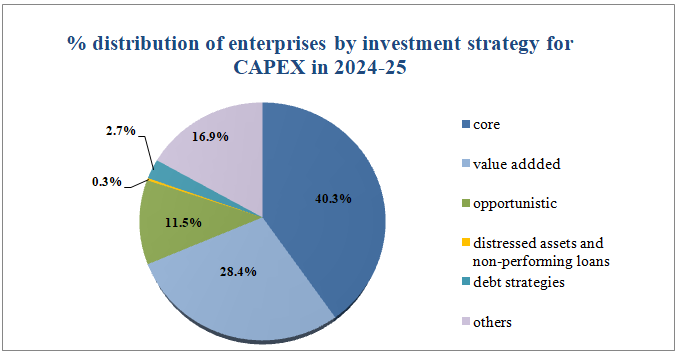
  • The strategy of 40.3% of enterprises is to undertake CAPEX on core assets during 2024–25, followed by 28.4% to invest in value addition to existing assets

Survey Background:

In 2022–23, the Parliamentary Standing Committee recommended that the Ministry of Statistics and Programme Implementation (MoSPI) develop a comprehensive methodology to capture capital expenditure (CAPEX) data from the private sector. Survey instruments designed to capture data on past investments, projected CAPEX for the next two years, and the breakdown of investments by asset type were developed in alignment with the specifications of the Department of Economic Affairs (DEA), Ministry of Finance.

Responding to this recommendation, the National Statistical Office (NSO) conducted the inaugural Forward-Looking Survey on Private Sector CAPEX Investment Intentions between November 2024 and January 2025. This marked the first initiative of MoSPI to engage the corporate sector through a self-administered, web-based survey platform, supported by chatbot assistance, to collect structured CAPEX data. MoSPI has released the findings of the survey in the form of a comprehensive booklet. A brief overview of key aspects, such as survey coverage, sampling methodology, and data collection process, is included in the Endnote.

The primary objective of the CAPEX survey is to estimate the CAPEX trends of private corporate sector enterprises from the past three financial years (2021-22, 2022-23 & 2023-24) along with anticipated capital expenditure for the current year (2024-25) and upcoming financial years (2025-26).

Key advantages of the Survey:

Capital expenditure (CAPEX) plays a crucial role in contributing to national investment and enhancing the stock of physical assets within the economy. It leads to the creation of long-term assets, which not only generate revenue for many years but also improve the overall operational efficiency of economic activities. CAPEX is fundamental to expanding production capacity, thereby serving as a catalyst for accelerated economic growth. This growth, in turn, supports job creation and enhances labour productivity.

Comprehensive data on CAPEX will be a valuable asset for a wide range of stakeholders, including government departments, private enterprises, trade associations, researchers, and other relevant entities. It will enable evidence-based policy formulation through the analysis of trends in future investments. Furthermore, a clear understanding of CAPEX patterns and scale can assist enterprises in making strategic, data-driven investment decisions, guided by the insights derived from survey findings.

Important Caveat:

In this inaugural edition of the survey, industry participation varied, with an overall response rate of 58.3% (58.6% in the census sector and 57.2% in the sample sector). Respondents appeared cautious in disclosing CAPEX plans, often pending management approvals. Certain entities, such as Special Purpose Vehicles (SPVs) involved in infrastructure projects, were excluded from the survey frame as they report no turnover despite high CAPEX. Meanwhile, some included SPVs had no future investment plans due to project completion. As this is the first round of the survey, the findings may be seen as indicative and subject to refinement in future iterations. It is also important to note that the results reflect responses from larger enterprises above specified turnover thresholds and may not represent the entire private corporate sector. Users are advised to interpret the results keeping these limitations in mind.

Insights and Way Forward for Future Survey Conduct

The Forward-Looking Survey on Private Sector Capex Investment Intentions, the first of its kind by the NSO, was conducted under the Collection of Statistics Act, 2008. Notices were issued to selected enterprises, explaining the survey's objectives and assuring confidentiality. However, some enterprises questioned the legitimacy of notices containing portal credentials, leading to multiple cyber risk concerns. Explaining portal usage and submission procedures over the phone was challenging. Data analysis revealed issues such as incorrect unit entries (e.g., Rupees instead of Rupees thousands) and non-responses to follow-up queries. Enterprises also faced difficulties in selecting correct NIC codes and estimating future investments when official data was unavailable.

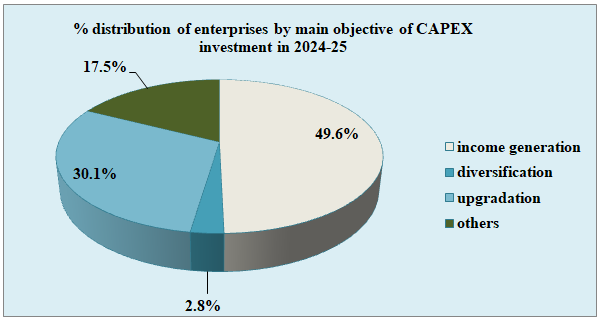
CAPEX tends to rise when enterprises pursue growth strategies rather than maintain current operations. Despite challenges like weak demand, geopolitical tensions, and high borrowing costs, about 30% of firms plan to invest in upgradation in 2024–25, supporting the sharp increase in CAPEX for that year. The slightly lower intended CAPEX for 2025–26, though still above 2023–24 levels, reflects cautious planning after a strong 2024–25. Overall, the trend indicates growing corporate confidence and a judicious approach to investment amid improving economic certainty.

While the response rate and results were generally promising, this initial round of the survey can be considered as an experimental phase, providing valuable insights to refine the questionnaire, methodology, estimation processes, and overall implementation. The lessons learned will guide improvements for future surveys, with necessary adjustments to various aspects of the survey process. Moving forward, responding enterprises will be engaged more proactively before the survey, with concerns about the authenticity of the online survey being addressed, assistance provided in understanding the questionnaire, confidentiality of individual responses ensured, and field personnel deployed to support enterprises in overcoming technical and conceptual challenges in completing future-oriented surveys. Additionally, the survey will incorporate qualitative inputs, such as reasons for year-on-year changes in investment, to gain deeper insights into enterprise-level CAPEX intentions and trends. The next round of the CAPEX survey is expected to be conducted during October to December 2025.

Key highlights from the CAPEX results:

Aggregated (Unweighted, i.e. without applying any multiplier) CAPEX during (2021-22 to 2025-26)

A total of 2,172 enterprises submitted complete information for all five years of the reference period, forming a fixed panel. The aggregated (unweighted) CAPEX data from this panel of enterprises serves as a reliable basis for analyzing capital expenditure trends over the five-year period, as presented below. The results show an overall increase of 66.3% in aggregate CAPEX (unweighted) over the four-year period from 2021-22 to 2024-25.:

                (in ₹ Crore)

Actual CAPEX in 2021-22

Actual CAPEX

2022-23

Actual CAPEX

2023-24

Intended CAPEX in

2024-25

Intended CAPEX

in 2025-26

394,681.5

572,199.7

422,183.3

656,492.7

488,865.5

Out of the 3,064 responding enterprises, 2,172 reported their Capex intentions for 2025–26. The data indicates a cautious approach by respondents in declaring their capital expenditure plans. Therefore, the Capex data for 2025–26 should be interpreted with caution, considering the conservative approach and apprehension shown by the responding enterprises in reporting these figures. However, the results show an overall increase of 23.9% in aggregate CAPEX (unweighted) during 2021-22 to 2025-26 for this fixed panel of 2,172 enterprises.

Estimated Key Indicators for past years (2021-22 to 2023-24) by Industry of Activity as per National Industry of Classification (Activity Categories)

The average Gross Fixed Asset (GFA) per enterprise in the private corporate sector was estimated at ₹3,151.9 crore in 2021–22. It increased by 4.0% to ₹3,279.4 crores in 2022–23, and further grew by 27.5% to reach ₹4,183.3 crore in 2023–24.

The highest GFA per enterprise, exceeding ₹14,000 crore, was observed in the industry category ‘Electricity, Gas, Steam, and Air Conditioning Supply’, followed by ‘Manufacturing” enterprises (₹7,000 crore to ₹10,000 crore). Enterprises principally engaged in manufacturing activities accounted for more than 65% of the total Gross fixed asset[1] in private corporate sector over the past three years from 2021-22 to 2023-24 followed by enterprises engaged in ‘Electricity, Gas, Steam, and Air Conditioning Supply’ (8%-10%).

In 2021–22, the estimated actual CAPEX per enterprise was ₹109.3 crore, compared to the proposed value of ₹102.7 crore, resulting in a realisation ratio of 106.41 %. A similar trend was observed in 2022–23, where the estimated value of actual CAPEX per enterprise reached ₹148.8 crore against a proposed value of ₹133.3 crore, also yielding a realisation ratio exceeding 100%. For 2023–24, the realisation ratio stands at 99.7%, with the estimated actual CAPEX per enterprise at ₹107.6 and the proposed CAPEX at ₹107.9.

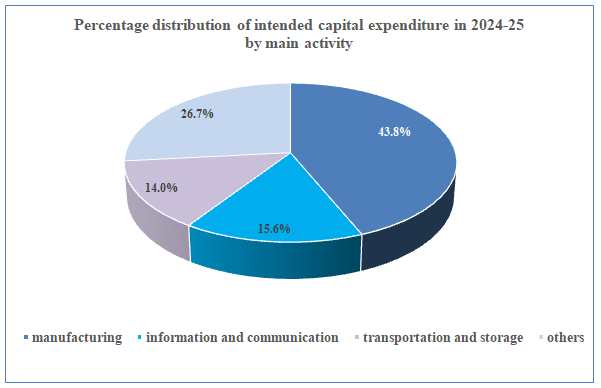
The estimated provisional capital expenditure per enterprise for acquiring new assets in 2024–25 stands at ₹172.2 crore. Among the sectors, manufacturing enterprises account for the largest share at 43.8%, followed by those in ‘Information and Communication Activities’ (15.6%) and ‘Transportation and Storage Activities’ (14.0%).
Estimated Key Indicators for 2023-24 by Asset Groups

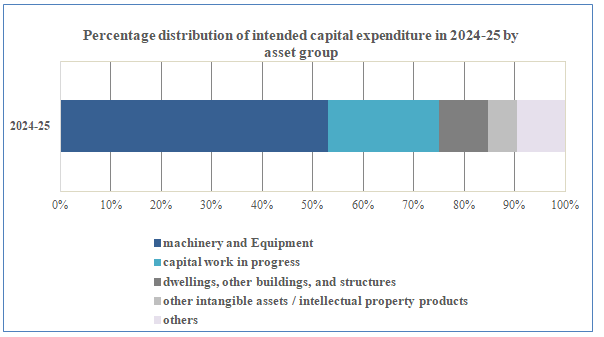
The estimated provisional capital expenditure per enterprise for acquiring new assets in 2024–25 stands at ₹172.2 crore. Out of the total capital expenditure provisionally incurred in the year 2024-25, nearly 53.1% were utilized for purchasing machinery & equipment. The amount allocated for ‘capital work in progress’ (22.0%) and purchasing ‘dwellings, other buildings and structures’ (9.7%) had the next highest share of allocation.
Strategy of CAPEX in 2024-25

According to survey estimates, nearly 40.3% of enterprises plan to undertake CAPEX on core assets during 2024–25. Additionally, 28.4% intend to invest in value addition to existing assets, while around 11.5% focus on opportunistic assets, and 2.7% on debt strategies. The strategy of investing in distressed assets and non-performing loans was adopted by less than one-half of a percent of enterprises. Meanwhile, about 16.9% allocated their CAPEX towards other diverse investment strategies.
Objectives of CAPEX in 2024-25

The survey estimates indicate that nearly 49.6% of private corporate sector enterprises undertook CAPEX in 2024–25 primarily for income generation. An additional 30.1% directed their investments toward upgradation, while around 2.8% focused on diversification. Remaining 17.5% of enterprises reported using their CAPEX for other reasons.
The results of CAPEX survey are provided in the booklet which is available in the website of the Ministry (https://www.mospi.gov.in). To protect the confidentiality of CAPEX investment plans of individual enterprises, the Steering Committee of NSS Surveys recommended that unit-level data of CAPEX survey would not be disseminated.

Endnote: A brief about the coverage, sampling scheme, sample size and data collection mechanism in the Forward-Looking Survey on Private Sector CAPEX Investment Intentions:

A. Coverage:

The survey covered large private corporate sector enterprises that play a significant role in their respective sectors. The sampling frame was madeusing data from active enterprises registered with the Ministry of Corporate Affairs (MCA), filtered based on annual turnover thresholds achieved in at least one of the last three financial years. The eligibility criteria were as follows:

  • Manufacturing enterprises with an annual turnover of ₹400 crore or more
  • Trade enterprises with an annual turnover of ₹300 crore or more
  • Other enterprises with an annual turnover of ₹100 crore or more

Based on these criteria, the final survey frame consisted of 16,025 enterprises.

B. Sampling Scheme:

Eligible enterprises were initially categorized into seventeen (17) strata based on their Principal Business Activity as reported in the MGT-7 Form of the Ministry of Corporate Affairs (MCA). In strata with 100 or fewer enterprises, all units were included in the Census Sector for complete enumeration.

For strata with more than 100 enterprises, the selection process involved identifying Census Sector Enterprises and Sample Sector Enterprises. To determine the Census Sector, enterprises were ranked in descending order based on (i) the highest fixed asset value in the past three years and (ii) the fixed asset value of latest reported year. The top enterprises accounting for 90% of asset value (or 80% for Construction and Trade) from either list were classified as Census Sector Enterprises. The remaining units formed the Sample Sector, from which 10% were randomly selected using Simple Random Sampling without Replacement (SRSWOR), with allocation proportional to each stratum’s size and variation.

C. Sample Size:

The sample size for the survey was of 5,380 enterprises: 4,145 enterprises in the Census Sector and 1,235 enterprises in sample sector.

DData Collection Mechanism:

The survey was conducted under the provisions of the Collection of Statistics Act, 2008, with prior notices sent to all selected enterprises outlining the survey’s objective and intended use of the data. Confidentiality of individual responses was strictly maintained, and no unit-level data would be disseminated. A secure, dedicated web portal was developed to enable selected enterprises to complete and submit the survey questionnaire online. The portal included background information on the survey, reasons for a unit’s selection, and chatbot support to assist respondents in understanding key concepts and definitions.

Topics

Acts Income Tax