

Loading...

Top
Help
×

By creating an account you can:

Logo TaxTMI
Call Us / Help / Feedback

Contact Us At :

E-mail: [email protected]

Call / WhatsApp at: +91 99117 96707

For more information, Check Contact Us

FAQs :

To know Frequently Asked Questions, Check FAQs

Most Asked Video Tutorials :

For more tutorials, Check Video Tutorials

Submit Feedback/Suggestion :

Email :
Please provide your email address so we can follow up on your feedback.
Category :
Description :
Min 15 characters 0/2000
Make Most of Text Search
  1. Checkout this video tutorial: How to search effectively on TaxTMI.
  2. Put words in double quotes for exact word search, eg: "income tax"
  3. Avoid noise words such as : 'and, of, the, a'
  4. Sort by Relevance to get the most relevant document.
  5. Press Enter to add multiple terms/multiple phrases, and then click on Search to Search.
  6. Text Search
  7. The system will try to fetch results that contains ALL your words.
  8. Once you add keywords, you'll see a new 'Search In' filter that makes your results even more precise.
  9. Text Search
Add to...
You have not created any category. Kindly create one to bookmark this item!
Create New Category
Hide
Title :
Description :
❮❮ Hide
Default View
Expand ❯❯
Close ✕
🔎 News - Adv. Search
TEXT SEARCH:

Press 'Enter' to add multiple search terms. Rules for Better Search

Search In:
Main Text + AI Text
  • Main Text
  • Main Text + AI Text
  • AI Text
Category: ?
Categorized by AI
---- All Categories ----
  • ---- All Categories ----
  • Income Tax
  • GST
  • Customs, DGFT & SEZ
  • FEMA & RBI
  • Corp. Laws, SEBI & IBC
  • PMLA, Black Money & ED
  • Budget
  • News and Press Release
  • PTI News
Month:
---- All Months ----
  • ---- All Months ----
  • January
  • February
  • March
  • April
  • May
  • June
  • July
  • August
  • September
  • October
  • November
  • December
Year:
---- All Years ----
  • ---- All Years ----
  • 2026
  • 2025
  • 2024
  • 2023
  • 2022
  • 2021
  • 2020
  • 2019
  • 2018
  • 2017
  • 2016
  • 2015
  • 2014
  • 2013
  • 2012
  • 2011
Sort By: ?
In Sort By 'Default', exact matches for text search are shown at the top, followed by the remaining results in their regular order.
Relevance Default Date
    US economy grows a sluggish 1.5% second-quarter with inflation remaining stubbornly high
    Gold rises Rs 1,000 to Rs 1.48 lakh/10g on fresh retail buying
    DFS Launches Protection & Indemnity Insurance Product under Bharat Maritime Insurance Pool (BMIP)
    Investec Selects Infosys Finacle SaaS Platform on Microsoft Azure for Digital Banking Transformation
    Kotak Securities Earns Great Place to Work® Certification and Recognition Among India's Best Workplaces™ in Investments 2026
    India rises from 82nd to 57th in global rankings, in structural and pro-competitive reforms: Report by Competere Foundation
    Aadhaar enrolment in Manipur has reached 87-88 pc: Officials
    IndoStar Capital Finance Limited Q1FY27 Disbursements ₹ 1,235 crore up 44% vis-à-vis Q1FY26
    Global gold demand flat at 1,269 tonnes in June quarter, says WGC
    MCD to launch 5-year PPP policy to modernise school stadiums, offer free sports coaching
    Piramal Pharma Limited Announces Results for Q1 FY27
    Advisory on Keeping on Hold the Proposed e-Way Bill Enhancements
    Innovation, Startups, MSMEs and Quality Manufacturing are Pillars of India's Future Growth: Shri Piyush Goyal at 22nd J.R.D. Tata Memorial Lecture
    UP ATS nabs kingpin of fake document racket from West Bengal
    Calcutta HC says voter ID, Aadhaar, PAN not proof of Indian citizenship
    Corporate Mitra Scheme Awareness Webinar organized by IICA Shillong, Ministry of Corporate Affairs witnessing overwhelming participation of youth and ...
    CCI approves amalgamation of Go Digit Infoworks Services, holding company of Go Digit General Insurance Ltd, with Go Digit General Insurance Ltd, such...
    CCI approves acquisition of units of Oaktree capital group Holdings, L.P. (OCGH), and Oaktree Equity Plan, L.P. (OEP) by Brookfield Asset Management L...
    Assam Exports First International Consignment of Purabi Ice Cream to Bhutan
    Building Deep and Resilient Financial Markets for a Viksit Bharat - Keynote Address delivered by Shri Rohit Jain, Deputy Governor at the Financial Ins...
❯❯
Maximize Maximize Maximize
0 / 200
Expand Note
Add to Folder

No Folders have been created

+

Are you sure you want to delete "My most important" ?

NOTE:

News
Showing Results for :
Reset Filters
Results Found:
Show All Summaries Hide All Summaries
July 30, 2026
Show AI Summary
Economic growth and persistent inflation shaped slower output, import pressures, and continued interest-rate restraint despite resilient consumer spending.
United States economic growth slowed in the second quarter as increased imports reduced gross domestic product growth, despite stronger consumer spending and business investment linked to artificial intelligence. The preferred inflation measure moderated but remained above the central bank's target, with core consumer prices showing limited change. The benchmark interest rate was retained for a fifth consecutive meeting, though some regional presidents supported an increase to address elevated inflation. Employment growth and consumer spending continued to support economic resilience amid high living costs and energy-price pressures.
July 30, 2026
Show AI Summary
Gold market volatility reflects retail buying, global price trends, currency movements, and weaker domestic demand linked to higher customs duty.
Gold prices rose on fresh buying by jewellers and retailers amid firm international trends, while silver prices declined. Improved domestic demand and a pullback in the US dollar supported gold, though a stronger rupee limited further gains. India's gold demand declined year-on-year during April-June, attributed to seasonally subdued sales, higher customs duty and an appeal to reduce purchases. Global gold demand remained broadly unchanged, while precious metals were expected to remain volatile and range-bound.
July 30, 2026
Show AI Summary
Protection and indemnity insurance expands domestic maritime risk coverage for third-party liabilities and strengthens self-reliant insurance capacity.
Bharat Maritime Insurance Pool has introduced a sovereign-backed Protection & Indemnity insurance product to cover third-party maritime liabilities, including crew and cargo claims, pollution liability and wreck removal. The product expands the pool beyond cargo and hull war-risk coverage and is supported by combined indemnity capacity and a port-correspondent network. The pool is intended to maintain uninterrupted maritime war-risk insurance, build domestic underwriting capacity, strengthen maritime risk management, reduce foreign-market dependence and promote self-reliance in specialised insurance solutions.
July 30, 2026
Show AI Summary
Cloud-native digital banking transformation integrates lending, cash management and liquidity tools while supporting scalable, resilient and compliant operations.
Digital banking transformation through a cloud-native software-as-a-service platform entails migration from legacy systems to integrated deposits, lending, virtual account management and liquidity-management capabilities. Real-time data, artificial intelligence foundations, open APIs and event-driven architecture are intended to support digital banking products, corporate cash management and operational agility. Liquidity tools are designed to provide visibility and control over cash positions and working capital. The implementation is intended to deliver scalability, resilience, security and high availability while assisting regulatory compliance; projected benefits remain subject to risks and uncertainties.
July 30, 2026
Show AI Summary
Workplace culture recognition highlights continued investment in employee wellbeing, inclusion, learning, collaboration and growth at a stockbroking firm.
Workplace culture recognition was awarded to Kotak Securities through Great Place to Work Certification for a second consecutive year and inclusion among India's Best Workplaces in Investments 2026. The recognition followed assessment of employee feedback, workplace practices and organisational culture, reflecting employee trust, engagement and belonging. The company states that it will continue initiatives supporting employee wellbeing, learning and development, inclusion, collaboration and growth.
July 30, 2026
Show AI Summary
Pro-competitive reforms strengthen market conditions through competition policy, investment review, trade facilitation, and reduced international regulatory barriers.
Structural and pro-competitive reforms between 2010 and 2023 are assessed as reducing market distortions and strengthening competitiveness. The assessment covers property-rights protection, domestic competition and international competition, including the Goods and Services Tax, Insolvency and Bankruptcy Code, regulatory improvements and trade-facilitation modernisation. Further priorities include evidence-based competition policy, consumer-welfare review of sector-specific investment restrictions, and cooperation to address international regulatory barriers.
July 30, 2026
Show AI Summary
Aadhaar enrolment access expands through a new service centre, with coordinated efforts focused on improving young children's coverage.
Aadhaar enrolment in Manipur has reached approximately 87-88 per cent, with comparatively lower coverage among children aged 0-5 years. The first Aadhaar Seva Kendra in Imphal has been inaugurated to expand access to enrolment and Aadhaar-related services. The State Government is coordinating with welfare and health departments, hospitals and UIDAI to improve young children's enrolment, alongside services available through Deputy Commissioners' offices and authorised enrolment centres.
July 30, 2026
Show AI Summary
Secured retail lending growth accompanied enhanced credit controls, digital lending processes, and branch expansion by a middle-layer non-banking finance company.
IndoStar Capital Finance Limited, a middle-layer non-banking finance company registered with the Reserve Bank of India, reported growth in secured used-vehicle finance and micro loans against property for the quarter ended June 30, 2026. It reported higher disbursements, assets under management and net interest income, alongside a lower weighted average cost of funds. The company also stated that it strengthened underwriting, customer-selection filters, scorecards and early-warning systems, while advancing electronic lending processes and expanding its branch and micro-loans-against-property network.
July 30, 2026
Show AI Summary
Gold demand trends show central bank buying and OTC investment offsetting weaker ETF and jewellery demand.
Global gold demand remained broadly unchanged during the April-June quarter, with reduced gold exchange-traded fund, bar and coin investment offset in part by over-the-counter investment supported by Asian investors. Central banks and official institutions increased net additions to gold reserves, while high prices reduced jewellery volumes and encouraged demand for lighter products. Total supply was unchanged as increased mine production was offset by lower recycling. Investment is expected to drive future demand, while high prices may continue to constrain jewellery demand and recycling.
July 30, 2026
Show AI Summary
Sports infrastructure PPP framework enables private stadium operation while requiring free coaching, child protection compliance, and student performance tracking.
The PPP framework permits private operators to modernise, operate and maintain school sports stadiums at their own cost, while providing free organised sports training to enrolled students. Operators may commercially offer paid coaching and facilities to external users outside school hours, subject to student-related obligations. Selection is based on technical eligibility and detailed evaluation of sports, PPP, operational and technology capabilities. Agreements have an initial five-year term, with possible extension based on performance, mutual consent and public interest. Child-protection compliance, bank-routed transactions and disqualification for insolvency or statutory and child-safety violations apply.
July 30, 2026
Show AI Summary
Quarterly financial reporting highlights operational growth, FDA inspection compliance, product integration, and prior insolvency proceeds in pharmaceutical operations.
Quarterly financial reporting records revenue growth and improved EBITDA performance across CDMO, Complex Hospital Generics and Consumer Healthcare operations. CDMO growth was linked to order inflows, higher capacity utilisation, pricing discipline and commercial expansion, while quality compliance included an Establishment Inspection Report for the Sellersville facility and continued Zero Official Action Indicated status. The prior-year exceptional item related to one-time insolvency proceeds from a supplier claim filed before the NCLT. Consumer Healthcare growth was attributed to power brands, e-commerce, premiumisation, pricing and cost optimisation.
July 30, 2026
Show AI Summary
Proposed e-Way Bill enhancements remain on hold, with no production changes required pending further communication.
Proposed e-Way Bill enhancements have been kept on hold until further notice. Stakeholders are not required to make production-environment changes pursuant to the earlier advisories concerning those enhancements. The related advisories and FAQs are to be withdrawn from the GST Portal pending further communication.
July 30, 2026
Show AI Summary
Innovation-led industrial growth promotes deep-tech investment, startup commercialisation, technology-enabled MSMEs, quality manufacturing and global market expansion.
Innovation-led industrial growth is linked to deep technology, research and development, skilled manpower, startups, MSMEs and globally competitive manufacturing. Public initiatives include long-term risk capital for emerging technologies, affordable computing capacity and semiconductor investment support. Startups are encouraged to move from prototypes to commercialisation through industry adoption and early domestic investment. Manufacturing and MSME policy emphasise technology adoption, automation, productivity, branding and uncompromising quality. Free Trade Agreements are presented as supporting global market access and export expansion.
July 29, 2026
Show AI Summary
Fraudulent Aadhaar enrolment allegations involve forged supporting documents, misuse of operator credentials, remote access, and continuing investigation.
Forgery of Indian identity and supporting documents is alleged in an interstate racket using false birth, domicile and school certificates to obtain Aadhaar cards for foreign nationals. The racket allegedly misused authorised Aadhaar enrolment operator login credentials and used virtual private networks and remote access to enrol applicants. The alleged mastermind was arrested, and investigation, including proposed custodial interrogation, remains ongoing.
July 29, 2026
Show AI Summary
Citizenship proof requires more than identity, tax, electoral or banking records when nationality remains unestablished.
Voter identity cards, Aadhaar cards, PAN cards and bank-account records were treated as non-conclusive proof of Indian citizenship. The petitioner and detainee were required to establish citizenship under the Immigration and Foreigners Act, 2025, and an appeal against deletion from electoral rolls did not itself satisfy that burden. The inability to identify the burial locations of the detainee's parents prevented proposed DNA-based verification and supported an adverse inference concerning their citizenship.
July 29, 2026
Show AI Summary
Corporate Mitra Scheme builds local compliance professionals to strengthen MSME regulatory, financial, taxation, accounting and governance support.
The Corporate Mitra Scheme develops qualified and accredited para-professionals to provide MSMEs with accessible, affordable compliance and business-support services. Corporate Mitras are intended to assist enterprises with regulatory compliance, finance, taxation, accounting and governance-related requirements, enabling MSMEs to focus on innovation, expansion and growth. IICA Shillong serves as the nodal agency for Northeast regional coordination, stakeholder liaison, promotion and awareness, with regional participation encouraged through reserved course seats and a fee concession.
July 29, 2026
Show AI Summary
Amalgamation of Go Digit Infoworks with Go Digit General Insurance approved, with the general insurer continuing as surviving entity.
The Competition Commission of India approved the amalgamation of Go Digit Infoworks Services Private Limited, the holding company of Go Digit General Insurance Limited, with Go Digit General Insurance Limited as the surviving entity. Infoworks has no present market-facing business activities. Go Digit General provides general and health insurance products and services in India, with a specialised focus on general insurance.
July 29, 2026
Show AI Summary
Competition approval enables Brookfield's indirect acquisition of Oaktree entities, combining alternative investment management businesses.
Competition approval was granted for Brookfield Asset Management Ltd. to indirectly acquire units in Oaktree Capital Group Holdings, L.P. and Oaktree Equity Plan, L.P., resulting in the acquisition of the Oaktree operating group of entities. Brookfield Asset Management is a global alternative asset manager, while the Oaktree group provides alternative investment management services.
July 29, 2026
Show AI Summary
Processed dairy exports to Bhutan expand through compliance support, market access facilitation, and planned diversification of longer-shelf-life products.
Processed dairy exports from Assam to Bhutan commenced with a Purabi Ice Cream consignment exported by North East Dairy and Foods Limited and manufactured through Assam's cooperative dairy network. The Agricultural and Processed Food Products Export Development Authority supported export documentation, regulatory compliance, market access and stakeholder coordination. The initiative seeks to expand value-added dairy exports from the North Eastern Region, with plans to introduce longer-shelf-life products and increase exports according to market demand.
July 29, 2026
Show AI Summary
Financial-market depth requires reliable liquidity, risk transfer, transparent products and shared institutional responsibility for resilient long-term financing.
Financial-market depth requires reliable liquidity and price discovery, efficient risk distribution, and diverse, meaningful participation across market conditions. Government and corporate bond markets, money markets, and foreign exchange and derivative markets should channel long-term savings into investment and enable management of interest-rate, currency and credit risks. Product innovation must serve genuine needs and be supported by suitability assessments, transparent disclosure, fair pricing, independent valuation and user risk-management capacity. Regulators, market institutions, issuers, investors and infrastructure providers share responsibility for resilient, transparent and trusted markets.

News

Back

All News

Showing Results for :
Reset Filters
No Records Found

News

Back

All News

Showing Results for : Reset Filters

Findings of the Forward-Looking Survey on Private Sector CAPEX Investment Intentions (Survey period: November 2024 to January 2025)

April 30, 2025

Contents
Summary
Note

Note

-

Bookmark

Print

Print

Private Corporate Sector CAPEX: Three-Year Trends and Future Outlook:

Key findings:

  • The average Gross Fixed Assets per enterprise in the private corporate sector increased from ₹3,151.9 crore in 2021–22 to ₹3,279.4 crore in 2022–23 (4% growth), and further to ₹4,183.3 crore in 2023–24, reflecting a significant 27.5% growth.
  • The estimated CAPEX per enterprise for the years 2021–22, 2022–23, and 2023–24 was ₹109.2 crore, ₹148.8 crore and ₹107.6 crore respectively.
  • The estimated provisional capital expenditure per enterprise for purchasing new assets in 2024–25 is ₹172.2 crore.
  • Overall increase of 66.3% in aggregate CAPEX (unweighted) over the four-year period from 2021-22 to 2024-25.
  • The strategy of 40.3% of enterprises is to undertake CAPEX on core assets during 2024–25, followed by 28.4% to invest in value addition to existing assets

Survey Background:

In 2022–23, the Parliamentary Standing Committee recommended that the Ministry of Statistics and Programme Implementation (MoSPI) develop a comprehensive methodology to capture capital expenditure (CAPEX) data from the private sector. Survey instruments designed to capture data on past investments, projected CAPEX for the next two years, and the breakdown of investments by asset type were developed in alignment with the specifications of the Department of Economic Affairs (DEA), Ministry of Finance.

Responding to this recommendation, the National Statistical Office (NSO) conducted the inaugural Forward-Looking Survey on Private Sector CAPEX Investment Intentions between November 2024 and January 2025. This marked the first initiative of MoSPI to engage the corporate sector through a self-administered, web-based survey platform, supported by chatbot assistance, to collect structured CAPEX data. MoSPI has released the findings of the survey in the form of a comprehensive booklet. A brief overview of key aspects, such as survey coverage, sampling methodology, and data collection process, is included in the Endnote.

The primary objective of the CAPEX survey is to estimate the CAPEX trends of private corporate sector enterprises from the past three financial years (2021-22, 2022-23 & 2023-24) along with anticipated capital expenditure for the current year (2024-25) and upcoming financial years (2025-26).

Key advantages of the Survey:

Capital expenditure (CAPEX) plays a crucial role in contributing to national investment and enhancing the stock of physical assets within the economy. It leads to the creation of long-term assets, which not only generate revenue for many years but also improve the overall operational efficiency of economic activities. CAPEX is fundamental to expanding production capacity, thereby serving as a catalyst for accelerated economic growth. This growth, in turn, supports job creation and enhances labour productivity.

Comprehensive data on CAPEX will be a valuable asset for a wide range of stakeholders, including government departments, private enterprises, trade associations, researchers, and other relevant entities. It will enable evidence-based policy formulation through the analysis of trends in future investments. Furthermore, a clear understanding of CAPEX patterns and scale can assist enterprises in making strategic, data-driven investment decisions, guided by the insights derived from survey findings.

Important Caveat:

In this inaugural edition of the survey, industry participation varied, with an overall response rate of 58.3% (58.6% in the census sector and 57.2% in the sample sector). Respondents appeared cautious in disclosing CAPEX plans, often pending management approvals. Certain entities, such as Special Purpose Vehicles (SPVs) involved in infrastructure projects, were excluded from the survey frame as they report no turnover despite high CAPEX. Meanwhile, some included SPVs had no future investment plans due to project completion. As this is the first round of the survey, the findings may be seen as indicative and subject to refinement in future iterations. It is also important to note that the results reflect responses from larger enterprises above specified turnover thresholds and may not represent the entire private corporate sector. Users are advised to interpret the results keeping these limitations in mind.

Insights and Way Forward for Future Survey Conduct

The Forward-Looking Survey on Private Sector Capex Investment Intentions, the first of its kind by the NSO, was conducted under the Collection of Statistics Act, 2008. Notices were issued to selected enterprises, explaining the survey's objectives and assuring confidentiality. However, some enterprises questioned the legitimacy of notices containing portal credentials, leading to multiple cyber risk concerns. Explaining portal usage and submission procedures over the phone was challenging. Data analysis revealed issues such as incorrect unit entries (e.g., Rupees instead of Rupees thousands) and non-responses to follow-up queries. Enterprises also faced difficulties in selecting correct NIC codes and estimating future investments when official data was unavailable.

CAPEX tends to rise when enterprises pursue growth strategies rather than maintain current operations. Despite challenges like weak demand, geopolitical tensions, and high borrowing costs, about 30% of firms plan to invest in upgradation in 2024–25, supporting the sharp increase in CAPEX for that year. The slightly lower intended CAPEX for 2025–26, though still above 2023–24 levels, reflects cautious planning after a strong 2024–25. Overall, the trend indicates growing corporate confidence and a judicious approach to investment amid improving economic certainty.

While the response rate and results were generally promising, this initial round of the survey can be considered as an experimental phase, providing valuable insights to refine the questionnaire, methodology, estimation processes, and overall implementation. The lessons learned will guide improvements for future surveys, with necessary adjustments to various aspects of the survey process. Moving forward, responding enterprises will be engaged more proactively before the survey, with concerns about the authenticity of the online survey being addressed, assistance provided in understanding the questionnaire, confidentiality of individual responses ensured, and field personnel deployed to support enterprises in overcoming technical and conceptual challenges in completing future-oriented surveys. Additionally, the survey will incorporate qualitative inputs, such as reasons for year-on-year changes in investment, to gain deeper insights into enterprise-level CAPEX intentions and trends. The next round of the CAPEX survey is expected to be conducted during October to December 2025.

Key highlights from the CAPEX results:

Aggregated (Unweighted, i.e. without applying any multiplier) CAPEX during (2021-22 to 2025-26)

A total of 2,172 enterprises submitted complete information for all five years of the reference period, forming a fixed panel. The aggregated (unweighted) CAPEX data from this panel of enterprises serves as a reliable basis for analyzing capital expenditure trends over the five-year period, as presented below. The results show an overall increase of 66.3% in aggregate CAPEX (unweighted) over the four-year period from 2021-22 to 2024-25.:

                (in ₹ Crore)

Actual CAPEX in 2021-22

Actual CAPEX

2022-23

Actual CAPEX

2023-24

Intended CAPEX in

2024-25

Intended CAPEX

in 2025-26

394,681.5

572,199.7

422,183.3

656,492.7

488,865.5

Out of the 3,064 responding enterprises, 2,172 reported their Capex intentions for 2025–26. The data indicates a cautious approach by respondents in declaring their capital expenditure plans. Therefore, the Capex data for 2025–26 should be interpreted with caution, considering the conservative approach and apprehension shown by the responding enterprises in reporting these figures. However, the results show an overall increase of 23.9% in aggregate CAPEX (unweighted) during 2021-22 to 2025-26 for this fixed panel of 2,172 enterprises.

Estimated Key Indicators for past years (2021-22 to 2023-24) by Industry of Activity as per National Industry of Classification (Activity Categories)

The average Gross Fixed Asset (GFA) per enterprise in the private corporate sector was estimated at ₹3,151.9 crore in 2021–22. It increased by 4.0% to ₹3,279.4 crores in 2022–23, and further grew by 27.5% to reach ₹4,183.3 crore in 2023–24.

The highest GFA per enterprise, exceeding ₹14,000 crore, was observed in the industry category ‘Electricity, Gas, Steam, and Air Conditioning Supply’, followed by ‘Manufacturing” enterprises (₹7,000 crore to ₹10,000 crore). Enterprises principally engaged in manufacturing activities accounted for more than 65% of the total Gross fixed asset[1] in private corporate sector over the past three years from 2021-22 to 2023-24 followed by enterprises engaged in ‘Electricity, Gas, Steam, and Air Conditioning Supply’ (8%-10%).

In 2021–22, the estimated actual CAPEX per enterprise was ₹109.3 crore, compared to the proposed value of ₹102.7 crore, resulting in a realisation ratio of 106.41 %. A similar trend was observed in 2022–23, where the estimated value of actual CAPEX per enterprise reached ₹148.8 crore against a proposed value of ₹133.3 crore, also yielding a realisation ratio exceeding 100%. For 2023–24, the realisation ratio stands at 99.7%, with the estimated actual CAPEX per enterprise at ₹107.6 and the proposed CAPEX at ₹107.9.

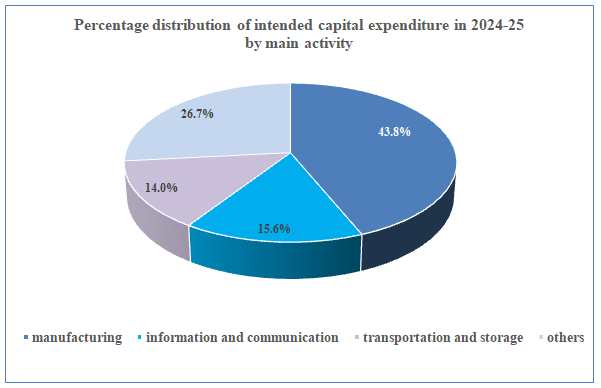
The estimated provisional capital expenditure per enterprise for acquiring new assets in 2024–25 stands at ₹172.2 crore. Among the sectors, manufacturing enterprises account for the largest share at 43.8%, followed by those in ‘Information and Communication Activities’ (15.6%) and ‘Transportation and Storage Activities’ (14.0%).
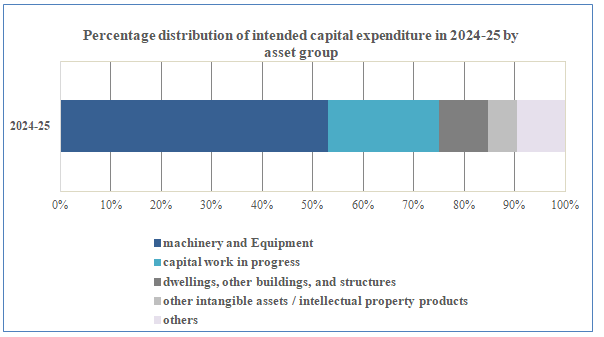
Estimated Key Indicators for 2023-24 by Asset Groups

The estimated provisional capital expenditure per enterprise for acquiring new assets in 2024–25 stands at ₹172.2 crore. Out of the total capital expenditure provisionally incurred in the year 2024-25, nearly 53.1% were utilized for purchasing machinery & equipment. The amount allocated for ‘capital work in progress’ (22.0%) and purchasing ‘dwellings, other buildings and structures’ (9.7%) had the next highest share of allocation.
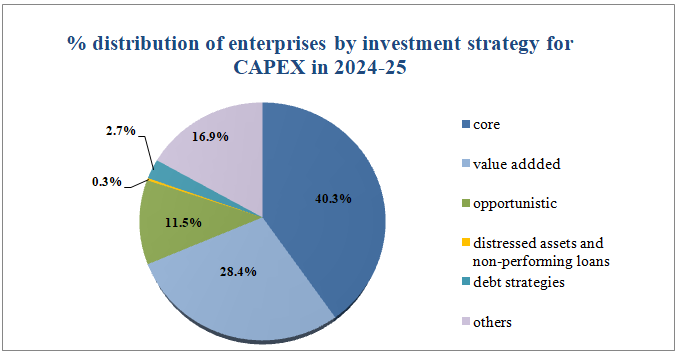
Strategy of CAPEX in 2024-25

According to survey estimates, nearly 40.3% of enterprises plan to undertake CAPEX on core assets during 2024–25. Additionally, 28.4% intend to invest in value addition to existing assets, while around 11.5% focus on opportunistic assets, and 2.7% on debt strategies. The strategy of investing in distressed assets and non-performing loans was adopted by less than one-half of a percent of enterprises. Meanwhile, about 16.9% allocated their CAPEX towards other diverse investment strategies.
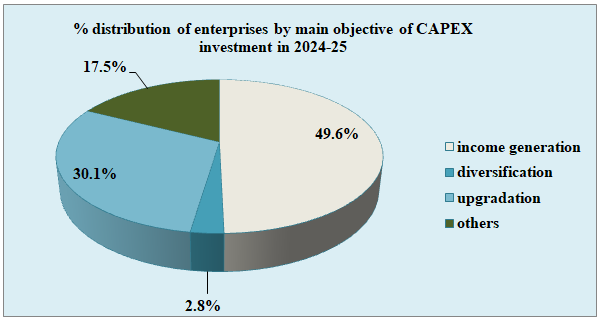
Objectives of CAPEX in 2024-25

The survey estimates indicate that nearly 49.6% of private corporate sector enterprises undertook CAPEX in 2024–25 primarily for income generation. An additional 30.1% directed their investments toward upgradation, while around 2.8% focused on diversification. Remaining 17.5% of enterprises reported using their CAPEX for other reasons.
The results of CAPEX survey are provided in the booklet which is available in the website of the Ministry (https://www.mospi.gov.in). To protect the confidentiality of CAPEX investment plans of individual enterprises, the Steering Committee of NSS Surveys recommended that unit-level data of CAPEX survey would not be disseminated.

Endnote: A brief about the coverage, sampling scheme, sample size and data collection mechanism in the Forward-Looking Survey on Private Sector CAPEX Investment Intentions:

A. Coverage:

The survey covered large private corporate sector enterprises that play a significant role in their respective sectors. The sampling frame was madeusing data from active enterprises registered with the Ministry of Corporate Affairs (MCA), filtered based on annual turnover thresholds achieved in at least one of the last three financial years. The eligibility criteria were as follows:

  • Manufacturing enterprises with an annual turnover of ₹400 crore or more
  • Trade enterprises with an annual turnover of ₹300 crore or more
  • Other enterprises with an annual turnover of ₹100 crore or more

Based on these criteria, the final survey frame consisted of 16,025 enterprises.

B. Sampling Scheme:

Eligible enterprises were initially categorized into seventeen (17) strata based on their Principal Business Activity as reported in the MGT-7 Form of the Ministry of Corporate Affairs (MCA). In strata with 100 or fewer enterprises, all units were included in the Census Sector for complete enumeration.

For strata with more than 100 enterprises, the selection process involved identifying Census Sector Enterprises and Sample Sector Enterprises. To determine the Census Sector, enterprises were ranked in descending order based on (i) the highest fixed asset value in the past three years and (ii) the fixed asset value of latest reported year. The top enterprises accounting for 90% of asset value (or 80% for Construction and Trade) from either list were classified as Census Sector Enterprises. The remaining units formed the Sample Sector, from which 10% were randomly selected using Simple Random Sampling without Replacement (SRSWOR), with allocation proportional to each stratum’s size and variation.

C. Sample Size:

The sample size for the survey was of 5,380 enterprises: 4,145 enterprises in the Census Sector and 1,235 enterprises in sample sector.

DData Collection Mechanism:

The survey was conducted under the provisions of the Collection of Statistics Act, 2008, with prior notices sent to all selected enterprises outlining the survey’s objective and intended use of the data. Confidentiality of individual responses was strictly maintained, and no unit-level data would be disseminated. A secure, dedicated web portal was developed to enable selected enterprises to complete and submit the survey questionnaire online. The portal included background information on the survey, reasons for a unit’s selection, and chatbot support to assist respondents in understanding key concepts and definitions.

Topics

Acts Income Tax