

Loading...

Top
Help
×

By creating an account you can:

Logo TaxTMI
Call Us / Help / Feedback

Contact Us At :

E-mail: [email protected]

Call / WhatsApp at: +91 99117 96707

For more information, Check Contact Us

FAQs :

To know Frequently Asked Questions, Check FAQs

Most Asked Video Tutorials :

For more tutorials, Check Video Tutorials

Submit Feedback/Suggestion :

Email :
Please provide your email address so we can follow up on your feedback.
Category :
Description :
Min 15 characters 0/2000
Make Most of Text Search
  1. Checkout this video tutorial: How to search effectively on TaxTMI.
  2. Put words in double quotes for exact word search, eg: "income tax"
  3. Avoid noise words such as : 'and, of, the, a'
  4. Sort by Relevance to get the most relevant document.
  5. Press Enter to add multiple terms/multiple phrases, and then click on Search to Search.
  6. Text Search
  7. The system will try to fetch results that contains ALL your words.
  8. Once you add keywords, you'll see a new 'Search In' filter that makes your results even more precise.
  9. Text Search
Add to...
You have not created any category. Kindly create one to bookmark this item!
Create New Category
Hide
Title :
Description :
❮❮ Hide
Default View
Expand ❯❯
Close ✕
🔎 News - Adv. Search
TEXT SEARCH:

Press 'Enter' to add multiple search terms. Rules for Better Search

Search In:
Main Text + AI Text
  • Main Text
  • Main Text + AI Text
  • AI Text
Category: ?
Categorized by AI
---- All Categories ----
  • ---- All Categories ----
  • Income Tax
  • GST
  • Customs, DGFT & SEZ
  • FEMA & RBI
  • Corp. Laws, SEBI & IBC
  • PMLA, Black Money & ED
  • Budget
  • News and Press Release
  • PTI News
Month:
---- All Months ----
  • ---- All Months ----
  • January
  • February
  • March
  • April
  • May
  • June
  • July
  • August
  • September
  • October
  • November
  • December
Year:
---- All Years ----
  • ---- All Years ----
  • 2026
  • 2025
  • 2024
  • 2023
  • 2022
  • 2021
  • 2020
  • 2019
  • 2018
  • 2017
  • 2016
  • 2015
  • 2014
  • 2013
  • 2012
  • 2011
Sort By: ?
In Sort By 'Default', exact matches for text search are shown at the top, followed by the remaining results in their regular order.
Relevance Default Date
    Rupee gains 13 paise to close at 95.15 against US dollar post-RBI policy decision
    ED raids premises linked to ex-Andhra MLA Malla Vijaya Prasad in chit fund scam
    'Gungi gudiya' remark against Sunetra shows Cong's 'ideological bankruptcy': NCP leader Tatkare
    RBI holds interest rates for fourth straight meeting, awaits clearer inflation outlook
    Highlights of RBI's August monetary policy
    RBI targeting polymer currency notes launch in early FY28: Guv Malhotra
    Two women held at Delhi airport with 1 kg gold concealed as silver-coated armlet
    Sensex trades higher, Nifty flat post RBI policy
    India's services sector growth hits four-and-a-half-year low in July on weak demand: PMI
    SC grants interim bail to businessman Anwar Dhebar in manpower commission 'scam' case
    The Taxation and Other Laws Amendment Bill 2026 - Introduced in Lok Sabha on 4th August 2026
    RBI marginally raises FY27 GDP growth projection to 6.7 pc, lowers inflation forecast
    Collaboration, Inclusion and Entrepreneurship: How SIDBI MSME Samvaad Is Shaping the Future of India’s MSME Ecosystem
    RBI keeps policy rate unchanged for third time in row in FY27 amid West Asia crisis
    RBI keeps policy rate unchanged for third time in row amid West Asia crisis
    Markets climb in early trade on falling crude oil prices; RBI monetary policy decision awaited
    Rupee jumps 39 paise to 94.89 against US dollar ahead of RBI monetary policy decision
    Punjab govt committed to paying all valid dues; legal options being examined: FM Cheema
    ED searches multiple locations in Punjab, Chandigarh in PMLA case against PSIEC officials
    Rupee gains 9 paise against US dollar
❯❯
Maximize Maximize Maximize
0 / 200
Expand Note
Add to Folder

No Folders have been created

+

Are you sure you want to delete "My most important" ?

NOTE:

News
Showing Results for :
Reset Filters
Results Found:
Show All Summaries Hide All Summaries
August 5, 2026
Show AI Summary
Foreign exchange stability measures support the rupee as policy continuity, capital inflows and global risk sentiment shape currency expectations.
Foreign exchange market movement reflected a rupee appreciation against the US dollar following the monetary policy decision to retain the repo rate and neutral stance. Market sentiment was supported by softer crude oil prices, weakness in the US dollar, lower US Treasury yields and foreign equity inflows. The monetary policy framework sought to support capital inflows and maintain an orderly rupee trajectory, with geopolitical developments and US economic data remaining relevant to near-term exchange-rate expectations.
August 5, 2026
Show AI Summary
Money-laundering investigation examines alleged proceeds from chit fund operations following searches linked to a former company managing director.
A money-laundering investigation concerns alleged proceeds of crime arising from a multi-state chit fund operation associated with Welfare Building and Estates Pvt Ltd. The company is alleged to have collected investor deposits through investment schemes promising high returns before defaulting. Searches at premises linked to its former managing director form part of the inquiry into alleged laundering. The underlying alleged fraud had previously resulted in a CBI case and multiple police FIRs.
August 5, 2026
Show AI Summary
Political restraint in public communications was urged, alongside adherence to principal-speaker protocol during press conferences and media interactions.
Political restraint in public communications was urged after a social-media remark directed at Sunetra Pawar was criticised as ideologically irresponsible. It was stated that regret alone was insufficient and that leaders should exercise care in public comments. Press-conference protocol was also emphasised: the principal dignitary should respond to media questions, and those seated alongside should not participate in the interaction. Party colleagues were expected to act more responsibly in future media engagements.
August 5, 2026
Show AI Summary
Neutral monetary policy stance continues as inflation clarity is awaited, alongside cooperative banking and lending-rate transparency measures.
Monetary policy maintained the benchmark policy repo rate and a neutral stance pending clearer evidence that energy-cost pressures will generate broad-based inflation. Inflation is expected to rise temporarily due principally to food and fuel prices before moderating, while core inflation remains benign. The approach remains data-dependent, supported by two-way liquidity operations. Proposed measures include resuming urban cooperative bank licensing, revising rural cooperative bank credit-monitoring directions, and harmonising interest-rate regulation on advances across regulated entities to improve transparency and consumer protection.
August 5, 2026
Show AI Summary
Repo rate stability preserves the policy stance amid lower inflation projections, stronger growth expectations and external-sector resilience.
Monetary policy maintained the repo rate at 5.25 per cent following a unanimous policy committee decision. The growth forecast for FY27 was marginally increased, while the inflation projection was lowered. Inflation conditions remain uncertain because of monsoon, El Nino and geopolitical developments. Liquidity remained in surplus, and external-sector indicators reflected a current-account surplus, buoyant foreign direct investment inflows, renewed foreign portfolio investment inflows, and adequate foreign-exchange reserves.
August 5, 2026
Show AI Summary
Polymer currency notes target improved durability as monetary policy remains data-dependent and rupee management pursues an orderly trajectory.
Polymer currency notes are targeted for circulation at the beginning of the next financial year, subject to implementation proceeding as planned. They are intended to improve durability, especially for lower-denomination notes with high circulation velocity. Monetary policy decisions will remain data-dependent and focused on aligning headline inflation with its medium-term target. Foreign Currency Non-Resident (Bank) scheme inflows are expected to remain healthy until closure, with no proposal for premature termination. Rupee management aims to maintain an orderly exchange-rate trajectory.
August 5, 2026
Show AI Summary
Customs anti-smuggling enforcement targets gold concealed as silver-coated armlets following passenger profiling and personal search at airport.
Customs officers intercepted two passengers arriving from Istanbul after Advance Passenger Information System profiling and their activation of the Door Frame Metal Detector. A personal search recovered approximately one kilogram of gold, silver-coated and concealed as traditional armlets worn on the upper arms. The gold was seized under the Customs Act, a smuggling case was registered, and investigation was initiated into the source and any wider smuggling network.
August 5, 2026
Show AI Summary
Closing auction price discovery for eligible derivatives shares begins as monetary policy retains the repo rate and neutral stance.
The Reserve Bank retained the repo rate with a neutral stance amid uncertainty over energy prices and supply disruptions. Stock exchanges introduced the Closing Auction Session in the equity cash segment for eligible shares with futures and options contracts. This auction-based mechanism determines closing prices of eligible stocks and aims to make price discovery more transparent and robust.
August 5, 2026
Show AI Summary
Services-sector growth slowed as weaker demand, competition and postponed orders moderated business activity, while employment improved modestly.
Services-sector growth slowed as domestic and export orders moderated amid weaker demand, competitive pressures, softer market conditions and postponed orders. Output continued to expand, but at its weakest pace in more than four years. Employment growth improved modestly, while input costs rose and firms increased selling prices. Business confidence remained positive but declined, and the composite output indicator weakened due principally to the sharp slowdown in services activity.
August 5, 2026
Show AI Summary
Interim bail conditions require residence outside the state and trial attendance in alleged manpower commission corruption proceedings.
Interim bail was granted to Anwar Dhebar in a matter involving alleged corruption and an illegal commission mechanism linked to a state marketing corporation. Conditions require him to remain outside Chhattisgarh, attend the trial court, and provide his residential address. The allegations concern manpower supply agencies allegedly being compelled to pay commissions for clearance of legitimate bills, with proceeds routed through intermediaries. The case was registered under the Indian Penal Code and the Prevention of Corruption Act.
August 5, 2026
Show AI Summary
Tax certainty measures revise fund-management safe harbours, electronic-payment charges, sectoral exemptions, business-trust treatment, and excess expenditure appropriation.
The Taxation and Other Laws (Amendment) Bill, 2026 proposes to replace the Income-tax (Amendment) Ordinance, 2026 and amend payment-system and tax laws. It would prohibit charges on notified electronic payments, revise safe-harbour conditions for eligible investment funds and fund managers, and expand tax exemptions for Government securities, qualifying rough-diamond sales and bonded-warehouse component storage. It also modifies exemptions concerning electronic-goods contract manufacturing, data centres and business-trust dividends, while imposing a differentiated surcharge on qualifying special purpose vehicles. A separately included appropriation bill authorises excess expenditure from the Consolidated Fund of India.
August 5, 2026
Show AI Summary
Growth and inflation projections reflect resilient domestic activity while energy volatility, supply disruptions, and food prices sustain inflation risks.
Monetary policy projections for fiscal 2026-27 revise real GDP growth upward to 6.7 per cent and Consumer Price Index inflation downward to 5 per cent. Domestic activity is described as resilient amid global uncertainty, but inflationary risks persist from rainfall disruption, energy-price volatility, supply-chain uncertainty, and second-round effects of higher food, fuel and input costs. Core inflation is projected at 4.3 per cent for the fiscal year.
August 5, 2026
Show AI Summary
Industry collaboration strengthens MSME competitiveness through shared resources, market linkages, capability building and inclusive support for women entrepreneurs.
MSME development is linked to collaboration, knowledge-sharing, institutional support and capability building. Industry associations can provide networking, policy advocacy, business intelligence, skills programmes, shared infrastructure and market linkages, while collective procurement, shared logistics, digital commerce and export readiness may improve competitiveness. Women-led enterprises benefit from market-oriented capability development, mentorship, continuous learning, professional networks, capacity-building programmes and institutional support. The Development of Industry Associations initiative is intended to connect associations and facilitate the sharing of best practices.
August 5, 2026
Show AI Summary
Monetary policy rate maintenance continues under a neutral stance amid energy disruption, inflation concerns and sustained currency depreciation.
Monetary policy rate maintenance was continued with the repo rate retained at 5.25 per cent under a neutral stance amid uncertainty over energy prices and supply disruptions associated with the West Asia crisis. The growth forecast was marginally increased and the inflation projection reduced. Sustained rupee depreciation against the dollar was attributed to costly oil, capital outflows, widening trade deficits and a strong US dollar.
August 5, 2026
Show AI Summary
Monetary policy rate pause maintains a neutral stance amid energy disruption, inflation concerns and sustained rupee depreciation pressures.
Monetary policy rates were retained without change for a third consecutive review, with a neutral stance maintained amid uncertainty over energy prices and supply disruptions associated with the West Asia crisis. The policy assessment noted retail inflation above the medium-term target, alongside an upward revision to growth expectations and a downward revision to the inflation projection. Continued rupee depreciation was linked to higher oil prices, capital outflows, widening trade deficits and a stronger US dollar.
August 5, 2026
Show AI Summary
Monetary policy expectations shape equity sentiment as softer crude prices and foreign investment support domestic financial assets.
Equity market sentiment improved in early trading as lower crude oil prices and foreign fund inflows supported benchmark indices, while investors awaited the monetary policy decision. Softer crude prices, rupee recovery, improving global risk sentiment, resilient economic growth, corporate earnings and sustained foreign portfolio investment supported domestic financial assets, despite continuing global and geopolitical uncertainties.
August 5, 2026
Show AI Summary
Foreign exchange market movement strengthens as lower crude prices and monetary policy signals influence the rupee's direction.
Foreign exchange market movement saw the rupee appreciate against the US dollar in early trading, supported by lower crude oil prices, a softer dollar index, domestic equity gains and net foreign institutional investment. Market attention centred on the Reserve Bank of India's monetary policy decision, with expectations of an unchanged benchmark repo rate. Policy communication on inflation and developments in Hormuz-related talks were identified as factors that could influence the rupee's direction.
August 4, 2026
Show AI Summary
Dearness allowance arrears must be cleared promptly, while the government examines legal remedies and continues its structured liquidation plan.
Pending dearness allowance arrears of government employees and pensioners are to be cleared within a fortnight, with restraint on unproductive expenditure until admissible dues are paid. The government states that it will pay constitutionally and legally valid dues while examining the judgment, precedents and possible legal remedies. It attributes the arrears to delayed pay commission implementation and frozen dearness allowance, and states that a structured liquidation plan has been prepared and partly implemented.
August 4, 2026
Show AI Summary
Money-laundering investigation examines alleged fraudulent industrial plot allotments, benami holdings and diversion of plots to residential use.
A money-laundering investigation under the Prevention of Money Laundering Act examines alleged irregularities in industrial-plot allotments involving corporation officials, private persons, property dealers and alleged benamidars. The inquiry concerns alleged use of fictitious firms and false addresses to obtain plots, allotments to relatives and associates, and alleged diversion or change of land use from industrial to residential purposes. These activities are alleged to have generated private gains while causing loss to the public exchequer.
August 4, 2026
Show AI Summary
Rupee exchange-rate movement gains support from capital inflows, while oil prices, dollar strength and monetary policy shape sentiment.
Rupee exchange-rate movement was supported by foreign capital inflows and improved global risk sentiment, while elevated crude-oil prices and a stronger US dollar constrained gains. Market attention shifted to monetary policy, overseas dollar-deposit incentives and easier foreign access to government bonds, which were reported to support capital inflows and India's external position. A cautious approach to the benchmark repo rate was expected amid assessment of the West Asia conflict.

News

Back

All News

Showing Results for :
Reset Filters
No Records Found

News

Back

All News

Showing Results for : Reset Filters

Findings of the Forward-Looking Survey on Private Sector CAPEX Investment Intentions (Survey period: November 2024 to January 2025)

April 30, 2025

Contents
Summary
Note

Note

-

Bookmark

Print

Print

Private Corporate Sector CAPEX: Three-Year Trends and Future Outlook:

Key findings:

  • The average Gross Fixed Assets per enterprise in the private corporate sector increased from ₹3,151.9 crore in 2021–22 to ₹3,279.4 crore in 2022–23 (4% growth), and further to ₹4,183.3 crore in 2023–24, reflecting a significant 27.5% growth.
  • The estimated CAPEX per enterprise for the years 2021–22, 2022–23, and 2023–24 was ₹109.2 crore, ₹148.8 crore and ₹107.6 crore respectively.
  • The estimated provisional capital expenditure per enterprise for purchasing new assets in 2024–25 is ₹172.2 crore.
  • Overall increase of 66.3% in aggregate CAPEX (unweighted) over the four-year period from 2021-22 to 2024-25.
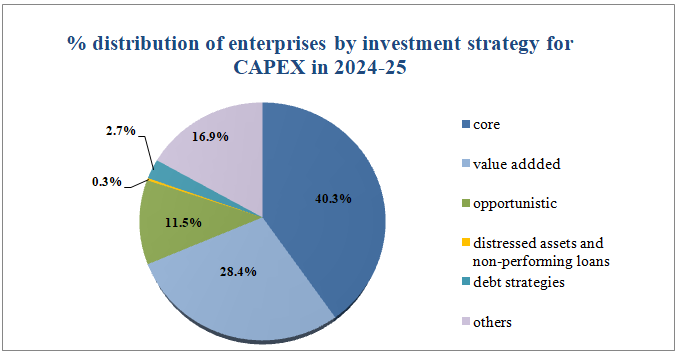
  • The strategy of 40.3% of enterprises is to undertake CAPEX on core assets during 2024–25, followed by 28.4% to invest in value addition to existing assets

Survey Background:

In 2022–23, the Parliamentary Standing Committee recommended that the Ministry of Statistics and Programme Implementation (MoSPI) develop a comprehensive methodology to capture capital expenditure (CAPEX) data from the private sector. Survey instruments designed to capture data on past investments, projected CAPEX for the next two years, and the breakdown of investments by asset type were developed in alignment with the specifications of the Department of Economic Affairs (DEA), Ministry of Finance.

Responding to this recommendation, the National Statistical Office (NSO) conducted the inaugural Forward-Looking Survey on Private Sector CAPEX Investment Intentions between November 2024 and January 2025. This marked the first initiative of MoSPI to engage the corporate sector through a self-administered, web-based survey platform, supported by chatbot assistance, to collect structured CAPEX data. MoSPI has released the findings of the survey in the form of a comprehensive booklet. A brief overview of key aspects, such as survey coverage, sampling methodology, and data collection process, is included in the Endnote.

The primary objective of the CAPEX survey is to estimate the CAPEX trends of private corporate sector enterprises from the past three financial years (2021-22, 2022-23 & 2023-24) along with anticipated capital expenditure for the current year (2024-25) and upcoming financial years (2025-26).

Key advantages of the Survey:

Capital expenditure (CAPEX) plays a crucial role in contributing to national investment and enhancing the stock of physical assets within the economy. It leads to the creation of long-term assets, which not only generate revenue for many years but also improve the overall operational efficiency of economic activities. CAPEX is fundamental to expanding production capacity, thereby serving as a catalyst for accelerated economic growth. This growth, in turn, supports job creation and enhances labour productivity.

Comprehensive data on CAPEX will be a valuable asset for a wide range of stakeholders, including government departments, private enterprises, trade associations, researchers, and other relevant entities. It will enable evidence-based policy formulation through the analysis of trends in future investments. Furthermore, a clear understanding of CAPEX patterns and scale can assist enterprises in making strategic, data-driven investment decisions, guided by the insights derived from survey findings.

Important Caveat:

In this inaugural edition of the survey, industry participation varied, with an overall response rate of 58.3% (58.6% in the census sector and 57.2% in the sample sector). Respondents appeared cautious in disclosing CAPEX plans, often pending management approvals. Certain entities, such as Special Purpose Vehicles (SPVs) involved in infrastructure projects, were excluded from the survey frame as they report no turnover despite high CAPEX. Meanwhile, some included SPVs had no future investment plans due to project completion. As this is the first round of the survey, the findings may be seen as indicative and subject to refinement in future iterations. It is also important to note that the results reflect responses from larger enterprises above specified turnover thresholds and may not represent the entire private corporate sector. Users are advised to interpret the results keeping these limitations in mind.

Insights and Way Forward for Future Survey Conduct

The Forward-Looking Survey on Private Sector Capex Investment Intentions, the first of its kind by the NSO, was conducted under the Collection of Statistics Act, 2008. Notices were issued to selected enterprises, explaining the survey's objectives and assuring confidentiality. However, some enterprises questioned the legitimacy of notices containing portal credentials, leading to multiple cyber risk concerns. Explaining portal usage and submission procedures over the phone was challenging. Data analysis revealed issues such as incorrect unit entries (e.g., Rupees instead of Rupees thousands) and non-responses to follow-up queries. Enterprises also faced difficulties in selecting correct NIC codes and estimating future investments when official data was unavailable.

CAPEX tends to rise when enterprises pursue growth strategies rather than maintain current operations. Despite challenges like weak demand, geopolitical tensions, and high borrowing costs, about 30% of firms plan to invest in upgradation in 2024–25, supporting the sharp increase in CAPEX for that year. The slightly lower intended CAPEX for 2025–26, though still above 2023–24 levels, reflects cautious planning after a strong 2024–25. Overall, the trend indicates growing corporate confidence and a judicious approach to investment amid improving economic certainty.

While the response rate and results were generally promising, this initial round of the survey can be considered as an experimental phase, providing valuable insights to refine the questionnaire, methodology, estimation processes, and overall implementation. The lessons learned will guide improvements for future surveys, with necessary adjustments to various aspects of the survey process. Moving forward, responding enterprises will be engaged more proactively before the survey, with concerns about the authenticity of the online survey being addressed, assistance provided in understanding the questionnaire, confidentiality of individual responses ensured, and field personnel deployed to support enterprises in overcoming technical and conceptual challenges in completing future-oriented surveys. Additionally, the survey will incorporate qualitative inputs, such as reasons for year-on-year changes in investment, to gain deeper insights into enterprise-level CAPEX intentions and trends. The next round of the CAPEX survey is expected to be conducted during October to December 2025.

Key highlights from the CAPEX results:

Aggregated (Unweighted, i.e. without applying any multiplier) CAPEX during (2021-22 to 2025-26)

A total of 2,172 enterprises submitted complete information for all five years of the reference period, forming a fixed panel. The aggregated (unweighted) CAPEX data from this panel of enterprises serves as a reliable basis for analyzing capital expenditure trends over the five-year period, as presented below. The results show an overall increase of 66.3% in aggregate CAPEX (unweighted) over the four-year period from 2021-22 to 2024-25.:

                (in ₹ Crore)

Actual CAPEX in 2021-22

Actual CAPEX

2022-23

Actual CAPEX

2023-24

Intended CAPEX in

2024-25

Intended CAPEX

in 2025-26

394,681.5

572,199.7

422,183.3

656,492.7

488,865.5

Out of the 3,064 responding enterprises, 2,172 reported their Capex intentions for 2025–26. The data indicates a cautious approach by respondents in declaring their capital expenditure plans. Therefore, the Capex data for 2025–26 should be interpreted with caution, considering the conservative approach and apprehension shown by the responding enterprises in reporting these figures. However, the results show an overall increase of 23.9% in aggregate CAPEX (unweighted) during 2021-22 to 2025-26 for this fixed panel of 2,172 enterprises.

Estimated Key Indicators for past years (2021-22 to 2023-24) by Industry of Activity as per National Industry of Classification (Activity Categories)

The average Gross Fixed Asset (GFA) per enterprise in the private corporate sector was estimated at ₹3,151.9 crore in 2021–22. It increased by 4.0% to ₹3,279.4 crores in 2022–23, and further grew by 27.5% to reach ₹4,183.3 crore in 2023–24.

The highest GFA per enterprise, exceeding ₹14,000 crore, was observed in the industry category ‘Electricity, Gas, Steam, and Air Conditioning Supply’, followed by ‘Manufacturing” enterprises (₹7,000 crore to ₹10,000 crore). Enterprises principally engaged in manufacturing activities accounted for more than 65% of the total Gross fixed asset[1] in private corporate sector over the past three years from 2021-22 to 2023-24 followed by enterprises engaged in ‘Electricity, Gas, Steam, and Air Conditioning Supply’ (8%-10%).

In 2021–22, the estimated actual CAPEX per enterprise was ₹109.3 crore, compared to the proposed value of ₹102.7 crore, resulting in a realisation ratio of 106.41 %. A similar trend was observed in 2022–23, where the estimated value of actual CAPEX per enterprise reached ₹148.8 crore against a proposed value of ₹133.3 crore, also yielding a realisation ratio exceeding 100%. For 2023–24, the realisation ratio stands at 99.7%, with the estimated actual CAPEX per enterprise at ₹107.6 and the proposed CAPEX at ₹107.9.

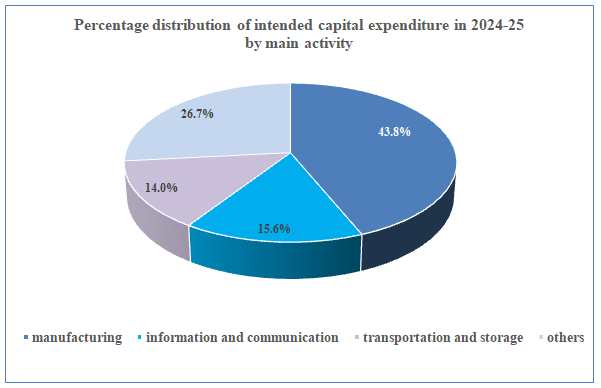
The estimated provisional capital expenditure per enterprise for acquiring new assets in 2024–25 stands at ₹172.2 crore. Among the sectors, manufacturing enterprises account for the largest share at 43.8%, followed by those in ‘Information and Communication Activities’ (15.6%) and ‘Transportation and Storage Activities’ (14.0%).
Estimated Key Indicators for 2023-24 by Asset Groups

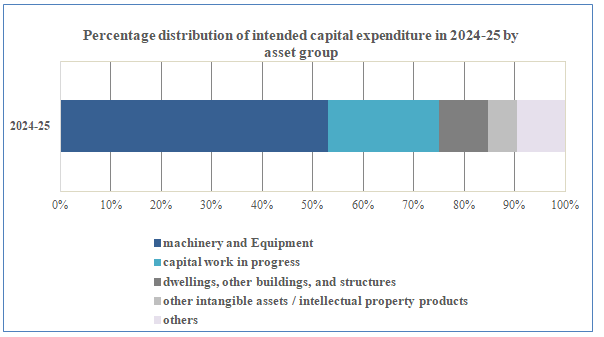
The estimated provisional capital expenditure per enterprise for acquiring new assets in 2024–25 stands at ₹172.2 crore. Out of the total capital expenditure provisionally incurred in the year 2024-25, nearly 53.1% were utilized for purchasing machinery & equipment. The amount allocated for ‘capital work in progress’ (22.0%) and purchasing ‘dwellings, other buildings and structures’ (9.7%) had the next highest share of allocation.
Strategy of CAPEX in 2024-25

According to survey estimates, nearly 40.3% of enterprises plan to undertake CAPEX on core assets during 2024–25. Additionally, 28.4% intend to invest in value addition to existing assets, while around 11.5% focus on opportunistic assets, and 2.7% on debt strategies. The strategy of investing in distressed assets and non-performing loans was adopted by less than one-half of a percent of enterprises. Meanwhile, about 16.9% allocated their CAPEX towards other diverse investment strategies.
Objectives of CAPEX in 2024-25

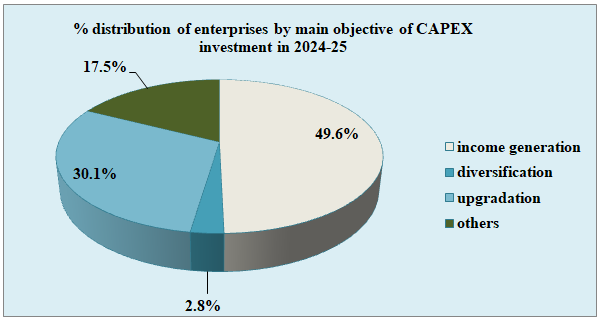
The survey estimates indicate that nearly 49.6% of private corporate sector enterprises undertook CAPEX in 2024–25 primarily for income generation. An additional 30.1% directed their investments toward upgradation, while around 2.8% focused on diversification. Remaining 17.5% of enterprises reported using their CAPEX for other reasons.
The results of CAPEX survey are provided in the booklet which is available in the website of the Ministry (https://www.mospi.gov.in). To protect the confidentiality of CAPEX investment plans of individual enterprises, the Steering Committee of NSS Surveys recommended that unit-level data of CAPEX survey would not be disseminated.

Endnote: A brief about the coverage, sampling scheme, sample size and data collection mechanism in the Forward-Looking Survey on Private Sector CAPEX Investment Intentions:

A. Coverage:

The survey covered large private corporate sector enterprises that play a significant role in their respective sectors. The sampling frame was madeusing data from active enterprises registered with the Ministry of Corporate Affairs (MCA), filtered based on annual turnover thresholds achieved in at least one of the last three financial years. The eligibility criteria were as follows:

  • Manufacturing enterprises with an annual turnover of ₹400 crore or more
  • Trade enterprises with an annual turnover of ₹300 crore or more
  • Other enterprises with an annual turnover of ₹100 crore or more

Based on these criteria, the final survey frame consisted of 16,025 enterprises.

B. Sampling Scheme:

Eligible enterprises were initially categorized into seventeen (17) strata based on their Principal Business Activity as reported in the MGT-7 Form of the Ministry of Corporate Affairs (MCA). In strata with 100 or fewer enterprises, all units were included in the Census Sector for complete enumeration.

For strata with more than 100 enterprises, the selection process involved identifying Census Sector Enterprises and Sample Sector Enterprises. To determine the Census Sector, enterprises were ranked in descending order based on (i) the highest fixed asset value in the past three years and (ii) the fixed asset value of latest reported year. The top enterprises accounting for 90% of asset value (or 80% for Construction and Trade) from either list were classified as Census Sector Enterprises. The remaining units formed the Sample Sector, from which 10% were randomly selected using Simple Random Sampling without Replacement (SRSWOR), with allocation proportional to each stratum’s size and variation.

C. Sample Size:

The sample size for the survey was of 5,380 enterprises: 4,145 enterprises in the Census Sector and 1,235 enterprises in sample sector.

DData Collection Mechanism:

The survey was conducted under the provisions of the Collection of Statistics Act, 2008, with prior notices sent to all selected enterprises outlining the survey’s objective and intended use of the data. Confidentiality of individual responses was strictly maintained, and no unit-level data would be disseminated. A secure, dedicated web portal was developed to enable selected enterprises to complete and submit the survey questionnaire online. The portal included background information on the survey, reasons for a unit’s selection, and chatbot support to assist respondents in understanding key concepts and definitions.

Topics

Acts Income Tax