

Loading...

Top
Help
×

By creating an account you can:

Logo TaxTMI
Call Us / Help / Feedback

Contact Us At :

E-mail: [email protected]

Call / WhatsApp at: +91 99117 96707

For more information, Check Contact Us

FAQs :

To know Frequently Asked Questions, Check FAQs

Most Asked Video Tutorials :

For more tutorials, Check Video Tutorials

Submit Feedback/Suggestion :

Email :
Please provide your email address so we can follow up on your feedback.
Category :
Description :
Min 15 characters 0/2000
Make Most of Text Search
  1. Checkout this video tutorial: How to search effectively on TaxTMI.
  2. Put words in double quotes for exact word search, eg: "income tax"
  3. Avoid noise words such as : 'and, of, the, a'
  4. Sort by Relevance to get the most relevant document.
  5. Press Enter to add multiple terms/multiple phrases, and then click on Search to Search.
  6. Text Search
  7. The system will try to fetch results that contains ALL your words.
  8. Once you add keywords, you'll see a new 'Search In' filter that makes your results even more precise.
  9. Text Search
Add to...
You have not created any category. Kindly create one to bookmark this item!
Create New Category
Hide
Title :
Description :
❮❮ Hide
Default View
Expand ❯❯
Close ✕
🔎 News - Adv. Search
TEXT SEARCH:

Press 'Enter' to add multiple search terms. Rules for Better Search

Search In:
Main Text + AI Text
  • Main Text
  • Main Text + AI Text
  • AI Text
Category: ?
Categorized by AI
---- All Categories ----
  • ---- All Categories ----
  • Income Tax
  • GST
  • Customs, DGFT & SEZ
  • FEMA & RBI
  • Corp. Laws, SEBI & IBC
  • PMLA, Black Money & ED
  • Budget
  • News and Press Release
  • PTI News
Month:
---- All Months ----
  • ---- All Months ----
  • January
  • February
  • March
  • April
  • May
  • June
  • July
  • August
  • September
  • October
  • November
  • December
Year:
---- All Years ----
  • ---- All Years ----
  • 2026
  • 2025
  • 2024
  • 2023
  • 2022
  • 2021
  • 2020
  • 2019
  • 2018
  • 2017
  • 2016
  • 2015
  • 2014
  • 2013
  • 2012
  • 2011
Sort By: ?
In Sort By 'Default', exact matches for text search are shown at the top, followed by the remaining results in their regular order.
Relevance Default Date
    Cyber fraudsters invent 'boss' scam to target companies; Ahmedabad cops bust international network
    Personal Loan Prepayment Charges: What RBI Rules Say in 2026
    Zeeba Revamps Packaging and Announces Chef Vikas Khanna as Its Global Brand Ambassador
    Paul Merchants Finance Launches Loan Against Silver, Becomes India’s First NBFC to Set Up Exclusive Silver Loan Branches
    CarePass Launches This Independence Day, Bringing Healthcare Savings Across India's Top and Premium Hospitals
    Keralam CM flags off containers from Vizhinjam, marking start of EXIM operations
    Kerala: Fresh ED raids in CMRL-Exalogic Solutions case
    ED raids KPSC office, ex-chairman in veterinary officers hiring 'scam' case
    Keralam CM reviews operational preparedness at Vizhinjam port
    Union Minister for Finance and Corporate Affairs Smt. Nirmala Sitharaman chairs 3rd Meeting of Apex Monitoring Authority of NICDIT and reviews the pro...
    NBCC moves SC for RERA exemptions to complete 16 stalled Supertech projects
    DFS Hosts PSB Confluence 2026: Day 1 Deliberations focus on Four themes- Deposit Mobilisation, Banking for Youth, Supporting the Investment Cycle and ...
    Govt to soon announce high-level panel on 'Banking for Viksit Bharat': FM
    Rupee falls 19 paise to close at 95.61 against US dollar
    Govt to soon announce high-level panel on 'Banking for Viksit Bharat'
    Union Minister of Finance and Corporate Affairs interacts with interns from PM Internship Scheme in New Delhi
    DRI uncovers large-scale illegal use of SAFTA agreement in areca imports
    Rupee falls 17 paise to 95.59 against US dollar in early trade
    Colombian president asks Trump to suspend tariffs to help earthquake recovery
    Mission Samudra to be launched alongside Vizhinjam’s EXIM operations
❯❯
Maximize Maximize Maximize
0 / 200
Expand Note
Add to Folder

No Folders have been created

+

Are you sure you want to delete "My most important" ?

NOTE:

News
Showing Results for :
Reset Filters
Results Found:
Show All Summaries Hide All Summaries
August 18, 2026
Show AI Summary
Boss scam prevention requires independent verification of payment requests and avoidance of malicious WhatsApp attachments that enable executive impersonation.
Boss scam, or CEO impersonation fraud, uses malicious WhatsApp attachments and impersonation of regulatory officials or company executives to obtain control of WhatsApp sessions and issue fraudulent payment instructions. The alleged network supplied SIM cards, dummy SIMs, WhatsApp accounts and one-time passwords to cyber-fraud operators, illustrating a Cybercrime as a Service model. Preventive measures include avoiding suspicious ZIP, executable, library and APK files and independently verifying all financial-transfer requests.
August 18, 2026
Show AI Summary
Floating-rate personal loan prepayment protections prohibit charges and compulsory lock-ins for qualifying individual non-business borrowers from 2026.
Prepayment charges are prohibited for part or full repayment of qualifying floating-rate loans availed by individual borrowers for non-business purposes and sanctioned or renewed on or after 1 January 2026. Compulsory lock-in periods cannot restrict prepayment of such loans. Fixed-rate personal loans may still attract prepayment or foreclosure charges under lender policy and contractual terms. Borrowers should check the loan's rate type, sanction letter, loan agreement and key fact statement, where applicable, and compare applicable charges with potential interest savings before early repayment.
August 18, 2026
Show AI Summary
Premium Basmati rice positioning drives Zeeba's packaging refresh and ambassador-led campaign focused on quality, authenticity and domestic expansion.
Zeeba has refreshed its packaging and appointed Chef Vikas Khanna as global brand ambassador to support expansion in India. Its "Aisa Basmati Nahi Dekha" campaign positions the brand around export-quality Basmati rice, consistency, authenticity and a superior culinary experience. Promotional activity will extend across digital, retail and consumer touchpoints. The premium Basmati range is described as carefully sourced, naturally aged and processed according to global quality standards, with emphasis on grain quality, authentic taste, purity and consistency.
August 18, 2026
Show AI Summary
Silver-collateral lending creates a formal secured-credit channel for eligible borrowers, subject to regulatory requirements and lender policies.
Loans against silver collateral have been introduced following the Reserve Bank of India's Lending Against Gold and Silver Collateral Directions, 2025, enabling eligible regulated lenders to accept silver as security. The offering provides a formal and transparent credit channel against eligible silver jewellery, ornaments and approved silver coins. It is intended for individuals, proprietors and MSMEs requiring liquidity for personal, business and other legitimate financial needs, subject to lending policies and applicable regulatory requirements.
August 18, 2026
Show AI Summary
Healthcare discount membership provides instant savings on out-of-pocket care at participating premium providers without insurance claims or paperwork.
CarePass is a healthcare savings membership card providing instant point-of-billing discounts at participating premium healthcare providers across India. It covers out-of-pocket spending on hospital treatment, diagnostics, dental, vision, dermatology, hair and skin care, and IVF and maternity services, without claim processing, waiting periods or paperwork. Members present a digital CarePass at a participating provider to receive the applicable discount. Four membership tiers offer differing benefits, with higher tiers including tele-consultations and annual health checks. CarePass is a discount membership and not an insurance product.
August 18, 2026
Show AI Summary
EXIM operations at Vizhinjam commence with container movement, supported by investor facilitation, infrastructure backing and port-led logistics development.
EXIM operations at Vizhinjam international seaport commenced with the flagging off of two containers after a successful trial export shipment. The state government proposes investor engagement, regulatory facilitation and infrastructure support to expand global export activities through the port. Mission Samudra is to operate as a port-led industrial and logistics development scheme. The deep-water port was developed under a public-private partnership model and had received commercial commissioning certification.
August 18, 2026
Show AI Summary
Money-laundering investigation under PMLA expands through searches into alleged consultancy payments linked to CMRL and Exalogic Solutions.
Money-laundering investigation under the Prevention of Money Laundering Act involves fresh searches connected with Cochin Minerals and Rutile Ltd and Exalogic Solutions. The inquiry concerns alleged fraudulent payments made under the guise of IT consultancy services and a purported money trail involving persons allegedly connected with those transactions. The action follows earlier searches and questioning in relation to the same matter.
August 18, 2026
Show AI Summary
Recruitment examination irregularities trigger money-laundering investigation into alleged bribery, paper leaks, answer-sheet tampering, and preferential veterinary officer selections.
Money-laundering investigation under the Prevention of Money Laundering Act concerns alleged irregularities in veterinary officers' final selection through a public recruitment examination. Searches covered premises linked to commission officials, alleged intermediaries, the digital evaluation entity, and selected candidates. Allegations include bribery demands, examination-paper leakage, OMR answer-sheet tampering, and facilitation of selection for relatives of commission officials.
August 18, 2026
Show AI Summary
Export-import operations advance through operational preparedness review and planned port-led industrial and logistics development initiatives.
Operational preparedness for full land-based export-import operations at Vizhinjam Seaport was reviewed, including the Vehicle Traffic Management System. EXIM cargo operations follow a trial shipment of the port's first export container to Valencia. Mission Samudra is proposed to support port-led industrial and logistics development alongside these operations. The deep-water port was developed through a public-private partnership model and had obtained commercial commissioning certification before its dedication to the nation.
August 18, 2026
Show AI Summary
Industrial corridor development prioritises empowered SPVs, integrated infrastructure and investor-ready parks to accelerate manufacturing investment and operations.
National Industrial Corridor Development Programme implementation prioritises timely infrastructure completion, land allotment, investment mobilisation and commencement of manufacturing. PM GatiShakti-aligned planning requires integrated connectivity, utilities and social infrastructure, while States should resolve land, clearance and SPV-power bottlenecks. BHAVYA proposes investment-ready, plug-and-play industrial parks appraised for ready land, credible demand, connectivity, utilities, realistic phasing and early investor attraction. NICDIT routes Government participation and equity support for BHAVYA project SPVs, and NICDC coordinates implementation and monitoring.
August 17, 2026
Show AI Summary
RERA compliance exemption for stalled housing projects raises whether statutory obligations may be waived to enable phased project completion.
RERA compliance exemption is sought for completion of 16 stalled residential projects by a public sector construction entity appointed under a project-completion arrangement. The appellate insolvency tribunal declined to direct a waiver, considering itself incompetent to exempt compliance with statutory provisions. The arrangement requires phased completion, award and commencement of construction work, and oversight through an apex committee and project-wise committees. The projects remain incomplete owing to the developer's financial crisis.
August 17, 2026
Show AI Summary
Deposit mobilisation and youth banking guide strategies for stronger public financial institutions, investment financing and Global Capability Centre opportunities.
PSB Confluence 2026 considers strategic priorities for Public Sector Banks and Public Financial Institutions across deposit mobilisation, banking for youth, investment-cycle financing and Global Capability Centres. Discussions seek practical, scalable strategies to strengthen customer engagement, youth-responsive banking propositions, institutional financing capabilities and participation in the expanding Global Capability Centre ecosystem. Youth engagement may use the MY Bharat platform to strengthen links with the formal financial system and awareness of education finance, entrepreneurship, internships and financial-sector careers. Further themes include value-chain infrastructure, priority sector lending and credit card business reform.
August 17, 2026
Show AI Summary
Banking-sector reform will guide lender capacity, financial stability, inclusion, consumer protection, deposit growth and responsible credit-card expansion.
Banking-sector reform is proposed through a high-level committee on Banking for Viksit Bharat to review the sector and align it with growth needs while safeguarding financial stability, financial inclusion and consumer protection. Key themes include deposit mobilisation, youth banking, investment support, global capability centres, value-chain infrastructure, credit cards and priority-sector lending. Public-sector banks are expected to improve competitiveness through technology, sectoral expertise, product adaptation and customer-focused deposit growth. Credit-card development must maintain responsible underwriting, customer protection and appropriate risk controls.
August 17, 2026
Show AI Summary
FCNR(B) concessional swap facility availability narrows to timely mobilised deposits amid rupee depreciation and foreign currency inflow concerns.
Foreign-exchange conditions reflected rupee depreciation amid weak domestic equity markets and higher crude oil prices. FCNR(B) concessional swap facility availability is confined to foreign currency deposits mobilised by banks within the revised cut-off period, replacing the previously longer mobilisation window. The facility is intended to encourage foreign currency inflows, while banks use the FCNR(B) scheme to mobilise foreign currency deposits through attractive interest rates.
August 17, 2026
Show AI Summary
Banking sector review panel will align future growth with financial stability, inclusion and consumer protection through government recommendations.
High Level Committee on Banking for Viksit Bharat is proposed to comprehensively review the banking sector and align it with India's next phase of growth. It is intended to safeguard financial stability, financial inclusion and consumer protection, while providing views and recommendations to the Government on banking-sector development and reform.
August 17, 2026
Show AI Summary
Prime Minister Internship Scheme enhances youth employability through paid industry exposure, cross-field learning, workplace readiness and potential full-time employment.
The Prime Minister Internship Scheme provides paid internships with leading companies across India to improve youth employability through practical workplace exposure, industry experience and skills development. It addresses the gap between classroom learning and employers' expectations of workplace readiness. Participation is not confined to academic qualifications, allowing youth to pursue fields of interest and gain hands-on professional learning. Strong internship performance may lead to full-time roles, while the scheme stresses responsible work where errors may affect quality, consumer safety and organisational reputation.
August 17, 2026
Show AI Summary
SAFTA origin fraud in areca imports allegedly enabled improper duty exemption through false Bangladeshi-origin declarations.
SAFTA preferential duty treatment for areca-nut imports was allegedly misused by falsely declaring goods originating in South-East Asian countries as Bangladeshi origin. Since areca nuts normally attract 100% basic customs duty, the scheme sought to obtain the full SAFTA exemption reserved for qualifying Bangladeshi goods meeting Rules of Origin requirements. The alleged mechanism included routing goods through Bangladesh, changing containers and bags, using improperly obtained Certificates of Origin, and facilitating clearance through importers, Customs Brokers and IEC holders. Investigative findings also indicated cash proceeds, hawala channels and dummy entities.
August 17, 2026
Show AI Summary
FCNR(B) concessional swap facility closure may reduce temporary foreign-currency inflow support and heighten rupee weakness concerns.
The Reserve Bank of India restricted its concessional swap facility for FCNR(B) deposits to deposits mobilised by August 31, advancing the earlier cut-off date. The facility was intended to encourage foreign-currency inflows, while banks mobilise such deposits through attractive interest rates. Market commentary indicated that existing inflows may support the rupee in the near term, but the curtailed availability of the facility could reduce this temporary cushion and increase depreciation risk.
August 16, 2026
Show AI Summary
Temporary tariff suspension for earthquake recovery is sought to ease pressure on affected Colombian businesses.
Temporary suspension of high tariffs on Colombian products has been sought to support business recovery following a severe earthquake declared a natural disaster. The request links tariff relief to economic disruption affecting businesses amid extensive destruction, injuries and missing persons. United States emergency assistance has been provided through food, shelter and health supplies, while no response to the tariff-suspension request had been reported.
August 16, 2026
Show AI Summary
Port-led industrial development and direct export operations aim to expand logistics infrastructure, market access and trade connectivity.
Mission Samudra is proposed as a port-led industrial and logistics development programme linked to the commencement of export-import operations at Vizhinjam seaport. It covers industrial clusters, new cities, port connectivity, logistics, development initiatives, programme management and capacity building. Direct export shipments are intended to improve overseas-market access and reduce transit time and logistics costs, particularly for small and medium enterprises. The framework also anticipates growth in warehousing, cold storage, container freight stations and logistics parks, supported by private participation and road and rail connectivity.

News

Back

All News

Showing Results for :
Reset Filters
No Records Found

News

Back

All News

Showing Results for : Reset Filters

Findings of the Forward-Looking Survey on Private Sector CAPEX Investment Intentions (Survey period: November 2024 to January 2025)

April 30, 2025

Contents
Summary
Note

Note

-

Bookmark

Print

Print

Private Corporate Sector CAPEX: Three-Year Trends and Future Outlook:

Key findings:

  • The average Gross Fixed Assets per enterprise in the private corporate sector increased from ₹3,151.9 crore in 2021–22 to ₹3,279.4 crore in 2022–23 (4% growth), and further to ₹4,183.3 crore in 2023–24, reflecting a significant 27.5% growth.
  • The estimated CAPEX per enterprise for the years 2021–22, 2022–23, and 2023–24 was ₹109.2 crore, ₹148.8 crore and ₹107.6 crore respectively.
  • The estimated provisional capital expenditure per enterprise for purchasing new assets in 2024–25 is ₹172.2 crore.
  • Overall increase of 66.3% in aggregate CAPEX (unweighted) over the four-year period from 2021-22 to 2024-25.
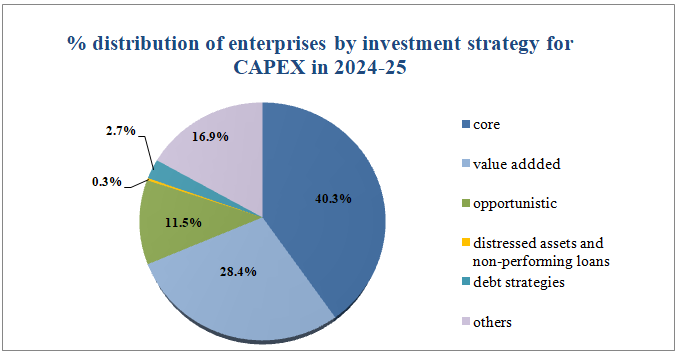
  • The strategy of 40.3% of enterprises is to undertake CAPEX on core assets during 2024–25, followed by 28.4% to invest in value addition to existing assets

Survey Background:

In 2022–23, the Parliamentary Standing Committee recommended that the Ministry of Statistics and Programme Implementation (MoSPI) develop a comprehensive methodology to capture capital expenditure (CAPEX) data from the private sector. Survey instruments designed to capture data on past investments, projected CAPEX for the next two years, and the breakdown of investments by asset type were developed in alignment with the specifications of the Department of Economic Affairs (DEA), Ministry of Finance.

Responding to this recommendation, the National Statistical Office (NSO) conducted the inaugural Forward-Looking Survey on Private Sector CAPEX Investment Intentions between November 2024 and January 2025. This marked the first initiative of MoSPI to engage the corporate sector through a self-administered, web-based survey platform, supported by chatbot assistance, to collect structured CAPEX data. MoSPI has released the findings of the survey in the form of a comprehensive booklet. A brief overview of key aspects, such as survey coverage, sampling methodology, and data collection process, is included in the Endnote.

The primary objective of the CAPEX survey is to estimate the CAPEX trends of private corporate sector enterprises from the past three financial years (2021-22, 2022-23 & 2023-24) along with anticipated capital expenditure for the current year (2024-25) and upcoming financial years (2025-26).

Key advantages of the Survey:

Capital expenditure (CAPEX) plays a crucial role in contributing to national investment and enhancing the stock of physical assets within the economy. It leads to the creation of long-term assets, which not only generate revenue for many years but also improve the overall operational efficiency of economic activities. CAPEX is fundamental to expanding production capacity, thereby serving as a catalyst for accelerated economic growth. This growth, in turn, supports job creation and enhances labour productivity.

Comprehensive data on CAPEX will be a valuable asset for a wide range of stakeholders, including government departments, private enterprises, trade associations, researchers, and other relevant entities. It will enable evidence-based policy formulation through the analysis of trends in future investments. Furthermore, a clear understanding of CAPEX patterns and scale can assist enterprises in making strategic, data-driven investment decisions, guided by the insights derived from survey findings.

Important Caveat:

In this inaugural edition of the survey, industry participation varied, with an overall response rate of 58.3% (58.6% in the census sector and 57.2% in the sample sector). Respondents appeared cautious in disclosing CAPEX plans, often pending management approvals. Certain entities, such as Special Purpose Vehicles (SPVs) involved in infrastructure projects, were excluded from the survey frame as they report no turnover despite high CAPEX. Meanwhile, some included SPVs had no future investment plans due to project completion. As this is the first round of the survey, the findings may be seen as indicative and subject to refinement in future iterations. It is also important to note that the results reflect responses from larger enterprises above specified turnover thresholds and may not represent the entire private corporate sector. Users are advised to interpret the results keeping these limitations in mind.

Insights and Way Forward for Future Survey Conduct

The Forward-Looking Survey on Private Sector Capex Investment Intentions, the first of its kind by the NSO, was conducted under the Collection of Statistics Act, 2008. Notices were issued to selected enterprises, explaining the survey's objectives and assuring confidentiality. However, some enterprises questioned the legitimacy of notices containing portal credentials, leading to multiple cyber risk concerns. Explaining portal usage and submission procedures over the phone was challenging. Data analysis revealed issues such as incorrect unit entries (e.g., Rupees instead of Rupees thousands) and non-responses to follow-up queries. Enterprises also faced difficulties in selecting correct NIC codes and estimating future investments when official data was unavailable.

CAPEX tends to rise when enterprises pursue growth strategies rather than maintain current operations. Despite challenges like weak demand, geopolitical tensions, and high borrowing costs, about 30% of firms plan to invest in upgradation in 2024–25, supporting the sharp increase in CAPEX for that year. The slightly lower intended CAPEX for 2025–26, though still above 2023–24 levels, reflects cautious planning after a strong 2024–25. Overall, the trend indicates growing corporate confidence and a judicious approach to investment amid improving economic certainty.

While the response rate and results were generally promising, this initial round of the survey can be considered as an experimental phase, providing valuable insights to refine the questionnaire, methodology, estimation processes, and overall implementation. The lessons learned will guide improvements for future surveys, with necessary adjustments to various aspects of the survey process. Moving forward, responding enterprises will be engaged more proactively before the survey, with concerns about the authenticity of the online survey being addressed, assistance provided in understanding the questionnaire, confidentiality of individual responses ensured, and field personnel deployed to support enterprises in overcoming technical and conceptual challenges in completing future-oriented surveys. Additionally, the survey will incorporate qualitative inputs, such as reasons for year-on-year changes in investment, to gain deeper insights into enterprise-level CAPEX intentions and trends. The next round of the CAPEX survey is expected to be conducted during October to December 2025.

Key highlights from the CAPEX results:

Aggregated (Unweighted, i.e. without applying any multiplier) CAPEX during (2021-22 to 2025-26)

A total of 2,172 enterprises submitted complete information for all five years of the reference period, forming a fixed panel. The aggregated (unweighted) CAPEX data from this panel of enterprises serves as a reliable basis for analyzing capital expenditure trends over the five-year period, as presented below. The results show an overall increase of 66.3% in aggregate CAPEX (unweighted) over the four-year period from 2021-22 to 2024-25.:

                (in ₹ Crore)

Actual CAPEX in 2021-22

Actual CAPEX

2022-23

Actual CAPEX

2023-24

Intended CAPEX in

2024-25

Intended CAPEX

in 2025-26

394,681.5

572,199.7

422,183.3

656,492.7

488,865.5

Out of the 3,064 responding enterprises, 2,172 reported their Capex intentions for 2025–26. The data indicates a cautious approach by respondents in declaring their capital expenditure plans. Therefore, the Capex data for 2025–26 should be interpreted with caution, considering the conservative approach and apprehension shown by the responding enterprises in reporting these figures. However, the results show an overall increase of 23.9% in aggregate CAPEX (unweighted) during 2021-22 to 2025-26 for this fixed panel of 2,172 enterprises.

Estimated Key Indicators for past years (2021-22 to 2023-24) by Industry of Activity as per National Industry of Classification (Activity Categories)

The average Gross Fixed Asset (GFA) per enterprise in the private corporate sector was estimated at ₹3,151.9 crore in 2021–22. It increased by 4.0% to ₹3,279.4 crores in 2022–23, and further grew by 27.5% to reach ₹4,183.3 crore in 2023–24.

The highest GFA per enterprise, exceeding ₹14,000 crore, was observed in the industry category ‘Electricity, Gas, Steam, and Air Conditioning Supply’, followed by ‘Manufacturing” enterprises (₹7,000 crore to ₹10,000 crore). Enterprises principally engaged in manufacturing activities accounted for more than 65% of the total Gross fixed asset[1] in private corporate sector over the past three years from 2021-22 to 2023-24 followed by enterprises engaged in ‘Electricity, Gas, Steam, and Air Conditioning Supply’ (8%-10%).

In 2021–22, the estimated actual CAPEX per enterprise was ₹109.3 crore, compared to the proposed value of ₹102.7 crore, resulting in a realisation ratio of 106.41 %. A similar trend was observed in 2022–23, where the estimated value of actual CAPEX per enterprise reached ₹148.8 crore against a proposed value of ₹133.3 crore, also yielding a realisation ratio exceeding 100%. For 2023–24, the realisation ratio stands at 99.7%, with the estimated actual CAPEX per enterprise at ₹107.6 and the proposed CAPEX at ₹107.9.

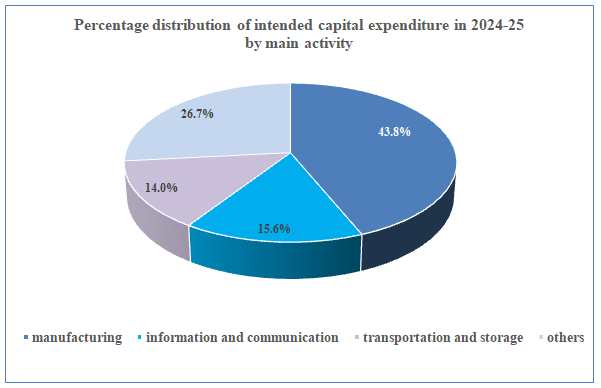
The estimated provisional capital expenditure per enterprise for acquiring new assets in 2024–25 stands at ₹172.2 crore. Among the sectors, manufacturing enterprises account for the largest share at 43.8%, followed by those in ‘Information and Communication Activities’ (15.6%) and ‘Transportation and Storage Activities’ (14.0%).
Estimated Key Indicators for 2023-24 by Asset Groups

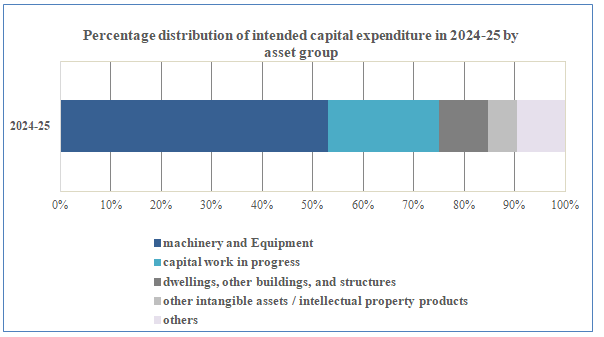
The estimated provisional capital expenditure per enterprise for acquiring new assets in 2024–25 stands at ₹172.2 crore. Out of the total capital expenditure provisionally incurred in the year 2024-25, nearly 53.1% were utilized for purchasing machinery & equipment. The amount allocated for ‘capital work in progress’ (22.0%) and purchasing ‘dwellings, other buildings and structures’ (9.7%) had the next highest share of allocation.
Strategy of CAPEX in 2024-25

According to survey estimates, nearly 40.3% of enterprises plan to undertake CAPEX on core assets during 2024–25. Additionally, 28.4% intend to invest in value addition to existing assets, while around 11.5% focus on opportunistic assets, and 2.7% on debt strategies. The strategy of investing in distressed assets and non-performing loans was adopted by less than one-half of a percent of enterprises. Meanwhile, about 16.9% allocated their CAPEX towards other diverse investment strategies.
Objectives of CAPEX in 2024-25

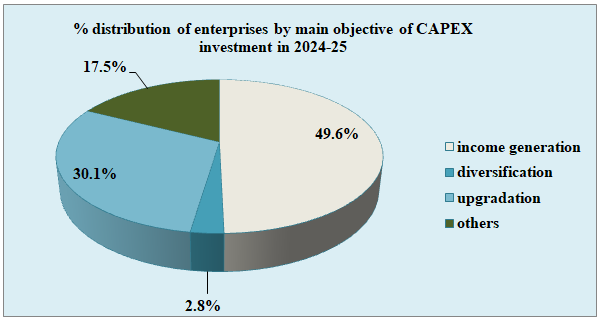
The survey estimates indicate that nearly 49.6% of private corporate sector enterprises undertook CAPEX in 2024–25 primarily for income generation. An additional 30.1% directed their investments toward upgradation, while around 2.8% focused on diversification. Remaining 17.5% of enterprises reported using their CAPEX for other reasons.
The results of CAPEX survey are provided in the booklet which is available in the website of the Ministry (https://www.mospi.gov.in). To protect the confidentiality of CAPEX investment plans of individual enterprises, the Steering Committee of NSS Surveys recommended that unit-level data of CAPEX survey would not be disseminated.

Endnote: A brief about the coverage, sampling scheme, sample size and data collection mechanism in the Forward-Looking Survey on Private Sector CAPEX Investment Intentions:

A. Coverage:

The survey covered large private corporate sector enterprises that play a significant role in their respective sectors. The sampling frame was madeusing data from active enterprises registered with the Ministry of Corporate Affairs (MCA), filtered based on annual turnover thresholds achieved in at least one of the last three financial years. The eligibility criteria were as follows:

  • Manufacturing enterprises with an annual turnover of ₹400 crore or more
  • Trade enterprises with an annual turnover of ₹300 crore or more
  • Other enterprises with an annual turnover of ₹100 crore or more

Based on these criteria, the final survey frame consisted of 16,025 enterprises.

B. Sampling Scheme:

Eligible enterprises were initially categorized into seventeen (17) strata based on their Principal Business Activity as reported in the MGT-7 Form of the Ministry of Corporate Affairs (MCA). In strata with 100 or fewer enterprises, all units were included in the Census Sector for complete enumeration.

For strata with more than 100 enterprises, the selection process involved identifying Census Sector Enterprises and Sample Sector Enterprises. To determine the Census Sector, enterprises were ranked in descending order based on (i) the highest fixed asset value in the past three years and (ii) the fixed asset value of latest reported year. The top enterprises accounting for 90% of asset value (or 80% for Construction and Trade) from either list were classified as Census Sector Enterprises. The remaining units formed the Sample Sector, from which 10% were randomly selected using Simple Random Sampling without Replacement (SRSWOR), with allocation proportional to each stratum’s size and variation.

C. Sample Size:

The sample size for the survey was of 5,380 enterprises: 4,145 enterprises in the Census Sector and 1,235 enterprises in sample sector.

DData Collection Mechanism:

The survey was conducted under the provisions of the Collection of Statistics Act, 2008, with prior notices sent to all selected enterprises outlining the survey’s objective and intended use of the data. Confidentiality of individual responses was strictly maintained, and no unit-level data would be disseminated. A secure, dedicated web portal was developed to enable selected enterprises to complete and submit the survey questionnaire online. The portal included background information on the survey, reasons for a unit’s selection, and chatbot support to assist respondents in understanding key concepts and definitions.

Topics

Acts Income Tax