

Loading...

Top
Help
×

By creating an account you can:

Logo TaxTMI
Call Us / Help / Feedback

Contact Us At :

E-mail: [email protected]

Call / WhatsApp at: +91 99117 96707

For more information, Check Contact Us

FAQs :

To know Frequently Asked Questions, Check FAQs

Most Asked Video Tutorials :

For more tutorials, Check Video Tutorials

Submit Feedback/Suggestion :

Email :
Please provide your email address so we can follow up on your feedback.
Category :
Description :
Min 15 characters 0/2000
Make Most of Text Search
  1. Checkout this video tutorial: How to search effectively on TaxTMI.
  2. Put words in double quotes for exact word search, eg: "income tax"
  3. Avoid noise words such as : 'and, of, the, a'
  4. Sort by Relevance to get the most relevant document.
  5. Press Enter to add multiple terms/multiple phrases, and then click on Search to Search.
  6. Text Search
  7. The system will try to fetch results that contains ALL your words.
  8. Once you add keywords, you'll see a new 'Search In' filter that makes your results even more precise.
  9. Text Search
Add to...
You have not created any category. Kindly create one to bookmark this item!
Create New Category
Hide
Title :
Description :
❮❮ Hide
Default View
Expand ❯❯
Close ✕
🔎 News - Adv. Search
TEXT SEARCH:

Press 'Enter' to add multiple search terms. Rules for Better Search

Search In:
Main Text + AI Text
  • Main Text
  • Main Text + AI Text
  • AI Text
Category: ?
Categorized by AI
---- All Categories ----
  • ---- All Categories ----
  • Income Tax
  • GST
  • Customs, DGFT & SEZ
  • FEMA & RBI
  • Corp. Laws, SEBI & IBC
  • PMLA, Black Money & ED
  • Budget
  • News and Press Release
  • PTI News
Month:
---- All Months ----
  • ---- All Months ----
  • January
  • February
  • March
  • April
  • May
  • June
  • July
  • August
  • September
  • October
  • November
  • December
Year:
---- All Years ----
  • ---- All Years ----
  • 2026
  • 2025
  • 2024
  • 2023
  • 2022
  • 2021
  • 2020
  • 2019
  • 2018
  • 2017
  • 2016
  • 2015
  • 2014
  • 2013
  • 2012
  • 2011
Sort By: ?
In Sort By 'Default', exact matches for text search are shown at the top, followed by the remaining results in their regular order.
Relevance Default Date
    Rupee rises 1 paisa to 95.73 against US dollar in early trade
    CCI approves acquisition of 23% equity shareholding of TM International Logistics by Tata Steel Ltd
    CCI approves acquisition of additional shareholding of Acko Technology & Services Pvt Ltd. by General Atlantic Singapore ACK Pte. Ltd
    Union Minister of Commerce & Industry Shri Piyush Goyal invites Japanese businesses to deepen investments and partnerships in India
    Department of Commerce Organises Awareness Session on EU CBAM Regulations for Exporters
    PSB Confluence 2026 concludes with actionable strategies across seven themes for Public Sector Banks and Public Financial Institutions
    Previous LDF govt didn't fulfil many obligations related to Vizhinjam port: CM Satheesan
    Sitharaman calls on public sector banks to translate strength into competitiveness and leadership
    Sitharaman asks public sector banks to focus on youth; provide cool, simple banking to suit their needs
    I-T department officials discuss roadmap for improving services for taxpayers
    India-UK trade agreement to benefit Haryana's industries and services sector: CM Saini
    FM asks banks to keep pace with youth expectation; calls for outreach campaign from Oct 2
    CCI approves acquisition of certain equity shareholding in Bharti Life Insurance Company by Prudential Corporation Holdings
    Suspicious foreign remittances under I-T department scanner
    Delhi tightens rules for ration shops, makes big stock discrepancies an FIR offence
    Regional Rural Banks (RRBs) Record Strong Growth in Credit Delivery during FY 2025–26
    METSTO Delivers Adjustable Pallet Racking System Solutions for Warehouses
    China rolls out new measures to boost consumption in counties, smaller cities
    Strengthening Collaboration to Preserve Sovereignty: Collaborative Cash Ecosystems - Global Strategies to Preserve Trust and Sovereignty - Keynote Add...
    SC asks CBI to examine all six allegations of dubious transactions involving Indiabulls
❯❯
Maximize Maximize Maximize
0 / 200
Expand Note
Add to Folder

No Folders have been created

+

Are you sure you want to delete "My most important" ?

NOTE:

News
Showing Results for :
Reset Filters
Results Found:
Show All Summaries Hide All Summaries
August 19, 2026
Show AI Summary
Foreign exchange market conditions supported marginal rupee strength despite crude oil pressures, regional tensions and oil-company dollar demand.
Foreign exchange market conditions reflected a marginal strengthening of the rupee against the US dollar in early trading, supported by reported Reserve Bank of India intervention, a softer dollar index and foreign institutional equity inflows. Higher global crude oil prices, West Asia tensions and oil-company demand for dollars continued to exert pressure, resulting in a range-bound trading environment.
August 19, 2026
Show AI Summary
Competition approval for Tata Steel's share acquisition restructures ownership of logistics joint venture following an existing partner's exit.
Competition approval has been granted for Tata Steel Ltd.'s acquisition of IQ Martrade Holding Und Management GmbH's entire 23% equity shareholding in TM International Logistics Ltd., resulting in IQ Martrade's exit. Following completion, Tata Steel and NYK (Europe) B.V. will hold 74% and 26% equity shareholding, respectively. TM International Logistics primarily serves Tata Steel's logistics and cargo transportation requirements through railway cargo transportation, port operations and cargo handling, freight forwarding, and value-added logistics services.
August 19, 2026
Show AI Summary
Competition approval enables increased insurtech shareholding through a rights issue, crossing the prescribed ownership threshold in insurance businesses.
Competition approval has been granted for General Atlantic Singapore ACK Pte. Ltd. to acquire additional shareholding in Acko Technology & Services Private Limited through the target's rights issue, resulting in the acquirer crossing the 25% shareholding threshold on a fully diluted basis. The target is an Indian insurtech company with subsidiaries conducting licensed general and life insurance businesses, while another subsidiary awaits a corporate agency licence for insurance-policy distribution.
August 19, 2026
Show AI Summary
India-Japan investment partnership prioritises technology, manufacturing and infrastructure collaboration, with Uttar Pradesh positioned for deeper Japanese commercial engagement.
India-Japan economic cooperation is positioned for deeper investment and commercial partnerships in manufacturing, technology, infrastructure, energy, defence, artificial intelligence, semiconductors, critical minerals, batteries and next-generation mobility. Uttar Pradesh is identified as a prospective destination for Japanese investment because of its workforce, connectivity, manufacturing base, MSME sector, export capacity, transport infrastructure and industrial clusters. Investment facilitation is associated with reforms in ease of doing business, digital public infrastructure and multimodal logistics.
August 19, 2026
Show AI Summary
Carbon border adjustment compliance requires reliable emissions data, reporting, accreditation and verification throughout exporters' supply chains.
European Union Carbon Border Adjustment Mechanism compliance requires exporters to address covered products, embedded-emissions calculation, data collection, reporting, accreditation and verification. Preparedness across the export value chain depends on timely emissions data from suppliers and other stakeholders, supported by credible verification mechanisms. Capacity-building and engagement seek to facilitate workable compliance with evolving sustainability-related international trade requirements.
August 19, 2026
Show AI Summary
Youth banking engagement promotes sustained customer relationships through digital access, campus outreach and financial support across evolving life stages.
Public Sector Banks and Public Financial Institutions are urged to implement actionable strategies with clear ownership and realistic timelines. Youth banking engagement is to be strengthened through a focused campaign, a common digital access platform and physical outreach, supporting young customers' evolving financial needs. Priority sector lending requires granular monitoring, early identification of target gaps and productive credit flow to intended beneficiaries. Agriculture and horticulture value-chain financing may cover farmer producer organisations, storage, processing, logistics and market linkages, while credit card strategies include digital onboarding, cross-selling and RuPay-UPI integration.
August 18, 2026
Show AI Summary
Port connectivity obligations shape Vizhinjam export-import operations, logistics integration, infrastructure acceleration, and scrutiny of prior stakeholder notification.
Vizhinjam port concession obligations include road and rail connectivity to maximise the benefits of export-import operations. The State government proposes land acquisition funding for a ring-road project, is engaging with central ministries on rail connectivity, and is seeking to expedite national-highway construction. Mission Samudra is intended to connect Cochin port and 18 mini ports with Vizhinjam to support lower-cost, faster exports. Concerns were also raised over the State government not receiving prior intimation of a proposed stake transfer in the port project company.
August 18, 2026
Show AI Summary
Public sector banking competitiveness requires distinct institutional strengths, early capability building and strategic support for economic growth priorities.
Public sector banks are urged to use their customer base, branch networks, geographic reach, institutional experience and digital capabilities to build stronger competitive positions and leadership. Each bank may develop distinct areas of excellence based on geography, customer relationships, sectoral expertise, technology capabilities or international presence. Strategic priorities include deposit mobilisation, banking for youth, support for investment and global capability centres, agriculture and horticulture infrastructure, credit-card business reorientation and priority sector lending.
August 18, 2026
Show AI Summary
Youth-focused banking requires public sector banks to deliver personalised digital services, financial awareness, and responsible credit engagement.
Public sector banks are urged to implement sustained youth-focused banking through campus outreach, simple personalised round-the-clock services, dedicated youth support and financial awareness. Engagement should develop long-term relationships beyond account opening while preserving prudential standards. Youth should receive guidance on the formal credit ecosystem, including credit scores, credit history, bank credit products and government credit schemes, to support responsible credit discipline and future financial needs. A dedicated portal may provide a single access point for banking awareness and suitable financial opportunities.
August 18, 2026
Show AI Summary
Taxpayer service improvement and litigation reduction guide administrative planning for stronger infrastructure, systems, coordination and future tax department functioning.
Improvement of taxpayer services, reduction of tax litigation, infrastructure strengthening and preparation of an actionable roadmap for future Income Tax Department functioning were considered as operational priorities. Deliberations covered e-HRMS, service matters, reservation policy, systems administration, capacity building, expenditure budgeting, TDS administration, inter-agency coordination, and office infrastructure. Officials identified institutional challenges and priorities for strengthening taxpayer-facing and internal departmental functions.
August 18, 2026
Show AI Summary
Duty-free UK market access strengthens export opportunities for Indian goods and services, supporting MSMEs, agriculture, manufacturing and global value-chain participation.
India-UK Comprehensive Economic and Trade Agreement provides duty-free access to the UK market for nearly all Indian exports and may improve the competitiveness of Haryana's manufacturing, agricultural, MSME and services sectors. Preferential access covers products including textiles, engineering goods, auto parts, processed foods and pharmaceuticals, while agricultural exports remain subject to exceptions for sensitive products. The agreement also provides market access across 137 UK services sub-sectors, supporting IT, digital, professional, financial and technical services and facilitating global value-chain participation.
August 18, 2026
Show AI Summary
Youth banking outreach promotes campus engagement, financial awareness, responsible credit discipline and long-term access to formal banking services.
Public sector banks are urged to conduct a month-long "Banking for Youth" outreach campaign from 2 October 2026 for persons above 16 years of age. Outreach through educational and skill-development campuses should combine account opening, financial awareness and direct engagement. Banks should develop tailored youth strategies to build long-term banking relationships. Proposed measures include online learning content, lifestyle-linked benefits, dedicated youth banking support, and awareness of credit scores, credit products and government credit schemes. A dedicated youth banking-awareness portal may serve as a single access point for appropriate banking services and financial opportunities.
August 18, 2026
Show AI Summary
Competition approval for Prudential's acquisition of equity shareholding in an Indian life insurer supports the proposed insurance-sector combination.
Competition approval has been granted for Prudential Corporation Holdings Limited to acquire certain equity shareholding in Bharti Life Insurance Company Limited. The acquirer is the holding company for its group's insurance and asset-management operations in Asia and supports operations in Asia and Africa. The target is an IRDAI-licensed Indian life insurer.
August 18, 2026
Show AI Summary
Foreign remittance certification due diligence faces nationwide verification targeting shell entities, their controllers, and certifying professionals.
Nationwide verification of suspicious outward foreign remittances targets entities with little or no reported business activity, their controllers, and professionals issuing tax determination certificates. Scrutiny concerns remittances disproportionate to reported turnover, inconsistent with stated purposes, or linked to entities not operating from declared addresses. Form 15CB, or Form 146 under the corresponding framework, requires certifying accountants to assess taxability from books of account and relevant records, supporting tax deduction at source and treaty compliance through due care, diligence and professional judgment.
August 18, 2026
Show AI Summary
Fair Price Shop regulation introduces graded stock-shortage penalties, mandatory FIRs for major discrepancies, and restructured licensing requirements.
Fair Price Shop regulation introduces quantity-based penalties for stock discrepancies, ranging from performance-guarantee forfeiture and replenishment obligations to interim suspension, cancellation-related action and mandatory FIR registration for major shortages. Repeated or deliberate diversion or manipulation of public distribution supplies may lead to cancellation, blacklisting and FIR registration. Licensing now includes continuing regular licences and short-term temporary licences, with wider eligibility, points-based selection, card-linked performance guarantees and compulsory approved e-PoS, weighing-scale and iris-scanner use.
August 18, 2026
Show AI Summary
Priority sector lending strengthened rural credit access through agricultural, micro-enterprise and weaker-section finance, reinforcing financial inclusion and sustainable development.
Regional Rural Banks expanded rural credit delivery while maintaining strong Priority Sector Lending performance during FY 2025-26. Almost all Regional Rural Banks met the prescribed overall priority-sector target. Agriculture and allied activities remained the largest priority-sector component, with farm credit accounting for nearly all agricultural lending. MSME finance predominantly supported micro enterprises, rural entrepreneurs, artisans and small businesses. Lending to weaker sections and finance for housing, education, renewable energy and social infrastructure promoted inclusive access to institutional credit and sustainable rural development.
August 18, 2026
Show AI Summary
Adjustable pallet racking systems support customised, scalable warehouse storage through configurable layouts, safety assessment, installation and lifecycle support.
Adjustable pallet racking systems are configurable warehouse-storage solutions for varied inventory dimensions, weights and product types. They support bulk pallet storage, multi-level picking and high-density configurations through adjustable beams and shelves, load-bearing capacity, structural durability and space-efficient layouts. Storage configurations are customised after assessing inventory dimensions, payload requirements, available space and material-movement frequency, with support for design, installation, inspections and after-sales service.
August 18, 2026
Show AI Summary
Domestic consumption expansion targets lower-tier markets through improved retail channels, distribution networks, employment support and household income opportunities.
China has introduced measures to strengthen domestic consumption in counties, smaller cities, townships and rural areas. The measures include upgrading township commercial centres, rural markets and local fairs; encouraging domestic and international brands to establish regional debut stores; and reusing existing land resources to improve services. They also seek better services for elderly persons and children, stronger urban-rural distribution networks, county-level employment and resident income channels. The strategy supports a shift towards household consumption amid weak domestic demand, property-sector pressures and subdued consumer sentiment.
August 18, 2026
Show AI Summary
Currency management preserves monetary sovereignty through clean notes, secure logistics, decentralised distribution, durable banknotes, and sustainable cash-cycle operations.
Currency management supports trust in cash and monetary sovereignty through demand planning, secure production, distribution, replacement, and disposal. The Clean Note Policy requires good-quality banknotes to be available in required denominations and locations, with unfit notes continuously withdrawn and replaced. A decentralised Currency Chest network distributes fresh currency, processes returned notes, supports linked bank branches, and operates under licensing, real-time reporting, inspection, and audit requirements. Current priorities include managing uncertain cash demand, improving note durability, and reducing the carbon footprint of the cash cycle.
August 18, 2026
Show AI Summary
Independent investigation of alleged dubious transactions requires examination of all six allegations despite prior police conclusions.
Investigation into alleged dubious transactions involving Indiabulls Housing Finance Limited and related entities must cover all six allegations identified by the Enforcement Directorate. The CBI must independently examine five allegations previously reviewed by the Delhi Police Economic Offence Wing, irrespective of its conclusion, and submit a comprehensive report. Further investigation into the sixth allegation depends on the special PMLA court deciding the CBI's pending application, after which the CBI must provide a progress or status report.

News

Back

All News

Showing Results for :
Reset Filters
No Records Found

News

Back

All News

Showing Results for : Reset Filters

Findings of the Forward-Looking Survey on Private Sector CAPEX Investment Intentions (Survey period: November 2024 to January 2025)

April 30, 2025

Contents
Summary
Note

Note

-

Bookmark

Print

Print

Private Corporate Sector CAPEX: Three-Year Trends and Future Outlook:

Key findings:

  • The average Gross Fixed Assets per enterprise in the private corporate sector increased from ₹3,151.9 crore in 2021–22 to ₹3,279.4 crore in 2022–23 (4% growth), and further to ₹4,183.3 crore in 2023–24, reflecting a significant 27.5% growth.
  • The estimated CAPEX per enterprise for the years 2021–22, 2022–23, and 2023–24 was ₹109.2 crore, ₹148.8 crore and ₹107.6 crore respectively.
  • The estimated provisional capital expenditure per enterprise for purchasing new assets in 2024–25 is ₹172.2 crore.
  • Overall increase of 66.3% in aggregate CAPEX (unweighted) over the four-year period from 2021-22 to 2024-25.
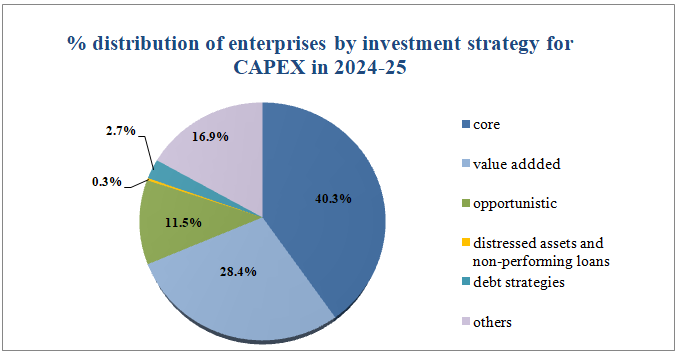
  • The strategy of 40.3% of enterprises is to undertake CAPEX on core assets during 2024–25, followed by 28.4% to invest in value addition to existing assets

Survey Background:

In 2022–23, the Parliamentary Standing Committee recommended that the Ministry of Statistics and Programme Implementation (MoSPI) develop a comprehensive methodology to capture capital expenditure (CAPEX) data from the private sector. Survey instruments designed to capture data on past investments, projected CAPEX for the next two years, and the breakdown of investments by asset type were developed in alignment with the specifications of the Department of Economic Affairs (DEA), Ministry of Finance.

Responding to this recommendation, the National Statistical Office (NSO) conducted the inaugural Forward-Looking Survey on Private Sector CAPEX Investment Intentions between November 2024 and January 2025. This marked the first initiative of MoSPI to engage the corporate sector through a self-administered, web-based survey platform, supported by chatbot assistance, to collect structured CAPEX data. MoSPI has released the findings of the survey in the form of a comprehensive booklet. A brief overview of key aspects, such as survey coverage, sampling methodology, and data collection process, is included in the Endnote.

The primary objective of the CAPEX survey is to estimate the CAPEX trends of private corporate sector enterprises from the past three financial years (2021-22, 2022-23 & 2023-24) along with anticipated capital expenditure for the current year (2024-25) and upcoming financial years (2025-26).

Key advantages of the Survey:

Capital expenditure (CAPEX) plays a crucial role in contributing to national investment and enhancing the stock of physical assets within the economy. It leads to the creation of long-term assets, which not only generate revenue for many years but also improve the overall operational efficiency of economic activities. CAPEX is fundamental to expanding production capacity, thereby serving as a catalyst for accelerated economic growth. This growth, in turn, supports job creation and enhances labour productivity.

Comprehensive data on CAPEX will be a valuable asset for a wide range of stakeholders, including government departments, private enterprises, trade associations, researchers, and other relevant entities. It will enable evidence-based policy formulation through the analysis of trends in future investments. Furthermore, a clear understanding of CAPEX patterns and scale can assist enterprises in making strategic, data-driven investment decisions, guided by the insights derived from survey findings.

Important Caveat:

In this inaugural edition of the survey, industry participation varied, with an overall response rate of 58.3% (58.6% in the census sector and 57.2% in the sample sector). Respondents appeared cautious in disclosing CAPEX plans, often pending management approvals. Certain entities, such as Special Purpose Vehicles (SPVs) involved in infrastructure projects, were excluded from the survey frame as they report no turnover despite high CAPEX. Meanwhile, some included SPVs had no future investment plans due to project completion. As this is the first round of the survey, the findings may be seen as indicative and subject to refinement in future iterations. It is also important to note that the results reflect responses from larger enterprises above specified turnover thresholds and may not represent the entire private corporate sector. Users are advised to interpret the results keeping these limitations in mind.

Insights and Way Forward for Future Survey Conduct

The Forward-Looking Survey on Private Sector Capex Investment Intentions, the first of its kind by the NSO, was conducted under the Collection of Statistics Act, 2008. Notices were issued to selected enterprises, explaining the survey's objectives and assuring confidentiality. However, some enterprises questioned the legitimacy of notices containing portal credentials, leading to multiple cyber risk concerns. Explaining portal usage and submission procedures over the phone was challenging. Data analysis revealed issues such as incorrect unit entries (e.g., Rupees instead of Rupees thousands) and non-responses to follow-up queries. Enterprises also faced difficulties in selecting correct NIC codes and estimating future investments when official data was unavailable.

CAPEX tends to rise when enterprises pursue growth strategies rather than maintain current operations. Despite challenges like weak demand, geopolitical tensions, and high borrowing costs, about 30% of firms plan to invest in upgradation in 2024–25, supporting the sharp increase in CAPEX for that year. The slightly lower intended CAPEX for 2025–26, though still above 2023–24 levels, reflects cautious planning after a strong 2024–25. Overall, the trend indicates growing corporate confidence and a judicious approach to investment amid improving economic certainty.

While the response rate and results were generally promising, this initial round of the survey can be considered as an experimental phase, providing valuable insights to refine the questionnaire, methodology, estimation processes, and overall implementation. The lessons learned will guide improvements for future surveys, with necessary adjustments to various aspects of the survey process. Moving forward, responding enterprises will be engaged more proactively before the survey, with concerns about the authenticity of the online survey being addressed, assistance provided in understanding the questionnaire, confidentiality of individual responses ensured, and field personnel deployed to support enterprises in overcoming technical and conceptual challenges in completing future-oriented surveys. Additionally, the survey will incorporate qualitative inputs, such as reasons for year-on-year changes in investment, to gain deeper insights into enterprise-level CAPEX intentions and trends. The next round of the CAPEX survey is expected to be conducted during October to December 2025.

Key highlights from the CAPEX results:

Aggregated (Unweighted, i.e. without applying any multiplier) CAPEX during (2021-22 to 2025-26)

A total of 2,172 enterprises submitted complete information for all five years of the reference period, forming a fixed panel. The aggregated (unweighted) CAPEX data from this panel of enterprises serves as a reliable basis for analyzing capital expenditure trends over the five-year period, as presented below. The results show an overall increase of 66.3% in aggregate CAPEX (unweighted) over the four-year period from 2021-22 to 2024-25.:

                (in ₹ Crore)

Actual CAPEX in 2021-22

Actual CAPEX

2022-23

Actual CAPEX

2023-24

Intended CAPEX in

2024-25

Intended CAPEX

in 2025-26

394,681.5

572,199.7

422,183.3

656,492.7

488,865.5

Out of the 3,064 responding enterprises, 2,172 reported their Capex intentions for 2025–26. The data indicates a cautious approach by respondents in declaring their capital expenditure plans. Therefore, the Capex data for 2025–26 should be interpreted with caution, considering the conservative approach and apprehension shown by the responding enterprises in reporting these figures. However, the results show an overall increase of 23.9% in aggregate CAPEX (unweighted) during 2021-22 to 2025-26 for this fixed panel of 2,172 enterprises.

Estimated Key Indicators for past years (2021-22 to 2023-24) by Industry of Activity as per National Industry of Classification (Activity Categories)

The average Gross Fixed Asset (GFA) per enterprise in the private corporate sector was estimated at ₹3,151.9 crore in 2021–22. It increased by 4.0% to ₹3,279.4 crores in 2022–23, and further grew by 27.5% to reach ₹4,183.3 crore in 2023–24.

The highest GFA per enterprise, exceeding ₹14,000 crore, was observed in the industry category ‘Electricity, Gas, Steam, and Air Conditioning Supply’, followed by ‘Manufacturing” enterprises (₹7,000 crore to ₹10,000 crore). Enterprises principally engaged in manufacturing activities accounted for more than 65% of the total Gross fixed asset[1] in private corporate sector over the past three years from 2021-22 to 2023-24 followed by enterprises engaged in ‘Electricity, Gas, Steam, and Air Conditioning Supply’ (8%-10%).

In 2021–22, the estimated actual CAPEX per enterprise was ₹109.3 crore, compared to the proposed value of ₹102.7 crore, resulting in a realisation ratio of 106.41 %. A similar trend was observed in 2022–23, where the estimated value of actual CAPEX per enterprise reached ₹148.8 crore against a proposed value of ₹133.3 crore, also yielding a realisation ratio exceeding 100%. For 2023–24, the realisation ratio stands at 99.7%, with the estimated actual CAPEX per enterprise at ₹107.6 and the proposed CAPEX at ₹107.9.

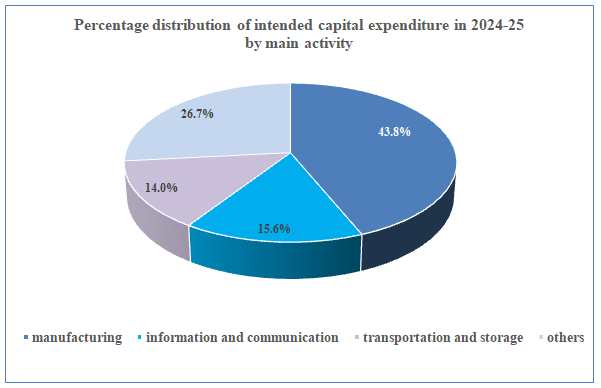
The estimated provisional capital expenditure per enterprise for acquiring new assets in 2024–25 stands at ₹172.2 crore. Among the sectors, manufacturing enterprises account for the largest share at 43.8%, followed by those in ‘Information and Communication Activities’ (15.6%) and ‘Transportation and Storage Activities’ (14.0%).
Estimated Key Indicators for 2023-24 by Asset Groups

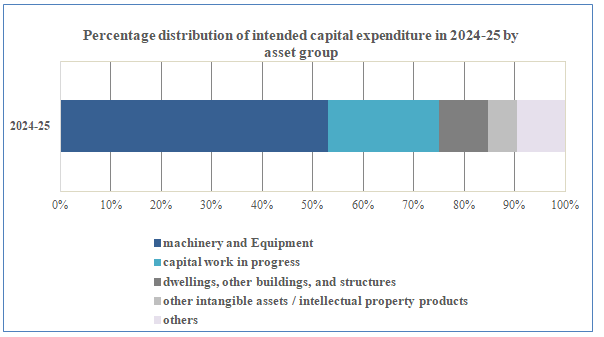
The estimated provisional capital expenditure per enterprise for acquiring new assets in 2024–25 stands at ₹172.2 crore. Out of the total capital expenditure provisionally incurred in the year 2024-25, nearly 53.1% were utilized for purchasing machinery & equipment. The amount allocated for ‘capital work in progress’ (22.0%) and purchasing ‘dwellings, other buildings and structures’ (9.7%) had the next highest share of allocation.
Strategy of CAPEX in 2024-25

According to survey estimates, nearly 40.3% of enterprises plan to undertake CAPEX on core assets during 2024–25. Additionally, 28.4% intend to invest in value addition to existing assets, while around 11.5% focus on opportunistic assets, and 2.7% on debt strategies. The strategy of investing in distressed assets and non-performing loans was adopted by less than one-half of a percent of enterprises. Meanwhile, about 16.9% allocated their CAPEX towards other diverse investment strategies.
Objectives of CAPEX in 2024-25

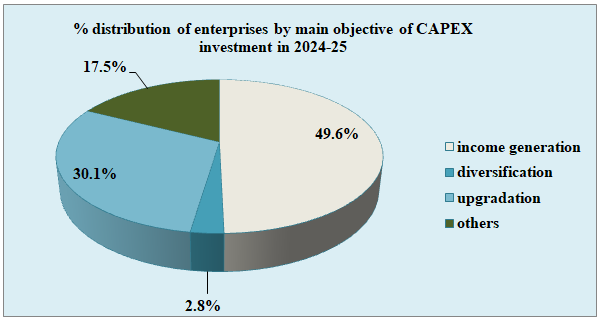
The survey estimates indicate that nearly 49.6% of private corporate sector enterprises undertook CAPEX in 2024–25 primarily for income generation. An additional 30.1% directed their investments toward upgradation, while around 2.8% focused on diversification. Remaining 17.5% of enterprises reported using their CAPEX for other reasons.
The results of CAPEX survey are provided in the booklet which is available in the website of the Ministry (https://www.mospi.gov.in). To protect the confidentiality of CAPEX investment plans of individual enterprises, the Steering Committee of NSS Surveys recommended that unit-level data of CAPEX survey would not be disseminated.

Endnote: A brief about the coverage, sampling scheme, sample size and data collection mechanism in the Forward-Looking Survey on Private Sector CAPEX Investment Intentions:

A. Coverage:

The survey covered large private corporate sector enterprises that play a significant role in their respective sectors. The sampling frame was madeusing data from active enterprises registered with the Ministry of Corporate Affairs (MCA), filtered based on annual turnover thresholds achieved in at least one of the last three financial years. The eligibility criteria were as follows:

  • Manufacturing enterprises with an annual turnover of ₹400 crore or more
  • Trade enterprises with an annual turnover of ₹300 crore or more
  • Other enterprises with an annual turnover of ₹100 crore or more

Based on these criteria, the final survey frame consisted of 16,025 enterprises.

B. Sampling Scheme:

Eligible enterprises were initially categorized into seventeen (17) strata based on their Principal Business Activity as reported in the MGT-7 Form of the Ministry of Corporate Affairs (MCA). In strata with 100 or fewer enterprises, all units were included in the Census Sector for complete enumeration.

For strata with more than 100 enterprises, the selection process involved identifying Census Sector Enterprises and Sample Sector Enterprises. To determine the Census Sector, enterprises were ranked in descending order based on (i) the highest fixed asset value in the past three years and (ii) the fixed asset value of latest reported year. The top enterprises accounting for 90% of asset value (or 80% for Construction and Trade) from either list were classified as Census Sector Enterprises. The remaining units formed the Sample Sector, from which 10% were randomly selected using Simple Random Sampling without Replacement (SRSWOR), with allocation proportional to each stratum’s size and variation.

C. Sample Size:

The sample size for the survey was of 5,380 enterprises: 4,145 enterprises in the Census Sector and 1,235 enterprises in sample sector.

DData Collection Mechanism:

The survey was conducted under the provisions of the Collection of Statistics Act, 2008, with prior notices sent to all selected enterprises outlining the survey’s objective and intended use of the data. Confidentiality of individual responses was strictly maintained, and no unit-level data would be disseminated. A secure, dedicated web portal was developed to enable selected enterprises to complete and submit the survey questionnaire online. The portal included background information on the survey, reasons for a unit’s selection, and chatbot support to assist respondents in understanding key concepts and definitions.

Topics

Acts Income Tax