

Loading...

Top
Help
×

By creating an account you can:

Logo TaxTMI
Call Us / Help / Feedback

Contact Us At :

E-mail: [email protected]

Call / WhatsApp at: +91 99117 96707

For more information, Check Contact Us

FAQs :

To know Frequently Asked Questions, Check FAQs

Most Asked Video Tutorials :

For more tutorials, Check Video Tutorials

Submit Feedback/Suggestion :

Email :
Please provide your email address so we can follow up on your feedback.
Category :
Description :
Min 15 characters 0/2000
Make Most of Text Search
  1. Checkout this video tutorial: How to search effectively on TaxTMI.
  2. Put words in double quotes for exact word search, eg: "income tax"
  3. Avoid noise words such as : 'and, of, the, a'
  4. Sort by Relevance to get the most relevant document.
  5. Press Enter to add multiple terms/multiple phrases, and then click on Search to Search.
  6. Text Search
  7. The system will try to fetch results that contains ALL your words.
  8. Once you add keywords, you'll see a new 'Search In' filter that makes your results even more precise.
  9. Text Search
Add to...
You have not created any category. Kindly create one to bookmark this item!
Create New Category
Hide
Title :
Description :
❮❮ Hide
Default View
Expand ❯❯
Close ✕
🔎 News - Adv. Search
TEXT SEARCH:

Press 'Enter' to add multiple search terms. Rules for Better Search

Search In:
Main Text + AI Text
  • Main Text
  • Main Text + AI Text
  • AI Text
Category: ?
Categorized by AI
---- All Categories ----
  • ---- All Categories ----
  • Income Tax
  • GST
  • Customs, DGFT & SEZ
  • FEMA & RBI
  • Corp. Laws, SEBI & IBC
  • PMLA, Black Money & ED
  • Budget
  • News and Press Release
  • PTI News
Month:
---- All Months ----
  • ---- All Months ----
  • January
  • February
  • March
  • April
  • May
  • June
  • July
  • August
  • September
  • October
  • November
  • December
Year:
---- All Years ----
  • ---- All Years ----
  • 2026
  • 2025
  • 2024
  • 2023
  • 2022
  • 2021
  • 2020
  • 2019
  • 2018
  • 2017
  • 2016
  • 2015
  • 2014
  • 2013
  • 2012
  • 2011
Sort By: ?
In Sort By 'Default', exact matches for text search are shown at the top, followed by the remaining results in their regular order.
Relevance Default Date
    A Vision for Responsible AI, Resilient Banking - Keynote Address [Contributions by RBI colleagues Ms. Chandni Trehan Saluja and Ms. Kavita Gangwal, De...
    Razorpay Launches Multi-Currency Account, Helping Exporters Retain International Earnings in Foreign Currencies
    DB HiTek to Make Debut at electronica India 2026, Targeting Growth in Indian Market
    BJP demands Vijayan’s resignation from Keralam LoP post over ED findings in CMRL case
    Pakistan seeks USD 10 bn US facility to bolster forex stability
    DRI busts a wildlife trafficking syndicate involved in illicit trade of ivory artefacts
    Japan reports record exports, imports for July as energy costs climb
    Five held in UP's Bareilly for alleged fake Ayushman cards racket
    MSMEs are the true builders of India’s economic resilience: LG Sinha
    RBI MPC preferred wait-and-watch stance amid food and fuel inflation risks: Minutes
    Bihar Police arrests man over alleged exam irregularities
    United Arab Emirates suspends trade with Iran after coming under renewed missile fire
    RBI minutes: Governor Malhotra awaits more clarity on inflation, opts for rate hold
    Instant Credit Card Application With JioFinance: Step-by-Step Guide
    Union Minister of Commerce & Industry Shri Piyush Goyal leaves for Singapore for 4th India-Singapore Ministerial Roundtable and 4th India-Singapore Bu...
    IDFC FIRST Bank successfully accesses international debt capital markets with maiden US$500 million bond issuance
    Any attempt to defame CAS by manipulation will be dealt with sternly, warns Sebi's Pandey
    Rupee falls 2 paise to settle at 95.76 against US dollar
    QualityKiosk Establishes Hyderabad Engineering Hub to Advance AI Reliability, Agentic Engineering and AI Assurance for Global Enterprises
    ED raids SP leader Azam Khan's Trust and university in UP
❯❯
Maximize Maximize Maximize
0 / 200
Expand Note
Add to Folder

No Folders have been created

+

Are you sure you want to delete "My most important" ?

NOTE:

News
Showing Results for :
Reset Filters
Results Found:
Show All Summaries Hide All Summaries
August 20, 2026
Show AI Summary
Responsible AI banking requires human oversight, explainable customer decisions, fair conduct, resilient systems and inclusive credit access.
Responsible AI in banking must promote inclusion, resilience and customer trust while preserving human judgement, governance accountability and clear responsibility. AI and alternative data may widen access to credit where data is obtained with consent, tested for reliability and bias, and used prudently. Banks must maintain capacity to challenge models, oversee providers, test systems under adverse conditions and intervene when automation fails. Material customer decisions must be explainable, clearly communicated and subject to review by an authorised person. Fair conduct, meaningful disclosure, impartial complaint review and transparent communication remain essential throughout the customer relationship.
August 20, 2026
Show AI Summary
Multi-Currency EEFC settlements let exporters retain foreign earnings and choose conversion timing for overseas payment obligations.
Multi-Currency EEFC Account settlements enable exporters and international businesses to receive payment settlements directly into Exchange Earners' Foreign Currency accounts in the original transaction currency without immediate conversion into Indian rupees. Retention of foreign currency earnings permits businesses to choose when conversion is required, reducing repeated foreign-exchange conversion cycles and supporting management of foreign-currency cash flows and overseas obligations.
August 20, 2026
Show AI Summary
Power semiconductor foundry expansion targets Indian fabless customers through technology showcasing, process development, and collaboration in the growing semiconductor market.
DB HiTek seeks to expand foundry business with Indian fabless semiconductor companies by showcasing power semiconductor and specialised process technologies. Its commercial focus includes BCD processes for automotive and industrial applications, together with silicon-carbide and gallium-nitride process development and planned volume production. Product-performance evaluations are underway with strategic customers. Customer expansion also covers X-ray, global-shutter, single-photon avalanche diode, specialty CIS, and mixed-signal/RF processes, supported by collaboration with local fabless firms.
August 20, 2026
Show AI Summary
Money-laundering allegations over payments without services raise concerns about overseas transfers, identity-linked communications, and mineral smuggling.
Money-laundering allegations concern claimed payments by Cochin Minerals and Rutile Ltd. to Exalogic Solutions Pvt. Ltd., a company promoted by Veena T., without corresponding services. Searches reportedly yielded handwritten material referring to fund transfers to Dubai and digital material relating to a SIM card obtained in another person's name. Further allegations included overseas fund movement, hawala transfers, and possible thorium or monazite smuggling, all presented as allegations requiring examination.
August 20, 2026
Show AI Summary
Exchange stabilisation support aims to strengthen foreign-exchange resilience, reduce rollover dependence and restore access to longer-term market financing.
Pakistan has sought a proposed Exchange Stabilisation Support Facility to reinforce foreign-exchange stability and signal currency resilience to international capital markets. The strategy seeks to reduce reliance on short-term bilateral loans, deposits and rollovers by moving towards market-based financing with longer repayment periods. Improving sovereign creditworthiness through engagement with credit-rating agencies is intended to facilitate international market access, lower borrowing costs and enable longer-maturity debt raising.
August 20, 2026
Show AI Summary
Elephant ivory trade prohibition supports enforcement against wildlife trafficking, seizure of carved ivory articles, and further investigation.
Illicit trade in elephant ivory and articles manufactured from it is prohibited under the Wildlife (Protection) Act, 1972, supporting India's CITES obligations. Enforcement action against a wildlife-trafficking syndicate resulted in the interception of four persons and seizure of 54 carved ivory artefacts. The seized articles and apprehended persons were transferred to the State Forest Department for further investigation. The action forms part of continuing measures against unlawful trade in wildlife derivatives and biodiversity threats.
August 20, 2026
Show AI Summary
Trade deficit pressures persist as energy-import costs and currency weakness offset record automobile and electronics export growth.
Japan recorded its highest July import and export values since comparable statistics began, but continued to experience a trade deficit as rising energy costs increased import expenditure. Higher crude oil prices and disruption to Middle East supply routes affected an economy reliant on imported oil, while a weak yen raised the cost of fuel, food and raw materials. Strong automobile, semiconductor and electronics exports benefited from currency weakness, which also increased the yen value of overseas earnings.
August 19, 2026
Show AI Summary
Forged health-scheme cards allegedly enabled ineligible treatment and misuse of public healthcare funds through false beneficiary details.
Alleged misuse of Ayushman health-scheme cards involved collecting identity and ration-card details by promising free treatment, then creating forged beneficiary cards with false particulars. The alleged scheme enabled treatment for ineligible persons and purported claims of government health-scheme funds. Police arrested five persons, recovered purported forged identity and beneficiary cards, and are investigating possible involvement of hospital and medical-office personnel, the scale of card forgery, and alleged diversion of public funds.
August 19, 2026
Show AI Summary
MSME competitiveness requires affordable credit, technology adoption, formalisation, sustainable trade and stronger export-market access for inclusive growth.
MSME development is identified as central to employment generation, exports, entrepreneurship, economic resilience and self-reliance. Key priorities include affordable credit, technology upgradation, supply-chain integration, market access, brand-building and reduced red tape. Formalisation of micro industries is emphasised to expand institutional credit access, while sustainable trade is promoted through green technologies and renewable energy. Export competitiveness is to be strengthened through regional production capabilities and the "One District, One Export Hub" initiative.
August 19, 2026
Show AI Summary
Supply-side inflation risks support a policy pause pending evidence of broad-based, persistent price pressures and de-anchored expectations.
Monetary policy calibration remained on hold because food and fuel inflation had not yet produced broad-based or persistent price pressures. The policy pause was supported by limited pass-through of supply-side shocks, contained core inflation and no clear demand-driven overheating. Recalibration depends on incoming evidence of persistent inflation, entrenched supply-side pressures, de-anchored expectations and the evolving growth-inflation dynamic. Geopolitical disruption, volatile oil prices, monsoon conditions and El Nin o-related agricultural risks remain material inflation risks.
August 19, 2026
Show AI Summary
Examination irregularities investigation examines alleged answer-sheet cheating, managed centres and suspected solver-gang involvement by a biometric operator.
Alleged examination irregularities involved suspected cheating through the receipt of an answer sheet by an examinee from personnel of a private firm conducting the examination. Police arrested a biometric operator following an investigation into his alleged involvement. His prior work with biometric firms and manpower supply agencies was examined in connection with clues concerning allegedly managed examination centres and a suspected solver gang.
August 19, 2026
Show AI Summary
Trade restrictions on Iran halt commercial and financial exchanges as regional security threats disrupt maritime commerce and re-export access.
UAE trade restrictions on Iran halted all trade, commercial exchanges and financial transactions until further notice following reported ballistic-missile incidents and regional security escalation. The UAE assessed the missiles as directed at maritime traffic, while Iran denied launching them. The suspension disrupts the UAE's role as a major trade and re-export gateway for Iran and may increase Iran's economic isolation. Continuing threats to shipping through the Strait of Hormuz also create economic risk for the UAE's regional business, finance and tourism position.
August 19, 2026
Show AI Summary
Inflation persistence and expectations guide continued rate hold amid supply shocks and uncertainty over broader price pressures.
Monetary policy calibration remains contingent on clearer evidence that supply-side price shocks are becoming persistent, broad-based inflationary pressures. The policy rate was maintained unchanged amid uncertainty from higher energy costs, supply-chain disruption, an erratic monsoon and food, fuel and input-price risks. Policy tightening may be required if inflation becomes generalised, expectations become de-anchored, or inflation persists. A wait-and-watch approach was preferred pending clearer realised inflation, forecasts, weather effects and global conditions.
August 19, 2026
Show AI Summary
Online credit card applications streamline comparison, eligibility screening and e-KYC, while approval remains subject to issuing-bank criteria.
Online credit card applications through the JioFinance app combine card comparison, eligibility checks, electronic verification, application submission and status tracking. Eligibility screening may occur without affecting the applicant's credit score, but approval remains subject to the issuing bank's criteria and internal policies. Aadhaar-based e-KYC or other accepted electronic verification may be used where applicable. Applicants should provide accurate Aadhaar, PAN and mobile details. Eligible approved applicants may receive a virtual card before physical-card delivery, subject to applicable terms and conditions.
August 19, 2026
Show AI Summary
Comprehensive strategic partnership drives ministerial and business engagements on investment, market access, technology collaboration, skills and agri-food trade.
India-Singapore economic engagement is being advanced through ministerial and business roundtables under the Comprehensive Strategic Partnership. A multidisciplinary business delegation is undertaking business-to-business, government-to-business and institutional engagements focused on partnerships, investment, market access, technology collaboration and talent development. Agricultural trade cooperation includes promotion of Indian agri-food exports through a retail initiative. The engagement seeks to strengthen trade, investment, digitalisation, advanced manufacturing, skills development, green-economy cooperation and people-to-people ties.
August 19, 2026
Show AI Summary
International senior notes issuance diversifies the bank's funding sources and expands access to global debt capital markets.
IDFC FIRST Bank accessed international debt capital markets through its IFSC Banking Unit at GIFT City by issuing inaugural fixed-rate senior notes with a three-year tenor, due in 2029. The notes were offered to investors outside the United States under the Regulation S format. The issuance followed an investment-grade long-term issuer credit rating with a stable outlook, diversifies the bank's funding sources, and creates an avenue for access to global capital markets in support of long-term growth.
August 19, 2026
Show AI Summary
Closing auction session safeguards market transparency through pooled order matching, backed by immediate action against manipulation and stronger monitoring.
Closing auction session (CAS) improves transparency and reduces manipulation in end-of-trading price formation by pooling buy and sell orders during a designated closing window for auction-style matching. Manipulation intended to undermine CAS is subject to prompt and stringent action, supported by enhanced monitoring. Responsible use of artificial intelligence and machine learning requires tiered accountability and governance, including kill-switch, human-in-the-loop and data controls. Regulated entities remain responsible for privacy, security and integrity of investor data used by every AI tool they deploy.
August 19, 2026
Show AI Summary
Foreign exchange market movement shows rupee pressure from elevated crude prices, moderated by reserves, intervention and FCNR(B) inflows.
Foreign exchange market movement saw the rupee depreciate marginally against the US dollar amid higher global crude oil prices, heightened West Asia tensions, a stronger dollar environment and weaker domestic equity markets. Central-bank intervention and foreign fund inflows provided support. Adequate foreign-exchange reserves and stronger-than-expected FCNR(B) scheme inflows were identified as factors limiting the scope for sharp depreciation.
August 19, 2026
Show AI Summary
AI reliability engineering expands through an enterprise hub supporting AI assurance, agentic engineering, observability and trusted AI deployment.
QualityKiosk Technologies has established a Hyderabad engineering hub to expand AI reliability engineering, AI assurance and agentic engineering capabilities. The centre supports engineering, marketing, branding, analyst-relations and advisory functions, while serving enterprise demand for AI reliability, product engineering, CloudOps and automation. It advances an AI reliability operating framework covering AI for reliability, reliability of AI, agentic engineering, shift-right engineering, frontier-system reliability, observability and platform-based delivery to promote governance, resilience, operational trust and assurance in AI-powered systems.
August 19, 2026
Show AI Summary
Money laundering investigation examines alleged diversion of government contract funds and their use in creating trust and university assets.
Money-laundering investigation under the Prevention of Money Laundering Act led to searches of premises associated with the Maulana Mohammad Ali Jauhar Trust, its university, linked companies, promoters and a chartered accountant. The inquiry concerns alleged diversion of government contract funds through private contractors and their alleged subsequent use, including for creating assets of the Trust and university. Separate planning-law issues concern allegations that most university buildings were constructed without approved plans.

News

Back

All News

Showing Results for :
Reset Filters
No Records Found

News

Back

All News

Showing Results for : Reset Filters

Findings of the Forward-Looking Survey on Private Sector CAPEX Investment Intentions (Survey period: November 2024 to January 2025)

April 30, 2025

Contents
Summary
Note

Note

-

Bookmark

Print

Print

Private Corporate Sector CAPEX: Three-Year Trends and Future Outlook:

Key findings:

  • The average Gross Fixed Assets per enterprise in the private corporate sector increased from ₹3,151.9 crore in 2021–22 to ₹3,279.4 crore in 2022–23 (4% growth), and further to ₹4,183.3 crore in 2023–24, reflecting a significant 27.5% growth.
  • The estimated CAPEX per enterprise for the years 2021–22, 2022–23, and 2023–24 was ₹109.2 crore, ₹148.8 crore and ₹107.6 crore respectively.
  • The estimated provisional capital expenditure per enterprise for purchasing new assets in 2024–25 is ₹172.2 crore.
  • Overall increase of 66.3% in aggregate CAPEX (unweighted) over the four-year period from 2021-22 to 2024-25.
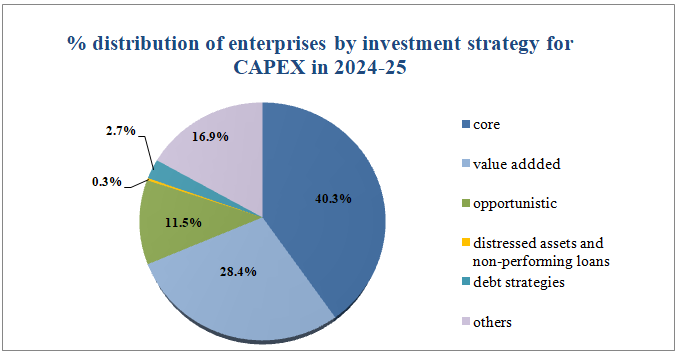
  • The strategy of 40.3% of enterprises is to undertake CAPEX on core assets during 2024–25, followed by 28.4% to invest in value addition to existing assets

Survey Background:

In 2022–23, the Parliamentary Standing Committee recommended that the Ministry of Statistics and Programme Implementation (MoSPI) develop a comprehensive methodology to capture capital expenditure (CAPEX) data from the private sector. Survey instruments designed to capture data on past investments, projected CAPEX for the next two years, and the breakdown of investments by asset type were developed in alignment with the specifications of the Department of Economic Affairs (DEA), Ministry of Finance.

Responding to this recommendation, the National Statistical Office (NSO) conducted the inaugural Forward-Looking Survey on Private Sector CAPEX Investment Intentions between November 2024 and January 2025. This marked the first initiative of MoSPI to engage the corporate sector through a self-administered, web-based survey platform, supported by chatbot assistance, to collect structured CAPEX data. MoSPI has released the findings of the survey in the form of a comprehensive booklet. A brief overview of key aspects, such as survey coverage, sampling methodology, and data collection process, is included in the Endnote.

The primary objective of the CAPEX survey is to estimate the CAPEX trends of private corporate sector enterprises from the past three financial years (2021-22, 2022-23 & 2023-24) along with anticipated capital expenditure for the current year (2024-25) and upcoming financial years (2025-26).

Key advantages of the Survey:

Capital expenditure (CAPEX) plays a crucial role in contributing to national investment and enhancing the stock of physical assets within the economy. It leads to the creation of long-term assets, which not only generate revenue for many years but also improve the overall operational efficiency of economic activities. CAPEX is fundamental to expanding production capacity, thereby serving as a catalyst for accelerated economic growth. This growth, in turn, supports job creation and enhances labour productivity.

Comprehensive data on CAPEX will be a valuable asset for a wide range of stakeholders, including government departments, private enterprises, trade associations, researchers, and other relevant entities. It will enable evidence-based policy formulation through the analysis of trends in future investments. Furthermore, a clear understanding of CAPEX patterns and scale can assist enterprises in making strategic, data-driven investment decisions, guided by the insights derived from survey findings.

Important Caveat:

In this inaugural edition of the survey, industry participation varied, with an overall response rate of 58.3% (58.6% in the census sector and 57.2% in the sample sector). Respondents appeared cautious in disclosing CAPEX plans, often pending management approvals. Certain entities, such as Special Purpose Vehicles (SPVs) involved in infrastructure projects, were excluded from the survey frame as they report no turnover despite high CAPEX. Meanwhile, some included SPVs had no future investment plans due to project completion. As this is the first round of the survey, the findings may be seen as indicative and subject to refinement in future iterations. It is also important to note that the results reflect responses from larger enterprises above specified turnover thresholds and may not represent the entire private corporate sector. Users are advised to interpret the results keeping these limitations in mind.

Insights and Way Forward for Future Survey Conduct

The Forward-Looking Survey on Private Sector Capex Investment Intentions, the first of its kind by the NSO, was conducted under the Collection of Statistics Act, 2008. Notices were issued to selected enterprises, explaining the survey's objectives and assuring confidentiality. However, some enterprises questioned the legitimacy of notices containing portal credentials, leading to multiple cyber risk concerns. Explaining portal usage and submission procedures over the phone was challenging. Data analysis revealed issues such as incorrect unit entries (e.g., Rupees instead of Rupees thousands) and non-responses to follow-up queries. Enterprises also faced difficulties in selecting correct NIC codes and estimating future investments when official data was unavailable.

CAPEX tends to rise when enterprises pursue growth strategies rather than maintain current operations. Despite challenges like weak demand, geopolitical tensions, and high borrowing costs, about 30% of firms plan to invest in upgradation in 2024–25, supporting the sharp increase in CAPEX for that year. The slightly lower intended CAPEX for 2025–26, though still above 2023–24 levels, reflects cautious planning after a strong 2024–25. Overall, the trend indicates growing corporate confidence and a judicious approach to investment amid improving economic certainty.

While the response rate and results were generally promising, this initial round of the survey can be considered as an experimental phase, providing valuable insights to refine the questionnaire, methodology, estimation processes, and overall implementation. The lessons learned will guide improvements for future surveys, with necessary adjustments to various aspects of the survey process. Moving forward, responding enterprises will be engaged more proactively before the survey, with concerns about the authenticity of the online survey being addressed, assistance provided in understanding the questionnaire, confidentiality of individual responses ensured, and field personnel deployed to support enterprises in overcoming technical and conceptual challenges in completing future-oriented surveys. Additionally, the survey will incorporate qualitative inputs, such as reasons for year-on-year changes in investment, to gain deeper insights into enterprise-level CAPEX intentions and trends. The next round of the CAPEX survey is expected to be conducted during October to December 2025.

Key highlights from the CAPEX results:

Aggregated (Unweighted, i.e. without applying any multiplier) CAPEX during (2021-22 to 2025-26)

A total of 2,172 enterprises submitted complete information for all five years of the reference period, forming a fixed panel. The aggregated (unweighted) CAPEX data from this panel of enterprises serves as a reliable basis for analyzing capital expenditure trends over the five-year period, as presented below. The results show an overall increase of 66.3% in aggregate CAPEX (unweighted) over the four-year period from 2021-22 to 2024-25.:

                (in ₹ Crore)

Actual CAPEX in 2021-22

Actual CAPEX

2022-23

Actual CAPEX

2023-24

Intended CAPEX in

2024-25

Intended CAPEX

in 2025-26

394,681.5

572,199.7

422,183.3

656,492.7

488,865.5

Out of the 3,064 responding enterprises, 2,172 reported their Capex intentions for 2025–26. The data indicates a cautious approach by respondents in declaring their capital expenditure plans. Therefore, the Capex data for 2025–26 should be interpreted with caution, considering the conservative approach and apprehension shown by the responding enterprises in reporting these figures. However, the results show an overall increase of 23.9% in aggregate CAPEX (unweighted) during 2021-22 to 2025-26 for this fixed panel of 2,172 enterprises.

Estimated Key Indicators for past years (2021-22 to 2023-24) by Industry of Activity as per National Industry of Classification (Activity Categories)

The average Gross Fixed Asset (GFA) per enterprise in the private corporate sector was estimated at ₹3,151.9 crore in 2021–22. It increased by 4.0% to ₹3,279.4 crores in 2022–23, and further grew by 27.5% to reach ₹4,183.3 crore in 2023–24.

The highest GFA per enterprise, exceeding ₹14,000 crore, was observed in the industry category ‘Electricity, Gas, Steam, and Air Conditioning Supply’, followed by ‘Manufacturing” enterprises (₹7,000 crore to ₹10,000 crore). Enterprises principally engaged in manufacturing activities accounted for more than 65% of the total Gross fixed asset[1] in private corporate sector over the past three years from 2021-22 to 2023-24 followed by enterprises engaged in ‘Electricity, Gas, Steam, and Air Conditioning Supply’ (8%-10%).

In 2021–22, the estimated actual CAPEX per enterprise was ₹109.3 crore, compared to the proposed value of ₹102.7 crore, resulting in a realisation ratio of 106.41 %. A similar trend was observed in 2022–23, where the estimated value of actual CAPEX per enterprise reached ₹148.8 crore against a proposed value of ₹133.3 crore, also yielding a realisation ratio exceeding 100%. For 2023–24, the realisation ratio stands at 99.7%, with the estimated actual CAPEX per enterprise at ₹107.6 and the proposed CAPEX at ₹107.9.

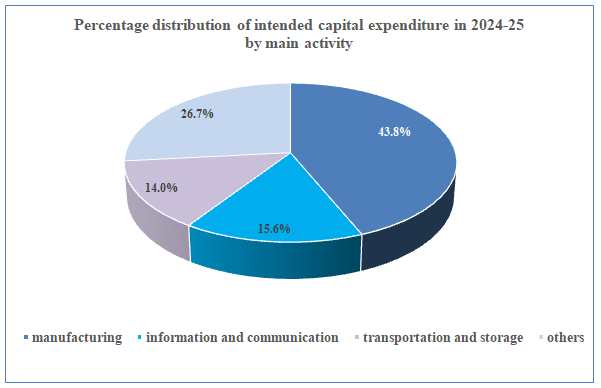
The estimated provisional capital expenditure per enterprise for acquiring new assets in 2024–25 stands at ₹172.2 crore. Among the sectors, manufacturing enterprises account for the largest share at 43.8%, followed by those in ‘Information and Communication Activities’ (15.6%) and ‘Transportation and Storage Activities’ (14.0%).
Estimated Key Indicators for 2023-24 by Asset Groups

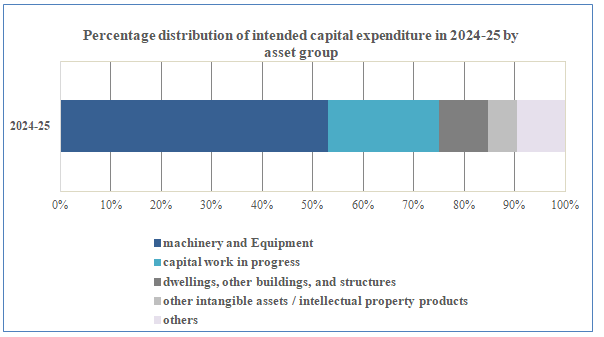
The estimated provisional capital expenditure per enterprise for acquiring new assets in 2024–25 stands at ₹172.2 crore. Out of the total capital expenditure provisionally incurred in the year 2024-25, nearly 53.1% were utilized for purchasing machinery & equipment. The amount allocated for ‘capital work in progress’ (22.0%) and purchasing ‘dwellings, other buildings and structures’ (9.7%) had the next highest share of allocation.
Strategy of CAPEX in 2024-25

According to survey estimates, nearly 40.3% of enterprises plan to undertake CAPEX on core assets during 2024–25. Additionally, 28.4% intend to invest in value addition to existing assets, while around 11.5% focus on opportunistic assets, and 2.7% on debt strategies. The strategy of investing in distressed assets and non-performing loans was adopted by less than one-half of a percent of enterprises. Meanwhile, about 16.9% allocated their CAPEX towards other diverse investment strategies.
Objectives of CAPEX in 2024-25

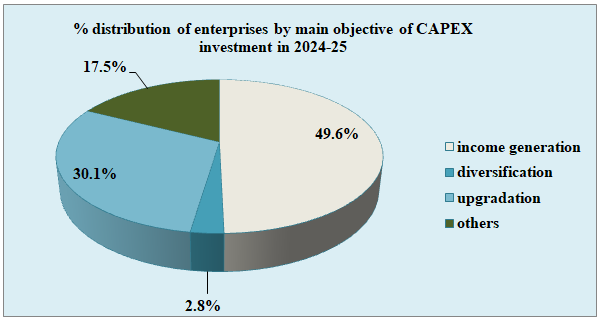
The survey estimates indicate that nearly 49.6% of private corporate sector enterprises undertook CAPEX in 2024–25 primarily for income generation. An additional 30.1% directed their investments toward upgradation, while around 2.8% focused on diversification. Remaining 17.5% of enterprises reported using their CAPEX for other reasons.
The results of CAPEX survey are provided in the booklet which is available in the website of the Ministry (https://www.mospi.gov.in). To protect the confidentiality of CAPEX investment plans of individual enterprises, the Steering Committee of NSS Surveys recommended that unit-level data of CAPEX survey would not be disseminated.

Endnote: A brief about the coverage, sampling scheme, sample size and data collection mechanism in the Forward-Looking Survey on Private Sector CAPEX Investment Intentions:

A. Coverage:

The survey covered large private corporate sector enterprises that play a significant role in their respective sectors. The sampling frame was madeusing data from active enterprises registered with the Ministry of Corporate Affairs (MCA), filtered based on annual turnover thresholds achieved in at least one of the last three financial years. The eligibility criteria were as follows:

  • Manufacturing enterprises with an annual turnover of ₹400 crore or more
  • Trade enterprises with an annual turnover of ₹300 crore or more
  • Other enterprises with an annual turnover of ₹100 crore or more

Based on these criteria, the final survey frame consisted of 16,025 enterprises.

B. Sampling Scheme:

Eligible enterprises were initially categorized into seventeen (17) strata based on their Principal Business Activity as reported in the MGT-7 Form of the Ministry of Corporate Affairs (MCA). In strata with 100 or fewer enterprises, all units were included in the Census Sector for complete enumeration.

For strata with more than 100 enterprises, the selection process involved identifying Census Sector Enterprises and Sample Sector Enterprises. To determine the Census Sector, enterprises were ranked in descending order based on (i) the highest fixed asset value in the past three years and (ii) the fixed asset value of latest reported year. The top enterprises accounting for 90% of asset value (or 80% for Construction and Trade) from either list were classified as Census Sector Enterprises. The remaining units formed the Sample Sector, from which 10% were randomly selected using Simple Random Sampling without Replacement (SRSWOR), with allocation proportional to each stratum’s size and variation.

C. Sample Size:

The sample size for the survey was of 5,380 enterprises: 4,145 enterprises in the Census Sector and 1,235 enterprises in sample sector.

DData Collection Mechanism:

The survey was conducted under the provisions of the Collection of Statistics Act, 2008, with prior notices sent to all selected enterprises outlining the survey’s objective and intended use of the data. Confidentiality of individual responses was strictly maintained, and no unit-level data would be disseminated. A secure, dedicated web portal was developed to enable selected enterprises to complete and submit the survey questionnaire online. The portal included background information on the survey, reasons for a unit’s selection, and chatbot support to assist respondents in understanding key concepts and definitions.

Topics

Acts Income Tax