

Loading...

Top
Help
×

By creating an account you can:

Logo TaxTMI
Call Us / Help / Feedback

Contact Us At :

E-mail: [email protected]

Call / WhatsApp at: +91 99117 96707

For more information, Check Contact Us

FAQs :

To know Frequently Asked Questions, Check FAQs

Most Asked Video Tutorials :

For more tutorials, Check Video Tutorials

Submit Feedback/Suggestion :

Email :
Please provide your email address so we can follow up on your feedback.
Category :
Description :
Min 15 characters 0/2000
Make Most of Text Search
  1. Checkout this video tutorial: How to search effectively on TaxTMI.
  2. Put words in double quotes for exact word search, eg: "income tax"
  3. Avoid noise words such as : 'and, of, the, a'
  4. Sort by Relevance to get the most relevant document.
  5. Press Enter to add multiple terms/multiple phrases, and then click on Search to Search.
  6. Text Search
  7. The system will try to fetch results that contains ALL your words.
  8. Once you add keywords, you'll see a new 'Search In' filter that makes your results even more precise.
  9. Text Search
Add to...
You have not created any category. Kindly create one to bookmark this item!
Create New Category
Hide
Title :
Description :
❮❮ Hide
Default View
Expand ❯❯
Close ✕
🔎 News - Adv. Search
TEXT SEARCH:

Press 'Enter' to add multiple search terms. Rules for Better Search

Search In:
Main Text + AI Text
  • Main Text
  • Main Text + AI Text
  • AI Text
Category: ?
Categorized by AI
---- All Categories ----
  • ---- All Categories ----
  • Income Tax
  • GST
  • Customs, DGFT & SEZ
  • FEMA & RBI
  • Corp. Laws, SEBI & IBC
  • PMLA, Black Money & ED
  • Budget
  • News and Press Release
  • PTI News
Month:
---- All Months ----
  • ---- All Months ----
  • January
  • February
  • March
  • April
  • May
  • June
  • July
  • August
  • September
  • October
  • November
  • December
Year:
---- All Years ----
  • ---- All Years ----
  • 2026
  • 2025
  • 2024
  • 2023
  • 2022
  • 2021
  • 2020
  • 2019
  • 2018
  • 2017
  • 2016
  • 2015
  • 2014
  • 2013
  • 2012
  • 2011
Sort By: ?
In Sort By 'Default', exact matches for text search are shown at the top, followed by the remaining results in their regular order.
Relevance Default Date
    Stock Market for Beginners: How to Start Investing Without Feeling Overwhelmed
    CGST Zone detects clandestine pan masala, tobacco unit, detects tax evasion of Rs 160 cr
    Korea Industry Expo (KoINDEX) 2026 Opens at Yashobhoomi on 27 August
    Protection in predicate offence doesn't automatically extend to PMLA case: Delhi HC
    DFS Concludes Two-Day Workshop on Enhancing Accessibility of Financial Services for Divyangjans
    National Financial Reporting Authority (NFRA) conducts sixth outreach programmes with focus on small and medium auditors under the theme “Creating a...
    CCI imposes monetary and non-monetary sanctions on Agro Input Dealers Association, Agro Input Welfare Association for indulging in anti-competitive co...
    India-Finland cooperation takes centre stage at circular economy forum
    CCI imposes penalty on Rekha Agencies and SS Marketing for indulging in anti-competitive conduct in respect of Himachal Pradesh Tender 2013 for the pr...
    US is set to impose 50% tariffs on $20 billion worth of Canadian products
    Rupee settles 3 paise higher at 95.71 against US dollar
    29 FDI Investments Worth ₹4,895.65 Crore Reported Under Revised Framework
    India and ADB sign $230 million loan to modernise water supply and sanitation in Chennai
    DGGI unearths clandestine pan masala and tobacco manufacturing network in Uttar Pradesh; 27 undeclared pouch-packing machines seized, evasion of about...
    Mission SAKSHAM: Scaling Capability through Co-operation - Keynote Address by Shri Swaminathan J, Deputy Governor at Mission SAKSHAM Programme for Dir...
    India’s Foreign Exchange Markets: Getting ready for the next Decade [Keynote Address delivered by Deputy Governor Shri Rohit Jain on the Annual Day ...
    Govt rejects ethanol link to sugar price surge, says duty free imports allowed to curb prices
    China moves to wrap up saga of troubled property giant Evergrande after founder gets life sentence
    India's forex kitty swells USD 9.9 bn to USD 716.9 bn
    Bengaluru airport: AERA slashes user development fee to Rs 300 for domestic passengers
❯❯
Maximize Maximize Maximize
0 / 200
Expand Note
Add to Folder

No Folders have been created

+

Are you sure you want to delete "My most important" ?

NOTE:

News
Showing Results for :
Reset Filters
Results Found:
Show All Summaries Hide All Summaries
August 22, 2026
Show AI Summary
Beginner stock market investing requires regulated accounts, risk-aware financial planning, diversification and informed company assessment before purchasing securities.
Beginner stock market investing requires a bank account, a trading or broking account with a SEBI-registered broker, and a Demat account for electronic holding of securities. Investments involve risk of loss and should align with financial goals, time horizon and loss-bearing capacity. Investors should understand primary and secondary markets, distinguish long-term investing from short-term trading, assess companies before purchase, diversify holdings, consider charges, maintain records and avoid borrowed-money investing, rumours and momentum-driven decisions.
August 22, 2026
Show AI Summary
Capacity-based tobacco taxation targets undeclared packing machinery used for clandestine production and clearance without indirect tax payment.
Clandestine manufacture and clearance of pan masala, scented jarda and tobacco products without registration or payment of GST, HSNS Cess and central excise duty was detected through an intelligence-led search. Undeclared Form-Fill-Seal packing machines, workers, finished goods, raw materials, transport vehicles, packing materials and records indicated unaccounted production and clearance. Capacity-based monthly HSNS Cess for pan masala is computed according to the number, type and capacity of installed packing machines, while a corresponding capacity-based central excise levy applies to chewing tobacco, jarda and gutkha.
August 22, 2026
Show AI Summary
Trade exhibition connects Korean exporters with Indian buyers through sector-specific consultations and certification guidance for market entry.
KoINDEX 2026 is a business-to-business trade exhibition bringing Korean manufacturers and exporters together with buyers in India and South Asia. It focuses on beauty and personal-care products, processed and functional foods, and construction, building and safety products. Commercial engagement includes pre-matched export consultations with project owners, contractors, distributors, wholesalers, e-commerce platforms and food distribution businesses. A seminar addresses Bureau of Indian Standards certification and market-entry requirements for Korean products entering the Indian market.
August 22, 2026
Show AI Summary
Independent PMLA proceedings require separate anticipatory bail assessment; predicate-offence protection alone cannot establish pre-arrest protection.
Protection in a predicate-offence FIR does not automatically extend to independent PMLA proceedings. Anticipatory bail in a money-laundering investigation must be assessed under the applicable PMLA condition and on the material connecting the applicant to alleged proceeds of crime. Relevant considerations include the financial trail, recorded statements, bank-account analysis, compliance with summonses, cooperation with inquiry, and the need for personal participation in evidence collection and confrontation with documentary and digital material.
August 22, 2026
Show AI Summary
Financial accessibility for Divyangjans requires compliance standards, practical implementation measures and stronger institutional capacity across financial services.
Accessibility of financial services for Divyangjans was examined through a workshop focused on public sector banks, insurance companies, regulators and public financial institutions. Discussions covered accessibility standards, compliance requirements, legal provisions, practical implementation challenges and institutional best practices under the Sugamya Bharat initiative. Participants considered operational measures to strengthen institutional capacity, inclusivity and equitable access to financial services.
August 22, 2026
Show AI Summary
Audit quality enhancement for small and medium auditors emphasises technology, global standards, inspection insights and stronger financial reporting.
Audit quality and financial reporting reliability were the focus of NFRA's outreach programme for small and medium audit firms. The programme promoted professional capacity-building, alignment with contemporary global standards, adoption of appropriate audit technology, and the public-interest role of the accountancy profession. Technical sessions covered audit strategy documentation, risks of material misstatement, and practical lessons from audit-firm oversight to support improved day-to-day audit practice and high-quality financial reporting.
August 22, 2026
Show AI Summary
Cartelisation by agro-input dealer associations attracted monetary sanctions, cease-and-desist directions, and mandatory competition-compliance training for responsible officials.
Cartelisation by the two agro-input dealer associations and named individuals contravened Section 3(3)(b) read with Section 3(1) of the Competition Act, 2002. Monetary sanctions were imposed, and association office-bearers were held liable under Section 48. The parties and liable officials were directed to cease and desist from future anti-competitive conduct and to organise competition-compliance training to promote awareness and compliance within the associations.
August 22, 2026
Show AI Summary
Circular economy partnerships promote resilient value chains, resource efficiency and sustainable growth alongside evolving India-EU trade integration.
India-Finland circular economy cooperation is being developed through business, technology, investment and commercial partnerships supporting resource-efficient and sustainable growth. Discussions focused on competitive and resilient value chains based on circularity, traceability, resource efficiency and sustainable business practices. Circular economy principles extend beyond waste management into product design, value chains, resource use, skills development and new business models. The India-EU free trade agreement remains subject to legal review and formal ratification and is not yet in force.
August 22, 2026
Show AI Summary
Bid rigging through pre-bid exchange of sensitive price information attracted penalties and cease-and-desist directions in tyre procurement.
Bid rigging in tyre procurement was established where Rekha Agencies and SS Marketing exchanged commercially sensitive price-bid information before submitting bids for the Himachal Pradesh Tender 2013. The concerted conduct contravened the prohibition on anti-competitive agreements and bid rigging. Monetary penalties and cease-and-desist directions were imposed on both enterprises. An official of Rekha Agencies was also penalised for liability arising from the contravention, while proceedings against the official of SS Marketing stood abated following his death.
August 22, 2026
Show AI Summary
Import tariffs on Canadian products trigger potential retaliatory levies after bilateral negotiations fail to reach agreement.
Import tariffs on Canadian products are set to be imposed by the United States at a 50% rate after bilateral negotiations did not produce an agreement. The measures cover products including hockey sticks and tongue depressors and affect a limited share of Canada's annual exports to the United States. Canada has indicated possible retaliatory levies, intensifying the bilateral trade dispute.
August 21, 2026
Show AI Summary
Rupee exchange-rate movement reflected geopolitical tensions, crude oil conditions and market intervention, while export payment rules expanded rupee invoicing.
Foreign Trade Policy amendments facilitate export invoicing and receipt of payments in Indian rupees. For exports to countries outside the Asian Clearing Union, export contracts and invoices may be denominated in Indian rupees or any foreign currency. The earlier general requirement that export earnings be received in a freely convertible currency is thereby eased, while applicable rules continue to vary according to destination.
August 21, 2026
Show AI Summary
Non-controlling land-bordering country ownership permits eligible foreign investment through the automatic route, subject to sectoral conditions and reporting.
Foreign direct investment may use the automatic route where non-controlling beneficial ownership from a land-bordering country in the investor entity does not exceed 10%, subject to sectoral caps, entry routes and other applicable conditions. The beneficial ownership test applies at the investor-entity level. Eligible investors need not obtain separate prior Government approval after reporting relevant information to the Government. The framework replaces the earlier approval requirement applicable even to minimal beneficial ownership from land-bordering countries.
August 21, 2026
Show AI Summary
Climate-resilient urban water security modernises Chennai's supply and sanitation systems through ring-main infrastructure, digital monitoring, and safer sewer operations.
Chennai Climate-Resilient Water Security and Sewerage Project modernises and expands water supply and sanitation infrastructure through a loan arrangement between the Government of India and the Asian Development Bank. Measures include new pipelines, upgraded pumping stations, performance-based utility operations, and a comprehensive ring-main system to improve water-pressure balance, distribution efficiency, reliability and climate resilience. Digital monitoring and advanced blockage-detection technology are intended to improve operational decisions, customer responsiveness and worker safety while eliminating hazardous manual sewer inspections.
August 21, 2026
Show AI Summary
Capacity-based taxation targets undeclared pouch-packing machinery used for clandestine pan masala and tobacco production and untaxed clearances.
Capacity-based taxation of pan masala and specified tobacco products is determined by the number, type and capacity of installed pouch-packing machines. Searches at interconnected manufacturing and trading premises detected unregistered operations using undeclared machinery for clandestine manufacture and clearance of pan masala, scented jarda and gutkha without payment of GST, HSNS cess and central excise duty. Finished goods, raw materials, packing materials and machinery were seized. The manufacturing firm's proprietor was prima facie identified as managing the operation and was arrested under the applicable cess and central excise laws.
August 21, 2026
Show AI Summary
Technology risk oversight requires Urban Co-operative Banks to retain accountability while building shared and role-specific capabilities.
Urban Co-operative Banks must strengthen digital and risk-management capabilities as technology dependence exposes them to cyber threats, fraud, service-provider failures and common-platform vulnerabilities. Outsourcing critical systems does not transfer the bank's responsibility for oversight, safeguards and continuity. Boards and senior management must retain sufficient knowledge to supervise external providers effectively. Mission SAKSHAM supports role-specific, continuous capability building through physical and online learning, while collective infrastructure and shared expertise can supplement individual institutional capacity.
August 21, 2026
Show AI Summary
Foreign exchange market modernisation prioritises delegated decisions, customer transparency, digital workflows, local-currency settlement and accountable risk management.
Foreign exchange market modernisation advances a facilitative, principles-based framework based on delegated decision-making by Authorised Dealers, risk-based reporting, and customer-centric service standards. Authorised Dealers must apply clear internal policies, avoid unnecessary documentation, disclose charges, timelines and grievance mechanisms, and ensure consistent treatment of comparable transactions. Local-currency settlement requires viable trade corridors, competitive hedging, correspondent relationships and robust AML/CFT controls. Digital workflows, electronic trading and reporting infrastructure should improve transparency and resilience, while automated tools remain subject to explainability, review and data-protection safeguards.
August 21, 2026
Show AI Summary
Sugar price containment measures restrict stockholding, permit duty-free imports, and strengthen inventory verification to deter hoarding.
Sugar price containment measures include stock limits for dealers, consumption-based inventory restrictions for bulk consumers, duty-free raw sugar imports, and physical verification of mill stocks to prevent hoarding and artificial scarcity. Price increases are attributed to lower domestic output, festive demand, crop damage, tighter global supplies, and speculation rather than sugar diversion for ethanol. Earlier crushing is advised to improve seasonal availability, while the ethanol programme supports management of sugar surpluses, mill liquidity, and timely sugarcane payments.
August 21, 2026
Show AI Summary
Cross-border insolvency enforcement constrains asset recovery as Evergrande liquidation, founder asset confiscation, and audit-related claims continue.
Evergrande's insolvency process involves liquidation proceedings for its mainland property-development unit and its Hong Kong-listed holding company. Cross-border recovery is constrained by separate Hong Kong and mainland China legal systems, particularly because most operational assets are located in mainland China. Liquidators are pursuing asset-tracing and recovery measures against the founder and connected persons, as well as claims concerning pre-collapse audits. Investigations identified revenue overstatement through manipulated financial data. Creditor recoveries are expected to be limited due to substantial liabilities and constraints on asset realisation.
August 21, 2026
Show AI Summary
Foreign exchange reserves rose through higher currency assets and gold holdings amid measures to attract external forex inflows.
India's foreign exchange reserves increased during the reporting week, led by higher foreign currency assets and gold reserves. Foreign currency assets include the dollar-value effects of movements in non-US currencies held as reserves. Special drawing rights declined marginally, while the reserve position with the International Monetary Fund increased marginally. Concessional swap arrangements formed part of measures to attract foreign-exchange inflows, while earlier reserve movements were linked to rupee pressure and dollar-sale intervention in the foreign-exchange market.
August 21, 2026
Show AI Summary
Incremental tariff recovery aligns airport user charges with completed infrastructure, preventing passengers from funding non-operational capital projects prematurely.
User development fees and airport tariffs for Bengaluru International Airport have been revised for the April 2026 to March 2031 control period. The incremental Average Revenue Requirement framework excludes costs of identified high-value capital projects from tariffs until the relevant assets are completed, commissioned and available for users. Incremental tariff recovery may begin only upon operational availability, aligning charges with infrastructure use, reducing premature recovery risk for passengers and airlines, and encouraging timely completion of major capital works.

News

Back

All News

Showing Results for :
Reset Filters
No Records Found

News

Showing Results for : Reset Filters

Findings of the Forward-Looking Survey on Private Sector CAPEX Investment Intentions (Survey period: November 2024 to January 2025)

April 30, 2025

Contents
Summary
Note

Note

-

Bookmark

Print

Print

Private Corporate Sector CAPEX: Three-Year Trends and Future Outlook:

Key findings:

  • The average Gross Fixed Assets per enterprise in the private corporate sector increased from ₹3,151.9 crore in 2021–22 to ₹3,279.4 crore in 2022–23 (4% growth), and further to ₹4,183.3 crore in 2023–24, reflecting a significant 27.5% growth.
  • The estimated CAPEX per enterprise for the years 2021–22, 2022–23, and 2023–24 was ₹109.2 crore, ₹148.8 crore and ₹107.6 crore respectively.
  • The estimated provisional capital expenditure per enterprise for purchasing new assets in 2024–25 is ₹172.2 crore.
  • Overall increase of 66.3% in aggregate CAPEX (unweighted) over the four-year period from 2021-22 to 2024-25.
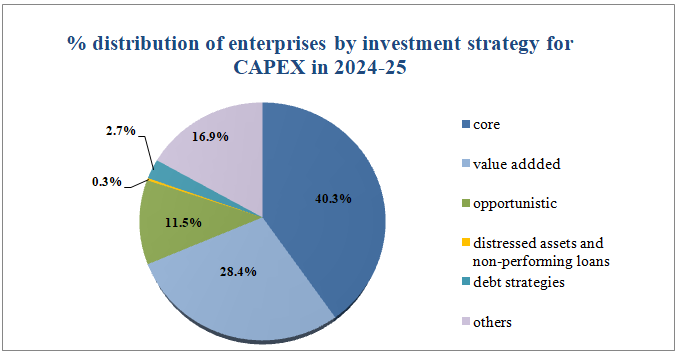
  • The strategy of 40.3% of enterprises is to undertake CAPEX on core assets during 2024–25, followed by 28.4% to invest in value addition to existing assets

Survey Background:

In 2022–23, the Parliamentary Standing Committee recommended that the Ministry of Statistics and Programme Implementation (MoSPI) develop a comprehensive methodology to capture capital expenditure (CAPEX) data from the private sector. Survey instruments designed to capture data on past investments, projected CAPEX for the next two years, and the breakdown of investments by asset type were developed in alignment with the specifications of the Department of Economic Affairs (DEA), Ministry of Finance.

Responding to this recommendation, the National Statistical Office (NSO) conducted the inaugural Forward-Looking Survey on Private Sector CAPEX Investment Intentions between November 2024 and January 2025. This marked the first initiative of MoSPI to engage the corporate sector through a self-administered, web-based survey platform, supported by chatbot assistance, to collect structured CAPEX data. MoSPI has released the findings of the survey in the form of a comprehensive booklet. A brief overview of key aspects, such as survey coverage, sampling methodology, and data collection process, is included in the Endnote.

The primary objective of the CAPEX survey is to estimate the CAPEX trends of private corporate sector enterprises from the past three financial years (2021-22, 2022-23 & 2023-24) along with anticipated capital expenditure for the current year (2024-25) and upcoming financial years (2025-26).

Key advantages of the Survey:

Capital expenditure (CAPEX) plays a crucial role in contributing to national investment and enhancing the stock of physical assets within the economy. It leads to the creation of long-term assets, which not only generate revenue for many years but also improve the overall operational efficiency of economic activities. CAPEX is fundamental to expanding production capacity, thereby serving as a catalyst for accelerated economic growth. This growth, in turn, supports job creation and enhances labour productivity.

Comprehensive data on CAPEX will be a valuable asset for a wide range of stakeholders, including government departments, private enterprises, trade associations, researchers, and other relevant entities. It will enable evidence-based policy formulation through the analysis of trends in future investments. Furthermore, a clear understanding of CAPEX patterns and scale can assist enterprises in making strategic, data-driven investment decisions, guided by the insights derived from survey findings.

Important Caveat:

In this inaugural edition of the survey, industry participation varied, with an overall response rate of 58.3% (58.6% in the census sector and 57.2% in the sample sector). Respondents appeared cautious in disclosing CAPEX plans, often pending management approvals. Certain entities, such as Special Purpose Vehicles (SPVs) involved in infrastructure projects, were excluded from the survey frame as they report no turnover despite high CAPEX. Meanwhile, some included SPVs had no future investment plans due to project completion. As this is the first round of the survey, the findings may be seen as indicative and subject to refinement in future iterations. It is also important to note that the results reflect responses from larger enterprises above specified turnover thresholds and may not represent the entire private corporate sector. Users are advised to interpret the results keeping these limitations in mind.

Insights and Way Forward for Future Survey Conduct

The Forward-Looking Survey on Private Sector Capex Investment Intentions, the first of its kind by the NSO, was conducted under the Collection of Statistics Act, 2008. Notices were issued to selected enterprises, explaining the survey's objectives and assuring confidentiality. However, some enterprises questioned the legitimacy of notices containing portal credentials, leading to multiple cyber risk concerns. Explaining portal usage and submission procedures over the phone was challenging. Data analysis revealed issues such as incorrect unit entries (e.g., Rupees instead of Rupees thousands) and non-responses to follow-up queries. Enterprises also faced difficulties in selecting correct NIC codes and estimating future investments when official data was unavailable.

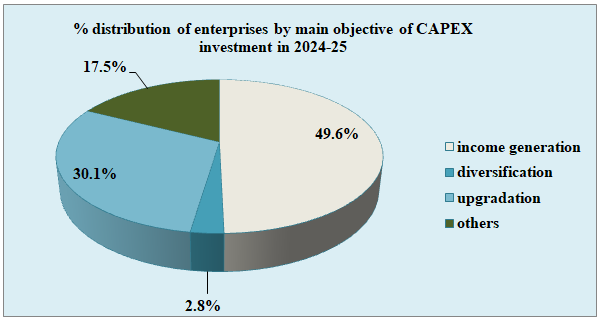
CAPEX tends to rise when enterprises pursue growth strategies rather than maintain current operations. Despite challenges like weak demand, geopolitical tensions, and high borrowing costs, about 30% of firms plan to invest in upgradation in 2024–25, supporting the sharp increase in CAPEX for that year. The slightly lower intended CAPEX for 2025–26, though still above 2023–24 levels, reflects cautious planning after a strong 2024–25. Overall, the trend indicates growing corporate confidence and a judicious approach to investment amid improving economic certainty.

While the response rate and results were generally promising, this initial round of the survey can be considered as an experimental phase, providing valuable insights to refine the questionnaire, methodology, estimation processes, and overall implementation. The lessons learned will guide improvements for future surveys, with necessary adjustments to various aspects of the survey process. Moving forward, responding enterprises will be engaged more proactively before the survey, with concerns about the authenticity of the online survey being addressed, assistance provided in understanding the questionnaire, confidentiality of individual responses ensured, and field personnel deployed to support enterprises in overcoming technical and conceptual challenges in completing future-oriented surveys. Additionally, the survey will incorporate qualitative inputs, such as reasons for year-on-year changes in investment, to gain deeper insights into enterprise-level CAPEX intentions and trends. The next round of the CAPEX survey is expected to be conducted during October to December 2025.

Key highlights from the CAPEX results:

Aggregated (Unweighted, i.e. without applying any multiplier) CAPEX during (2021-22 to 2025-26)

A total of 2,172 enterprises submitted complete information for all five years of the reference period, forming a fixed panel. The aggregated (unweighted) CAPEX data from this panel of enterprises serves as a reliable basis for analyzing capital expenditure trends over the five-year period, as presented below. The results show an overall increase of 66.3% in aggregate CAPEX (unweighted) over the four-year period from 2021-22 to 2024-25.:

                (in ₹ Crore)

Actual CAPEX in 2021-22

Actual CAPEX

2022-23

Actual CAPEX

2023-24

Intended CAPEX in

2024-25

Intended CAPEX

in 2025-26

394,681.5

572,199.7

422,183.3

656,492.7

488,865.5

Out of the 3,064 responding enterprises, 2,172 reported their Capex intentions for 2025–26. The data indicates a cautious approach by respondents in declaring their capital expenditure plans. Therefore, the Capex data for 2025–26 should be interpreted with caution, considering the conservative approach and apprehension shown by the responding enterprises in reporting these figures. However, the results show an overall increase of 23.9% in aggregate CAPEX (unweighted) during 2021-22 to 2025-26 for this fixed panel of 2,172 enterprises.

Estimated Key Indicators for past years (2021-22 to 2023-24) by Industry of Activity as per National Industry of Classification (Activity Categories)

The average Gross Fixed Asset (GFA) per enterprise in the private corporate sector was estimated at ₹3,151.9 crore in 2021–22. It increased by 4.0% to ₹3,279.4 crores in 2022–23, and further grew by 27.5% to reach ₹4,183.3 crore in 2023–24.

The highest GFA per enterprise, exceeding ₹14,000 crore, was observed in the industry category ‘Electricity, Gas, Steam, and Air Conditioning Supply’, followed by ‘Manufacturing” enterprises (₹7,000 crore to ₹10,000 crore). Enterprises principally engaged in manufacturing activities accounted for more than 65% of the total Gross fixed asset[1] in private corporate sector over the past three years from 2021-22 to 2023-24 followed by enterprises engaged in ‘Electricity, Gas, Steam, and Air Conditioning Supply’ (8%-10%).

In 2021–22, the estimated actual CAPEX per enterprise was ₹109.3 crore, compared to the proposed value of ₹102.7 crore, resulting in a realisation ratio of 106.41 %. A similar trend was observed in 2022–23, where the estimated value of actual CAPEX per enterprise reached ₹148.8 crore against a proposed value of ₹133.3 crore, also yielding a realisation ratio exceeding 100%. For 2023–24, the realisation ratio stands at 99.7%, with the estimated actual CAPEX per enterprise at ₹107.6 and the proposed CAPEX at ₹107.9.

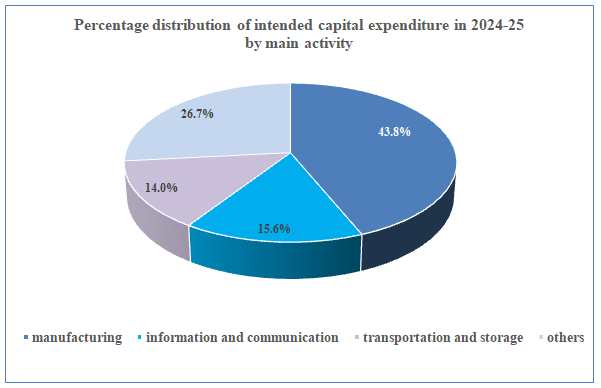
The estimated provisional capital expenditure per enterprise for acquiring new assets in 2024–25 stands at ₹172.2 crore. Among the sectors, manufacturing enterprises account for the largest share at 43.8%, followed by those in ‘Information and Communication Activities’ (15.6%) and ‘Transportation and Storage Activities’ (14.0%).
Estimated Key Indicators for 2023-24 by Asset Groups

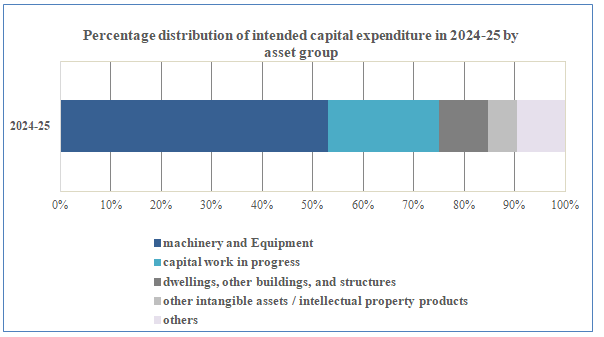
The estimated provisional capital expenditure per enterprise for acquiring new assets in 2024–25 stands at ₹172.2 crore. Out of the total capital expenditure provisionally incurred in the year 2024-25, nearly 53.1% were utilized for purchasing machinery & equipment. The amount allocated for ‘capital work in progress’ (22.0%) and purchasing ‘dwellings, other buildings and structures’ (9.7%) had the next highest share of allocation.
Strategy of CAPEX in 2024-25

According to survey estimates, nearly 40.3% of enterprises plan to undertake CAPEX on core assets during 2024–25. Additionally, 28.4% intend to invest in value addition to existing assets, while around 11.5% focus on opportunistic assets, and 2.7% on debt strategies. The strategy of investing in distressed assets and non-performing loans was adopted by less than one-half of a percent of enterprises. Meanwhile, about 16.9% allocated their CAPEX towards other diverse investment strategies.
Objectives of CAPEX in 2024-25

The survey estimates indicate that nearly 49.6% of private corporate sector enterprises undertook CAPEX in 2024–25 primarily for income generation. An additional 30.1% directed their investments toward upgradation, while around 2.8% focused on diversification. Remaining 17.5% of enterprises reported using their CAPEX for other reasons.
The results of CAPEX survey are provided in the booklet which is available in the website of the Ministry (https://www.mospi.gov.in). To protect the confidentiality of CAPEX investment plans of individual enterprises, the Steering Committee of NSS Surveys recommended that unit-level data of CAPEX survey would not be disseminated.

Endnote: A brief about the coverage, sampling scheme, sample size and data collection mechanism in the Forward-Looking Survey on Private Sector CAPEX Investment Intentions:

A. Coverage:

The survey covered large private corporate sector enterprises that play a significant role in their respective sectors. The sampling frame was madeusing data from active enterprises registered with the Ministry of Corporate Affairs (MCA), filtered based on annual turnover thresholds achieved in at least one of the last three financial years. The eligibility criteria were as follows:

  • Manufacturing enterprises with an annual turnover of ₹400 crore or more
  • Trade enterprises with an annual turnover of ₹300 crore or more
  • Other enterprises with an annual turnover of ₹100 crore or more

Based on these criteria, the final survey frame consisted of 16,025 enterprises.

B. Sampling Scheme:

Eligible enterprises were initially categorized into seventeen (17) strata based on their Principal Business Activity as reported in the MGT-7 Form of the Ministry of Corporate Affairs (MCA). In strata with 100 or fewer enterprises, all units were included in the Census Sector for complete enumeration.

For strata with more than 100 enterprises, the selection process involved identifying Census Sector Enterprises and Sample Sector Enterprises. To determine the Census Sector, enterprises were ranked in descending order based on (i) the highest fixed asset value in the past three years and (ii) the fixed asset value of latest reported year. The top enterprises accounting for 90% of asset value (or 80% for Construction and Trade) from either list were classified as Census Sector Enterprises. The remaining units formed the Sample Sector, from which 10% were randomly selected using Simple Random Sampling without Replacement (SRSWOR), with allocation proportional to each stratum’s size and variation.

C. Sample Size:

The sample size for the survey was of 5,380 enterprises: 4,145 enterprises in the Census Sector and 1,235 enterprises in sample sector.

DData Collection Mechanism:

The survey was conducted under the provisions of the Collection of Statistics Act, 2008, with prior notices sent to all selected enterprises outlining the survey’s objective and intended use of the data. Confidentiality of individual responses was strictly maintained, and no unit-level data would be disseminated. A secure, dedicated web portal was developed to enable selected enterprises to complete and submit the survey questionnaire online. The portal included background information on the survey, reasons for a unit’s selection, and chatbot support to assist respondents in understanding key concepts and definitions.

Topics

Acts Income Tax
