

Loading...

Top
Help
×

By creating an account you can:

Logo TaxTMI
Call Us / Help / Feedback

Contact Us At :

E-mail: [email protected]

Call / WhatsApp at: +91 99117 96707

For more information, Check Contact Us

FAQs :

To know Frequently Asked Questions, Check FAQs

Most Asked Video Tutorials :

For more tutorials, Check Video Tutorials

Submit Feedback/Suggestion :

Email :
Please provide your email address so we can follow up on your feedback.
Category :
Description :
Min 15 characters 0/2000
Make Most of Text Search
  1. Checkout this video tutorial: How to search effectively on TaxTMI.
  2. Put words in double quotes for exact word search, eg: "income tax"
  3. Avoid noise words such as : 'and, of, the, a'
  4. Sort by Relevance to get the most relevant document.
  5. Press Enter to add multiple terms/multiple phrases, and then click on Search to Search.
  6. Text Search
  7. The system will try to fetch results that contains ALL your words.
  8. Once you add keywords, you'll see a new 'Search In' filter that makes your results even more precise.
  9. Text Search
Add to...
You have not created any category. Kindly create one to bookmark this item!
Create New Category
Hide
Title :
Description :
❮❮ Hide
Default View
Expand ❯❯
Close ✕
🔎 News - Adv. Search
TEXT SEARCH:

Press 'Enter' to add multiple search terms. Rules for Better Search

Search In:
Main Text + AI Text
  • Main Text
  • Main Text + AI Text
  • AI Text
Category: ?
Categorized by AI
---- All Categories ----
  • ---- All Categories ----
  • Income Tax
  • GST
  • Customs, DGFT & SEZ
  • FEMA & RBI
  • Corp. Laws, SEBI & IBC
  • PMLA, Black Money & ED
  • Budget
  • News and Press Release
  • PTI News
Month:
---- All Months ----
  • ---- All Months ----
  • January
  • February
  • March
  • April
  • May
  • June
  • July
  • August
  • September
  • October
  • November
  • December
Year:
---- All Years ----
  • ---- All Years ----
  • 2026
  • 2025
  • 2024
  • 2023
  • 2022
  • 2021
  • 2020
  • 2019
  • 2018
  • 2017
  • 2016
  • 2015
  • 2014
  • 2013
  • 2012
  • 2011
Sort By: ?
In Sort By 'Default', exact matches for text search are shown at the top, followed by the remaining results in their regular order.
Relevance Default Date
    Commerce and Industry Minister Shri Piyush Goyal Leads A 200-Member Business Delegation to Japan.
    CBN busts inter-state heroin syndicate in ‘Op Black Hawk’; seizes over 18.6 kg crude heroin - Three members of inter-state trafficking network arr...
    Bank unions threaten nationwide strike on Sep 11 to press for 5-day banking, other demands
    Goyal says India negotiating FTAs with 8-9 more blocs, aims to cover 75 pc of global trade
    Rupee rises 7 paise to 95.64 against US dollar in early trade
    Woman passenger from Sharjah held with undeclared gold chain at Ahmedabad airport
    Delhi: Retired railway employee put under 'digital arrest', duped of Rs 30 lakh; one held
    CPI(M) accuses ED of ‘politically targeting’ Pinarayi Vijayan in CMRL case
    ED arrests ex-Andhra minister K Nageswara Rao in liquor transport 'scam'
    Orris Infrastructure MD Amit Gupta arrested in cheating case
    In a knot: Surat weaving units take voluntary two-day holiday as yarn prices shoot up
    Canada will impose retaliatory tariffs on US goods beginning Sept 8 as trade negotiations collapse
    Trade war between Canada, US deepens rupture in what had been close and durable alliance
    Canada will impose retaliatory tariffs on US good beginning Sept 8
    J-K parties oppose hike in power tarrif
    IAS officer Gangwar not ‘missing’, away in UP over father’s health: Karnataka minister
    J-K Dy CM terms ED case against his brother 'selective targeting'
    T'gana HC CJ calls for timely, expert dispute resolution in telecom, broadcasting, airport sectors
    Latur CA booked for issuing certificates to facilitate remittance of hundreds of crores abroad
    Stock Market for Beginners: How to Start Investing Without Feeling Overwhelmed
❯❯
Maximize Maximize Maximize
0 / 200
Expand Note
Add to Folder

No Folders have been created

+

Are you sure you want to delete "My most important" ?

NOTE:

News
Showing Results for :
Reset Filters
Results Found:
Show All Summaries Hide All Summaries
August 24, 2026
Show AI Summary
Bilateral trade and investment cooperation advances through business engagement in high-technology manufacturing, clean energy, innovation and industrial collaboration.
India's commerce and industry engagement with Japan is structured around a business delegation visit to deepen bilateral trade, investment, technology and industrial collaboration. Sector-focused discussions cover semiconductors, artificial intelligence, start-ups, automotive manufacturing, steel, electronics, industrial and consumer markets. Business roadshows and investor interactions are directed at presenting opportunities in India's manufacturing, clean-energy and consumer sectors, while advancing cooperation in high-technology manufacturing and next-generation industries.
August 24, 2026
Show AI Summary
Inter-state heroin trafficking enforcement uncovered concealed narcotics in transport vehicles, triggering arrests, confiscation, and continuing supply-chain investigations.
Operation Black Hawk targeted an alleged inter-state heroin trafficking network moving crude heroin from the North-East region towards Uttar Pradesh. Intelligence-led vehicle tracking and highway interceptions resulted in the seizure of over 18.6 kg of crude heroin and the arrest of three suspected network members under the Narcotic Drugs and Psychotropic Substances Act, 1985. The narcotics were detected in specially fabricated concealed compartments within a passenger vehicle fuel tank and a heavy commercial vehicle body frame. Both vehicles and the contraband were confiscated, while financial and logistical investigations continue into suppliers and distribution channels.
August 24, 2026
Show AI Summary
Five-day banking and uniform performance incentives drive proposed bank union action over unresolved pension and employment demands.
Banking labour relations are affected by proposed nationwide industrial action over five-day banking, performance-linked incentives, and pension-related demands. Five-day banking remains pending despite a bipartite arrangement for extended weekday hours. Unions dispute an incentive scheme that differentiates awards by seniority and individual performance, contending that it departs from bank-level performance linkage and uniformity across cadres. They also allege that implementation during pending conciliation breaches a status quo obligation, while pension revision, uniform dearness allowance, and a pension-scheme switch option remain unresolved.
August 24, 2026
Show AI Summary
Free trade agreement strategy expands preferential market access and supports India's integration into global value chains and investment partnerships.
India's free trade agreement strategy seeks to expand preferential market access and integrate the country into global value chains as a trusted trading partner. Negotiations with additional country groups and individual nations are intended to extend agreement coverage to a substantial share of global trade. Investment opportunities are identified in data centres, manufacturing and artificial intelligence, alongside an objective of developing more balanced trade relations between India and Japan.
August 24, 2026
Show AI Summary
Foreign exchange market conditions supported rupee appreciation, but crude prices, importer demand and geopolitical sanctions concerns limited gains.
Foreign exchange market conditions supported a modest early appreciation of the rupee against the US dollar due to relative dollar softness. The gain was limited by elevated crude oil prices, importer demand for dollars, and caution over anticipated sanctions affecting Iranian oil trade, banking networks and shipping routes. Currency markets remained sensitive to geopolitical uncertainty and possible wider trade effects.
August 23, 2026
Show AI Summary
Undeclared gold importation led to customs interception, seizure, arrest and continuing investigation after concealment inside passenger clothing.
Customs enforcement against undeclared gold importation involved interception of a passenger arriving from Sharjah at Ahmedabad airport following passenger profiling. A gold chain concealed inside clothing was recovered after it was not declared for customs purposes. The chain was seized and the passenger was arrested under the Customs Act, 1962, before being released on bail, with further investigation continuing.
August 23, 2026
Show AI Summary
Digital arrest cyber fraud used impersonation, forged notices and coercive video calls to obtain transfers through mule accounts.
Digital arrest cyber fraud allegedly used impersonation of law-enforcement and central banking officials, fabricated notices, threats of arrest and continuous video communications to coerce a retired railway employee into disclosing financial details and transferring funds for purported verification. The alleged proceeds were routed through mule and shell accounts. Banking records, KYC details, digital evidence and transaction trails allegedly connected a recipient account with suspicious transactions and multiple cyber-fraud cases; part of the cheated amount was recovered or refunded.
August 23, 2026
Show AI Summary
Political targeting allegations challenge money-laundering enforcement actions, searches, questioning, and public disclosures in the CMRL investigation.
CPI(M) alleges that enforcement action under the Prevention of Money Laundering Act in the CMRL matter is politically motivated targeting of Pinarayi Vijayan, family members and party associates. It contends that searches, questioning and public communications during the investigation were used to create suspicion without incriminating evidence, and characterises references to hawala as a new investigative narrative. The party also alleges selective anti-money-laundering enforcement against opposition leaders and states that the company will address the CMRL-related matter.
August 23, 2026
Show AI Summary
Money-laundering investigation into alleged liquor transport irregularities results in arrests connected with claimed loss to the government exchequer.
Money-laundering proceedings concerning alleged financial irregularities in liquor transport led to the arrest of former Andhra Pradesh minister Karumuri Nageswara Rao under the Prevention of Money Laundering Act. The inquiry concerns alleged wrongful loss to the government exchequer arising from liquor-transport operations. Investigative measures included raids and the arrest of Rao's son, along with arrests of a former state beverages corporation managing director and the person described as the principal accused.
August 23, 2026
Show AI Summary
Alleged LLP record forgery raises cheating, breach of trust and conspiracy concerns over unauthorised partnership interest changes.
Alleged forgery, cheating, criminal breach of trust and conspiracy concern purported unauthorised changes to LLP statutory records filed with the Registrar of Companies. The allegations include use of false documents to remove a nominated partner, substitute another person as partner and transfer a partner's interest in the LLP. The matter also draws attention to separate land-collaboration allegations and delayed possession claims by homebuyers in a halted housing project.
August 23, 2026
Show AI Summary
Voluntary production curtailment addresses polyester yarn cost volatility as weaving units seek customs-duty relief on inputs.
Voluntary production curtailment by weaving units is being adopted in response to increased polyester yarn and related input costs. Units may reduce shifts or observe periodic holidays according to individual commercial feasibility to limit yarn consumption until prices and fabric-market conditions stabilise. Industry representatives allege that yarn-price increases exceed corresponding input-cost movements and seek examination of possible artificial pricing, along with customs-duty relief on yarn and relevant inputs.
August 22, 2026
Show AI Summary
Retaliatory tariffs escalate trade restrictions as historic tariff authority enables duties without prior investigation or a prescribed duration.
Retaliatory tariffs are set to escalate bilateral trade restrictions after the United States imposed tariffs of up to 50 per cent on specified Canadian imports. Canada proposes dollar-for-dollar countermeasures covering sectors including steel, dairy, appliances, agricultural equipment, pulp and paper and electronics. Section 338 of the Tariff Act of 1930 is invoked as the legal basis for the United States measures, permitting presidential import duties up to 50 per cent without a prior investigation or prescribed maximum duration. Escalation creates uncertainty for supply chains and renewal of the United States-Mexico-Canada Agreement.
August 22, 2026
Show AI Summary
Reciprocal tariffs reshape Canada-United States trade relations, increasing supply-chain risks and accelerating Canadian trade diversification beyond its primary export market.
Canada-United States trade relations are described as entering a confrontational phase after tariff negotiations collapsed. The United States imposed tariffs on specified Canadian goods, while Canada committed to reciprocal import taxes and suspended negotiations. The dispute marks a retreat from preferential market access and continental integration. Canada's export dependence on the United States may limit retaliation and increase risks to output, employment, investment and integrated supply chains. Trade diversification, non-United States investment and expanded Pacific export infrastructure are identified as responses to a potentially enduring protectionist bilateral relationship.
August 22, 2026
Show AI Summary
Retaliatory tariffs on United States goods will target key sectors after trade negotiations failed and reciprocal tariff relief was unavailable.
Retaliatory tariffs on United States goods will take effect from 8 September in response to United States tariffs on Canadian products and unsuccessful negotiations. The dollar-for-dollar measures will cover steel, dairy, appliances, agricultural equipment, pulp and paper, and electronics, with product-specific details to follow. Canada had been willing to remove certain retaliatory tariffs if corresponding United States tariffs were substantially reduced, but considered the final demands unacceptable.
August 22, 2026
Show AI Summary
Power tariff revision faces political opposition over increased consumer electricity costs and conflict with prior free-electricity commitments.
Power tariff regulation in Jammu and Kashmir and Ladakh has been revised through approval of an average tariff increase, effective from 1 September 2026. Political representatives have opposed the increase on the ground that it adds to consumer hardship amid unemployment, inflation, and sectoral difficulties. The criticism also contrasts the revised tariff with prior commitments concerning free domestic electricity and gas.
August 22, 2026
Show AI Summary
Recruitment examination integrity prompted enforcement scrutiny and proposed disciplinary inquiry, while an officer's absence was attributed to family emergency.
Reported absence of an IAS officer was attributed to a family medical emergency and a pending leave request, rather than enforcement searches concerning an alleged recruitment-examination scam. The officer denied any connection with those searches and expressed willingness to face an inquiry. Enforcement searches at the Karnataka Public Service Commission concerned a money-laundering investigation into alleged recruitment irregularities. The State Cabinet decided to advise suspension of the commission chairperson and initiation of an inquiry after an earlier suspension was set aside for lacking the Cabinet's aid and advice.
August 22, 2026
Show AI Summary
Money-laundering and benami asset allegations prompt enforcement proceedings, while the accused officer's brother calls the action selective targeting.
Enforcement proceedings under the Prevention of Money Laundering Act concern allegations that suspended police officer Vijay Choudhary managed numerous assets through benami transactions and engaged in money laundering. An Anti-Corruption Bureau FIR had already been registered in relation to the allegations. Surinder Choudhary characterised the action as selective targeting but maintained that investigating agencies and the judiciary should address and decide matters concerning his family.
August 22, 2026
Show AI Summary
Specialised dispute resolution requires technical expertise, timely proceedings, mediation support, and human oversight to safeguard natural justice.
Specialised, timely and effective dispute-resolution mechanisms are necessary for technically complex disputes in telecom, broadcasting, airport tariffs and cyber sectors. Technology may assist legal reasoning but cannot replace judicial reasoning, requiring verification, professional responsibility and meaningful human oversight. Effective specialised adjudication should combine domain expertise with judicial discipline, respond to technical complexity, and protect natural justice, transparency and reasoned decision-making. Mediation and other consensual mechanisms can support dispute resolution.
August 22, 2026
Show AI Summary
Form 15CB certification faces scrutiny where inadequate verification allegedly enables foreign remittances through shell companies and false certificates.
Alleged misuse of Form 15CB certification has resulted in criminal proceedings concerning certificates issued for foreign remittances without verification of underlying documents. Form 15CB requires certification of applicable taxability and tax-deduction particulars for specified remittances to non-residents before processing by an authorised dealer. The allegations concern certificates that potentially enabled cross-border transfers through shell or non-existent companies, involving cheating, false certification, false evidence and common intention.
August 22, 2026
Show AI Summary
Beginner stock market investing requires regulated accounts, risk-aware financial planning, diversification and informed company assessment before purchasing securities.
Beginner stock market investing requires a bank account, a trading or broking account with a SEBI-registered broker, and a Demat account for electronic holding of securities. Investments involve risk of loss and should align with financial goals, time horizon and loss-bearing capacity. Investors should understand primary and secondary markets, distinguish long-term investing from short-term trading, assess companies before purchase, diversify holdings, consider charges, maintain records and avoid borrowed-money investing, rumours and momentum-driven decisions.

News

Back

All News

Showing Results for :
Reset Filters
No Records Found

News

Showing Results for : Reset Filters

Findings of the Forward-Looking Survey on Private Sector CAPEX Investment Intentions (Survey period: November 2024 to January 2025)

April 30, 2025

Contents
Summary
Note

Note

-

Bookmark

Print

Print

Private Corporate Sector CAPEX: Three-Year Trends and Future Outlook:

Key findings:

  • The average Gross Fixed Assets per enterprise in the private corporate sector increased from ₹3,151.9 crore in 2021–22 to ₹3,279.4 crore in 2022–23 (4% growth), and further to ₹4,183.3 crore in 2023–24, reflecting a significant 27.5% growth.
  • The estimated CAPEX per enterprise for the years 2021–22, 2022–23, and 2023–24 was ₹109.2 crore, ₹148.8 crore and ₹107.6 crore respectively.
  • The estimated provisional capital expenditure per enterprise for purchasing new assets in 2024–25 is ₹172.2 crore.
  • Overall increase of 66.3% in aggregate CAPEX (unweighted) over the four-year period from 2021-22 to 2024-25.
  • The strategy of 40.3% of enterprises is to undertake CAPEX on core assets during 2024–25, followed by 28.4% to invest in value addition to existing assets

Survey Background:

In 2022–23, the Parliamentary Standing Committee recommended that the Ministry of Statistics and Programme Implementation (MoSPI) develop a comprehensive methodology to capture capital expenditure (CAPEX) data from the private sector. Survey instruments designed to capture data on past investments, projected CAPEX for the next two years, and the breakdown of investments by asset type were developed in alignment with the specifications of the Department of Economic Affairs (DEA), Ministry of Finance.

Responding to this recommendation, the National Statistical Office (NSO) conducted the inaugural Forward-Looking Survey on Private Sector CAPEX Investment Intentions between November 2024 and January 2025. This marked the first initiative of MoSPI to engage the corporate sector through a self-administered, web-based survey platform, supported by chatbot assistance, to collect structured CAPEX data. MoSPI has released the findings of the survey in the form of a comprehensive booklet. A brief overview of key aspects, such as survey coverage, sampling methodology, and data collection process, is included in the Endnote.

The primary objective of the CAPEX survey is to estimate the CAPEX trends of private corporate sector enterprises from the past three financial years (2021-22, 2022-23 & 2023-24) along with anticipated capital expenditure for the current year (2024-25) and upcoming financial years (2025-26).

Key advantages of the Survey:

Capital expenditure (CAPEX) plays a crucial role in contributing to national investment and enhancing the stock of physical assets within the economy. It leads to the creation of long-term assets, which not only generate revenue for many years but also improve the overall operational efficiency of economic activities. CAPEX is fundamental to expanding production capacity, thereby serving as a catalyst for accelerated economic growth. This growth, in turn, supports job creation and enhances labour productivity.

Comprehensive data on CAPEX will be a valuable asset for a wide range of stakeholders, including government departments, private enterprises, trade associations, researchers, and other relevant entities. It will enable evidence-based policy formulation through the analysis of trends in future investments. Furthermore, a clear understanding of CAPEX patterns and scale can assist enterprises in making strategic, data-driven investment decisions, guided by the insights derived from survey findings.

Important Caveat:

In this inaugural edition of the survey, industry participation varied, with an overall response rate of 58.3% (58.6% in the census sector and 57.2% in the sample sector). Respondents appeared cautious in disclosing CAPEX plans, often pending management approvals. Certain entities, such as Special Purpose Vehicles (SPVs) involved in infrastructure projects, were excluded from the survey frame as they report no turnover despite high CAPEX. Meanwhile, some included SPVs had no future investment plans due to project completion. As this is the first round of the survey, the findings may be seen as indicative and subject to refinement in future iterations. It is also important to note that the results reflect responses from larger enterprises above specified turnover thresholds and may not represent the entire private corporate sector. Users are advised to interpret the results keeping these limitations in mind.

Insights and Way Forward for Future Survey Conduct

The Forward-Looking Survey on Private Sector Capex Investment Intentions, the first of its kind by the NSO, was conducted under the Collection of Statistics Act, 2008. Notices were issued to selected enterprises, explaining the survey's objectives and assuring confidentiality. However, some enterprises questioned the legitimacy of notices containing portal credentials, leading to multiple cyber risk concerns. Explaining portal usage and submission procedures over the phone was challenging. Data analysis revealed issues such as incorrect unit entries (e.g., Rupees instead of Rupees thousands) and non-responses to follow-up queries. Enterprises also faced difficulties in selecting correct NIC codes and estimating future investments when official data was unavailable.

CAPEX tends to rise when enterprises pursue growth strategies rather than maintain current operations. Despite challenges like weak demand, geopolitical tensions, and high borrowing costs, about 30% of firms plan to invest in upgradation in 2024–25, supporting the sharp increase in CAPEX for that year. The slightly lower intended CAPEX for 2025–26, though still above 2023–24 levels, reflects cautious planning after a strong 2024–25. Overall, the trend indicates growing corporate confidence and a judicious approach to investment amid improving economic certainty.

While the response rate and results were generally promising, this initial round of the survey can be considered as an experimental phase, providing valuable insights to refine the questionnaire, methodology, estimation processes, and overall implementation. The lessons learned will guide improvements for future surveys, with necessary adjustments to various aspects of the survey process. Moving forward, responding enterprises will be engaged more proactively before the survey, with concerns about the authenticity of the online survey being addressed, assistance provided in understanding the questionnaire, confidentiality of individual responses ensured, and field personnel deployed to support enterprises in overcoming technical and conceptual challenges in completing future-oriented surveys. Additionally, the survey will incorporate qualitative inputs, such as reasons for year-on-year changes in investment, to gain deeper insights into enterprise-level CAPEX intentions and trends. The next round of the CAPEX survey is expected to be conducted during October to December 2025.

Key highlights from the CAPEX results:

Aggregated (Unweighted, i.e. without applying any multiplier) CAPEX during (2021-22 to 2025-26)

A total of 2,172 enterprises submitted complete information for all five years of the reference period, forming a fixed panel. The aggregated (unweighted) CAPEX data from this panel of enterprises serves as a reliable basis for analyzing capital expenditure trends over the five-year period, as presented below. The results show an overall increase of 66.3% in aggregate CAPEX (unweighted) over the four-year period from 2021-22 to 2024-25.:

                (in ₹ Crore)

Actual CAPEX in 2021-22

Actual CAPEX

2022-23

Actual CAPEX

2023-24

Intended CAPEX in

2024-25

Intended CAPEX

in 2025-26

394,681.5

572,199.7

422,183.3

656,492.7

488,865.5

Out of the 3,064 responding enterprises, 2,172 reported their Capex intentions for 2025–26. The data indicates a cautious approach by respondents in declaring their capital expenditure plans. Therefore, the Capex data for 2025–26 should be interpreted with caution, considering the conservative approach and apprehension shown by the responding enterprises in reporting these figures. However, the results show an overall increase of 23.9% in aggregate CAPEX (unweighted) during 2021-22 to 2025-26 for this fixed panel of 2,172 enterprises.

Estimated Key Indicators for past years (2021-22 to 2023-24) by Industry of Activity as per National Industry of Classification (Activity Categories)

The average Gross Fixed Asset (GFA) per enterprise in the private corporate sector was estimated at ₹3,151.9 crore in 2021–22. It increased by 4.0% to ₹3,279.4 crores in 2022–23, and further grew by 27.5% to reach ₹4,183.3 crore in 2023–24.

The highest GFA per enterprise, exceeding ₹14,000 crore, was observed in the industry category ‘Electricity, Gas, Steam, and Air Conditioning Supply’, followed by ‘Manufacturing” enterprises (₹7,000 crore to ₹10,000 crore). Enterprises principally engaged in manufacturing activities accounted for more than 65% of the total Gross fixed asset[1] in private corporate sector over the past three years from 2021-22 to 2023-24 followed by enterprises engaged in ‘Electricity, Gas, Steam, and Air Conditioning Supply’ (8%-10%).

In 2021–22, the estimated actual CAPEX per enterprise was ₹109.3 crore, compared to the proposed value of ₹102.7 crore, resulting in a realisation ratio of 106.41 %. A similar trend was observed in 2022–23, where the estimated value of actual CAPEX per enterprise reached ₹148.8 crore against a proposed value of ₹133.3 crore, also yielding a realisation ratio exceeding 100%. For 2023–24, the realisation ratio stands at 99.7%, with the estimated actual CAPEX per enterprise at ₹107.6 and the proposed CAPEX at ₹107.9.

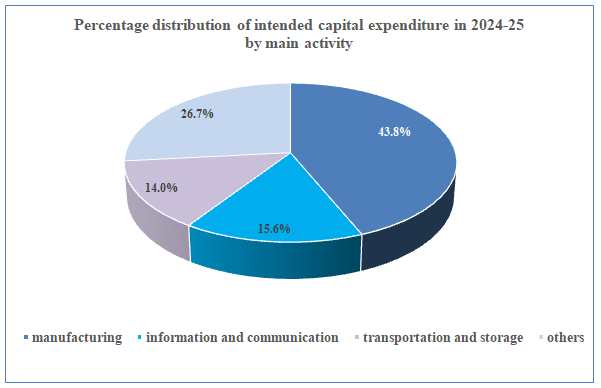
The estimated provisional capital expenditure per enterprise for acquiring new assets in 2024–25 stands at ₹172.2 crore. Among the sectors, manufacturing enterprises account for the largest share at 43.8%, followed by those in ‘Information and Communication Activities’ (15.6%) and ‘Transportation and Storage Activities’ (14.0%).
Estimated Key Indicators for 2023-24 by Asset Groups

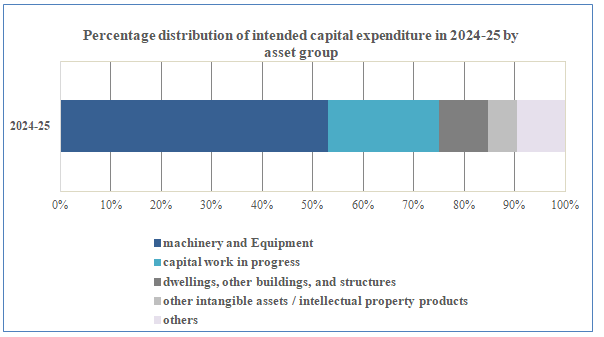
The estimated provisional capital expenditure per enterprise for acquiring new assets in 2024–25 stands at ₹172.2 crore. Out of the total capital expenditure provisionally incurred in the year 2024-25, nearly 53.1% were utilized for purchasing machinery & equipment. The amount allocated for ‘capital work in progress’ (22.0%) and purchasing ‘dwellings, other buildings and structures’ (9.7%) had the next highest share of allocation.
Strategy of CAPEX in 2024-25

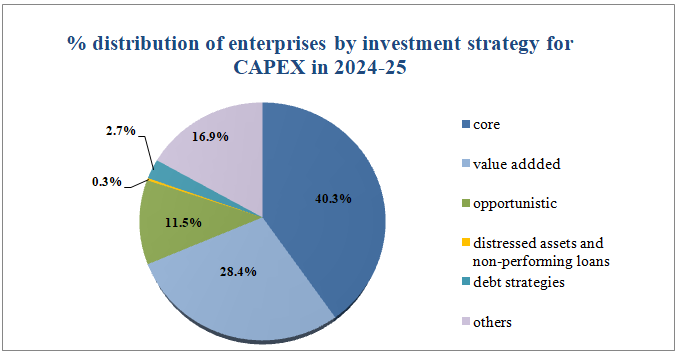
According to survey estimates, nearly 40.3% of enterprises plan to undertake CAPEX on core assets during 2024–25. Additionally, 28.4% intend to invest in value addition to existing assets, while around 11.5% focus on opportunistic assets, and 2.7% on debt strategies. The strategy of investing in distressed assets and non-performing loans was adopted by less than one-half of a percent of enterprises. Meanwhile, about 16.9% allocated their CAPEX towards other diverse investment strategies.
Objectives of CAPEX in 2024-25

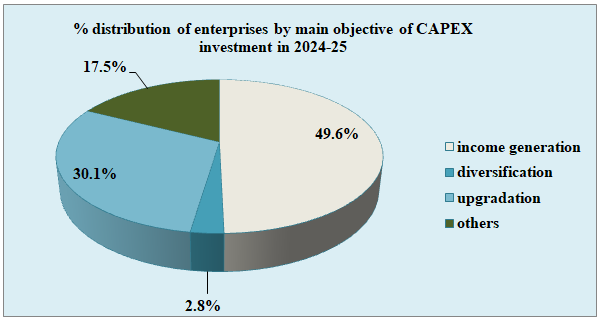
The survey estimates indicate that nearly 49.6% of private corporate sector enterprises undertook CAPEX in 2024–25 primarily for income generation. An additional 30.1% directed their investments toward upgradation, while around 2.8% focused on diversification. Remaining 17.5% of enterprises reported using their CAPEX for other reasons.
The results of CAPEX survey are provided in the booklet which is available in the website of the Ministry (https://www.mospi.gov.in). To protect the confidentiality of CAPEX investment plans of individual enterprises, the Steering Committee of NSS Surveys recommended that unit-level data of CAPEX survey would not be disseminated.

Endnote: A brief about the coverage, sampling scheme, sample size and data collection mechanism in the Forward-Looking Survey on Private Sector CAPEX Investment Intentions:

A. Coverage:

The survey covered large private corporate sector enterprises that play a significant role in their respective sectors. The sampling frame was madeusing data from active enterprises registered with the Ministry of Corporate Affairs (MCA), filtered based on annual turnover thresholds achieved in at least one of the last three financial years. The eligibility criteria were as follows:

  • Manufacturing enterprises with an annual turnover of ₹400 crore or more
  • Trade enterprises with an annual turnover of ₹300 crore or more
  • Other enterprises with an annual turnover of ₹100 crore or more

Based on these criteria, the final survey frame consisted of 16,025 enterprises.

B. Sampling Scheme:

Eligible enterprises were initially categorized into seventeen (17) strata based on their Principal Business Activity as reported in the MGT-7 Form of the Ministry of Corporate Affairs (MCA). In strata with 100 or fewer enterprises, all units were included in the Census Sector for complete enumeration.

For strata with more than 100 enterprises, the selection process involved identifying Census Sector Enterprises and Sample Sector Enterprises. To determine the Census Sector, enterprises were ranked in descending order based on (i) the highest fixed asset value in the past three years and (ii) the fixed asset value of latest reported year. The top enterprises accounting for 90% of asset value (or 80% for Construction and Trade) from either list were classified as Census Sector Enterprises. The remaining units formed the Sample Sector, from which 10% were randomly selected using Simple Random Sampling without Replacement (SRSWOR), with allocation proportional to each stratum’s size and variation.

C. Sample Size:

The sample size for the survey was of 5,380 enterprises: 4,145 enterprises in the Census Sector and 1,235 enterprises in sample sector.

DData Collection Mechanism:

The survey was conducted under the provisions of the Collection of Statistics Act, 2008, with prior notices sent to all selected enterprises outlining the survey’s objective and intended use of the data. Confidentiality of individual responses was strictly maintained, and no unit-level data would be disseminated. A secure, dedicated web portal was developed to enable selected enterprises to complete and submit the survey questionnaire online. The portal included background information on the survey, reasons for a unit’s selection, and chatbot support to assist respondents in understanding key concepts and definitions.

Topics

Acts Income Tax
