

Loading...

Top
Help
×

By creating an account you can:

Logo TaxTMI
Call Us / Help / Feedback

Contact Us At :

E-mail: [email protected]

Call / WhatsApp at: +91 99117 96707

For more information, Check Contact Us

FAQs :

To know Frequently Asked Questions, Check FAQs

Most Asked Video Tutorials :

For more tutorials, Check Video Tutorials

Submit Feedback/Suggestion :

Email :
Please provide your email address so we can follow up on your feedback.
Category :
Description :
Min 15 characters 0/2000
Make Most of Text Search
  1. Checkout this video tutorial: How to search effectively on TaxTMI.
  2. Put words in double quotes for exact word search, eg: "income tax"
  3. Avoid noise words such as : 'and, of, the, a'
  4. Sort by Relevance to get the most relevant document.
  5. Press Enter to add multiple terms/multiple phrases, and then click on Search to Search.
  6. Text Search
  7. The system will try to fetch results that contains ALL your words.
  8. Once you add keywords, you'll see a new 'Search In' filter that makes your results even more precise.
  9. Text Search
Add to...
You have not created any category. Kindly create one to bookmark this item!
Create New Category
Hide
Title :
Description :
❮❮ Hide
Default View
Expand ❯❯
Close ✕
🔎 News - Adv. Search
TEXT SEARCH:

Press 'Enter' to add multiple search terms. Rules for Better Search

Search In:
Main Text + AI Text
  • Main Text
  • Main Text + AI Text
  • AI Text
Category: ?
Categorized by AI
---- All Categories ----
  • ---- All Categories ----
  • Income Tax
  • GST
  • Customs, DGFT & SEZ
  • FEMA & RBI
  • Corp. Laws, SEBI & IBC
  • PMLA, Black Money & ED
  • Budget
  • News and Press Release
  • PTI News
Month:
---- All Months ----
  • ---- All Months ----
  • January
  • February
  • March
  • April
  • May
  • June
  • July
  • August
  • September
  • October
  • November
  • December
Year:
---- All Years ----
  • ---- All Years ----
  • 2026
  • 2025
  • 2024
  • 2023
  • 2022
  • 2021
  • 2020
  • 2019
  • 2018
  • 2017
  • 2016
  • 2015
  • 2014
  • 2013
  • 2012
  • 2011
Sort By: ?
In Sort By 'Default', exact matches for text search are shown at the top, followed by the remaining results in their regular order.
Relevance Default Date
    Fourth Session of the India-Namibia Joint Trade Committee held in New Delhi
    Winning in the AI Era: The New Playbook for Indian Banks - Inaugural Address by Shri Sanjay Malhotra, Governor, Reserve Bank of India at the FIBAC 202...
    Assam Cabinet okays funds for land acquisition for Guwahati satellite city
    ED arrests Chhattisgarh Congress leader in liquor 'scam' case; sent to 7 days' custody
    Sales Tax Assistant Commissioner arrested for demanding bribe of Rs 8 lakh
    Net direct tax kitty grows 23 pc to Rs 8.11 lakh cr on slower refunds, higher non-corp taxes
    Delhi court sets aside summon order in cheque bounce case
    BRICS grouping discussing linking CBDCs, fast payment systems: RBI Guv Malhotra
    PM GatiShakti National Master Plan Enables Integrated and Coordinated Infrastructure Planning
    GeM Strengthens Participation of MSMEs, Startups, Women Entrepreneurs and SHGs
    Net direct tax collection grows 23 pc to Rs 8.11 lakh cr so far this fiscal
    National Accreditation Board for Testing and Calibration Laboratories Launches India’s First Accreditation Scheme for Mobile Food Testing Laboratori...
    Commerce and Industry Minister Shri Piyush Goyal awards top buyers and sellers on GEM platform at the 10th Anniversary celebrations of GEM
    PolicyBazaar working with partners to fast-track Assam flood insurance claims
    ED arrests Chhattisgarh Congress leader in liquor 'scam' case
    ED arrests Chhattisgarh Congress leader in liquor scam case
    Register FIR in cases of missing persons immediately, irrespective of age or gender: SC
    ED freezes 182 bank accounts, seizes Rs 1 cr cash in connection to Rs 2k crore chit-fund scam
    Rupee falls 8 paise to 95.38 against US dollar in early trade
    Punjab Assembly passes nine key bills
❯❯
Maximize Maximize Maximize
0 / 200
Expand Note
Add to Folder

No Folders have been created

+

Are you sure you want to delete "My most important" ?

NOTE:

News
Showing Results for :
Reset Filters
Results Found:
Show All Summaries Hide All Summaries
August 12, 2026
Show AI Summary
Bilateral trade cooperation advances through investment focal points, services and health working groups, and planned preferential trade agreement negotiations.
India-Namibia economic cooperation is being progressed through agreed follow-up mechanisms focused on value addition, investment facilitation and sectoral collaboration. Investment focal points have been designated, and a Services Working Group is to prepare a work plan for the Joint Trade Committee. Priority areas include health and pharmaceuticals, critical-mineral processing, gems and jewellery, digital payments, FinTech, railways, renewable energy and green hydrogen. Terms of Reference for the India-SACU preferential trade agreement were finalised, with negotiations to begin after signature and conclude within one year.
August 12, 2026
Show AI Summary
AI governance in banking requires explainability, board accountability, rigorous testing, vendor controls and meaningful human oversight for customer-facing decisions.
AI adoption in banking should be governed through a principles-based and proportionate framework that aligns innovation with financial stability, customer protection and accountability. Banks should maintain inventories of AI systems, adopt board-approved governance policies, ensure explainability for material lending and fraud decisions, conduct periodic red-teaming and stress testing, and preserve meaningful human oversight. Key risks include opacity, bias, vendor concentration, third-party dependence, data misuse, cyber vulnerability and loss of institutional accountability. Vendor arrangements require audit and explanation rights and credible exit plans.
August 11, 2026
Show AI Summary
Land acquisition funding and regulatory approvals advance satellite-city development, tax relief, identity enrolment, employment verification, and jail reform.
Assam Cabinet approvals include first-phase funding for land acquisition and development of the Aerotropolis Satellite City Project and a lease deed for a hotel supporting the Jagiroad semiconductor ecosystem. Measures also provide Aadhaar enrolment relaxation for Moran and Matak communities, zero agricultural tax up to the prescribed net-income threshold, OBC Non-Creamy Layer certificates, and trainee and graduate-assistance funding. Government jobs will be provisionally held pending police verification, with automatic confirmation where no report is submitted within six months. Jail rules will be amended to promote non-discrimination, sanitation, security and fair work allocation.
August 11, 2026
Show AI Summary
Money-laundering investigation into alleged liquor-sale proceeds led to arrest and custodial questioning amid contested political allegations.
Money-laundering investigation concerning an alleged liquor scam led to the Enforcement Directorate's arrest of Ramgopal Agrawal and seven days' custodial remand under the Prevention of Money Laundering Act. The agency alleged his connection with proceeds of crime, non-attendance despite multiple summonses, and evasiveness during questioning. Allegations concern purported control of the state excise department, illegal liquor sales, and sharing of commissions. The Congress has denied the allegations and described the investigation as politically motivated.
August 11, 2026
Show AI Summary
GST inquiry closure bribery allegations prompted anti-corruption proceedings against a Sales Tax officer under corruption law.
Alleged bribery in GST inquiry closure led to the arrest of a Sales Tax Assistant Commissioner after a scrap trader complained of a demand for illegal gratification to close an inquiry initiated through a GST show-cause notice. Anti-corruption officials reportedly verified the allegation through intermediaries, during which the officer allegedly agreed to accept payment for closing the matter. A criminal case was registered under the Prevention of Corruption Act, with further investigation ongoing.
August 11, 2026
Show AI Summary
Direct tax collection growth reflected stronger non-corporate taxes and securities transaction tax receipts alongside slower refund issuances.
Net direct tax collections increased by 23 per cent to over Rs 8.11 lakh crore through August 10, driven by higher non-corporate tax collections and slower refund growth. Gross direct tax collections grew by 19.75 per cent to about Rs 9.55 lakh crore. Net corporate tax collections rose about 20 per cent, net non-corporate tax collections rose 23 per cent, and Securities Transaction Tax collections increased 51 per cent. Refund issuances grew by 3.8 per cent year-on-year.
August 11, 2026
Show AI Summary
Vicarious liability in cheque dishonour cases cannot attach to trust associates without statutory status or transaction-specific involvement.
Vicarious criminal liability for cheque dishonour under section 141 of the Negotiable Instruments Act does not extend to a trust, because a trust is not a juristic person. A person cannot be summoned merely for alleged active involvement in a trust where the person was neither drawer nor signatory of the cheques, trustee, office-bearer, authorised account operator, guarantor, or executor of transaction documents.
August 11, 2026
Show AI Summary
Cross-border payment integration through CBDCs and fast payment systems remains under BRICS discussion to reduce transfer costs.
Cross-border payment integration is under discussion through potential linkages between central bank digital currencies and fast payment systems, including UPI-type platforms. These approaches seek faster and less costly trade and remittance transfers, particularly retail payments, but remain at a discussion stage. Rupee internationalisation is also being pursued through central-bank memorandums of understanding for bilateral trade settlement in local currencies, with existing arrangements covering Indonesia, Maldives, Mauritius and the UAE.
August 11, 2026
Show AI Summary
Integrated infrastructure planning under PM GatiShakti coordinates project evaluation, multimodal connectivity, geospatial data use, and decentralized implementation.
PM GatiShakti National Master Plan provides an integrated, data-driven infrastructure planning framework using geospatial data, satellite imagery and API integration. Project approval, implementation and funding remain with the respective Central Ministries, Departments and States or Union Territories under their own plans and budgetary provisions; the framework sets no separate budgetary allocation or quantified targets. The Network Planning Group evaluates critical Central Government projects at the planning stage for multimodality, synchronisation, last-mile connectivity, comprehensive local development and coordinated decision-making.
August 11, 2026
Show AI Summary
MSME procurement through GeM has expanded alongside analytics-driven controls against suspicious bidding, collusion, and vendor misconduct.
GeM uses AI/ML analytics to detect order splitting, suspicious bidding, abnormal pricing, repeated participation and potential buyer-seller collusion. Flagged cases are placed before buyer organisations for review and action, while suspected cartels are assessed through digital-footprint, pricing and bid-timing indicators. Its Incident Management framework addresses false documents, fraud, collusive behaviour and other misconduct through administrative measures, including suspension. Anti-competitive conduct and cartel formation are Severe/Grave deviations, with proven cases attracting suspension for up to 365 days.
August 11, 2026
Show AI Summary
Direct tax collections show stronger corporate, non-corporate and securities transaction tax receipts, alongside increased refunds during the fiscal period.
Net direct tax collections grew by 23.09 per cent to over Rs 8.11 lakh crore up to August 10 of the current fiscal year, while gross direct tax collections increased by 19.75 per cent to about Rs 9.55 lakh crore. Corporate tax, non-corporate tax including personal income tax, and Securities Transaction Tax receipts recorded growth. Refunds issued between April 1 and August 10 also rose over the corresponding earlier period. Direct tax collections are budgeted at Rs 26.97 lakh crore for the fiscal year.
August 11, 2026
Show AI Summary
Mobile food testing laboratory accreditation expands quality-assured testing access and supports coordinated food-safety surveillance and regulatory efficiency.
NABL has launched an Accreditation Scheme for Mobile Food Testing Laboratories under the Integrated Assessment Programme. The framework enables mobile laboratories to provide reliable, quality-assured and internationally benchmarked food-testing services closer to communities, extending accredited testing beyond conventional laboratory settings. It is intended to strengthen food-safety surveillance, improve access to quality testing, support faster regulatory intervention and enhance consumer confidence. Coordinated assessments, regulatory harmonisation and mutual recognition are also intended to reduce duplication and improve regulatory efficiency while maintaining quality and compliance standards.
August 11, 2026
Show AI Summary
Digital public procurement will expand AI-led price intelligence, marketplace integrity, inclusive access, credit linkages and sustainable purchasing.
Government e-Marketplace is advancing an AI-enabled public procurement ecosystem focused on efficiency, transparency, competition, price intelligence and marketplace integrity. Priorities include last-mile access through Suvidha Kendras, integration of public entities, credit linkages, sustainable procurement and university outreach. A nationwide five-digit Helpdesk short code, 14550, mapped to existing infrastructure, is intended to maintain service continuity and improve access to support and official communications. The platform seeks to provide enterprises with a more accessible and predictable procurement market and buyers with a data-driven procurement experience.
August 11, 2026
Show AI Summary
Expedited flood insurance claims require insurers and partners to simplify documentation and provide immediate service to affected policyholders.
Expedited insurance-claim handling for flood-affected policyholders in Assam is being pursued through simplified documentation, prompt settlement and immediate service response. PolicyBazaar is coordinating with insurer partners to reduce processing delays. The Insurance Regulatory and Development Authority of India has directed insurers, including life insurers and standalone health insurers, to mobilise resources for immediate assistance, alongside governmental efforts for expeditious and hassle-free claim disposal.
August 11, 2026
Show AI Summary
Money laundering investigation in alleged liquor scam leads to arrest and proposed custodial-remand proceedings under anti-money-laundering law.
Money laundering investigation concerning an alleged liquor scam in Chhattisgarh led to the arrest of Congress leader Ramgopal Agrawal under the Prevention of Money Laundering Act. Custodial remand is to be sought for interrogation. The allegations concern an alleged syndicate that purportedly controlled the state excise department, enabled illegal liquor sales and distributed resulting commissions. Chargesheets name political figures, excise officials and officials associated with the Chief Minister's Office.
August 11, 2026
Show AI Summary
Money-laundering investigation into an alleged liquor scam leads to arrest and proposed custodial interrogation under the prevention law.
Money-laundering investigation under the Prevention of Money Laundering Act concerns an alleged liquor scam in Chhattisgarh. A former state political party treasurer has been arrested for alleged involvement and is to be produced before a local court for a request for custodial interrogation. The alleged scheme is stated to have involved control of the state excise department by a criminal syndicate, with multiple accused named in six chargesheets.
August 11, 2026
Show AI Summary
Immediate FIR registration for every missing person is mandatory, with missing children treated as suspected kidnapping or abduction cases.
Immediate FIR registration is required whenever information is received that any person is missing, irrespective of age or gender, without preliminary inquiry. Missing-person FIRs must include relevant provisions concerning kidnapping and trafficking. A missing child must be treated from the outset as a suspected case of kidnapping or abduction. States and Union Territories may face contempt action for non-compliance. Traced children should ordinarily be restored to their families within 24 hours unless trafficking or exploitation by the family is suspected.
August 11, 2026
Show AI Summary
Money-laundering investigation targets alleged chit-fund collections, investor-fund diversion, concealed deposits, and irregular land transactions.
Money-laundering investigation into an alleged multi-state chit-fund scheme involved searches at premises linked to Wellfare Buildings and Estates Pvt Ltd and its directors, seizure of cash, vehicles, property-related records and digital devices, and freezing of bank accounts. The alleged scheme concerns unauthorised public-fund collection through land-allotment schemes, followed by closure of operations. Allegations include diversion of investor funds, manipulation of financial statements to conceal deposits, and irregular land transactions intended to suppress actual consideration and evade statutory obligations.
August 11, 2026
Show AI Summary
Rupee exchange-rate pressure intensified as crude oil, regional uncertainty and weaker equities constrained the local currency in early trade.
Foreign-exchange market conditions placed the rupee under pressure against the US dollar amid West Asia uncertainty, higher crude oil prices, and weaker domestic equity markets. Foreign institutional investor inflows and Reserve Bank of India intervention supported the rupee and limited further depreciation. Reported dollar sales through state-run banks helped contain downside pressure despite rising Brent crude prices and uncertainty concerning the Strait of Hormuz.
August 10, 2026
Show AI Summary
GST refund facilitation expands provisional input tax credit refunds and removes the minimum threshold for export-related IGST refunds.
Punjab's GST amendments facilitate voluntary compliance and reduce procedural burdens by allowing a 90 per cent provisional input tax credit refund in inverted duty structure cases and removing the minimum threshold for IGST refunds on exported goods. Additional measures cap annual fee increases by private unaided educational institutions, establish digital open universities for technology-enabled higher education, protect trees and green cover, and address common infrastructure, panchayati raj, and contractual engagement of outsourced State personnel.

News

Back

All News

Showing Results for :
Reset Filters
No Records Found

News

Back

All News

Showing Results for : Reset Filters
News and Press Release

India’s DBT: Boosting Welfare Efficiency - Report Reveals ₹3.48 Lakh Crore in Savings and 16-Fold Increase in Beneficiaries.

April 21, 2025

Contents
Summary
Note

Note

-

Bookmark

Print

Print

Introduction

India’s Direct Benefit Transfer (DBT) system has helped the country save an estimated ₹3.48 lakh crore till 2024 by plugging leakages in welfare delivery, according to a new quantitative assessment by the BlueKraft Digital Foundation. The report also finds that subsidy allocations have been halved from 16 percent to 9 percent of total government expenditure since the implementation of DBT, reflecting a major improvement in the efficiency of public spending.
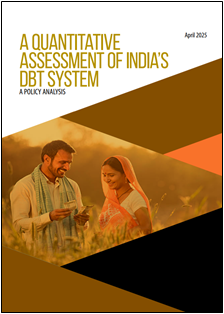
The assessment evaluates data from 2009 to 2024 to examine the impact of DBT on budgetary efficiency, subsidy rationalisation, and social outcomes. It shows how the shift from paper-based disbursals to direct digital transfers has ensured that public funds reach the people they are meant for. One of the key features of DBT is the use of the JAM trinity, which stands for Jan Dhan bank accounts, Aadhaar unique ID numbers and mobile phones. This framework has enabled targeted and transparent transfers on a massive scale.
To capture the full extent of its impact, the report introduces a Welfare Efficiency Index. This index combines fiscal outcomes such as savings and reduced subsidies with social indicators like the number of beneficiaries reached, offering a clear picture of how well the system is working. The index has risen nearly threefold from 0.32 in 2014 to 0.91 in 2023, reflecting a sharp increase in both effectiveness and inclusion.

At a time when governments across the world are rethinking how to strengthen social protection, the DBT model presents valuable lessons in aligning financial prudence with equitable governance.

Key Findings

Budgetary Allocation Trends

The data on subsidy allocations reveals a significant shift post-DBT implementation, highlighting improvements in fiscal efficiency despite a surge in beneficiary coverage.
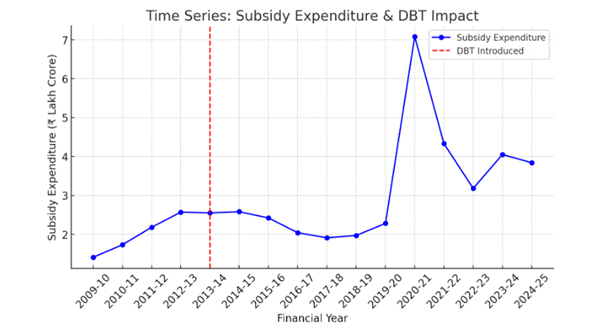
  • Pre-DBT Era (2009–2013): Subsidies averaged 16% of total expenditure, amounting to ₹2.1 lakh crore annually, with considerable leakages in the system.
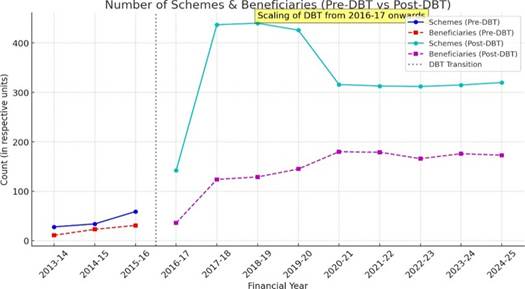
  • Post-DBT Era (2014–2024): Subsidy expenditure decreased to 9% of total expenditure in 2023-24, while beneficiary coverage surged 16-fold from 11 crore to 176 crore.
  • COVID-19 Outlier: A temporary spike in subsidies occurred during the 2020–21 fiscal year due to emergency fiscal measures. However, efficiency rebounded following the pandemic, further validating the system's long-term effectiveness.

Subsidy Allocation Trends (2009-2024)

The reduction in subsidy burden, despite a significant increase in coverage, underscores DBT’s role in optimising fiscal allocations. By eliminating ghost beneficiaries and middlemen, the system redirected funds to genuine recipients without proportional increases in the budget.

Sectoral Analysis

A detailed breakdown of sector-specific impacts shows how DBT has particularly benefited high-leakage programmes.
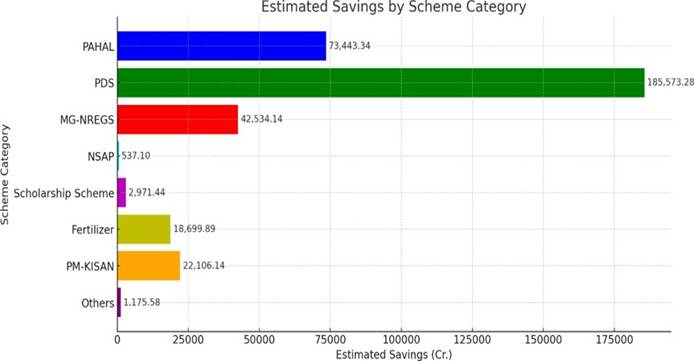
  • Food Subsidies (PDS): ₹1.85 lakh crore saved, accounting for 53% of total DBT savings. This was largely due to Aadhaar-linked ration card authentication.
  • MGNREGS: 98% of wages were transferred timely, saving ₹42,534 crore through DBT-driven accountability.
  • PM-KISAN: ₹22,106 crore saved by deleting 2.1 crore ineligible beneficiaries from the scheme.
  • Fertilizer Subsidies: Sales of 158 lakh MT of fertiliser were reduced, saving ₹18,699.8 crore through targeted disbursement.

Sectoral Impact Analysis

These sector-specific savings highlight DBT’s disproportionate impact on high-leakage programs, such as food subsidies and wage schemes like MGNREGS. The system’s role in biometric authentication and direct transfers has been crucial in improving efficiency and curbing misuse.

Correlation and Causality Findings

The correlation analysis further underscores the effectiveness of DBT in improving welfare delivery.
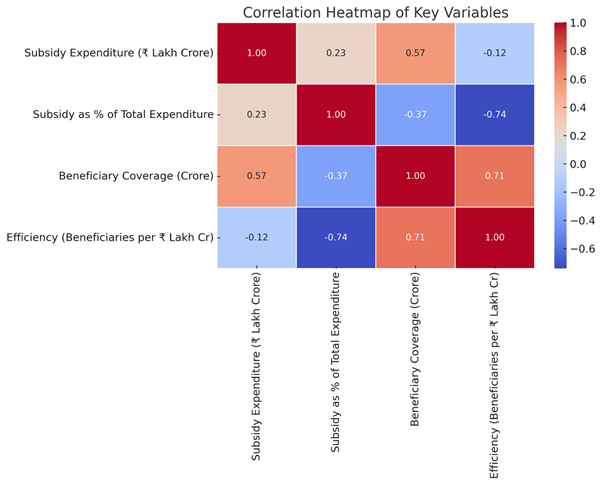
  • Strong Positive Correlation (0.71): There is a strong positive correlation between beneficiary coverage and DBT savings, signifying that as coverage expanded, savings increased.
  • Negative Correlation (-0.74): There is a significant negative correlation between subsidy expenditure as a percentage of total expenditure and welfare efficiency, highlighting the reduction in waste and leakages facilitated by DBT.

Heat-map showing correlation between key variables

The heat-map analysis quantifies the relationship between budget allocations, DBT savings, and welfare efficiency. As DBT savings increased, subsidy allocations decreased, demonstrating that DBT improved targeting while reducing leakages. This enabled the government to expand welfare programs, reaching more beneficiaries without increasing fiscal outlays. The inverse relationship between subsidy expenditure and efficiency challenges critiques of “declining welfare spending” and affirms DBT’s role as a powerful tool for fiscal optimisation.

Welfare Efficiency Index (WEI)

As part of the methodology for assessing the impact of the Direct Benefit Transfer (DBT) system, the Welfare Efficiency Index (WEI) was developed as a composite metric to measure efficiency gains across various dimensions. The WEI comprises three weighted components:

DBT Savings (50% weight): This component captures the direct reduction in leakage, normalised against the maximum observed savings of ₹3.48 lakh crore.


Subsidy Reduction (30% weight): Measures the decline in subsidy expenditure as a percentage of the total national budget.


Beneficiary Growth (20% weight): Assesses the expansion in the number of beneficiaries, adjusted for population growth.

The rise in the WEI from 0.32 in 2014 to 0.91 in 2023 quantifies systemic improvements, emphasising that efficiency gains stem from multi-dimensional factors—not merely budget cuts. This index provides a replicable model for global policymakers to evaluate welfare reforms.

The WEI surged, driven by:

  • DBT Savings (50% weight): ₹3.48 lakh crore cumulative leakage reduction.
  • Subsidy Reduction (30% weight): A decline from 16% to 9% of total expenditure.
  • Beneficiary Growth (20% weight): A 16-fold expansion in coverage.

Conclusion

The Direct Benefit Transfer (DBT) system has proven to be a transformative tool for India’s welfare delivery, significantly enhancing the efficiency of public spending and expanding the reach of social benefits. Over the past decade, DBT has not only reduced fiscal leakages by ₹3.48 lakh crore but also ensured that subsidies are better targeted, with a marked decline in subsidy allocations as a percentage of total expenditure. The rise in the Welfare Efficiency Index (WEI) underscores the success of DBT in optimizing fiscal resources while broadening coverage for millions of beneficiaries. The sectoral savings, particularly in high-leakage programs like food subsidies, MGNREGS, and PM-KISAN, illustrate how the system’s integration of Aadhaar and mobile-based transfers has addressed inefficiencies and curbed misuse.

As per the report by the BlueKraft Digital Foundation, this data-driven assessment demonstrates that fiscal prudence and inclusivity can go hand-in-hand, offering valuable insights for policymakers worldwide looking to refine their own social protection models. As governments grapple with balancing fiscal constraints and social equity, India’s experience with DBT presents a compelling case for the efficacy of direct transfers in fostering both economic and social development. The lessons learned from this success story can guide global efforts to make welfare systems more efficient, transparent, and inclusive.

Reference:

 Click here to see in PDF

Santosh Kumar/ Sheetal Angral/ Saurabh Kalia

Topics

Acts Income Tax
