

Loading...

Top
Help
×

By creating an account you can:

Logo TaxTMI
Call Us / Help / Feedback

Contact Us At :

E-mail: [email protected]

Call / WhatsApp at: +91 99117 96707

For more information, Check Contact Us

FAQs :

To know Frequently Asked Questions, Check FAQs

Most Asked Video Tutorials :

For more tutorials, Check Video Tutorials

Submit Feedback/Suggestion :

Email :
Please provide your email address so we can follow up on your feedback.
Category :
Description :
Min 15 characters 0/2000
Make Most of Text Search
  1. Checkout this video tutorial: How to search effectively on TaxTMI.
  2. Put words in double quotes for exact word search, eg: "income tax"
  3. Avoid noise words such as : 'and, of, the, a'
  4. Sort by Relevance to get the most relevant document.
  5. Press Enter to add multiple terms/multiple phrases, and then click on Search to Search.
  6. Text Search
  7. The system will try to fetch results that contains ALL your words.
  8. Once you add keywords, you'll see a new 'Search In' filter that makes your results even more precise.
  9. Text Search
Add to...
You have not created any category. Kindly create one to bookmark this item!
Create New Category
Hide
Title :
Description :
❮❮ Hide
Default View
Expand ❯❯
Close ✕
🔎 News - Adv. Search
TEXT SEARCH:

Press 'Enter' to add multiple search terms. Rules for Better Search

Search In:
Main Text + AI Text
  • Main Text
  • Main Text + AI Text
  • AI Text
Category: ?
Categorized by AI
---- All Categories ----
  • ---- All Categories ----
  • Income Tax
  • GST
  • Customs, DGFT & SEZ
  • FEMA & RBI
  • Corp. Laws, SEBI & IBC
  • PMLA, Black Money & ED
  • Budget
  • News and Press Release
  • PTI News
Month:
---- All Months ----
  • ---- All Months ----
  • January
  • February
  • March
  • April
  • May
  • June
  • July
  • August
  • September
  • October
  • November
  • December
Year:
---- All Years ----
  • ---- All Years ----
  • 2026
  • 2025
  • 2024
  • 2023
  • 2022
  • 2021
  • 2020
  • 2019
  • 2018
  • 2017
  • 2016
  • 2015
  • 2014
  • 2013
  • 2012
  • 2011
Sort By: ?
In Sort By 'Default', exact matches for text search are shown at the top, followed by the remaining results in their regular order.
Relevance Default Date
    Jio Platforms gets Sebi nod to launch IPO
    PM Jan Dhan Yojana has had unparalleled impact, transformative outcomes: PM Modi
    Bajaj Finance Personal Loan Offers Flexible Repayment Options with Loan Utsav 2026 Benefits
    ED arrests 3 more people in pan-India digital arrest case
    Rupee rises 6 paise to settle at 95.39 against US dollar
    Senior citizen threatened with terror funding case probe, duped of Rs 7.2 crore
    Rupee declines 10 paise to 95.55 against US dollar in early trade
    UK’s PG Paper welcomes SEBI review of fraud allegations against Indian firm
    'Neta-Company Loot Tribunal': Cong on NCLT haircut approval for Subhash Chandra
    S&P affirms India's 'BBB' sovereign rating; cites dynamic economy, policy stability
    Sugar prices ease marginally to Rs 64.33 per kg on Thursday
    ED freezes assets worth Rs 33 crore after raids against Gurugram realty group
    CARD91 Launches SpendFlow, a Commercial Card Platform Built for Enterprise Requirements
    Will talk to Japan on increasing basmati rice exports from India: Goyal
    Will consider Air India's biz strategy, other factors before deciding on additional fund requests: Singapore Airlines
    Commerce and Industry Minister Shri Piyush Goyal Concludes Japan Visit; Calls for Greater Japanese Investment and Stronger Industrial Partnerships wit...
    PM Jan Dhan Yojana Completes 12 Years of Transforming India’s Financial Inclusion Landscape
    Rassense Becomes First Indian CFS Company to Cross 5,000+ Employees; On Track to Cross INR 600 Crore in Revenue
    SVC Bank's Nationwide Cyber Safety Drive Reaches Over 19,061 Citizens Across 213 Housing Societies
❯❯
Maximize Maximize Maximize
0 / 200
Expand Note
Add to Folder

No Folders have been created

+

Are you sure you want to delete "My most important" ?

NOTE:

News
Showing Results for :
Reset Filters
Results Found:
Show All Summaries Hide All Summaries
August 28, 2026
Show AI Summary
IPO regulatory approval enables Jio Platforms to advance preparations for its proposed fresh equity share public offering.
Jio Platforms Ltd. has obtained Sebi's final observations for its proposed initial public offering. This key regulatory stage enables further preparations for the public issue, subject to applicable regulatory requirements. The proposed offering comprises up to 27 crore fresh equity shares and is expected to account for approximately 2.9 per cent of the company's post-issue equity base.
August 28, 2026
Show AI Summary
Financial inclusion through basic bank accounts expands banking access with no-balance accounts, debit cards, and emergency overdraft support.
Pradhan Mantri Jan Dhan Yojana enables unbanked adults to open basic bank accounts without minimum-balance or maintenance-charge requirements. Accounts include a free RuPay debit card with accident insurance coverage and eligibility for an overdraft facility during emergencies. The scheme promotes digital transactions, financial security and participation in the formal economy, while extending banking access to rural and semi-urban communities and increasing women's financial inclusion.
August 28, 2026
Show AI Summary
Flexible personal loan repayment enables eligible borrowers to select longer tenures, subject to eligibility, terms, verification, and repayment capacity.
Bajaj Finance personal loans offer eligible customers collateral-free borrowing with flexible repayment tenures of 12 to 108 months, subject to eligibility, applicable terms, verification and documentation. A longer tenure may reduce monthly EMIs by spreading repayment over more months, but can increase total interest payable. Borrowers should compare the interest rate, tenure, EMI, processing charges and other costs, while considering their income, existing commitments and repayment capacity. Loan Utsav 2026 provides limited-period rewards for eligible customers whose loans are successfully disbursed during the campaign period, subject to applicable terms.
August 28, 2026
Show AI Summary
Digital arrest money laundering investigation tracks cyber-fraud proceeds through layered bank accounts, cash withdrawals, and foreign-exchange conversion.
Arrests under the Prevention of Money Laundering Act form part of an investigation into alleged digital arrest cyber fraud and laundering of fraud proceeds. Funds were reportedly routed through numerous bank accounts, withdrawn in cash, and converted into foreign currency through licensed money changers. The financial trail is linked to commodity trading, travel and foreign-exchange entities allegedly connected with cyber-fraud complaints and first information reports. The inquiry also identified alleged shell or dummy companies using proxy directors to conceal control and facilitate fund movement.
August 28, 2026
Show AI Summary
Foreign exchange intervention and lower crude prices supported rupee appreciation despite a stronger dollar and foreign institutional investor outflows.
Foreign exchange market conditions supported a six-paise appreciation of the rupee against the US dollar at the close of trading. Lower global crude oil prices and Reserve Bank of India intervention to limit significant rupee depreciation contributed to the movement. A marginal strengthening of the US dollar and foreign institutional investor equity outflows continued to exert pressure, while FCNR(B) scheme inflows supported the currency.
August 28, 2026
Show AI Summary
Cyber fraud impersonating enforcement officials coerced a senior citizen into bank and cryptocurrency transfers through terror-funding threats.
Cyber fraudsters allegedly impersonated public officials and threatened a senior citizen with implication in money laundering, terror funding and cybercrime. Using WhatsApp video calls and purported official notices, they allegedly induced the victim to transfer funds to multiple bank accounts and a cryptocurrency wallet on the pretext of proving innocence. The victim reportedly liquidated fixed deposits and mutual fund investments before identifying the deception and reporting it through the cybercrime helpline. A cyber police case was registered for further investigation.
August 28, 2026
Show AI Summary
Rupee depreciation against US dollar reflects foreign investor outflows and crude supply disruptions, moderated by weaker dollar and oil prices.
Foreign institutional investor outflows and disruptions in global crude oil supplies placed downward pressure on the rupee against the US dollar. A weaker dollar index and lower Brent crude prices moderated the decline. Market commentary anticipated a narrow trading range, with expected Reserve Bank of India protection at the upper end and oil importer, month-end, and importer demand supporting the lower end. Participants also monitored the US Federal Reserve Chair's Jackson Hole speech.
August 27, 2026
Show AI Summary
Emergency flood response measures coordinate rescues, suspend cross-border transport, and address risks to public safety.
Severe flash floods in Nepal and along the Nepal-Tibet border prompted cross-border rescue coordination for missing and stranded persons, warnings of continued downstream flood risk, and international relief support. Preventive public-safety measures included temporary suspension of an Indo-Nepal bus service. Separate developments included disruption of public services during an employee strike, investigation of an aircraft crash, market measures affecting sugar and onion prices, and proposed trade engagement for greater market access for basmati rice and processed food exports.
August 27, 2026
Show AI Summary
Regulatory review of fraud allegations requires timely consideration of representations while merits and standing remain undecided.
SEBI must consider and decide, within two weeks, representations alleging fraud by an Indian logistics company and its subsidiary. The allegations concern systematic over-invoicing of freight charges and forged documentation, with a parallel criminal investigation based on an FIR registered by the Delhi Police Economic Offences Wing. No determination has been made on the merits of the allegations or the complainant's standing to approach SEBI. The allegations and criminal proceedings were disclosed in IPO offer documents.
August 27, 2026
Show AI Summary
Personal insolvency repayment plans test creditor voting thresholds, valuation safeguards, and limits on commercial review under insolvency law.
Personal insolvency resolution under the Insolvency and Bankruptcy Code involved approval of a repayment plan providing for payment of Rs 6.25 crore to creditors and Rs 25 lakh towards process costs against admitted creditor claims of about Rs 22,006.57 crore. Objections by dissenting creditors were rejected because they held less than 20 per cent of voting share, while the plan received 80.81 per cent support. Valuation indicated that the personal estate was worth less than the amount offered, and the tribunal declined to replace creditor commercial wisdom or assess settlement adequacy.
August 27, 2026
Show AI Summary
Sovereign credit rating stability reflects policy continuity, infrastructure investment, external strength, and fiscal consolidation pressures.
India's sovereign credit rating retained a BBB stable outlook, supported by strong growth, an external balance sheet, stable institutions, policy predictability, and infrastructure investment. Public investment and consumer demand are expected to sustain growth and assist fiscal consolidation. Constraints include weak fiscal performance, elevated government debt and interest burdens, and low per-capita income. Long-term rating support depends on financing infrastructure investment without materially widening the current-account deficit and on reducing the fiscal deficit through stable fiscal and monetary policies.
August 27, 2026
Show AI Summary
Sugar import liberalisation and stockholding limits seek to moderate retail prices amid constrained domestic supply and restricted exports.
Sugar price-control measures combine duty-free raw sugar imports, stockholding limits for dealers and bulk consumers, and an export prohibition to address elevated retail prices and curb hoarding. Domestic supply remains constrained by reduced sugarcane output, prior exports and diversion of sugar to ethanol. Net production is estimated below projected domestic demand, while closing stocks are expected to remain limited. Import access, inventory restrictions and export controls therefore operate as market-stabilisation mechanisms.
August 27, 2026
Show AI Summary
Money-laundering investigation into alleged homebuyer fraud led to searches and freezing of assets linked to realty promoters.
Money-laundering proceedings were initiated under the Prevention of Money Laundering Act on the basis of police FIRs alleging fraudulent inducement and non-delivery of residential plots. Searches at premises linked to real estate promoters resulted in the seizure or freezing of luxury vehicles, jewellery, bank accounts and securities. The investigation alleges that substantial upfront payments for residential plots were received, but a significant portion of promised plots remained undelivered, and certain plots were allegedly sold to third parties without consent.
August 27, 2026
Show AI Summary
Commercial card governance enables configurable credit, approvals, virtual cards and controlled supplier payments across enterprise payment workflows.
SpendFlow combines commercial card program configuration, credit management, virtual cards, spend controls, approvals, supplier payments, billing and accounting in one architecture. It supports centrally governed rules with approved corporate-level variations, enterprise hierarchy management, and virtual cards linked to entities, employees, accounts or credit facilities. Multi-tier approvals and virtual-card supplier payments support controlled business payment functions, while core banking and ERP connectivity links card activity with banking and enterprise financial workflows.
August 27, 2026
Show AI Summary
Basmati rice market access may be pursued through trade agreement review, subject to import limits and safety standards.
Market access for Indian basmati rice may be pursued through review of the Comprehensive Economic Partnership Agreement, as rice remains a sensitive sector subject to import quantity limits and duties beyond permitted quantities. Processed food exports offer further opportunities where exporters comply with Japanese quality and safety standards. Bilateral cooperation also covers investment, supply chains, technology partnerships and capital flows supporting infrastructure, manufacturing and semiconductor ecosystems.
August 27, 2026
Show AI Summary
Capital allocation discipline governs consideration of further Air India funding alongside business strategy, cash flow and investment requirements.
Further capital investment in Air India will be evaluated by Singapore Airlines' board through a disciplined capital-allocation process. Assessment will consider the group's capital requirements, Air India's business strategy, operating cash flow, investment needs for aircraft and products, and multi-hub investments intended to support long-term growth and returns. As a significant minority shareholder, Singapore Airlines supports Air India's transformation programme with Tata Sons, but no commitment to provide additional capital is indicated.
August 27, 2026
Show AI Summary
Semiconductor investment cooperation anchors expanded India-Japan industrial partnerships across technology, manufacturing, clean energy, infrastructure, and financial services.
Semiconductor and artificial-intelligence cooperation centres on a six-pillar semiconductor strategy encompassing chip design, semiconductor machinery and materials, fabrication, ATMP/OSAT, research and development, and talent development. Japanese participation is sought across semiconductor materials and equipment, power semiconductors, electronics, AI, logistics and related advanced technologies. Development of semiconductor clusters is linked to reliable power, ultra-pure water, skilled manpower and social infrastructure.
August 27, 2026
Show AI Summary
Financial inclusion through basic bank accounts enables direct welfare transfers, digital payments, insurance access and credit for excluded households.
PMJDY provides unbanked adults with basic bank accounts without minimum-balance or maintenance-charge requirements, free RuPay debit cards with accident insurance cover, and eligible overdraft support. Through the JAM framework, PMJDY accounts enable direct transfer of welfare benefits using bank accounts, Aadhaar-based biometric verification and mobile connectivity, reducing intermediary involvement and delays. The scheme emphasises rural, semi-urban, marginalised and women account holders while supporting access to insurance, pensions, savings, digital payments and credit, including MUDRA loans.
August 27, 2026
Show AI Summary
Contract food services expansion strengthens Rassense's nationwide institutional operations through new academic partnerships and technology-led service delivery.
Rassense Pvt Ltd reports crossing a workforce of more than 5,000 employees and projects revenue exceeding INR 600 crore. Its contract food services operations serve educational institutions, corporate campuses, healthcare facilities and industrial locations. New operations at IIM Jammu, IIM Bangalore and IIT Guwahati strengthen its nationwide institutional presence. Expansion is supported by academic institution partnerships, local workforce development, operational excellence, and technology-led capabilities in food production, food waste reduction and supply-chain management.
August 27, 2026
Show AI Summary
Cyber fraud awareness promotes safe digital banking by teaching customers to verify communications, protect credentials, and report suspicious transactions.
Cyber-fraud awareness and digital banking safety were promoted through community sessions addressing phishing, impersonation, OTP and UPI fraud, QR-code scams, digital-arrest fraud, and fraudulent customer-care calls. Participants were guided to identify authentic banking communications, avoid sharing confidential credentials, verify callers and links before acting, and promptly report suspected unauthorised transactions. Customer vigilance, financial literacy, and institutional security measures were emphasised as complementary safeguards against digital financial fraud.

News

Back

All News

Showing Results for :
Reset Filters
No Records Found

News

Showing Results for : Reset Filters
News and Press Release

India’s DBT: Boosting Welfare Efficiency - Report Reveals ₹3.48 Lakh Crore in Savings and 16-Fold Increase in Beneficiaries.

April 21, 2025

Contents
Summary
Note

Note

-

Bookmark

Print

Print

Introduction

India’s Direct Benefit Transfer (DBT) system has helped the country save an estimated ₹3.48 lakh crore till 2024 by plugging leakages in welfare delivery, according to a new quantitative assessment by the BlueKraft Digital Foundation. The report also finds that subsidy allocations have been halved from 16 percent to 9 percent of total government expenditure since the implementation of DBT, reflecting a major improvement in the efficiency of public spending.
The assessment evaluates data from 2009 to 2024 to examine the impact of DBT on budgetary efficiency, subsidy rationalisation, and social outcomes. It shows how the shift from paper-based disbursals to direct digital transfers has ensured that public funds reach the people they are meant for. One of the key features of DBT is the use of the JAM trinity, which stands for Jan Dhan bank accounts, Aadhaar unique ID numbers and mobile phones. This framework has enabled targeted and transparent transfers on a massive scale.
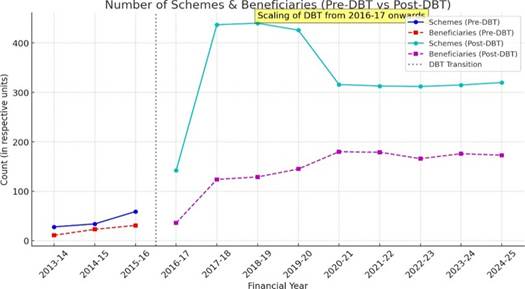
To capture the full extent of its impact, the report introduces a Welfare Efficiency Index. This index combines fiscal outcomes such as savings and reduced subsidies with social indicators like the number of beneficiaries reached, offering a clear picture of how well the system is working. The index has risen nearly threefold from 0.32 in 2014 to 0.91 in 2023, reflecting a sharp increase in both effectiveness and inclusion.

At a time when governments across the world are rethinking how to strengthen social protection, the DBT model presents valuable lessons in aligning financial prudence with equitable governance.

Key Findings

Budgetary Allocation Trends

The data on subsidy allocations reveals a significant shift post-DBT implementation, highlighting improvements in fiscal efficiency despite a surge in beneficiary coverage.
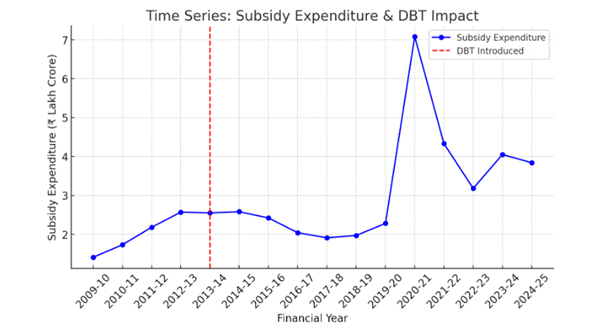
  • Pre-DBT Era (2009–2013): Subsidies averaged 16% of total expenditure, amounting to ₹2.1 lakh crore annually, with considerable leakages in the system.
  • Post-DBT Era (2014–2024): Subsidy expenditure decreased to 9% of total expenditure in 2023-24, while beneficiary coverage surged 16-fold from 11 crore to 176 crore.
  • COVID-19 Outlier: A temporary spike in subsidies occurred during the 2020–21 fiscal year due to emergency fiscal measures. However, efficiency rebounded following the pandemic, further validating the system's long-term effectiveness.

Subsidy Allocation Trends (2009-2024)

The reduction in subsidy burden, despite a significant increase in coverage, underscores DBT’s role in optimising fiscal allocations. By eliminating ghost beneficiaries and middlemen, the system redirected funds to genuine recipients without proportional increases in the budget.

Sectoral Analysis

A detailed breakdown of sector-specific impacts shows how DBT has particularly benefited high-leakage programmes.
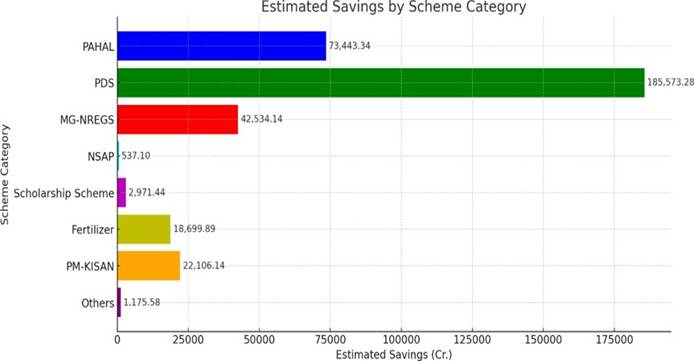
  • Food Subsidies (PDS): ₹1.85 lakh crore saved, accounting for 53% of total DBT savings. This was largely due to Aadhaar-linked ration card authentication.
  • MGNREGS: 98% of wages were transferred timely, saving ₹42,534 crore through DBT-driven accountability.
  • PM-KISAN: ₹22,106 crore saved by deleting 2.1 crore ineligible beneficiaries from the scheme.
  • Fertilizer Subsidies: Sales of 158 lakh MT of fertiliser were reduced, saving ₹18,699.8 crore through targeted disbursement.

Sectoral Impact Analysis

These sector-specific savings highlight DBT’s disproportionate impact on high-leakage programs, such as food subsidies and wage schemes like MGNREGS. The system’s role in biometric authentication and direct transfers has been crucial in improving efficiency and curbing misuse.

Correlation and Causality Findings

The correlation analysis further underscores the effectiveness of DBT in improving welfare delivery.
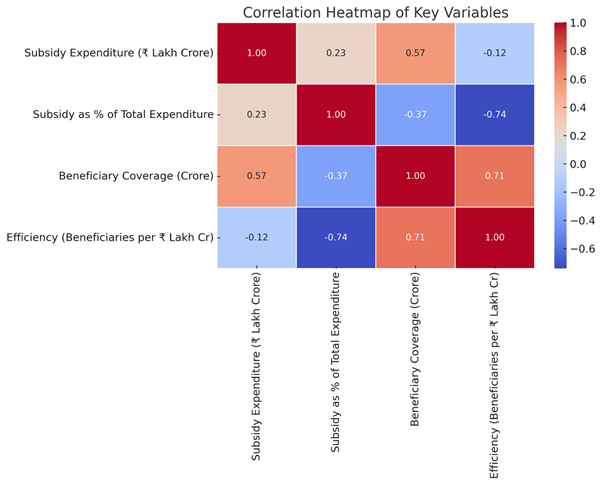
  • Strong Positive Correlation (0.71): There is a strong positive correlation between beneficiary coverage and DBT savings, signifying that as coverage expanded, savings increased.
  • Negative Correlation (-0.74): There is a significant negative correlation between subsidy expenditure as a percentage of total expenditure and welfare efficiency, highlighting the reduction in waste and leakages facilitated by DBT.

Heat-map showing correlation between key variables

The heat-map analysis quantifies the relationship between budget allocations, DBT savings, and welfare efficiency. As DBT savings increased, subsidy allocations decreased, demonstrating that DBT improved targeting while reducing leakages. This enabled the government to expand welfare programs, reaching more beneficiaries without increasing fiscal outlays. The inverse relationship between subsidy expenditure and efficiency challenges critiques of “declining welfare spending” and affirms DBT’s role as a powerful tool for fiscal optimisation.

Welfare Efficiency Index (WEI)

As part of the methodology for assessing the impact of the Direct Benefit Transfer (DBT) system, the Welfare Efficiency Index (WEI) was developed as a composite metric to measure efficiency gains across various dimensions. The WEI comprises three weighted components:

DBT Savings (50% weight): This component captures the direct reduction in leakage, normalised against the maximum observed savings of ₹3.48 lakh crore.


Subsidy Reduction (30% weight): Measures the decline in subsidy expenditure as a percentage of the total national budget.


Beneficiary Growth (20% weight): Assesses the expansion in the number of beneficiaries, adjusted for population growth.

The rise in the WEI from 0.32 in 2014 to 0.91 in 2023 quantifies systemic improvements, emphasising that efficiency gains stem from multi-dimensional factors—not merely budget cuts. This index provides a replicable model for global policymakers to evaluate welfare reforms.

The WEI surged, driven by:

  • DBT Savings (50% weight): ₹3.48 lakh crore cumulative leakage reduction.
  • Subsidy Reduction (30% weight): A decline from 16% to 9% of total expenditure.
  • Beneficiary Growth (20% weight): A 16-fold expansion in coverage.

Conclusion

The Direct Benefit Transfer (DBT) system has proven to be a transformative tool for India’s welfare delivery, significantly enhancing the efficiency of public spending and expanding the reach of social benefits. Over the past decade, DBT has not only reduced fiscal leakages by ₹3.48 lakh crore but also ensured that subsidies are better targeted, with a marked decline in subsidy allocations as a percentage of total expenditure. The rise in the Welfare Efficiency Index (WEI) underscores the success of DBT in optimizing fiscal resources while broadening coverage for millions of beneficiaries. The sectoral savings, particularly in high-leakage programs like food subsidies, MGNREGS, and PM-KISAN, illustrate how the system’s integration of Aadhaar and mobile-based transfers has addressed inefficiencies and curbed misuse.

As per the report by the BlueKraft Digital Foundation, this data-driven assessment demonstrates that fiscal prudence and inclusivity can go hand-in-hand, offering valuable insights for policymakers worldwide looking to refine their own social protection models. As governments grapple with balancing fiscal constraints and social equity, India’s experience with DBT presents a compelling case for the efficacy of direct transfers in fostering both economic and social development. The lessons learned from this success story can guide global efforts to make welfare systems more efficient, transparent, and inclusive.

Reference:

 Click here to see in PDF

Santosh Kumar/ Sheetal Angral/ Saurabh Kalia

Topics

Acts Income Tax

