

Loading...

Top
Help
Draft a reply to a
tax notice — free 🎉

150 credits · 30 days · No card needed

• Basic Search 1 Credit
• Advanced Search 3 Credits
• Drafter 20 to extract + 25 per issue
(≈ up to 2-3 drafts on us)

Already used our earlier 20-Credit Demo?
You are still eligible for this new 150-Credit Demo.

Activate your FREE Demo
×

By creating an account you can:

Logo TaxTMI
Call Us / Help / Feedback

Contact Us At :

E-mail: [email protected]

Call / WhatsApp at: +91 99117 96707

For more information, Check Contact Us

FAQs :

To know Frequently Asked Questions, Check FAQs

Most Asked Video Tutorials :

For more tutorials, Check Video Tutorials

Submit Feedback/Suggestion :

Email :
Please provide your email address so we can follow up on your feedback.
Category :
Description :
Min 15 characters 0/2000
Make Most of Text Search
  1. Checkout this video tutorial: How to search effectively on TaxTMI.
  2. Put words in double quotes for exact word search, eg: "income tax"
  3. Avoid noise words such as : 'and, of, the, a'
  4. Sort by Relevance to get the most relevant document.
  5. Press Enter to add multiple terms/multiple phrases, and then click on Search to Search.
  6. Text Search
  7. The system will try to fetch results that contains ALL your words.
  8. Once you add keywords, you'll see a new 'Search In' filter that makes your results even more precise.
  9. Text Search
Add to...
You have not created any category. Kindly create one to bookmark this item!
Create New Category
Hide
Title :
Description :
❮❮ Hide
Default View
Expand ❯❯
Close ✕
🔎 News - Adv. Search
TEXT SEARCH:

Press 'Enter' to add multiple search terms. Rules for Better Search

Search In:
Main Text + AI Text
  • Main Text
  • Main Text + AI Text
  • AI Text
Category: ?
Categorized by AI
---- All Categories ----
  • ---- All Categories ----
  • Income Tax
  • GST
  • Customs, DGFT & SEZ
  • FEMA & RBI
  • Corp. Laws, SEBI & IBC
  • PMLA, Black Money & ED
  • Budget
  • News and Press Release
  • PTI News
Month:
---- All Months ----
  • ---- All Months ----
  • January
  • February
  • March
  • April
  • May
  • June
  • July
  • August
  • September
  • October
  • November
  • December
Year:
---- All Years ----
  • ---- All Years ----
  • 2026
  • 2025
  • 2024
  • 2023
  • 2022
  • 2021
  • 2020
  • 2019
  • 2018
  • 2017
  • 2016
  • 2015
  • 2014
  • 2013
  • 2012
  • 2011
Sort By: ?
In Sort By 'Default', exact matches for text search are shown at the top, followed by the remaining results in their regular order.
Relevance Default Date
    Will talk to Japan on increasing basmati rice exports from India: Goyal
    Will consider Air India's biz strategy, other factors before deciding on additional fund requests: Singapore Airlines
    Commerce and Industry Minister Shri Piyush Goyal Concludes Japan Visit; Calls for Greater Japanese Investment and Stronger Industrial Partnerships wit...
    PM Jan Dhan Yojana Completes 12 Years of Transforming India’s Financial Inclusion Landscape
    Rassense Becomes First Indian CFS Company to Cross 5,000+ Employees; On Track to Cross INR 600 Crore in Revenue
    SVC Bank's Nationwide Cyber Safety Drive Reaches Over 19,061 Citizens Across 213 Housing Societies
    'Not haircut but mundan': Cong on NCLT clearing Subhash Chandra's Rs 6.5 crore payout
    Keralam: Escaped Assam prisoner reaches police station for Aadhaar card, flees again
    Women's Savings Account: Features that make opening one worth it
    Best Pension Plans and Annuity Plans in India 2026: A Full Comparison
    Rupee rises 4 paise to 95.40 against US dollar in early trade
    Minister of State for Commerce and Industry and Electronics & Information Technology Shri Jitin Prasada Concludes Official Visit to Morocco; Co-Chairs...
    Hyderabad police caution citizens against ''Hybrid Cyber Fraud''
    Hoping to work towards further expanding scope of India-Japan trade pact: Goyal
    Bajaj Finance Personal Loan Offers Limited-Time Rewards During Loan Utsav 2026
    Commerce and Industry Minister Shri Piyush Goyal Highlights India’s Growing Startup Ecosystem at India–Japan Startup Roundtable in Tokyo
    Sugar prices rise again by Re 1 per kg to Rs 65 in retail market
    SIDBI organizes a conclave of the Heads of Regional Rural Banks (RRBs) on expanding SIDBI-RRB MSME Co-Lending arrangement
    SC sets aside show cause notice to Tata Steel over input tax credit availed during FY19-23
❯❯
Maximize Maximize Maximize
0 / 200
Expand Note
Add to Folder

No Folders have been created

+

Are you sure you want to delete "My most important" ?

NOTE:

News
Showing Results for :
Reset Filters
Results Found:
Show All Summaries Hide All Summaries
August 27, 2026
Show AI Summary
Basmati rice market access may be pursued through trade agreement review, subject to import limits and safety standards.
Market access for Indian basmati rice may be pursued through review of the Comprehensive Economic Partnership Agreement, as rice remains a sensitive sector subject to import quantity limits and duties beyond permitted quantities. Processed food exports offer further opportunities where exporters comply with Japanese quality and safety standards. Bilateral cooperation also covers investment, supply chains, technology partnerships and capital flows supporting infrastructure, manufacturing and semiconductor ecosystems.
August 27, 2026
Show AI Summary
Capital allocation discipline governs consideration of further Air India funding alongside business strategy, cash flow and investment requirements.
Further capital investment in Air India will be evaluated by Singapore Airlines' board through a disciplined capital-allocation process. Assessment will consider the group's capital requirements, Air India's business strategy, operating cash flow, investment needs for aircraft and products, and multi-hub investments intended to support long-term growth and returns. As a significant minority shareholder, Singapore Airlines supports Air India's transformation programme with Tata Sons, but no commitment to provide additional capital is indicated.
August 27, 2026
Show AI Summary
Semiconductor investment cooperation anchors expanded India-Japan industrial partnerships across technology, manufacturing, clean energy, infrastructure, and financial services.
Semiconductor and artificial-intelligence cooperation centres on a six-pillar semiconductor strategy encompassing chip design, semiconductor machinery and materials, fabrication, ATMP/OSAT, research and development, and talent development. Japanese participation is sought across semiconductor materials and equipment, power semiconductors, electronics, AI, logistics and related advanced technologies. Development of semiconductor clusters is linked to reliable power, ultra-pure water, skilled manpower and social infrastructure.
August 27, 2026
Show AI Summary
Financial inclusion through basic bank accounts enables direct welfare transfers, digital payments, insurance access and credit for excluded households.
PMJDY provides unbanked adults with basic bank accounts without minimum-balance or maintenance-charge requirements, free RuPay debit cards with accident insurance cover, and eligible overdraft support. Through the JAM framework, PMJDY accounts enable direct transfer of welfare benefits using bank accounts, Aadhaar-based biometric verification and mobile connectivity, reducing intermediary involvement and delays. The scheme emphasises rural, semi-urban, marginalised and women account holders while supporting access to insurance, pensions, savings, digital payments and credit, including MUDRA loans.
August 27, 2026
Show AI Summary
Contract food services expansion strengthens Rassense's nationwide institutional operations through new academic partnerships and technology-led service delivery.
Rassense Pvt Ltd reports crossing a workforce of more than 5,000 employees and projects revenue exceeding INR 600 crore. Its contract food services operations serve educational institutions, corporate campuses, healthcare facilities and industrial locations. New operations at IIM Jammu, IIM Bangalore and IIT Guwahati strengthen its nationwide institutional presence. Expansion is supported by academic institution partnerships, local workforce development, operational excellence, and technology-led capabilities in food production, food waste reduction and supply-chain management.
August 27, 2026
Show AI Summary
Cyber fraud awareness promotes safe digital banking by teaching customers to verify communications, protect credentials, and report suspicious transactions.
Cyber-fraud awareness and digital banking safety were promoted through community sessions addressing phishing, impersonation, OTP and UPI fraud, QR-code scams, digital-arrest fraud, and fraudulent customer-care calls. Participants were guided to identify authentic banking communications, avoid sharing confidential credentials, verify callers and links before acting, and promptly report suspected unauthorised transactions. Customer vigilance, financial literacy, and institutional security measures were emphasised as complementary safeguards against digital financial fraud.
August 27, 2026
Show AI Summary
Personal insolvency repayment plans may be approved despite minimal creditor recovery when requisite voting support and comparative valuation support them.
Personal insolvency repayment plan approval was granted under the Insolvency and Bankruptcy Code, 2016, despite objections that creditor recoveries were negligible and the proposed payment uncertain. The plan received 80.81 per cent voting support, while dissenting creditors held less than 20 per cent voting share. Valuation showed that the debtor's personal estate was materially below the offered amount, and rejection could result in bankruptcy and lower recovery. Assessment of settlement adequacy was treated as a matter of creditor commercial wisdom.
August 27, 2026
Show AI Summary
Prison escape security lapses prompt coordinated tracing measures, transport monitoring, inter-state alerts, and a detailed custodial-security inquiry.
Prison escape and custodial-security lapses arose after a detainee escaped from Aluva Sub Jail, allegedly by using an under-construction structure within the premises to cross the compound wall. Following his later appearance at a police station seeking return of his Aadhaar card, search measures included a lookout circular, information sharing with police stations, railway-security coordination, and alerting police in Assam. A detailed inquiry has been initiated into the prison-security deficiencies enabling the escape.
August 27, 2026
Show AI Summary
Women's savings account selection depends on practical benefits, charges, eligibility, and banking needs rather than the account label.
Women's Savings Accounts may provide standard banking facilities together with additional services or benefits for eligible women. Their suitability depends on practical use of digital banking, transfers, payments, alerts, debit-card facilities, accessibility, security features, charges, and minimum-balance conditions. Since regular Savings Accounts may offer comparable facilities, the additional benefits should be assessed against associated costs and conditions. Selection should be based on comparison of eligibility, facilities, balance requirements, benefits, customer support, and authentication safeguards rather than the account's women-focused label alone.
August 27, 2026
Show AI Summary
Retirement annuity selection prioritises payout structure, taxation, insurer strength and flexibility over brand comparison for informed retirement decisions.
Retirement planning may combine market-linked accumulation during working years, deferred annuities that lock future guaranteed income, and immediate annuities that convert retirement savings into regular payments. Annuity choice depends on whether the priority is higher income, continuation for a surviving spouse, or return of capital on death. Product comparison should consider market-linked growth versus income certainty, taxation of annuity income at applicable slab rates, insurer strength, and flexibility in deferment, payout frequency and policy loans.
August 27, 2026
Show AI Summary
Foreign exchange inflows through deposit and borrowing measures provided near-term rupee support amid lower crude prices.
Reserve Bank special measures relating to FCNR(B) deposits, Overseas Foreign Currency Borrowings and External Commercial Borrowings were identified as attracting foreign-exchange inflows and providing near-term support to the rupee. The Reserve Bank became a net dollar buyer in June after two months of sales to support the rupee. The FCNR(B) window remained open until August 31, while the market outlook anticipated broader rupee depreciation over subsequent weeks.
August 27, 2026
Show AI Summary
Preferential trade agreement exploration advances bilateral market access, pharmaceutical cooperation, investment partnerships, and diversified trade.
India-Morocco economic cooperation is expanded through the seventh Joint Commission framework, targeting deeper and more diversified trade, investment, industrial collaboration and market access across goods and services. An India-Morocco Joint Working Group is to examine bilateral trade opportunities and the feasibility of a preferential trade agreement, including tariff and non-tariff barriers, improved market access and trade facilitation. Cooperation also addresses pharmaceutical market authorisation and approval timelines, food safety, sustainable agriculture, renewable energy, artificial intelligence, healthcare, and phosphates and fertilisers.
August 26, 2026
Show AI Summary
Hybrid cyber fraud exploits stolen smartphones and intercepted verification codes to compromise digital banking and payment accounts.
Hybrid cyber fraud combines physical smartphone theft with digital financial exploitation. Offenders obtain screen-lock credentials, steal devices and use control of the active SIM card to intercept verification codes and reset UPI and digital banking credentials. Preventive measures include withholding PINs, passwords and OTPs; avoiding storage of financial and identity records on phones; and immediately blocking the SIM card and freezing digital banking and UPI services after a theft.
August 26, 2026
Show AI Summary
CEPA review aims to expand bilateral trade engagement, address export barriers, and support regulatory registrations for exporters.
India and Japan are considering a review of the Comprehensive Economic Partnership Agreement to make the bilateral trade framework more contemporary and expand its scope, scale and commercial opportunities. The review is linked to balanced trade and to identifying export barriers arising from procedural requirements, language issues and time involved in market access. Regulatory compliance assistance may support product registrations required for overseas markets, including costly chemical registrations and pharmaceutical registrations.
August 26, 2026
Show AI Summary
Personal loan reward eligibility depends on successful campaign-period disbursal, alongside review of borrowing costs and repayment capacity.
Loan Utsav 2026 provides a limited-period reward bundle to eligible customers whose personal loan is successfully disbursed during the campaign period, subject to applicable terms and conditions. Personal loans are collateral-free and available subject to eligibility, customer profile, documentation and applicable loan terms. Applicants may choose a loan amount and repayment tenure based on their requirements. Extended tenures can reduce monthly EMI obligations but may increase total interest payable. Customers should review interest rates, EMI, processing charges, other loan costs and repayment capacity before accepting a loan offer.
August 26, 2026
Show AI Summary
Deep-tech investment cooperation advances through capital corridors, innovation bridges, manufacturing integration and startup pitching platforms for cross-border growth.
India-Japan startup cooperation is proposed to advance through a deep-tech capital corridor, a two-way innovation bridge, manufacturing and technology integration, and joint startup pitching platforms. Collaboration is directed towards patient capital, early-stage research, deep-tech commercialisation, technology validation, precision manufacturing, investment and market access. The partnership also emphasises MSME integration with startups and global supply chains, co-investment mechanisms, plug-and-play infrastructure, and institutional links among universities, research institutions, incubators and industry.
August 26, 2026
Show AI Summary
Sugar price-control measures combine raw-sugar imports, stockholding limits and export restrictions to curb retail price pressures.
Sugar price-control measures combine authorised raw-sugar imports, stockholding limits for dealers and bulk consumers, and an existing export prohibition to address elevated domestic prices. Imports are permitted within the specified period, while stockholding restrictions seek to curb speculation and hoarding. Retail prices continued to rise despite lower ex-mill prices, and the regulatory approach focuses on augmenting supply, limiting stock accumulation, and preventing export-related pressure on domestic availability.
August 26, 2026
Show AI Summary
Alternative dispute resolution enabled settlement of long-pending disputes, alongside reporting on court administration and regulatory compliance concerns.
Legal developments include resolution of long-pending tenancy, commercial and property disputes through a special Lok Adalat mechanism, including a digitally signed international settlement. Other matters concern a challenge to a riot-related murder conviction, allegations of administrative irregularities and selective case listing, fast-track court pendency, cancellation of a recruitment process following suspected examination malpractice, fraudulent identity documents used to claim citizenship, medical-qualification standards, and opposition to uranium exploration and mining.
August 26, 2026
Show AI Summary
MSME co-lending supports digital paperless credit delivery through rural banks for underserved rural and semi-urban enterprises.
SIDBI-RRB MSME co-lending arrangement is proposed for expansion to increase credit access for micro, small and medium enterprises in rural and semi-urban areas. The arrangement combines SIDBI's understanding of MSME credit requirements with Regional Rural Banks' local reach. SIDBI's Co-Lending Origination Platform provides an end-to-end digital credit process intended to enable faster, paperless loan processing, in-principle sanction communication, documentation and direct account disbursement without branch visits.
August 26, 2026
Show AI Summary
Input tax credit mismatch alone cannot support fraud-based GST demand without an assessing officer's recorded satisfaction of fraud or suppression.
Section 74 GST demand proceedings require the assessing officer's independent satisfaction of fraud, wilful misstatement or suppression of facts. An input tax credit mismatch or alleged short payment alone cannot establish these conditions. Unsupported assertions of suppression for invoking extended limitation are insufficient, and audit objections cannot replace the assessing officer's satisfaction. A show cause-cum-demand notice lacking factual allegations of a deliberate device to evade tax or avail excess input tax credit is vulnerable.

News

Back

All News

Showing Results for :
Reset Filters
No Records Found

News

Back

All News

Showing Results for : Reset Filters
Customs, DGFT & SEZ

RBI Issues April 2025 Policy Update

April 9, 2025

Contents
Plus +
Summary
Note

Note

-

Bookmark

Print

Print

RBI Cuts Repo Rate to 6%, Projects 6.5% GDP Growth for FY 2025-26

Introduction

The Monetary Policy Committee (MPC), in its 54th meeting and the first of the financial year 2025–26, unanimously decided to reduce the policy repo rate by 25 basis points, bringing it down to 6 per cent with immediate effect. The repo rate is the rate at which the Reserve Bank of India (RBI) lends money to commercial banks, and a cut in this rate is aimed at boosting lending and investment. This decision comes at a time when global economic conditions are becoming increasingly uncertain. Trade tensions have resurfaced, leading to a decline in crude oil prices, weakening of the US dollar, softening bond yields, and corrections in equity markets. While central banks across the world are adjusting their policies to address domestic concerns, they are doing so cautiously.
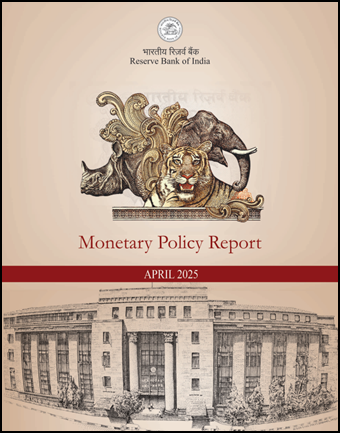
Within India, the outlook has shown signs of improvement. Inflation, particularly food inflation, has declined more than expected, offering some relief, though global and weather-related risks remain. Growth is recovering after a weak first half in the previous financial year, but it still falls short of the country’s potential. The Monetary Policy Report of April 2025, released alongside the MPC resolution, also outlines the GDP growth forecast and inflation projection for the coming months. This year also marks a milestone for the RBI as it completes 90 years since its establishment on 1st April 1935. Over the decades, it has evolved into a full-service central bank, balancing its roles of managing inflation, supporting growth, and ensuring financial stability.

Key Policy Decisions

  • The Monetary Policy Committee (MPC) unanimously decided to reduce the policy repo rate by 25 basis points, bringing it down to 6 per cent with immediate effect. The repo rate is the rate at which the Reserve Bank of India (RBI) lends money to commercial banks.
  • As a result, the Standing Deposit Facility (SDF) rate under the Liquidity Adjustment Facility (LAF) has been adjusted to 5.75 per cent. The SDF allows banks to park excess funds with the RBI without any collateral.
  • The Marginal Standing Facility (MSF) rate and the Bank Rate have both been revised to 6.25 per cent. MSF stands for Marginal Standing Facility, a provision made by the RBI that enables scheduled commercial banks to obtain overnight liquidity if inter-bank funds completely dry up. It is an emergency facility that allows banks to borrow at a rate higher than the repo rate.
  • These rate adjustments are consistent with the RBI’s objective of achieving the Consumer Price Index (CPI) inflation target of 4 per cent, within a flexible band of ±2 per cent, while also supporting economic growth.

Growth Assessment

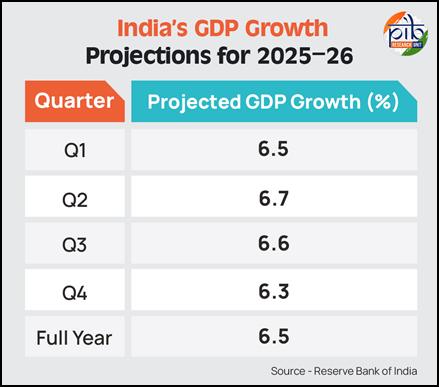
The Reserve Bank of India has projected real GDP growth at 6.5 per cent for 2025–26, maintaining the same rate as estimated for 2024–25, following a strong expansion of 9.2 per cent in the preceding year. The quarterly projections stand at 6.5 per cent in Q1, 6.7 per cent in Q2, 6.6 per cent in Q3, and 6.3 per cent in Q4. This marks a downward revision of 20 basis points from the February estimate, reflecting heightened global volatility. Agriculture remains on a positive footing, supported by healthy reservoir levels and robust crop production, which is expected to sustain rural demand. Manufacturing is showing early signs of revival amid improved business sentiment, and the services sector continues to demonstrate resilience.
On the investment side, activity is gaining pace on the back of higher capacity utilisation, continued government focus on infrastructure, and strong balance sheets of banks and corporates. Easing financial conditions have also aided this recovery. While services exports are likely to remain steady, merchandise exports could face headwinds from global uncertainties and trade disruptions. Looking ahead, the RBI has projected real GDP growth at 6.7 per cent for 2026–27, suggesting continued recovery momentum.

Inflation Outlook

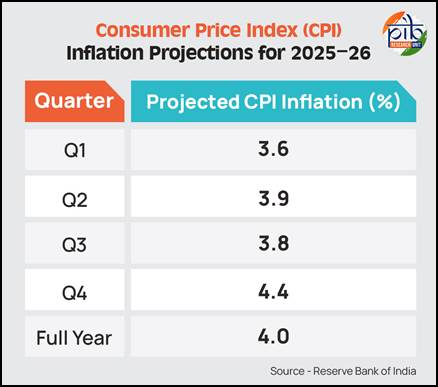
Headline inflation eased during January and February 2025, driven by a sharp decline in food prices. With uncertainties around the rabi crop largely resolved, and second advance estimates indicating record wheat output and higher pulse production than last year, food inflation is expected to soften further. This favourable trend is supported by robust kharif arrivals and a sharp fall in inflation expectations over the next three and twelve months, as reflected in recent surveys. The decline in crude oil prices has further strengthened the disinflationary outlook. Accordingly, Consumer Price Index (CPI) inflation for 2025–26 is projected at 4.0 per cent, with quarterly estimates at 3.6 per cent in Q1, 3.9 per cent in Q2, 3.8 per cent in Q3, and 4.4 per cent in Q4.
While the inflation outlook appears stable, global uncertainties and the possibility of weather-related supply shocks continue to pose upside risks to the inflation path. The Reserve Bank of India has assumed a normal monsoon in framing its projections, and it considers the risks to be evenly balanced at this stage.

External Sector Snapshot

  • Robust Services and Remittances: Services exports remained strong in January–February 2025, led by software, business, and transportation services. Net services and remittance receipts are expected to remain in large surplus, cushioning the merchandise trade deficit.
  • Sustainable Current Account Deficit: The current account deficit (CAD) for both 2024–25 and 2025–26 is projected to stay well within sustainable levels, supported by resilient external inflows.
  • Mixed Investment Flows: While gross FDI remained strong due to stable macroeconomic fundamentals, net FDI moderated because of higher repatriations and outward investments. Net FPI inflows touched USD 1.7 billion in 2024–25, driven by debt inflows despite equity outflows.
  • Healthy Forex Reserves: As of April 4, 2025, India’s foreign exchange reserves stood at USD 676.3 billion, offering an import cover of nearly 11 months and reflecting the strength of the external sector.

Liquidity and Financial Market Conditions

  • Liquidity Shortage and RBI Intervention: In January 2025, the banking system faced a shortage of funds, known as a liquidity deficit. To address this, the Reserve Bank of India (RBI) provided up to ₹3.1 lakh crore on 23rd January through the Liquidity Adjustment Facility (LAF) – a tool that allows banks to borrow money from the RBI for short periods to manage temporary mismatches in cash flow.
  • Improved Liquidity Position: The RBI later infused about ₹6.9 lakh crore into the system, and increased government spending in late March helped further. These actions improved the situation, and by 7th April 2025, the system had a liquidity surplus of ₹1.5 lakh crore – meaning there was more money available in banks for lending and investment.
  • Softening of Market Rates: With more liquidity available, the Weighted Average Call Rate (WACR) – the average interest rate at which banks lend to each other overnight – declined and hovered close to the repo rate, which is the interest rate at which the RBI lends money to commercial banks. This indicates stable short-term borrowing costs.
  • Lower Funding Costs in Debt Market: The difference between interest rates on Commercial Papers (CPs) and Certificates of Deposit (CDs) – short-term borrowing instruments used by companies and banks – and the 91-day Treasury Bill – a short-term government security – reduced. This narrowing of spreads means that borrowing became cheaper in financial markets. The RBI has stated it will continue to monitor these conditions and take action as needed to maintain sufficient liquidity.

Conclusion

The Monetary Policy Report of April 2025, released alongside the 54th meeting of the Monetary Policy Committee, reflects a balanced approach by the Reserve Bank of India (RBI) to support growth while maintaining price stability. The decision to cut the policy repo rate by 25 basis points to 6 per cent is underpinned by easing inflation, particularly in food prices, and a gradual recovery in economic activity. With GDP growth for 2025–26 projected at 6.5 per cent and inflation expected to remain within the 4 per cent target band, the report signals cautious optimism despite global uncertainties.

On the external front, robust services exports and strong remittance inflows have helped cushion the merchandise trade deficit, keeping the current account deficit at sustainable levels. Meanwhile, improved system liquidity, lower short-term borrowing costs, and stable foreign exchange reserves underscore the resilience of India’s financial system. The RBI has affirmed its commitment to closely monitor evolving conditions and take timely, calibrated measures to preserve macroeconomic and financial stability.

References:

Topics

Acts Income Tax